
A firm selling abroad had worked with an SEO agency for a year. The site was well structured. Every recommendation had been followed, every monthly report read, every invoice paid. Nothing had moved: not the enquiries, not the markets that mattered, not the feeling that buyers could find the firm.
The owner did not ask for a better agency. He asked for a different approach. The reading we made for him started with the simplest question there is, and the one every reading we make starts with now: what is the retainer actually buying?
It is not a rude question. It is the only one that can be answered from the firm’s own data, and most firms have never had it answered. This paper sets out what a retainer usually buys, why the usual reports cannot say whether it worked, what the firm’s own accounts showed when they were read together, and the questions any owner can put to the people they pay.
01What a Retainer Usually Buys
A search retainer usually pays for three things. A monthly report on rankings and traffic. A list of recommendations, some of them carried out. And a stream of new pages or links, measured by how many were made.
What it rarely measures is the thing the firm is paying for: which pages bring enquiries, from which buyers, in which markets. It almost never measures the AI answers, where a growing share of buyer questions now end. And it rarely says, with a date and a number, whether last quarter’s change moved anything.
So a firm can pay for a year, receive twelve reports that each look reasonable, and still be unable to say what the money bought. None of this requires bad faith. A report that shows rankings and traffic is easy to produce every month, easy to read and usually pleasant to receive. It is simply measuring something other than the firm’s business.
02Why Rankings Mislead
A ranking report answers “where do we appear?”, which sounds like the right question and usually is not.
A position in Search Console is an average across every search where a page was shown, including searches no buyer of the firm’s would make. It moves for reasons that have nothing to do with the site. In September 2025 Google stopped serving a hundred results on one page; average positions across the web moved within days, while clicks did not. Many reports read that as progress.
Traffic misleads in the same way. A large share of a site’s visits can be agents and bots rather than people. On one network we read, filtering for real interaction removed 97 % of the recorded sessions overnight, while the visits that came from search barely changed. A report that counts all of it counts mostly noise.
Even a high position is a weaker promise than it sounds. Across three of the sites the studio runs, with brand searches left out (1,506,928 impressions in Search Console), position one drew fewer than one click per hundred impressions, fewer than positions eleven to thirty. What decided a click was the question a buyer asked, more than where the page stood.
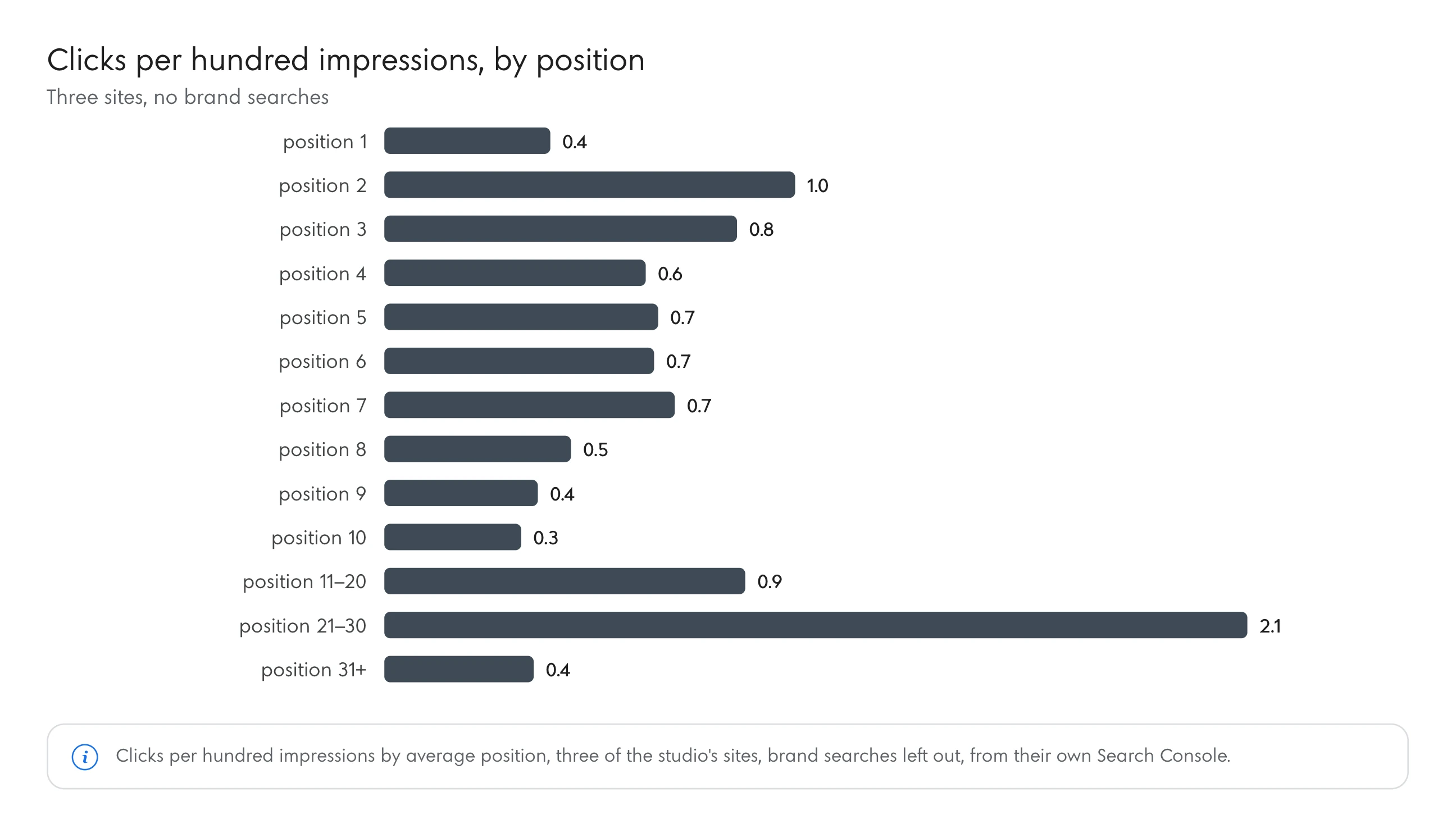
The numbers
| Average position | Clicks per hundred impressions |
|---|---|
| 1 | 0.4 |
| 2 | 1.0 |
| 3 | 0.8 |
| 4 | 0.6 |
| 5 | 0.7 |
| 6 | 0.7 |
| 7 | 0.7 |
| 8 | 0.5 |
| 9 | 0.4 |
| 10 | 0.3 |
| 11–20 | 0.9 |
| 21–30 | 2.1 |
| 31+ | 0.4 |
A ranking is not a buyer. The question that matters is what being found brings the firm, and from which pages.
03Step Zero: What the Presence Has Actually Done
Before anyone says what a firm should do, a reading measures what its presence has done. We call that step zero, and it is the part most often skipped.
It means joining four sources, page by page:
- Search Console: what Google shows, for which searches, on which pages.
- Analytics: what visitors do, and which pages turn into enquiries.
- Bing: the second engine, and the source Copilot answers from.
- The AI answers: the buyers’ own questions, asked live, every answer recorded: whether it names a firm, and which pages it quotes.
The record is archived first. Search Console keeps sixteen months (Google Search Central); every day the oldest day disappears. A firm that never saved its history cannot compare this year with the last one it had.
Then one split is made that almost no monthly report makes: searches that contain the firm’s own name, and searches that do not. The first kind measures demand the firm already has, created by its sales team, its trade fairs, its reputation and its customers’ memory. The second kind measures demand search itself brings: buyers who are looking for what the firm makes and have not yet heard of it. A retainer that raises the first and not the second is maintaining the firm’s existing demand, not creating new demand.
04Why Most Reports Cannot See It
The split between the two kinds of demand sounds simple, and the tools make it harder than it should be. Search Console hides many searches for privacy, so a share of every site’s clicks arrives with no query attached at all. The firm’s name has variants: the short form, the old name, the misspellings, the product names that only the firm uses, the domain typed as a search. A filter that catches only the exact name leaves most of the brand demand counted as new demand, and flatters the report.
Analytics adds its own fog. The channel it calls “Direct” collects everyone it cannot place: people who typed the address, people who clicked a link in an email or a chat, people whose browser withheld where they came from, and a great deal of automated traffic. On a busy site it is often the largest channel, and it is read as loyalty when much of it is machines.
Since November 2025 Search Console can make the first cut itself, with its branded queries filter (Google Search Central); the rest of the split still has to be built by hand, once, from the firm’s own vocabulary: every name, product and person a buyer could only know from the firm itself. It is an afternoon’s work, and it is the most useful afternoon a firm can spend on its search.
05What the Firm’s Own Data Showed
When the firm’s accounts were read together, the answer to the opening question was plain. Most of the site’s engagement came from people who had already met the brand. The searches a new buyer would make, describing what the firm makes without naming it, were barely reached at all.
The retainer had kept the existing demand in good order. It had never been pointed at new demand, and no report had measured that it was not. The agency had done honest work on the wrong question, and the firm had paid a year for an answer to a question it had not asked.
That is the most common finding of a first reading, and the reason it surprises owners is structural rather than personal. A report built on rankings and traffic cannot separate the two kinds of demand, so both look like the agency’s result. Split them, and the year’s work shows its real shape.
06Seven Documents, Then a Direction
The reading ended in documents the firm keeps, written so they can travel inside it and to its agency. First the record, seven documents of what is true and how we know it:
- The map of the work: the whole reading on one page, and the order in which the rest is read.
- Search reality: what Google, Bing and the AI answers show for the firm, and what visitors do.
- Customer reality: the buyers’ own first messages, read word for word.
- Competitive reality: who else answers the same questions, their claims quoted side by side.
- The site: every page read for what it promises, and where it disagrees with itself.
- The next market: the same reading for the market the firm wanted to enter.
- Additional findings: what the reading found that nobody had asked about.
Then the direction, finished work rather than advice: an alignment of sixty-five pages in the firm’s own brand style, with every page of the site mapped to new language and the missing sections named; a set of about five hundred images in the brand’s style, named and tagged for every page that needs one; and a four-hour session with the people who decide, in which the order of the work was set in the room.
Nothing in it depended on the studio carrying it out. It was written so that the firm, its own team or its agency could act on it, and so that each change carries the date on which it will be measured again.
07Clicks Are Not the Measure
The deepest problem with the monthly report is not that it shows the wrong numbers. It is that it treats a click as the result. A click is a visit; the firm is paid for enquiries.
So every reading the studio makes ends at the form. For each page it asks how many visitors opened the enquiry form, how many sent it, and how they said they found the firm. An enquiry form that asks “how did you find us?”, and records the page the visitor arrived on, is the cheapest instrument a firm can install, and the one most sites lack. With it, a quarter’s work can be judged by what it brought, not by what moved on a chart.
The enquiries themselves need reading, not only counting. A quarter that brings forty enquiries of which three fit the firm is worse than one that brings twelve of which ten do. So the form asks what a buyer needs, in the words the firm’s sales team would use to qualify them, and each enquiry is marked once: a fit, a near fit, or not for the firm. Read over a year, those marks show which pages bring the buyers the firm wants, which bring the wrong ones, and which questions on the site attract people the firm should not be serving. That is a measure an owner recognises at once, because it is the one their own sales team already uses.
Searches for the firm’s own name deserve a place in that measure too, read the right way. When they rise, something outside search has worked: a trade fair, a campaign, a recommendation. When they rise after a change to the site, the change has made the firm memorable to people who first met it through a search that did not contain its name. That is the effect a retainer should be able to show, and almost none can.
08What an Honest Report Shows
A firm does not need a longer monthly report. It needs a different one, and the difference fits on one page.
- Demand, split in two: clicks and enquiries from searches that contain the firm’s name, and from searches that do not, month on month.
- Enquiries by page: which pages a visitor arrived on before writing, and what the form says about how they found the firm.
- The answers: the buyers’ twenty questions asked live each month in Google’s AI Mode and in Copilot, with who was named and which page was quoted.
- People, not machines: the share of visits filtered out as automated, stated, so every rate is measured against people.
- Predictions, dated: what last month’s change was expected to move, by how much and by when, and whether it did.
A report like this is uncomfortable in the first month and indispensable by the third. It lets an owner see what each month bought, and it lets an agency show the work that matters.
09Questions to Ask the People You Pay
None of this needs a new supplier to begin. Any owner can put seven questions to the agency or the team that runs their search, and the answers, or their absence, are the first reading.
- Which pages brought enquiries last quarter, and how many? Not visits: enquiries.
- What share of our search clicks come from searches that contain our name? If it is most of them, the work is maintaining demand, not creating it.
- Which searches without our name do we appear for, and which that our buyers make do we miss? Ask for the list, not the summary.
- What do Google’s AI answers and Copilot say when asked our buyers’ questions? Who is named, which pages are quoted.
- What did last quarter’s change move, with a date and a number? A change without a measured result is an expense, not an improvement.
- How much of our traffic is automated, and is it filtered out of the report? If nobody knows, the rates in the report are measured against machines.
- Can we have the raw data? The exports from Search Console, Bing and Analytics belong to the firm. A report that cannot be checked against them is an opinion.
10What Two Weeks Show
With read-only access, the record is ready by day seven and the reading by day fourteen. Nothing on the site changes during that time. The firm receives two reports in its own brand style, so they can travel inside it, and to the agency:
- The search report: where demand comes from, which pages turn it into enquiries, what changed and when, every number recomputed from its file.
- The AI visibility report: which buyer questions get an answer, which firms are named, which pages are quoted, and which page of the firm’s own should own each answer.
With them comes a short list: the buyers’ questions, each with the page that should answer it, in the order worth doing.
11Beside the Agency You Have
A reading does not replace whoever runs a firm’s search. It reads what their work buys. Often the agency is doing honest work on the wrong pages, or measuring the wrong thing; sometimes it is doing the right work and the report is all it lacked. In both cases the reading helps them, and it can go to them too.
For the firm in this paper, the answer set a different order for the next year: the research and the direction first, then the content, then a system of sites built on it. The money was never the problem. Not knowing what it bought was.
12Method and Sources
The firm’s figures come from its own Search Console, Bing Webmaster Tools and Analytics, its enquiry records and the AI answers asked live in its main markets, read in August 2026. The firm is not named; its industry and its markets are left out, and the paper reports what the record showed rather than its counts.
Click-through by position: Search Console, three of the studio’s sites, 2025 and 2026, searches for the firms’ own names and one partner’s removed; 1,506,928 impressions and 9,746 clicks.
The bot filter: the studio’s reference network, Analytics, September 2026, before and after its tags waited for a real scroll, tap or key press. Its full record is in the paper Every Engine Keeps Its Own Record.
The change of September 2025 is Google’s removal of the parameter that served a hundred results on one page, which changed the average positions Search Console reports across the web; Google never announced it, and an industry analysis of its effect is Zeo’s. The reading itself: Search.