
Most buyer questions now get a written answer before they get a list of links. The answer names a few firms and quotes a page. The buyer may never open a search result; the quoted page has already done the work. So the useful question is no longer only “where do we rank?”. It is “when a buyer asks, which page does the machine quote, and is it ours?”
This paper sets out what the studio has measured about that choice, on three kinds of site, from their own accounts: a large reference network, a firm’s own site with its satellite, and three of the studio’s sites read for click-through by position. It ends with the tool the studio uses to act on it, the question map, and why acting on it is a decision for the whole firm rather than for one page.
01Search, with the Answer Included
An AI answer is easy to imagine as a new channel with its own rules. The measurements say otherwise. On a firm’s own site the studio read in September 2026, 81 % of the citations Copilot gave the site came on searches the site already appeared for in Google. On the large reference network the figure was two thirds. Most questions people put to an assistant are the questions they already type into search.
That has a practical consequence. The answer engines do not need a second website, a second content plan or a second budget. They need the pages a firm already has to be the kind of page an answer can use. The same work serves both, and a firm that does it for one is doing it for the other.
It also means the answer engines inherit search’s map of a firm. An answer is the visible end of an index: Google’s AI Overviews, AI Mode and Gemini answer from Google’s index; Copilot and most of the engines that license Bing answer from Bing’s. When Google removed the studio’s reference network from its results, its AI answers dropped the network the day before the notice. Copilot, reading Bing’s index, cited it more every month after. A page is quoted by the engines that keep it.
02What the Measurements Show
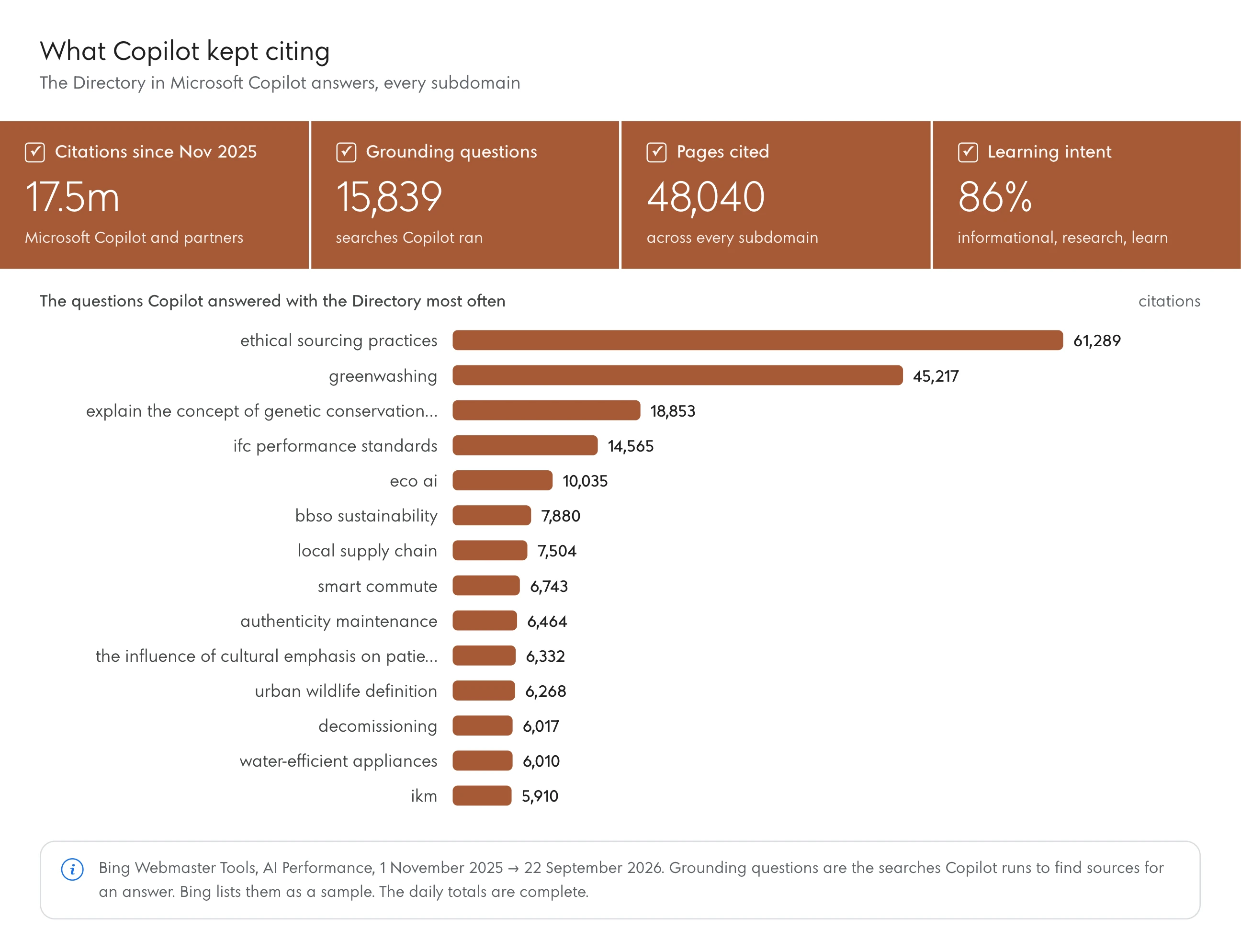
The largest record the studio holds is the reference network described in the paper Every Engine Keeps Its Own Record: a root and eleven subject sites, with Bing’s report of 17.5 million Copilot citations over eleven months, on 15,839 searches and 48,040 pages. Four findings from it changed how the studio builds pages.
An AI answer is not a ranking. 40 % of the pages Copilot cited never appeared in Google’s search data at all. The pages that rank and the pages that are quoted overlap, but they are not the same list.
Definitions are quoted first. Pages that define one term carried half of Copilot’s citations, against about a third of Google’s clicks. A plain statement of what something is, on a page of its own, is what an answer can lift.
A few pages carry most of the quotes. The top 1 % of pages drew 35 % of all citations. Quoting is concentrated: one clear page per question beats many similar ones.
It is asked at work. Weekend citations ran at about half of the weekday level. The person behind the question is a professional between two meetings, which is the reader most firms want.
The numbers
| The search Copilot answered | Citations | Intent |
|---|---|---|
| ethical sourcing practices | 61,289 | Informational |
| greenwashing | 45,217 | Learn and Solve |
| explain the concept of genetic conservation and its importance. | 18,853 | Informational |
| ifc performance standards | 14,565 | Informational |
| eco ai | 10,035 | Informational |
| bbso sustainability | 7,880 | Informational |
| local supply chain | 7,504 | Informational |
| smart commute | 6,743 | Informational |
| authenticity maintenance | 6,464 | Learn and Solve |
| the influence of cultural emphasis on patience and long-term orientation on investment strategies and savings habits | 6,332 | Research |
| urban wildlife definition | 6,268 | Informational |
| decomissioning | 6,017 | Learn and Solve |
| water-efficient appliances | 6,010 | Informational |
| ikm | 5,910 | Others |
| global monitoring system | 5,304 | Informational |
03What a Firm’s Own Site Showed
A reference network is not a firm. So the studio reads the same signals on the sites of the firms it works with, and the first full reading, in September 2026, confirmed three of the network’s findings and added two of its own.
The shape of a query does not reveal AI demand. It is tempting to size AI demand by counting long, conversational searches. On the firm’s site, 85 % of Copilot’s citations came on searches of one to three words. The assistant rewrites a person’s question into a short search before it looks, so the questions themselves never appear in any report. A firm that sizes its AI exposure from long queries will find almost none, and be wrong.
Each engine favours different pages. Google’s AI features drew mostly on the site’s glossary pages; Copilot drew on its practical pages, the ones that show how a thing is done. The same site, two maps of what it is for. A reading that looks at one of them describes half of the firm.
There is a list only this method shows. Some searches bring Copilot to the firm’s pages while the firm does not appear for them in Google at all. That list, the AI-only list, is the clearest map of where the firm already has authority that search has not yet recognised, and it is where the next page is usually best spent.
04Page One Is Not the Point
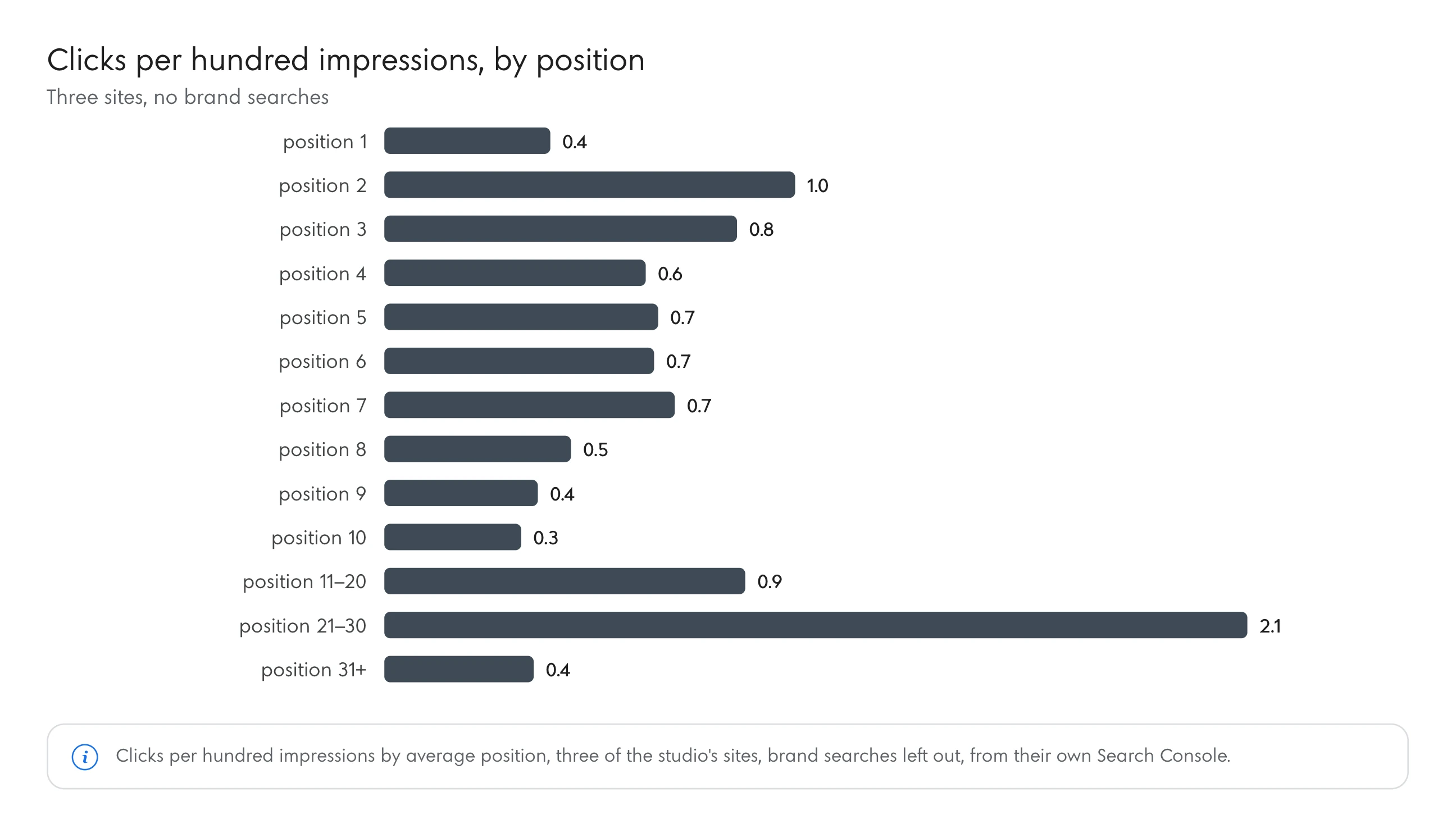
Most reports still measure success by position, and most quote a curve in which the first result takes about a third of the clicks and the tenth almost none. The studio measured its own curve, on three of its sites, with every search for the firms’ own names left out, because a search for a firm’s name is clicked wherever it stands and hides what the rest of the pages do.
Across 1,506,928 impressions and 9,746 clicks, the curve looked nothing like the quoted one. Clicks per hundred impressions were 0.4 at the first position, 1.0 at the second and 0.8 at the third, and the highest rate of all, 2.1, came between positions 21 and 30.
The numbers
| Average position | Clicks per hundred impressions |
|---|---|
| 1 | 0.4 |
| 2 | 1.0 |
| 3 | 0.8 |
| 4 | 0.6 |
| 5 | 0.7 |
| 6 | 0.7 |
| 7 | 0.7 |
| 8 | 0.5 |
| 9 | 0.4 |
| 10 | 0.3 |
| 11–20 | 0.9 |
| 21–30 | 2.1 |
| 31+ | 0.4 |
The studio does not read this as a law. Average position is a blunt measure, and a few hundred searches at the lower positions can move a rate. But two explanations fit what the record shows, and both point the same way. The searches where a page sits first are often broad ones where an AI answer or a list of other features stands above every link, so the first result is seen and not clicked. And the searches where a page sits on the third page are often narrow ones, asked by someone looking for exactly that page.
The conclusion for a firm is not to aim lower. It is to stop treating the first position as the goal. The goal is to be the page that answers: the one the buyer opens because it says exactly what they asked, whether a list put it first or an answer quoted it.
05Why Answers Concentrate
The concentration of quotes on a few pages is not an accident of one network. It follows from how an answer is made. An assistant takes the person’s question, rewrites it into one or more short searches, reads the first sources its index returns for each, and writes from the ones that state the answer in one place. Once a page has become the source for a term, it is the natural source for every question that turns on that term, and there are many such questions. On the reference network, a few hundred definition pages carried a third of all citations across thousands of different searches. On half of its citations the network held a quarter to a half of all the sources an answer used.
For a firm this is good news, because it means the work is finite. It does not need a page for every question a buyer might ask. It needs one plain, consistent page for each of the terms and facts its buyers’ questions turn on: what the firm does, for whom, how long it takes, what it costs, where it works, in which languages, what its methods are called. A firm with fifteen such pages, each the best statement of its fact anywhere, is better placed than a firm with five hundred pages that each half-answer something.
06What Makes a Page Quotable
From those measurements, and from reading the answers live with buyers’ own questions, a quotable page has five properties. None of them is a trick, and Google’s own guidance for its AI features says the same in its own words (AI features and your website; its guide to generative AI features): there is no special optimisation, it is still search, and what it rewards is content that is first-hand and not a commodity.
- It states one checkable fact plainly. What the firm does, for whom, where, since when, in one sentence an answer can repeat without rewording. A sentence that needs the page around it to make sense cannot be lifted.
- It owns one question. One question, one page. When three pages half-answer the same question, the machine quotes none of them, or someone else’s.
- It is built in the order the question is asked. The term first, then its parts, each part opening with the question a reader would type. The reference network’s plainest pages, built this way, drew the most citations of all.
- It says so in data too. Structured data names who the firm is, what it offers, where and in which language; a definition is marked as a defined term, a set of questions as questions. The machine does not have to infer from layout what the page already states.
- It agrees with every other page. If the services page, the about page and the brochure describe the firm three ways, the machine has no single fact to quote. Consistency is not a style preference; it is what makes a fact citable.
07The Question Map
The practical tool is a map: the questions buyers actually ask, in their words, each asked live to the AI answers. For each question the map records who is named, which page is quoted, and which page of the firm’s own should own the answer. A first map is short, twenty or thirty questions, and it is always more useful than its length suggests. An illustrative extract, for a firm that sells a technical service across borders:
| The buyer’s question | Asked in | Named in the answer | Quoted page | The firm’s page that should own it |
|---|---|---|---|---|
| who does this, for a firm like mine? | Google AI Mode | two competitors | a directory listing | the service page, its first screen |
| how long does it take? | Copilot | no one | none | a new page: the timeline, stated plainly |
| what does it cost? | Google AI Mode | one competitor | its price page | the offer page, the ranges it can state |
| is it done in my language? | Copilot | the firm | the firm’s glossary | the languages page, with each market’s address |
Most firms find three things on their first map. Questions where nobody is named, an open space a plain page can take. Questions where a competitor is quoted from a page that states the fact more plainly than the firm’s does. And questions the firm’s own pages almost answer, where one sentence moved to the first screen is the whole fix.
The map is read again at ninety days, against the same questions, in the same engines. A question that moved is marked. A question that did not tells the firm which page to rewrite next.
08How the Studio Measures It
The measurement is less mysterious than its subject. Every number above comes from reports a firm already has, read together.
- Bing Webmaster Tools, AI Performance: Copilot’s citations a day, the searches it ran to find its sources (a sample, but a large one) and the pages it cited.
- Search Console, the Generative AI report: the pages Google’s AI features showed, with their impressions. It lists no queries, so it is read beside the Performance report, page by page.
- Analytics and the form: for each page, the visits from search and from assistants, and how many of those visitors opened the enquiry form. A quoted page that brings no enquiries is a page the firm is paying to be cited by.
- The answers, asked live: the map’s questions, put to Google’s AI Mode and to Copilot in a signed-in browser, the answers recorded with the date.
The test that matters to a firm joins the first three: AI exposure per page against form opens and searches for the firm’s own name, and the click-through of quoted pages against unquoted pages at the same position. It is the difference between knowing that a machine mentions the firm and knowing that the mention brings work.
09The Mistakes the Studio Sees Most
Five mistakes come up in almost every first reading, and each of them is cheap to fix once it is seen.
- Writing for prompts. Long pages written as conversations, in the hope of matching how people talk to assistants. The assistant searches in short terms, so the page is never found for the question it imitates.
- Many pages for one question. Near-identical pages for each city, each product variant or each phrasing of a service. The engine sees no single owner of the fact and quotes a directory instead.
- Facts the machine cannot read. The founding year in a picture, the services in a slider, the method in a PDF without text, the prices in a brochure. What is not in the page’s text and data does not exist for an answer.
- One firm, several descriptions. The site, the profiles and the listings disagree about what the firm does, where it is and since when. The answer either picks one at random or names someone whose facts agree.
- Measuring with guesses. AI-visibility tools that estimate citations from their own sampled prompts, instead of the engines’ own reports. A firm can read Copilot’s citations and Google’s AI impressions directly; anything else is a model of a model.
10Why This Is the Work of Alignment
A quotable page cannot be written in isolation. Its one fact has to be the firm’s position; its words have to be the approved words; its data has to match the site’s; and every other page has to agree with it. That is a decision about the whole firm, not about one page.
So the question map belongs to the direction a firm sets for itself: the position and its words, a brief for every page with its first screen first and every claim fixed once, the term map and the question map, set in one room with the people who decide, and checked again at ninety days against the same record.
The machine quotes the page that is plainly right. A firm whose pages agree gives it one.
11Method and Sources
The reference network: Bing Webmaster Tools, AI Performance, 1 November 2025 to 22 September 2026; Search Console and Analytics for the same months. Its full record is set out in the paper Every Engine Keeps Its Own Record.
The firm’s site: Search Console, Bing Webmaster Tools with its AI Performance report, and Analytics with the enquiry form’s opens, read in September 2026. The firm is not named, and its field is left out; its figures are shares, not counts.
Click-through by position: Search Console, three of the studio’s sites, 2025 and 2026, searches for the firms’ own names and one partner’s removed; 1,506,928 impressions and 9,746 clicks, grouped by average position.
Google’s guidance is its documentation on AI features and websites and its guide to generative AI features, as published in 2025 and 2026. Bing’s AI Performance report: Bing Webmaster Blog. Search Console’s Generative AI report: Google Search Central. The question map extract is illustrative, not a client’s.