
Most firms read their presence through one window. A dashboard shows Google, a monthly report shows Google, and when the line goes down the conclusion is that the firm has gone down with it. This paper follows one property through two years in which that conclusion would have been wrong at every turn. Google removed it entirely. Bing kept sending the same readers. Microsoft’s Copilot cited it more after Google’s verdict than before it, seventeen and a half million times in all. The same pages, the same months, three different records. The lesson is not about one site. It is about what a firm actually owns when it is found, and how to know it.
The property is the Sustainability Directory, a reference of sustainability terms, questions and topics built and run on the studio’s own engine from April 2024: a root site and eleven subject subdomains, from climate and energy to fashion and pollution. At its largest Google knew about 26 million of its addresses. It was built with AI from its first month, which makes it an unusually early record of how search and the answer engines treat a site written at scale. Every figure below comes from its own accounts.
01The Record Comes First
The studio’s first rule for any reading is that the record is archived before anyone interprets it, and this case is the reason. Search Console keeps sixteen months of history and drops a day every day. Bing’s report of where its AI cites a site begins in November 2025. Analytics properties that are consolidated or deleted take their history with them. A firm that wants to know what happened has a window, and the window closes.
For the Directory, the archive was made in September 2026, before the sources let it go:
- Search Console, the domain property and twelve site properties: 500 days, 13 May 2025 to 24 September 2026, with the reports that exist only in the browser (manual actions, page indexing, crawl statistics, links, Google’s AI answers) captured as screens.
- Bing Webmaster Tools for the same twelve sites: 487 days of search, and its AI Performance report, which lists Copilot’s citations a day, the searches it ran and the pages it cited, from 1 November 2025.
- Analytics: the consolidated property from January 2026, and the twelve per-site properties used before it, read through the Data API before their deletion date. They reach back to the first month, April 2024.
In all about 17 GB of records. The Analytics history alone was 4.8 GB. Nothing in this paper is an estimate from a tool outside the property: each line is what one engine reported about its own behaviour.
02Two Years, Two Clocks
The Directory and the answer engines grew up at the same time. Its first pages went out in April 2024, a month before Google showed its first AI Overviews in the United States. Its pages were written on Google’s own Gemini models, through a gateway the studio ran itself, and each new model reached the engine within weeks of its release.
| Date | Around it | The Directory |
|---|---|---|
| Apr 2024 | The first month: 237 visits from search. | |
| 14 May 2024 | Google launches AI Overviews in the United States. | |
| May 2024 | The first visit from an AI assistant: Perplexity, four visits. | |
| Jun 2024 | Pages written on Gemini Flash; 162 publishing scripts dated that month. | |
| Oct 2024 | AI Overviews reach more than 100 countries; ChatGPT search launches. | |
| 2025 | Google AI Mode opens to everyone in the United States (20 May). | The eleven subjects open, one by one. |
| Nov 2025 | Copilot cites the Directory 743,409 times, the first month on record. | |
| 10 Feb 2026 | Bing opens the first report that shows publishers where its AI cites them. | Its history reaches back to November 2025, with the Directory in it. |
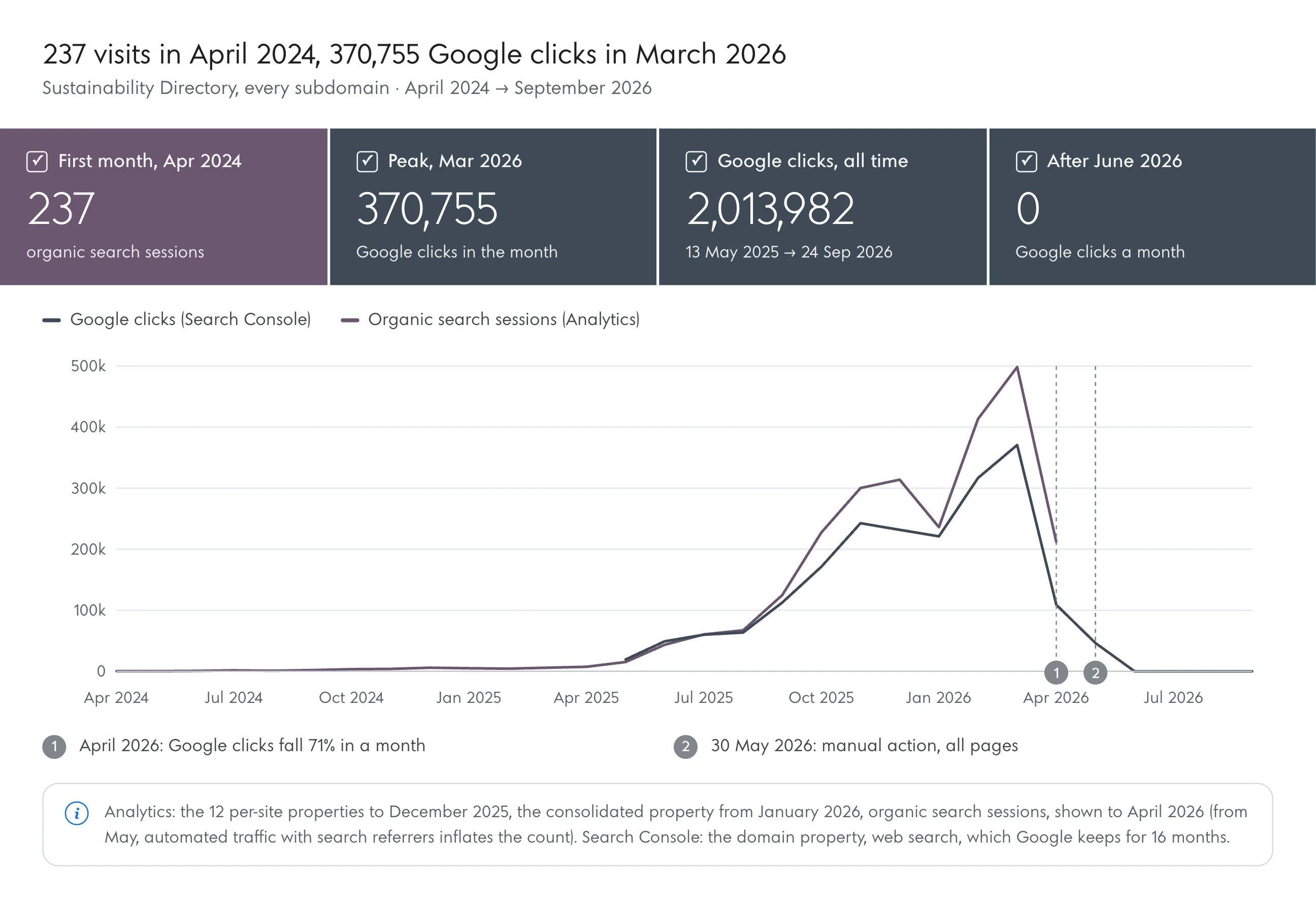
| Mar 2026 | 370,755 clicks from Google, the busiest month. | |
| 30 May 2026 | Google issues a manual action against the whole domain. | Google’s AI answers drop the Directory the day before the notice. |
| Sep 2026 | Copilot cites the Directory 2.72 million times in 22 days. |
The numbers
| Month | Visits from search (Analytics) | Google clicks (Search Console) |
|---|---|---|
| Apr 2024 | 237 | |
| May 2024 | 285 | |
| Jun 2024 | 628 | |
| Jul 2024 | 1,436 | |
| Aug 2024 | 957 | |
| Sep 2024 | 1,932 | |
| Oct 2024 | 3,402 | |
| Nov 2024 | 3,879 | |
| Dec 2024 | 5,793 | |
| Jan 2025 | 4,939 | |
| Feb 2025 | 4,283 | |
| Mar 2025 | 5,866 | |
| Apr 2025 | 7,433 | |
| May 2025 | 15,227 | 19,389 |
| Jun 2025 | 43,482 | 49,122 |
| Jul 2025 | 60,490 | 59,948 |
| Aug 2025 | 67,124 | 63,565 |
| Sep 2025 | 124,808 | 112,696 |
| Oct 2025 | 227,323 | 171,197 |
| Nov 2025 | 300,208 | 242,703 |
| Dec 2025 | 313,919 | 231,844 |
| Jan 2026 | 236,178 | 220,997 |
| Feb 2026 | 413,473 | 316,701 |
| Mar 2026 | 498,505 | 370,755 |
| Apr 2026 | 211,523 | 108,815 |
| May 2026 | 186,672 | 46,249 |
| Jun 2026 | 506,892 | 1 |
| Jul 2026 | 481,765 | 0 |
| Aug 2026 | 182,431 | 0 |
| Sep 2026 | 155,462 | 0 |
The subjects reached a thousand visits from search a day within six to eleven months of opening. By March 2026 the network drew 370,755 clicks a month from Google alone. Read through one window, this was a success story, and it was about to become a failure story. Read through all of them, it was neither.
03What the Answer Engines Cited
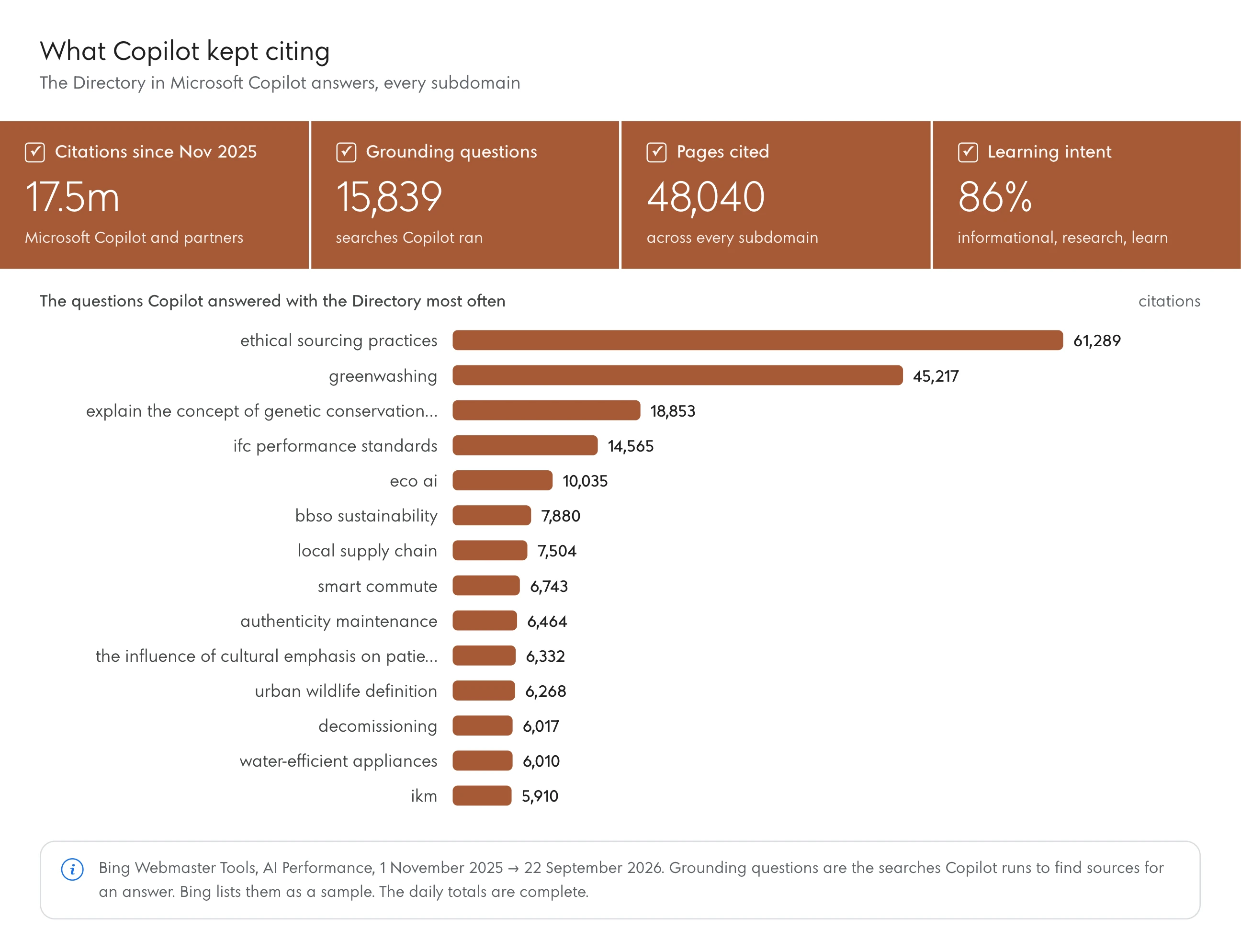
In February 2026 Bing opened a report no major search engine had offered before: where its AI cites a site, on which searches and how often. For the Directory the history began in November 2025 with 743,409 Copilot citations in a month, rose to 1.85 million in March and reached 17.5 million by September, on 15,839 searches and 48,040 pages.
What the answer engines read was not what search ranked. Four findings stand out, and each has shaped how the studio builds since.
Copilot searches in terms, not questions. Only 12 % of the searches it ran to ground its answers were phrased as questions. The rest were terms: “ethical sourcing practices”, “greenwashing”, “IFC performance standards”. It reached for the page that defines the thing.
Definitions carried half of the citations. Pages that define one term drew 50 % of Copilot’s citations, against a third of Google’s clicks. The plainest format, a term and then its parts, each part opening with the question a reader would type, was the one both people and machines used most.
It is not a ranking. 40 % of the pages Copilot cited never appeared in Google’s data at all. The answer engine was choosing pages that search had not shown anyone.
A few pages draw most of the weight. The top 1 % of pages drew 35 % of all citations, and on half of its citations the Directory held a quarter to a half of the answer’s sources.
The numbers
| The search Copilot answered | Citations | Intent |
|---|---|---|
| ethical sourcing practices | 61,289 | Informational |
| greenwashing | 45,217 | Learn and Solve |
| explain the concept of genetic conservation and its importance. | 18,853 | Informational |
| ifc performance standards | 14,565 | Informational |
| eco ai | 10,035 | Informational |
| bbso sustainability | 7,880 | Informational |
| local supply chain | 7,504 | Informational |
| smart commute | 6,743 | Informational |
| authenticity maintenance | 6,464 | Learn and Solve |
| the influence of cultural emphasis on patience and long-term orientation on investment strategies and savings habits | 6,332 | Research |
| urban wildlife definition | 6,268 | Informational |
| decomissioning | 6,017 | Learn and Solve |
| water-efficient appliances | 6,010 | Informational |
| ikm | 5,910 | Others |
| global monitoring system | 5,304 | Informational |
It also works office hours. Weekend citations ran at about half of the weekday level, the pattern of professionals asking between two meetings. That is the reader a firm wants: someone at work, asking the question their job depends on.
04Each Engine Picks Its Own Pages
Even before the verdict, the engines did not agree on which of the Directory’s pages mattered. Google’s AI answers, in the weeks they read the network, drew most heavily on the lifestyle subject (75,600 appearances), then pollution (39,006) and product (29,726); climate came fourth with 13,682 and energy reached 3,258. Copilot’s weight fell almost the other way round: climate drew 1,984,019 citations on 5,662 searches and energy 1,661,375 on 5,262.
The same network, two readers, two different maps of what it was good for. One read it as a guide to everyday choices, the other as a reference for the professions that deal with climate and energy. Neither is wrong. Each engine builds its picture of a site from the searches its own users make, and the picture it keeps is the one it will cite.
For a firm this changes what “ranking well” means. There is no single position to win. There is a set of questions, asked in different words in different engines, and each engine decides which page answers them. A reading that looks at one engine sees one map and mistakes it for the territory.
05The Verdict
The fall began before the verdict, and the record shows the order. In February 2026 Google doubled the network’s impressions, from 62.5 million to 134 million in a month, while the clicks did not follow: the click rate fell to 0.24 %. On 26 March the daily clicks broke. April closed at 108,815 clicks and May at 46,249.
On 30 May 2026 Google issued a manual action against the whole domain: “major spam problems”, affecting all pages. Its description names the techniques it acts on, among them scaled content abuse. A reference of about a million collection pages built on about 120,000 articles, written by machines and linked into each other without a hand on them, fits the pattern Google looks for. The verdict was not about one page. It was about how the site was produced.
Google’s AI answers had reached the Directory 15,000 to 19,000 times a day in the last weeks of May. On 29 May, the day before the notice, they showed it 138 times; after 12 June, never. By September Search Console reported no page indexed and 10.7 million not indexed, and Google’s record of the network’s links, external and internal, was empty. For Google, the property had ceased to exist.
Most firms would stop reading here. Their dashboard would show a dead site.
06Four Engines, Four Records
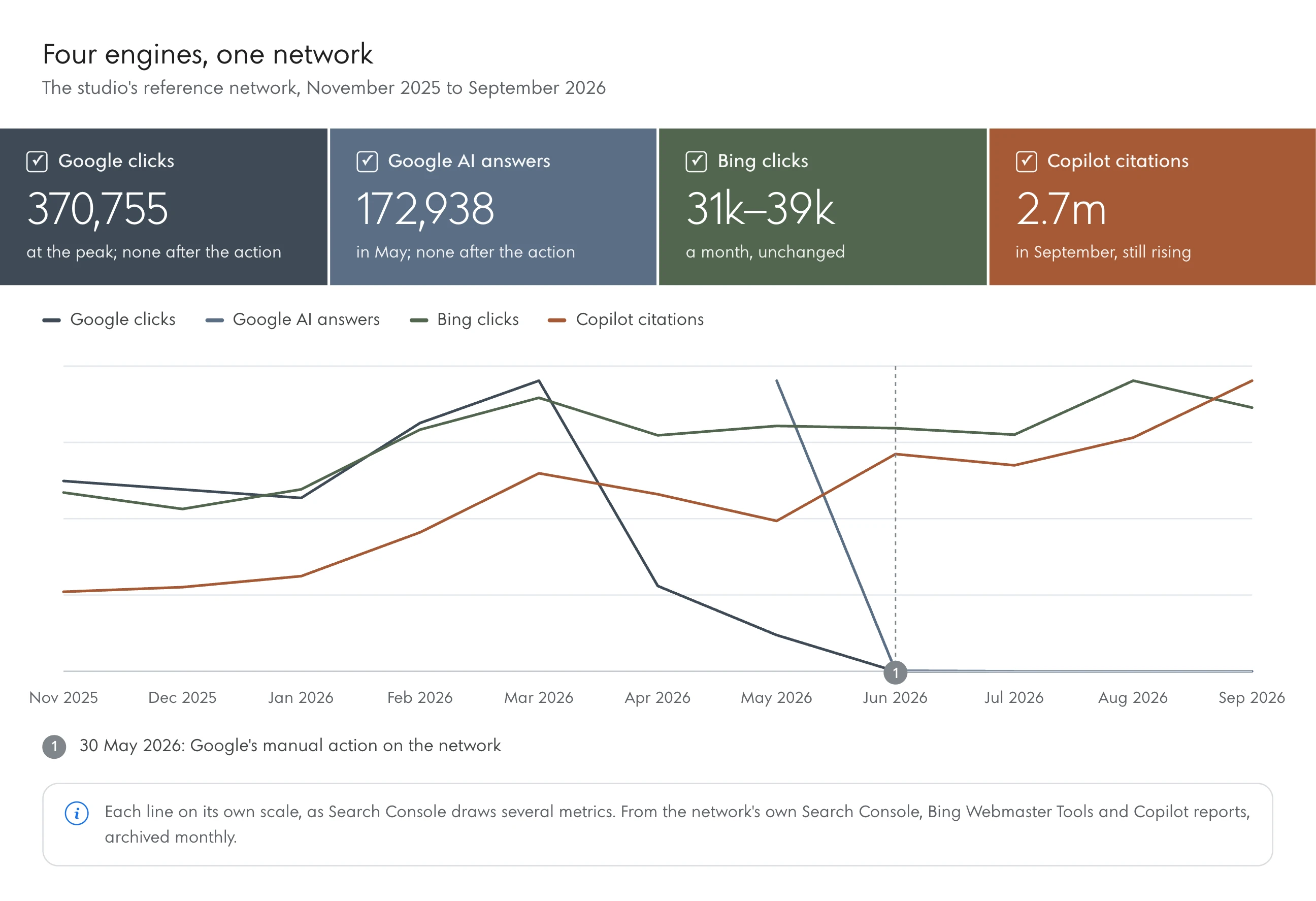
The same pages, in the same months, were read very differently by the engines that were not Google.
The numbers
| Month | Google clicks | Google AI answers | Bing clicks | Copilot citations |
|---|---|---|---|---|
| Nov 2025 | 242,703 | 23,848 | 743,409 | |
| Dec 2025 | 231,844 | 21,657 | 787,568 | |
| Jan 2026 | 220,997 | 24,278 | 890,102 | |
| Feb 2026 | 316,701 | 32,243 | 1,299,961 | |
| Mar 2026 | 370,755 | 36,499 | 1,852,508 | |
| Apr 2026 | 108,815 | 31,489 | 1,655,612 | |
| May 2026 | 46,249 | 172,938 | 32,735 | 1,406,185 |
| Jun 2026 | 1 | 340 | 32,440 | 2,031,858 |
| Jul 2026 | 0 | 5 | 31,579 | 1,926,793 |
| Aug 2026 | 0 | 0 | 38,790 | 2,186,748 |
| Sep 2026 | 0 | 7 | 35,180 | 2,719,538 |
Bing kept sending 31,000 to 39,000 clicks a month from November 2025 through September 2026, with no break at Google’s verdict: 32,440 in June, 31,579 in July, 38,790 in August.
Copilot‘s citations dipped in the spring and then set new records: two million in June, 2.72 million in the first 22 days of September. About 9,600 a day in November 2025 had become 164,000 a day by late September.
Google’s AI answers followed Google’s index out, the day before the notice.
A manual action is the decision of one company about its own results. It ends what that company shows. It does not end the pages, the readers who arrive through other engines, or the citations of the assistants that read another index.
07Assistants Follow Their Search Engine
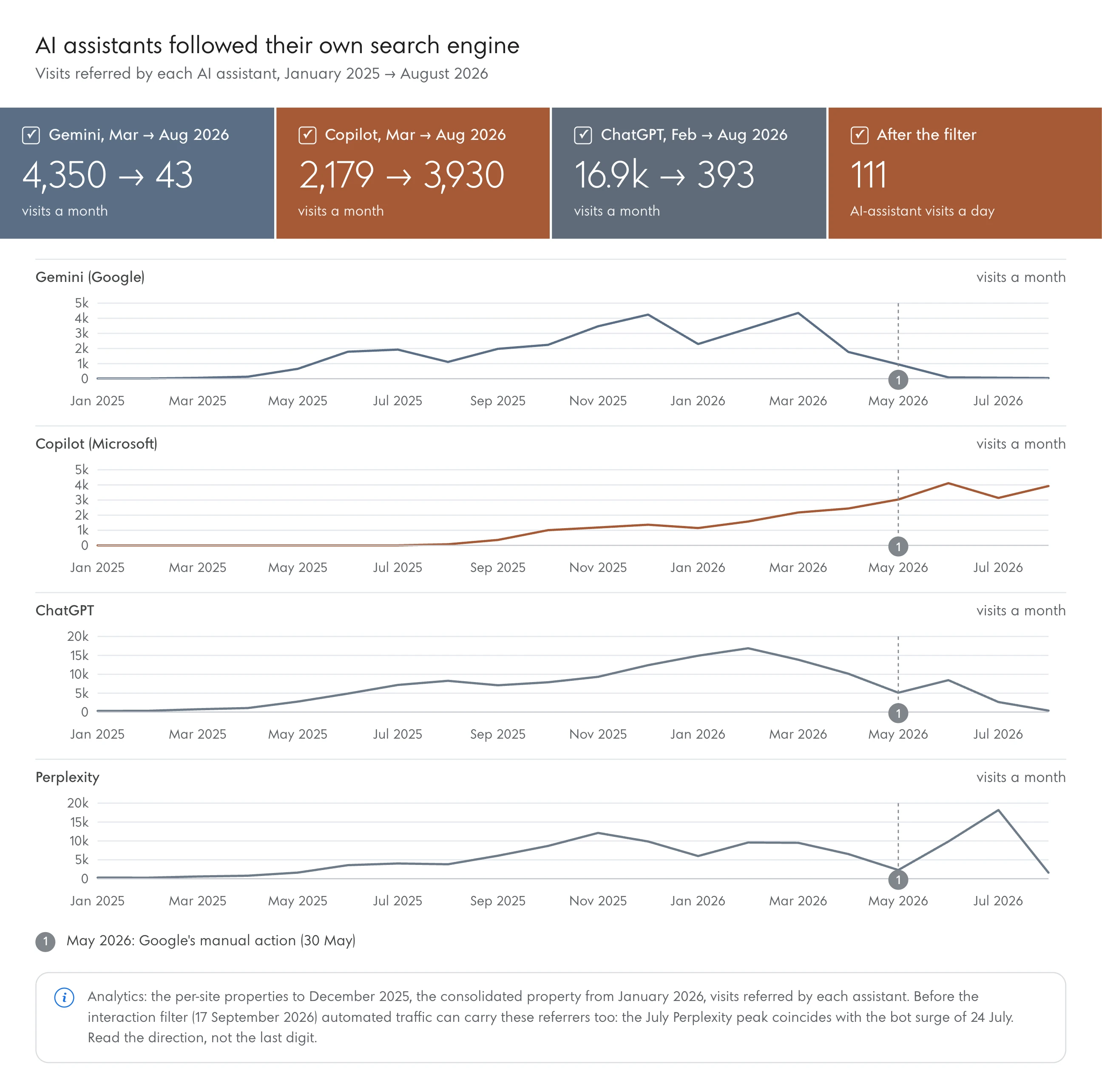
The answer engines did not judge the Directory on their own. Each one cited what its search engine had kept.
The numbers
| Month | Visits from Google (Analytics) | Visits from Bing (Analytics) |
|---|---|---|
| Jan 2026 | 203,558 | 24,049 |
| Feb 2026 | 358,225 | 42,487 |
| Mar 2026 | 424,954 | 57,098 |
| Apr 2026 | 141,628 | 54,401 |
| May 2026 | 69,905 | 94,878 |
| Jun 2026 | 21,560 | 268,989 |
| Jul 2026 | 1,566 | 251,220 |
| Aug 2026 | 2,228 | 114,687 |
| Sep 2026 | 1,905 | 104,923 |
Gemini, Google’s assistant, sent 4,350 visits in March 2026 and 43 in August. Copilot, which answers from Bing’s index, sent 2,179 in March and 3,930 in August, more after the action than before it. ChatGPT fell from 16,837 visits in February to 393 in August; it draws on several sources and its fall cannot be read as cleanly.
For a firm this is the practical point. Being named in an AI answer is not a separate channel with its own rules. It is the visible end of an index. Google’s index feeds AI Overviews, AI Mode and Gemini. Bing’s feeds Copilot and most of the other engines that license it. A firm that exists in only one of them is one decision away from disappearing from half of the answers.
08The Noise Under the Numbers
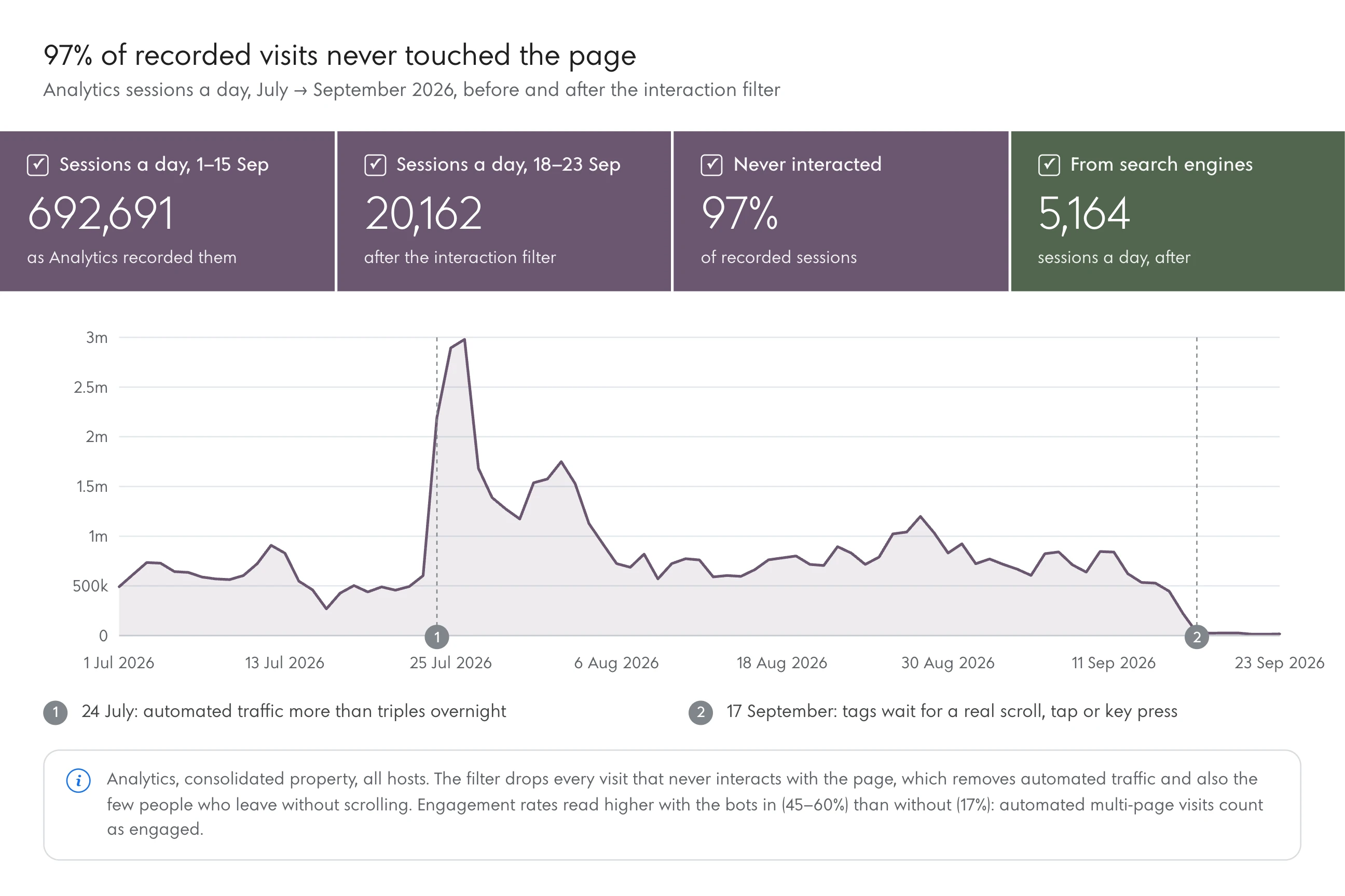
There is a second reason one window misleads, and it has nothing to do with Google. Most of what Analytics records is not people.
In September 2026 the studio changed one thing on the network: its analytics tags waited for a real scroll, tap or key press before they loaded. Nothing else changed. Recorded sessions fell from about 692,700 a day to about 20,200. Ninety-seven per cent of the visits Analytics had been reporting never touched the page.
The numbers
| Channel | Sessions a day, 1 to 15 September | Sessions a day, 18 to 23 September |
|---|---|---|
| Direct | 680,399 | 14,584 |
| Unassigned | 6,330 | 88 |
| Organic Search | 5,744 | 5,161 |
| Referral | 99 | 171 |
| AI Assistant | 86 | 111 |
| Organic Social | 32 | 47 |
| 1 | 0 | |
| Organic Video | 0 | 0 |
What did not move is as telling as what did. Visits from search went from 5,744 a day to 5,161, almost unchanged: the filter removed the machines and kept the searchers. Three months after Google’s verdict, about five thousand people a day were still arriving at the network from engines other than Google.
Before the filter, the channel called “Direct” had grown from 4.5 million sessions in January 2026 to 27.8 million in July, the shape of a success, and almost all of it was automated. Engagement even read higher with the bots in, because automated visits open many pages. A report built on those numbers would have been confidently wrong in both directions.
09What It Taught
The Directory was written with AI before AI answered questions, and it was still being cited by AI after Google stopped showing it. Two years of its record come down to a short list, which the studio now applies to every firm it reads.
What the answer engines reward. Write the definition: the page that says plainly what a thing is gets quoted. Say what each page is, in structured data, so no engine has to guess whether it reads a term, a question or a collection. Be in both indexes: when one closed, the other carried 97 % of the visits that still came from search.
What they punish. Scale is judged as a pattern. AI makes pages cheap to produce, and the reviewer judges how a site is produced, not one page at a time. And the rules arrive after the tools: the Directory adopted each new model within weeks; the rules for publishing with AI at scale came later, and they applied to everything already published.
How to know. Measure every engine on its own: a Google-only dashboard showed a dead site while Bing’s showed seventeen and a half million citations. Filter the bots before reading a number. Archive the record before it expires, because the most useful history is the first to disappear.
10What a Firm Can Check This Week
None of this needs the scale of the Directory to be useful. Any firm can run the same reading on its own accounts, in an afternoon, and most find something they did not expect.
- Open Bing Webmaster Tools. Verify the site if it is not verified, then read its AI Performance report: how often Copilot cites the firm’s pages, on which searches, and which pages. Many firms learn here, for the first time, that an assistant is already quoting them.
- Read Google’s two reports side by side. Search Console’s Performance report shows the clicks; its Generative AI report shows where Google’s AI answers used the firm’s pages. A page can matter in one and not the other.
- Ask the buyers’ questions, live. Put the five questions a buyer asks before choosing into Google’s AI Mode and into Copilot, and write down who is named, who is quoted, and whether it is the firm.
- Count the people. In Analytics, look at the share of sessions that never scroll, tap or press a key. If it is large, every rate in the monthly report is measured against machines.
- Export the record. Download Search Console’s sixteen months today, and every month after. The history a firm will want in a year is the history that is disappearing now.
11What the Studio Does Now
The case became the method. Every reading the studio makes now keeps four rules from it.
- Every engine, on its own. Google, Bing, Google’s AI answers and Copilot are read separately, because they disagree, and their disagreement is information.
- The record, archived first. Every source is saved before it is interpreted; Search Console keeps sixteen months.
- People, not bots. Visits are read only after automated traffic is filtered out; on this network it had been almost all of the traffic.
- Few pieces, first-hand. Never pages made in bulk to rank, the one thing every engine eventually punishes. Pages multiply only from data the firm holds and nobody else has.
The same lesson shaped what the studio builds. A satellite today is small and made for one market or one question, on the firm’s own engine, and it sends its readers home. Terms are defined once, in one sentence first, because the definition is what the answer engines quote. And every finding in a reading is written with the date on which it will be measured again, against the same record.
The point is not that Google can be done without. For most firms it is still the largest window. The point is that a firm is found through several windows at once, each with its own record and its own judgement, and that the record belongs to the firm only if the firm keeps it.
12Method and Sources
The Directory’s figures come from its own accounts: Google Search Console for the domain and each subject site; Bing Webmaster Tools, with its AI Performance report for Copilot; and Google Analytics, April 2024 to September 2026. Search Console keeps sixteen months (Google Search Central), so Google’s figures begin in May 2025; earlier visits from search are Analytics’ “Organic Search” channel.
Google’s AI answers are Search Console’s Generative AI report for the domain, whose history begins on 18 May 2026: 173,290 appearances in all, on about 1,000 pages in 216 countries.
Visits from AI assistants are those Analytics recorded with each assistant as the referrer. Before 17 September 2026 some automated traffic carried these referrers too, so the charts show direction rather than exact counts.
The engine of 2024 and 2025 is read from the Directory’s own archive of publishing scripts, dated by file.
Launch dates are as announced by each company: Google’s AI Overviews (14 May 2024 in the United States; 28 October 2024 in more than 100 countries), ChatGPT search (31 October 2024), Google AI Mode (20 May 2025 for everyone in the United States), Bing’s AI Performance report (10 February 2026, in public preview).
The charts follow the shape of Google’s own reports, in the studio’s colours, and their numbers are printed under each one.