
01Everything Under One Name
A firm is written in more places than its site.
It stands on the domain it operates and on that domain’s subdomains, in a shop, on a satellite built for one subject, on profiles held on other people’s platforms, in the messages a client receives and in what others write about it. A search engine built to read meaning meets all of these under one name. Semantic Authority Mesh treated a single site as a body, gave it a centre with a spread around it, counted the links and defined terms that tie it inside, and stopped at the edge of that site.
Here the object is the name with every property under it, and the subject is the relation between two of those properties.
Work on such relations has a name. Semantic Entanglement Optimisation, a term Noo–Studio coined in October 2026, keeps the three letters of search engine optimisation and gives them a second expansion, defined in one sentence: “Search engine optimisation redefined for engines that read meaning: the work on the relations that a site’s pages, and the sites under one name, hold with their neighbours in meaning, since each is placed and judged by what it is entangled with.”
The letters stay and the work moves.
So the width is part of the claim. One instance is a main site and its satellite. The same kind of relation holds between a site and a profile kept on someone else’s platform, and between a shop and the reviews written about it.
We have measured one instance and state the rest as theory, with the test beside it.
Four Kinds of Property
What stands under one name divides by who controls the text. First comes what the firm owns and operates: a registered domain, its subdomains, a shop, and any satellite, meaning a second site under the same name built around a narrower subject. Second is what the firm holds on other people’s platforms, where the platform owns the frame and the firm fills it in, such as a Business Profile, social accounts, listings and channels.
Then there is what it sends, the messages a client receives, which carry the firm’s domain in the sender’s address and its terms in the body. Last is what others write, reviews and mentions, where the firm controls nothing and can only earn the text.
Control falls from the first kind to the last, and with it the firm’s ability to give one account of itself in the same terms. An engine’s access falls along a rather different line. It can crawl the first kind and most of the second, and it often reads a large part of the fourth.
But a private message it never crawls; the receiving mail system reads that, and then a person does.
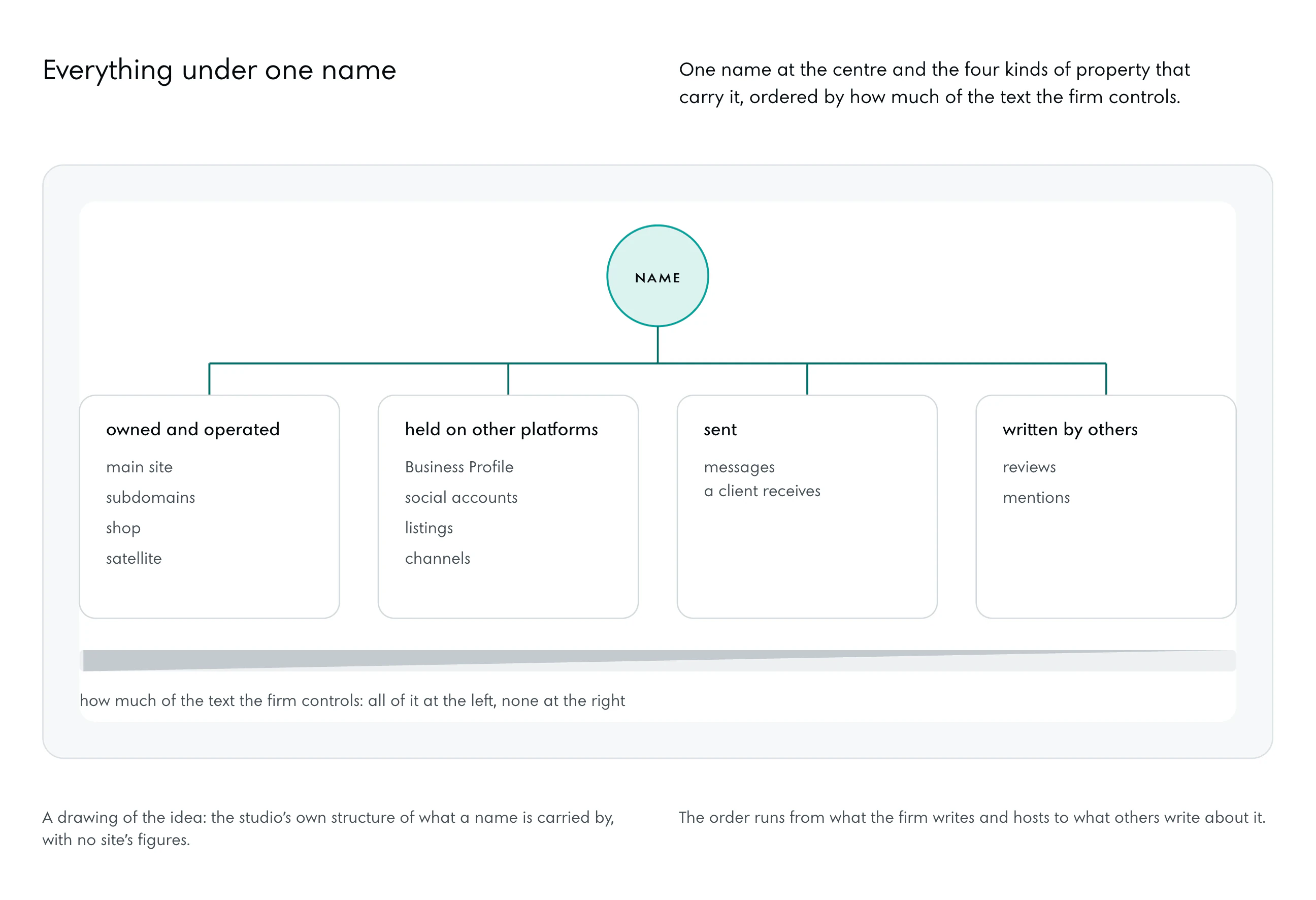
One member of the first kind is the body the second paper described. Semantic Token Optimisation named the full width once, in one paragraph, marking it there as theory without a measurement.
Figures That Need Two Bodies
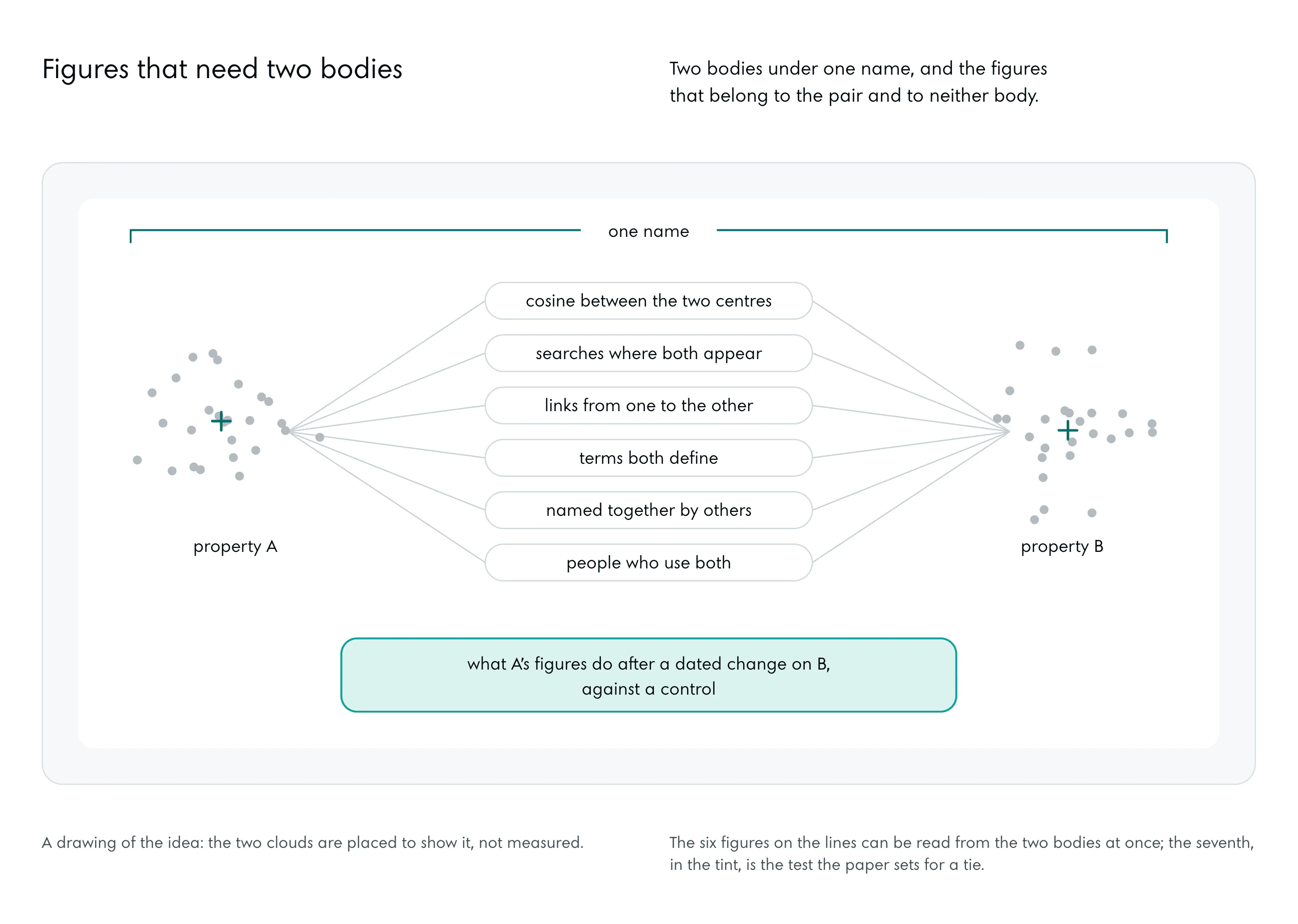
Between two properties under one name there are numbers that neither has alone, beyond the summary that the second paper gave to one site. Their two centres have a cosine between them, which says how close their subjects lie. On some share of searches both appear, and on a smaller share both stand on the same results page.
Links from one to the other can be counted, and so can the terms both define in identical wording. A third party names them together or it does not. And some share of the people who use one also use the other.
One more belongs to the pair and is of a different kind. It is a conditional, the course of one property’s figures after a dated change on the other, set against the course a control would give. Where that difference is zero, time after time, the two are separate bodies that happen to share a name.
If it holds, each needs the other to be described.
Google’s Edge of a Site
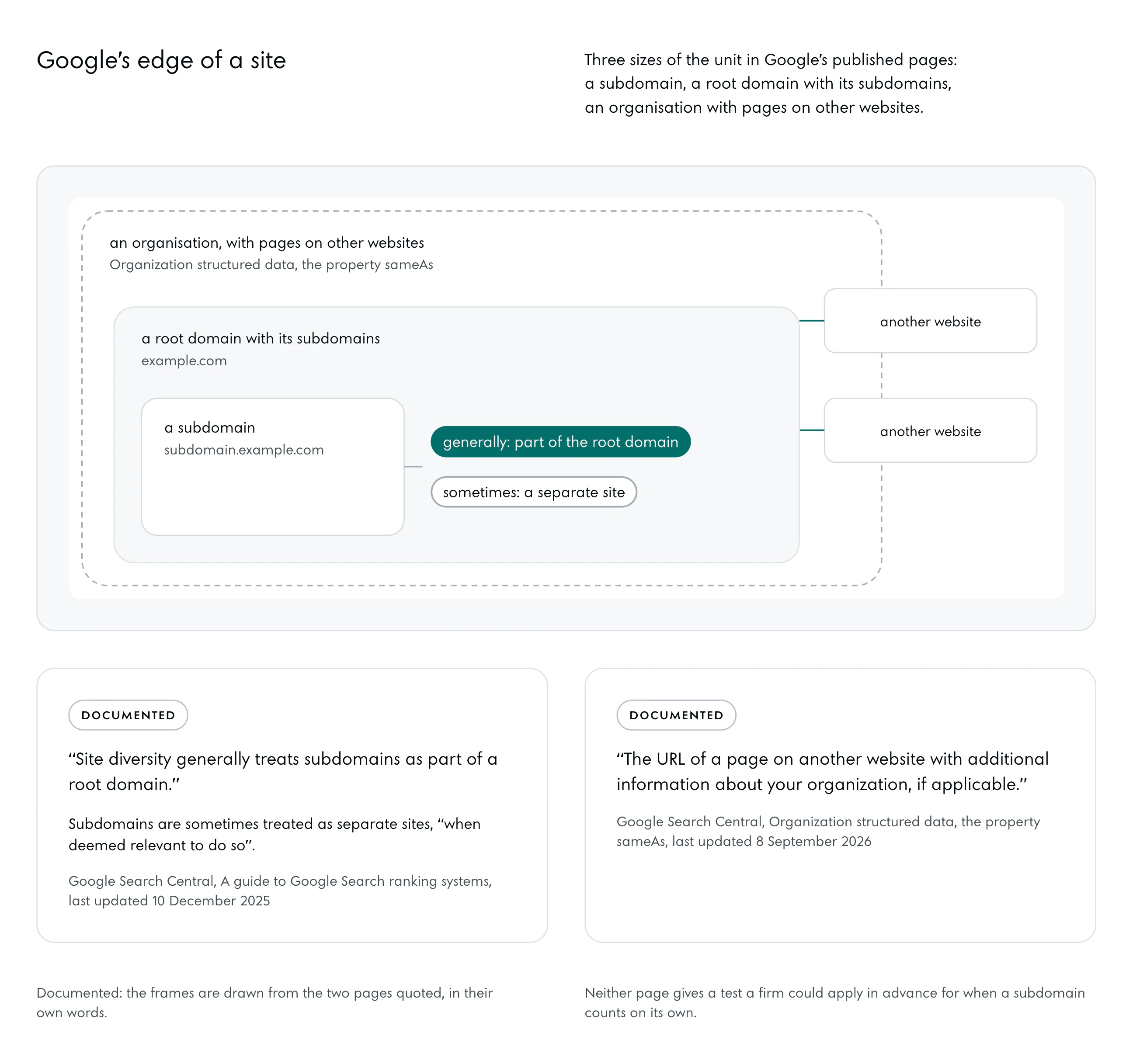
Engines leave their working unit open in what they publish. Google’s guide to its ranking systems, whose last update is dated 10 December 2025, describes a system that limits how many results one source may hold, and to do so it has to say what one source is. “Site diversity generally treats subdomains as part of a root domain.” The page then takes part of the rule back; subdomains, it adds, are sometimes treated as separate sites “when deemed relevant to do so”.
This is documented, in Google’s published words. So a subdomain is usually the same source as its root and sometimes a separate one, and the page never gives a test that a firm could apply in advance.
A wider unit stands in Google’s page on Organization structured data, whose last update is dated 8 September 2026. There the property sameAs is described as “The URL of a page on another website with additional information about your organization, if applicable.” An organisation, in that sentence, is a thing with pages on websites it does not operate, and so the published units already slide, from a hostname, through a root domain with its subdomains, up to an organisation spread over other people’s websites. Which of them applies is the engine’s decision, taken case by case; that decision is the relation this paper describes, seen from the engine’s side.
One Claim and Its Test
The definition speaks at two sizes. One is the pages of a single site, whose ties the second paper counted; the other is the sites under one name, which begin where that paper ended. Its two verbs follow the first two papers as well, placed for a position in a model and judged for the standing an engine gives.
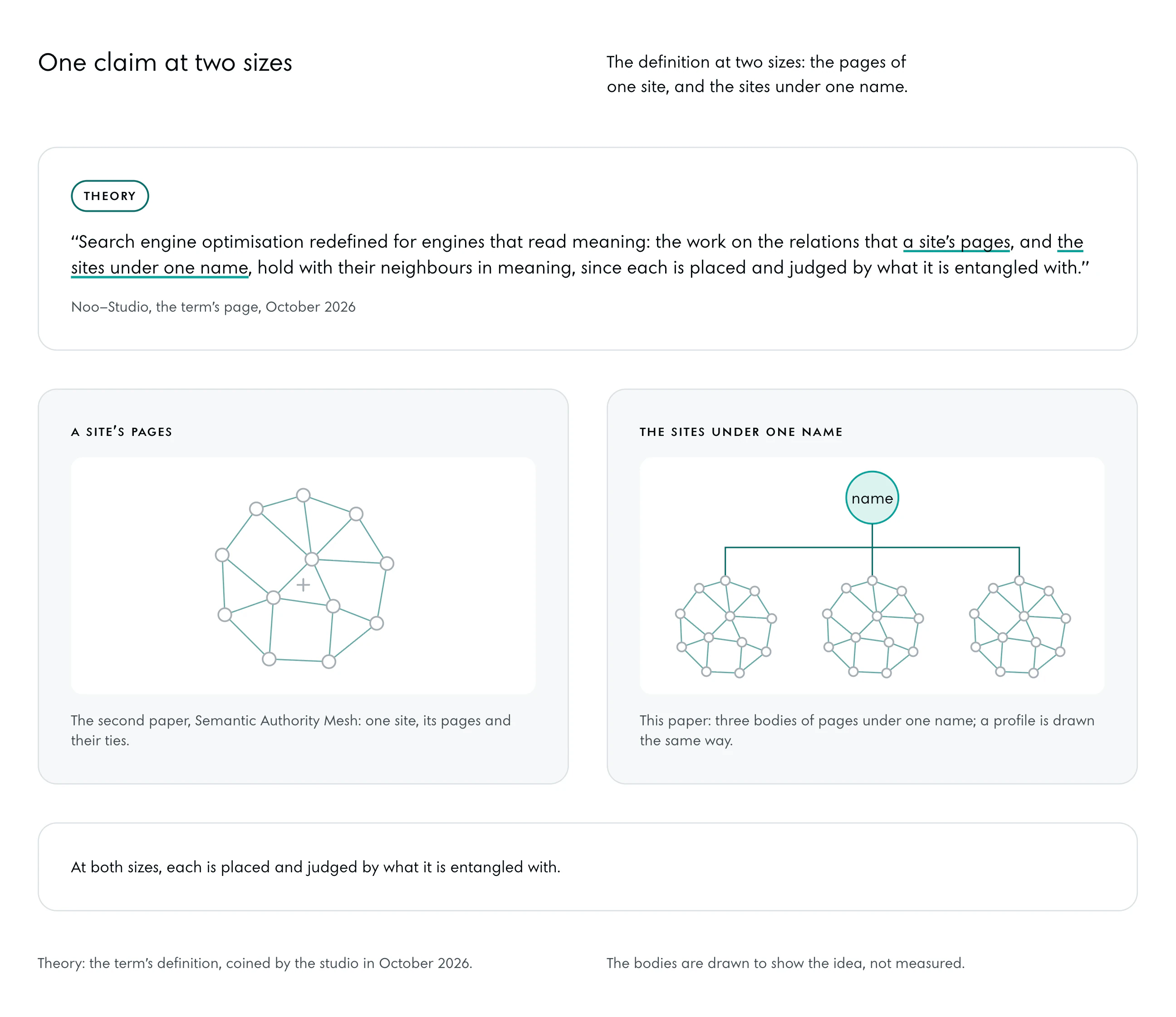
The studio’s position goes a step past the documents. It is that the properties under one name are taken together by an engine built to read meaning, each of them placed and judged by what it is entangled with, the firm’s other properties included. That is theory, under the labels the first paper set (documented, measured, theory), and its test is the conditional of the pair.
A dated change is made on one property and the others are followed against a control. If, across cases, the others keep the course their controls give, the position fails.
SEO in this second sense is a practice. No engine publishes a signal by that name, and nothing in it is a ranking factor or a weight. One instance has been measured by the studio so far, one main site and its satellite, in shares of the name’s search between July 2025 and September 2026.
Everything wider is theory, at the width stated.
02The Physics That Named It
Entanglement entered science in 1935 as a term for one precise thing, the state of two systems that have interacted and can no longer be described one at a time.
It answered an argument and was turned, in 1964, into a test that experiments settled between 1972 and 2015. Only part of the word is borrowed here, so the sources are set out exactly. No engine discussed in this paper is a quantum system, and nothing in it suggests that one is.
A Coinage of 1935
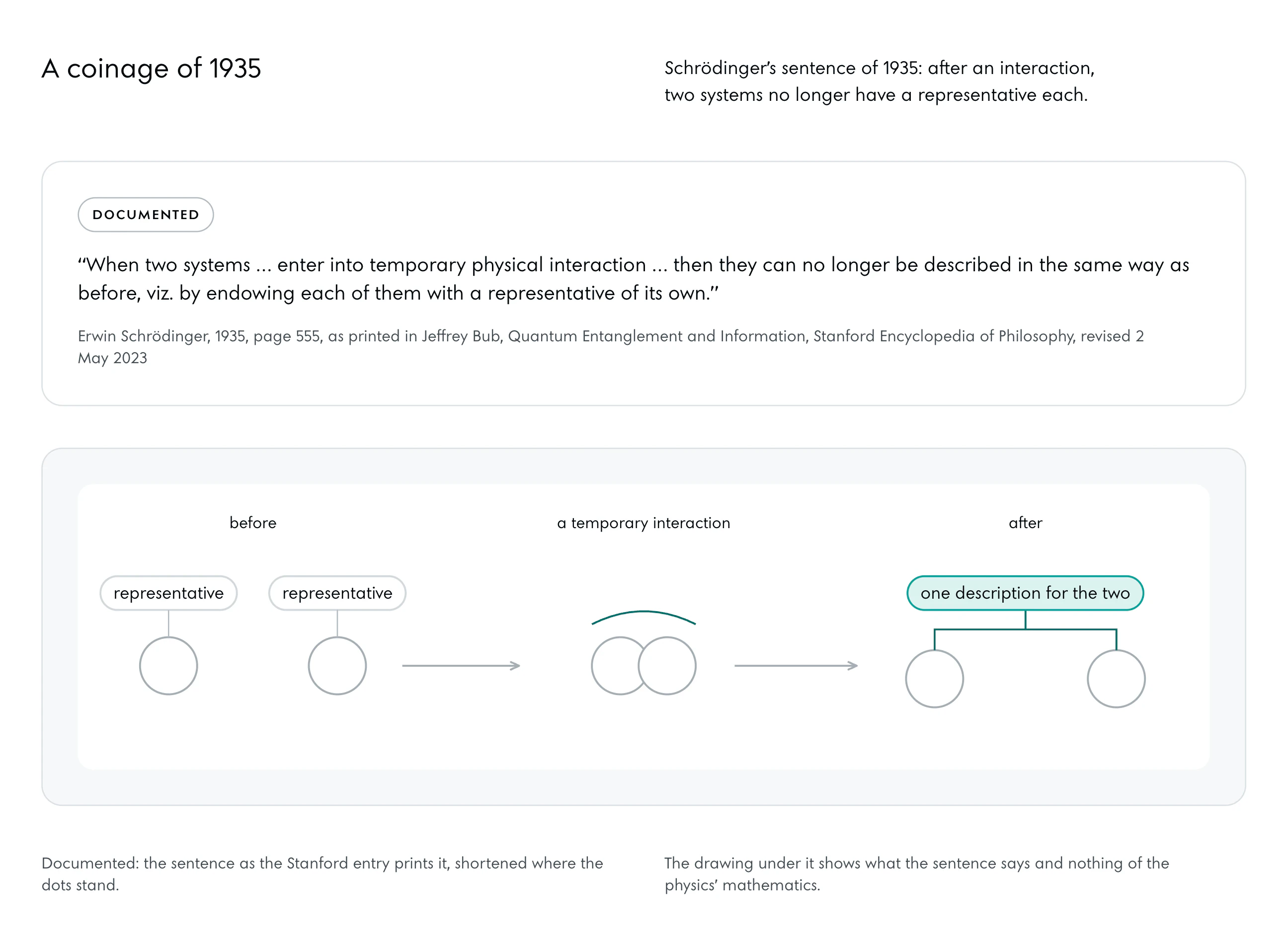
Erwin Schrödinger gave the phenomenon its word, in a two-part article for the Proceedings of the Cambridge Philosophical Society. Jeffrey Bub’s entry in the Stanford Encyclopedia of Philosophy, first published on 13 August 2001 and revised on 2 May 2023, dates the two parts to 1935 and 1936 and records that “Schrödinger coined the term ‘entanglement’ to describe this peculiar connection between quantum systems”. His sentences are quoted here as that entry prints them, from page 555 of the first part.
“When two systems, of which we know the states by their respective representatives, enter into temporary physical interaction due to known forces between them, and when after a time of mutual influence the systems separate again, then they can no longer be described in the same way as before, viz. by endowing each of them with a representative of its own.”
A representative is what a physicist now calls a state, the mathematical object from which every statistical statement about a system is derived. Afterwards there is one representative for the pair, and he wrote that by the interaction the two representatives “have become entangled”. Schrödinger’s claim is about description.
He never treated this as a detail. In the same passage he called it the trait that forces quantum mechanics away from classical lines of thought, and he said what follows for knowledge in a line that still serves to define it, “the best possible knowledge of a whole does not necessarily include the best possible knowledge of all its parts”.
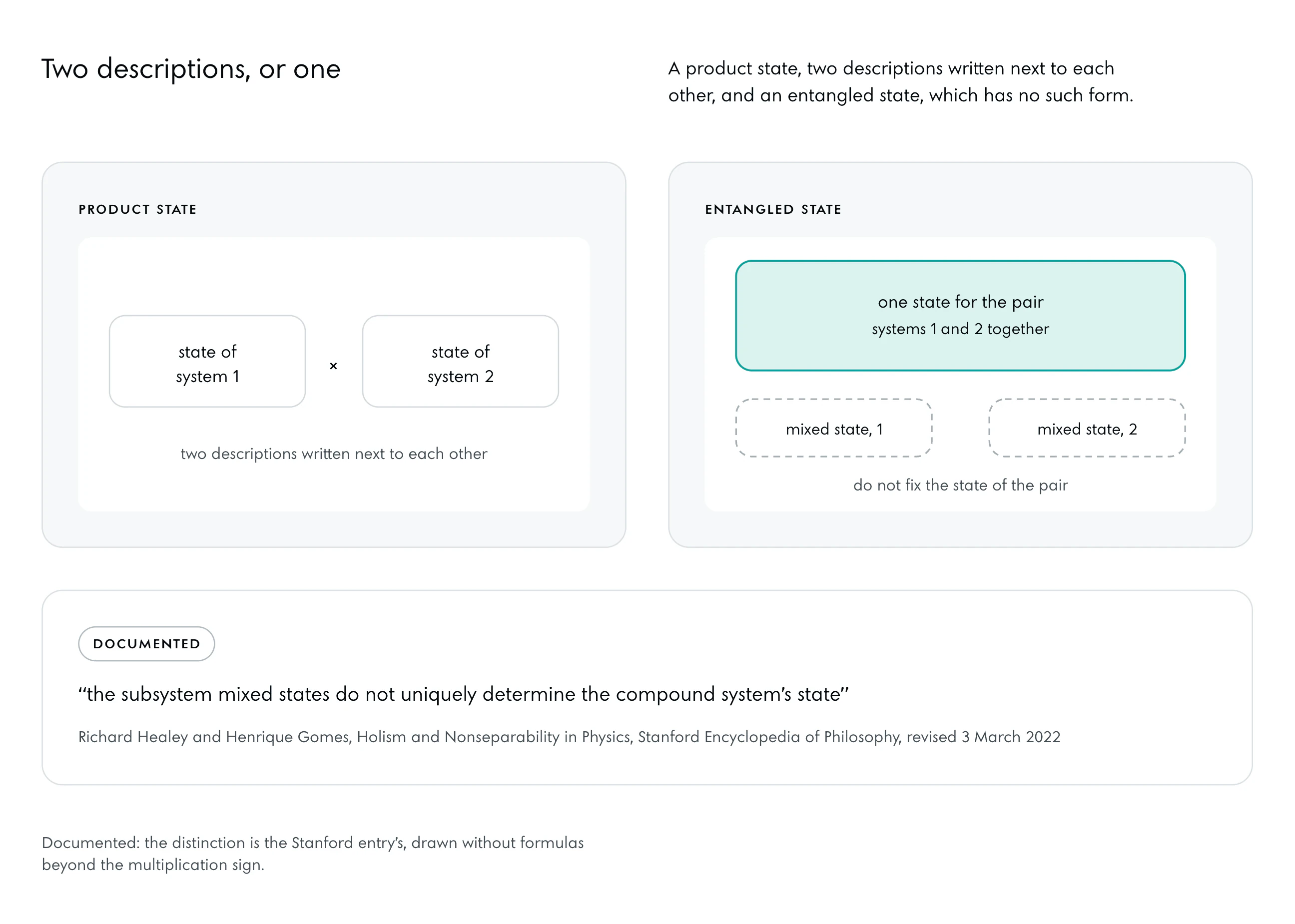
Today the statement is made with vectors. For two systems whose joint state is pure, which means it is known as fully as the theory allows, the state of the pair is a vector in the space built from the two systems’ spaces. Healey and Gomes, in the entry on holism and nonseparability of the same encyclopedia, revised on 3 March 2022, give the criterion.
The pair is entangled if and only if that vector is no product of one vector for each system, whichever two vectors are tried. A product state is two descriptions written next to each other; an entangled state has no such form. Each system taken alone can then be assigned only a mixed state, a statistical summary, and the entry adds that “the subsystem mixed states do not uniquely determine the compound system’s state”.
Two summaries, however complete, leave the state of the pair undetermined.
Einstein’s Objection
Schrödinger was extending a paper by Einstein, Podolsky and Rosen, published in the Physical Review in 1935. They considered two particles prepared together and then separated, such that to measure where one is tells where the other is with certainty, and to measure the momentum of one does the same for momentum. Either correlation can be observed on a given pair, never both.
From this they argued that quantum mechanics is incomplete; each particle, on their account, carries values that the theory’s state leaves out.
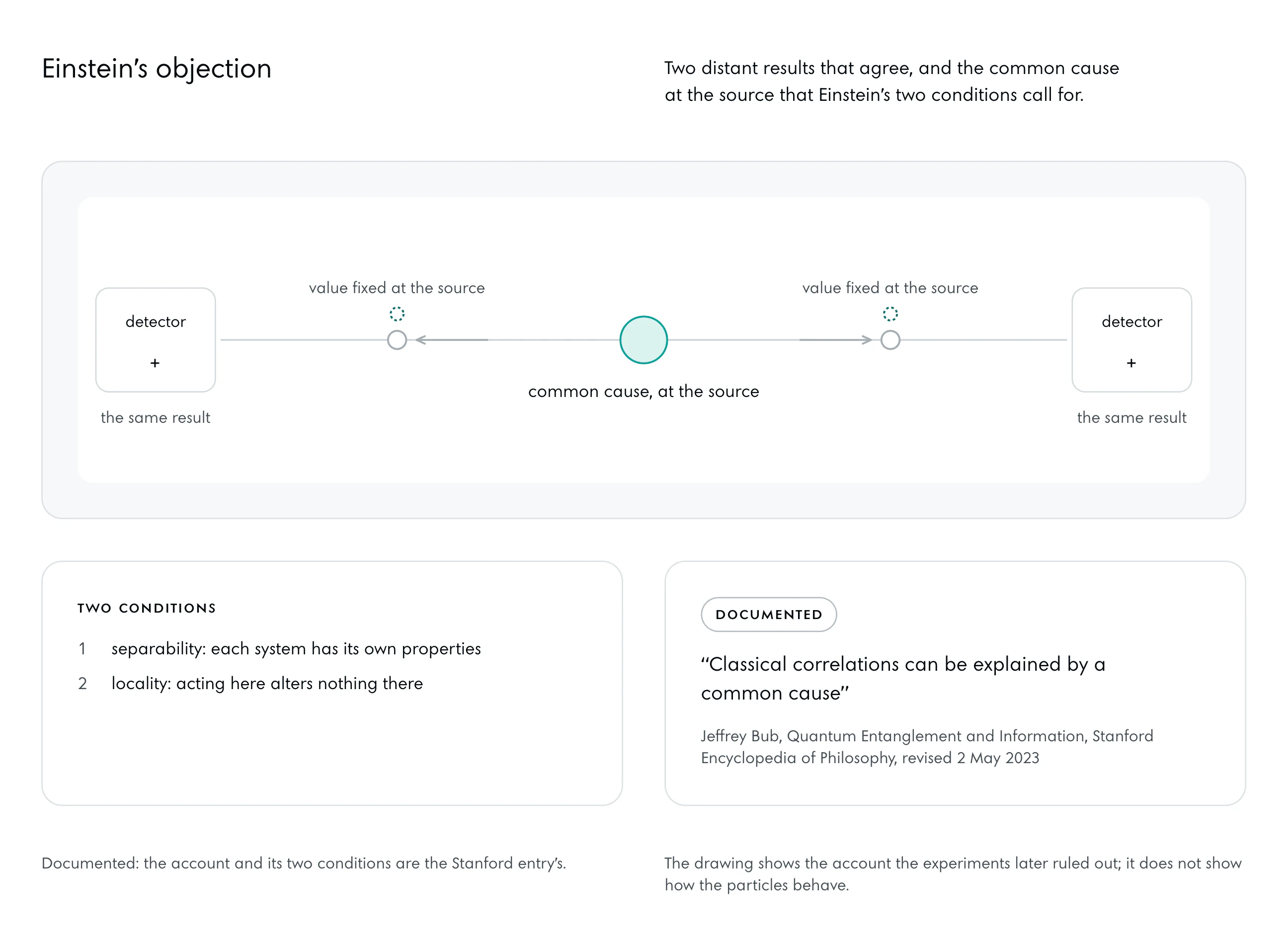
Two conditions stand behind the argument, and the Stanford entry attributes both to Einstein. Separability says that each system is characterised by properties of its own. Locality is given there as the demand that “it should be impossible to alter the properties of a distant system instantaneously (or the probabilities of these properties) by acting on a local system”.
Under those two conditions, distant results that agree can be explained in one way only. Something was fixed at the source, and each particle carried its share away. In the entry’s words, “Classical correlations can be explained by a common cause”, and on that account the missing values are the common cause, absent from the quantum state and present in the world.
Whether such a completion exists was the dispute that followed. But for almost thirty years no experiment could decide it.
Bell’s Inequality and Four Decades of Tests
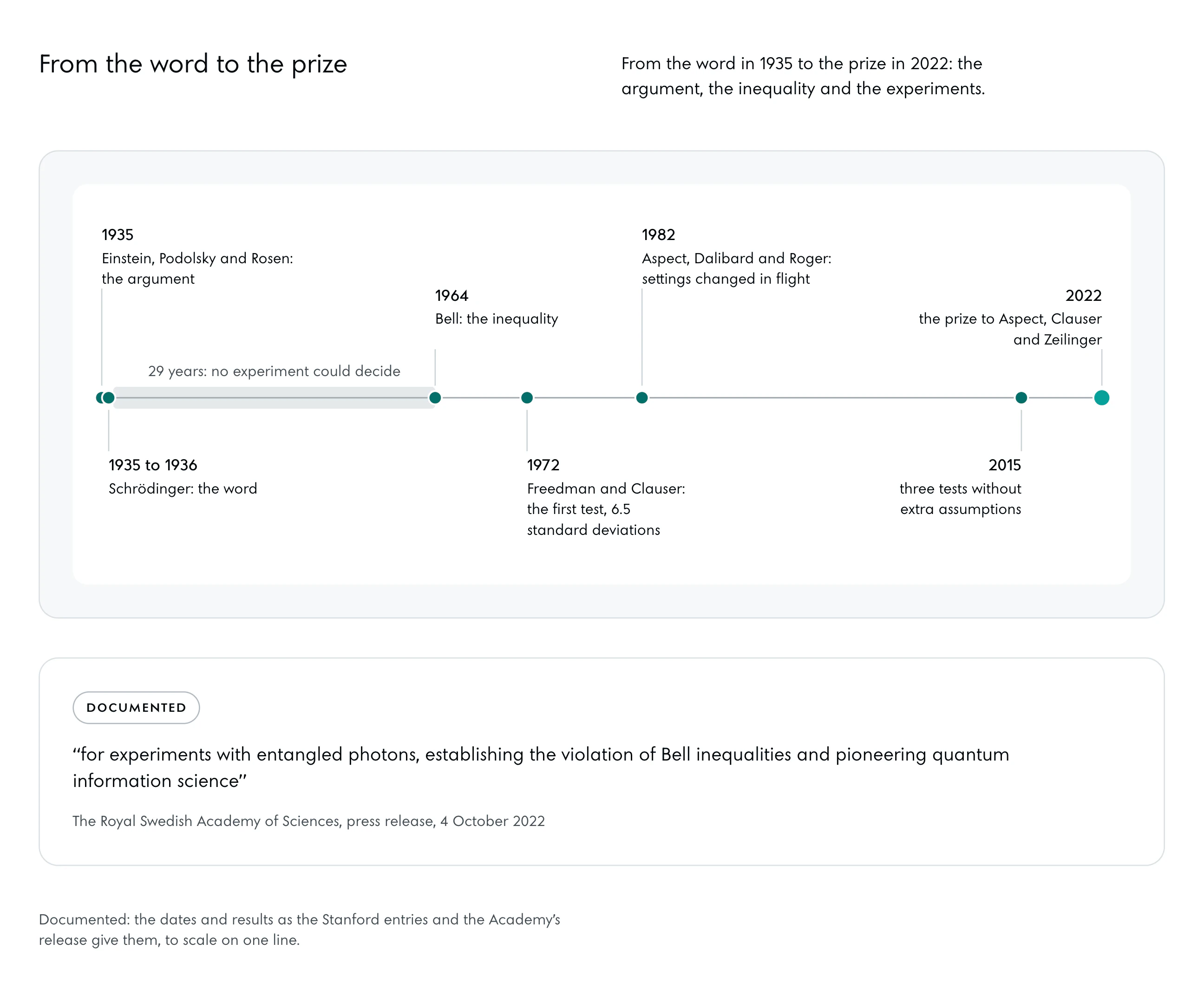
In 1964 the dispute became arithmetic. John Bell showed that any account of the correlations by a common cause, under Einstein’s two conditions and with settings chosen independently of the source, obeys an inequality: a certain signed sum of the correlations measured at different settings can never exceed a fixed value, and quantum mechanics exceeds it for suitable settings. Myrvold, Genovese and Shimony, whose Stanford entry on Bell’s theorem was revised on 25 January 2024, state the result as “no physical theory that satisfies a certain locality condition, which may be called Bell locality, can fully reproduce the quantum probabilities for outcomes of experiments”.
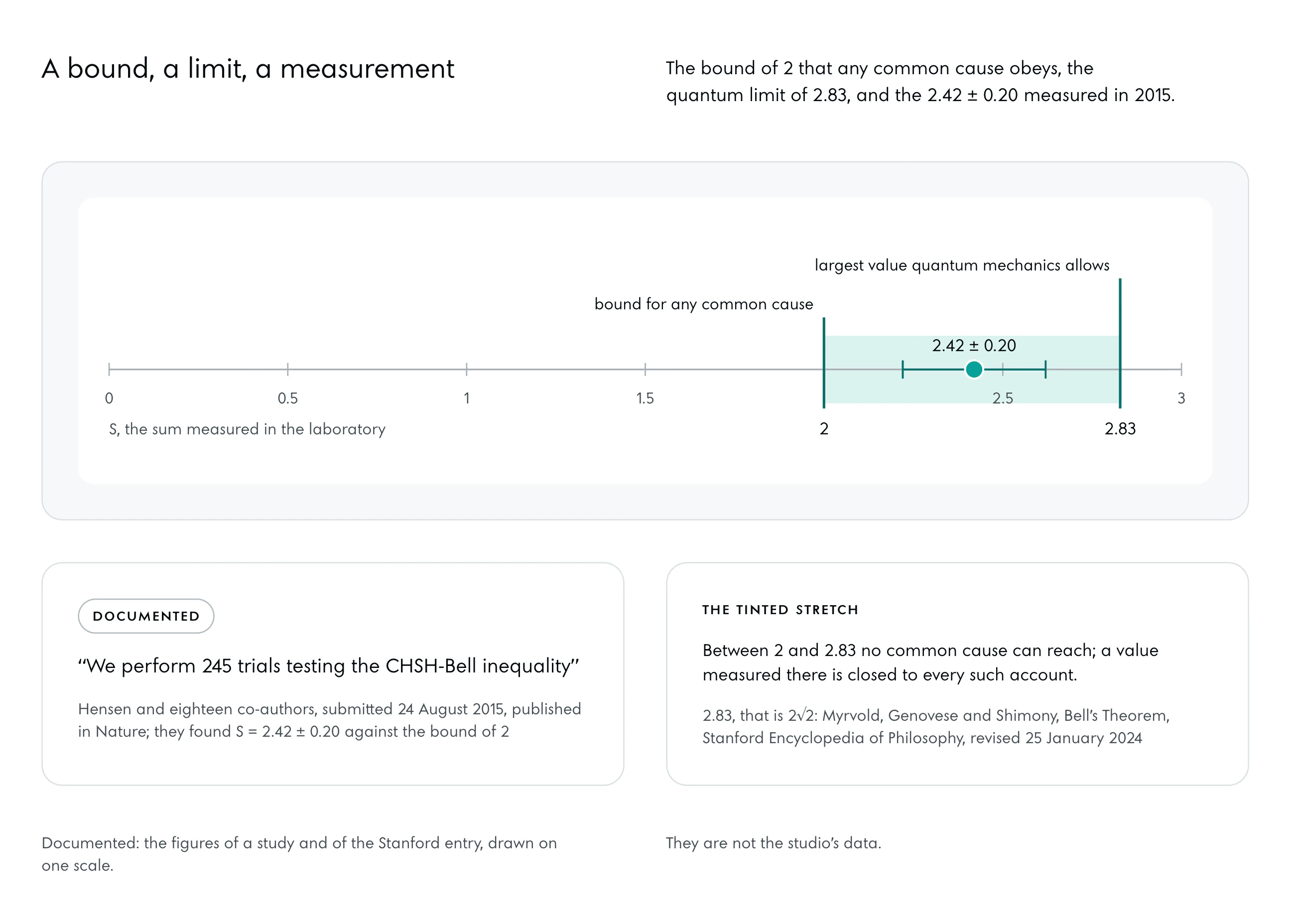
In the form used in laboratories that sum is written S and the bound is 2. Quantum mechanics allows at most 2√2, about 2.83, for any state.
Freedman and Clauser reported the first experiment in 1972, and the same entry gives its result as 6.5 standard deviations beyond the limit. Ten years later Aspect, Dalibard and Roger changed the settings while the photons were in flight. What that closed is said plainly in the release of the Royal Swedish Academy of Sciences of 4 October 2022, “He was able to switch the measurement settings after an entangled pair had left its source, so the setting that existed when they were emitted could not affect the result.” Earlier experiments had needed extra assumptions, and in 2015 three groups reported tests without them.
Hensen and eighteen co-authors, in a paper submitted on 24 August 2015 and published in Nature, used electron spins 1.3 kilometres apart. “We perform 245 trials testing the CHSH-Bell inequality”, their abstract says, and against the bound of 2 they found S = 2.42 ± 0.20.
A prize followed in 2022. It went to Alain Aspect, John Clauser and Anton Zeilinger “for experiments with entangled photons, establishing the violation of Bell inequalities and pioneering quantum information science”. And the same release draws the conclusion in plain words, “This means that quantum mechanics cannot be replaced by a theory that uses hidden variables.”
By then the property had become a working material. A review by the four Horodeckis, submitted on 26 February 2007 and published in Reviews of Modern Physics in 2009, describes entanglement as having “waited over 70 years to enter to laboratories as a new resource as real as energy”.
No Signal Between the Sides
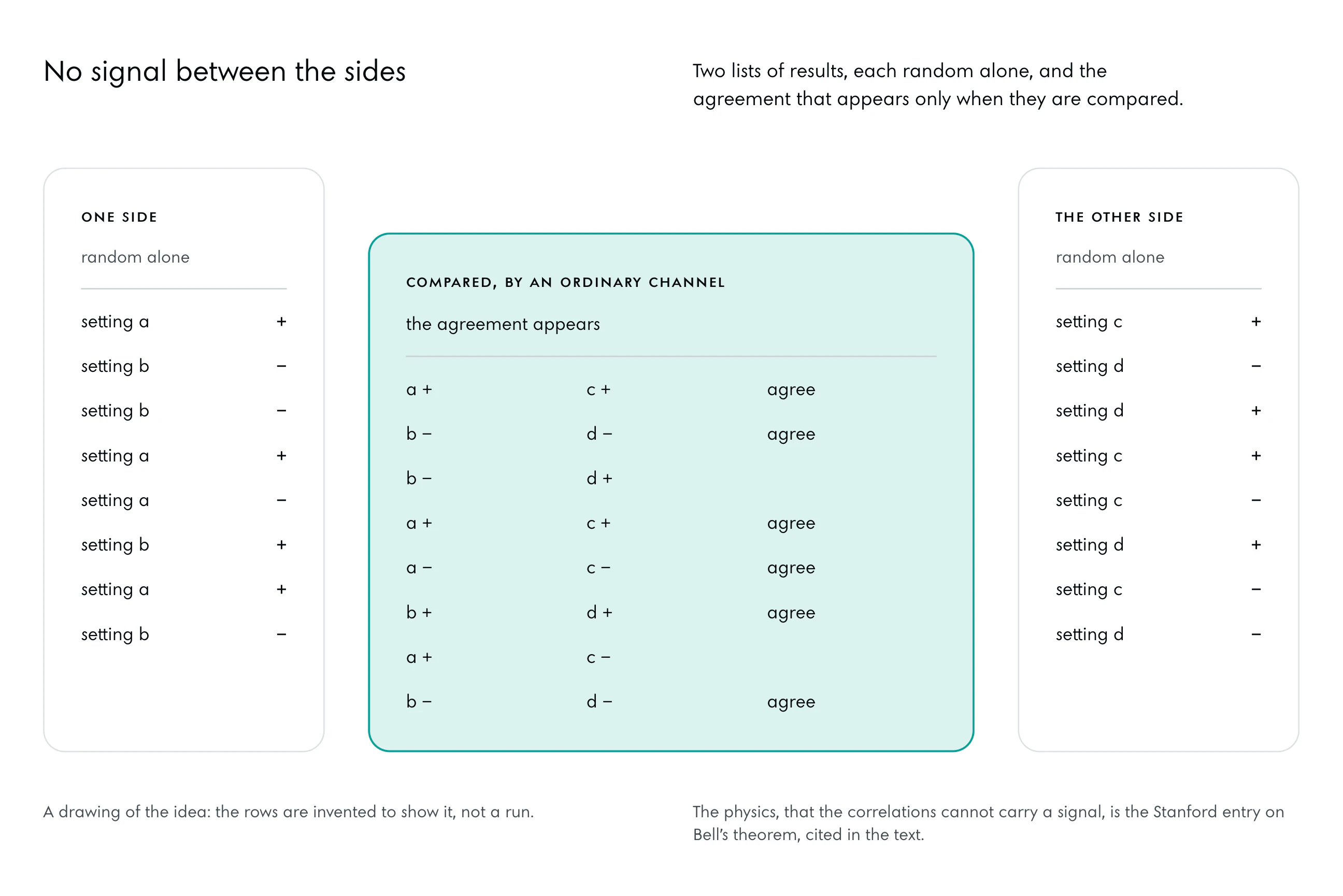
No message passes from one detector to the other. Retellings of the physics often lose this part. One side’s result is random, and its statistics are the same whatever is chosen or done on the other side.
For the formal statement the Stanford entry on Bell’s theorem cites proofs published between 1978 and 1982, “quantum correlations cannot be exploited to send signals superluminally”.
What an experimenter at either end holds is a list of settings and results that looks like noise. Only when the two lists are brought to one place, by an ordinary channel, and compared entry by entry does the correlation appear.
The correlation is therefore always a property of the joint results and of nothing smaller.
A relation can be real and still be missing from everything kept on one side alone.
So the common way of putting it, that touching one particle changes the other, is wrong in a way that matters here. Nothing changes at the far end that could be seen from the far end. A pair is fully described and each part is only summarised, and the description becomes visible in the comparison.
Two Borrowings and Their Limit
Semantic Entanglement Optimisation, the second expansion this paper gives to the letters of search engine optimisation, takes two things from that history. One is Schrödinger’s point. The other is where a relation is found.
Things that have interacted are described together, and a summary of each part, however complete, always leaves out what the pair holds; and a relation is found in joint results, sorted by what was done on each side, when a setting is chosen on one side and the two sets of results are compared.
Everything else stays in physics, beginning with the strength of the correlation. The absence of a signal stays there too. Quantum correlations can be stronger than any common cause allows, which is what Bell’s bound measures, and no such strength is claimed for anything on the web, where every correlation between two sites has ordinary causes.
Between two properties under one name causes do pass, by a link, by shared text, by the people who use both, by the one index that holds them, and the work this paper describes consists of those causes. The mathematics is left where it is as well; a site has no state vector, and nothing in the term depends on one.
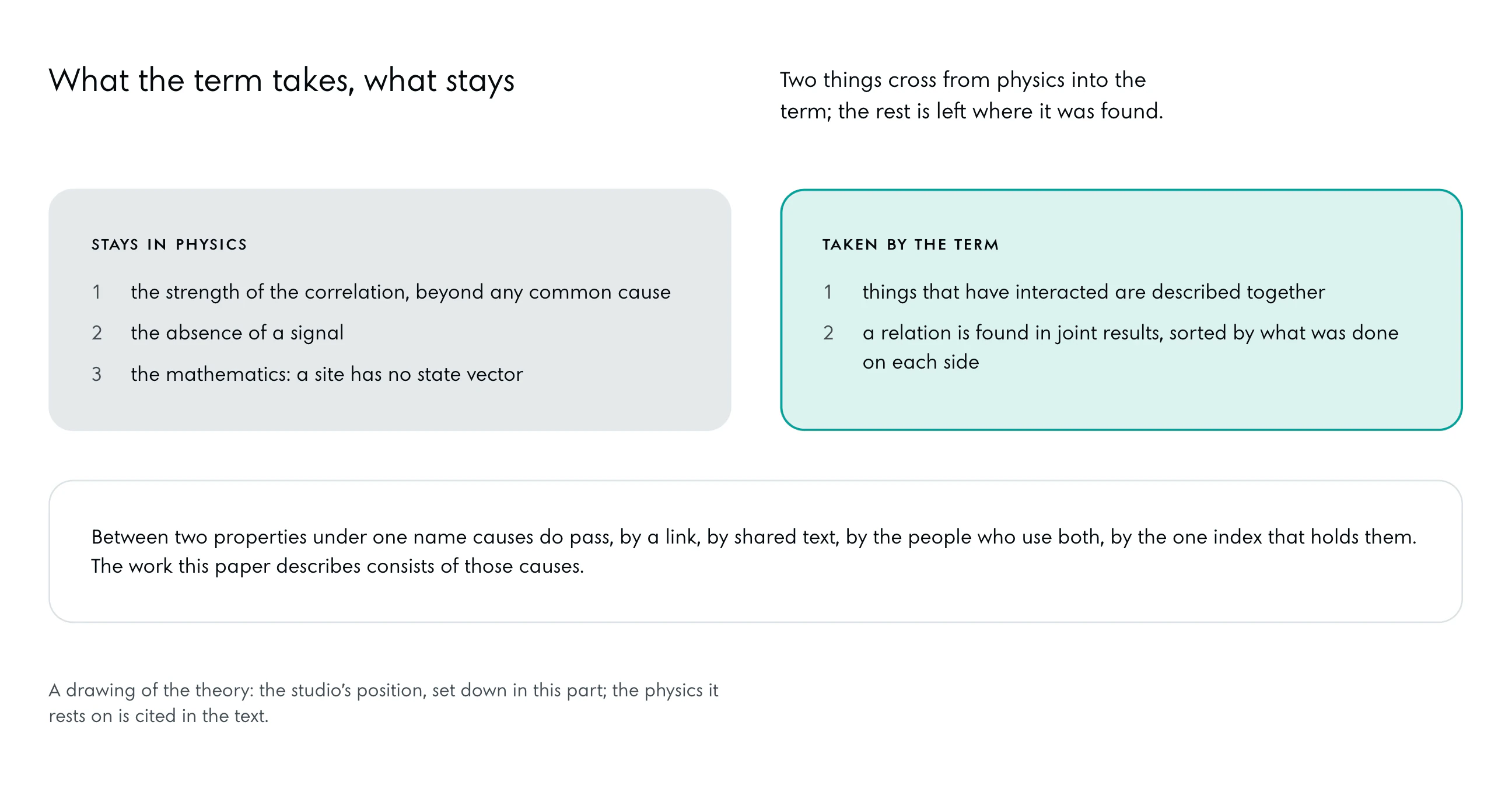
Table 1 sets the physical sense beside what the term takes from it.
| Aspect | In physics | In the term |
|---|---|---|
| What is described | Two systems after an interaction, with one state for the pair | Two properties under one name, with figures that belong to the pair |
| What each part has alone | A mixed state, which does not fix the state of the pair | A summary of its pages, which does not fix the relation |
| Where the relation shows | In two lists of results compared, sorted by the settings chosen | In two sets of figures compared, around a dated change on one side |
| Cause between the sides | None that carries a signal | Ordinary causes, by links, shared text, shared users and one index |
| Strength of the correlation | Beyond the bound any common cause allows, S up to 2.83 against 2 | No such claim; common causes are expected and have to be controlled for |
| Formalism | Vectors in a product space | None borrowed |
The studio’s record has the word put to search on 10 October 2026. It came as a question from Piotr Paweł Zalewski, founder of Noo–Studio, “So you think that semantic entanglement as a word in a SEO space could be a good one?” Our answer is yes, for the two things borrowed, and on the condition that the rest is left where it was found.
03From the Lexicon to the Model
Two fields outside physics took the word up, and each gave it a working sense. Research on memory used it for words that are activated together; research on learned representations uses it for factors that cannot be read apart.
Both senses bear on Semantic Entanglement Optimisation, the second expansion of the letters of search engine optimisation, since a name is a word in a person’s memory and a short string of tokens in a model, and in both places it is held by what it is associated with.
Free Association and Its Map
Psychologists chart a vocabulary by asking for the first other word that a cue brings to mind. Repeated over large samples, the procedure gives a number for every pair of words, the share of people who answered a cue with a given response. Bruza, Kitto, Nelson and McEvoy, in the Journal of Mathematical Psychology of October 2009, give the standard example, in which “the probabilities that planet produces earth and mars are 0.61 and 0.10, respectively”.
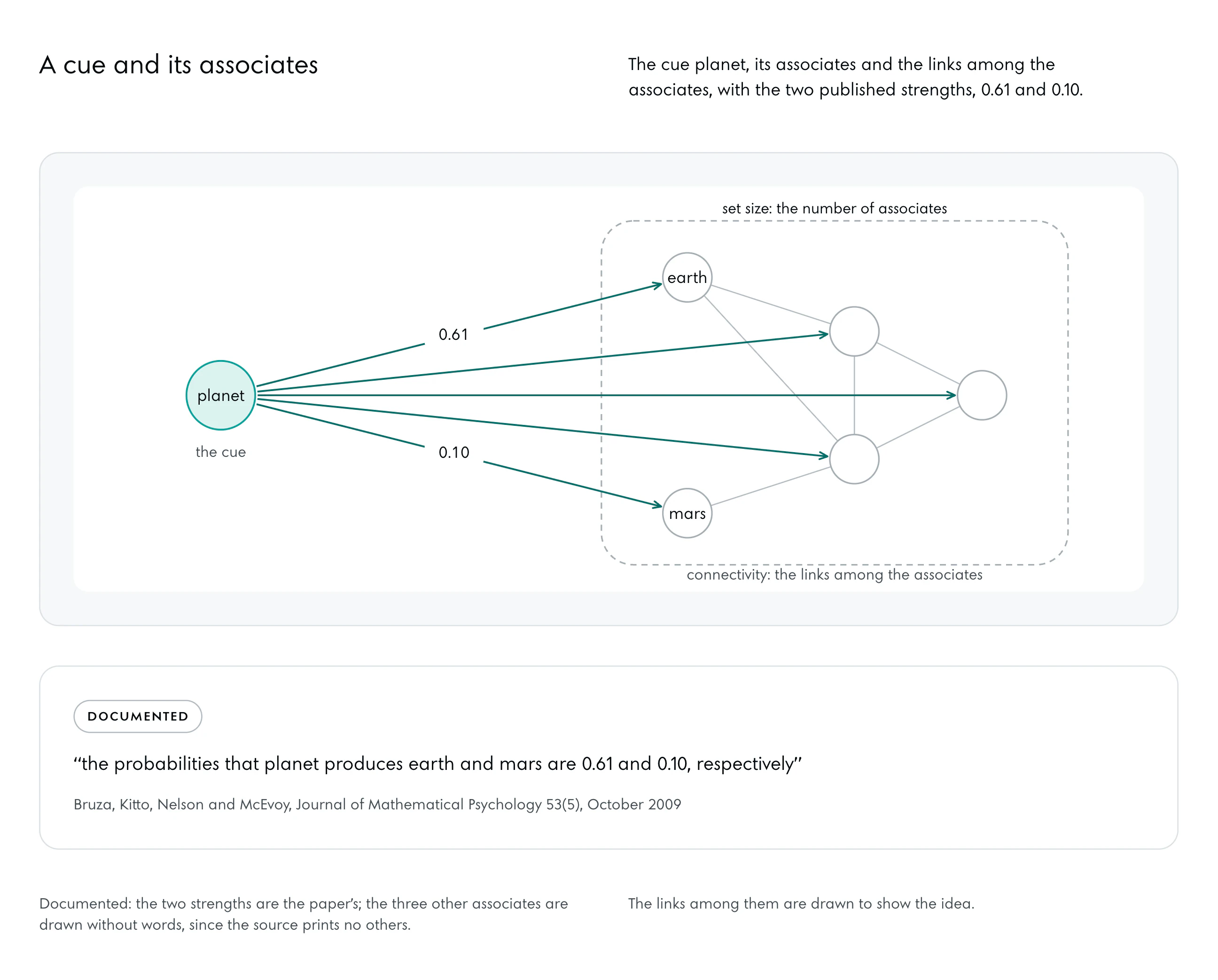
Such numbers come from norms collected at the University of South Florida. Nelson, McEvoy and Schreiber described them in 2004, in an article that offers “free association data for 72,000 word pairs, along with over a million entries of related data” for 5,019 normed words. Two measures of a word come out of such a map.
Set size is the number of its associates; connectivity is the number of links among those associates themselves.
Connectivity turned out to matter in a way the standard account did not allow. Under spreading activation, a studied word is strengthened by activation that goes out to its associates and comes back. Nelson, McEvoy and Pointer tested that in 2003 and found that “connections among the associates facilitated recall regardless of the number of returning connections”.
Their alternative assumed that the associates are activated in step with the word, so that what counts is how densely they are tied, whichever way the ties point. Bruza and his co-authors state that rule in one line, “Target activation strength is solely determined by the sum of the link strengths within the target’s associative set, regardless of origin or direction.” Over 336 word pairs its correlation with measured recall was .57, against .35 for spreading activation.
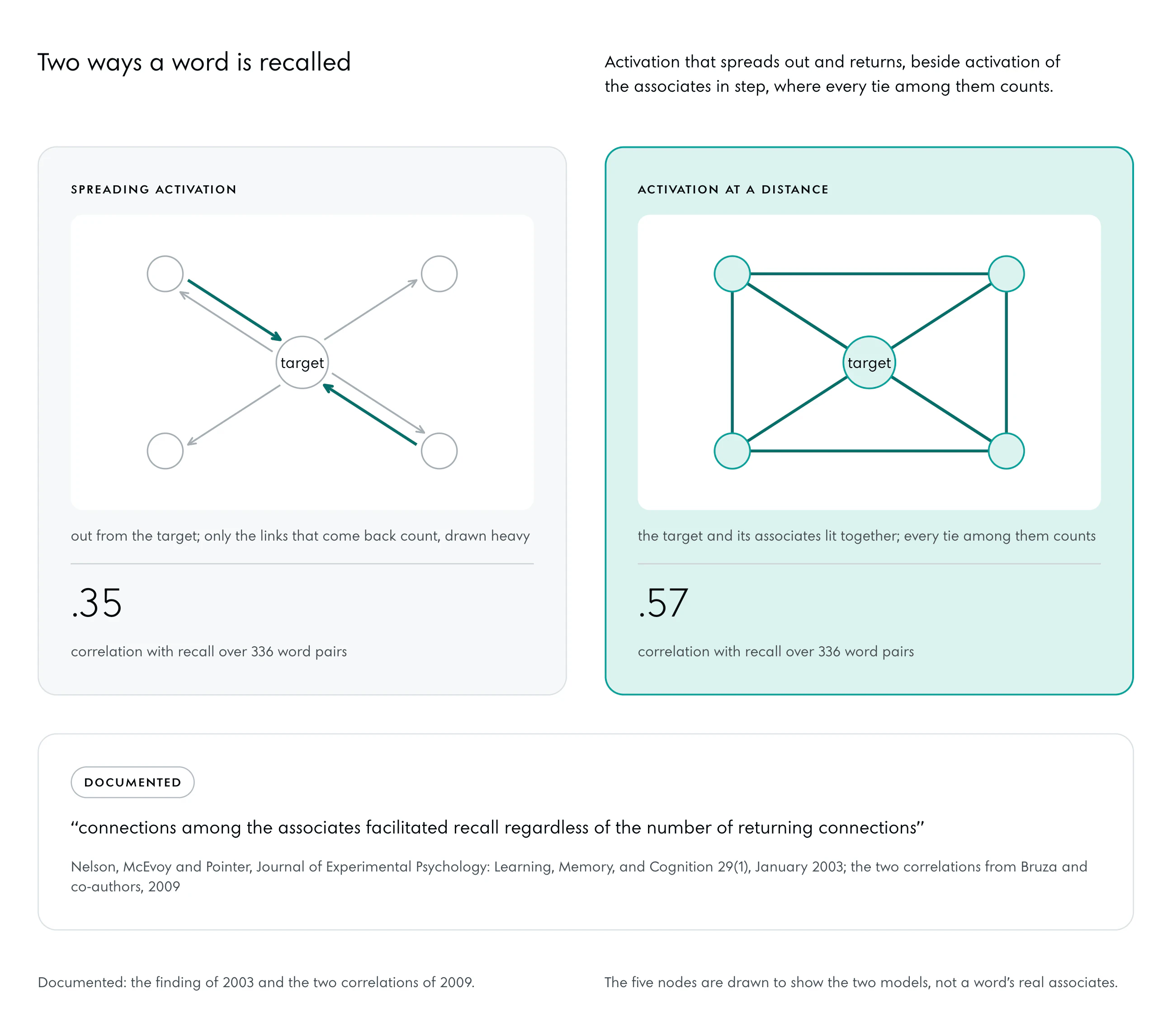
This finding is documented, in psychology, and it says plainly that how firmly a word is held depends also on ties that never touch the word, the ties its associates have to one another.
Quantum Formalism Applied to Words
By 2009 the borrowing had gone from a phrase to the mathematics. The 2003 study had taken its title from a physicists’ phrase; the 2009 paper took the equations. Its stated aim is wide, “In this paper quantum theory is proposed as a framework suitable for modelling the human mental lexicon”, and its fifth section, titled “Entangling words and meaning”, carries the physicists’ criterion over to words.
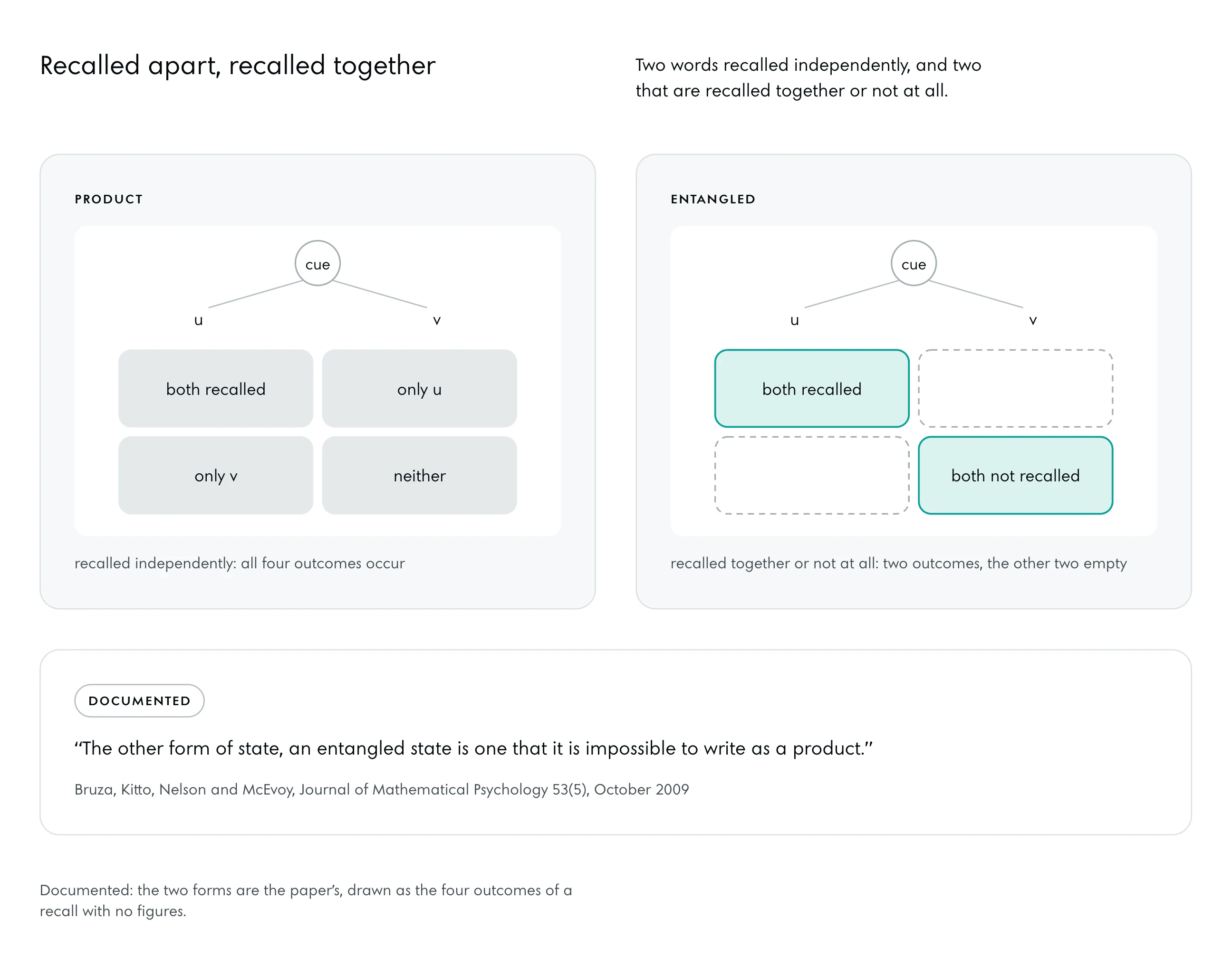
Two words recalled independently of each other have a joint state that is a product. Then comes the other case, “The other form of state, an entangled state is one that it is impossible to write as a product.” In the paper’s example, for a given cue, two words are “either both recalled, or both not recalled”.
On the standing of all this the authors are careful. They describe the distance rule as “an ad hoc model owing its origins to a quantum metaphor”, and in a companion paper submitted on 27 January 2009 they report that “a quantum model of word entanglement can recover aspects of both the Spreading Activation equation and the Spooky-activation-at-a-distance equation”. Their title asks whether there is something quantum-like about the lexicon, and the word like carries the weight.
Entangled states serve them as a modelling language for association, at least in these two papers, and no more is claimed here.
Aerts and Sozzo took the same step for concepts. Their paper was submitted on 7 April 2011. It holds that “a further relevant effect appears in a natural way whenever two or more concepts combine, namely, ‘entanglement’”, and reports an experiment with test subjects in which, by their analysis, Bell’s inequalities are violated.
But the following year Dzhafarov and Kujala set the limit on what such a result can mean. In behavioural data, they showed, “compliance of data with these inequalities is informative only if the data satisfy the requirement known as marginal selectivity”, which asks that the statistics of each response depend on its own factor alone. Where the inequality fails, the conclusion is an ordinary one, that “at least one of the two responses is influenced by both experimental factors”.
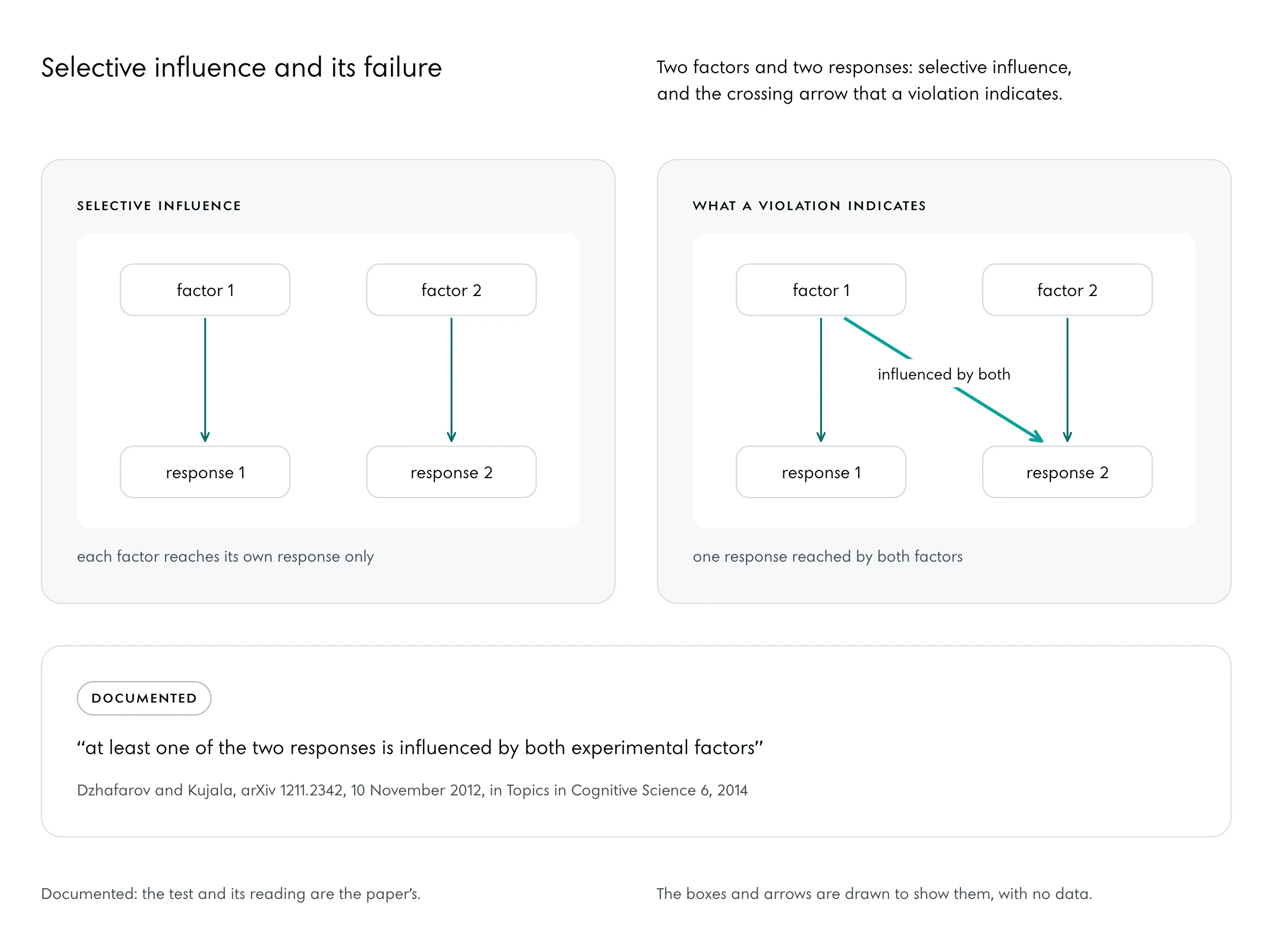
That limit is plainly the useful part. In psychology a Bell-type violation indicates cross-influence, a response shaped by both of two factors, which is a causal claim of the plainest kind. It is also the second borrowing of the term, restated for a system in which causes pass.
A relation shows when what is done on one side appears in the results of the other.
Entangled Factors in a Representation
Machine learning uses the same adjective with no physics in it. Bengio, Courville and Vincent, in a review of representation learning submitted on 24 June 2012, start from the point that “different representations can entangle and hide more or less the different explanatory factors of variation behind the data”. A factor is something that varies in the world independently of the rest, such as where an object stands or who is speaking.
Two factors are entangled in a representation when no coordinate, and no simple set of coordinates, moves with one of them alone.
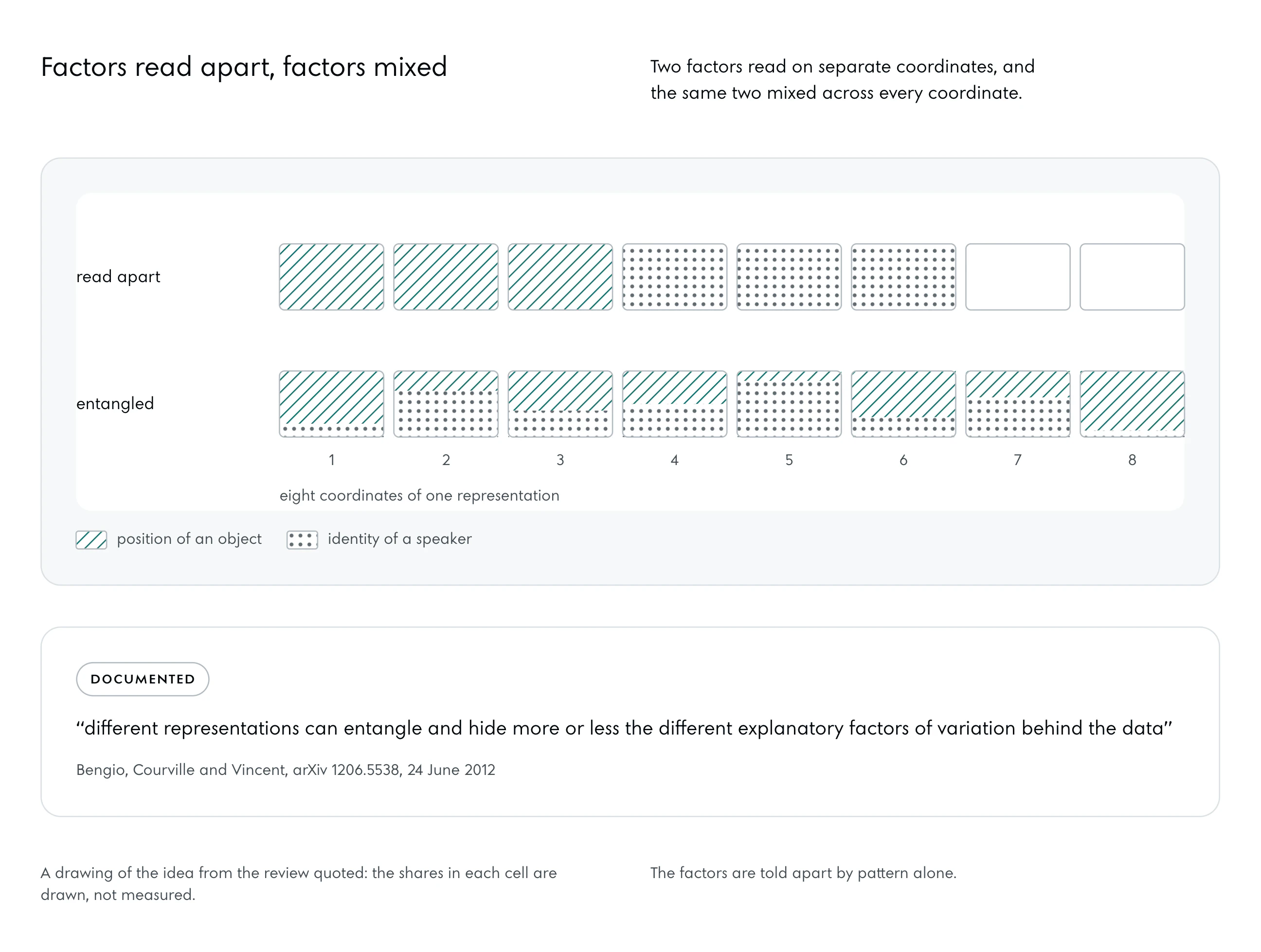
Its opposite became a research aim. Higgins and six co-authors, on 5 December 2018, describe that aim as “separating out (disentangling) the underlying structure of the world into disjoint parts of its representation” and concede in the same abstract that “there is no generally agreed-upon definition of disentangling”. Their proposal defines a separate factor by what can be done to it; it rests on transformations “that change only some properties of the underlying world state, while leaving all other properties invariant”.
A factor is separate when it can be changed alone.
Two results say how hard the aim is. Locatello and six co-authors trained more than 12,000 models and concluded, on 29 November 2018, that “the unsupervised learning of disentangled representations is fundamentally impossible without inductive biases on both the models and the data”. Elhage and fifteen co-authors, on 21 September 2022, showed why mixing is the default.
“Neural networks often pack many unrelated concepts into a single neuron”, they write, and a model with more features to store than dimensions to store them in keeps the extra ones in superposition, overlapped with others. So entangled is the normal state of a learned representation, and it is pulling the factors apart that takes work; both results are documented.
One paper already joins the two words of the term. Loghmani, on 20 April 2026, writes of retrieval systems that “standard vectorization produces embedding spaces in which semantically distinct content occupies overlapping neighborhoods. We term this condition semantic entanglement.” He defines an index for it and a four-stage method that restructures documents before they are embedded.
On a knowledge base of over 2,000 documents the mean index fell from 0.71 to 0.14, and retrieval precision rose from about 32 % to about 82 %.
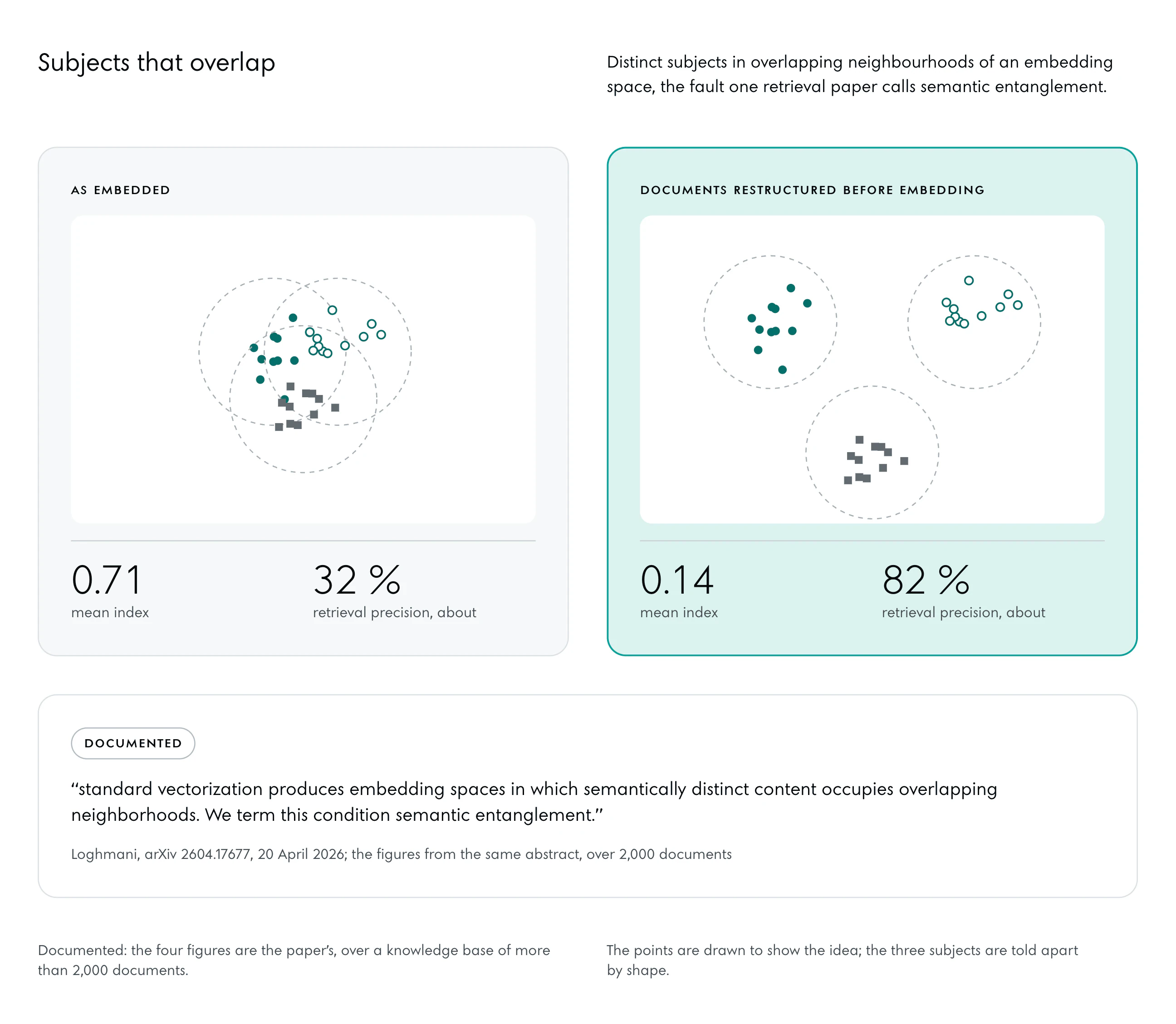
His is the phrase in retrieval, and the two senses differ. In that paper semantic entanglement is a fault inside one knowledge base, measured in order to be removed. The term, in the sense defined here, takes that state as given for everything published under one name, and asks which ties to build and which to keep apart.
Attributes Gathered at a Name
Distributional semantics is traced to two linguists, Firth and Zellig Harris, who are usually cited together. Brunila and LaViolette went back to both in a study submitted on 16 May 2022 and found “two distinct and in many ways divergent theories of meaning”. One, in their words, “focuses exclusively on the internal workings of linguistic forms”.
Firth’s is the wider, and it sets words “in a broader cultural and situational context”.
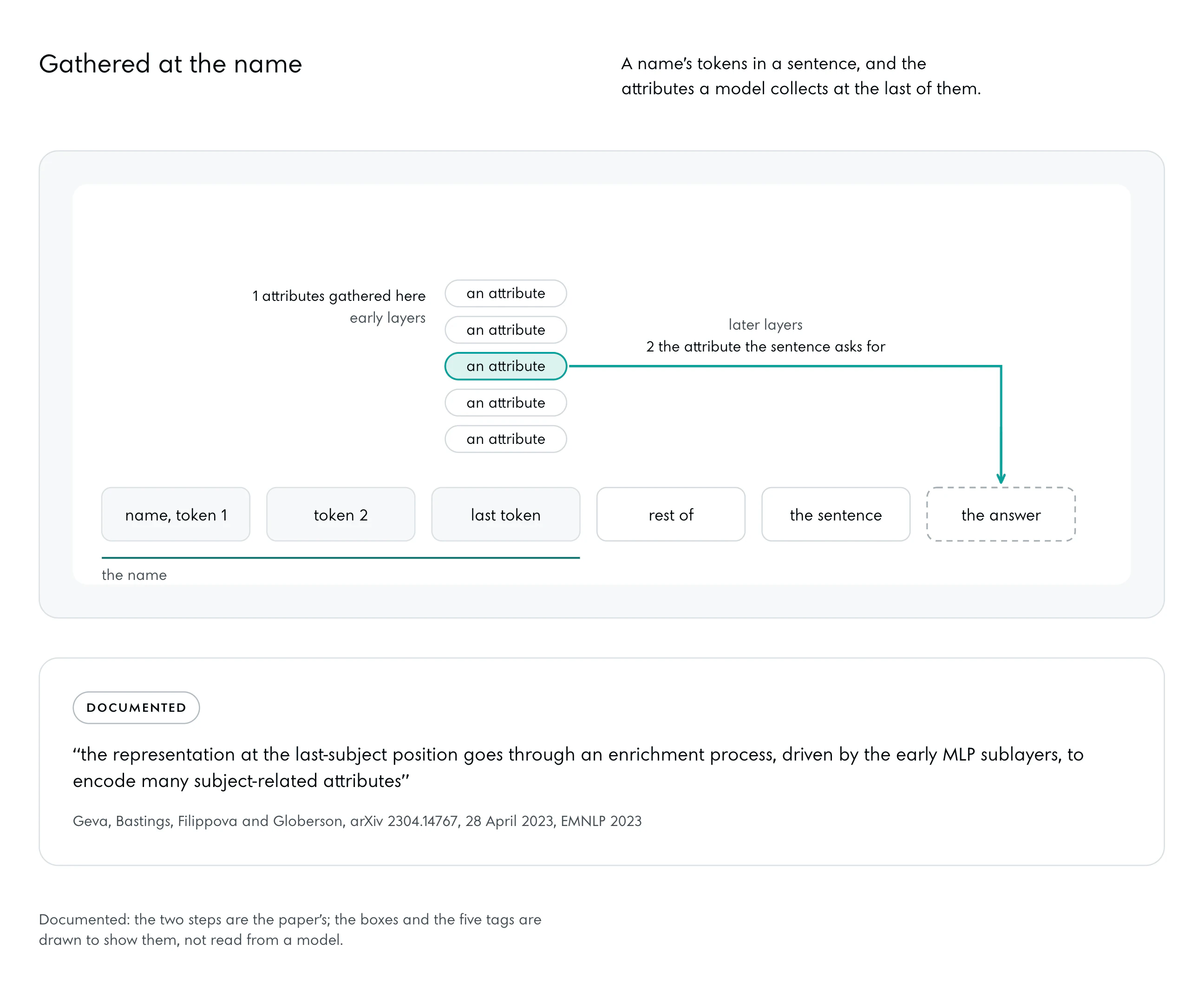
How a vector for a word is learned from its contexts belongs to the first paper. Work on language models since then has located where, inside a model, the contexts of a name are collected. Geva, Bastings, Filippova and Globerson, on 28 April 2023, traced how a model completes a fact about a subject and found that “the representation at the last-subject position goes through an enrichment process, driven by the early MLP sublayers, to encode many subject-related attributes”.
On meeting a name, the model first gathers what it holds about the thing named, at the name’s last token. Only then does it pick out the attribute the sentence asks for.
Those attributes are tied to one another. Cohen and four co-authors, on 24 July 2023, edited single facts inside models and then checked the facts that depend on them. One injected fact brings a ripple, they write, “in the form of additional facts that the model needs to update”.
Over a benchmark of five thousand edits they report that “current methods fail to introduce consistent changes in the model’s knowledge”.
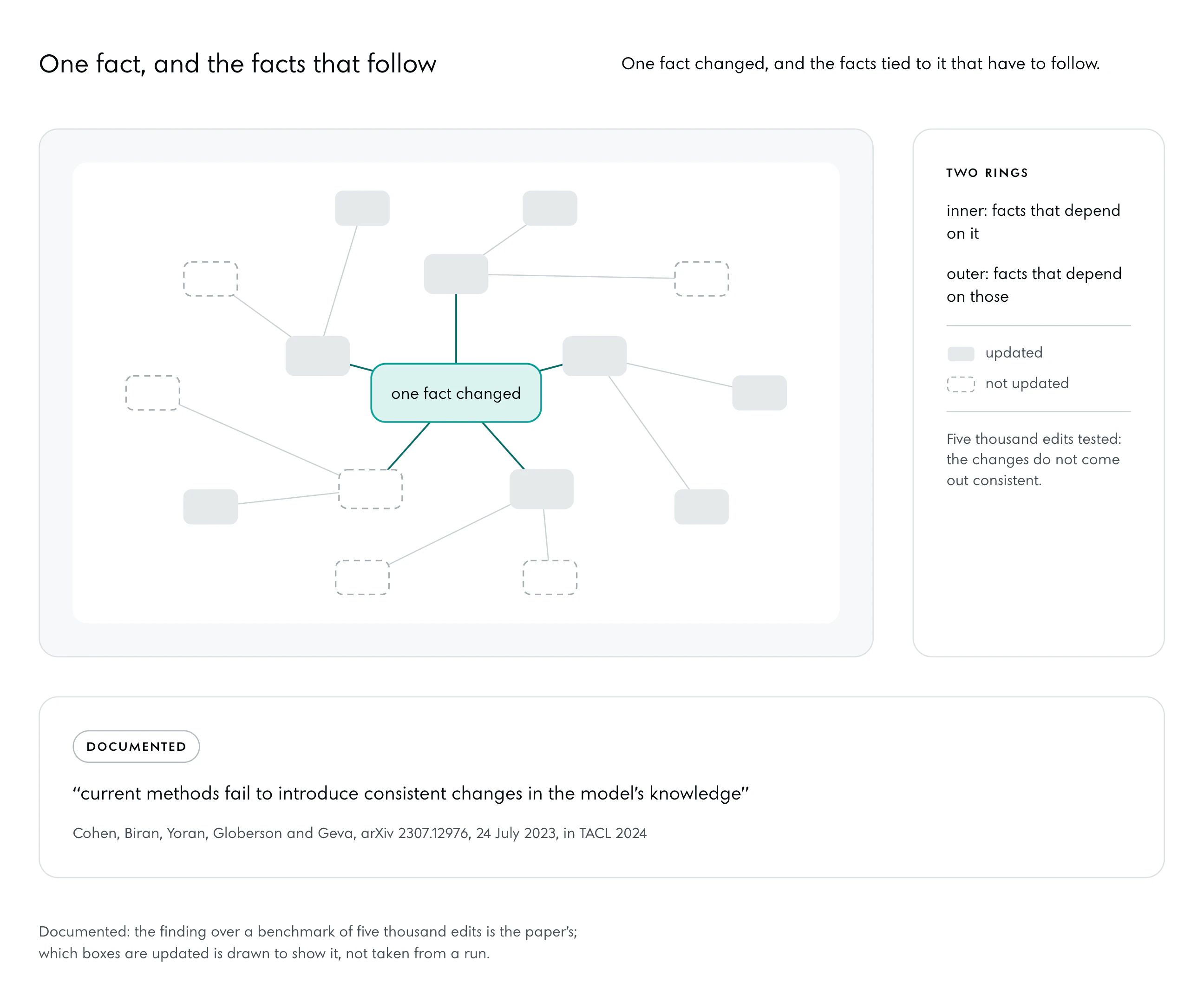
Taken together, the two studies describe a name in a model as a bundle. Its attributes are collected in one place and depend on one another, so that a fact which disagrees with the rest stays there unresolved.
As theory, we take the same to be true of a firm’s name in the models an engine uses. Its place is set by everything it has stood beside, on every property that carries it, and properties that describe the firm in different terms leave the model with attributes that do not agree. Both studies were made on open models, and so far no engine has published the equivalent for the models it serves.
The test is a fixed set of questions about the firm, put to the same assistants before and after its properties are brought to one account. If the answers agree with one another no more often afterwards, the theory fails for that firm.
The founder has one word for how firmly an old name holds its place, and the word is superposition, which he used in a narration of 14 October 2026. We take it in the sense of the models’ paper quoted above, where a model with more features than dimensions keeps the extra ones overlapped with others. Nothing of the physicists’ superposition is taken; the part on physics left their formalism where it was, and Table 1 says so.
In the models’ sense a name that has been met for years, on many properties and in much that others wrote, has its attributes gathered at one place, tied to one another and packed in among a great many other features, so that one new text reaches only a small part of what a model holds about it. The study of edits gives the documented half, since the methods it tested changed one fact and failed to carry the change through to the facts tied to it. That an established name is very hard to move for this reason is theory.
Its test is the turned-round one in the part on ground a firm does not host, where a firm that is widely written about has a few new stories set against it.
04Gravity and Its Gradient
Three sizes of text have now been set out in this set of papers. There are the uses of one term and the pages of one site, and there are now the properties under one name.
At each size the text stands as points in the space where an engine places what it reads, and at each the points lie thick in some places and thin in others. Where they lie thick, more of what an engine fetches comes from that place, and more of what a model holds; we call that a pull, and it has a slope.
Semantic Gravity Gradient is a term Noo–Studio coined in October 2026, and one sentence defines it: “The slope of the pull towards a centre of meaning in the space where engines place text: it is set by terms written one way, shaped by the terms around them, and read twice, as the descent of tokens towards that centre and, in its mirror, as the ascent of a position in search.”
All of it is theory, the studio’s way to read ground that the three papers cover, and so far nothing has been measured under that name.
What a Gradiometer Measures
Newton gave the pull between two bodies its rule in 1687, and a tutorial on tides by the National Oceanic and Atmospheric Administration of the United States gives it in the usual form, as an attraction that is “inversely proportional to the square of the distance between the bodies”. A field is that rule read at every point of space at once, the pull that a small body would feel there, summed over every mass that is present.
The gradient is a second quantity, and it says how much the pull differs between two points that lie close, for each unit of the space between them. An instrument built to measure just that sat at the centre of the GOCE satellite of the European Space Agency. In the agency’s words, “the gradiometer contains three pairs of proof masses positioned at the outer ends of three 50 cm long orthogonal axes”, and the two masses of a pair feel the Earth’s pull a little differently because they sit in different places.
“The difference in acceleration for each pair, scaled with the length of the connecting arm, called the gravity gradient, is used for gravity field analysis.”
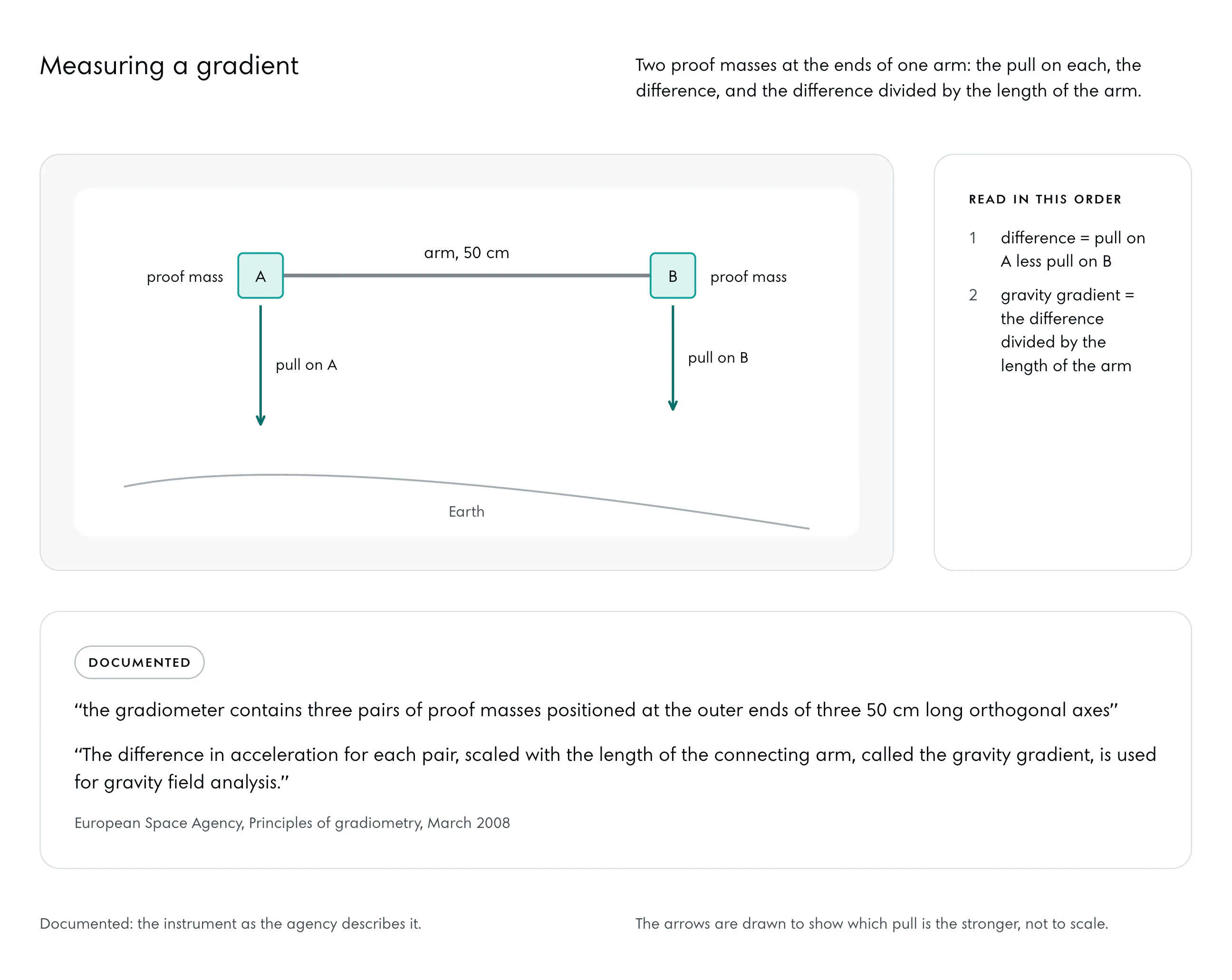
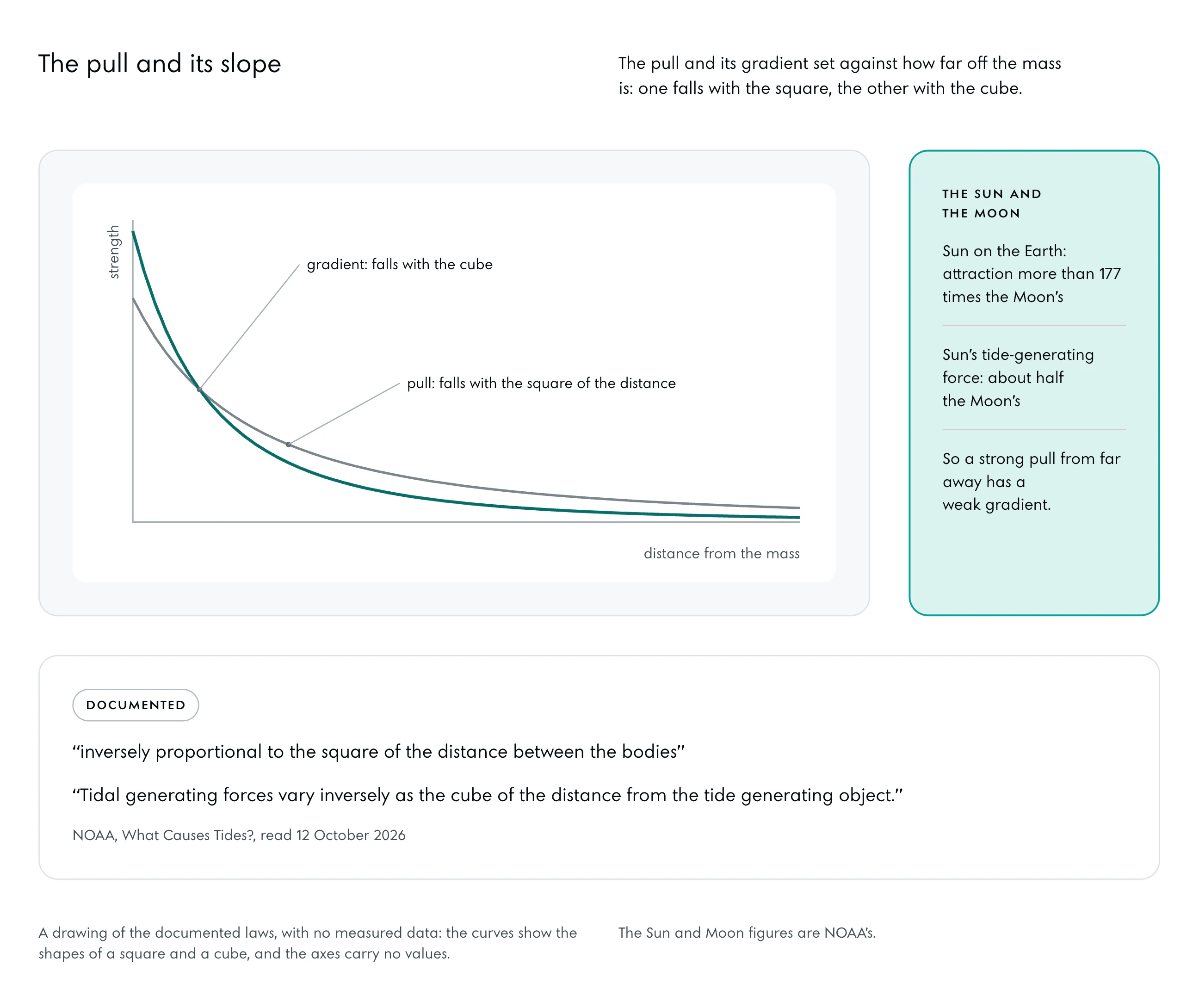
Tides are the same quantity at the size of a planet. The side of the Earth that faces the moon is pulled harder than the far side, and the sea shows the difference. Here the rule changes its power, for on the same page “Tidal generating forces vary inversely as the cube of the distance from the tide generating object.” So the pull falls with the square of the distance and its gradient with the cube, and near a mass the gradient climbs faster than the pull does.
The sun shows what follows from that, since its attraction on the Earth is, by NOAA’s figures, more than 177 times the moon’s. Yet “the sun’s tide-generating force is about half that of the moon”.
A strong pull from far away has a weak gradient.
Einstein’s theory gave the gradient a deeper standing. A body in free fall feels no weight, so the pull can always be made to vanish, at one place, by falling with it. What can never be made to vanish is how the pull differs across a region.
Markus Pössel, in a text of 2005 for Einstein Online, calls what is left the intrinsic part of gravity, which “manifests itself in tidal forces, and is associated with a specific property of geometry: The curvature of spacetime.” All of this is documented; in the theory that took the place of Newton’s, then, the gradient is the part of gravity that no choice of observer can remove.
Why the Membrane Is a Model
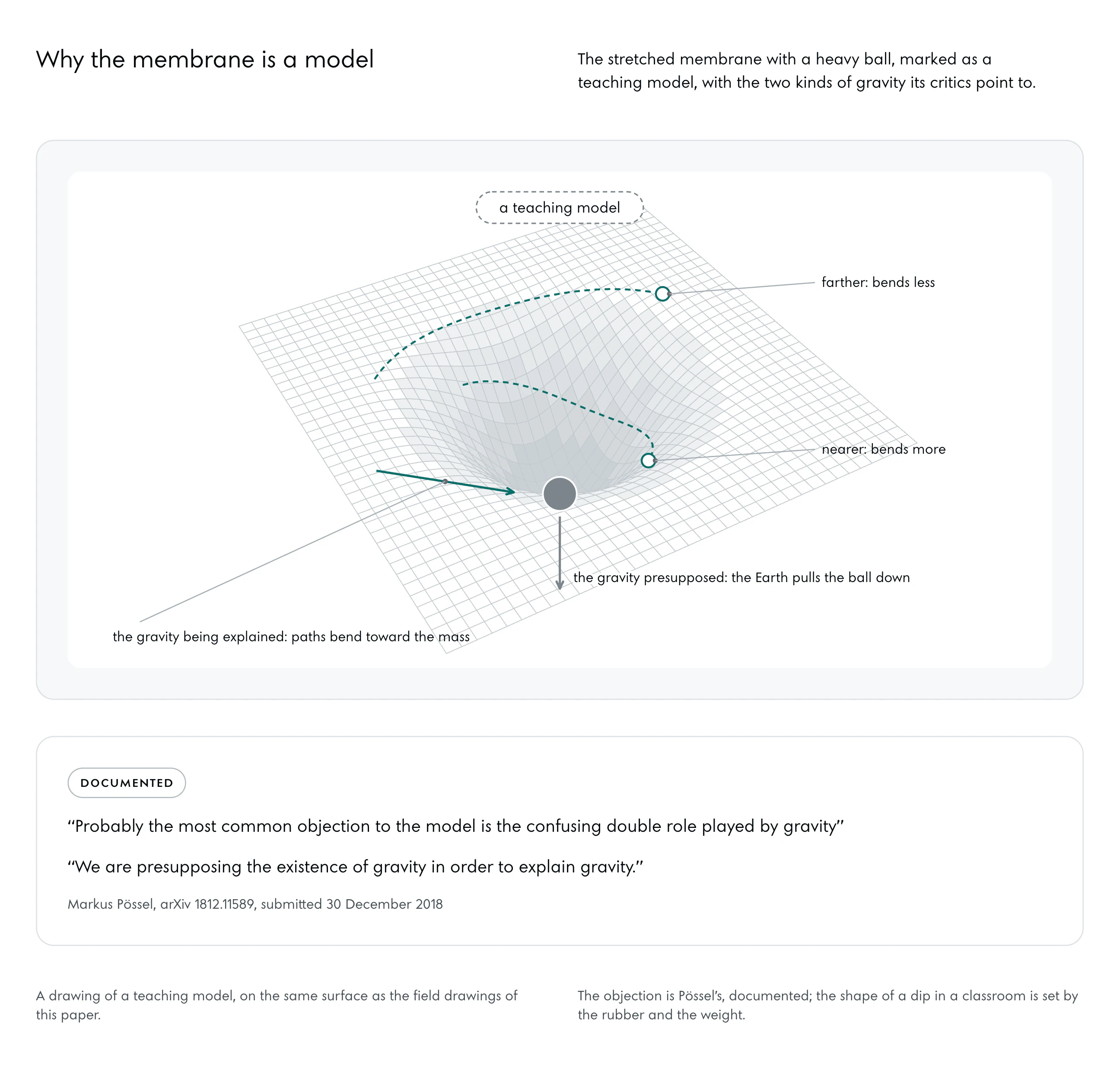
Curved spacetime cannot be drawn, so teachers often stretch an elastic surface, set a heavy ball in the middle and roll small balls past it. The small balls bend toward the dip and circle it, and they bend harder the closer they come. Pössel went through the models used to teach general relativity in a review submitted on 30 December 2018, and he gives this one its due before he gives its critics theirs.
“Probably the most common objection to the model is the confusing double role played by gravity”, he writes, since the heavy ball sinks only because the Earth pulls it down. “We are presupposing the existence of gravity in order to explain gravity.”
So the membrane is a picture even in physics. It shows clearly that paths bend toward a mass and bend harder near it, and it proves nothing. The shape of a dip in a classroom is set by the rubber and the weight.
On 12 October 2026 the founder sketched the same picture, a plane with a well in it, and his note on the shape guards against one way to misread it: “it’s not actually a cone because it has a curve”. A cone is as steep at the rim as at the tip, whereas in a well of this kind the steepness changes all the way down, and that change is the gradient.
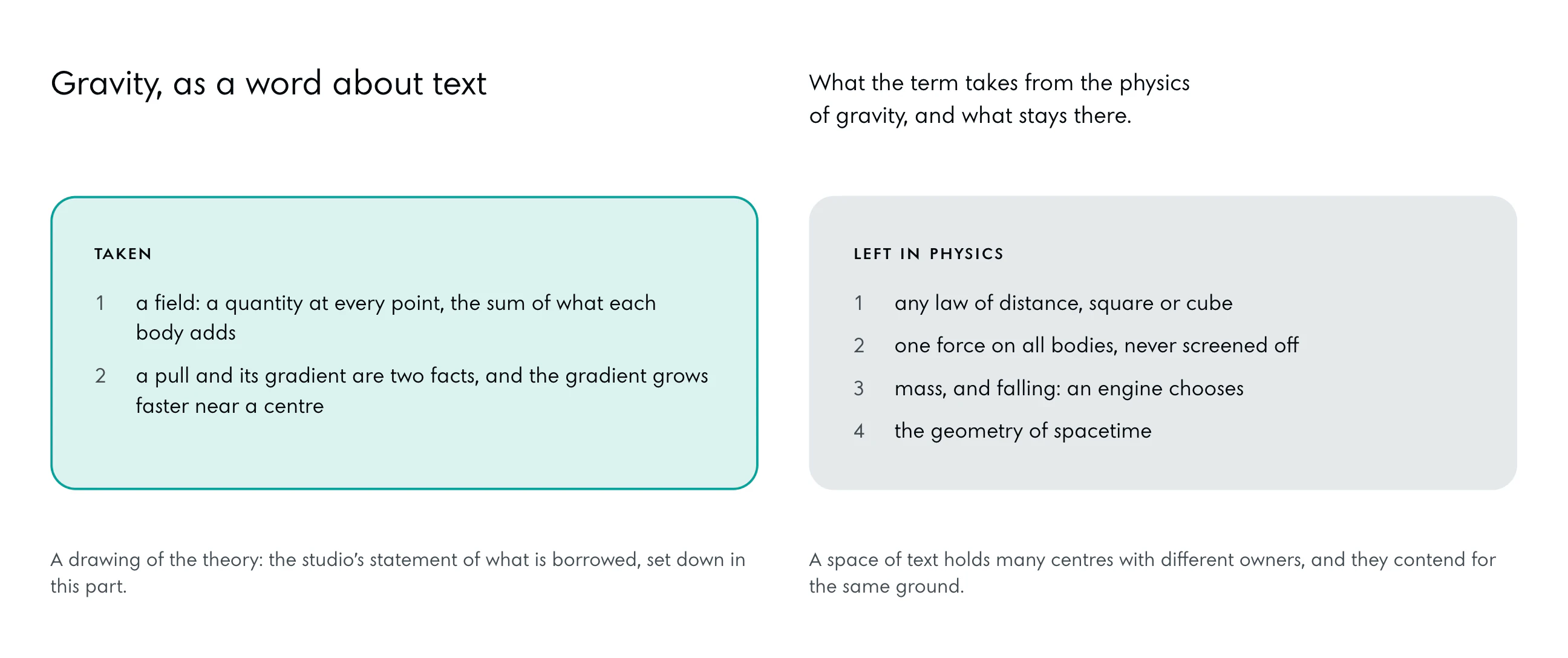
The term takes two things from this physics, as it did from the physics of entanglement. One is the field, a quantity that exists at every point and is the sum of what each body present adds to it. The other is the gap between a pull and its gradient; how strong the pull is and how fast it changes are two facts, and the second grows faster near a centre.
Everything else stays in physics, and first the law itself, since no law of distance is claimed for text, neither a square nor a cube. Gravity acts on all bodies alike and cannot be screened off, while a space of text holds many centres with different owners, and they contend for the same ground. Text has no mass and nothing falls; an engine chooses, and the pull is the pattern in what it chooses.
And the geometry of spacetime is left where it is.
Density, Its Slope, Its Peaks
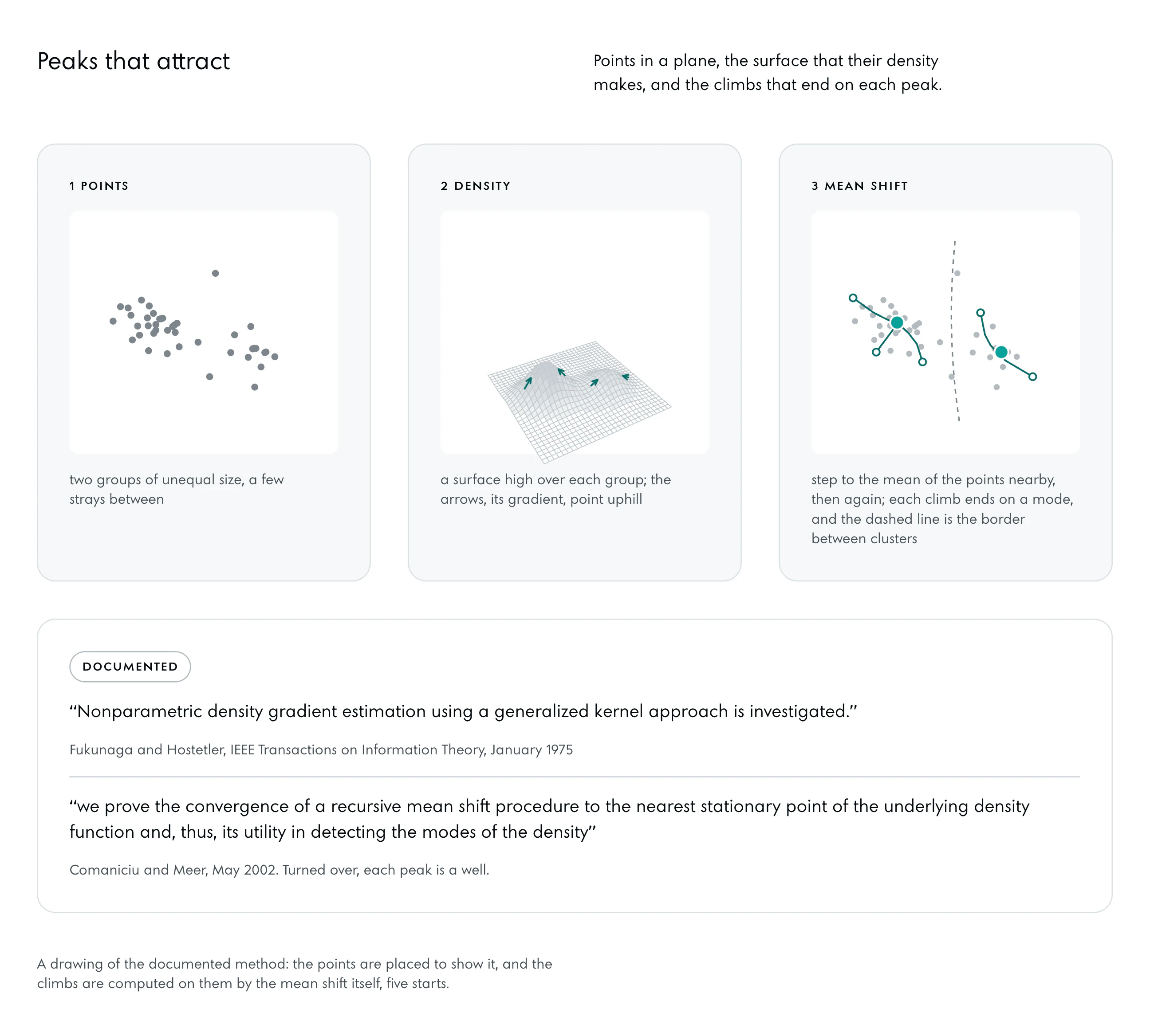
For points in a space the idea has had an exact form since 1975. A count of how thick the points lie round each place, once it is smoothed, gives a surface over the space, high where points crowd and low where they are few. That surface is a density, and like any surface it has a gradient, an arrow at each place that points the way the surface rises fastest.
Fukunaga and Hostetler opened the subject in the IEEE Transactions on Information Theory of January 1975, in a paper whose abstract begins, “Nonparametric density gradient estimation using a generalized kernel approach is investigated.” Their estimate of the arrow is the mean shift, the step from a place to the mean of the points round it, and they used it to sort points into groups. In May 2002 Comaniciu and Meer showed where such steps end when they are repeated, “we prove the convergence of a recursive mean shift procedure to the nearest stationary point of the underlying density function and, thus, its utility in detecting the modes of the density”, a mode being a peak of the surface. Carreira-Perpiñán, in a review submitted on 2 March 2015, draws the use of it for groups of points, “A natural way to characterize the cluster structure of a dataset is by finding regions containing a high density of data.” One climb is started from every point, and all the points that end on the same peak form one cluster.
So a peak that attracts is exact language here. Each peak fully owns the region of points that climb to it, and the borders between regions lie where the surface is lowest. Turned over, each peak is a well, and the two are one object with the sign changed.
Text is usually handled in this way today. BERTopic, which Grootendorst described on 11 March 2022, “generates document embedding with pre-trained transformer-based language models, clusters these embeddings” and then reads a topic off each cluster. In models that make images the gradient itself is the thing learned, and Song and Ermon, on 12 July 2019, introduced one whose “samples are produced via Langevin dynamics using gradients of the data distribution estimated with score matching”; we make no such claim for the models that write text.
One more result bears on search, for Radovanović, Nanopoulos and Ivanović, in the Journal of Machine Learning Research of 2010, counted for each point of a data set “the number of times a point appears among the k nearest neighbors of other points in a data set”. In spaces of many dimensions they found a few points, which they call hubs, that turn up far more often than the rest, and in real data, they add, “hubs tend to be closer than other points to their respective cluster centers”. A search by nearest neighbours, that is, hands back the points near a centre more often than the points at its edge.
Each of these results is documented, on data sets and on open models, and none of them, plainly, describes the index of a search engine.
Well Below, Mirror Above
Both faces of the field stand on one plane in the founder’s sketch. Below the plane is the dip that text makes. Every use of a term adds a point, and so does every page and every property that speaks of the subject.
Where they agree, the points pile up in one place and the dip goes deep. A drawing might show it darker where the pull is stronger.
Above the plane stands the same shape turned over, and its height is the place an engine gives a firm’s page in a ranking, highest over the centre and falling away toward the flat. At the centre is the firm’s most exact phrase, the longest one it has defined and used in one way, and shorter and looser queries lie further out.
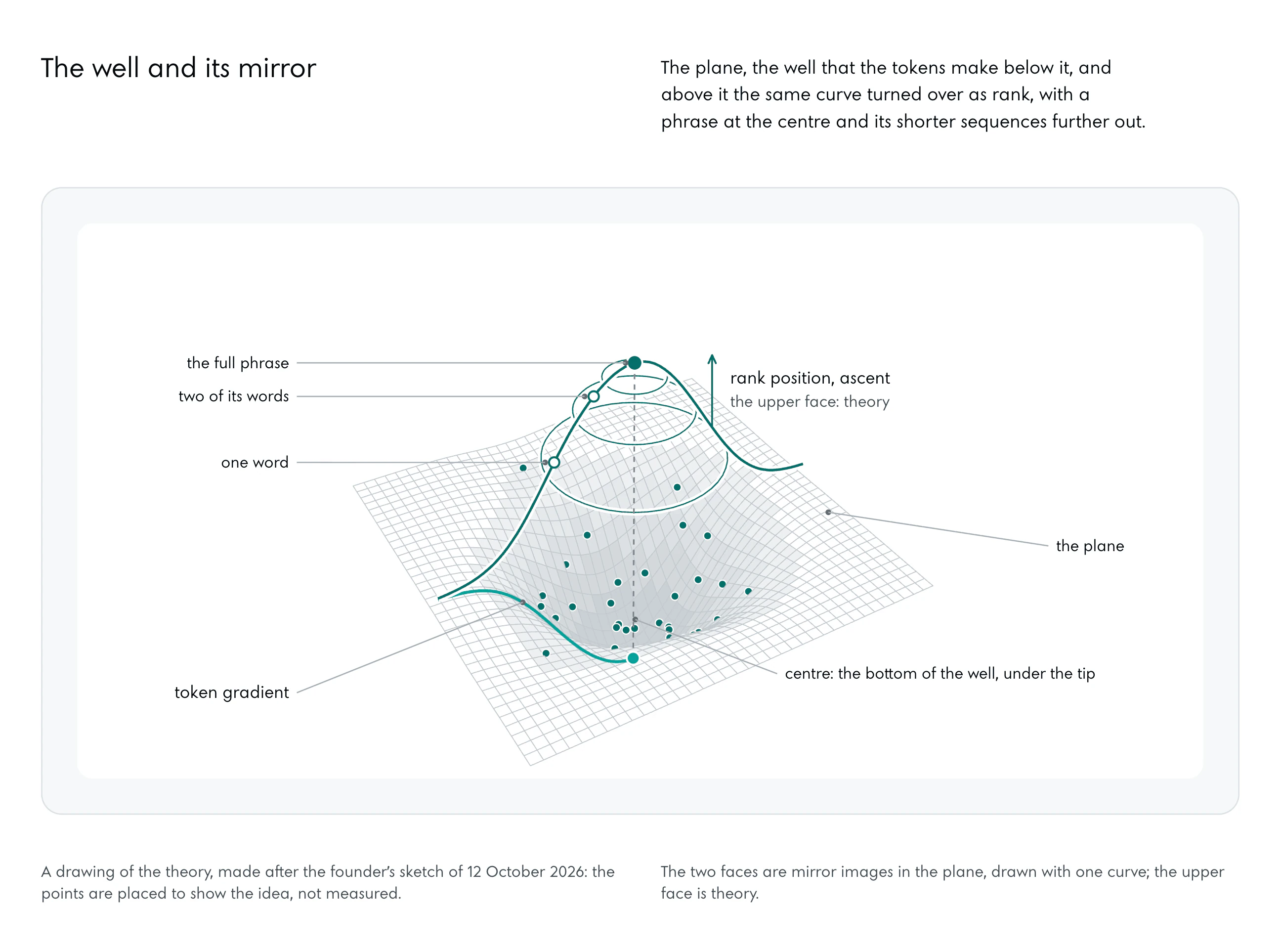
That the second face follows the first is theory, and it is entirely ours; no engine publishes such a rule, and nothing in it is a ranking factor. We hold that a firm ranks highest where its text is the largest share of all the text that lies in that place, and that its rank falls along a curve as a query moves out to ground that others hold.
The test is a phrase with its shorter sequences, and the three words of this paper’s title make a public case, since the studio set them side by side in October 2026 and found no earlier use of the three together. Inside them sit two pairs of words and three single words; one of the pairs has a prior use in retrieval research, which the part on words credits, and the single word entanglement has belonged to physics since 1935. So the full phrase stands where almost no other text stands, each pair where some does, and each single word where a great deal does.
On this theory a site that defines the phrase is found for the phrase first and for a single word last or never, with the pairs between. It fails if the single word comes with the phrase, or if the order pays no heed to how much other text holds each place. We claim no result here; the searches can be made by anyone, on dated days, and the answers kept.
The same curve accounts for a limit that practice keeps meeting, in which many pieces on a subject of four words fall short of the one word at its head. That word lies far out, near the flat, where the firm’s share of the text is usually small, whatever it has written on the four.
Sizes of One Field
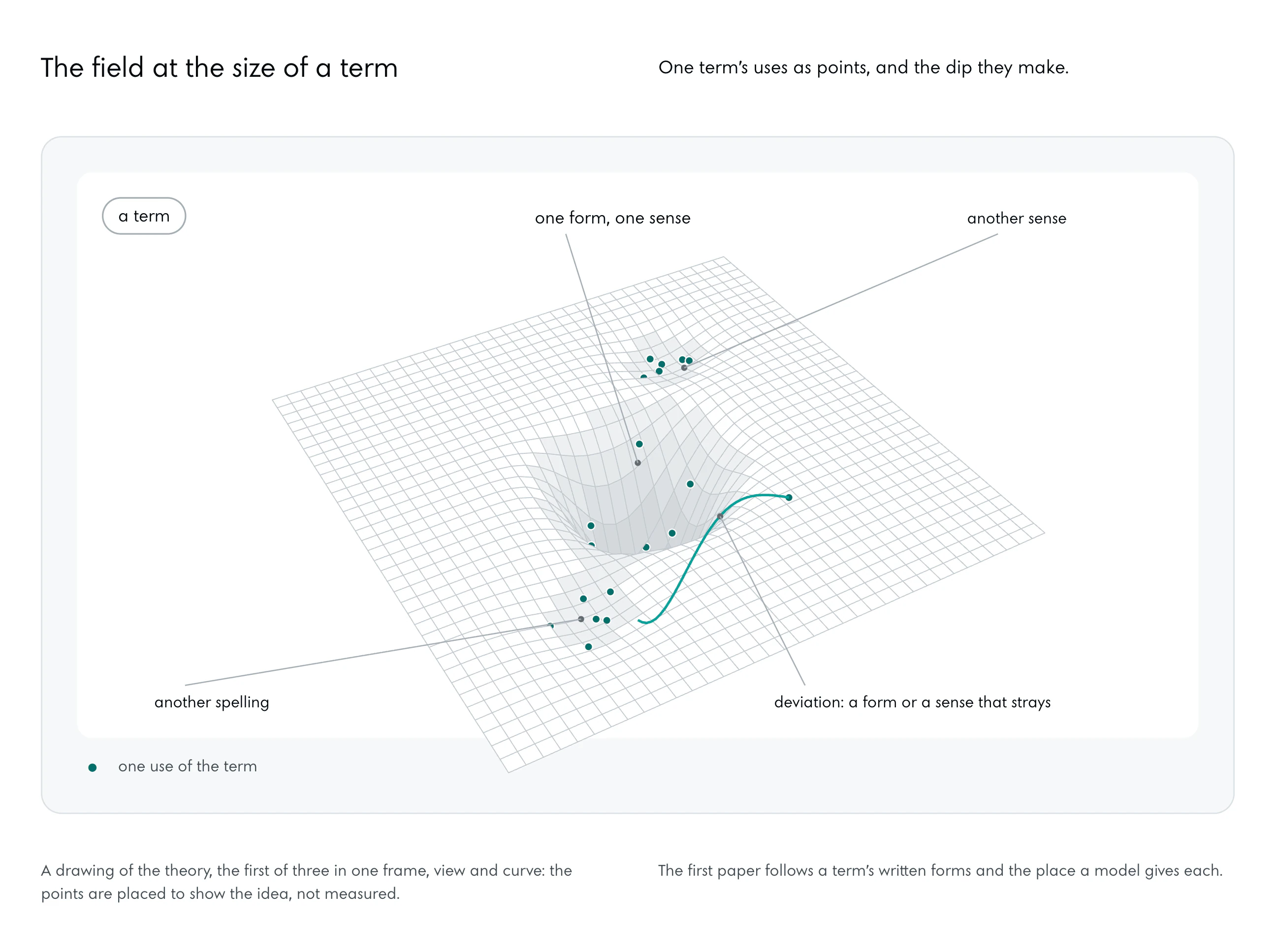
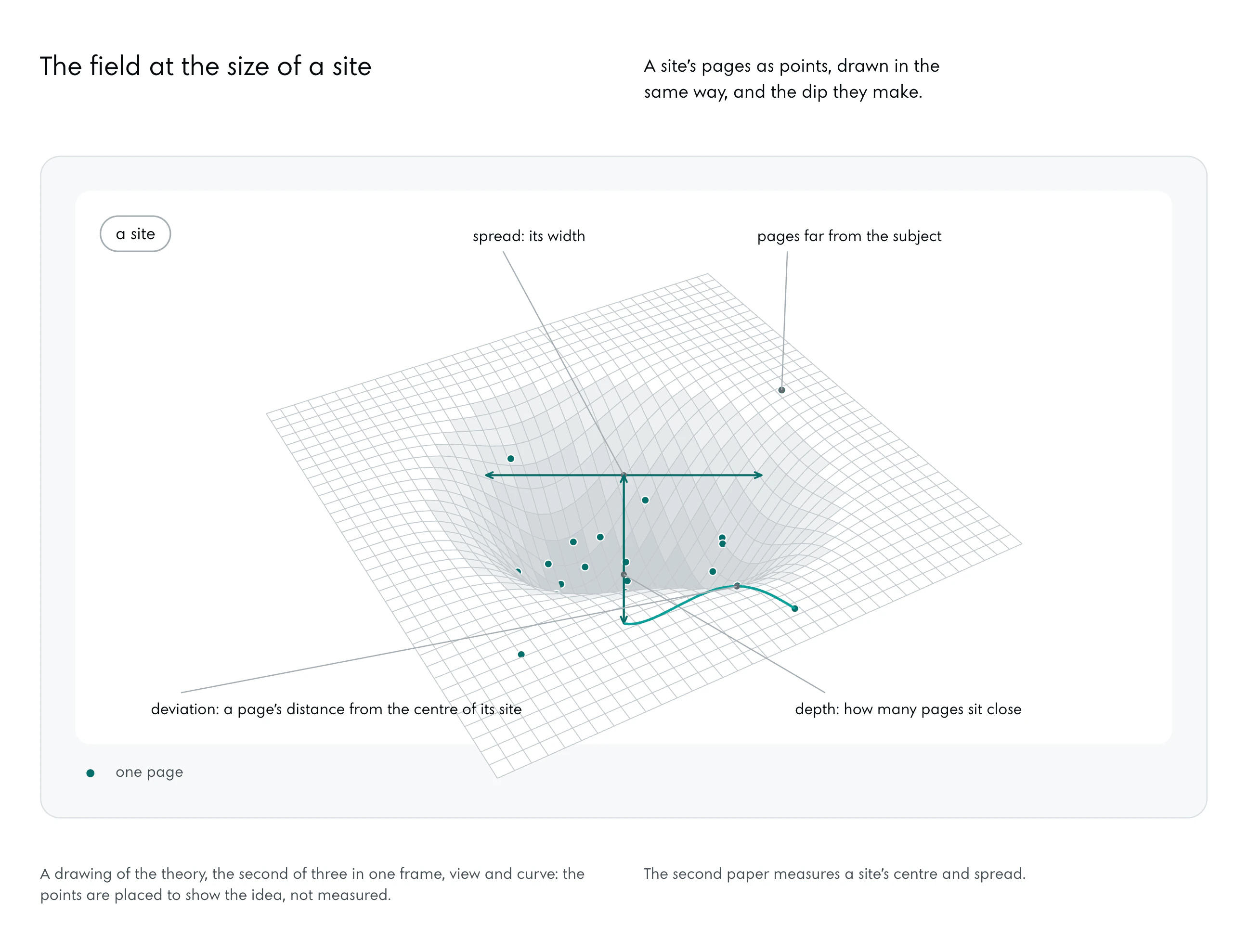
Nothing in the mathematics cares what a point stands for. It can be one use of a term, or it can be one page or one property, and the same surface can be drawn over each of them. Each paper of the set takes the gradient at its own size.
The first, Semantic Token Optimisation, does so in its part “The Gradient at the Size of a Term”, the second, Semantic Authority Mesh, in “The Gradient at the Size of a Site”, and this one takes the size of a name and sets the three side by side here, once. Read so, the three papers describe one gradient at three sizes, and they differ in what is measured, since each of them measures a deviation at its own size.
At the smallest size the points are the uses of one term. The first paper followed a term through its written forms and through the place a model gives each. Read as a field, uses in one form and one sense fall close and make a narrow, deep dip, while forms and senses that drift make several shallow ones.
At this size the deviation is a form or a sense that strays from the one fixed for the term.
A site’s pages are the points at the middle size, and the second paper gave a site a centre and a spread. In the field’s terms the spread is the width of the dip, and how many pages sit close is its depth. Pages far from the subject lie up the slope, where they add little.
So the deviation here is how far a page sits from the centre of its site, and the second paper sets out the two fields that the documentation leaked in 2024 stored for a site on just that.
Everything under one name makes up the points at the largest size, and here two forces meet. One is the inside, the text the firm writes on its sites, in its shop, on its profiles and in the messages it sends. The other is the outside, which is what others write about the firm.
What deviates at this size is a property, by its place among everything else under the name.
Each of the two forces makes a dip of its own.
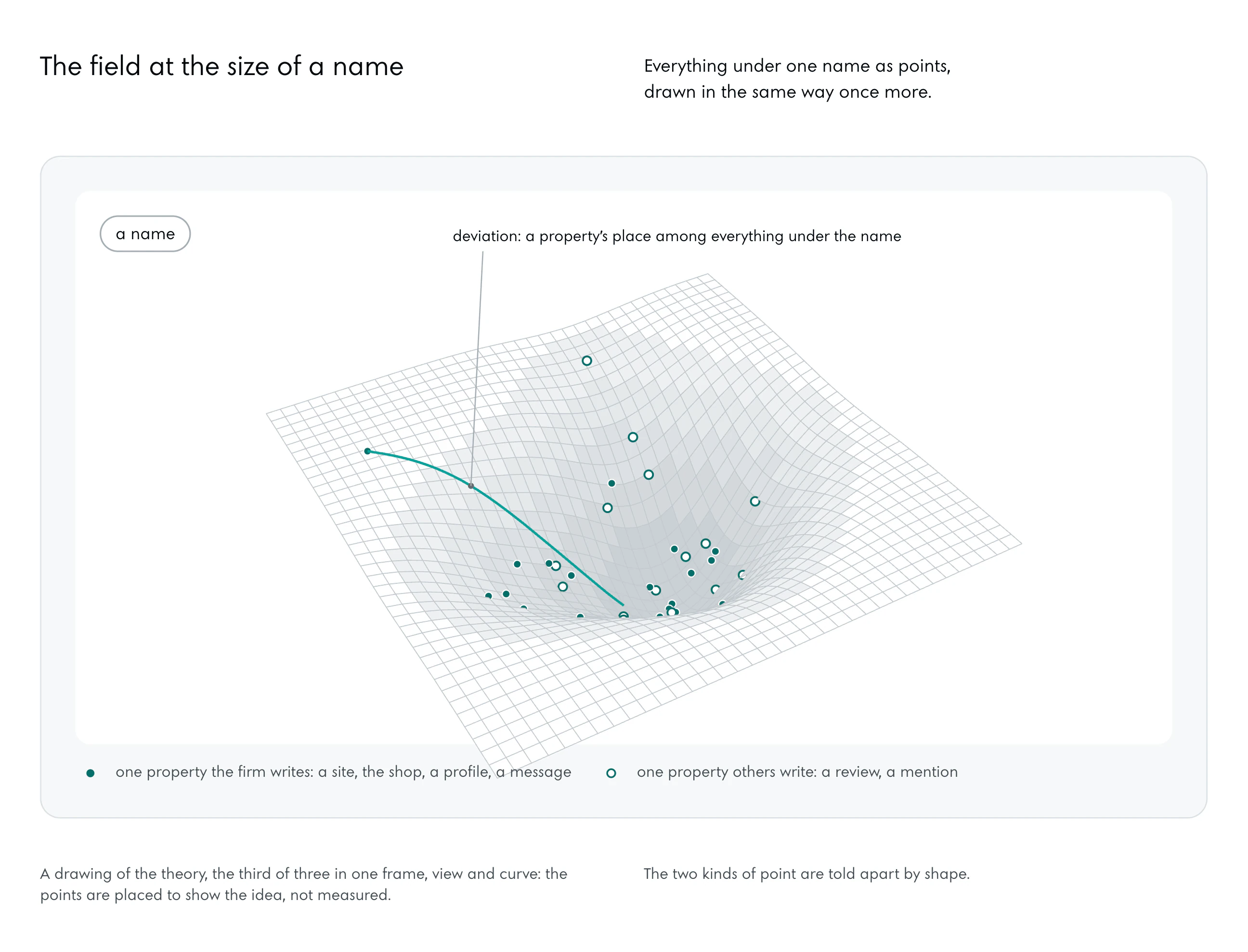
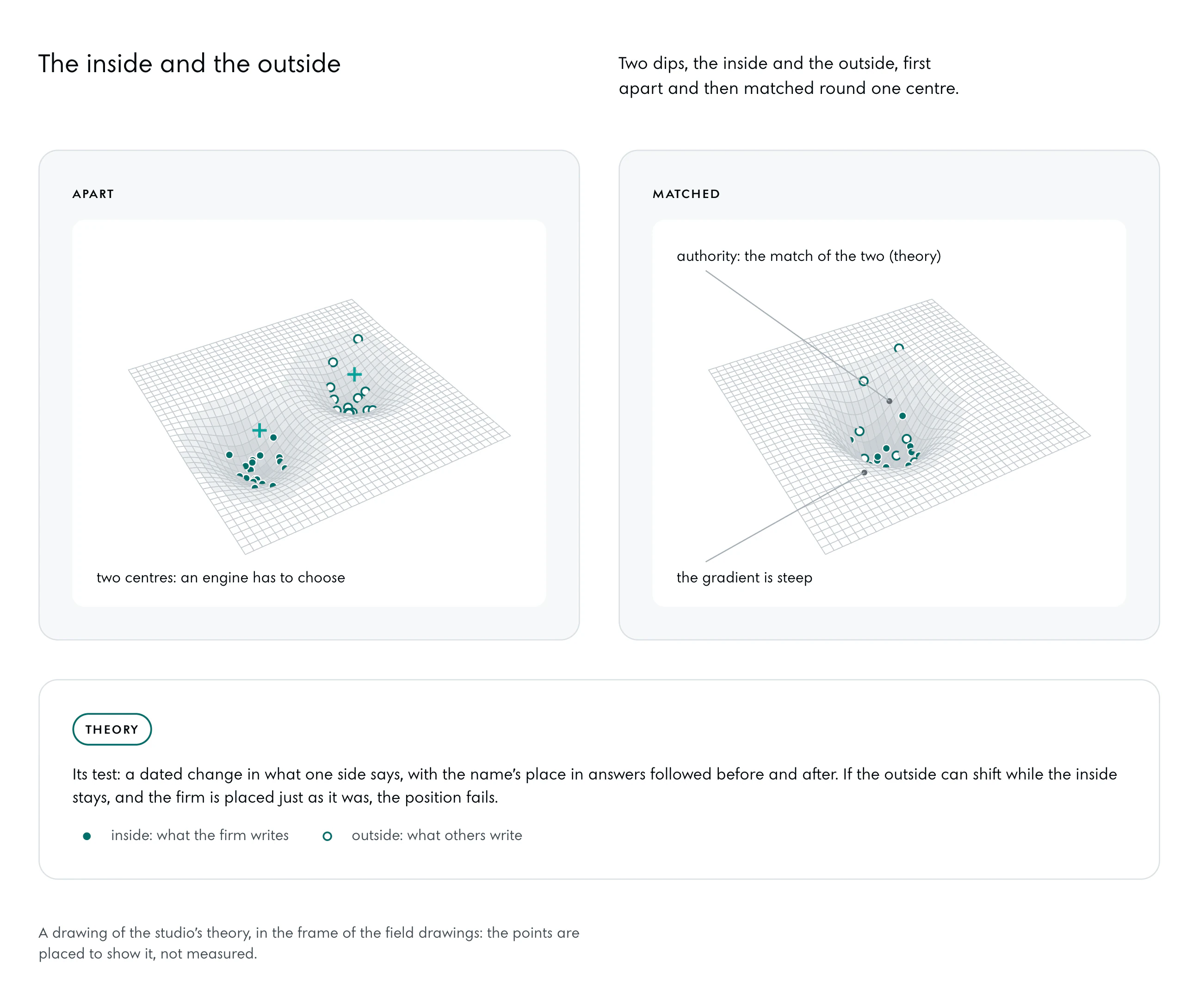
Our position is that authority is the match of the two, and we hold it as theory. Where the inside and the outside fall round one centre, the dips add and the gradient there is steep. If they fall apart, the name has two centres and an engine has to choose between them.
The test is a dated change in what one side says, with the name’s place in answers followed before and after. If the outside can shift while the inside stays, and the firm is placed just as it was, the position fails.
A zone of the space is where authority in this sense is read. There a site whose every page stands in the one zone can hold a steeper gradient than a large archive whose pages are spread over many fields, however much standing the archive has in sum. That too is theory, and it fails if, for queries inside the zone, the archive leads the small site wherever its links are the stronger.
Authority is the match between what a firm writes and what others write about it.
Semantic Entanglement Optimisation, the second expansion of the letters of search engine optimisation, is work on that match. It decides which properties to bring round one centre and which to keep well away from it.
Fixed Centre, Varied Surround
Writing a term one way settles where the dip is. The first paper measured what other written forms of one term cost, and nothing here changes that. Beyond the form lies the shape, how wide the dip is and toward which shorter queries its slope leans, and the first paper takes the shape at the size of a term in “The Gradient at the Size of a Term”; here it is followed over a page and over every property under a name.
That shape is set by the words that stand round the term, its shorter sequences and its neighbours in meaning.
Two documented facts stand behind this, and the first is that repeating one term gains less each time. A textbook by Manning, Raghavan and Schütze, published in 2008, says so in a line, “It seems unlikely that twenty occurrences of a term in a document truly carry twenty times the significance of a single occurrence.”, and adds that a common remedy is to score the logarithm of the count. The second is that an engine certainly reaches past the exact words, for Google’s account of how its results are generated speaks of “our sophisticated synonym system that allows us to find relevant documents even if they don’t contain the exact words you used”.
So the studio’s theory has two halves. In one form the primary term fixes the centre, and the words round it, which are varied on purpose over a page and over every property under the name, give the slope its reach. The founder’s phrase for the method is “semantics, not topics”; the structure follows meaning as a model places it, a term with its neighbours, and a list of topics is no guide to that.
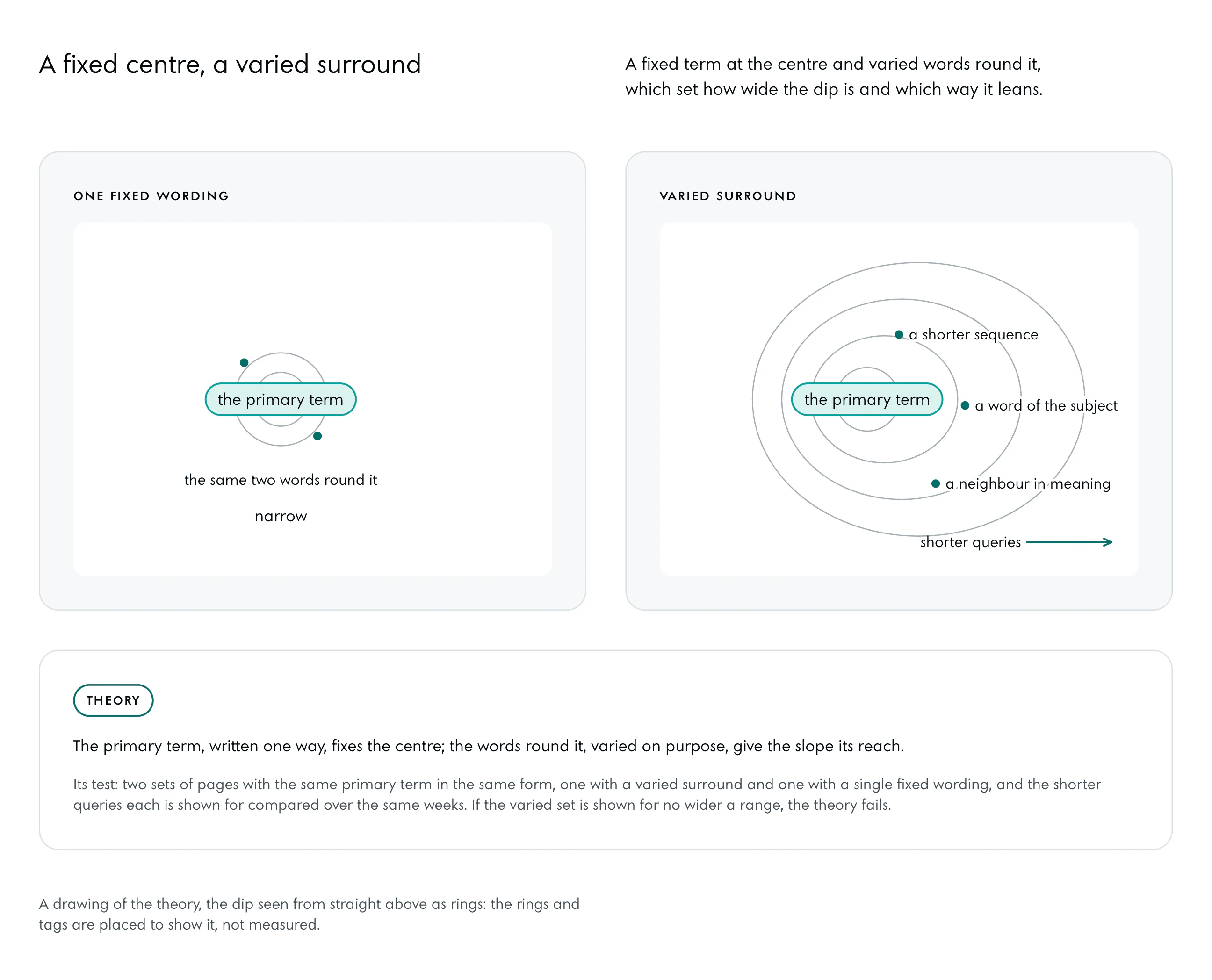
Its test takes two sets of pages that hold the same primary term in the same form. One set has a varied surround and the other a single fixed wording, and the shorter queries each is shown for are compared over the same weeks.
If the varied set is shown for no wider a range, the theory fails.
05Many Records, One Entity
Whether two pages speak of the same firm is a thing an engine has to decide. It decides before any text can count toward a name.
In the terms of the field, and as theory, text that is matched to one entity adds its points to one centre, while text that is held apart starts a small centre of its own. So we put the match ahead of everything else that a firm does under its name. The problem is clearly older than the web, and the engines now publish a good part of what they ask a firm to supply for it.
Strings Become Things
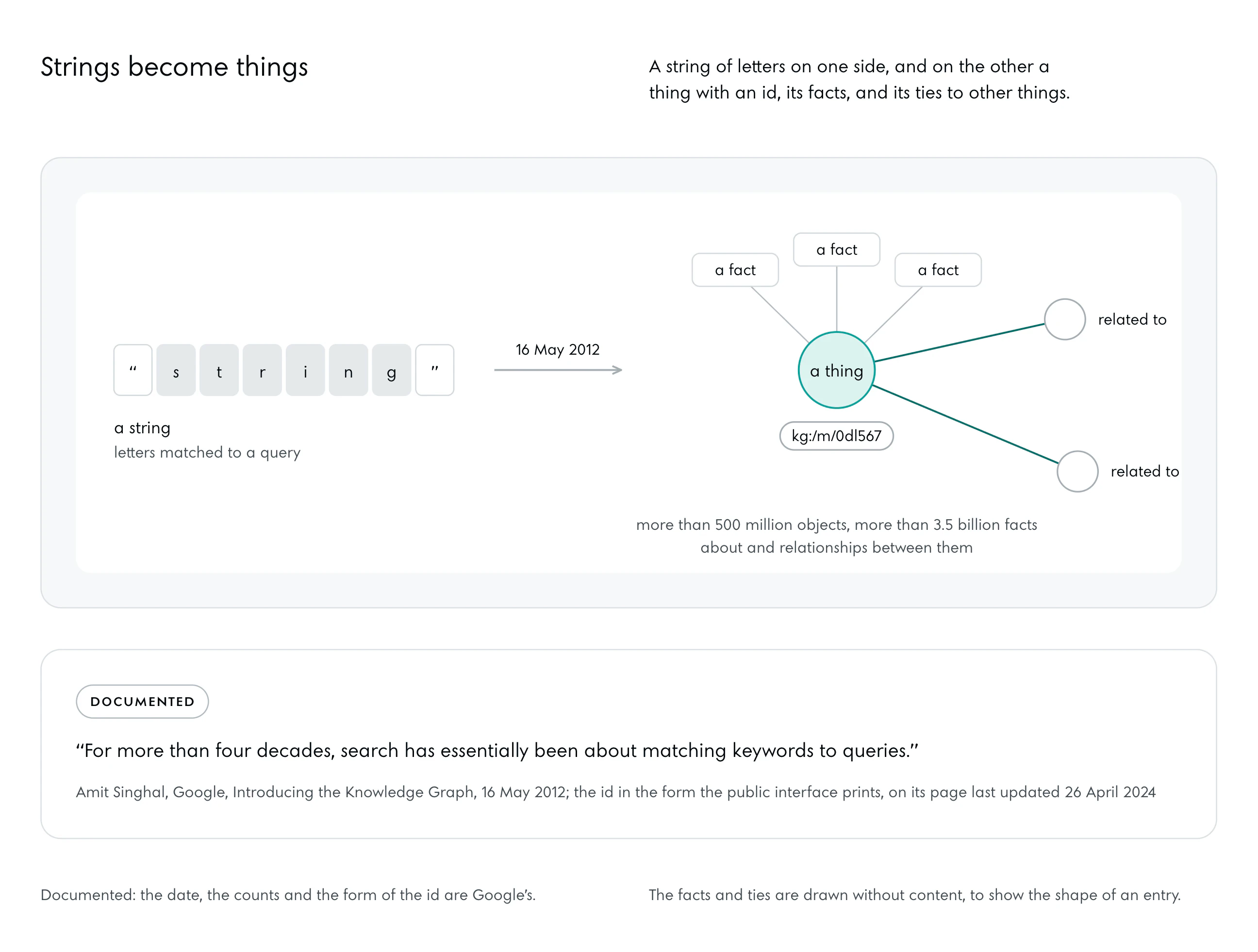
Google announced its Knowledge Graph on 16 May 2012; Amit Singhal signed the post. It starts from what search had been until then, “For more than four decades, search has essentially been about matching keywords to queries.” Then it counts the new store, which held “more than 500 million objects, as well as more than 3.5 billion facts about and relationships between these different objects”, and an object in that store has an id that is never a word. The public interface to the graph, on a page last updated on 26 April 2024, prints ids of the form kg:/m/0dl567 beside each name it hands back, which is how two things that share a name can be kept apart.
Two years on, Google’s researchers described how such a store is filled. Their Knowledge Vault, they wrote in 2014, “combines extractions from Web content (obtained via analysis of text, tabular data, page structure, and human annotations) with prior knowledge derived from existing knowledge repositories”. What comes out is a fact with a number on it that says how far it is believed.
Both lines are documented, the first as a product and the second as research.
Records That Name the Same Thing
Statisticians met the problem first, in files of people. A theory of it was in print by December 1969. Fellegi and Sunter set out in that month to treat the task of “recognizing those records in two files which represent identical persons, objects or events”.
Their model takes two entries and goes through them field by field, and for each field it notes whether the two agree; each pattern of yes and no is then weighed by how often it turns up among true pairs and how often among chance pairs. At the end the pair is always put in one of three classes, which are a link, a non-link, and a possible link that a person has to settle.
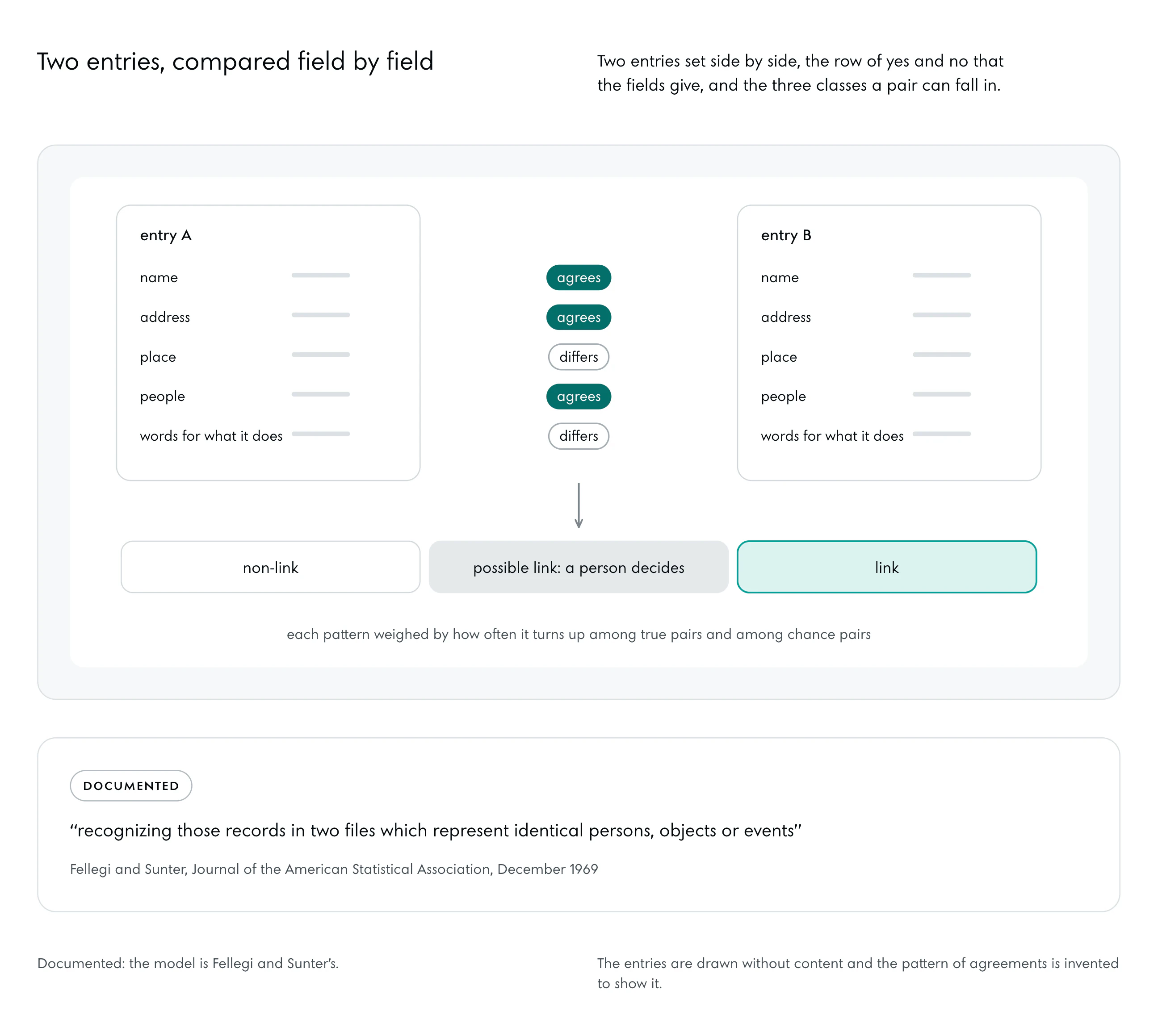
Current practice keeps the pair and changes the judge entirely. Li and four co-authors, on 1 April 2020, “cast EM as a sequence-pair classification problem”, where EM stands for entity matching. The two are written out as two pieces of text, and a language model that has read a great deal of other text says whether they match.
Two of their test sets were files of companies, one of 789 thousand rows and one of 412 thousand.
Every property under a firm’s name is a record of this kind. It has a name on it, an address, a place, some people, and the words in which the firm says what it does. In the model of 1969 a field that fails to agree lowers the weight of the pair.
That an engine weighs a firm’s properties in the same way is theory, and we claim no more for it. Its test is to bring one field into line on one property and to watch whether the engine’s own panel for the firm then takes that property in.
Mentions Linked to an Entity
Most of what is written about a firm sits in running text, where no field says whose name it is. Tying such a name to an entry in a store of entities is called entity linking. Cucerzan set the task out at scale in 2007, and the store that he used for it was Wikipedia.
Sevgili and four co-authors, in a survey submitted on 31 May 2020, give the steps that neural systems share as “candidate generation, mention-context encoding, and entity ranking”.
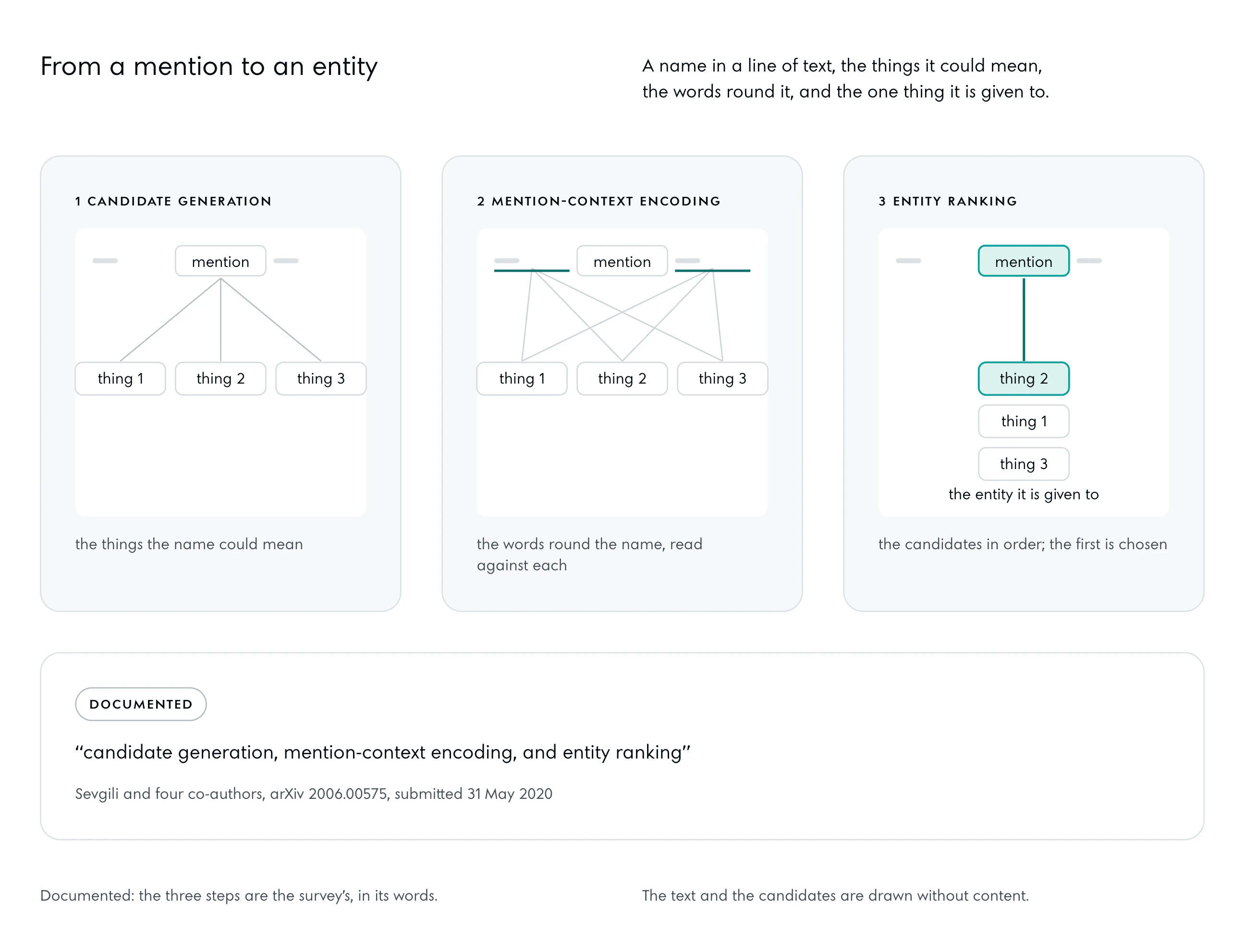
A system first lists the things a string could mean. It then reads the words round the name. Last it ranks the list against them.
The survey also treats what it calls “models for global linking”, in which all the names in one text are settled at once, so that each helps to fix the rest.
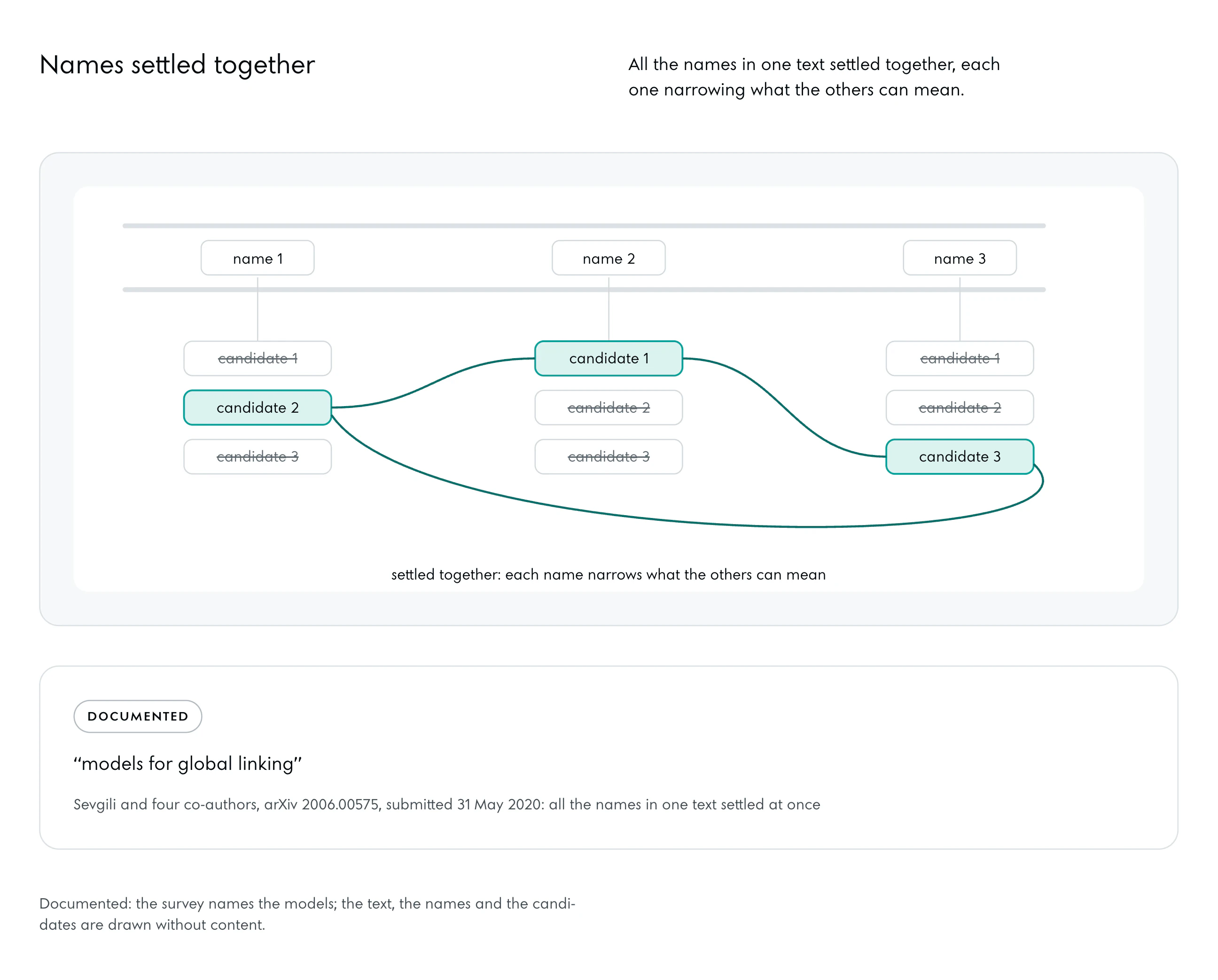
It follows that the words round a firm’s name decide which entity the name is given to, and that the other names in the same text help to settle it, as they do for any name at all. This is the first paper’s point about the company a string keeps, and here it does a second job.
Identity as the Engines Publish It
Site names are the plainest case that Google sets down. Its page on them, last updated on 10 December 2025, says, “Currently, Google Search only supports one site name per site, where a site is defined by the domain or subdomain.” The name is picked by a system that “takes into account content from a site’s home page and references to it that appear on the web”. So even the name shown beside a result is settled from the inside and from the outside at once.
The page on Organization markup, last updated on 8 September 2026, lists what a firm can declare about itself, and of the address of the site it says, “This helps Google uniquely identify your organization.” It adds that “Some properties are used behind the scenes” to tell one organization from the others, and it gives iso6523 and naics as examples, both of them numbers kept by registries. The shared vocabulary behind these pages is schema.org. It defines sameAs as the “URL of a reference Web page that unambiguously indicates the item’s identity.”
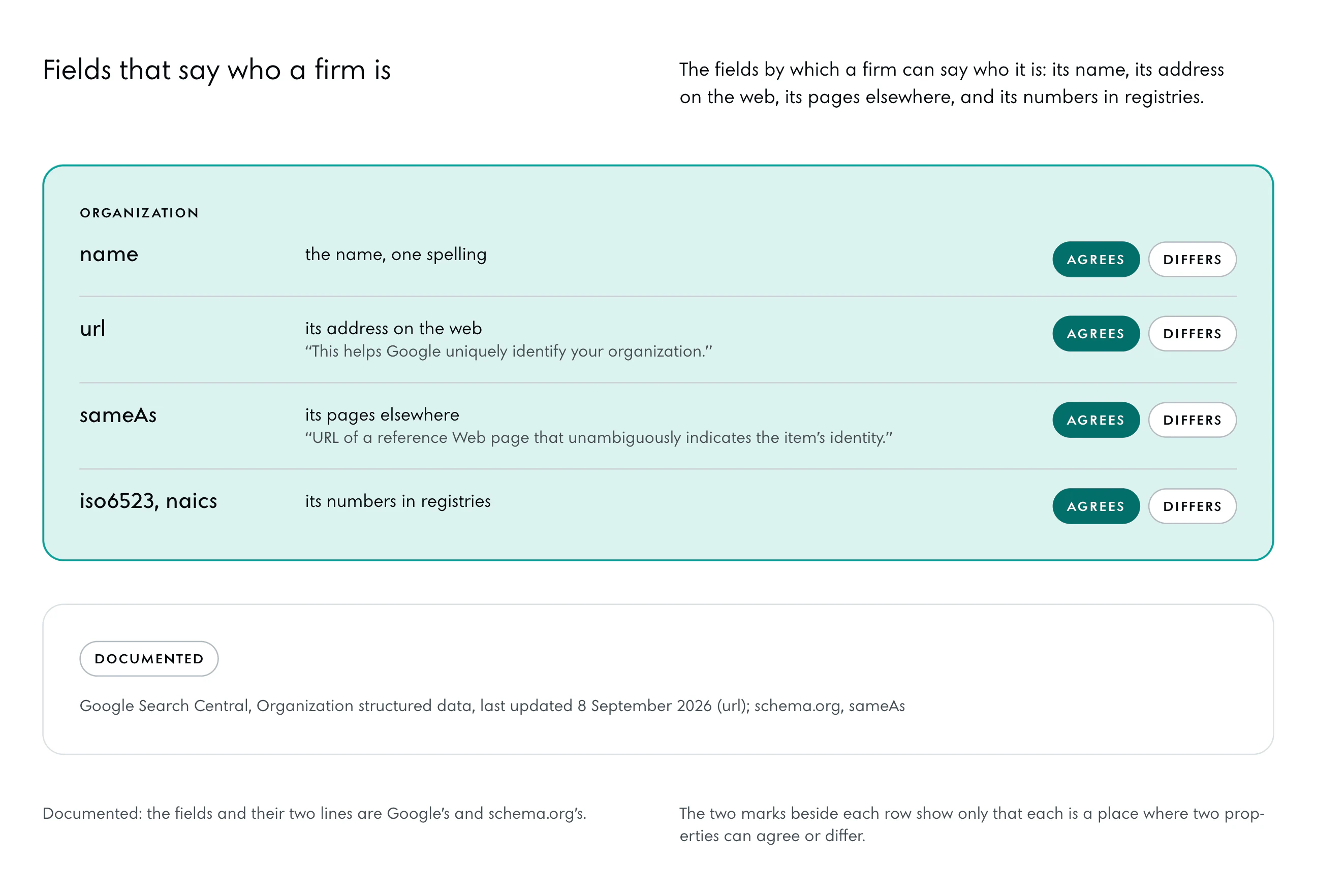
Each such field is a place where two properties can agree or can fail to. A firm that fills them in the same way on every property hands the engine a match that is nearly made.
06Properties and Who Controls Them
Under one name a firm writes in some places, fills in a frame in others, and is written about in the rest. The opening divided that ground into four classes by who holds the text.
Accounts are kept on the same test, for under IFRS 10 a parent and what it controls are presented “as those of a single economic entity”. Here each class gets the unit that a published standard already uses for it, and the four are then set against the two forces of the field.
Owned and Operated
Browsers and mail receivers already hold a rule for where one firm’s ground ends. It is the Public Suffix List. Mozilla began it and a community keeps it.
Its page gives the term a single line, “A “public suffix” is one under which Internet users can (or historically could) directly register names.” One label to the left of such a suffix makes the registrable domain, and all that stands further left is a subdomain of it. The list has a private section as well, and as it stood on 11 October 2026 that section carried the suffixes of platforms, among them myshopify.com, blogspot.com and github.io, so that a shop opened on a platform’s address is, by the list, a site apart from the firm’s domain and apart from every other shop there.
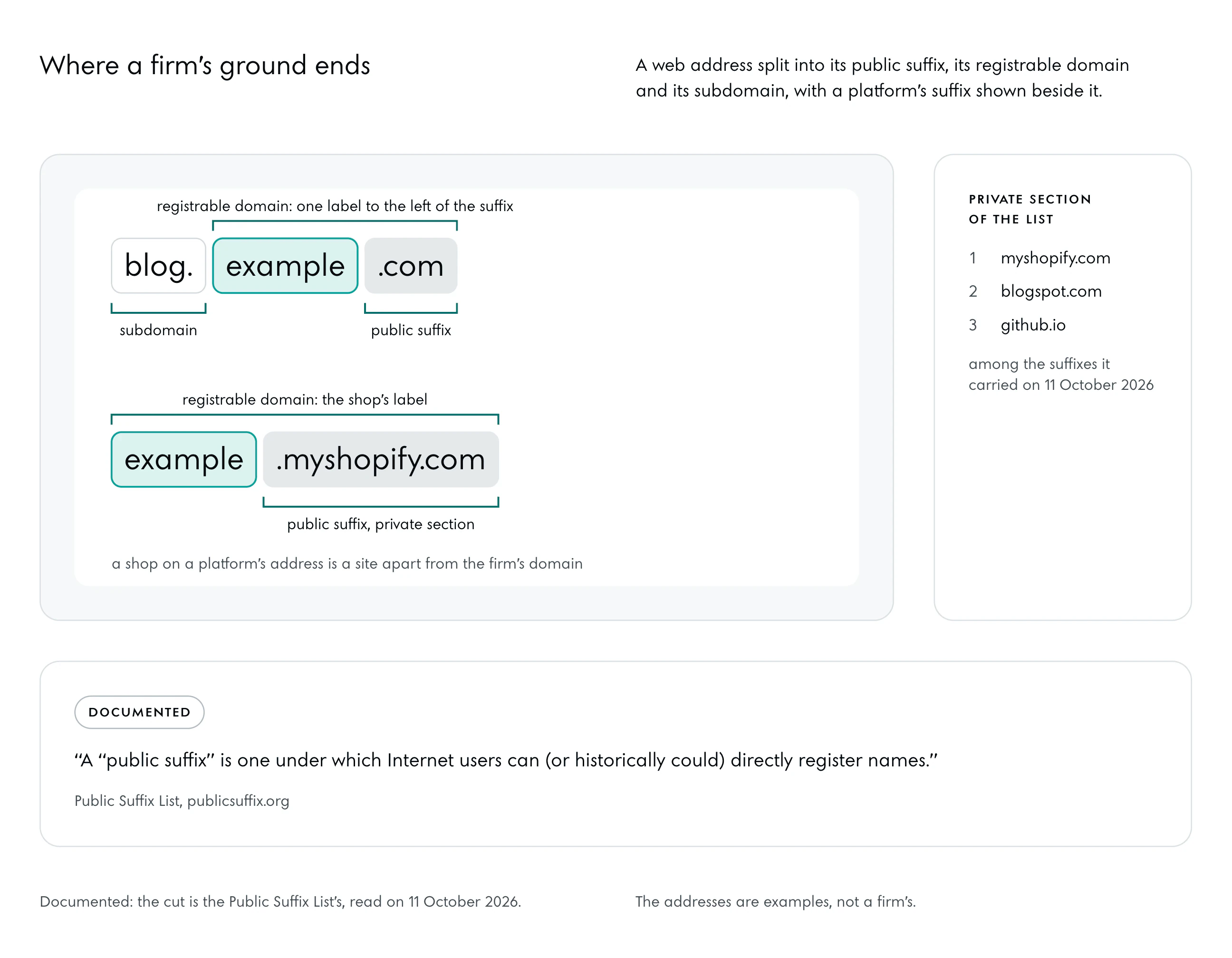
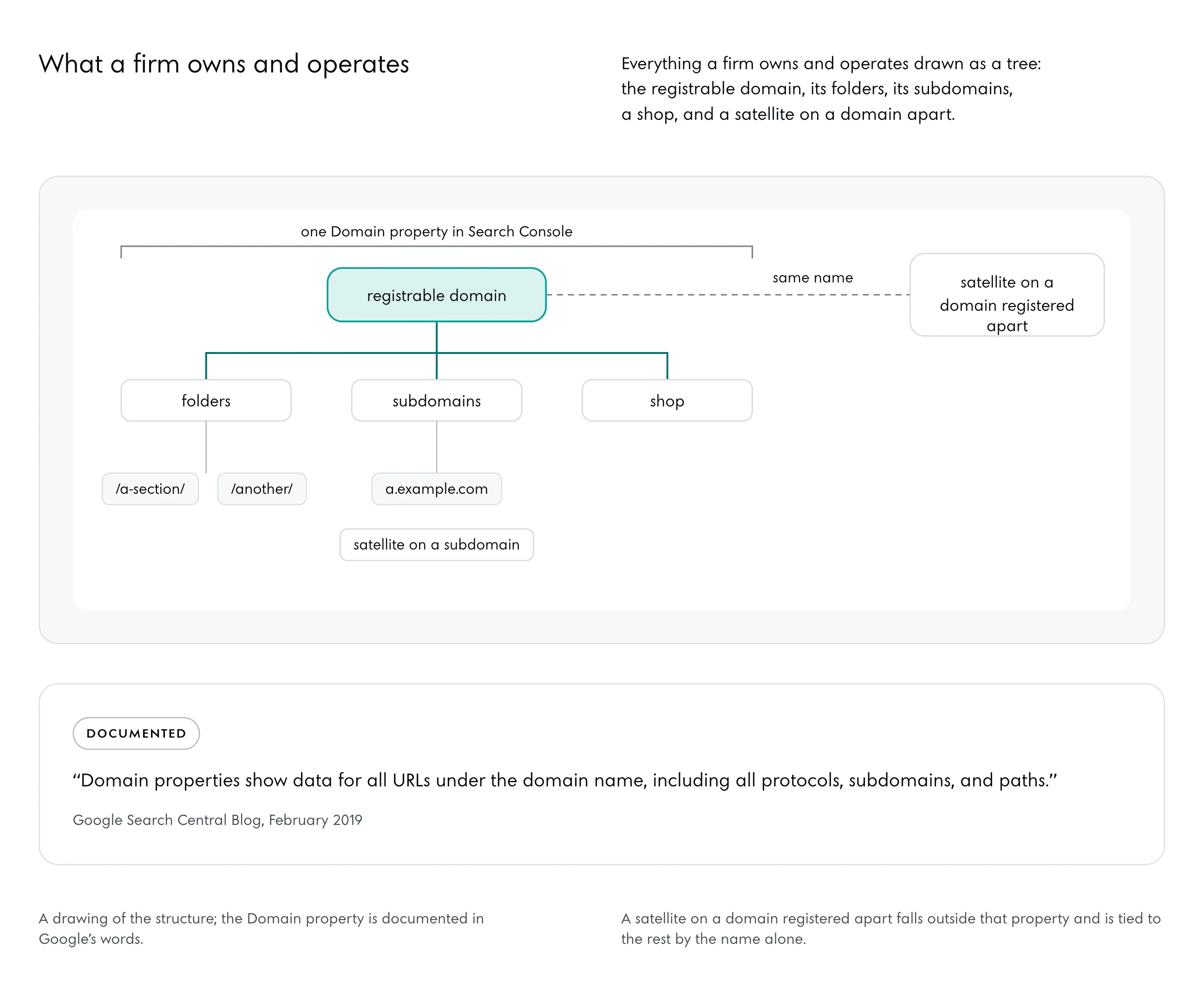
Search Console draws the same line from the engine’s side. Since February 2019 it has offered a property for the domain as such. Google’s post says, “Domain properties show data for all URLs under the domain name, including all protocols, subdomains, and paths.” So one registrable domain, with all that hangs from it, is a unit that Google itself reports on.
A satellite can stand in a folder of the main site, on a subdomain of its domain, or on a domain registered apart, and by the list only the last of these is a unit of its own.
Subdomain or Subfolder
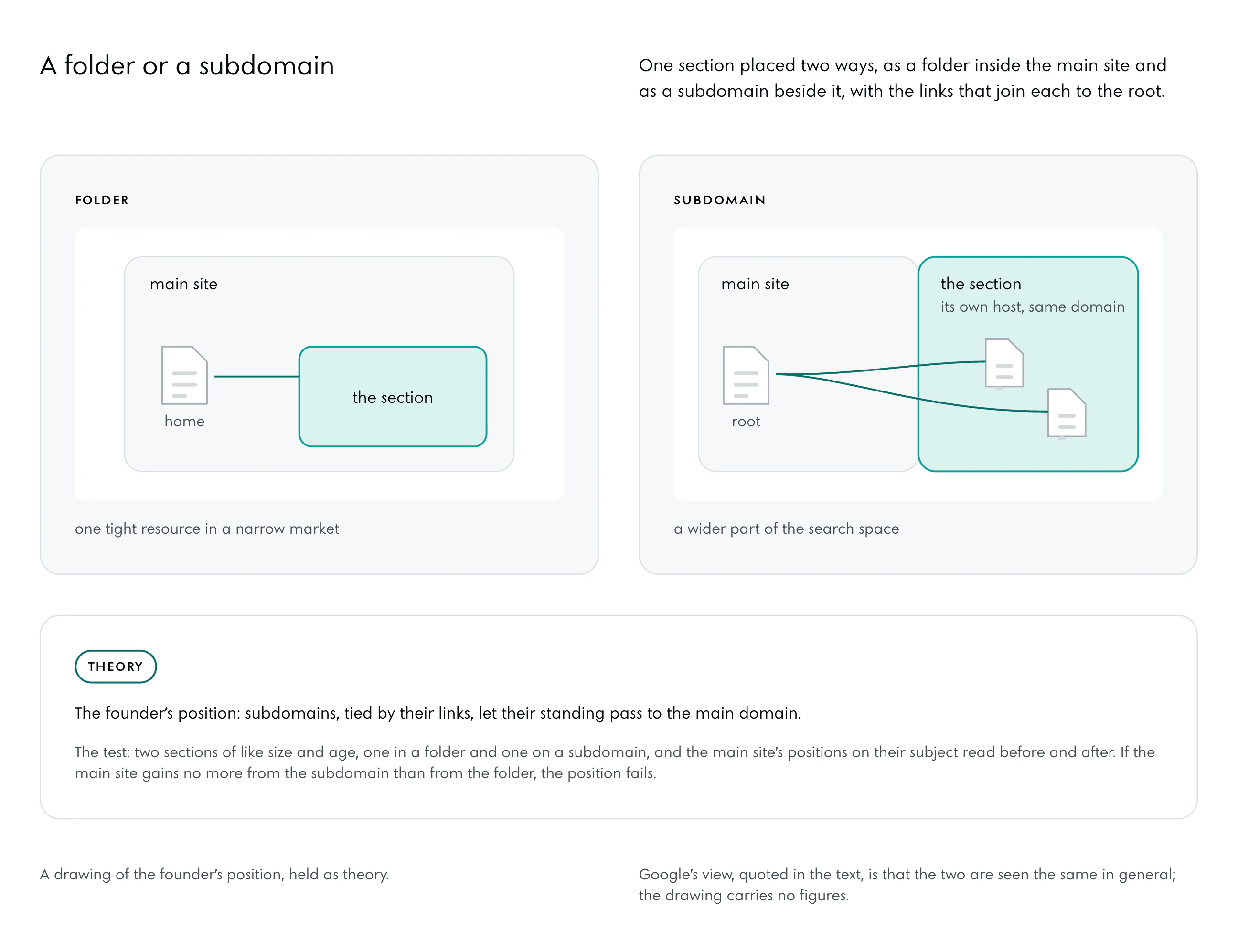
Advice on where to put a new section is very settled, and it usually says a folder. Matt Southern, in Search Engine Journal on 25 May 2018, reported what Google’s John Mueller had said of the choice. “In general, we see these the same. I would personally try to keep things together as much as possible.” There is something right in this. One place is certainly simpler to keep than two, and Mueller’s words put the two on a level as far as the engine goes, so that a small firm in a narrow market probably has nothing to gain by a split. Google’s published rule, which the opening quoted, cuts both ways, since it counts a subdomain with its root as a rule and apart from it sometimes, and it gives no test. The founder of Noo–Studio, Piotr Paweł Zalewski, holds a different position, and it is first hand. A folder, he says, serves a firm that wants one tight resource in a narrow market. For a firm that wants a wider part of the search space he builds on subdomains, which in his account an engine treats as connected through their links, so that their standing passes to the main domain. He adds that an AI assistant he works with advised a folder every time he asked how a site should be laid out, and that is perhaps the fairest sign of how settled the advice is. The Sustainability Directory is built his way, with its sections on subdomains of one domain; we name it for how it is built and give no figure of it.
In the terms of the field his position is theory. Each subdomain would hold a centre on its subject, and the links between them would let those centres count toward the one under the name. Its test takes two sections of like size and age, one in a folder and one on a subdomain, and reads the main site’s positions on their subject before and after.
If the main site gains no more from the subdomain than from the folder, the position fails.
Held on Other Platforms
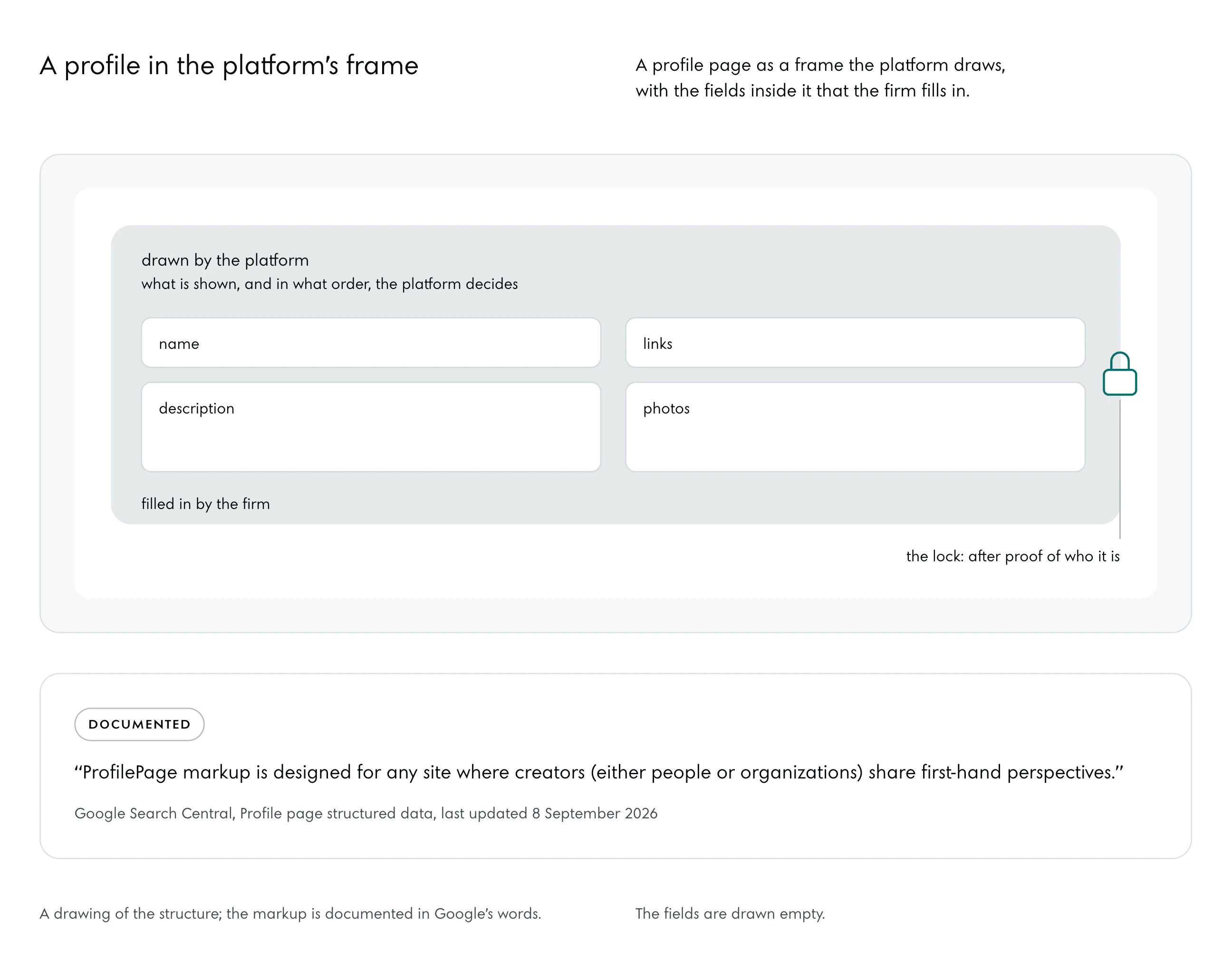
Elsewhere the frame belongs to someone else and the firm supplies the text. Google has a type of markup for such pages. Its page on it, last updated on 8 September 2026, says what the type is for, “ProfilePage markup is designed for any site where creators (either people or organizations) share first-hand perspectives.” The engine’s listing of a business is a thing of the same kind, a frame that Google hosts.
And the page on business details, last updated on 10 December 2025, says of it, “Once you verify yourself as the owner of a listing, you can provide or edit your address, contact info, business type, and photos.” So the firm writes there only after a check of who it is, and what the frame shows of that text, and in what order, is for the platform to decide.
Sent to a Client
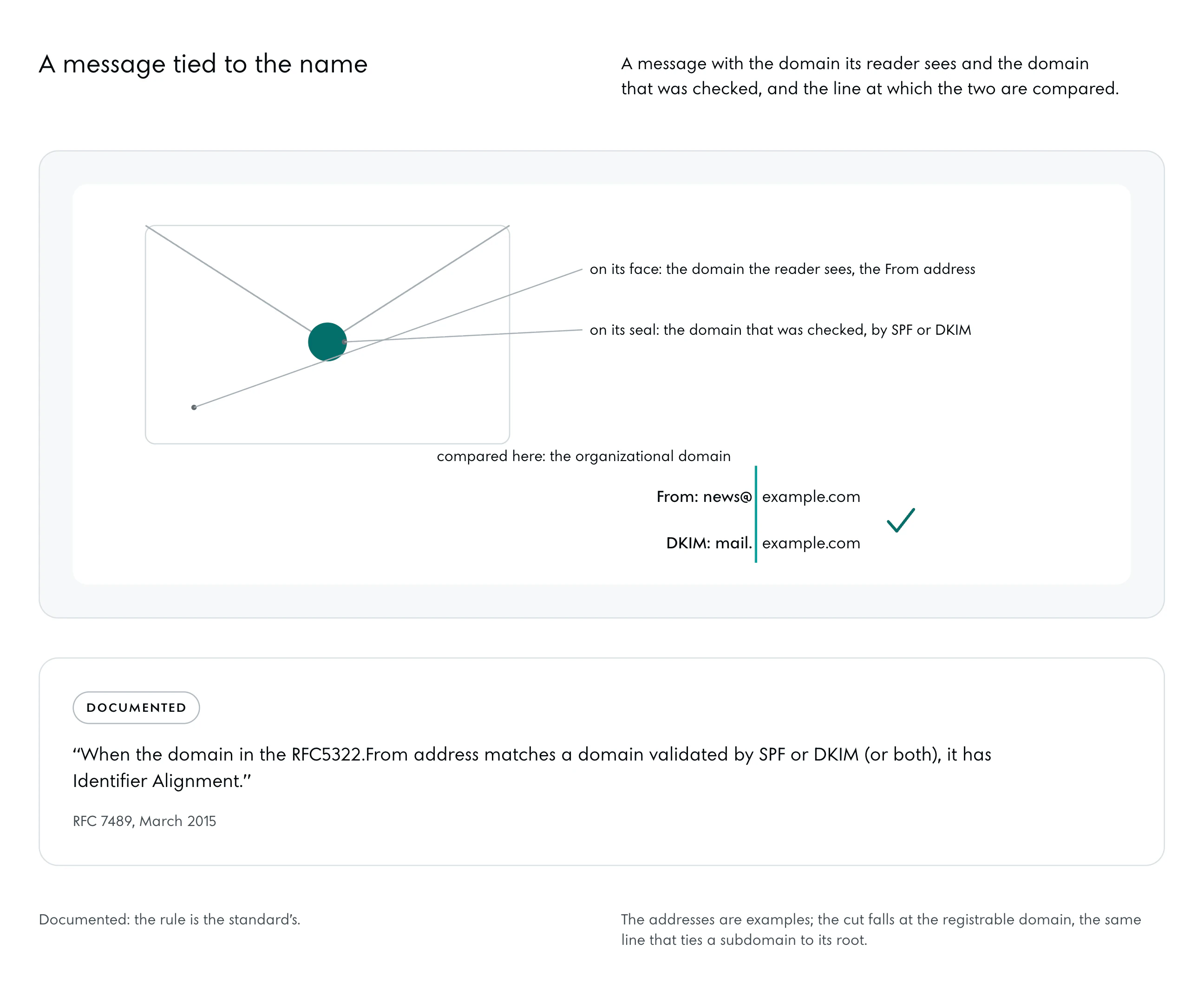
Mail carries a domain too, and although an engine never reads private mail, the receiver’s systems do, by a standard that has a unit of its own. RFC 7489, published in March 2015, defines it. “Organizational Domain: The domain that was registered with a domain name registrar.” A message passes when the sender’s visible domain lines up with one that has been checked, or in the standard’s words, “When the domain in the RFC5322.From address matches a domain validated by SPF or DKIM (or both), it has Identifier Alignment.” This is plainly the registrable domain again.
What a client receives is therefore tied to the name by the same line that ties a subdomain to its root.
Written by Others
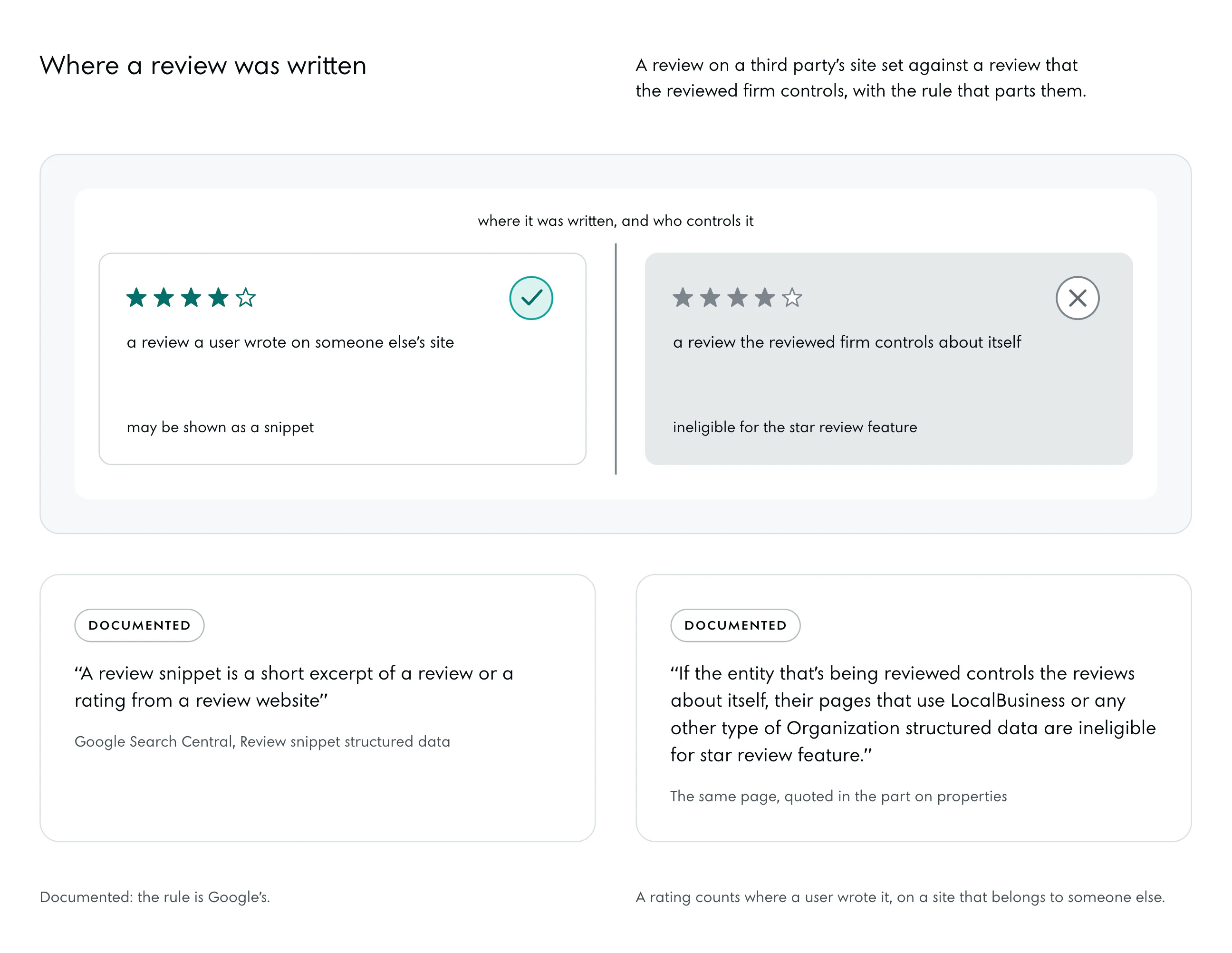
Reviews and mentions are the fourth class, and here the firm holds none of the text. Google’s rule for review markup, on a page last updated on 8 September 2026, draws its line by control. “If the entity that’s being reviewed controls the reviews about itself, their pages that use LocalBusiness or any other type of Organization structured data are ineligible for star review feature.”
A review counts, then, where the firm could not have written it.
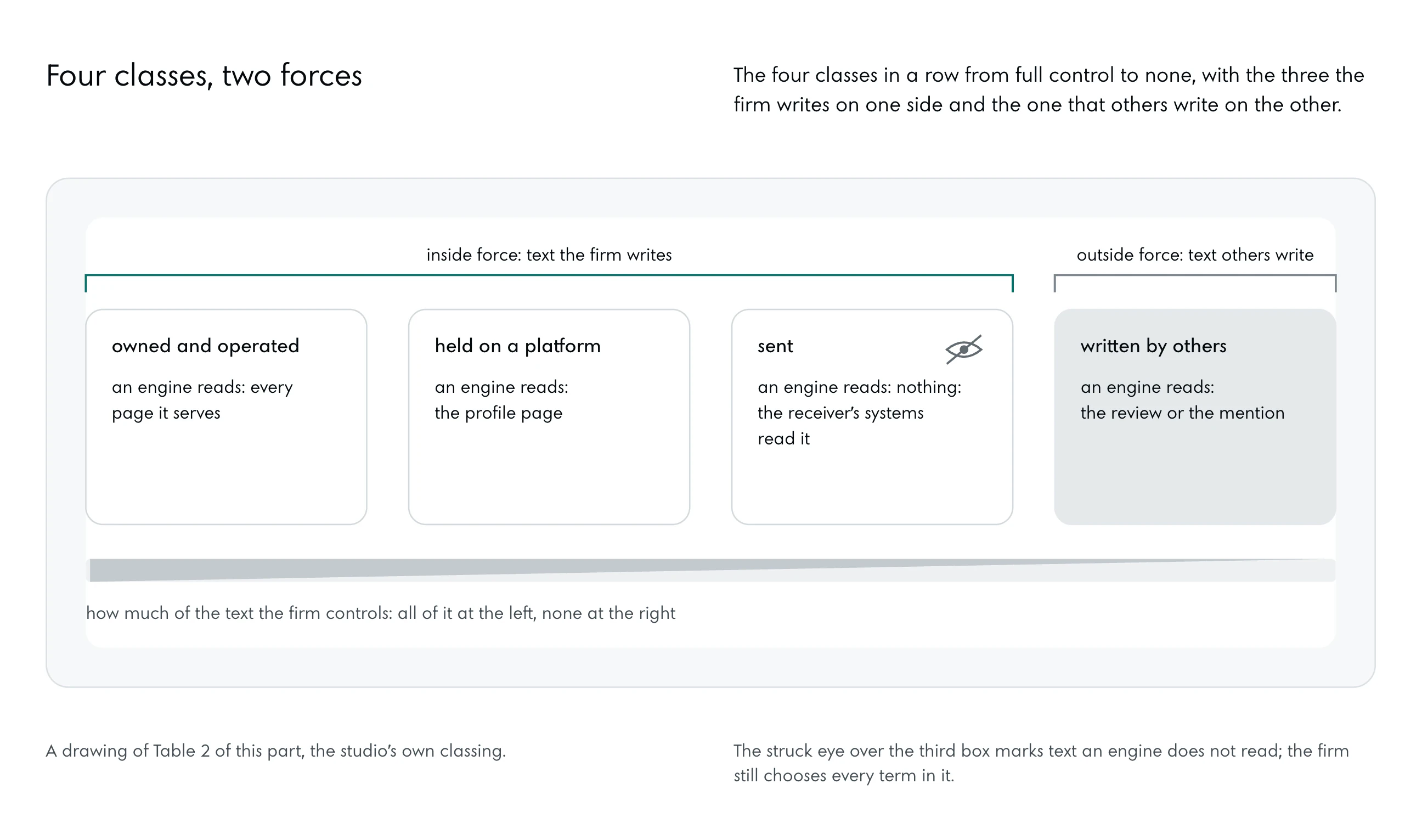
Table 2 sets the four classes side by side.
| Class | Who controls the text | What an engine reads | What ties it to the name |
|---|---|---|---|
| Owned and operated | The firm | Every page it serves | The registrable domain, once verified |
| Held on a platform | The firm, inside the platform’s frame | The profile page | Identity declared from both sides |
| Sent | The firm | Nothing, since the receiver’s systems read it | The aligned domain of the sender |
| Written by others | Others | The review or the mention | The name as written, and any link |
Set against the field, the first three rows are one force and the last row is the other. In those three the firm chooses every term, though the third stays out of an engine’s sight; in the fourth it chooses none. The part on the gradient gave, as theory, that authority is the match between the two, and so the table is also a map of where each side of that match gets written.
07Mechanisms That Tie Two Bodies
Six things can join one property to another, and each has left a published trace.
In the terms of the field each is a way for the text of two sites to count toward one centre, and we hold that part as theory throughout. What is documented is narrower, and it differs from one tie to the next, as each section says.
- A shared name, where both write the firm’s name and its terms one way.
- Declared identity, where each points to the other and the firm proves that it holds both.
- Links, where one links to the other and says nothing to qualify the link.
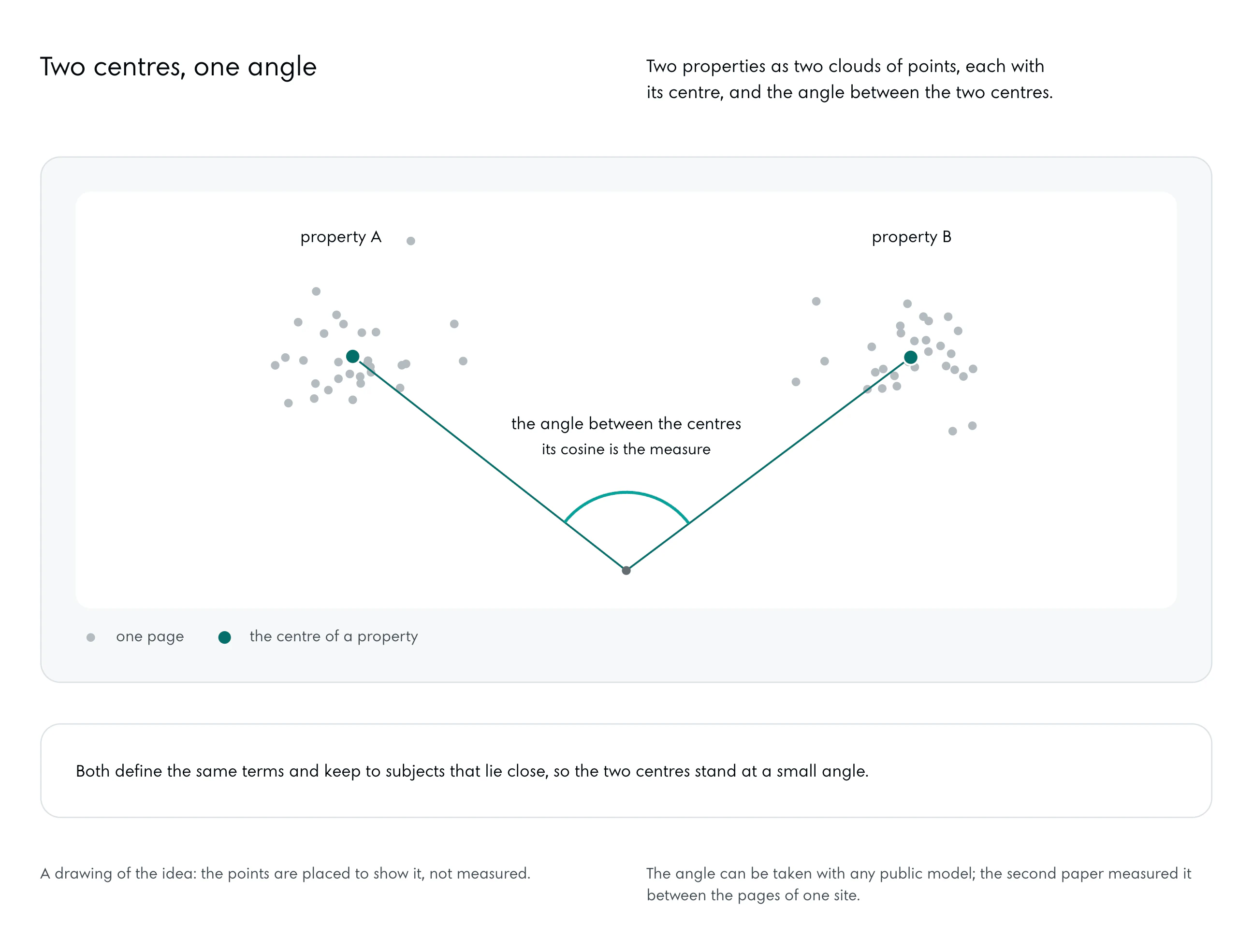
- Shared terms, where both define the same terms and keep to subjects that lie close.
- Co-mention, where other people name the two together.
- Shared users, where the same people open both.
Names That Agree Across Properties
Spelling comes first, because a name written two ways is two strings before it is one firm. The first paper measured what that costs inside one site. In the part on matching it came back as a field that agrees or fails to.
Between two properties the tie goes further than the name. When both define the same terms and keep to subjects that lie close, each of them has a centre in the space where engines place text, and the two centres stand at a small angle from one another. The second paper drew ties of this kind between the pages of one site, and here they are drawn between two bodies; the angle can be taken with any public model, which is what makes this tie the easiest of the six to measure.
One first-hand case of a tie by terms stands on the Sustainability Directory, named in the part on properties for its sections on subdomains. Its articles carry tags, and in the founder’s account, given on 14 October 2026, those tags formed a mesh of terms across the Directory. On his reading the mesh gave it standing in what its terms mean, and in his word it also carried a risk, that some of those terms would be read as new and then used as the original.
He reads its structure as bearing out the studio’s view of what reading costs an engine, which the second paper sets out in “Costs of Reading a Site”. How the mesh was made is the studio’s own method and is not published, and no figure of it is given here. That shared terms join the parts of one name in an engine’s reading is theory, as this part holds for every tie, and its test is the dated change of the part on joint description, with two parts of one name brought to share their defined terms on a known day and the other part’s figures read against a control.
Declared and Verified Identity
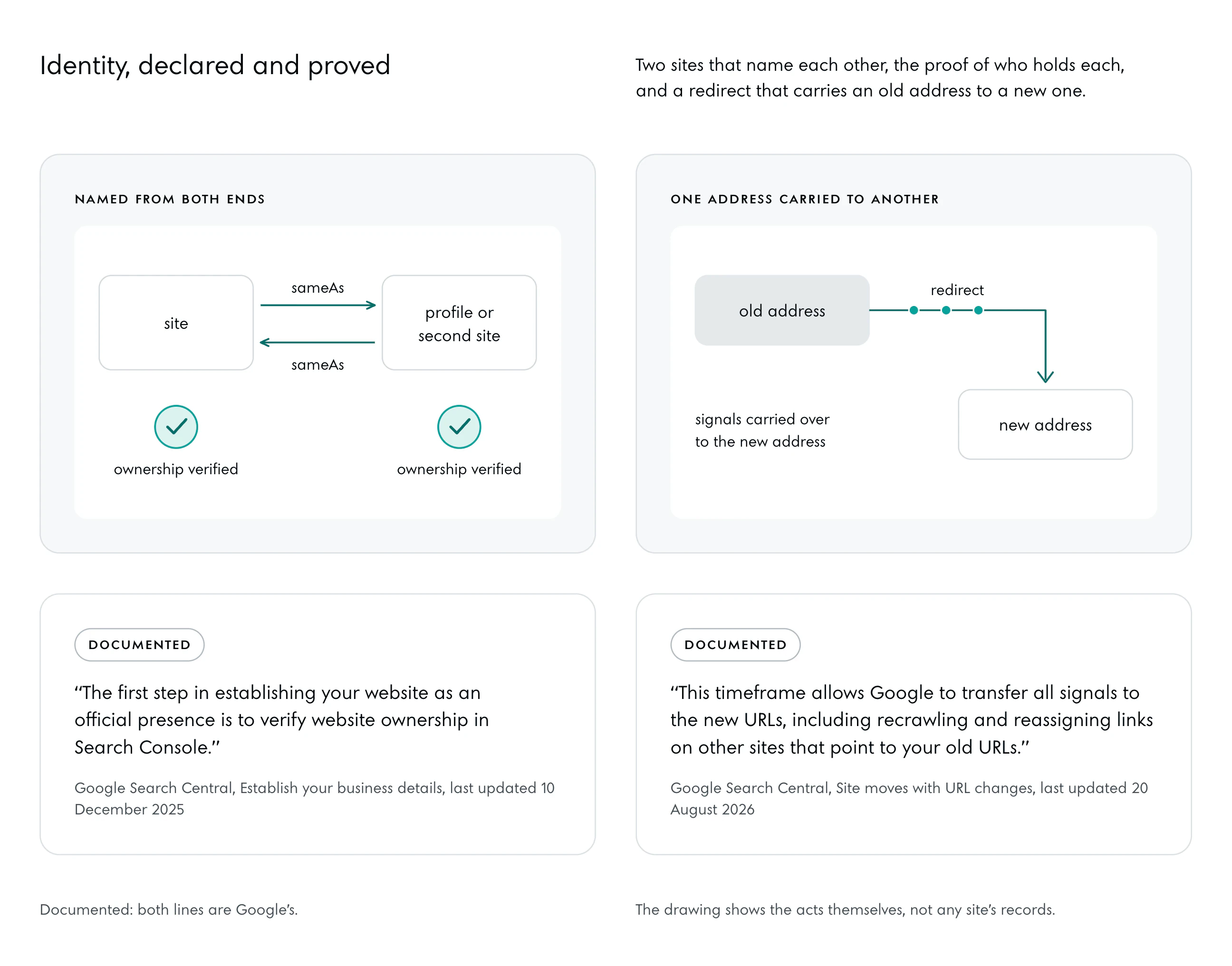
Ownership can be proved to an engine, and Google puts the proof first. “The first step in establishing your website as an official presence is to verify website ownership in Search Console.” A claimed profile is the same act on a platform, and markup then adds what the firm says of itself. With sameAs a site can name its other pages, and those pages can name the site back, so that the claim is made from both ends and an engine that finds one end can check it at the other.
Redirects say more, namely that an old address and a new one are the same thing. Google’s page on site moves, last updated on 20 August 2026, asks that redirects be kept in place for a period and gives its reason. “This timeframe allows Google to transfer all signals to the new URLs, including recrawling and reassigning links on other sites that point to your old URLs.” So an engine plainly has, by its own account, a way to carry what it knows of one address over to another.
Links Between a Firm’s Properties
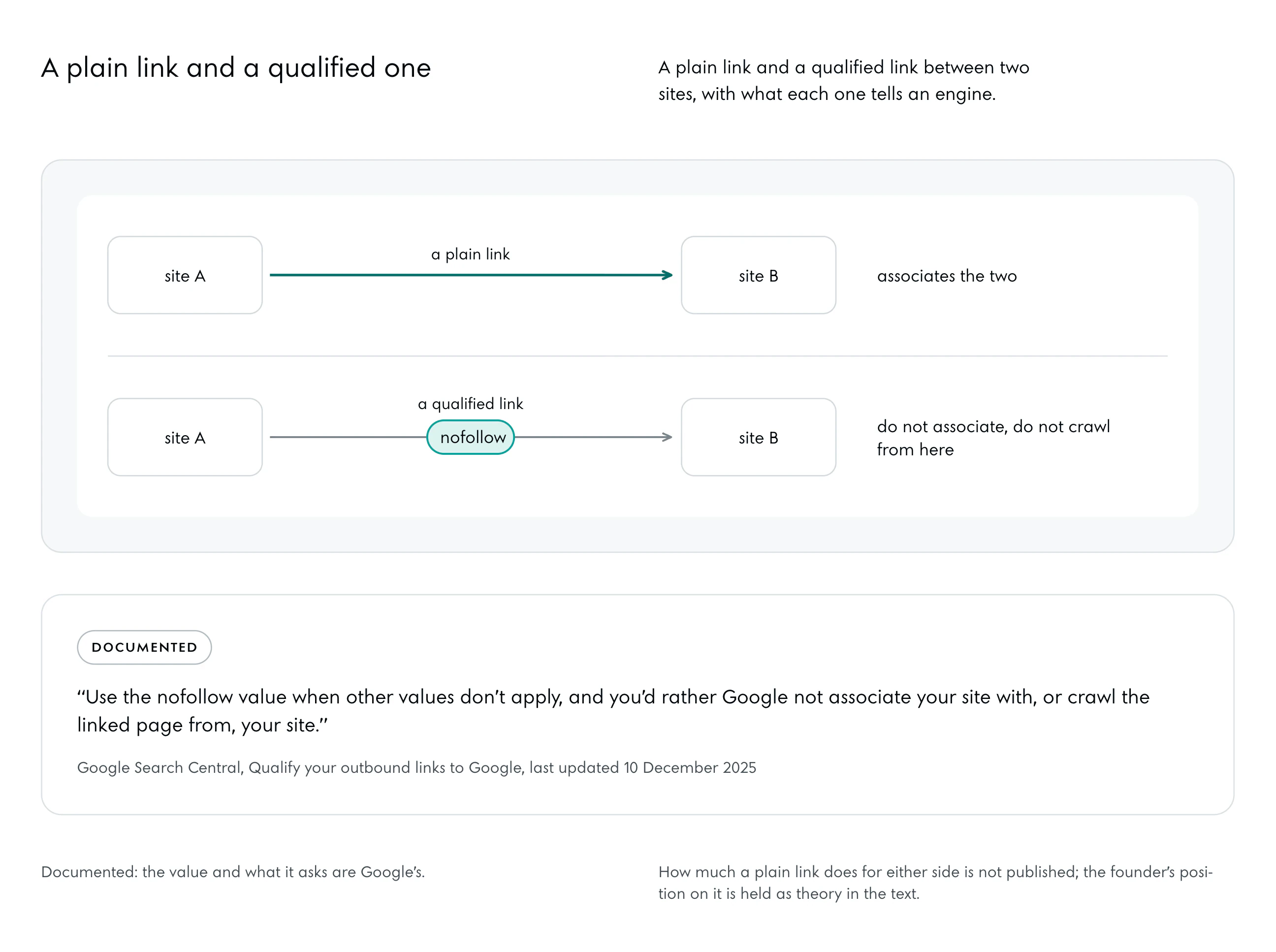
Hyperlinks from one site to another are read as a sign that the two have something to do with each other. Google’s page on how to qualify them, last updated on 10 December 2025, starts from there. “For certain links on your site, you might want to tell Google your relationship with the linked page.” And it gives the way out, “Use the nofollow value when other values don’t apply, and you’d rather Google not associate your site with, or crawl the linked page from, your site.” A plain link, then, associates the two, and this much is documented.
How much such a link does for either side is another matter. In the measured case of a later part a subject passed from the satellite to the main site with no link between the pages concerned, and the pages that were linked stood still. The founder keeps his position beside that, which is that authority is the match between what a firm writes and what is written about it, and in his words “that match is easier to find when you have the backlinks.
So I still think that backlinks are important.” We set this down as theory, which says that links are how an engine finds the match sooner, even where they are perhaps no part of what makes it. Its test takes two satellites alike in subject and age, one linked from the main site and one left unlinked, and notes the day on which each is first shown for searches on the name; if the unlinked one is found as soon, his position fails.
He holds the same of subdomains, whose links to the root would let their standing pass to it. The part on properties gave that as theory with its test. What it needs as a mechanism is only that an engine should count a link between two hosts of one registrable domain as a tie inside one source, and whether engines do so is not published.
Co-Mention and Shared Users
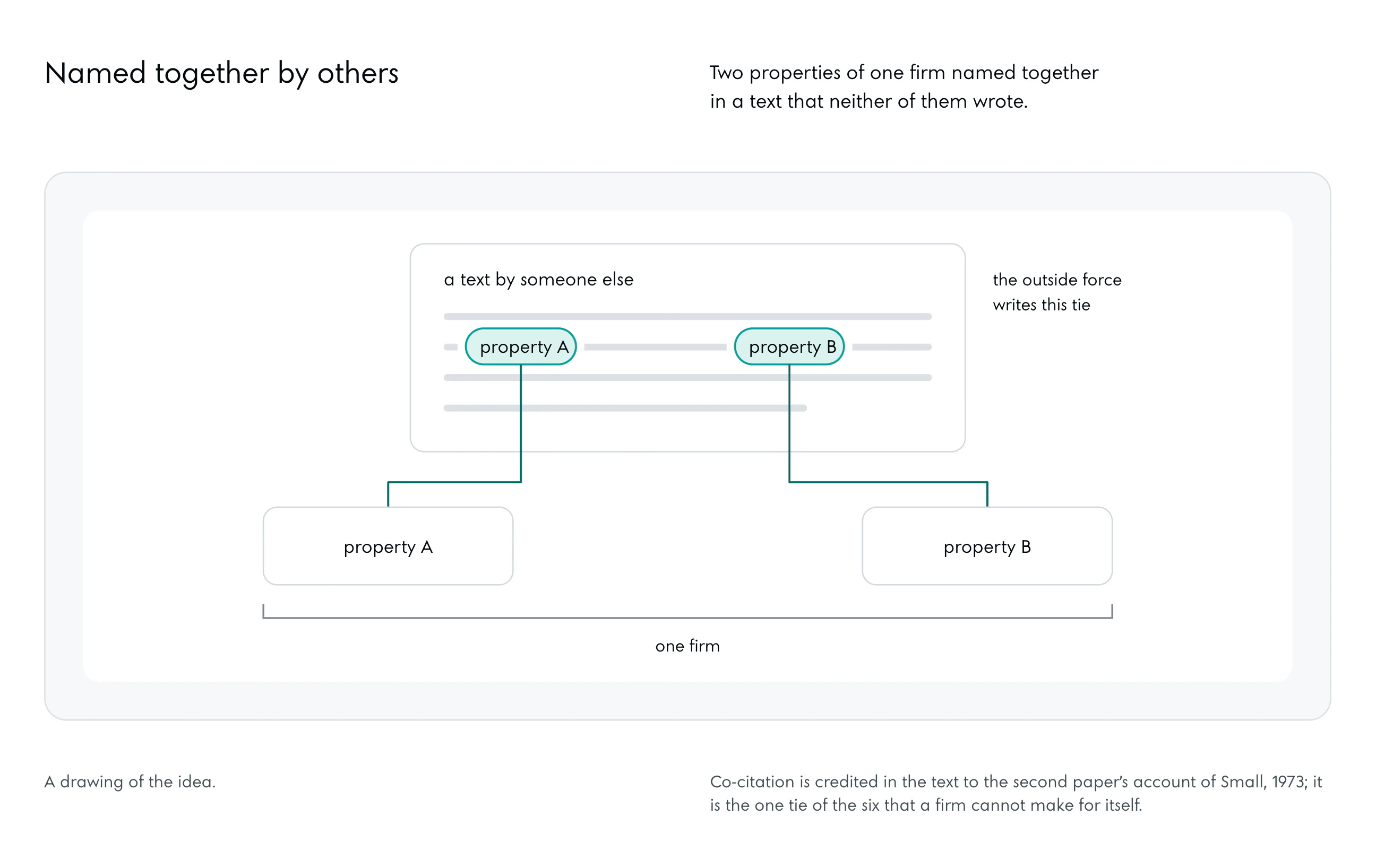
Others can tie two properties entirely without the firm. When a third party names both in one text the two are joined by co-citation, which the second paper took from Small’s work of 1973 and applied to pages. Between two bodies of one firm it is the outside force that writes the tie, and so it is the one tie of the six that a firm can never make for itself.
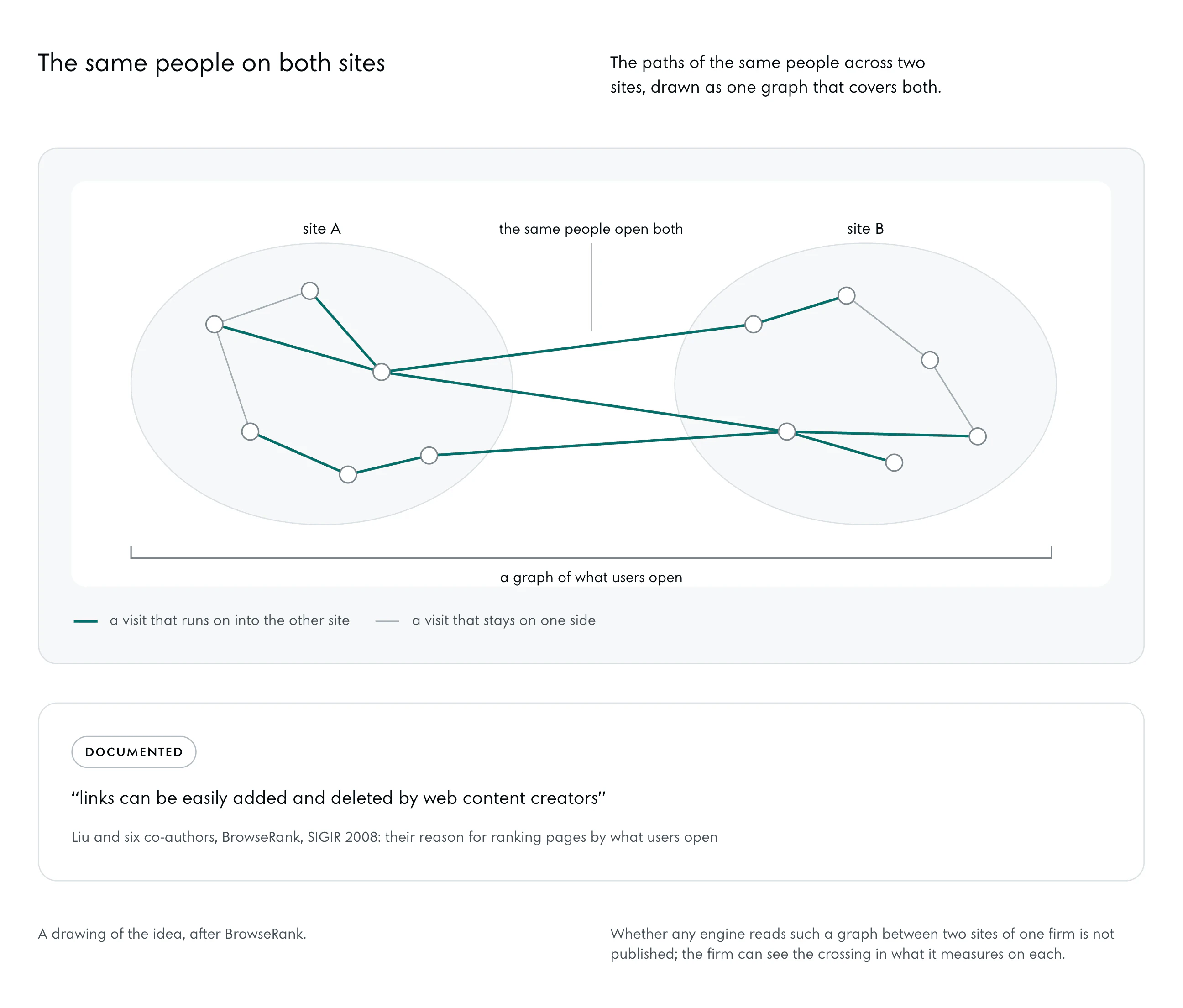
People tie them as well, for Liu and six co-authors proposed in 2008 to rank pages by a graph of what users open, and their reason was that “links can be easily added and deleted by web content creators”. But whether any engine reads such a graph between two sites of one firm is not published. That the same people open both is a thing the firm can see in what it measures on each.
Stored for Groups of Sites
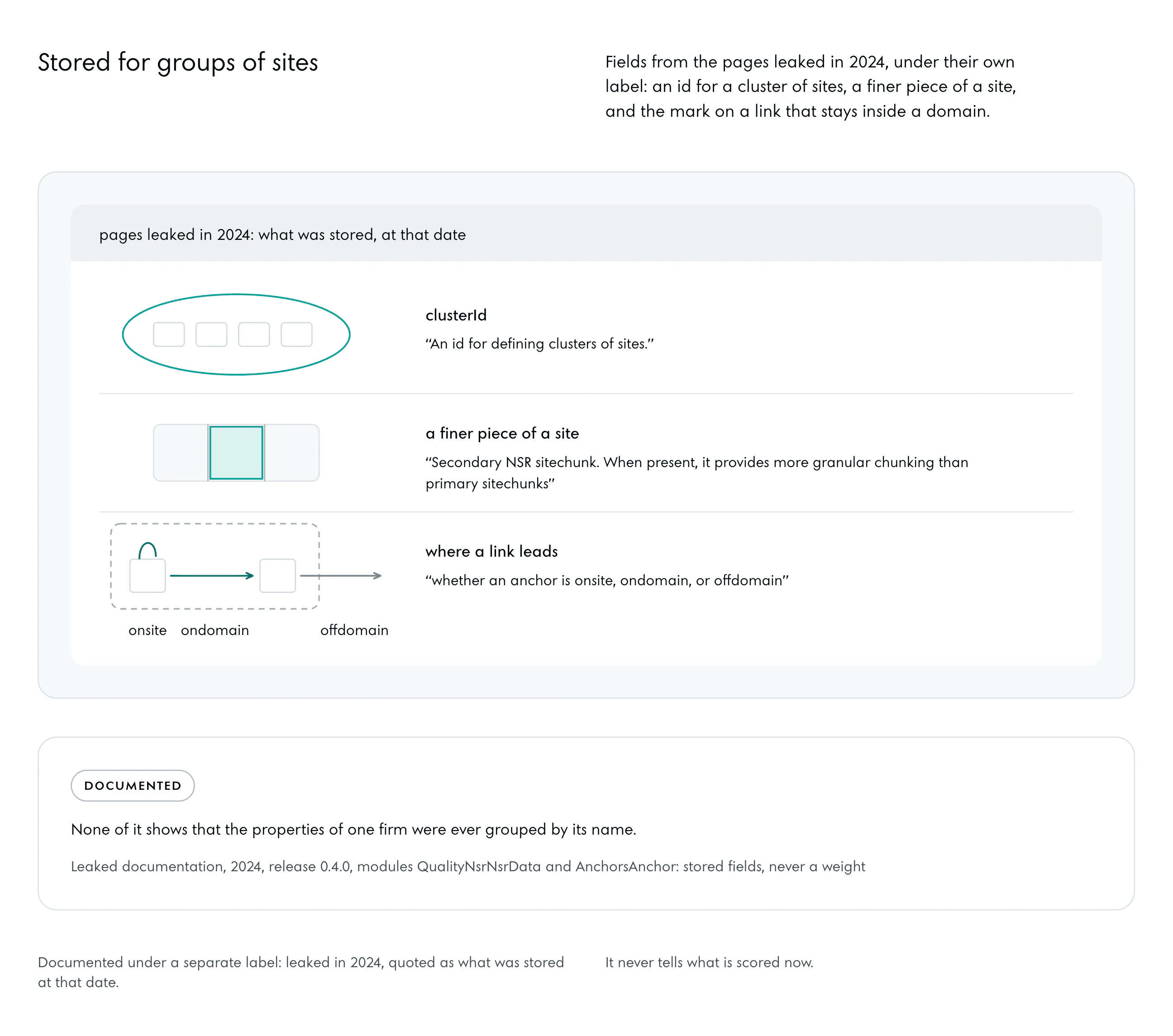
Leaked in 2024, a set of pages that describe an internal Google interface stands under a label of its own in this series. It is a dated list of what was stored; it never tells what is scored now.
Some of its entries bear on groups. One is clusterId, “An id for defining clusters of sites. Used in ecosystem experiments (project Tundra).” Beside it stands a module for “The uplift-per-cluster values used in Tundra’s uplift arm.”, which holds a “Score for the local sites arm.” and a “Score for the small sites arm.” There is a finer unit inside a site as well, a “Secondary NSR sitechunk.
When present, it provides more granular chunking than primary sitechunks”. Each anchor carries a mark of where it leads. One field tells “whether an anchor is onsite, ondomain, or offdomain”.
And of another the text says, in its own spelling, “The bit ~roughly~ indicates whether an anchor’s source and target pages are on the same domain.”
So at that date sites could be stored in clusters, a site could be cut finer than one piece, and a link was marked by whether it stayed inside a domain. None of it shows that the properties of one firm were ever grouped by its name.
08Joint Description and Its Test
Saying that two sites are one system is easy. It commits to something only when it is put so that figures could count against it.
Semantic Entanglement Optimisation, which we read beside search engine optimisation, rests on that saying, and so the saying needs a form that can fail and a method that reads it, which is a change made on one side at a known date and read on the other against a control.
Claims in Checkable Terms
Stated so that it can fail, the phrase says that the figures of one property are not accounted for without those of the other, so that a change on one side should show on the other. And the evidence against it would be just as plain, namely a change on one side that leaves the other side’s course where its control puts it.
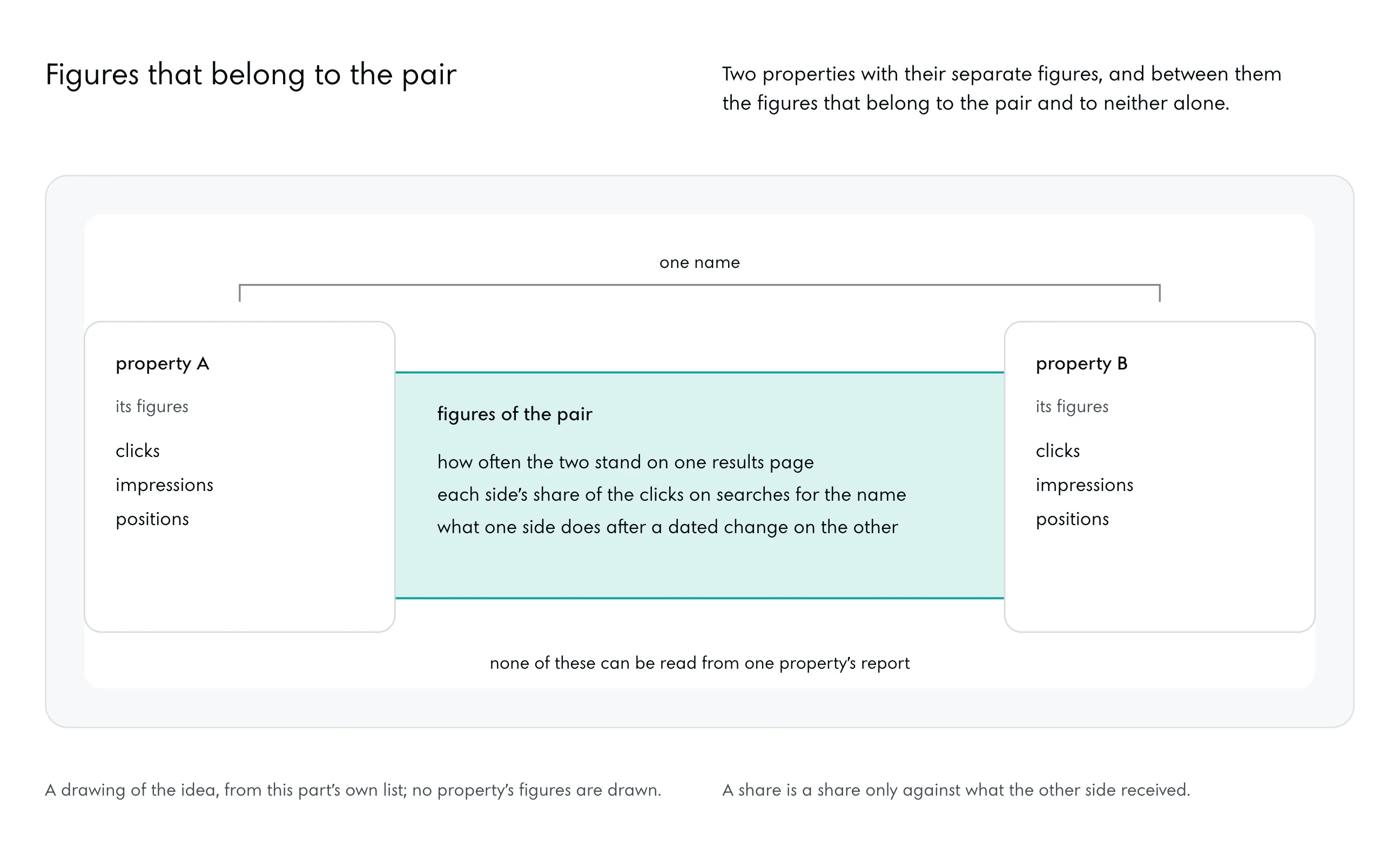
The figures that belong to the pair are of a particular kind. How often the two appear on one results page is one of them. A share of the clicks on searches for the name is another, since it is a share only against what the other side received.
Neither can be read from the report of one property, however long that report is, and this is the web’s plain version of the point made in the part on physics, that a summary of each side does not fix the relation.
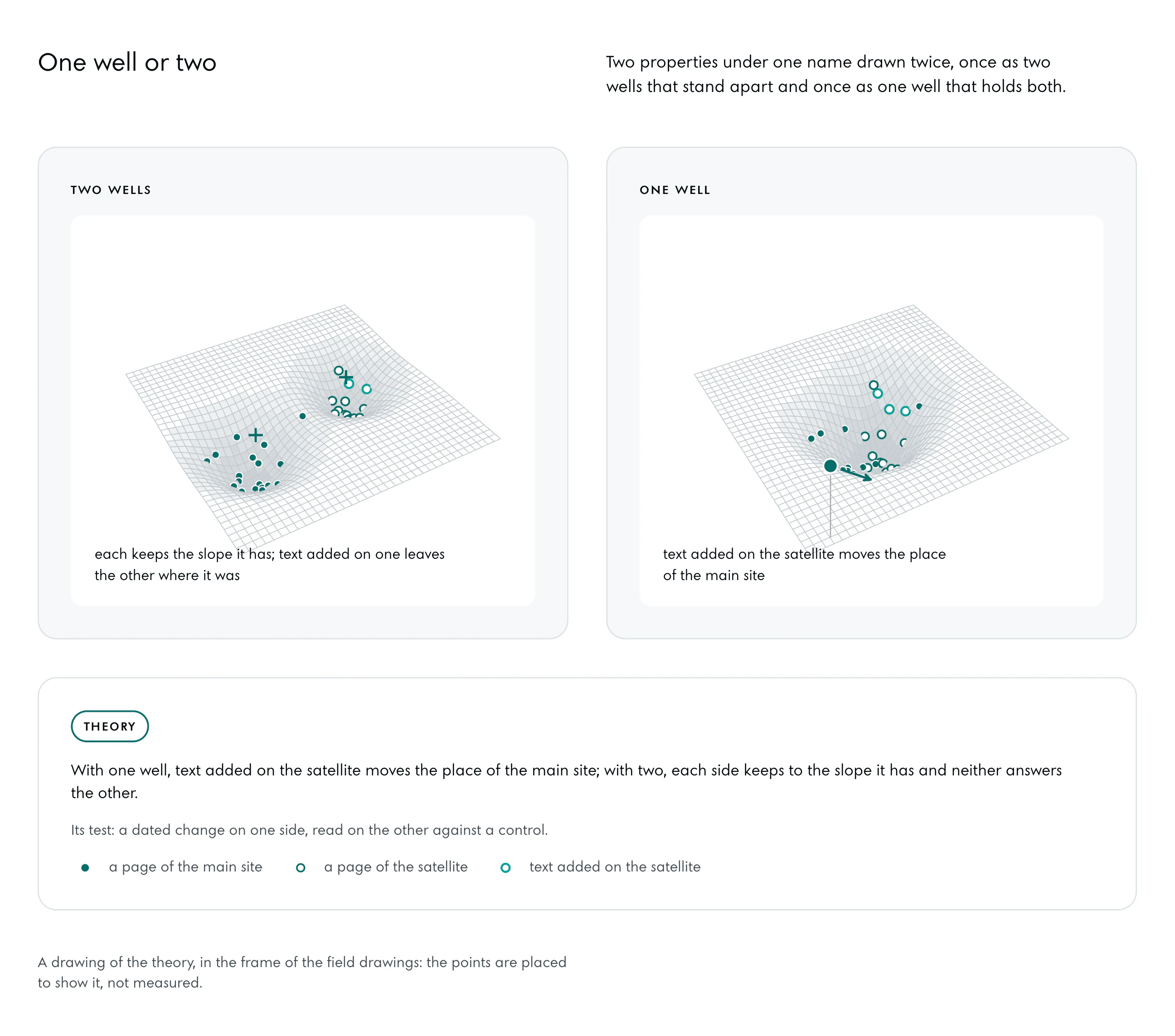
In the terms of the field the same thing is asked as whether there is one well under the name or two. With one well, text added on the satellite moves the place of the main site; with two, each side keeps to the slope it has and neither answers the other. This is theory, and its test is a dated change read against a control.
Curves That Rise Together
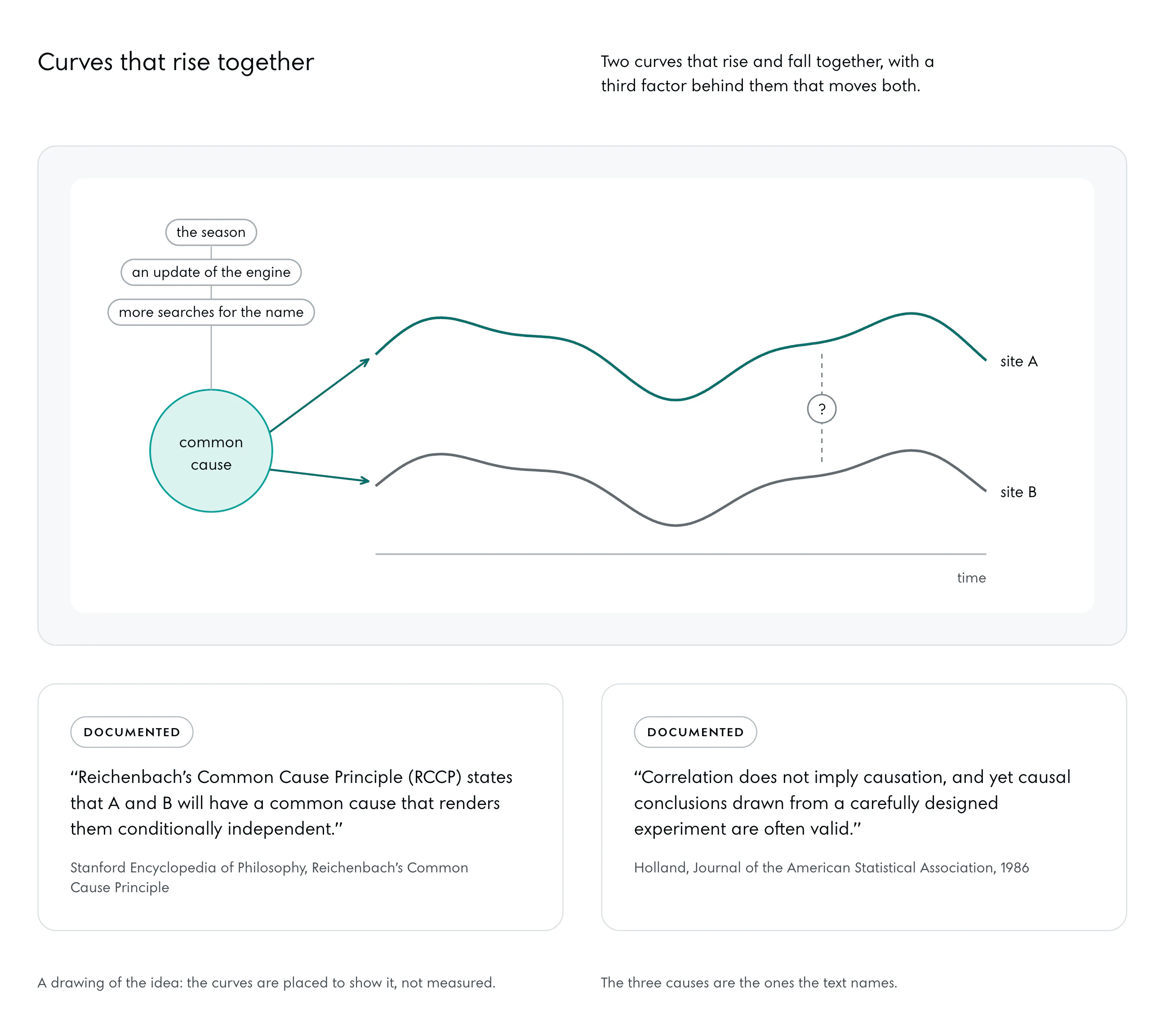
Watching both sites over a year shows two series that move alike, and that alone settles little, for a reason that Hans Reichenbach gave. Where two things go together and neither causes the other, his principle supplies a third thing behind both, and the Stanford Encyclopedia of Philosophy puts it in one line, “Reichenbach’s Common Cause Principle (RCCP) states that A and B will have a common cause that renders them conditionally independent.” Two sites under one name have such causes in plenty, for the season moves both curves at once, and so does an update of the engine or a rise in searches for the name itself.
Holland put the trouble and its remedy in one sentence in 1986.
Dated Change Against a Control
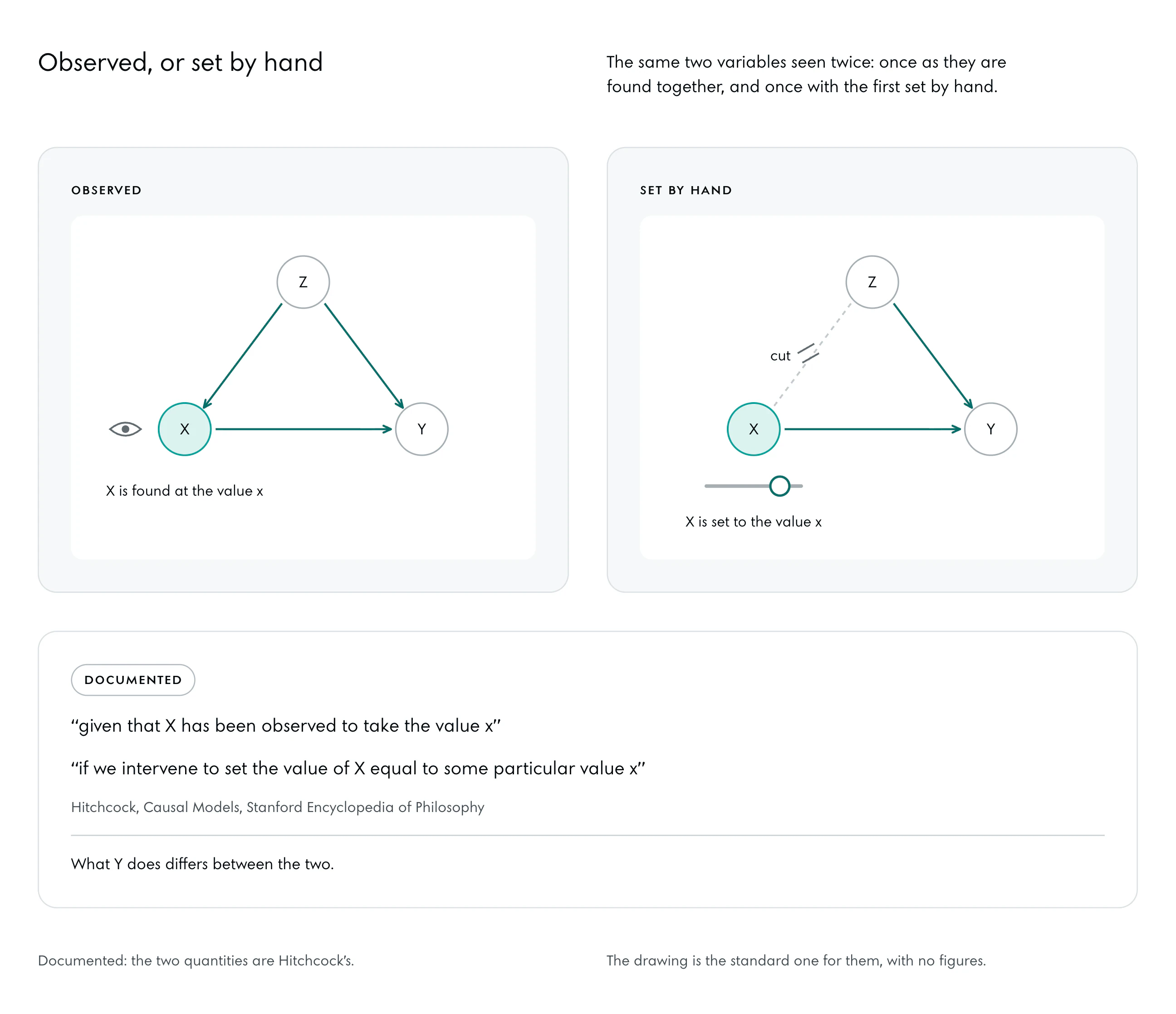
Intervention is the word that the literature uses for setting a thing by hand. Hitchcock’s article on causal models parts two quantities by it. One is what Y does “given that X has been observed to take the value x”, and the other is what Y does “if we intervene to set the value of X equal to some particular value x”.
Woodward’s article gives the idea behind the split, which is that “causal relationships are relationships that are potentially exploitable for purposes of manipulation and control”. A cause, on this account, is a handle.
Any firm holds such a handle, since it can change one property on one day and leave the other alone. Its handles are few, for it can publish a group of pages on one subject, take a set of links away, or move a section from one host to another, and each of these has a day on which it happened. What it then lacks is the course the other side would have taken with no change at all.
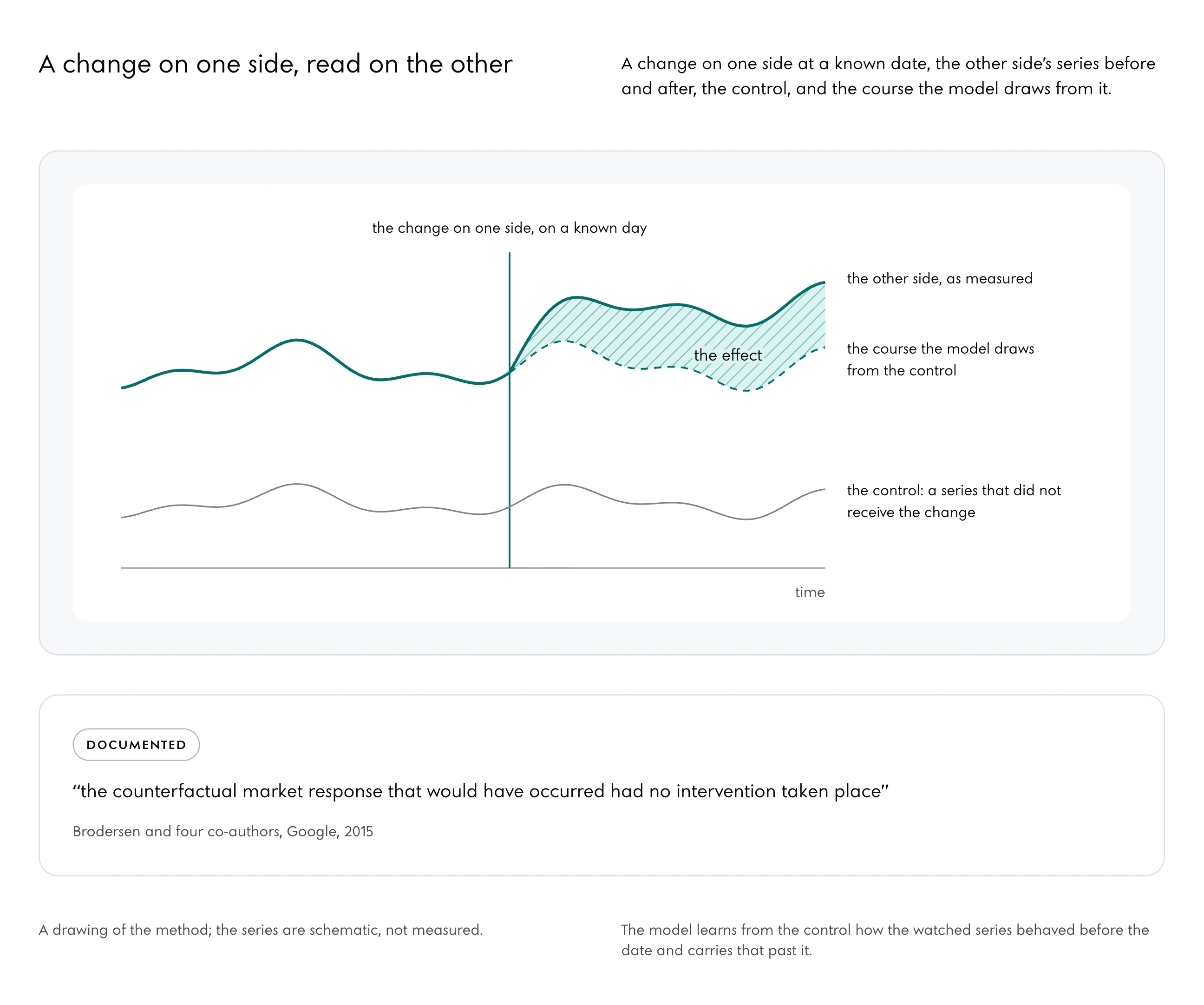
Researchers at Google published a model for that in 2015. Brodersen and four co-authors built it to estimate, in their words, “the counterfactual market response that would have occurred had no intervention taken place”. The model learns from a control, which is a series that did not receive the change, how the watched series behaved before the date, and it then carries that behaviour past the date, so that the gap between the course it draws and the course that was measured is the effect.
Conditions the Design Asks For
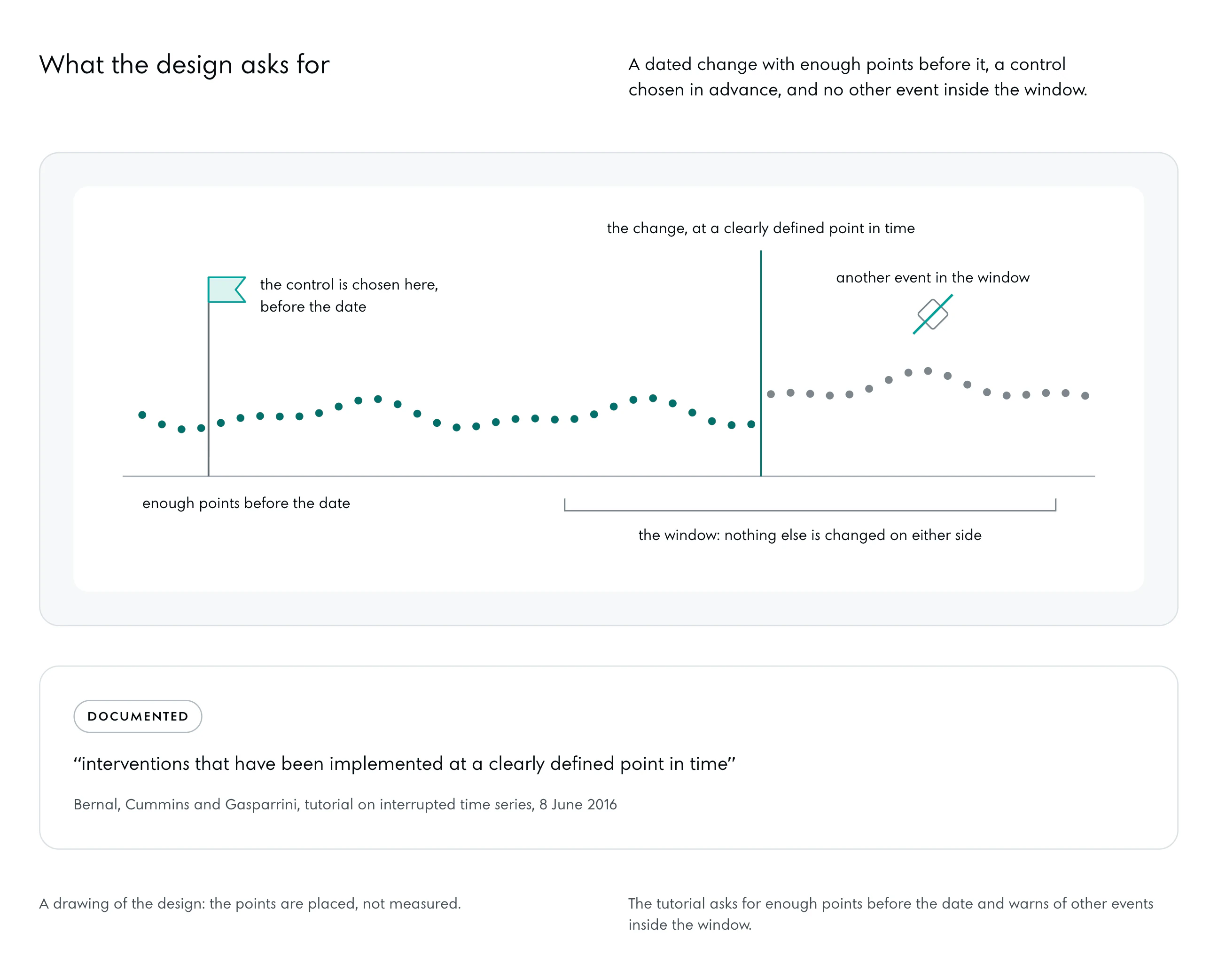
Bernal, Cummins and Gasparrini wrote a tutorial on series that are interrupted in this way. It was published on 8 June 2016, and it keeps the method to “interventions that have been implemented at a clearly defined point in time”. The same tutorial asks for enough points before the date, and it warns of other events that fall inside the window.
For a firm these come down to a short discipline. The change has a date, and nothing else is changed on either side while the window lasts. A control is always chosen before the date and never after it, and a site on another subject under another name will often serve.
Here the physics of an earlier part comes back in one clause, because there too a relation showed only when two lists were compared after a setting had been chosen on one side. But the difference that was stated there holds here as well, since on the web a cause does pass from one side to the other, by links, by shared text, by shared users and by one index, and so a design of this kind can find it.
The relation is seen most clearly on the day one side changes.
09Main Site and Satellite
Sixteen months of one relation have been measured by the studio. The two properties are a main site and its satellite, and the satellite stood on a subdomain of the main site’s registered domain.
Every figure here is measured, from the engines’ reports and from what the two sites counted for themselves. Each is a share, a multiple or an index.
Shares of One Name’s Search
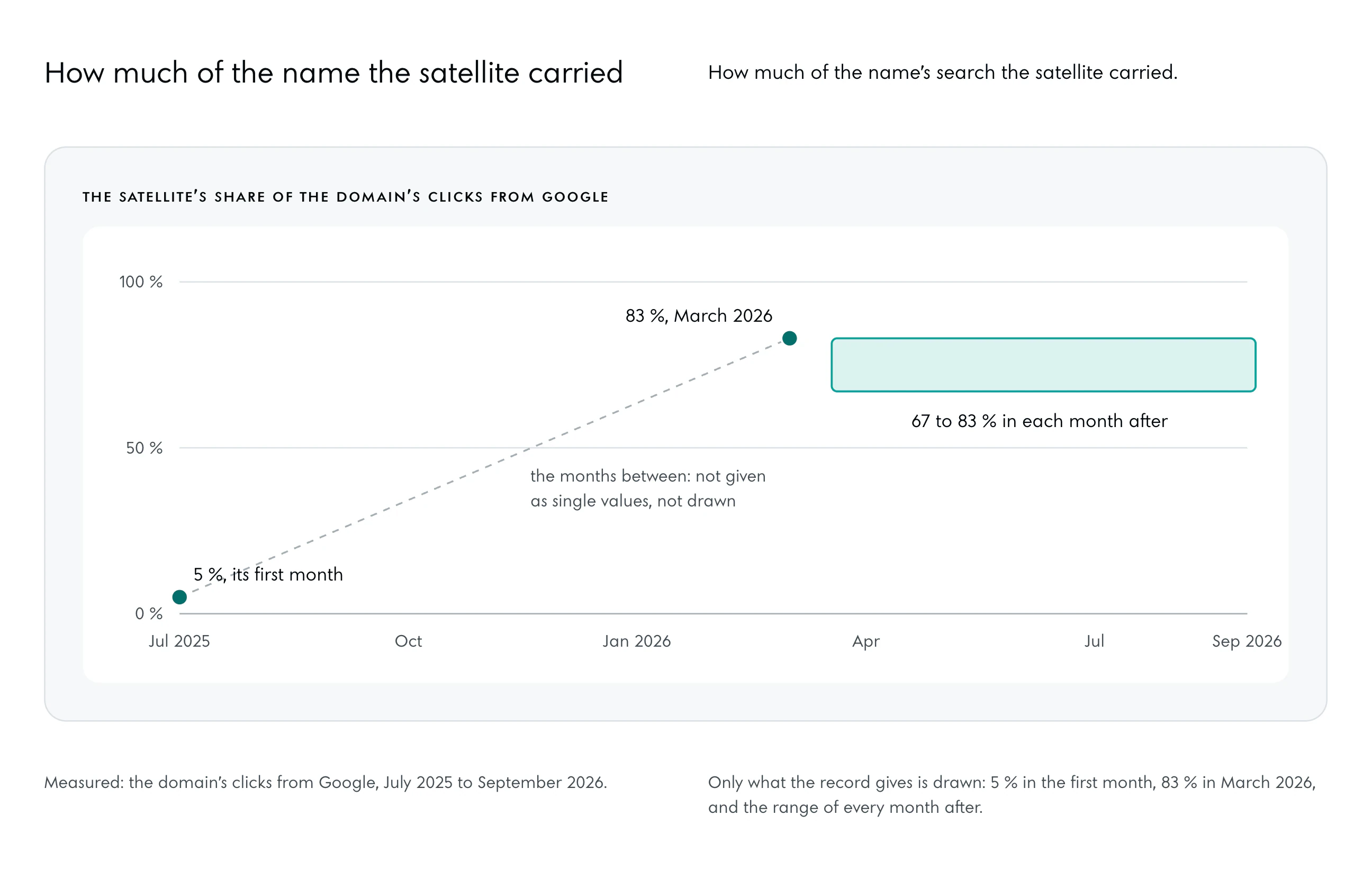
Clicks moved to the newer property fast. In July 2025, its first month, the satellite carried 5 % of the domain’s clicks from Google, by March 2026 it carried 83 %, and in each month after that it held between 67 % and 83 %.
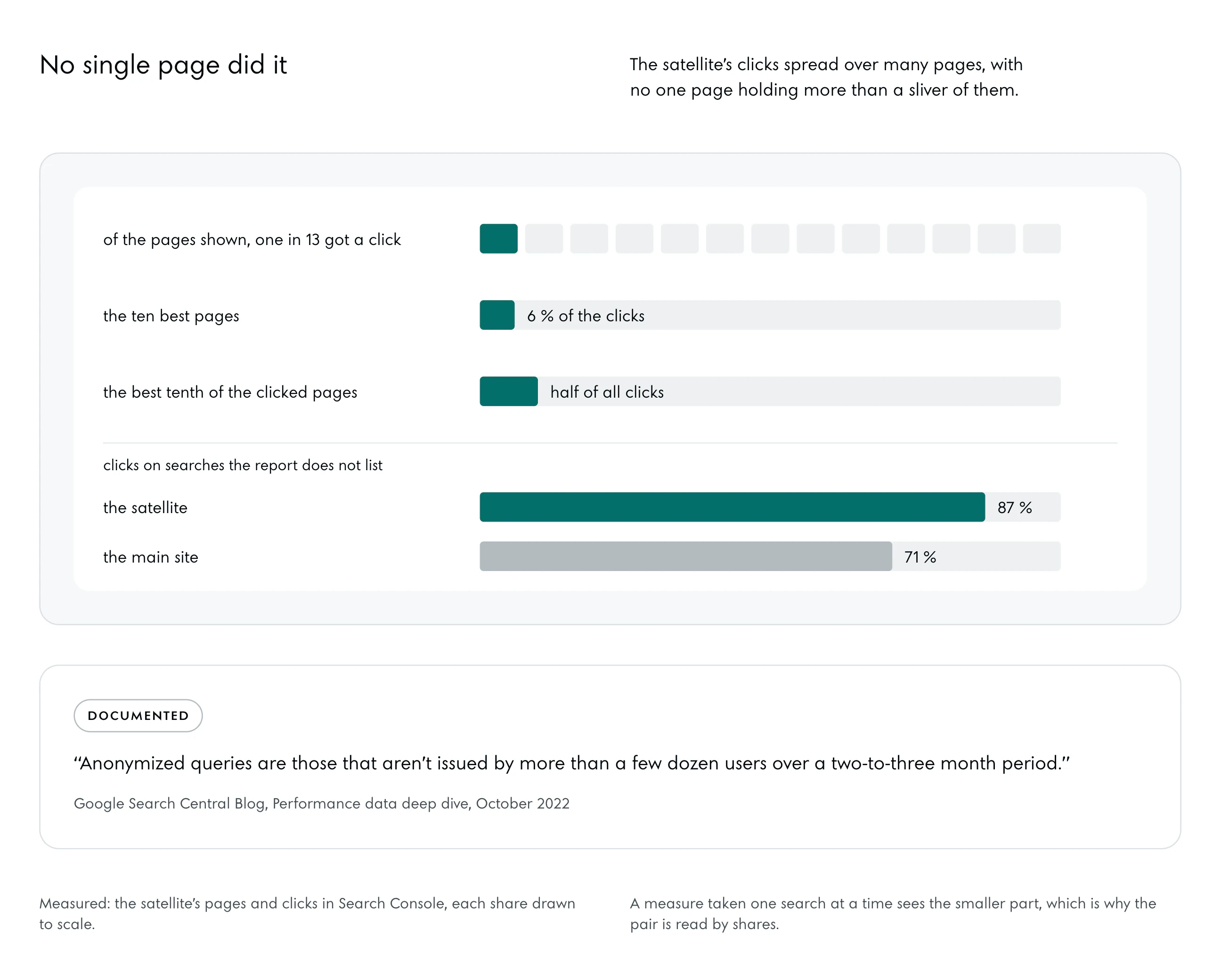
No single page did this, for of the pages that Google showed, one in 13 got a click; the ten best held 6 % of the clicks, and half of all clicks came from the best tenth of the pages that were clicked. Most of it cannot be seen search by search either, since 87 % of the satellite’s clicks and 71 % of the main site’s came on searches that the report does not list. Google gives the reason for the gap in its account of that report, “Anonymized queries are those that aren’t issued by more than a few dozen users over a two-to-three month period.” So a measure taken one search at a time sees the smaller part, and it is for that reason that we read the pair by shares.
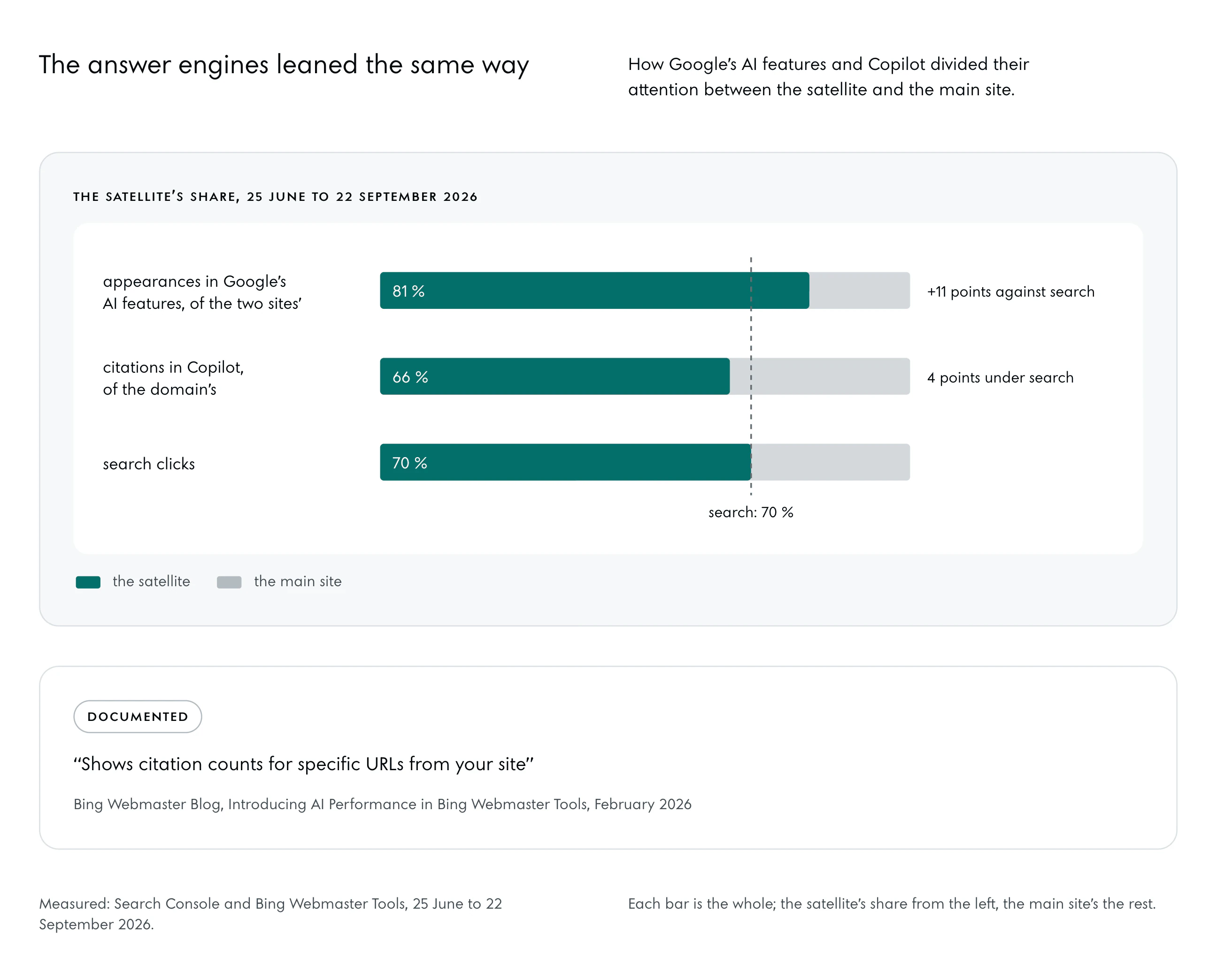
The answer engines leaned the same way, though by different amounts. From 25 June to 22 September 2026 the satellite took 81 % of the two sites’ appearances in Google’s AI features and 66 % of the domain’s citations in Copilot, against 70 % of its search clicks. Bing counts the second of these by address, in a report that, as its announcement says, “Shows citation counts for specific URLs from your site”.
Google’s AI features thus leaned on the satellite further than search did, by eleven points, and Copilot a little less than search, by four.
Meetings on a Results Page
Rarely did the two stand in one list. Where both ranked, the satellite stood at position 8 on average and the main site at 12. In the 30 days before they were separated, 2.5 % of the main site’s impressions came on searches that the satellite ranked for as well, and in no month did as much as 1 % come on a page that showed both.
The opening quoted Google’s rule that limits how many results one source may hold, and the two were almost never in a place where that rule could bear on them.
The clicks of one name moved from one site to the other, and the two almost never met on a results page.
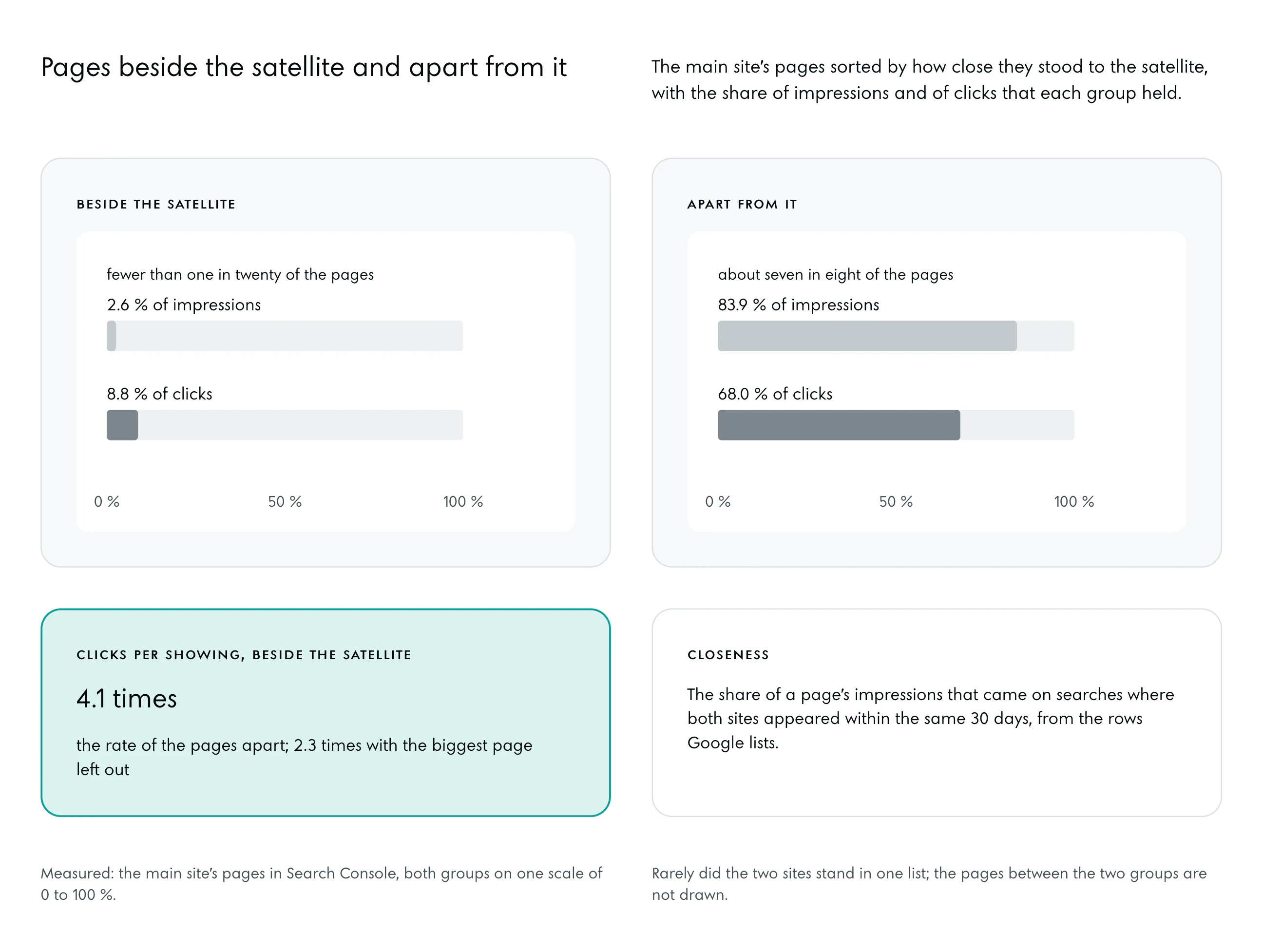
Fewer than one in twenty of the main site’s pages stood beside the satellite, and they held 2.6 % of its impressions and 8.8 % of its clicks, whereas about seven in eight sat apart from it, and those held 83.9 % of impressions and 68.0 % of clicks. Closeness is a narrow measure here, being the share of a page’s impressions that came on searches where both sites appeared within the same 30 days, taken from the rows that Google lists. Near the satellite a page drew more clicks each time it was shown, at 4.1 times the rate of the pages apart, or 2.3 times with the biggest page left out.
Subjects That Crossed Without a Link
Over the same months the main site changed what it was found for. Its older service pages stayed flat. Everything else fell from 93 to 38, with June 2025 as 100.
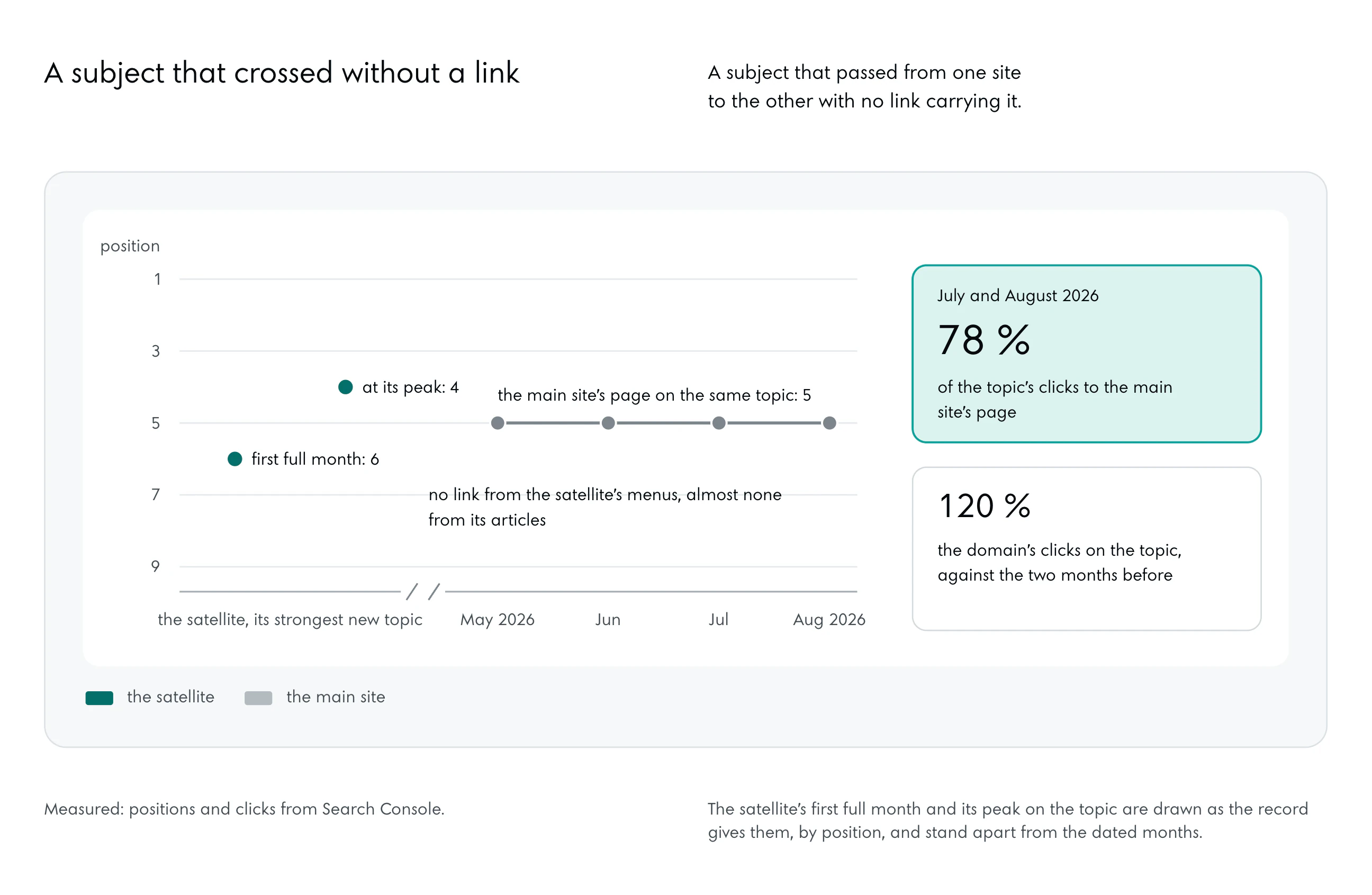
New pages on the satellite’s subjects, though, rose from none before December 2025 to 22 % of its clicks in June to September 2026. One subject shows the passage plainly. On its strongest new topic the satellite reached position 6 in its first full month and position 4 at its peak.
The main site’s page on the same topic appeared in May 2026 and held position 5. In July and August 2026 it took 78 % of the topic’s clicks, while the domain’s clicks on the topic stood at 120 % of the two months before.
That page had no link from the satellite’s menus and almost none from its articles.
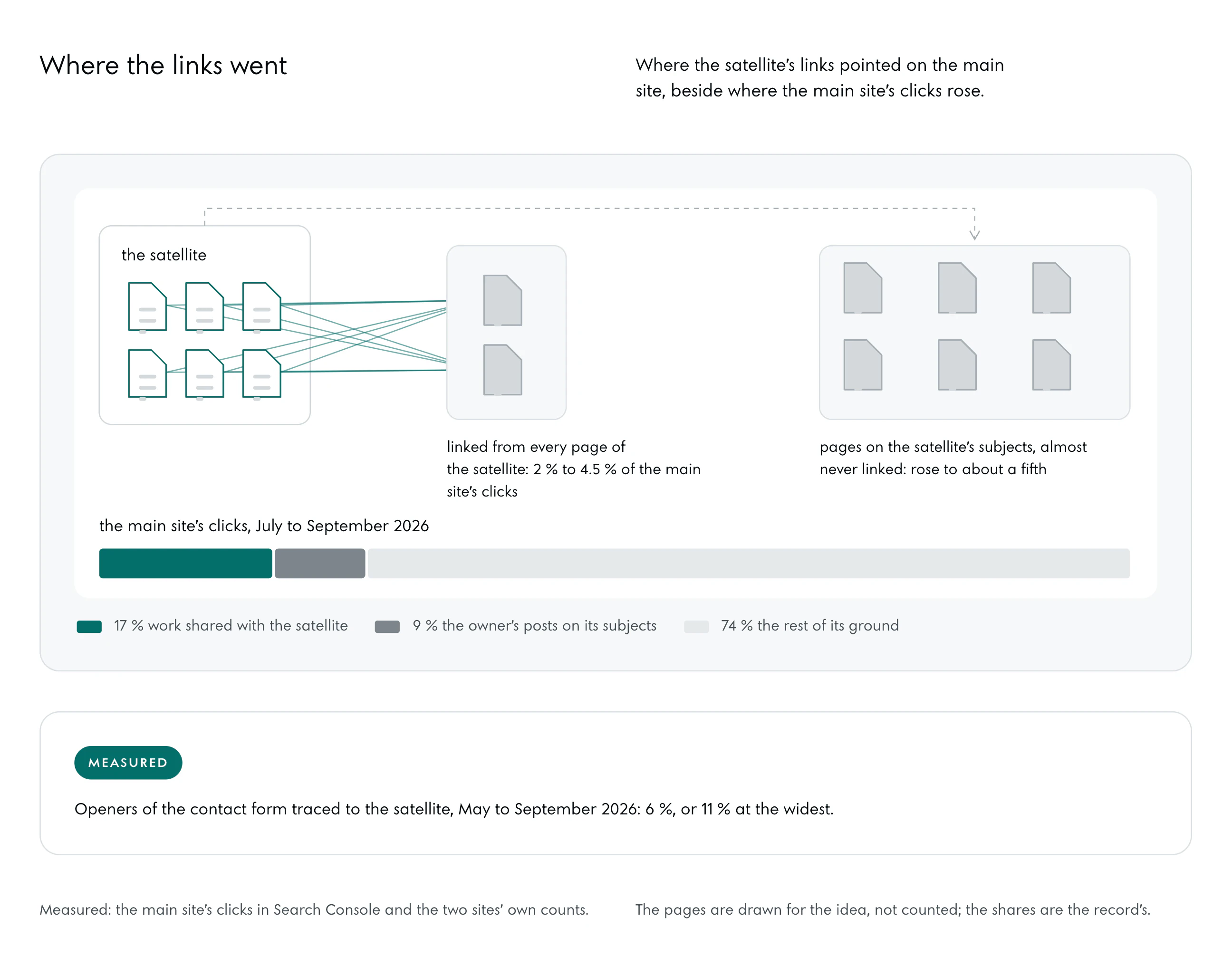
The links went elsewhere, for pages that every page of the satellite linked to stayed between 2 % and 4.5 % of the main site’s clicks, while pages on the satellite’s subjects, which were almost never linked, rose to about a fifth. Inside the main site, from July to September 2026, 17 % of clicks came from work shared with the satellite, 9 % from the owner’s posts on the satellite’s subjects, and 74 % from the rest of its ground. And of the people who opened its contact form from May to September 2026, 6 % can be traced to the satellite, or 11 % at the widest.
A finished record from another domain bears on links from the other side. In the summer of 2026 the links from a set of satellites into their main site broke while the sites stayed up. Those satellites were shown at 18 % of their impressions on the first day and at 6 % by the third, they stayed there for seven weeks, and on the day the links were restored they were back at 84 % or more.
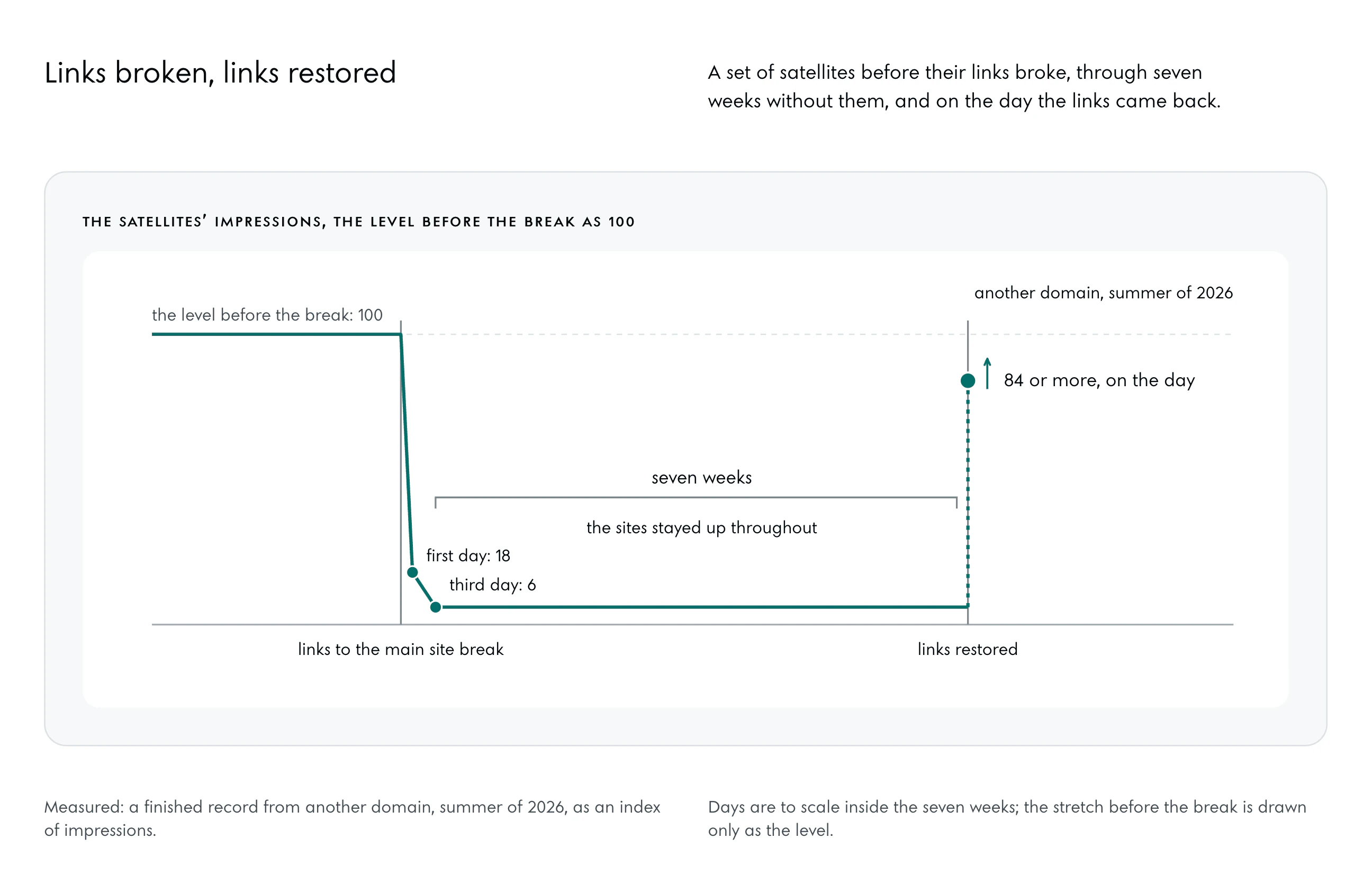
So one case has a subject that passed with no link. In the other, satellites fell on the day their links broke. The founder’s position, given as theory two parts back, stands beside both, and it is that links are how an engine finds the match sooner.
His position on subdomains stands here too, because this satellite was on one; the case is a single pair, and it cannot say what a folder would have done.
Neither case tests either position, since neither of them had a twin that was left unlinked.
Would the Main Site Have Fallen Anyway?
Year on year the older property was already lower. Early October 2026 was at 77 % of September, where the same week a year earlier had stood at 109 %. Its clicks in June, July, August and September 2026 stood at 62, 55, 58 and 53, with the same month of 2025 as 100, so that it drew a little over half of what it had drawn a year before.
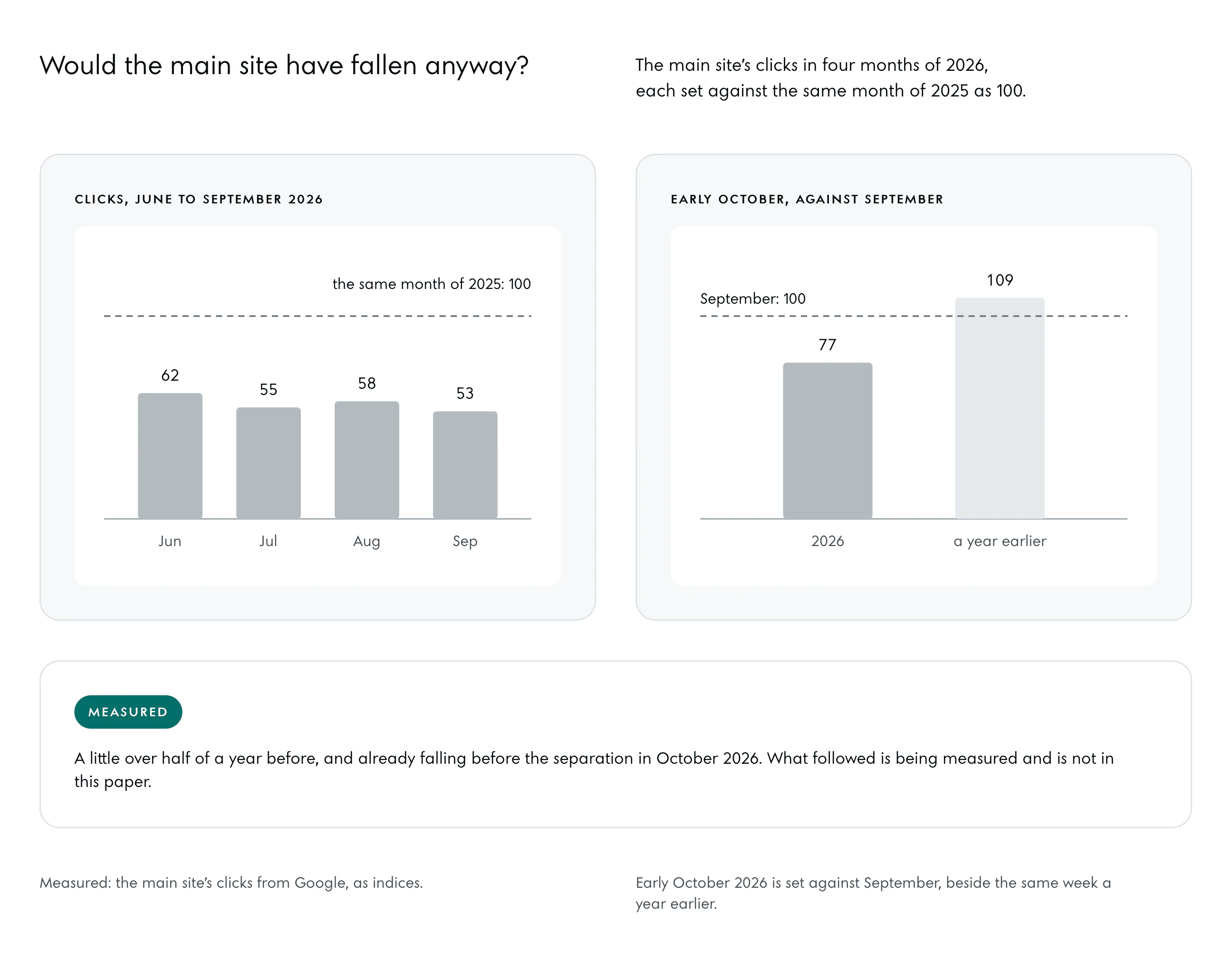
The two sites were separated in October 2026, and what followed is being measured and is not in this paper.
Table 3 holds the figures that carry a window.
| Quantity | Figure | Window |
|---|---|---|
| Satellite’s share of the domain’s Google clicks | 5 %, then 83 %, then 67 to 83 % | July 2025, March 2026, each month after |
| Satellite’s share of appearances in Google’s AI features | 81 % | 25 June to 22 September 2026 |
| Satellite’s share of the domain’s Copilot citations | 66 % | 25 June to 22 September 2026 |
| Satellite’s share of search clicks | 70 % | 25 June to 22 September 2026 |
| Main site’s impressions on searches both ranked for | 2.5 % | The 30 days before the two were separated |
| Main site’s impressions on a results page that showed both | Under 1 % | Any month |
| New pages on the satellite’s subjects, as a share of the main site’s clicks | From none to 22 % | Before December 2025, then June to September 2026 |
| Main site’s page on the topic that passed, as a share of the topic’s clicks | 78 % | July and August 2026 |
| Main site’s clicks from shared work, from the owner’s posts, from the rest | 17 %, 9 %, 74 % | July to September 2026 |
| Openers of the contact form traced to the satellite | 6 %, or 11 % at the widest | May to September 2026 |
| Main site’s clicks, with the same month of 2025 as 100 | 62, 55, 58, 53 | June to September 2026 |
These figures say what moved, and they are silent on why. Whether the engines held the two sites as one group is not shown, for the leaked pages name an id for clusters of sites and say no more. Nor is it shown whether the main site would have fallen without its satellite, because it was falling before.
As theory the figures fit one well under the name, in which text added on the satellite moved the main site’s place on the satellite’s subjects while the two almost never shared a page. The test of the part before this one asks for a control, and here we had none of our own.
10Ground a Firm Does Not Host
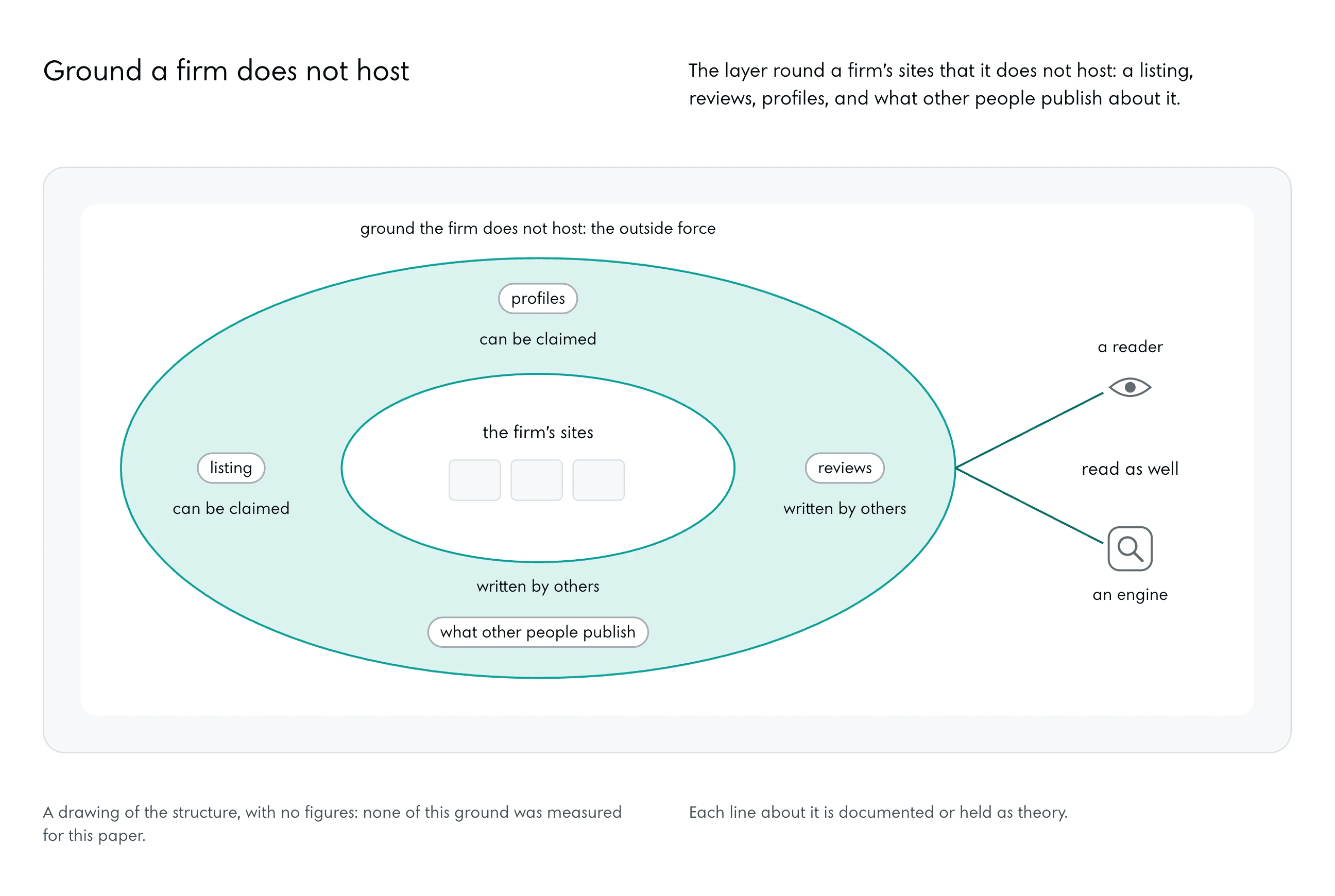
Off the site an engine still reads, and what it reads there is the outside force of the field. Some of that ground can be claimed.
All the rest of it is written by people whom the firm does not pay and whose words it cannot edit. We have never measured any of it, so each line below is either documented, from the engines’ pages and from published research, or it is theory and comes with its test.
Profiles the Engine Hosts
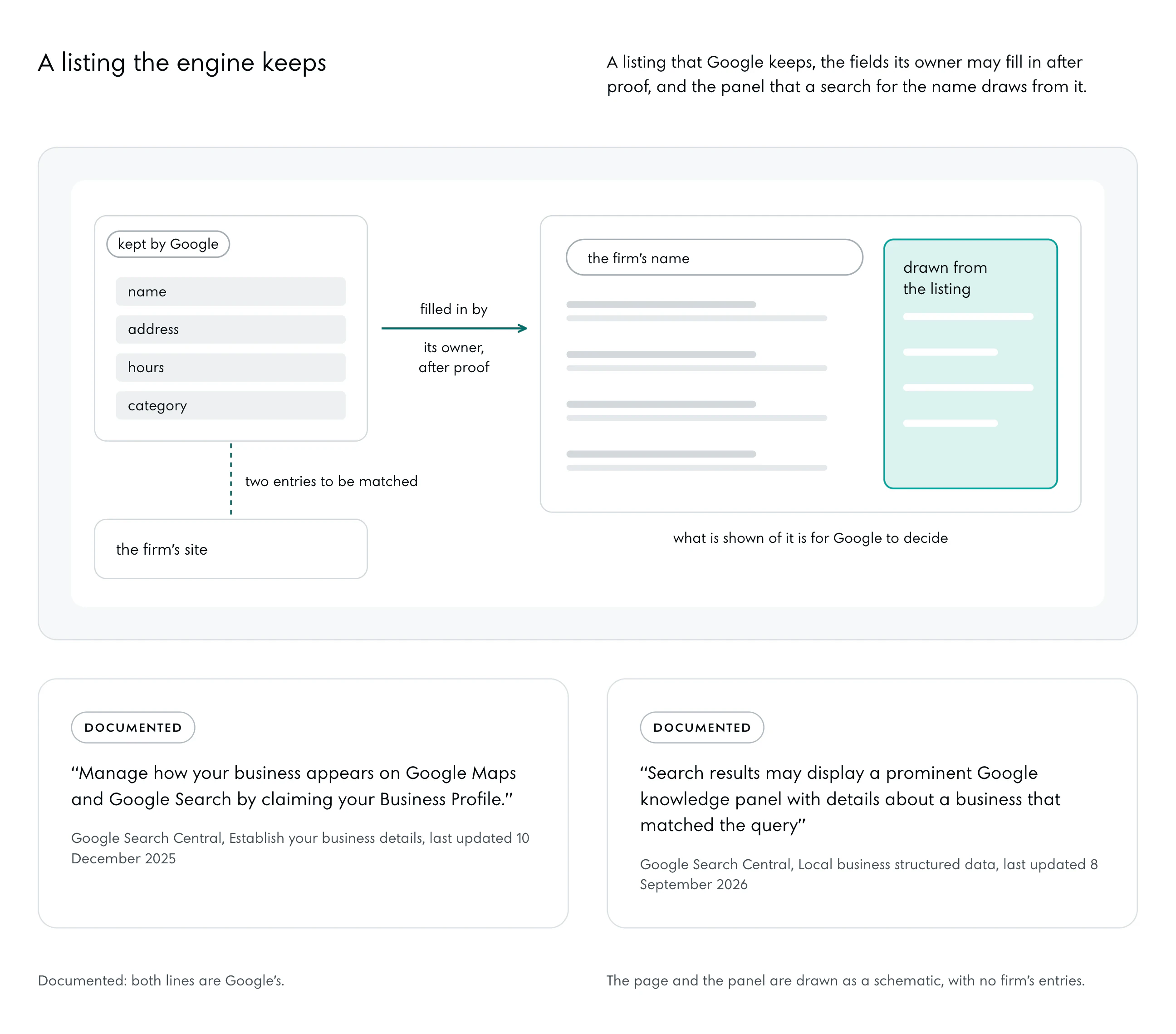
Listings are the nearest case, since a listing is a page about the business that Google itself keeps. Its page on business details gives the firm’s part in one line, “Manage how your business appears on Google Maps and Google Search by claiming your Business Profile.” And the page for local business markup, last updated on 8 September 2026, says where such a listing then shows, “Search results may display a prominent Google knowledge panel with details about a business that matched the query”. So the panel beside a search for the name is drawn from a page that the firm fills in and Google keeps; the name on the site and the name on the listing are then two entries, and an engine has to match them as it would match any two.
Its owner fills the listing in. What is shown of it is for Google to decide.
Reviews and Their Source
Ratings are the plainest outside text, and Google’s page on them fixes where they may come from. A snippet, it begins, is taken from elsewhere, “A review snippet is a short excerpt of a review or a rating from a review website”, and the page then asks that ratings should come straight from users. One more line of the same rule was given in the part on properties, and it is the one that shuts out reviews which a firm controls about itself.
Taken together these say that a rating counts where a user wrote it, on a site that belongs to someone else, entirely out of the firm’s reach.
Independent Sources Outweigh Self-Description
Human raters work for Google under guidelines that are written down. The edition of 11 September 2025 tells them how to weigh what a firm says of itself against what others say of it. It is guidance for people who grade results and never an account of how a system ranks, and that is why we label it so.
Two of its lines bear on this paper. The first says what is to be judged, “Reputation research applies to both the website and the actual company, organization, or entity that the website is representing.” And the second sets the weight, “When there is disagreement between what the website or content creators say about themselves and what reputable independent sources say, trust the independent sources.”
So the people who grade Google’s results are told to read a site and the firm behind it as one thing, and always to let the outside win where the two disagree.
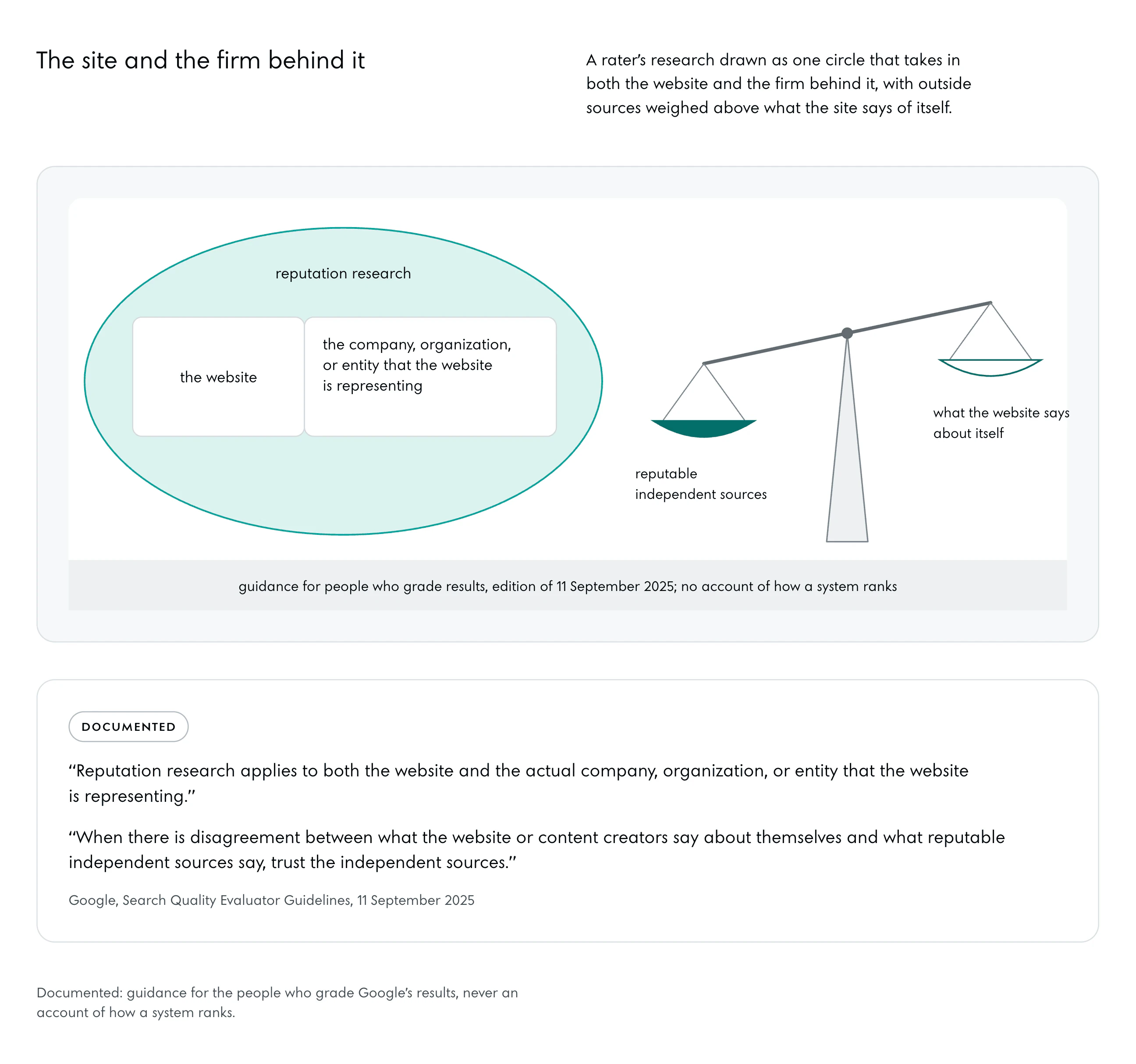
Answer Engines and Outside Text
Chen, Wang, Chen and Koudas studied AI search across several verticals in a paper of 10 September 2025, and what they report there is “a systematic and overwhelming bias towards Earned media (third-party, authoritative sources) over Brand-owned and Social content”. In the terms of this paper earned text is the outside force and brand-owned text is the inside one, so that if the finding holds, an answer engine leans on the outside when it speaks of a firm. That what the firm writes then serves mostly as the thing the outside is matched against is theory.
The part on the gradient gave the same theory for what authority is.
Only one measured case stands in this paper, and it sits to one side of all this. Every citation that was counted there went to a site that the firm wrote, and so it cannot tell how often the engines chose outside text where both kinds could be had.
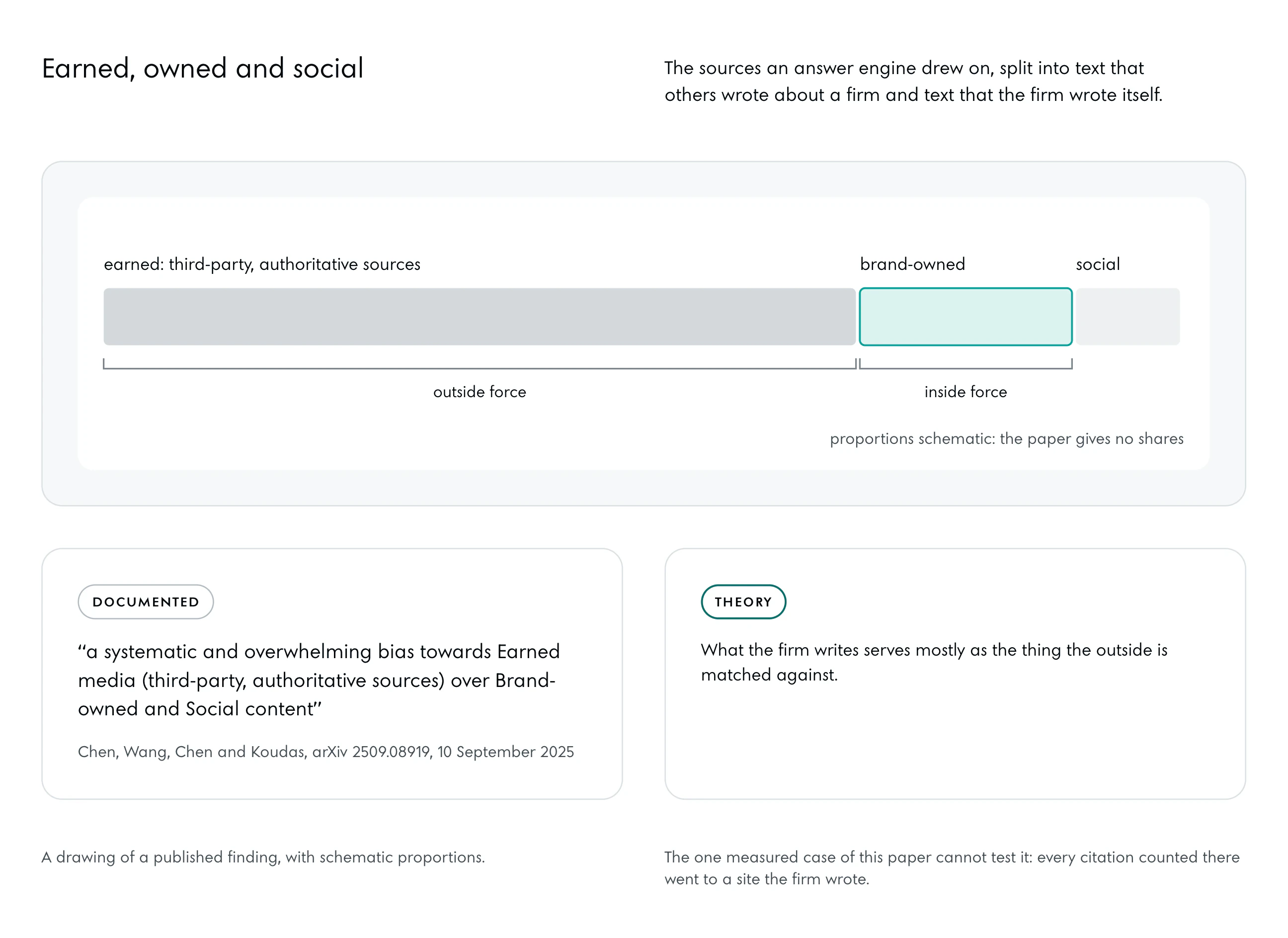
Invented Claims as Published Tests
Twice in the year before this paper someone made a story up and watched what the engines did with it. The first was published by Mateusz Makosiewicz of Ahrefs on 10 December 2025. “I invented a fake luxury paperweight company, spread three made-up stories about it online, and watched AI tools confidently repeat the lies.” The firm’s site carried an official page of questions and answers, three outside sources carried the stories.
To the tools he put 56 questions. By his report “Almost every AI I tested used the fake info”, and his summary is that “in AI search, the most detailed story wins, even if it’s false”. The second was reported by Thomas Germain of the BBC on 18 February 2026.
“I spent 20 minutes writing an article on my personal website”, he wrote. Less than 24 hours later, by his account, Google’s Gemini app, its AI Overviews and ChatGPT were repeating what that page said, though Claude was not taken in. Both are single tests on things about which there was almost nothing else to read, and that is all that either of them can be asked to show.
They show the outside force at work where the pull is weak, which is probably why a few texts could set the centre, for there was no other text to weigh them against.
As theory the same tests give authority its sense in the field, for on that account authority is how far the inside and the outside agree, and where they differ an engine that follows the outside will repeat the outside. The test that would break this is the first one turned round, with a firm that is widely written about and three new stories set against it.
If the stories win as easily there, the match counts for nothing.
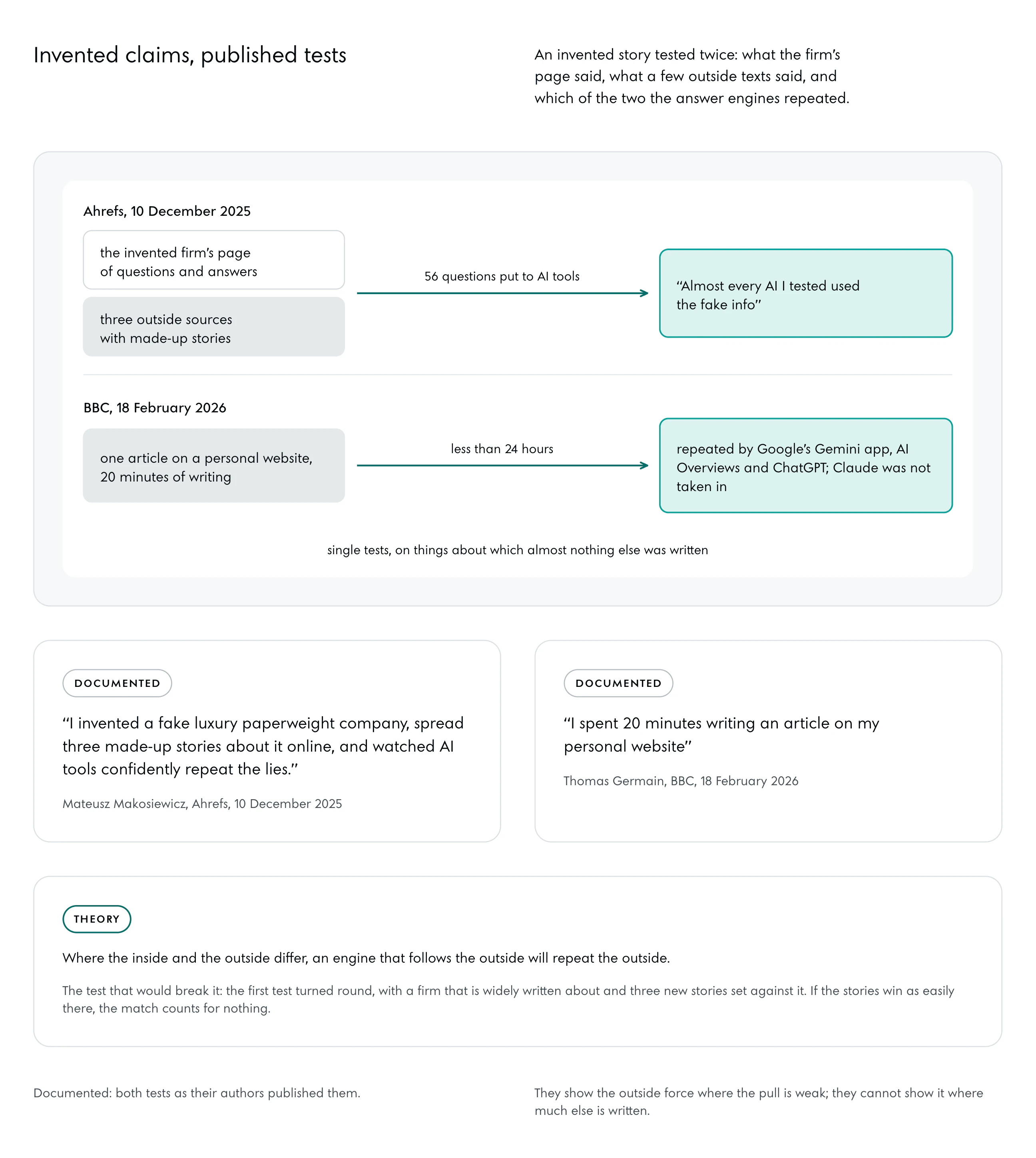
11Where a Tie Becomes Abuse
Whatever joins two sites carries blame as well as credit. So the practice this paper describes has an edge, and that edge is documented.
Google’s spam policies, last updated on 28 August 2026, name several ways of joining that they treat as abuse. In each of them the test is what the join was made for.
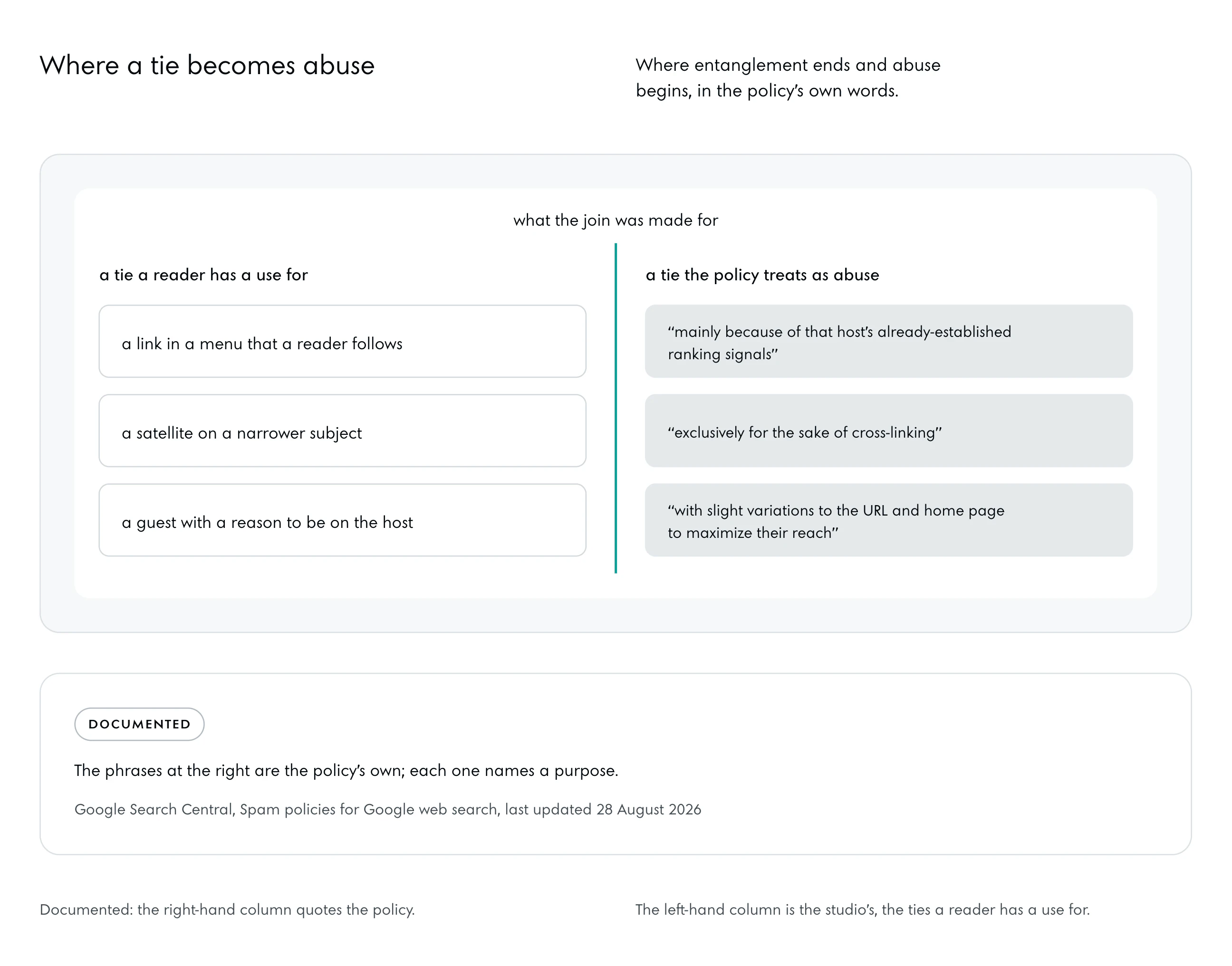
Standing Travels Both Ways
Trust was spread along links in a method of 2004. Gyöngyi, Garcia-Molina and Pedersen began with a very small seed of pages that people had checked by hand. From there the method let trust flow outward through what those pages linked to, and it rested on one observation, that “good pages seldom point to bad ones”.
Read the other way round, the same observation costs a page that does point to a bad one. What passes along a tie can be loss as much as gain. The finished case in the part on the main site and its satellite shows as much from the side of what was measured.
There a set of satellites lost most of what they had been shown for on the day their links to the main site broke.
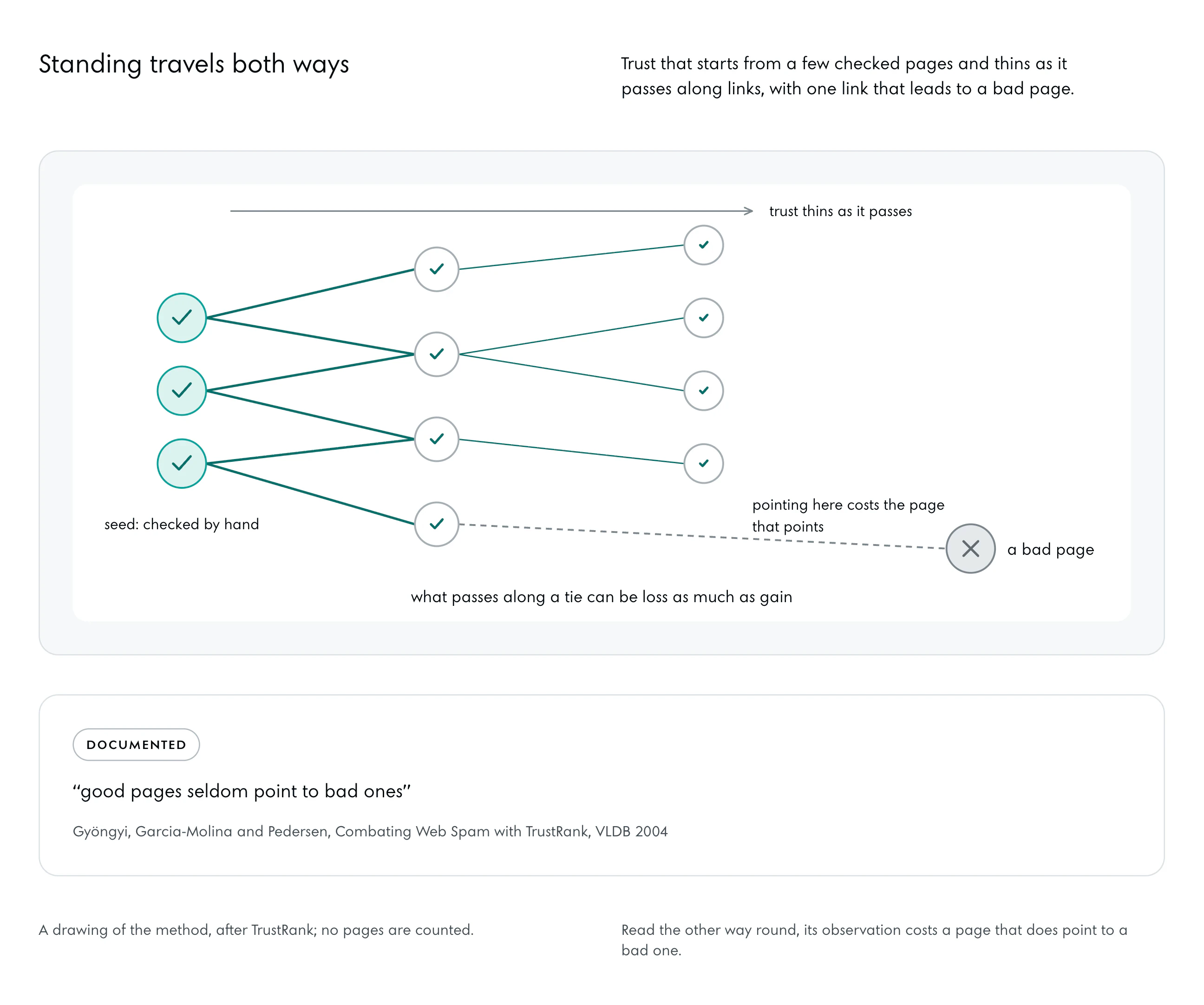
Content on a Borrowed Host
Publishers have let others write under their good name, and Google wrote a policy for it, in which one word, “mainly”, carries the rule. “The site reputation policy applies where third-party content is published on a host site mainly because of that host’s already-established ranking signals, which it has earned primarily from its first-party content.” A guest on a host is no offence, and what the policy asks is why the guest is there. On 19 November 2024 Google said how it treats a part of a site that does not belong with the rest.
Its post says, “we also have systems and methods designed to understand if a section of a site is independent or starkly different from the main content of the site”, and of such sections it adds, “It means we’re measuring them independently, even if they are located within a site.” Here an engine states that it can cut a tie which an address would seem to make, so that a section in a folder of a strong host may be weighed as if it stood entirely alone. In the terms of the field that is a second centre found inside one site, far enough from the first for the two to be read apart. How it is done is theory; that it is done is documented.
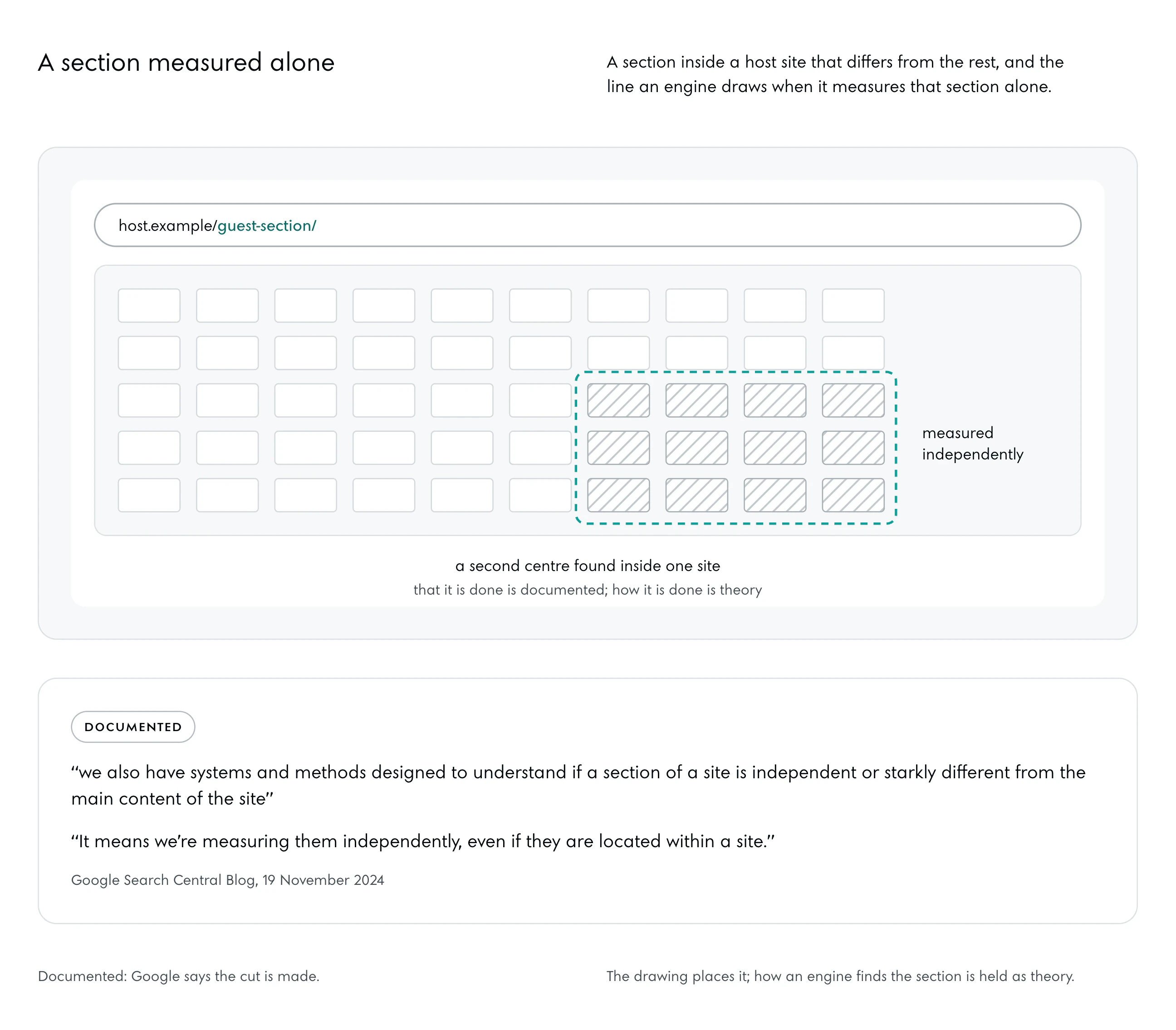
Doors and Links Between a Firm’s Sites
Purpose decides here as well, for the policy defines its next fault by what a thing was made for. “Link spam is the practice of creating links to or from a site primarily”, in the policy’s words, in order to manipulate where it ranks in search. Among its examples are “Excessive link exchanges (“Link to me and I’ll link to you”) or partner pages exclusively for the sake of cross-linking” and “Widely distributed links in the footers or templates of various sites”.
A firm that joins its properties through a menu or a footer makes links of nearly that shape. What keeps them clear of the rule is that a reader has a use for them.
Doorways are the same fault made with sites. One example in the policy is “Having multiple websites with slight variations to the URL and home page to maximize their reach for any specific query”. A satellite is therefore never a copy of the main site on another address, for it holds a narrower subject that the main site does not treat at length, and that is what parts it from a door.
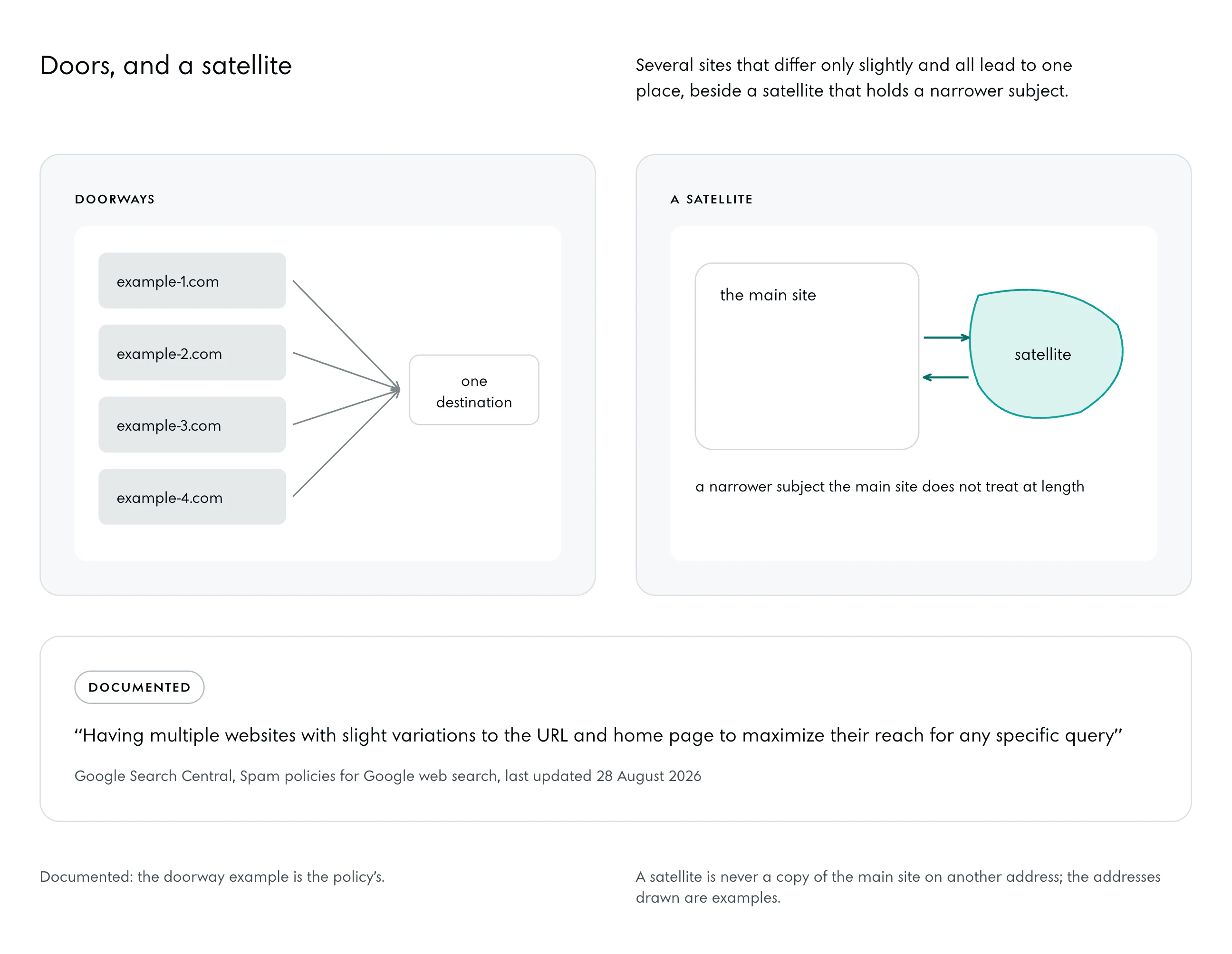
Sites under one name are read together, for better and for worse.
Forged Fields
PoisonedRAG is the name that Zou, Geng, Wang and Jia gave to an attack they published on 12 February 2024. They wrote a few false texts for each question they wished to bend and put them into the store from which a model draws its answers. The result they report is “a 90% attack success rate when injecting five malicious texts for each target question into a knowledge database with millions of texts”.
Five texts among millions were enough.
Varied wording round a fixed term is no cover for stuffing a page with it. The first paper quoted the policy’s line on that, and nothing here loosens it.
Both tests of the part before this one are the same thing done in the open, and they show what the field looks like to someone who means harm. Where little is written, a centre can often be set by whoever writes first and writes most. A firm’s defence is probably the plain one, which is to have written enough, in terms that agree, that a few new texts cannot move the centre; we give this as theory, and its test is the turned-round one already stated.
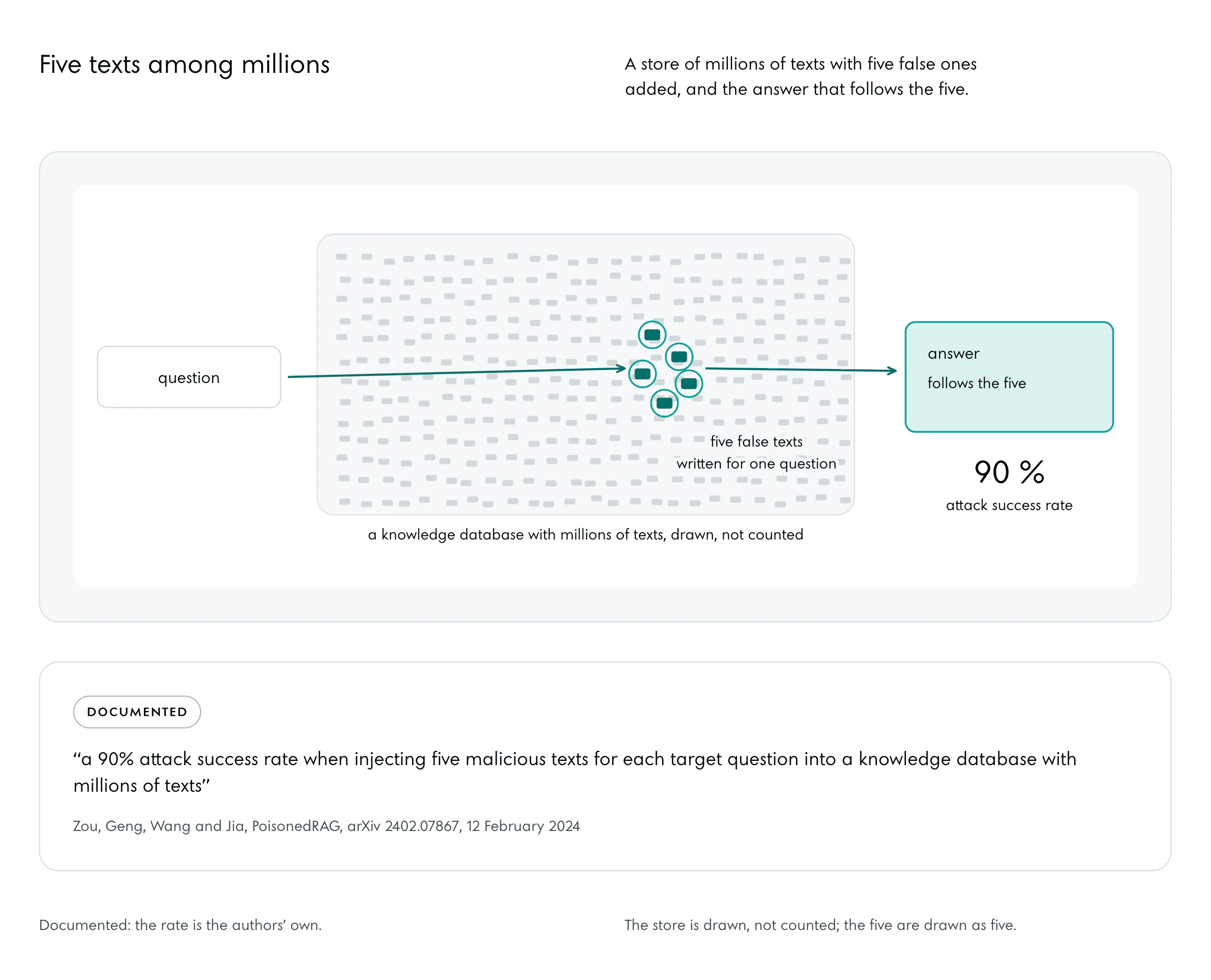
Actions and What They Cover
Enforcement is told in one sentence of the same policies. “Sites that violate our policies may rank lower in results or not appear in results at all.” The page adds that such cases are found both by systems and by people who review them. An engine that reads a firm’s sites together can act on them together, and we know of no published line that says how far an action against one site reaches the others under its name.
So the test a firm can apply before it ties two things is always the policy’s test, which is to ask what the tie is for and who gains by it.
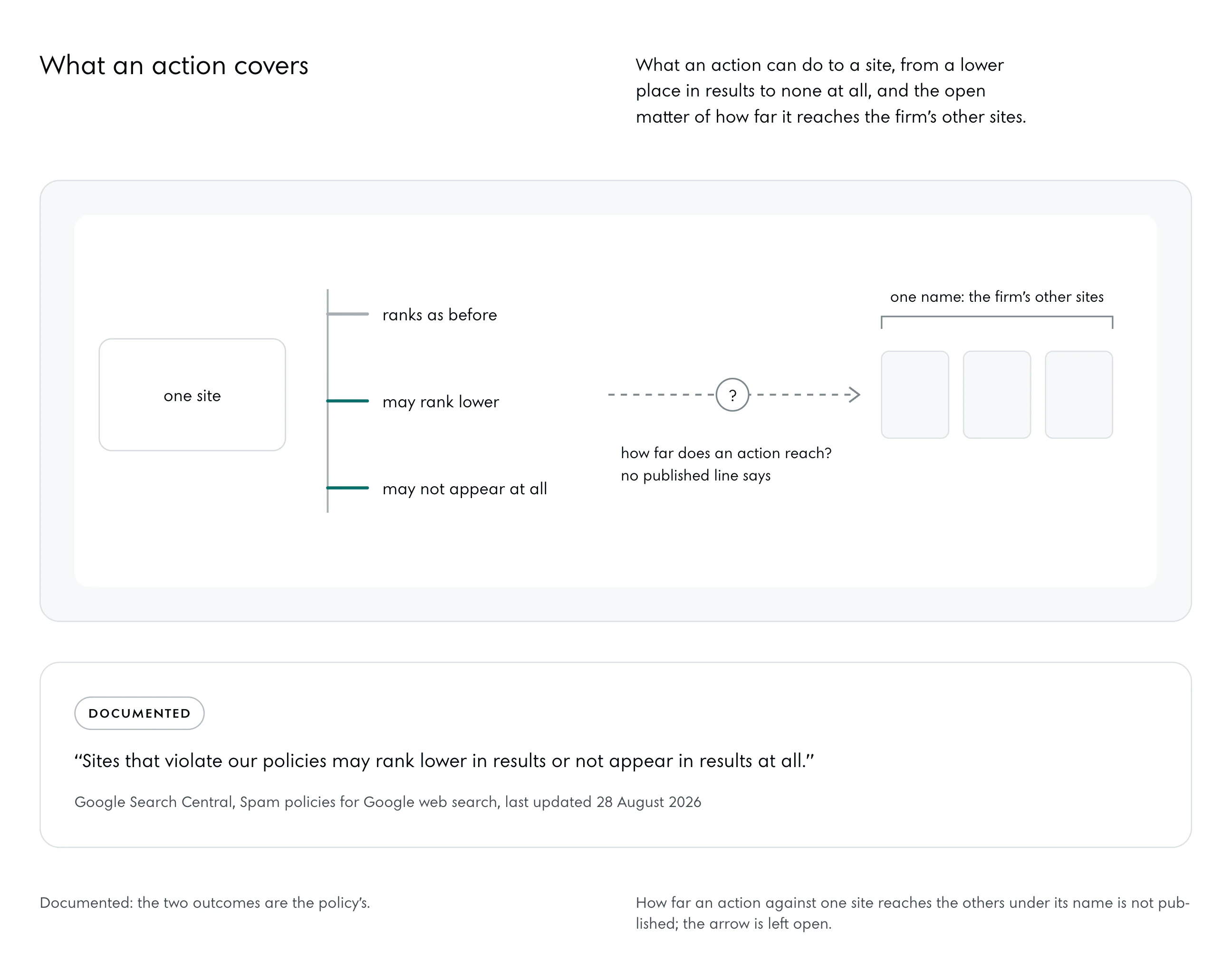
12Position Across Every Touch Point
Seven steps make up the practice, and they are taken in order.
- Every property is counted, class by class.
- The name is fixed in one spelling, with one alternate.
- Identity is declared and proved, from the inside out.
- One account of what the firm is gets written, in defined terms.
- That account is carried through what a client receives.
- Each subject is either tied to the name or kept apart from it.
- Before and after each change, the pair is measured.
Most of the seven rest on what earlier parts have documented, and several need no more than their line. Measuring the pair, which is the last of them, is a method in itself.
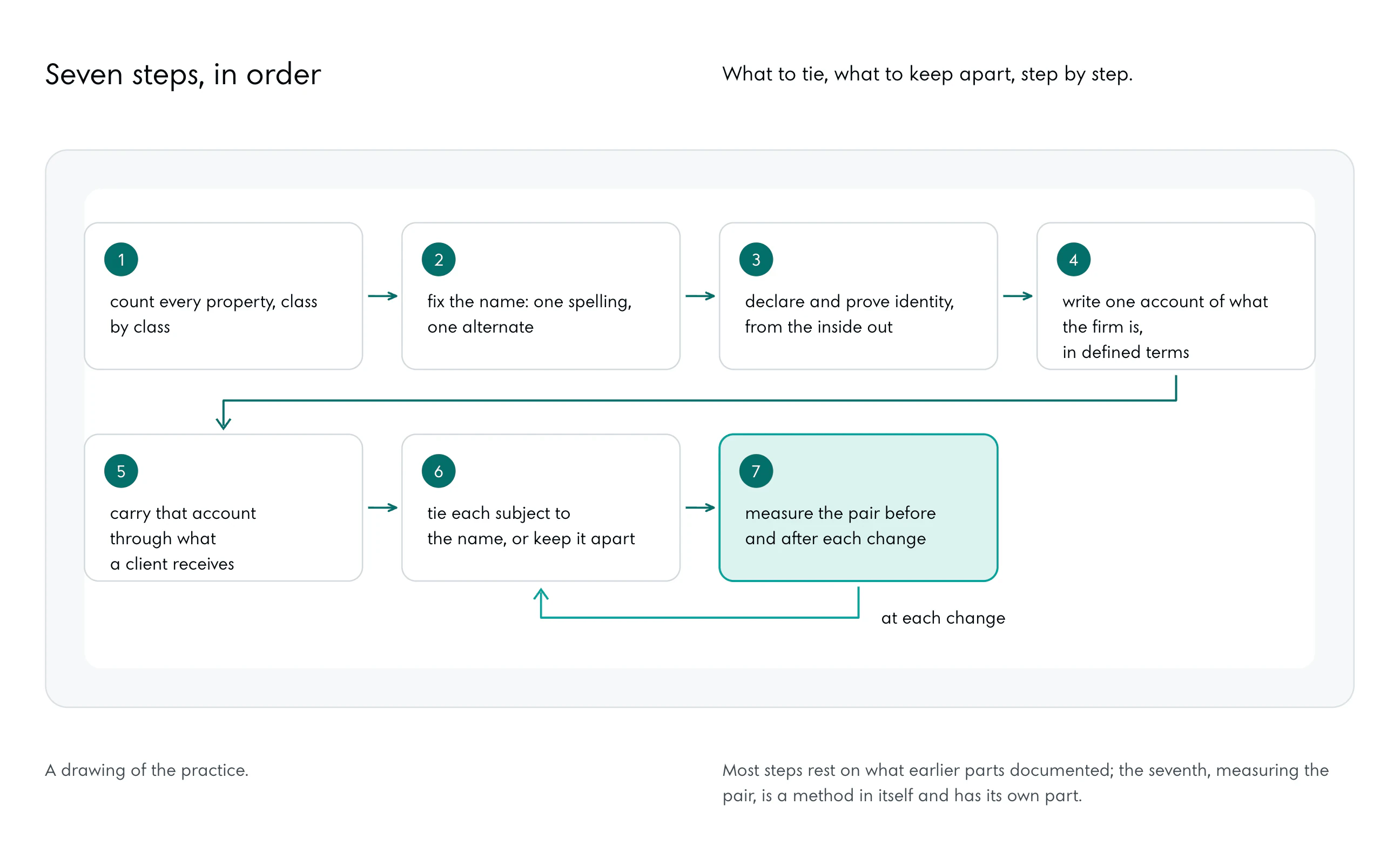
Inventory First, Then the Name
Counting what exists is the first step, and the four classes of the part on properties give its columns. For each property the count notes who controls the text, what unit it stands on, and what ties it to the name at present. Then comes the name, and Google’s page on Organization markup says how it should be written across a firm’s entries, “Use the same name and alternateName that you’re using for your site name.” One spelling and one alternate are then carried to every profile, to the listing, and to the sender’s name on mail.
This is plainly the first paper’s rule for a term, and here it is applied to the name of the firm itself.
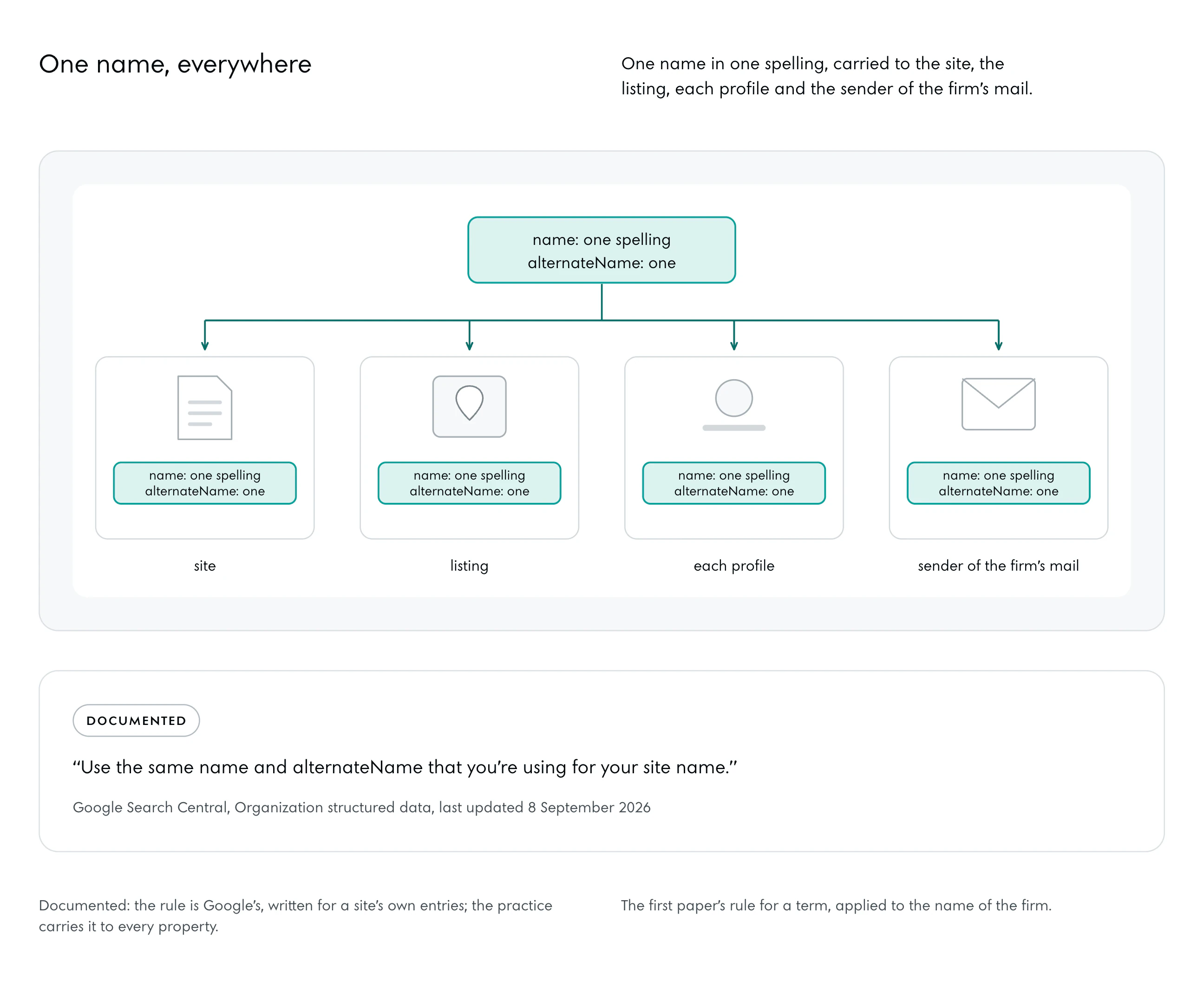
Verification in Order
Proof follows, and it goes from the inside out. Each proof has been quoted already, in the parts on properties and on ties, and what the practice adds is the order in which they are done. We prove the domain first, so that the listing and the profiles can then point at a site that the engine already holds to be the firm’s, and the site can name them back with sameAs and with its numbers in registries.
Mail comes last, since the sender’s domain is lined up with the registered one and never touches an index.
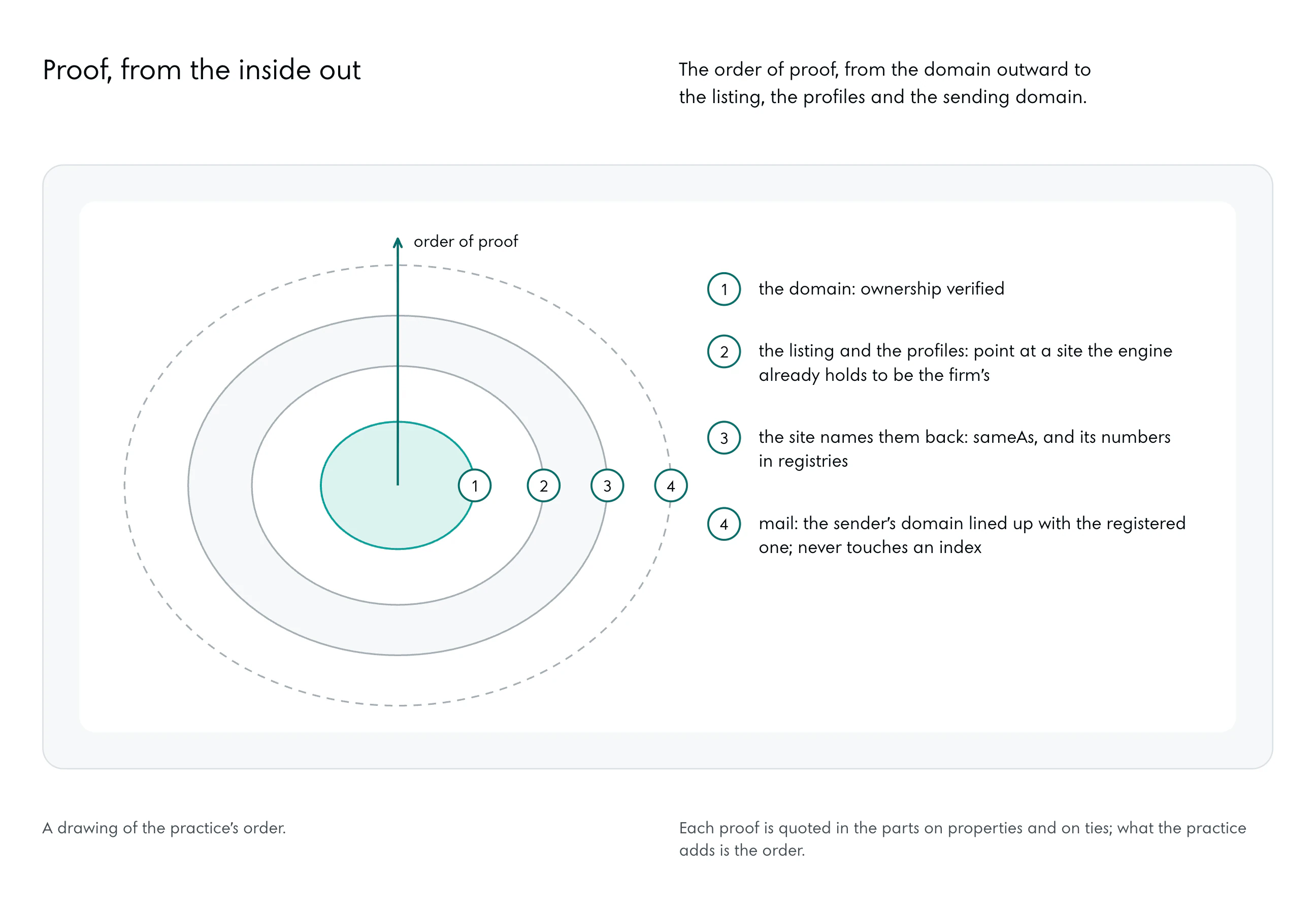
Same Account, Varied Words
Keller described in 1993 what a brand is in a buyer’s memory. “Brand knowledge is conceptualized according to an associative network memory model in terms of two components, brand awareness and brand image”, his abstract says. That is the structure of the lexicon in the part on words, a node with links to all that it has been met with, and every touch point adds links to the node.
One account of what the firm is, set on every property, makes those links agree.
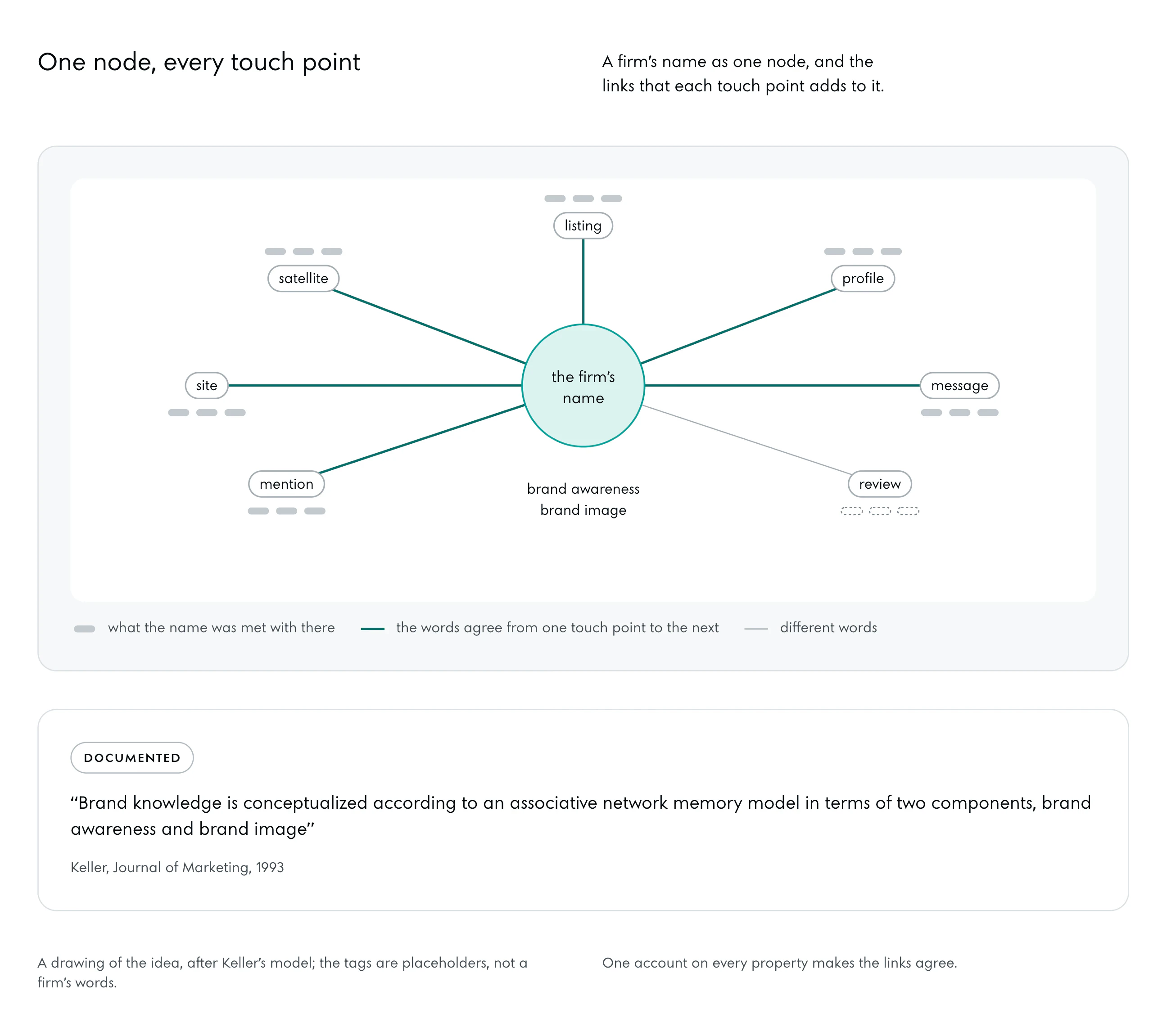
But one account does not mean one text copied everywhere. A primary term never varies; each has a single written form, and together they say where the centre is. Round them the other terms are varied on purpose, often widely, from one property to the next.
On the theory of this paper it is these that set the shape of the slope, which is to say how wide the well is and toward which shorter searches it leans. This is theory, it is the studio’s, and it comes with a test. The test takes two properties of one firm on one subject, both with the primary terms in one form.
One of them repeats the main site’s surrounding words, and the other draws on the wider vocabulary of the subject. If the second is shown for no more of the shorter searches than the first, the theory fails.
The fifth step takes the same account into what a client receives. An engine reads none of that mail, as the part on properties said, but the client does, and a client who later writes a review or a post is likely to write it in the words the firm used. So the inside force would reach the outside one through the people who stand between the two.
We hold this as theory too, and a firm can test it by reading the terms in its reviews before and after the terms in its messages are fixed.
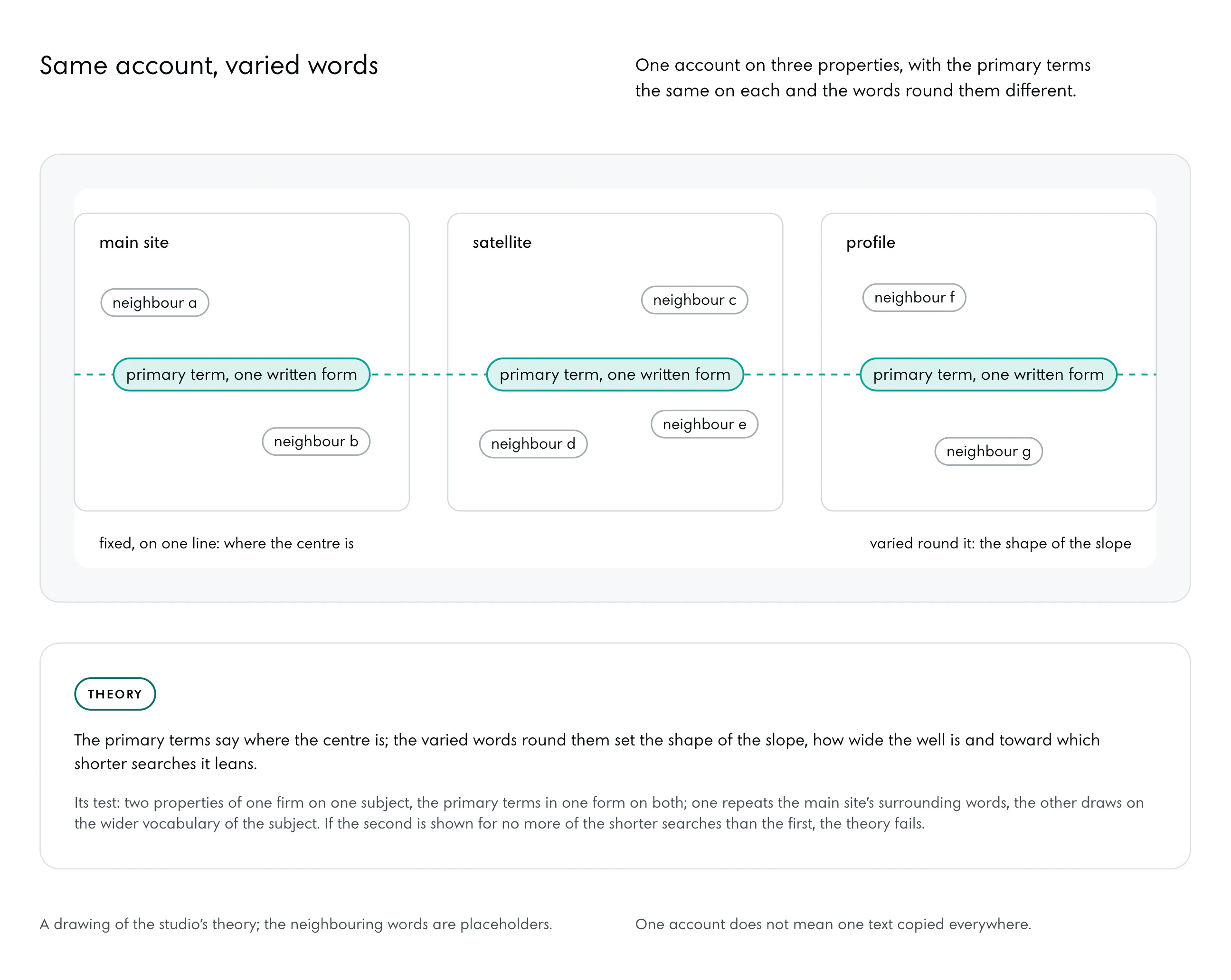
Tying and Keeping Apart
Each subject a firm writes on lies either near the centre under its name or far from it. A subject that lies near is tied. It goes on the main site, or on a satellite that declares the main site and is declared by it.
A subject that lies far always gets a separate body under another name, or else it is left unwritten.
The part on abuse gave the reason from the engine’s side, for Google states that it measures a section apart when that section differs starkly from its host. A firm that makes the cut itself chooses where it falls. And a tie that would be made for ranking alone is left out, by the policy’s test of purpose.
On the founder’s position a satellite that is meant to reach widely goes on a subdomain and a tight resource goes in a folder, which was given as theory with its test in the part on properties.
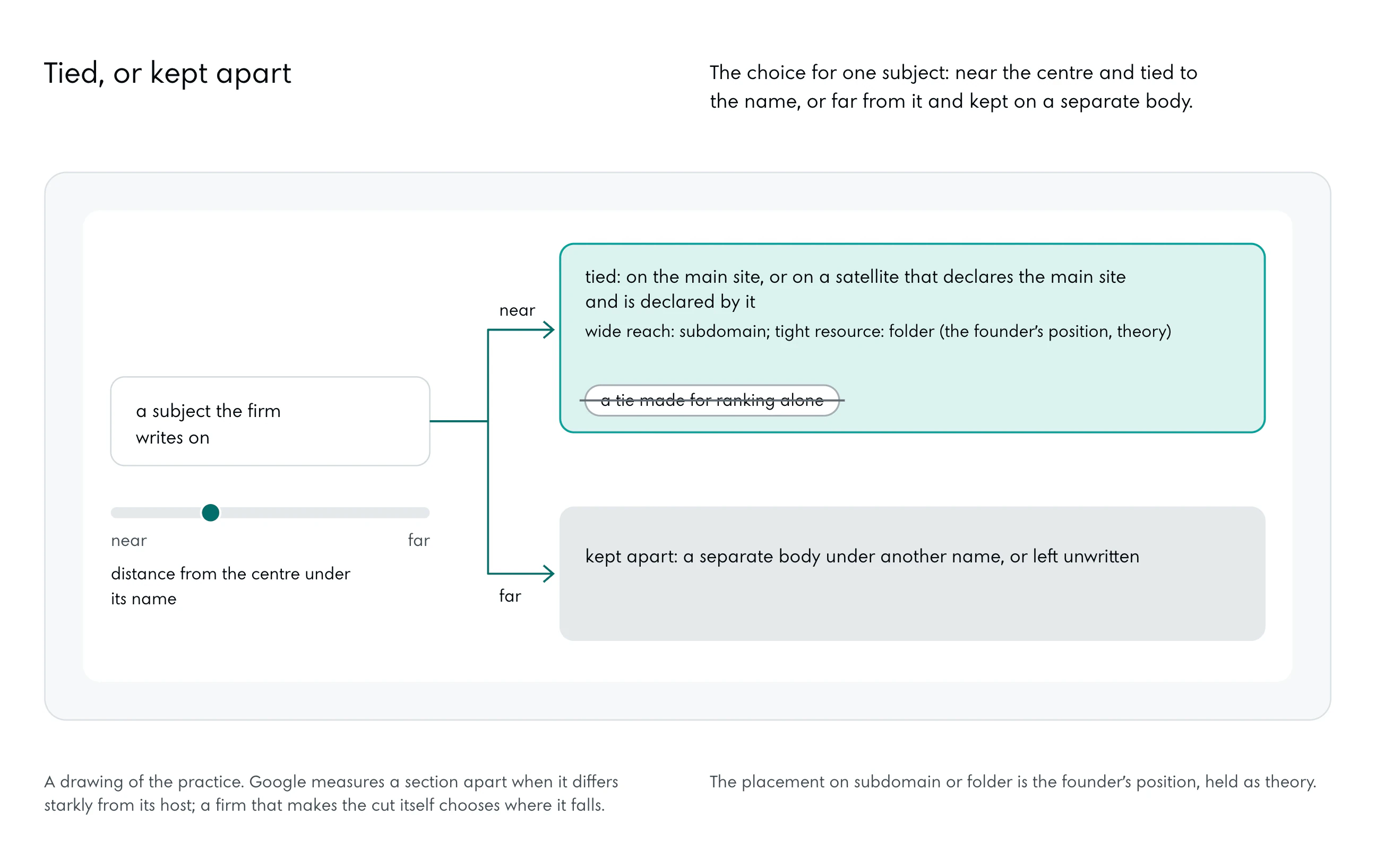
Starting Where the Pull Is Weak
Where a new property begins matters as much as what it says. The second paper holds a measurement of new domains on crowded subjects and on open ones; we point to it here and do not teach it again. In the terms of the field a crowded subject is a deep well that others have made, and a new property set down at its rim stands very far from the centre however well it is written.
An open subject has a shallow field, in which a few pages that agree can perhaps make a centre of their own. So a firm with a choice would probably begin on the open ground nearest to what it does and work inward from there, all of which is theory.
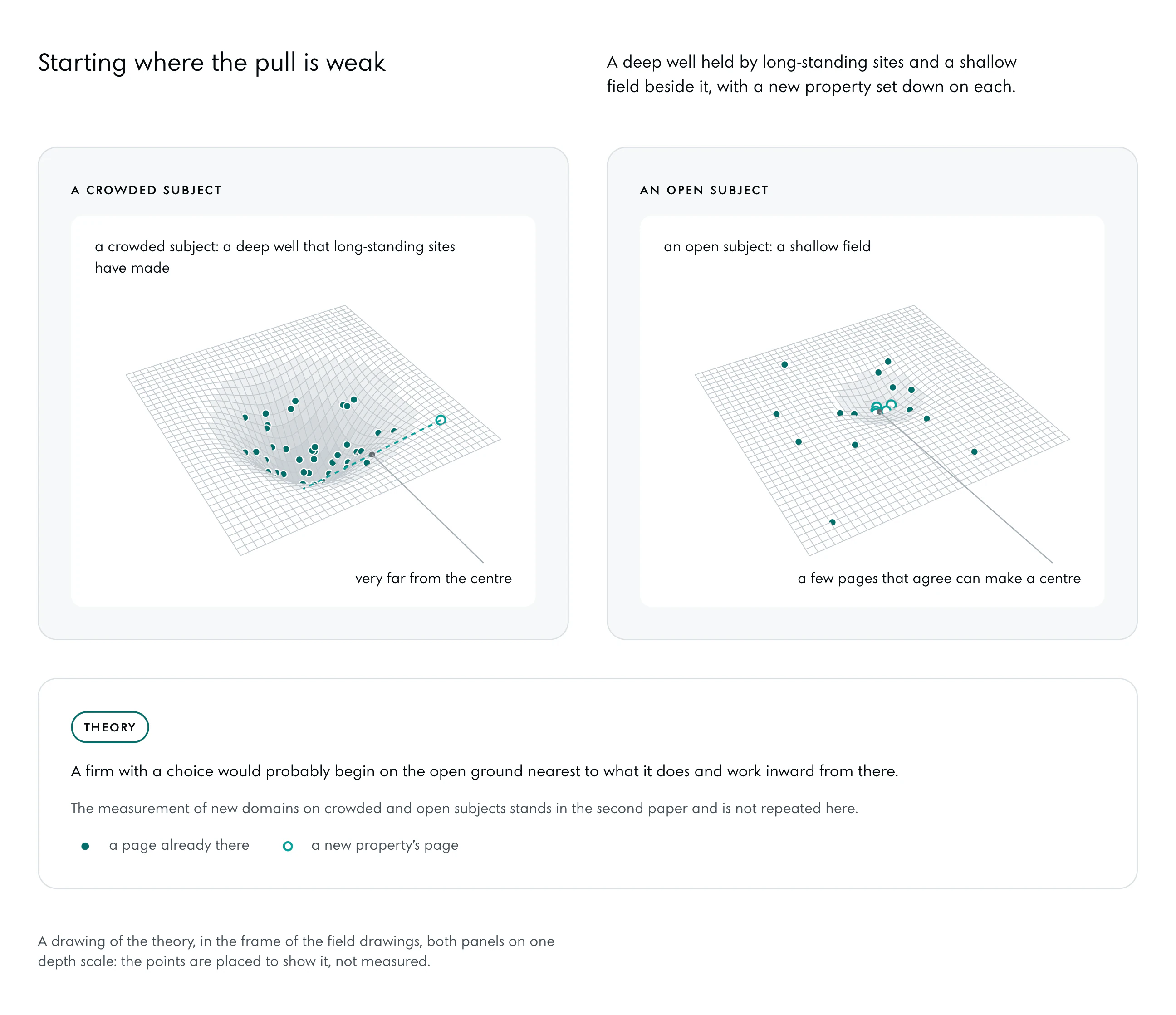
The part on the gradient placed a single word at the head of a subject far out on the slope, where a firm’s share of the text is small, and the founder puts a span of years on it. In his account, given on 14 October 2026, such a word takes years to rank on where long-standing sites hold it, since what keeps them in place is the standing others have given their domains, the links that point to them and how often people mention them. At the size of a name all three belong to the outside force, since others give them, over years, to everything under the name.
The second paper sets out, in “Can a Structure Be Taken?”, what it costs to displace one site’s body of pages; a name adds every property under it and everything others have written about it, and the part on words gave, as theory, why an old name’s place is so hard to move. His span of years is theory too. It fails if a new property reaches the first page within months for a head word that long-standing sites hold, while their links and mentions stay where they were.
On open ground a set of pages can bring out the pattern this paper describes. He gives its purpose as content that holds, and he says plainly that manipulating results is no part of it. The part on abuse gave the policy’s test of purpose, and here a firm applies it to its own work.
Time is a dimension of the same field. Points arrive one at a time. A centre forms only once enough of them stand close, and an engine has to fetch, index and place each one before it counts.
That a field built slowly holds better than one built at once is theory as well, and its test publishes one set of pages on one property in a day and the same pages on a twin over several months, and then compares what each is shown for at the end of a year.
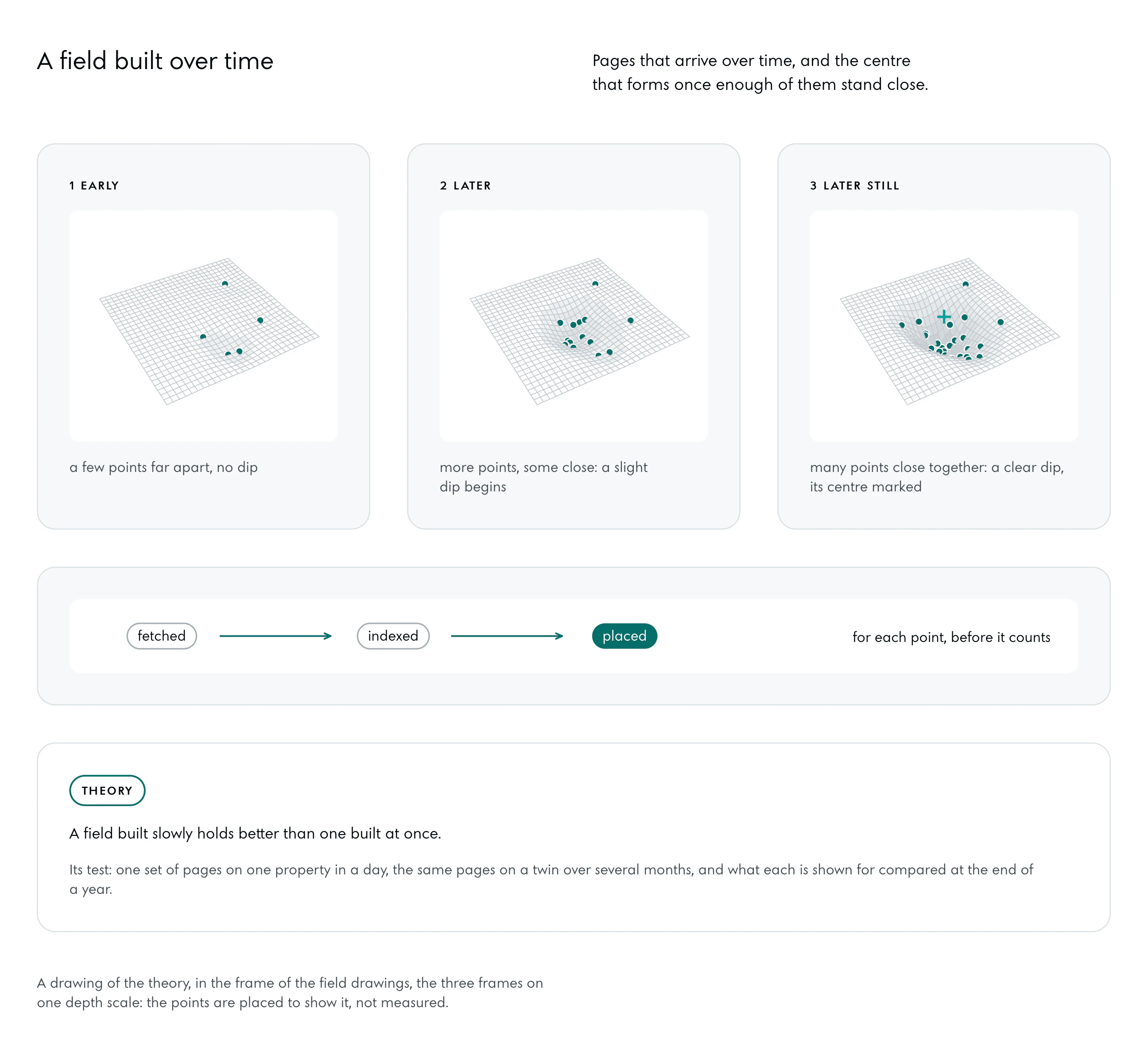
13Measuring a Relation
Nearly all that is needed to read a pair is already given by the engines’ reports and by tools that anyone may use. Five measures follow from the parts before this one.
- Share by property, the part of the name’s clicks and impressions that each property holds.
- The page for the name, who holds each place when the name itself is searched.
- Angle between centres, how close the text of two properties stands in a model’s space.
- Grouped searches, a phrase and its shorter forms read as rows of one report.
- A dated change, read on the other side against a control, with its window and its lag.
Reports by Property
Search Console’s interface for programs takes a site in either of two forms. A single site’s address is one of them. The other, as its page has it, last updated on 11 August 2026, is “sc-domain:example.com (for a Domain property)”, and it gathers every host of a registrable domain.
Asked for totals, the interface offers a choice of how to add them up, and one choice is to “Aggregate values by property.” So a firm can take the domain as one property and each host as another, and the share that a host holds of the domain’s clicks is then one figure divided by another from a single source. We made the shares of the measured case in this way. Bing counts citations in AI answers by address, as the part on that case quoted, so that the same division can be made for answers.
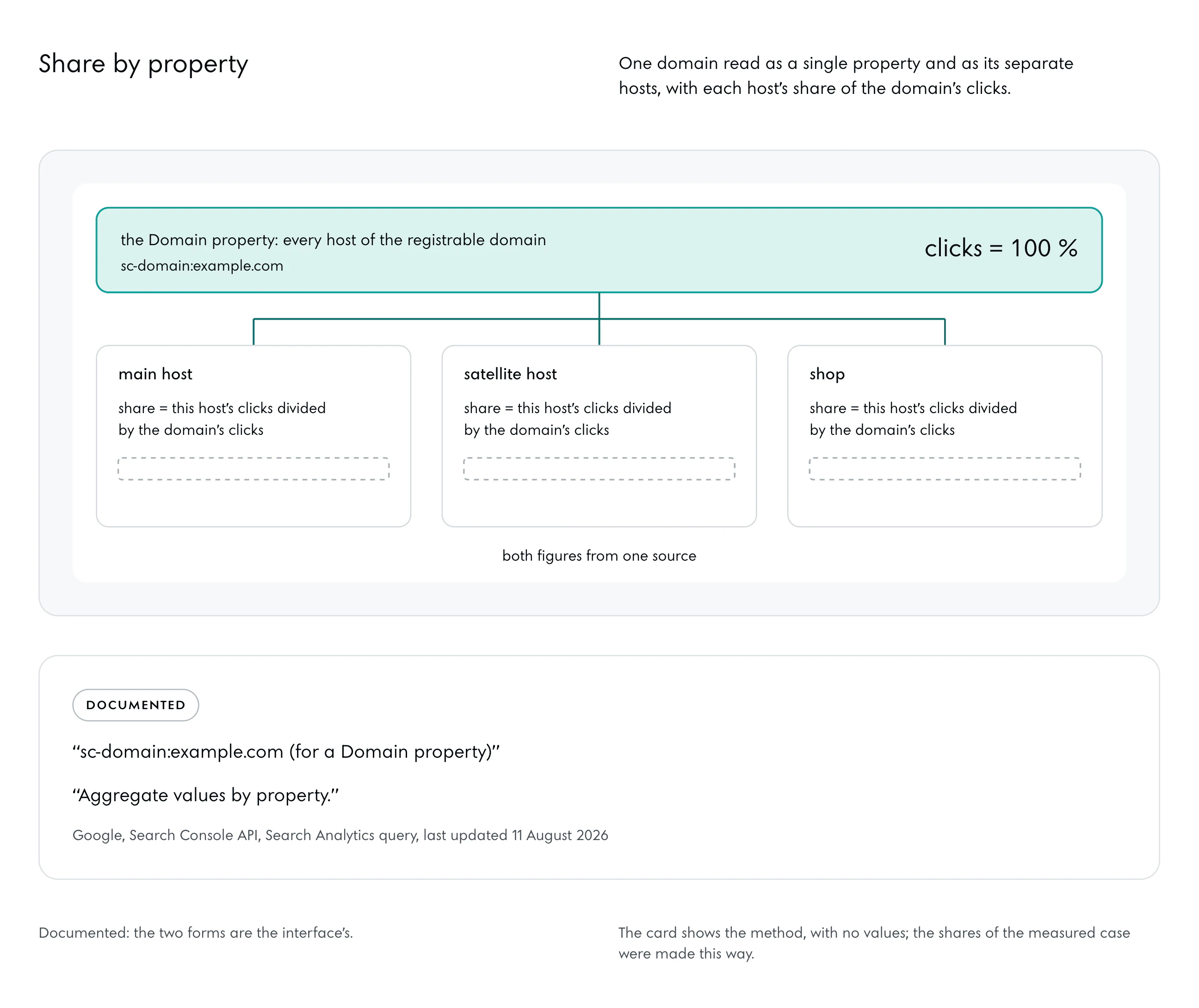
Results for the Name Itself
Whoever looks a firm up sees a page that the firm only partly wrote. Its site is there, and beside the site there may stand the panel drawn from its listing, its profiles on platforms, reviews, and pages that others wrote. The measure is a count made by hand on a fixed day of each month, and for every place on the page it notes which of the four classes holds it.
Places held by what the firm owns or fills in show the inside force, and places held by others show the outside one. A place held by another firm of the same name shows a match that failed. We give this as a method only, for we hold no series of it.
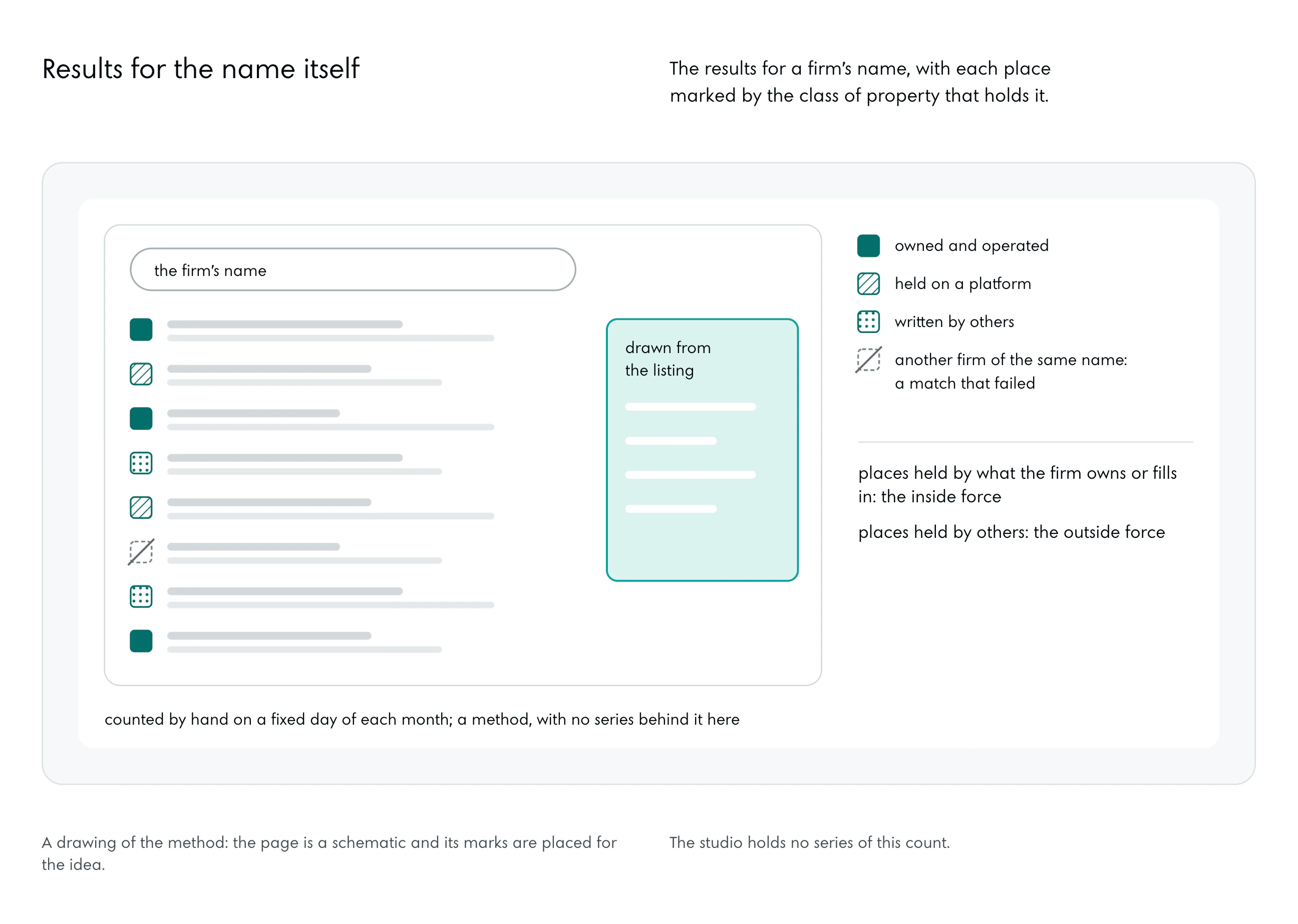
Distance Between Two Bodies
Embedding the pages of each property with a public model gives two clouds of points. The second paper took the centre of one such cloud and the spread round it. Between two properties the measure is the cosine of the angle between their two centres, and with it the share of each property’s pages that lie nearer to the other centre.
In the measured case closeness was taken another way, from shared searches, as that part said; the two measures answer different things, since one compares what the properties say and the other what they are shown for.
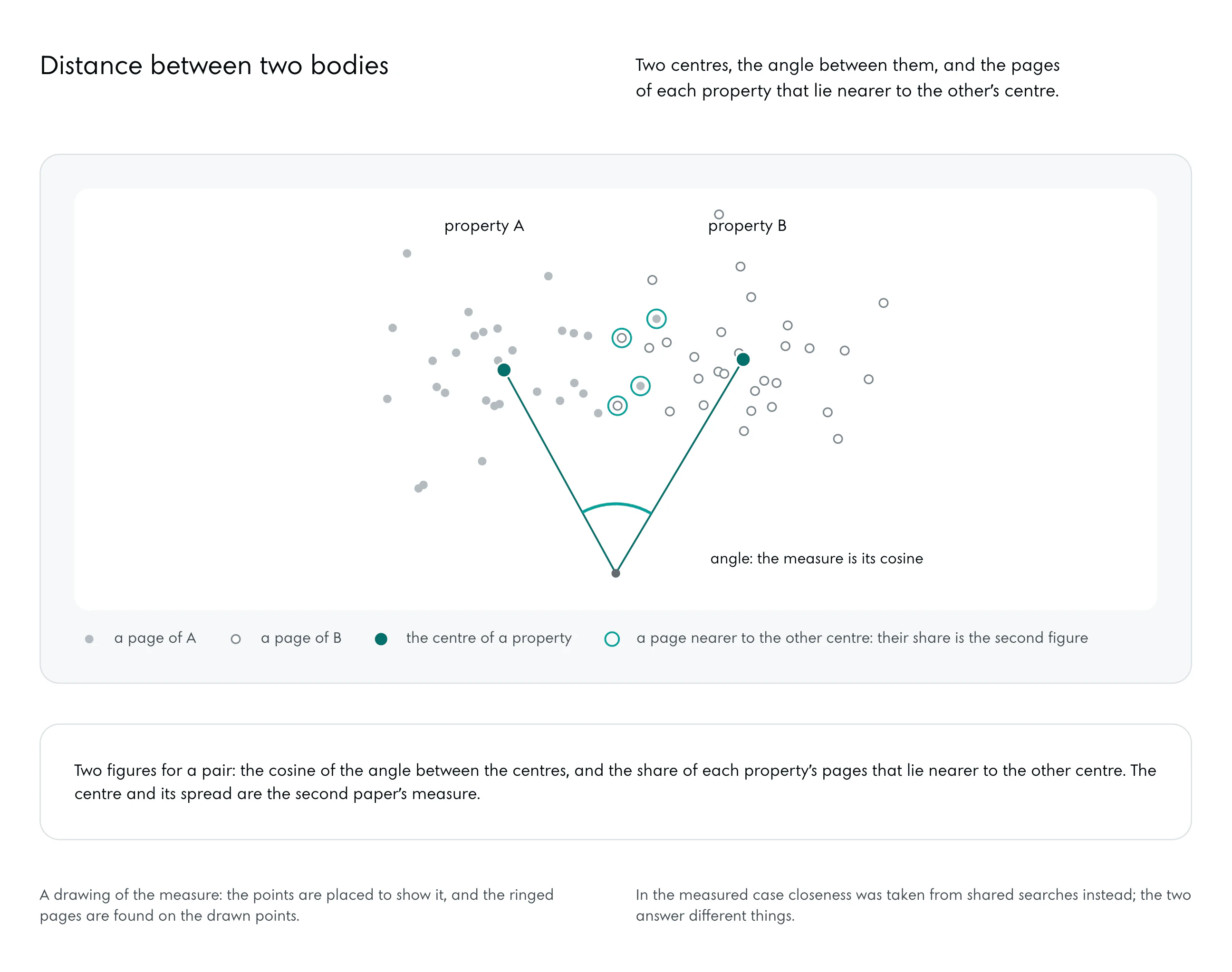
Grouped Queries and the Mirror
On 27 October 2025 Google began to gather similar searches together in one of its reports. “Query groups solve this problem by grouping similar queries.” Its post is careful about what the groups are. “The groups are computed using AI; they may evolve and change over time.”, it says, and it adds that they “don’t affect ranking”.
It says as well that “Query groups are available only to properties that have a large volume of queries”.
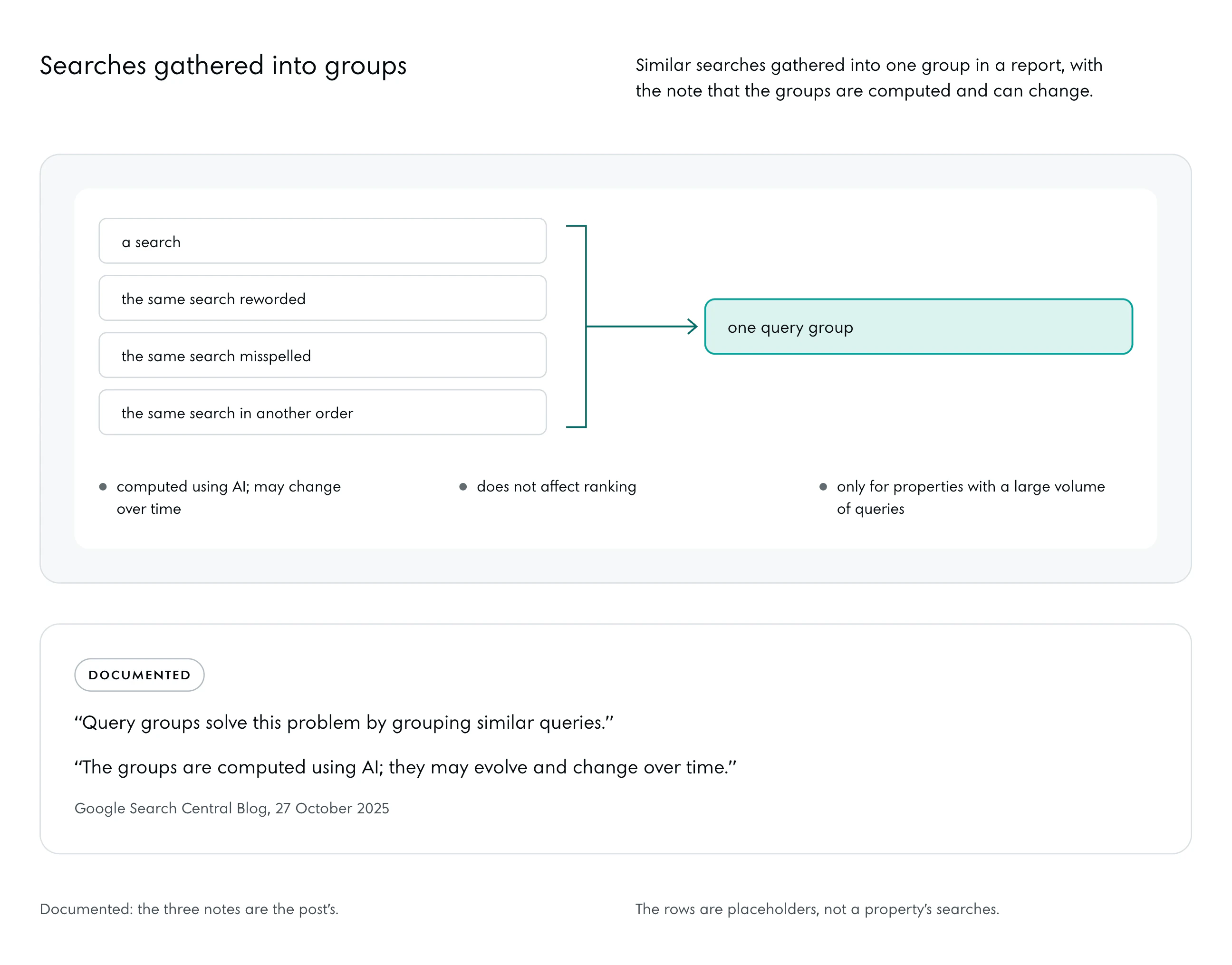
A group of this kind is the nearest thing in any report to the second face of the gradient. On the theory of this paper a position is the mirror of the well, so that a phrase and its shorter forms should lie along one curve, with the full phrase highest and the single word, which belongs to many other wells besides, far lower and the last to rise. A public case that anyone can inspect is the three words of this paper’s title, taken whole, then as the first two, then as the first alone; where the whole and its pairs stood on 12 October 2026 is set down in the last part, as a starting point and no more.
The measure is the average position of each of those rows, month by month. And the theory fails if a property comes to hold the short form before it holds the long ones.
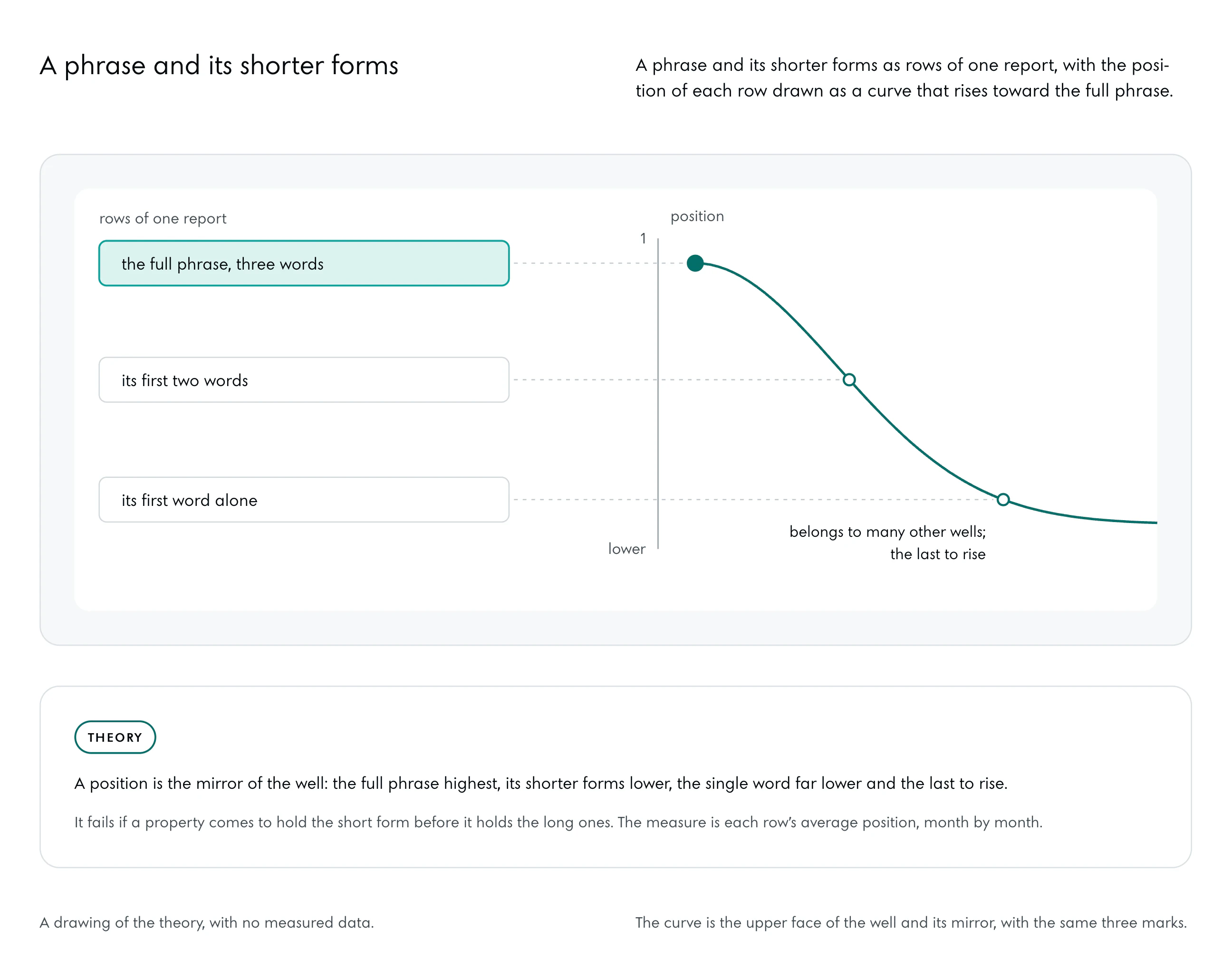
Lag and Window of a Change
Figures arrive late and incomplete, and a design has to allow for both. Unless it is asked otherwise the interface returns settled days only, for its page says that then “the returned data will include only finalized data”, and its days are counted in Pacific time. Part of the searches is never listed at all, and Google gives the reason.
“Some queries (called anonymized queries) are not included in Search Console data to protect the privacy of the user making the query.” So a change is given a date, a window on each side of that date, and a wait of some days before the last of them are read. The control is read over the same days, and the model that Brodersen and his co-authors published then draws the course that would have been.
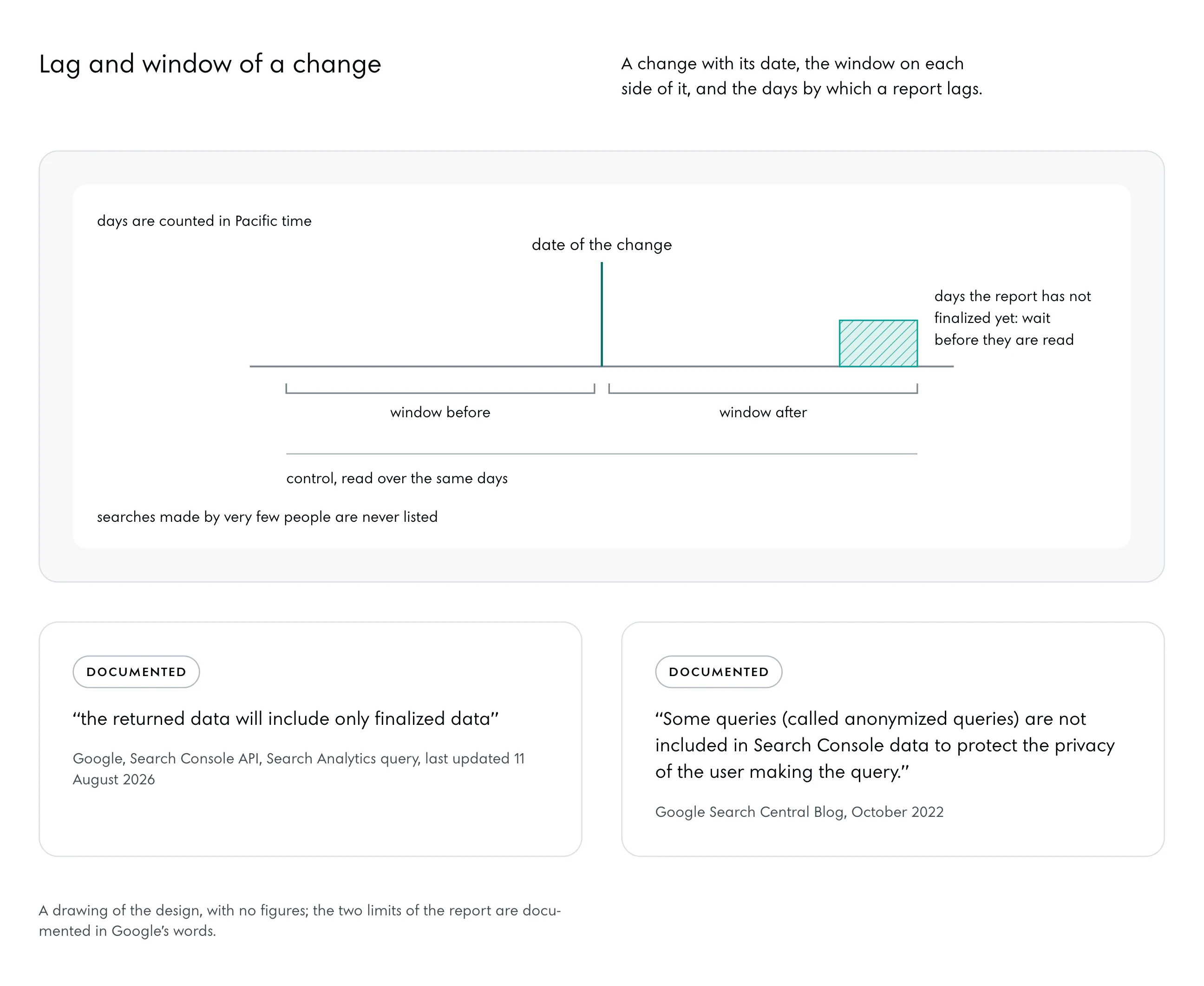
Young Properties and Their Positions
Launches give the mirror face its first test, and the studio read two of them on 10 October 2026. Both were groups of new satellites, built the same way, and each was under five weeks old, which is plainly too young to judge. The first stood on a registered domain with no history and was read at 24 days.
On exact, narrow searches it was shown at an average position between 11 and 16 in its first weeks, which is just beyond the first ten results; after those weeks the engine withdrew part of the pages it had shown, and the average went from about 11.5 to about 16. The second stood on subjects held by large, long-standing sites, and it was about a month old. Its sampled pages were indexed and almost never shown, and where it did appear it stood between positions 65 and 97.
These figures are measured, and they show one group near the first page and one far from it, with the subject deciding which. The founder’s wider view, that launches of this kind gather near the foot of the first page, is theory, and the move from 11.5 to 16 is given as a figure with nothing more read into it.
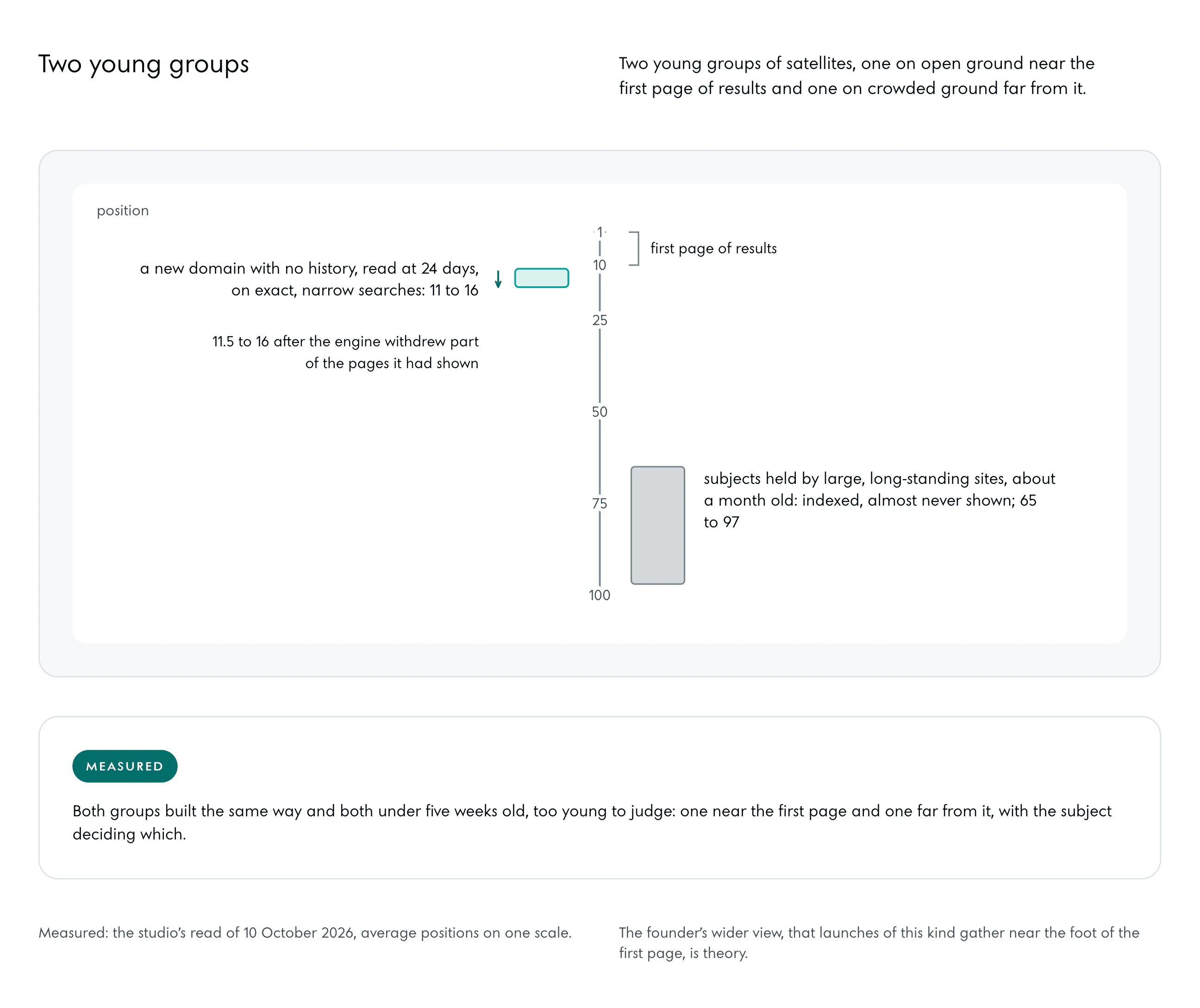
Younger still is the studio’s site, for which Search Console listed ten searches from 5 to 12 October 2026, each shown a few times, at average positions between 2 and 10. None of the three terms of the three papers had a row yet, since the report lags by some days and the pages for the terms were days old.
One capture stands beside this, for on 12 October 2026 the founder searched Google on his phone for “semantic search mesh”, and the studio’s page that defines Semantic Authority Mesh stood first, marked “2 days ago”, above pages of two large technology companies. An account was signed in on the capture, and he states that he also read the results without personalisation. Search Console’s inspection of the page that morning gave it as “Submitted and indexed”, last crawled on 10 October 2026, the day it was published, within minutes of the request to index it.
We read the same search that day in a browser with personalisation off, and it stood first when no country was set and off the first page when the country was the United States. So what moves this result is the market, since the account was out of play both times. One capture can never show whether the position holds.
The search has two senses, and the result beneath the studio’s page takes the other one. It is always Search Console that decides, and it had no row for that search yet.
His wider observation carries the same date. Piotr Paweł Zalewski, founder of Noo–Studio, said on 12 October 2026 that the studio’s pages for those three terms stood above research papers on searches for them. Our reading of that day in a browser, given in the last part, found each of the three first for its name.
The report held no row for them yet, and its dated rows will confirm the observation or break it.
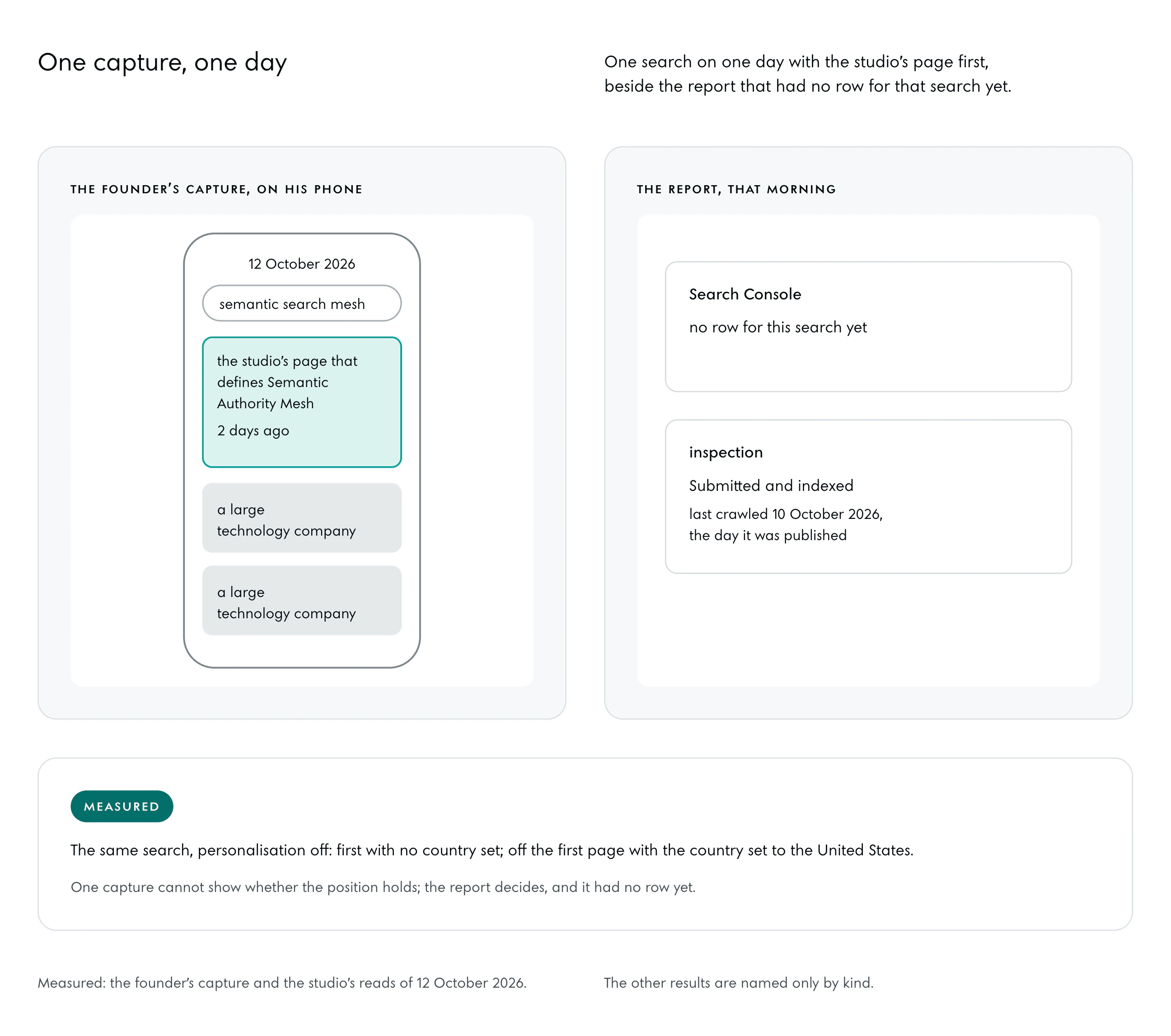
14Three Letters and Their Expansions
Naming is the last piece of the method, and here the method is turned on the name of the paper. Semantic Entanglement Optimisation is written beside search engine optimisation every time, under the same initials.
That was a decision, and it has a mechanism behind it, the same one that this paper has described for the properties of a firm.
Older Name and Its Claimants
Danny Sullivan went looking in 2004 for the earliest uses of the phrase, Barry Schwartz printed what he found on 14 June of that year, and two dates came out of it. For May 1997 he noted the first reference that he could “find within SEW to the exact phrase”, and it stood, he added, “but only within a meta tag.” In July of that year it was the “First reference I can find in newsgroups to the phrase”, which came this time “from a company pitching these services.” SEW is Search Engine Watch, which was his site at the time. Others put the start a little earlier than that.
Search Engine Journal’s history of the trade has it that “John Audette of Multimedia Marketing Group was using the term as early as February 15, 1997.” And Rob Garner, who wrote on the matter for MediaPost on 8 October 2008, found that “There were multiple claimants to the origins of the term “SEO” in the ’90s”. So the phrase has never had a single author, and it has a year of birth that is nearly agreed.
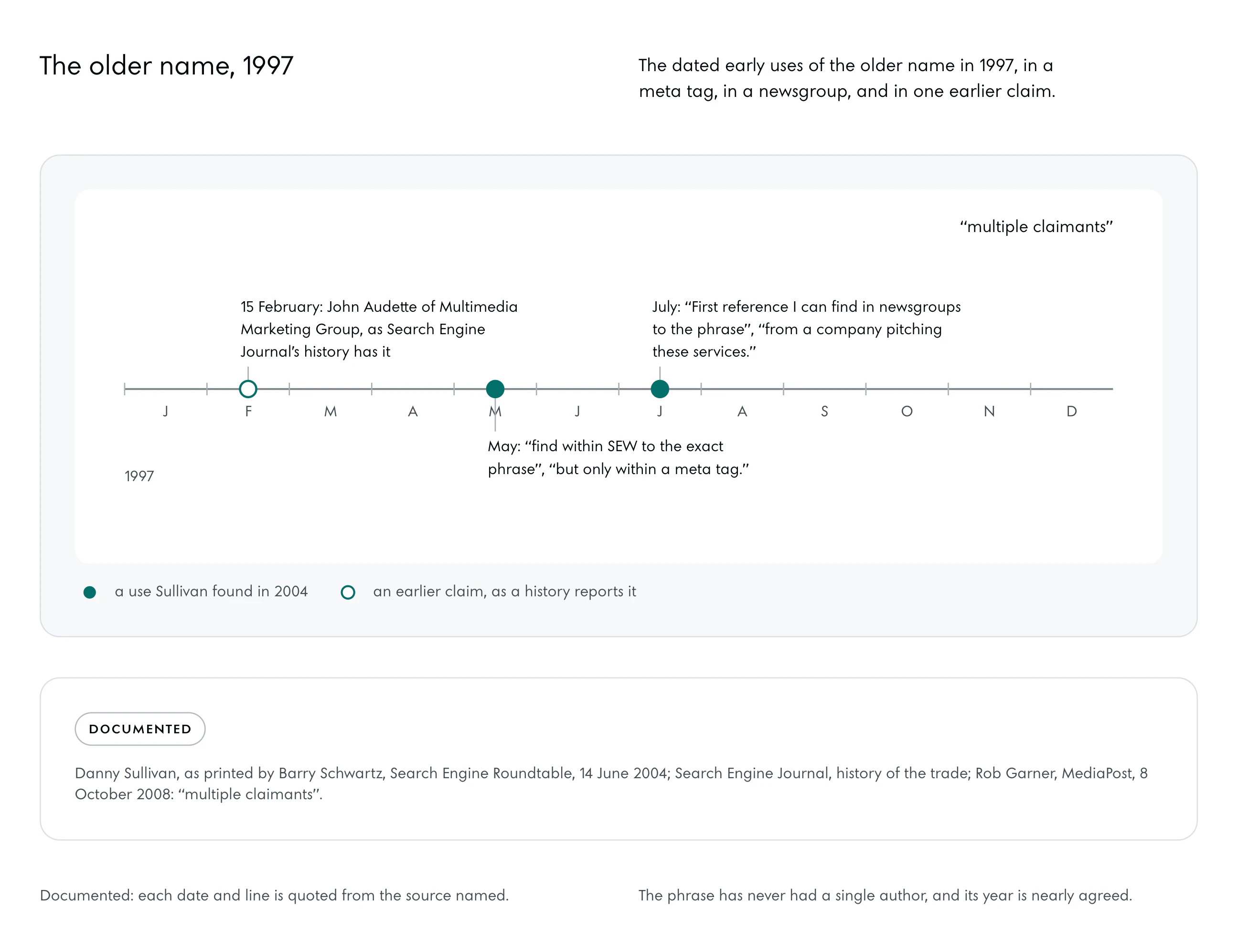
In 1997 an engine set the words of a search against the words of a page, and the phrase named the work of being placed by that match. What Google says it names now stands in its starter guide, last updated on 10 December 2025, where the work is “about helping search engines understand your content, and helping users find your site”. The verb has plainly moved from matching to understanding, while the three letters have stayed where they were.
Besides, the older name has two spellings, with a z in the lines quoted above and with an s wherever we write it. What the first paper measured of a second written form applies to it as it does to any other term.
Letters Kept, Work Renamed
Aggarwal and five co-authors changed the initials when they named a new practice on 16 November 2023. “we introduce Generative Engine Optimization (GEO)”, their abstract says. That is one way to rename.
It leaves the old name where it was and starts a second centre beside it.
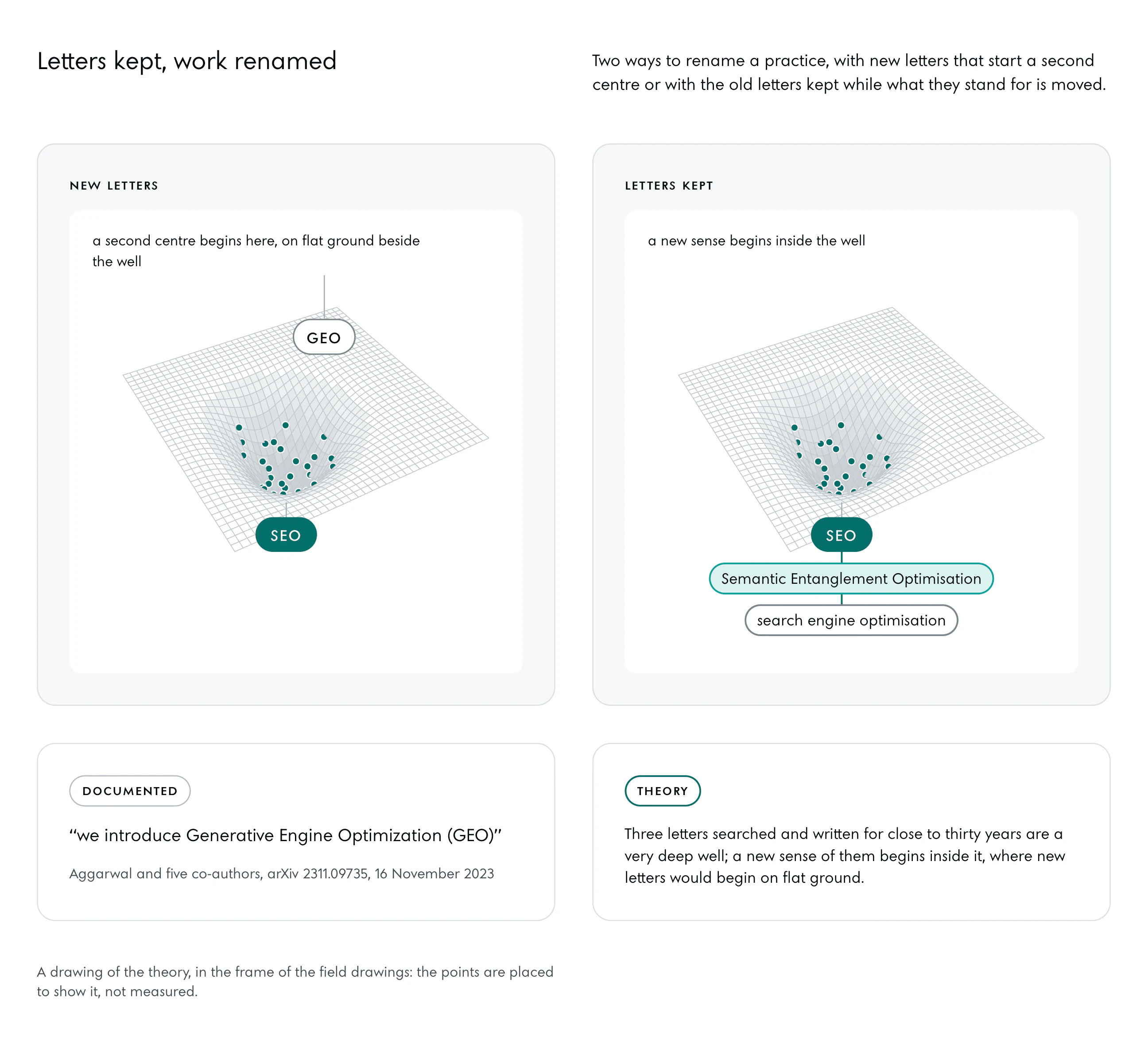
Our files show the other way being chosen. To redefine is to keep the letters and to move what they stand for. On 10 October 2026 the founder wrote, “Then maybe SEO as semantic antanglement optimisation – redefinition what seo is”, and the middle word is spelled here as he typed it.
Three letters that people have searched and written for close to thirty years are a very deep well, and a new set of letters would begin on flat ground beside it, whereas a new sense of the old letters begins inside the well, which is the reason as we give it, as theory and in the terms of the field.
Others have kept the letters before us, and the part on neighbouring work credits them.
Acronyms Resolved by Company
Veyseh, Dernoncourt, Tran and Nguyen built a set of 62,441 samples for one task in 2020. The task, in their words, is “finding the correct meaning of each acronym (i.e., acronym disambiguation (AD))”, and a model does it from the words that stand round the letters, as a reader does. Google’s page on site names says something close of its system for choosing a name, “our system might determine that a site is more commonly recognized by an acronym than by a full name”.
So three letters can hold several expansions at once. Whoever meets them, a person, a model or an engine, picks among those by what stands near. The first paper measured the same thing for a coined term; here it is the initials that take their sense from their neighbours.
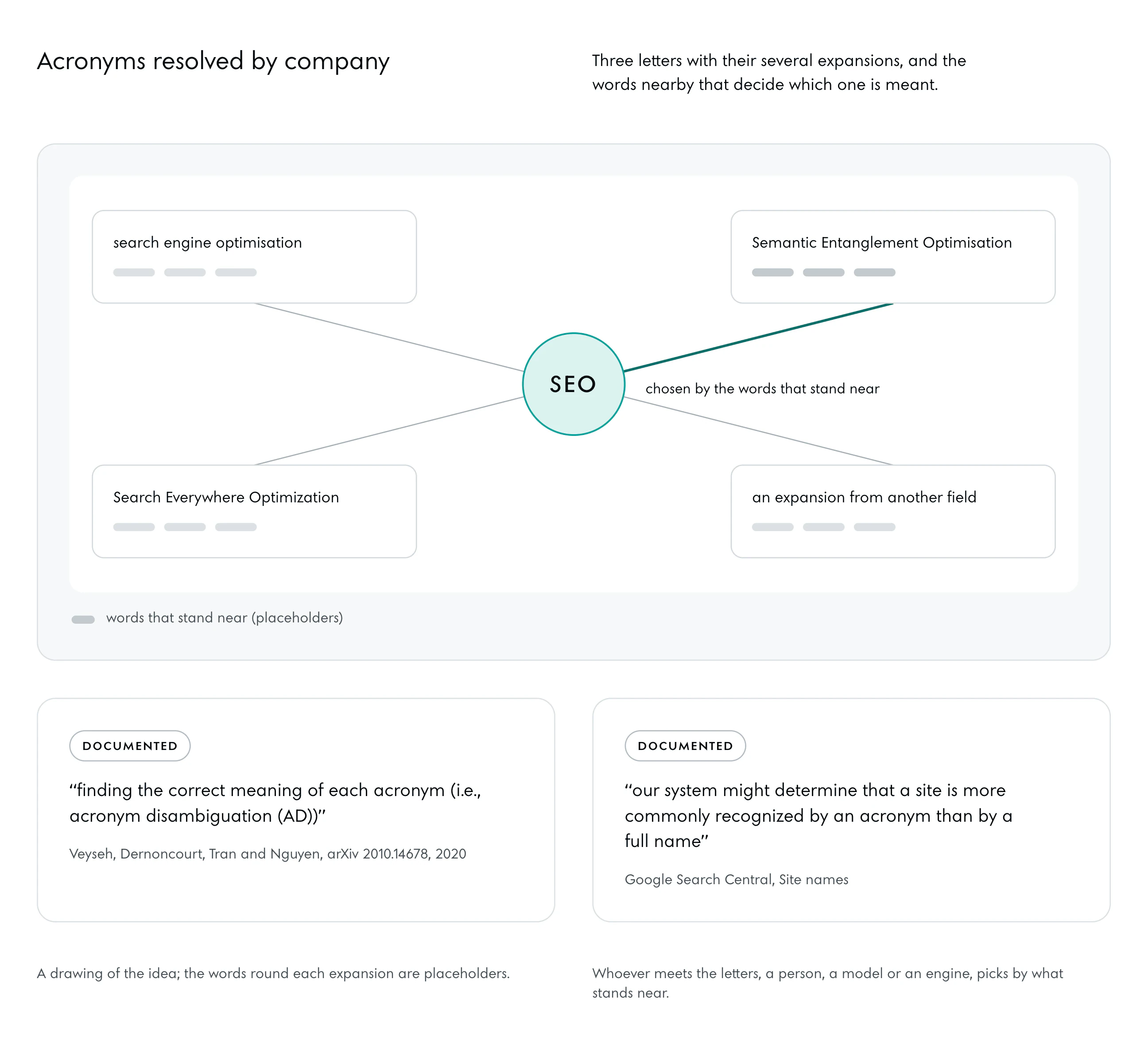
Pairs Written Together
Alone, a new expansion of old initials sits far from where the old one lives, and nothing on a page that held only our name would tie it to the trade whose letters it shares. Written beside the older name, every sentence that holds both is a small tie between the two. In the terms of the field the pair puts both expansions at one place, so that the three letters have one centre and the new sense is read as a sense of the old word.
It is the mechanism of the part on ties turned on a name, since two things that are always met together come to be counted together.
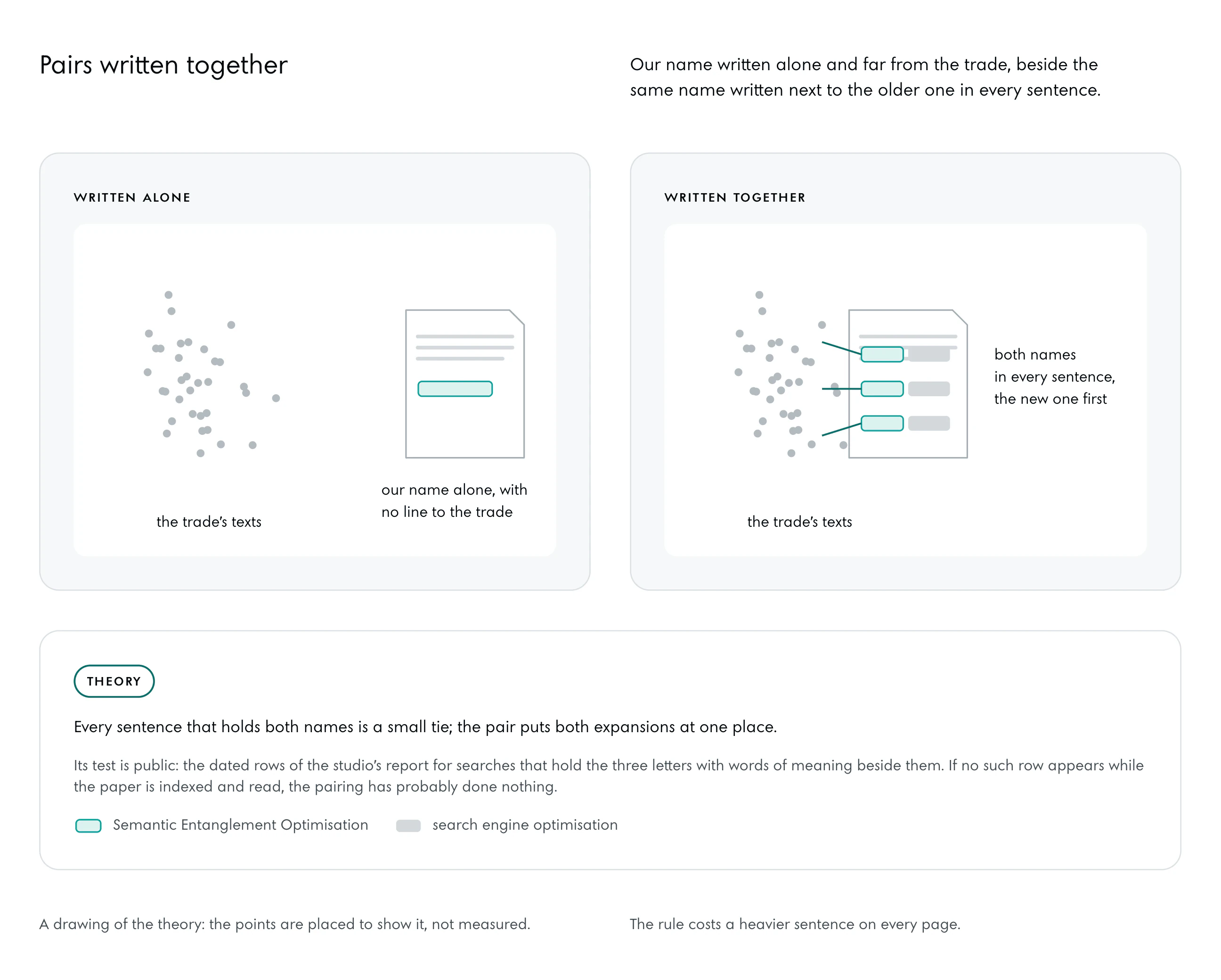
This too is theory, and its test is public. It lies in the dated rows of the studio’s report for searches that hold the three letters with words of meaning beside them.
If no such row appears while the paper is indexed and read, the pairing has probably done nothing.
The rule costs something, and we pay it on every page. A long name is written twice where once would read more easily; the sentence that carries the pair is usually heavier than the one that would carry either alone. But a name that is written two ways in two places is two names to an engine, and the first paper has already measured what that costs.
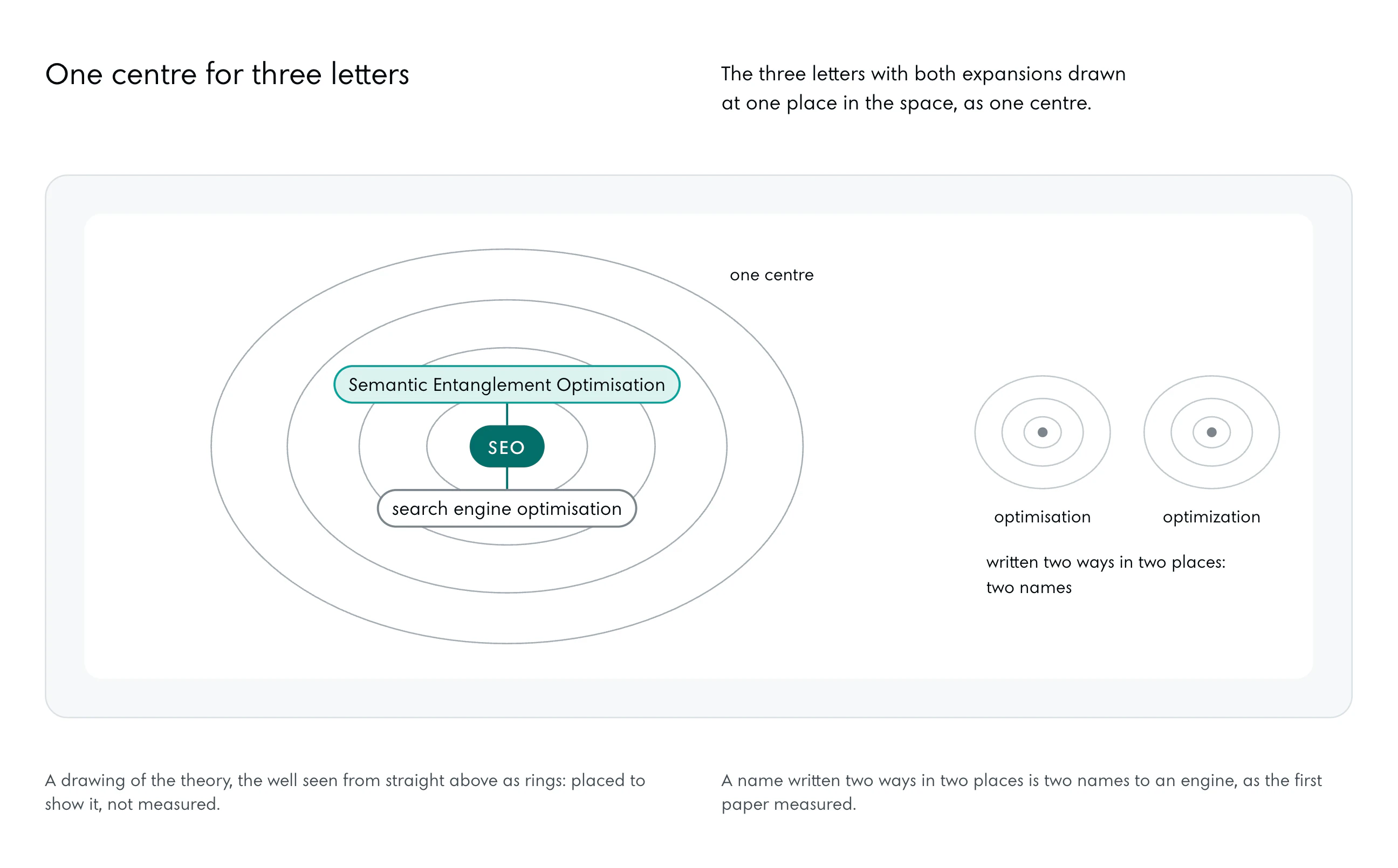
15Credit to Neighbouring Work
Several people stood on this ground before the studio did. Each is named here from a page of theirs that was opened.
For each we say what it covers and then what this paper sets beside it, which is always the same thing, the tie between properties taken as the unit.
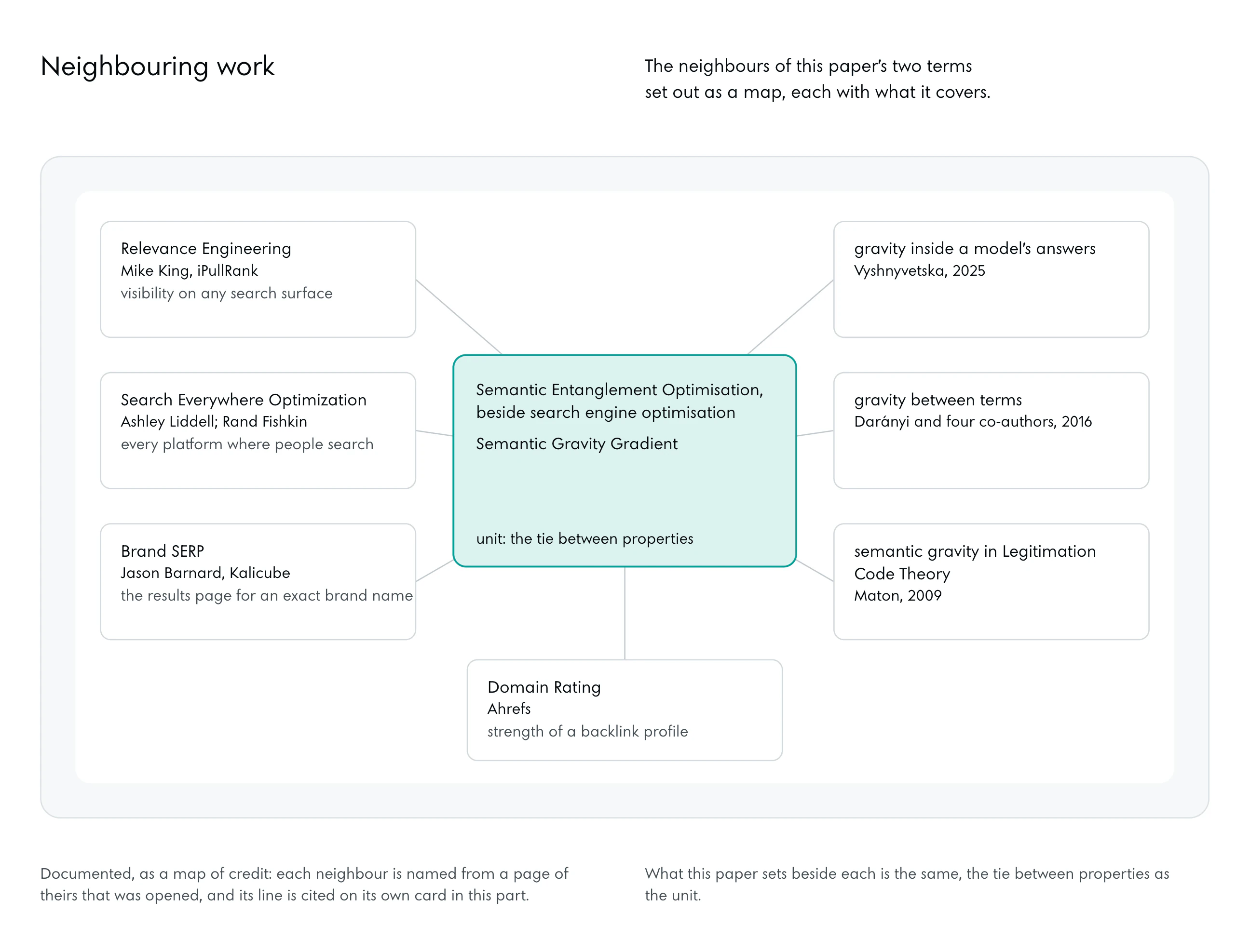
Relevance Engineering
Mike King’s firm is iPullRank. It names its practice on a page that was first published on 26 April 2025. “Relevance Engineering is the science behind improving visibility on any search surface.” That line leaves the engine out of the name.
It puts the surface in, probably on purpose. So an answer engine, a marketplace and a list of links all fall under it, and its unit, as the sentence has it, is the surface on which a thing is to be seen. Ours is narrower and lies crosswise to it, for it is the tie between two things that belong to one firm, on whatever surface they are shown.
Search Everywhere Optimization
Rand Fishkin argued on 30 May 2025 that the three letters should be kept and one of their words changed. He gives the credit for the phrase to someone else. So the letters were kept before us, and the E was the word that moved.
“A few years ago, Ashley Liddell from Deviation coined the term “Search Everywhere Optimization””, he writes, and of the letters he says, “Everyone will assume that the “E” in SEO always stood for Everywhere, and I don’t plan to correct ’em.” Their reading widens where the work is done, from one engine to every platform on which people look for things. Semantic Entanglement Optimisation, beside search engine optimisation, moves the same letter another way, since it says what is worked on, and the two readings can perhaps be held together without strain.
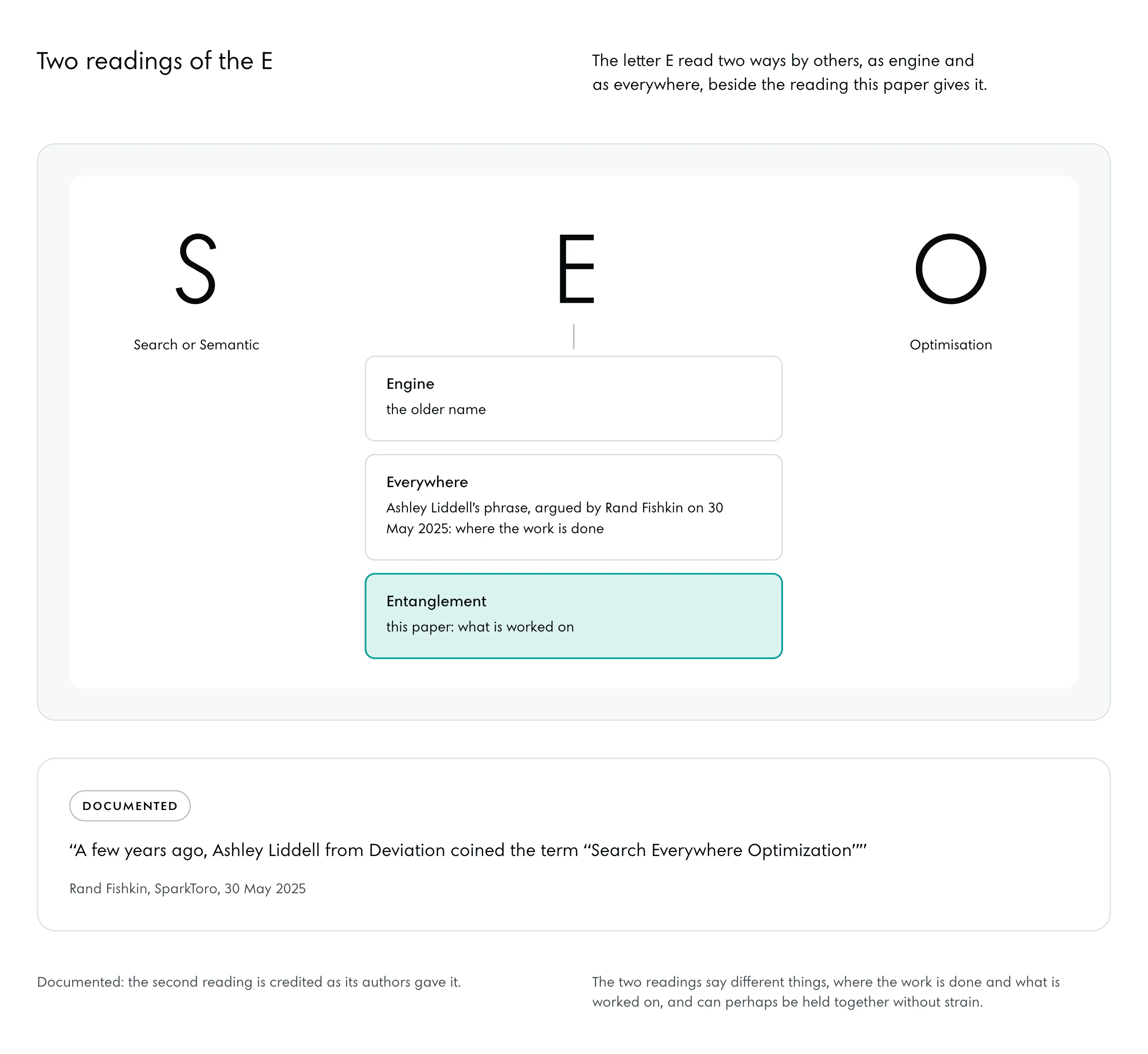
Brand Results and Entity Work
Jason Barnard has studied since 2012 the page that a person sees after typing a firm’s exact name, and Kalicube, his firm, says so where it sets the term out. “Brand SERP is a term coined by Jason Barnard in 2012 to describe the search engine results page that appears when someone searches for an exact brand name.” That page is the second of the five measures in the part on measuring, and the term for it is his. He treats the firm as one thing that an engine has to be taught, which is the matter of the part on matching.
What stands beside it here is the pair, since a firm’s properties are read against each other as well as against the name, and one of them can be moved by a change that is made on another.
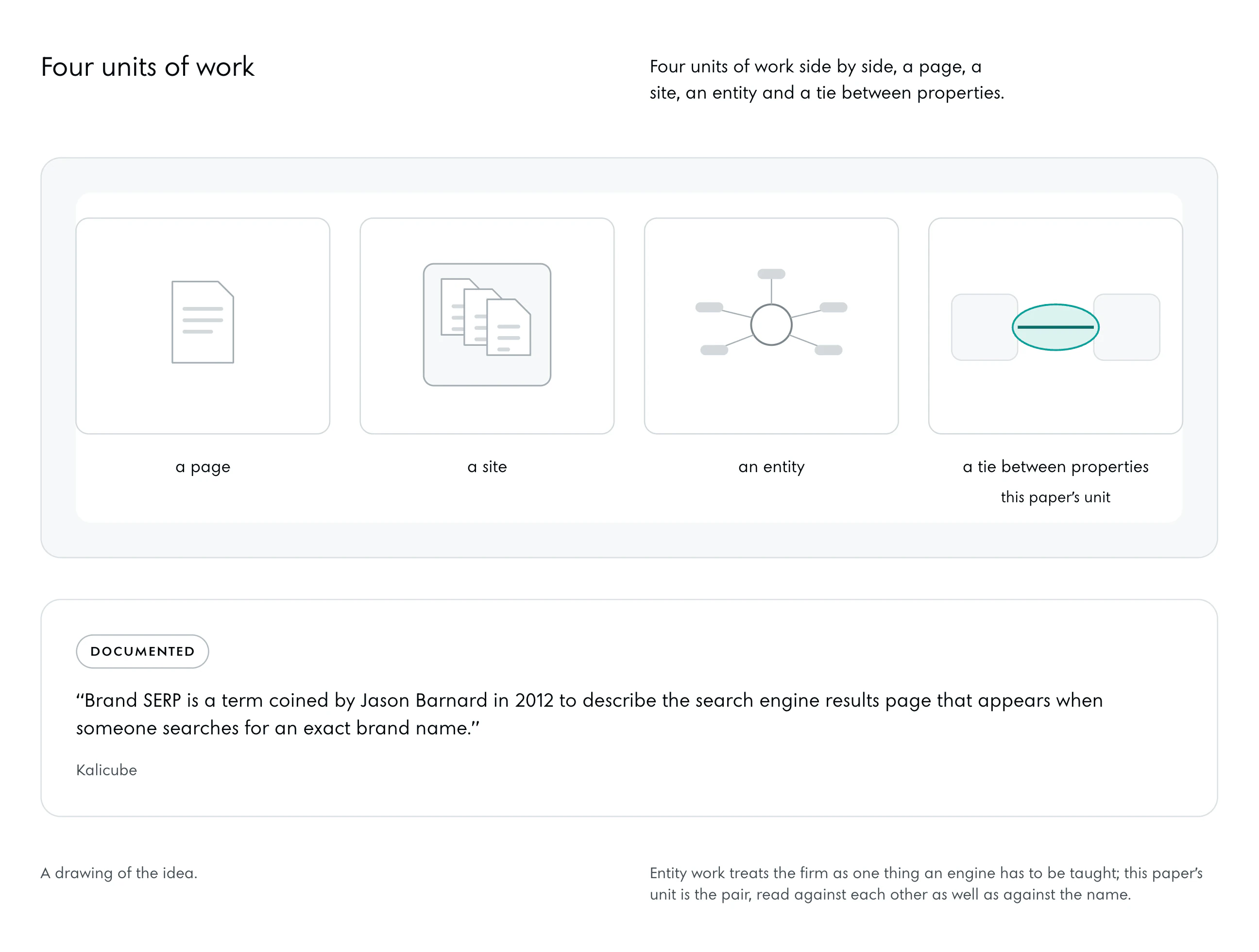
As for the two words semantic entanglement, Loghmani’s use of them in retrieval research, which is in another sense than ours, was credited in the part on words.
Semantic Gravity in Other Hands
Physics has lent its pull to language more than once, and three uses stand near ours. The nearest is Maryna Vyshnyvetska’s paper of 29 April 2025. “A query is viewed as an object with “information mass” that curves the semantic space of the model, creating gravitational potential wells that “attract” tokens during generation.” So the picture of a well that draws tokens is hers before it is ours, and the credit for it is due to her.
Her subject is what happens inside one model while it answers one prompt; ours is where a firm’s text stands across a site and a name. Ten years before this paper, Darányi, Wittek, Konstantinidis, Papadopoulos and Kontopoulos used the same force to study how the sense of terms drifts. Their abstract of 3 August 2016 says that “gravitation as a metaphor to express changes in the semantic content of a vector field lends a new perspective for experimentation”.
They took a term’s PageRank value as its mass, and so a pull between terms, with a measure made from links as the mass, is theirs. The two words semantic gravity belong to a third field, where they concern how far a meaning depends on its context. Karl Maton set them in Legitimation Code Theory, a framework used in research on teaching, and his abstract of 2009 names “legitimation codes (bases of achievement) and semantic gravity” together.
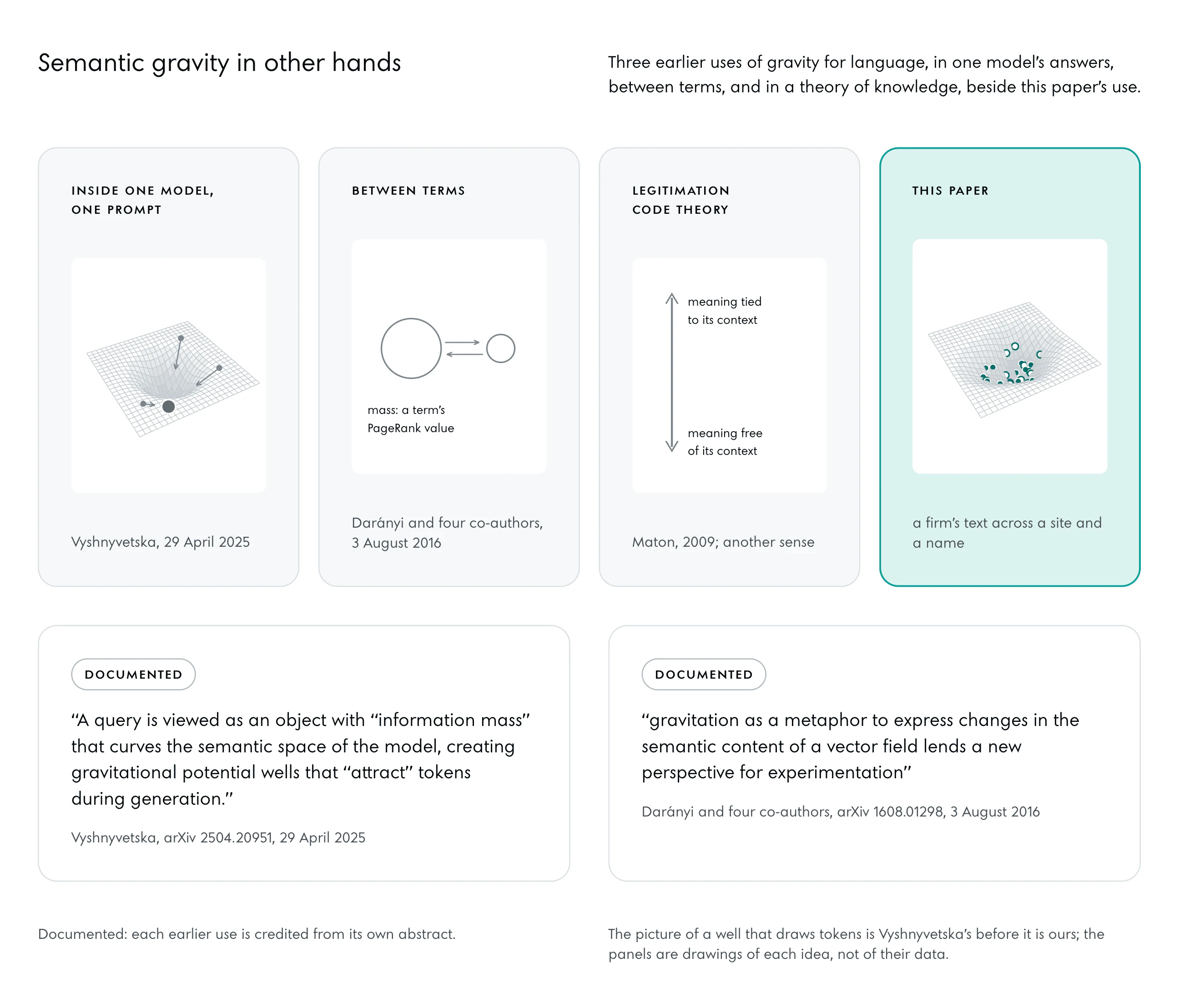
An earlier use of the three words together was looked for on 12 October 2026, on the web, in arXiv and in OpenAlex, and it was not found. The letters are another matter, for Semantic Gravity Gradient would shorten to SGG, and computer vision already has those letters, as in the survey by Zhu and ten co-authors of 3 January 2022, “Scene Graph Generation (SGG) refers to the task of automatically mapping an image into a semantic structural scene graph”. That is why this paper writes the name in full.
The studio had a term with gravity in it already, and we keep it as it stands. Answer Gravity names an effect as it is seen from outside, in answers, and the second paper kept it apart from the structure that produces it. It is never folded into the new term, because the one names what is seen and the other belongs to the theory of why.
Vendor Scores From Links
Ahrefs publishes a number for the strength of a site, and it says plainly what the number is made from. Tim Soulo’s page of 4 May 2022 sets it out. “Domain Rating (DR) is an Ahrefs metric that shows the relative strength of a website’s backlink profile.” It is a third party’s estimate, drawn from links and “measured on a logarithmic scale from 0 to 100”, and it is often useful for just what it is, since it lets two sites be compared by one published method.
The founder means something else by authority. On his account a property’s authority is its gradient inside one zone of the space, built by the text of that zone, so that a site whose every page stands in one zone can hold a steeper slope there than a large archive whose pages are spread over many. This is theory, and its test sets a small site that keeps to one subject against a large one that treats the subject in passing, on the narrow searches of that subject alone; if the large site holds them all, his account fails.
We offer no score for it, and authority in this sense is not a number that anyone publishes.
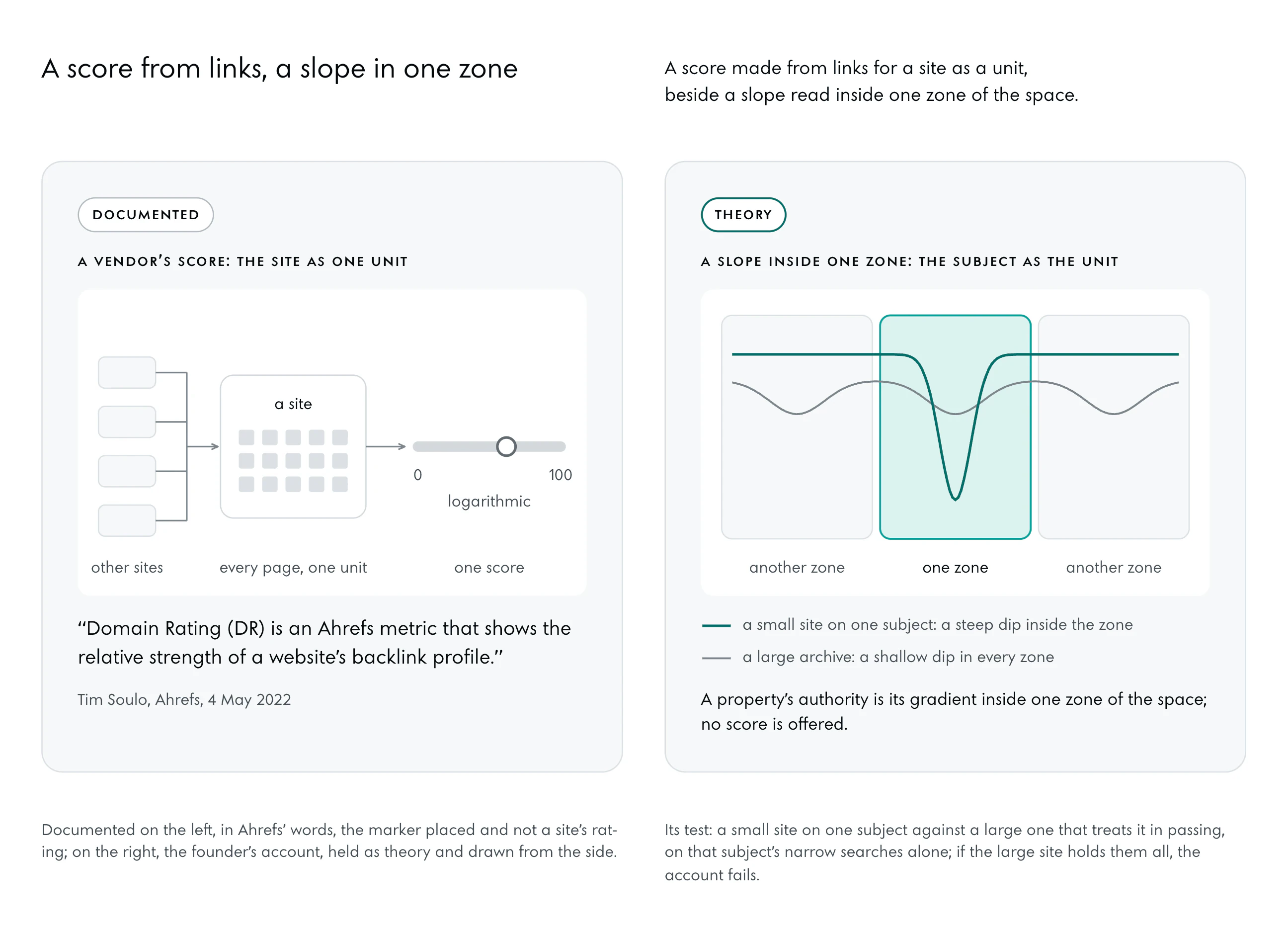
16Method, Sources and Omissions
Every outside line in this paper was read on 10, 11 or 12 October 2026, on the page it is linked to, with six exceptions.
Where a page would not open, the line was dropped, or else it was read in a public record of the same work, and the next section names the seven papers for which that was done, six of them quoted here.
How Sources Were Opened
Pages were fetched one at a time, and a line is quoted only where it was seen on the page that day. Google’s pages usually carry the date of their last update, and where they do that date is given beside each. Schrödinger’s words are quoted as the Stanford entry prints them.
Some publishers refused, and their pages for the papers of Fellegi and Sunter, Small, Holland, Keller, Maton, Fukunaga and Hostetler, and Comaniciu and Meer either would not open or were not tried again after the first refusals; the abstracts of those papers were therefore read in the records that OpenAlex holds, and where this paper links to one of them the link is its DOI. A few pages were dropped and are not cited at all, among them a support page of Google’s on the Business Profile, a guidelines page of Bing’s, and two archives of old web pages. One gloss of semantic gravity, from a paper on the teaching of chemistry, stood behind a publisher’s page that refused, and it is not quoted.
Table 4 counts the outside documents by kind.
| Kind of source | Documents | Label it carries |
|---|---|---|
| Google’s published pages, with its guidelines for raters | 20 | Documented, each with its date of last update |
| Pages of other engines, of standards and of public bodies | 9 | Documented |
| Research papers and preprints | 42 | Documented, from the paper or from its public record |
| Reference works | 8 | Documented |
| Trade press and practitioners’ pages | 10 | Documented as reported, with the author named |
| Pages leaked in 2024 | 3 | Documented under a separate label |
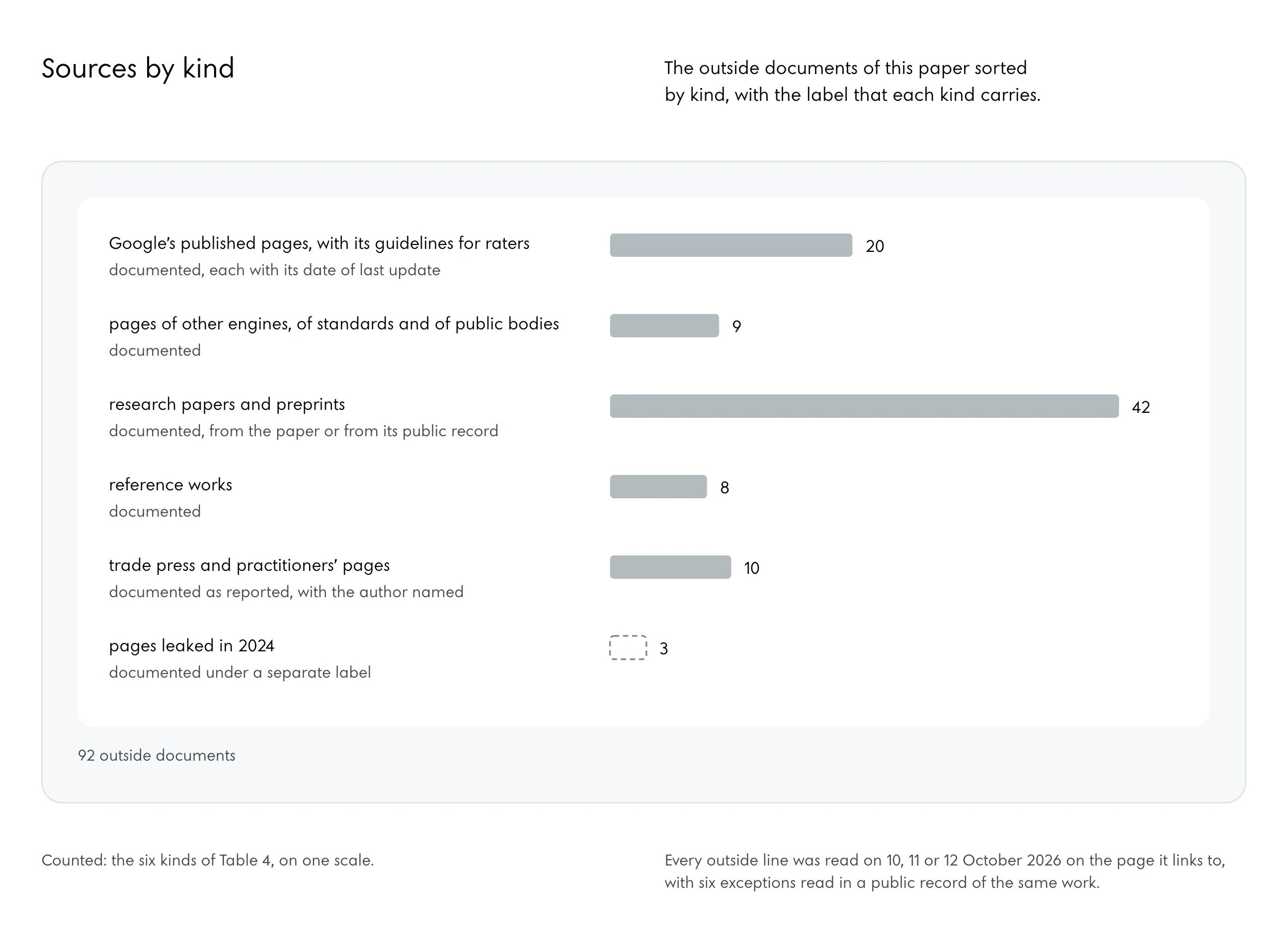
Labels on Every Claim
Documented, measured and theory are the three words set in bold. To be documented a line has to stand on a public page. A measured figure comes from what the studio exported out of the engines’ reports and the sites’ analytics.
Theory is whatever goes beyond those two, and it is always given with the test that would break it; the pages leaked in 2024 are documented under a separate label, as a dated list of what was stored.
Semantic Gravity Gradient carries the third label throughout. It is a term of October 2026, nothing has yet been measured under its name beyond the first positions and the first rows that the closing part sets down, and the sources for its physics were opened on 12 October 2026. The founder’s views on subdomains, on links and on authority are theory in the same sense, each with a test, and they are given in his name.
And what he says of the Sustainability Directory is a first-hand statement of how it is built, while his two observations about positions are first hand and dated as well, and they wait for rows in a report.
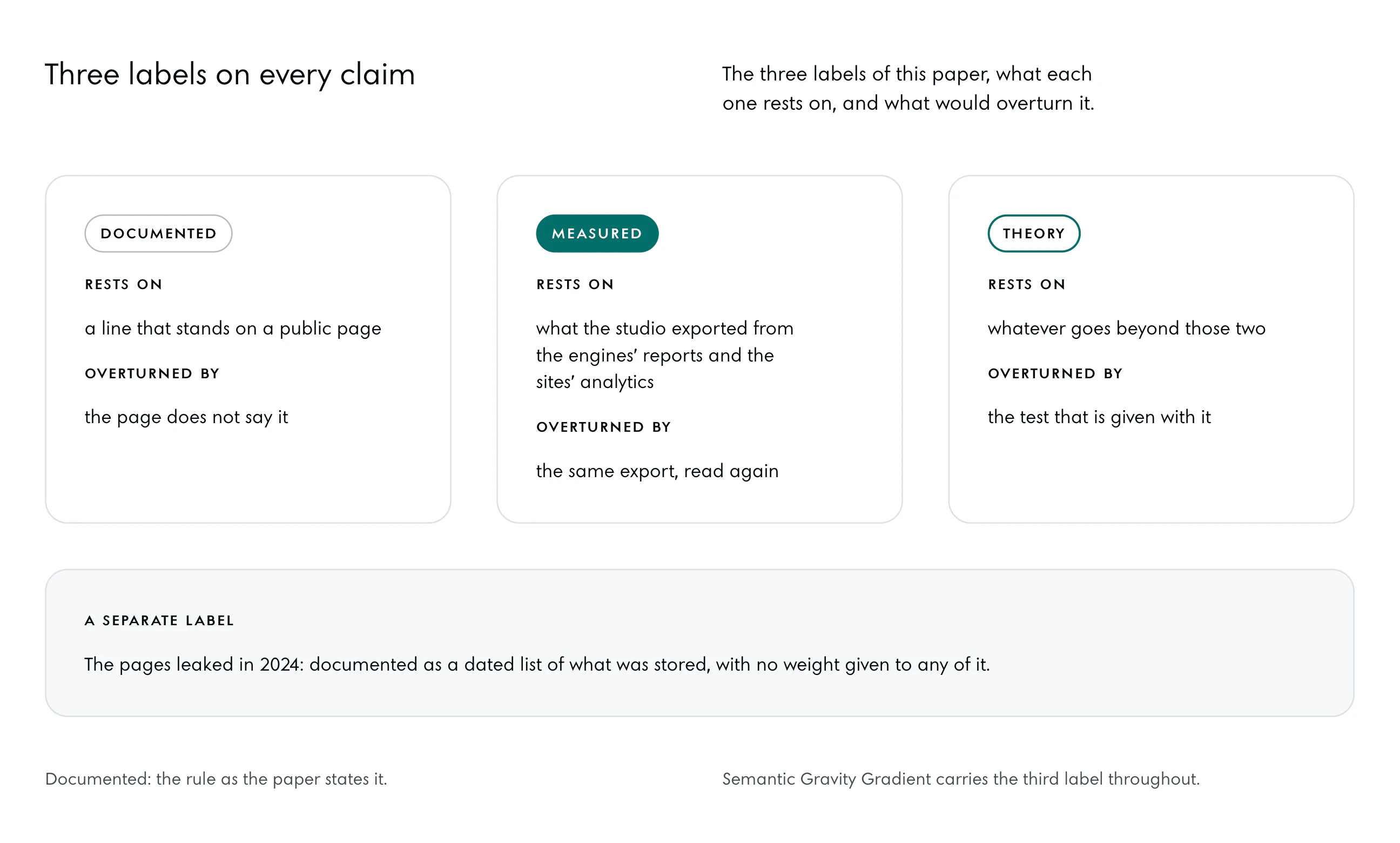
Dates of the Studio’s Record
Times are given here once, in Poland time, and nowhere in the running text. The satellite of the measured case ran from July 2025. Its monthly figures span sixteen months, from June 2025, which was the month before it was launched, to September 2026.
The public set of the study’s cards, from which every share, multiple and index in this paper is taken, was made and gated on 10 October 2026. A fresh pull from Google’s interface matched the daily figures on all 30 days before the two sites were parted, and in every month the clicks of the two sites added up to the domain’s to within a few clicks.
The studio read its younger properties on 10 October 2026, through Search Console and its analytics, and it read Search Console for the studio’s site on 12 October 2026, which is also the morning of the founder’s capture. That same day, at 05:15, the page for the term Semantic Gravity Gradient was published, and Google’s results for the three terms of the three papers were read in a browser with personalisation off. On 14 October 2026, from 12:07 to 12:08, the studio read Search Console through its interface for programs for the four pages that define the terms: the index status of each, and every search row from 10 to 14 October, in the freshest data, which Google may still revise.
By that record the page for Semantic Gravity Gradient was crawled at 05:27 on 12 October, twelve minutes after it was published.
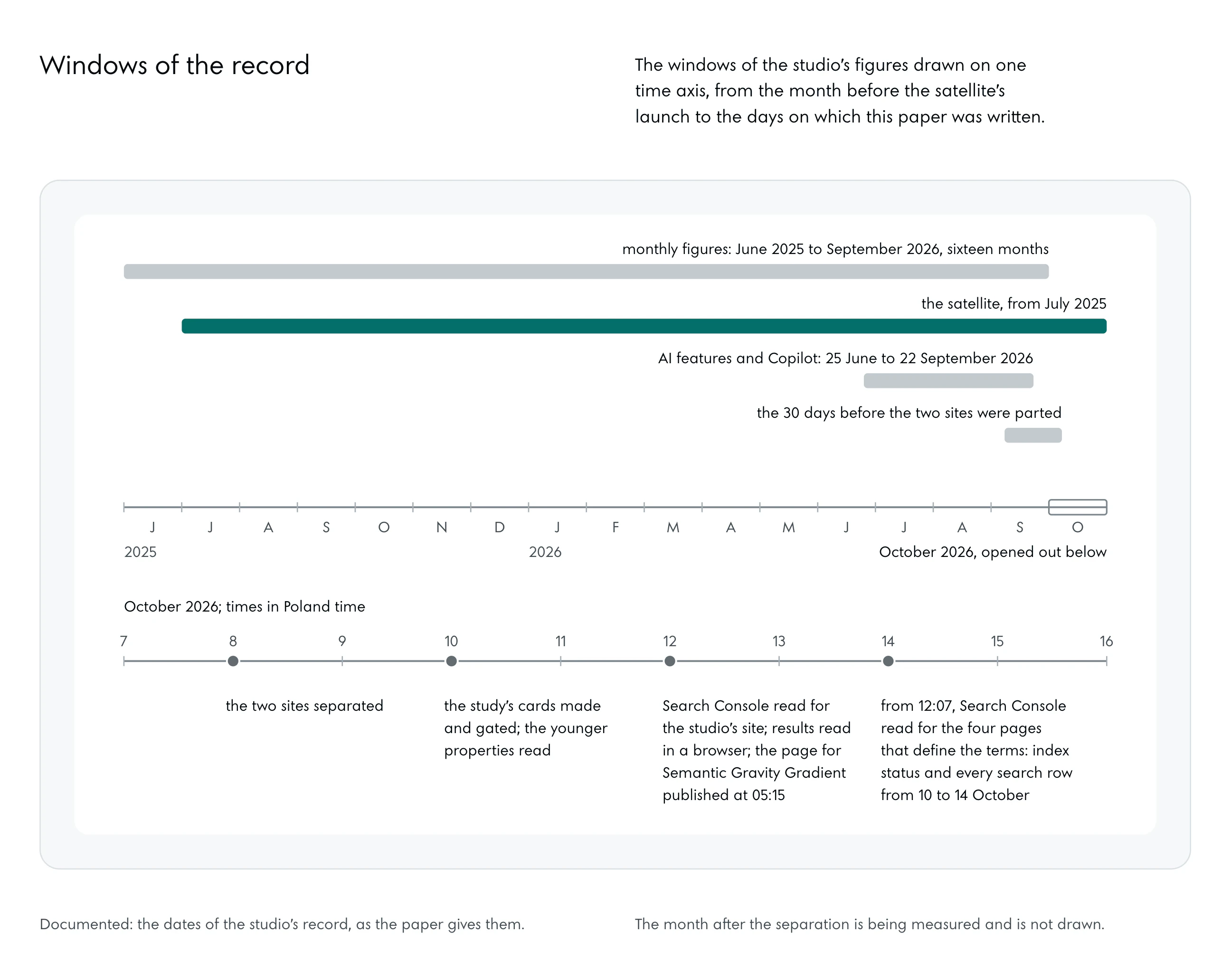
Omitted From This Paper
Left out, first, is the month that came after. What followed the separation of the two sites on 8 October 2026 is being measured, and none of it is in this paper.
The firm of the measured case is never named, and neither is its field nor its market. No score is offered for authority. Counts that the gated cards carry stay on the cards, and only shares, multiples and indices were brought across, and nothing is measured here of profiles, listings, reviews or mail, which is probably the widest gap, since those parts rest on published pages and on theory alone.
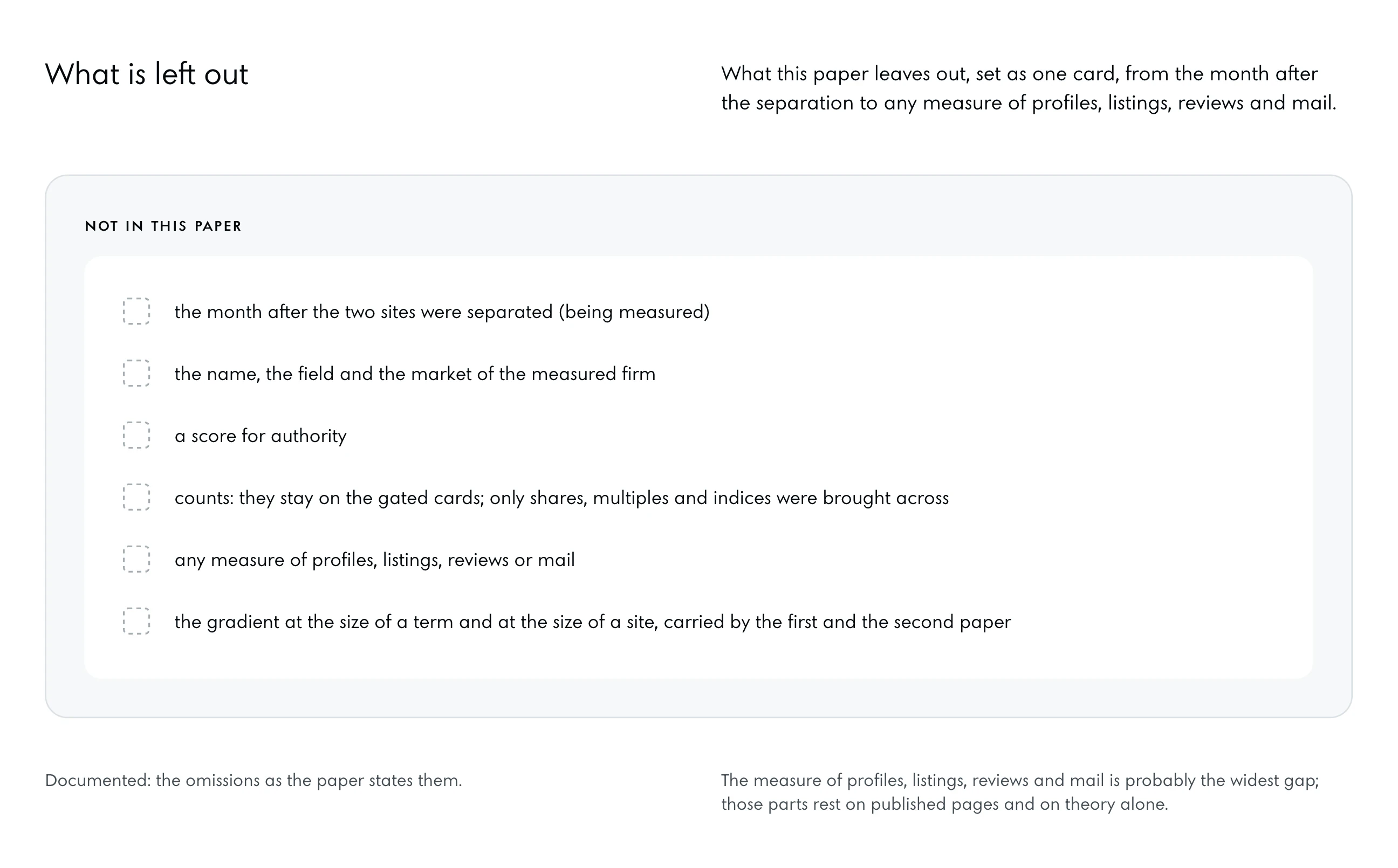
One more thing is left out here because the other two papers carry it. The first, Semantic Token Optimisation, takes the gradient at the size of a term in “The Gradient at the Size of a Term”, and the second, Semantic Authority Mesh, takes it at the size of a site in “The Gradient at the Size of a Site”. This paper reads the three sizes side by side once, in the part that names the gradient, and works through only the size of a name.
17Testing and Validation
Almost everything here was written on 12 October 2026, ahead of the event that it concerns.
On that day the three terms of the three papers each had a page that defines it, two days old, and none of the three long papers on them had been published. Nothing below is a result, for the days that could give one had not yet come. On 14 October, with no long paper yet published, three things were added under the first reading, which is left as it was written: a section on the first rows of Google’s own report, one paragraph in the founder’s name, and the report’s rows beside the later readings.
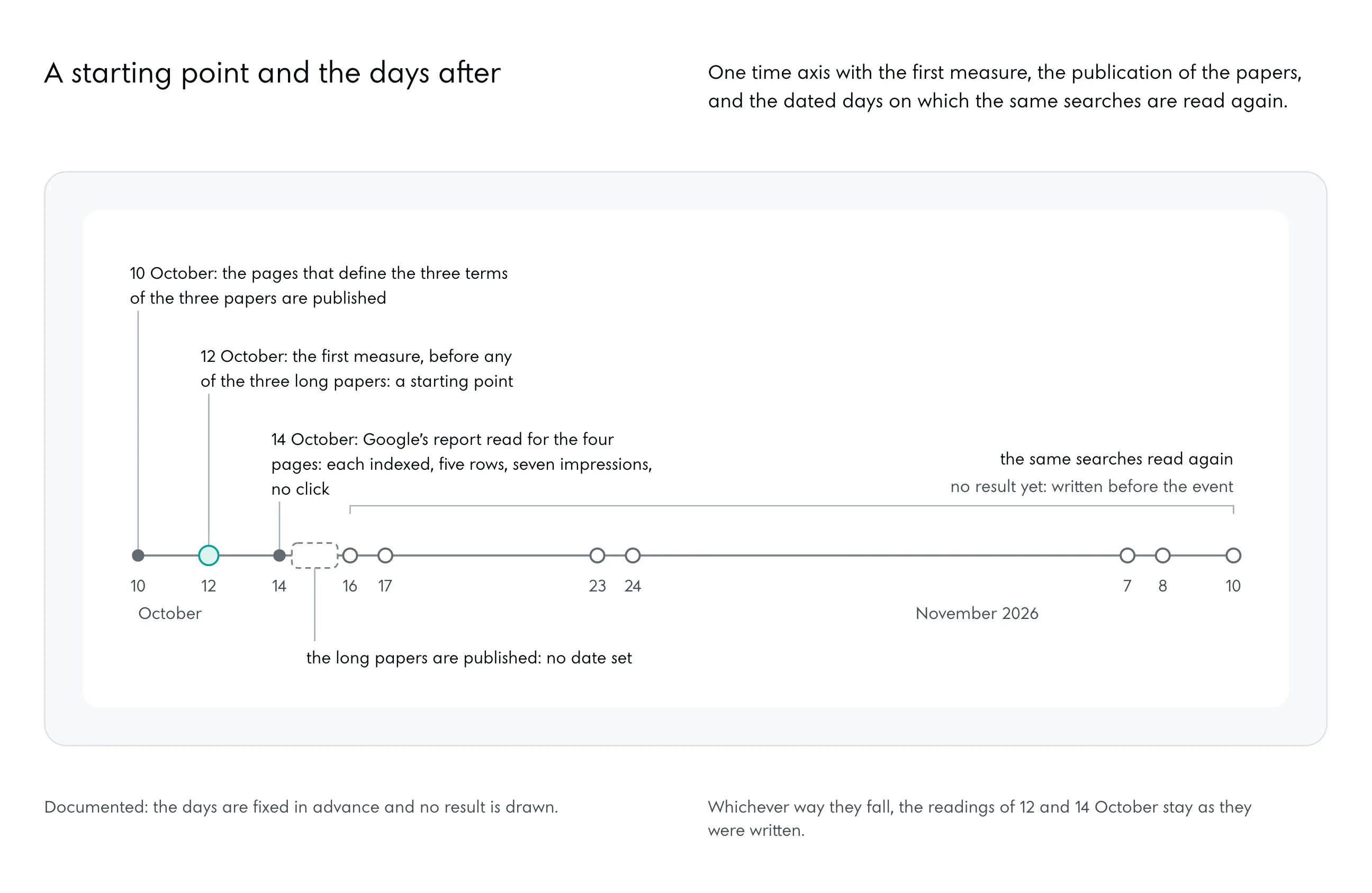
Positions Before the Papers
We searched Google in a browser on 12 October 2026, with personalisation off, which the results page confirmed each time, in English and with the country set to the United States; the pages that define the three terms were then two days old. Each term stood first for its name, in both spellings where it has two. Shorter forms fell away at different rates.
For Semantic Entanglement Optimisation, the name this paper writes beside search engine optimisation, the last two words stood first and the first two stood second, beneath a page of a research archive. The first and last words of Semantic Authority Mesh, taken together, stood eleventh among the links of the first page, and its other pairs were absent from that page. Neither pair of neighbouring words from Semantic Token Optimisation was on the first page at all.
These figures are measured, and their limits are narrow. It was a single reading of pages two days old, and it looked at the first page only. And a coined name has no rival pages, so first place for it is a floor, the least that the theory allows, and it proves very little.
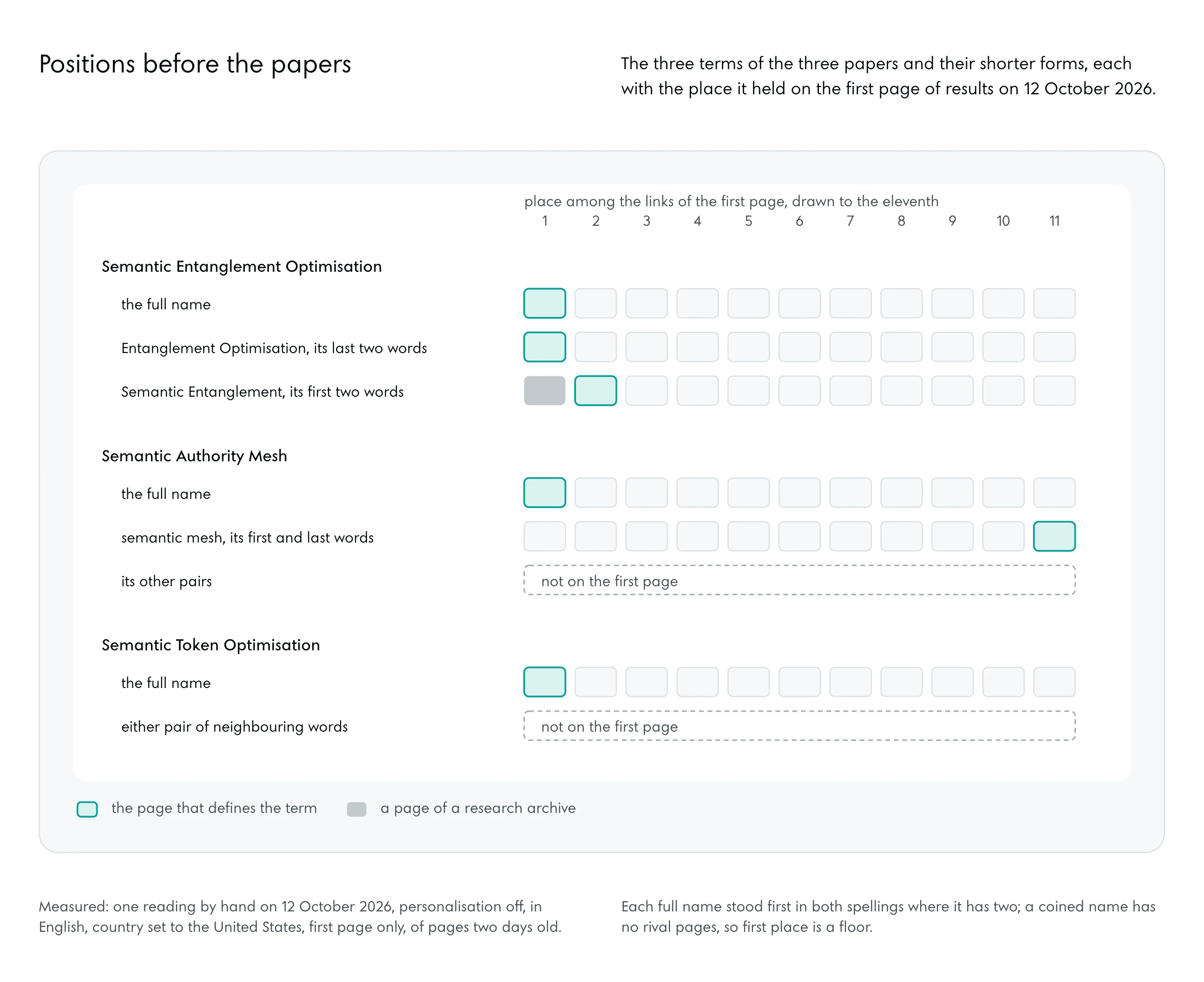
Index Status and First Rows
Four pages define the terms, the three of the three papers and Semantic Gravity Gradient, and on 14 October 2026 we read what Google’s Search Console held for them. Each was “Submitted and indexed”, and for each Google had chosen our own address as the canonical one. The page for Semantic Entanglement Optimisation, the name this paper writes beside search engine optimisation, had last been crawled on 10 October, the day it was published, and the page for the gradient within minutes of its publication on 12 October.
From 10 to 14 October the report held only five search rows for the four pages, seven impressions in all, and no click. Table 5 gives each row as the report gave it.
| Day | Page that defines | Search | Impressions | Clicks | Average position |
|---|---|---|---|---|---|
| 10 October | Semantic Token Optimisation | “query fan out”, in quotation marks | 1 | 0 | 14 |
| 11 October | Semantic Token Optimisation | “query fan out”, in quotation marks | 1 | 0 | 33 |
| 11 October | Semantic Authority Mesh | semantic mesh | 3 | 0 | 5.3 |
| 12 October | Semantic Gravity Gradient | semantic gravity | 1 | 0 | 5 |
| 13 October | Semantic Authority Mesh | semantic mesh | 1 | 0 | 1 |
This paper’s own page has no row. Nor does any full name, though the reading by hand two days earlier found three of them first; so few searches are either not counted yet or held back, as Google’s line on searches made by few people, quoted in the part on the main site and its satellite, allows. The rows come from the freshest data, which Google may still revise, the 14th was not complete, and the report counts each day on its own clock.
Two instruments stand in this part, and they are kept apart. The reading by hand was one search at a time on one morning, with the country set, while the report averages over whoever searched, wherever they were. So “semantic mesh” at the eleventh link by hand and at 5.3 and 1 in the report are two readings, both measured, and neither is added to the other or set against it.
Seven impressions are a start and no sample, and they support nothing in the founder’s expectation and break nothing.
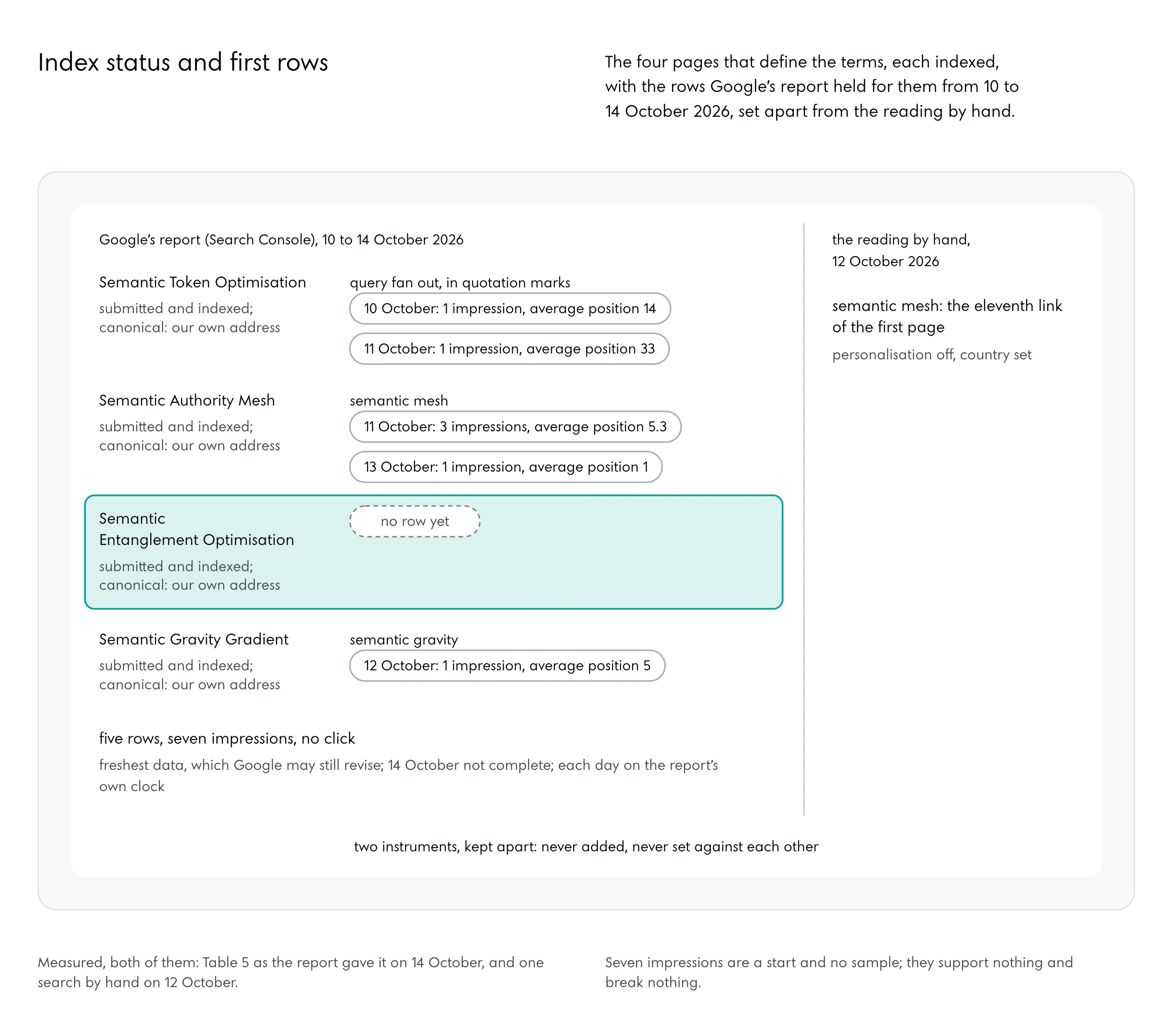
Outcomes Named in Advance
Piotr Paweł Zalewski, founder of Noo–Studio, expects the gradient to shift once the long papers are published. On his account the studio’s pages then begin to be shown for the second-level searches, the shorter and busier ones, while the three names keep first place. He set the comparison out himself that day, as “the measurement that we are doing now versus the measurement that’s going to be done” in a week or in a month.
This is theory, written down before the event, and it can fail in two ways.
Support would be searches that were off the first page on that day reaching it at the readings of a week and of a month. The account breaks if none of them moves, or if the names lose first place.
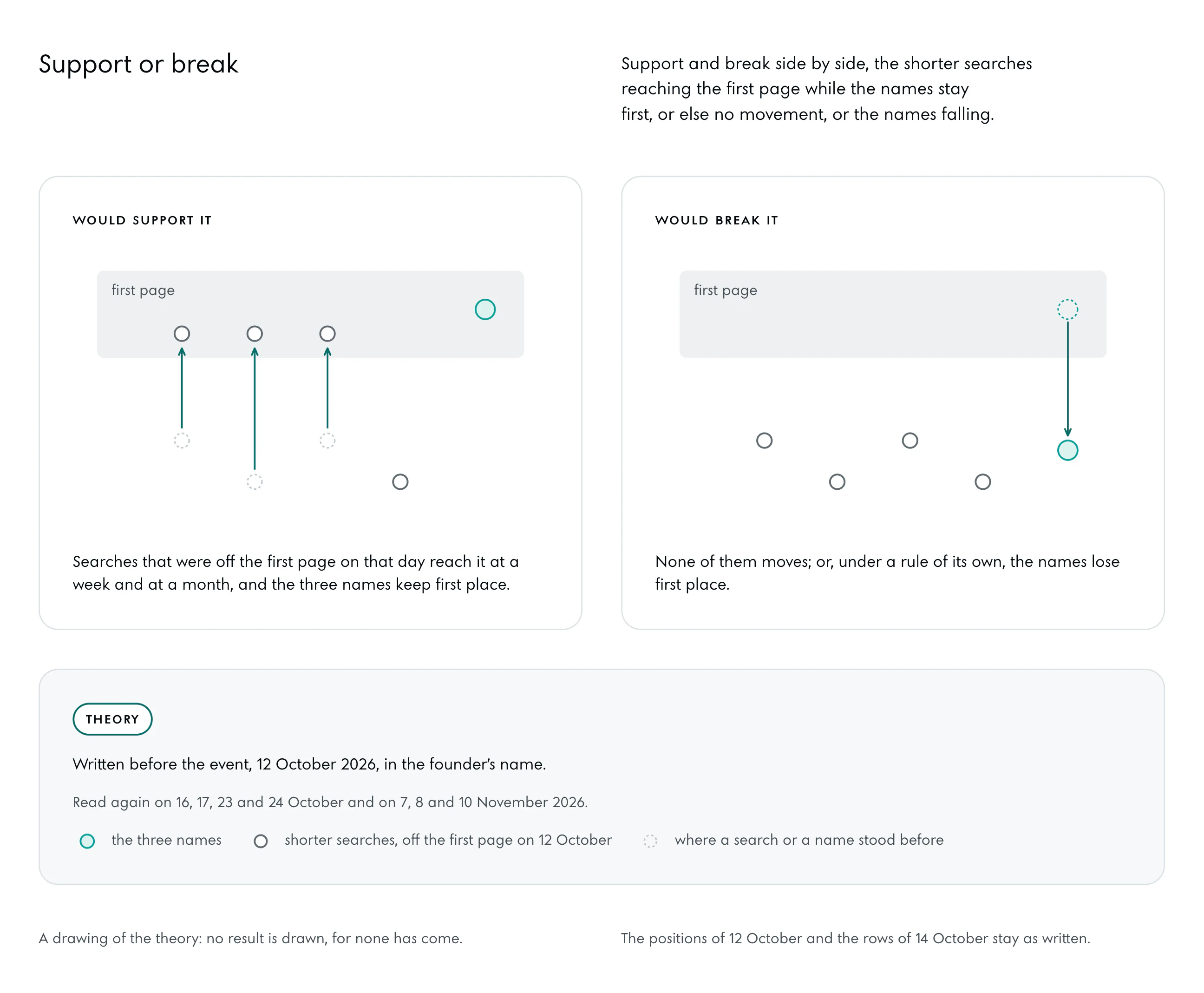
In his narration of 14 October 2026 the founder gave the same view a wider frame. All three papers argue from theory, and in his account the proof of the concept lies in the tests that he keeps making and that the studio will go on making over the coming months, of which these readings are the first.
On 16, 17, 23 and 24 October and on 7, 8 and 10 November 2026 the same searches are read again, in the same way, and the report’s rows with them. Whichever way those days fall, the positions of 12 October and the rows of 14 October stay as they were written here, and the later ones will be set beside them.