01One Object Made of Many Pages
An engine that turns text into vectors holds a site as a set of positions, and a set has properties that a single position lacks. It has a centre and a spread around that centre.
Its members can be tied to one another. Members of other sets can point at it. Semantic Token Optimisation followed one term to one place in a model’s space and ended there, so the body that a site’s pages make together begins where that argument stopped, and each of its properties can be computed with open models or read in papers and manuals that anyone can open.
Five components describe that body. Each of them, taken alone, is documented or measured. They are the point a page becomes, the centre of a site’s points, the spread around the centre, the ties between pages, which come in two kinds, and the citations that arrive from other sites.
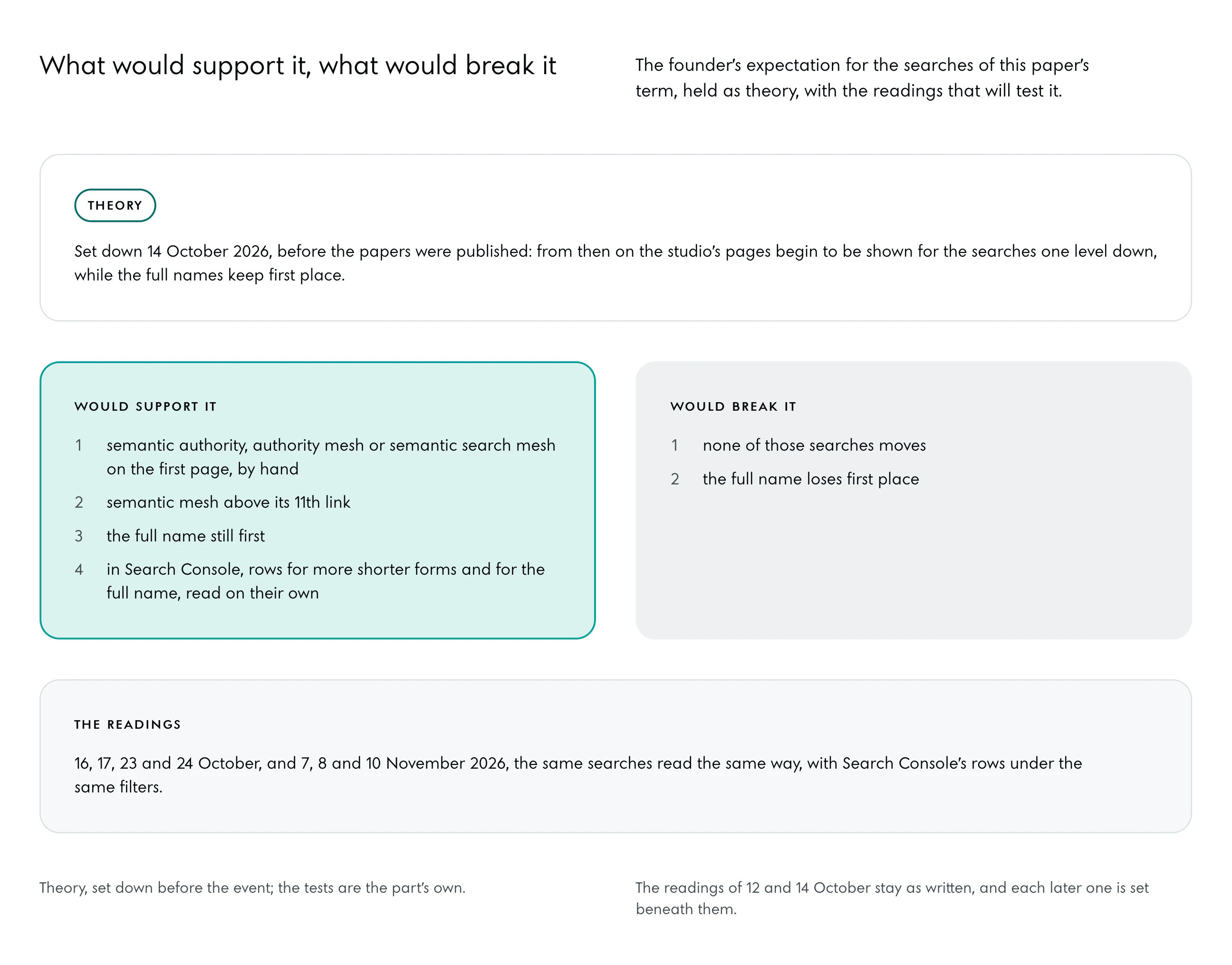
We hold, as theory, that an engine which reads meaning judges a site’s standing on a subject from these five together, and that a body built on all of them is harder to displace than any page inside it. That theory is stated with the test that would break it, at the place where the case is made.
Where the First Paper Stopped
One term, kept to one spelling and one sense, ends as one place in a model’s space, the centre of the small cloud that its uses make there. That was the unit the first paper worked on, and it is the smallest unit a firm controls. A page often holds several hundred tokens and a site holds its pages, so the same engine meets a firm at more than one size.
Between the sizes the arithmetic changes. A term is placed; of one place there is nothing more to compute. Ties join one member to another.
A mean needs at least two members, and so does a distance between members. Even a count of how many members an outsider has cited is a number about the set, and so a set of pages can be summarised where a single page can only be placed, and the summary holds quantities that no single page has.

Google’s published account of ranking allows for both sizes, and its guide to ranking systems, last updated on 10 December 2025, puts the page first, “Our ranking systems are designed to work on the page level, using a variety of signals and systems to understand how to rank individual pages.” Then comes the site, “Site-wide signals and classifiers are also used and contribute to our understanding of pages.” Both sentences are documented, as Google’s word. They say that a signal can belong to a site and still bear on a page.
Which signals, the guide leaves unnamed.
Definition and Its Three Clauses
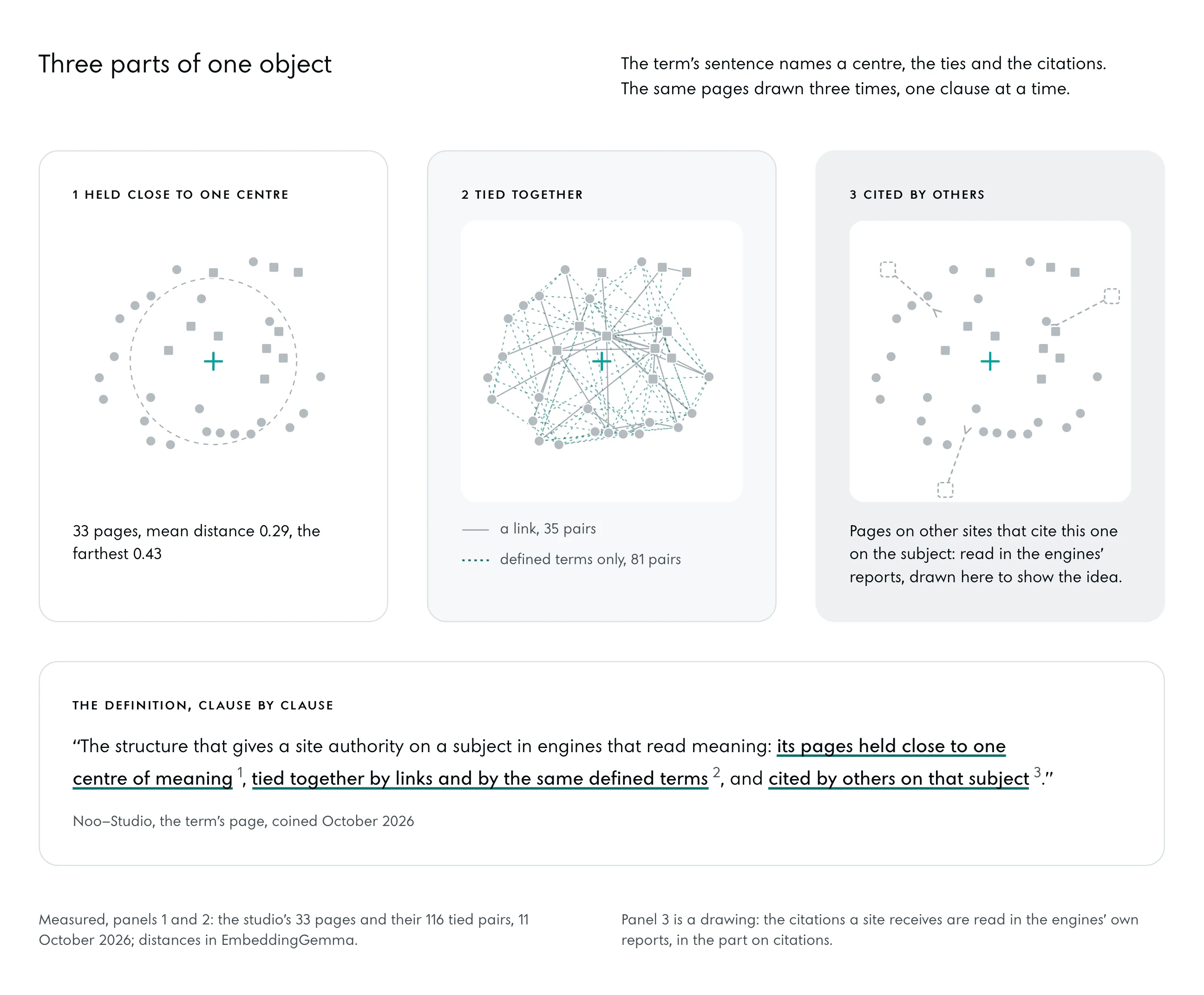
The studio’s name for that body is the Semantic Authority Mesh, a term Noo–Studio coined in October 2026. On the page behind that link the term is given in one sentence, “The structure that gives a site authority on a subject in engines that read meaning: its pages held close to one centre of meaning, tied together by links and by the same defined terms, and cited by others on that subject.”
That sentence has a head and three clauses. Its head names a structure and ties it to four things, a site, a subject, the engines that read meaning, and an effect on them. The first clause, pages held close to one centre of meaning, covers the points and the two quantities computed over them, a centre and a spread.
Links and the same defined terms are the two kinds of edge inside the site. With “cited by others on that subject” the sentence reaches outside the site, to ties that other sites make.
The verb in the head needs care. Our term’s page settles it in one line, that authority is what the engines conclude; the mesh is what they read to conclude it, and the term names the second of those. Engines have so far published no score under this name, and every claim about what the structure earns is marked below as theory.
Table 1 sets each component beside the way it is computed or read and the kind of evidence held on it.
| Component | What it is | How it is computed or read | Evidence held |
|---|---|---|---|
| The point | One page as one vector | An embedding model averages the vectors of the page’s tokens | Documented in research from 2019 and in model reports of 2025 |
| The centre | The mean of a site’s page vectors | Coordinates added, then divided by the number of pages | Documented as arithmetic, and named as a stored value in the files that leaked in 2024 |
| The spread | How far each page sits from the centre | One minus the cosine between page and centre, summarised for the site | Documented as arithmetic, with two stored values named in the same files |
| Edges of the first kind | Links between the site’s pages | Read from each page’s HTML and counted as a graph | Documented in research since 1997 and in Google’s pages on links |
| Edges of the second kind | One defined term carried by two pages | Read from the text and the structured data | Measured on the studio’s pages, while its effect on an engine is theory |
| Citations from outside | Other sites citing this one on the subject | Read in the engines’ reports of cited pages | Documented by Google for news, and measured on one site |
One size below sits the practice the first paper described, which works on the terms a mesh is tied with.
Each Word and Its Field
On 10 October 2026 the name was settled, in dictation, and the record of that day shows it arriving in stages. Piotr Paweł Zalewski, founder of Noo–Studio, first spoke of “building the topical mesh of authority” and added that “topical authority mesh is interesting term that could be added to it”. Later the same day he asked, “So like topical authority mesh or semantic authority mesh?”, and by then mesh and authority were fixed and only the adjective was open.
His words are kept as dictated.
Each part of the name comes from a field that had already fixed its meaning. Semantic has had a technical sense in retrieval at least since 1990, when Scott Deerwester, Susan Dumais, George Furnas, Thomas Landauer and Richard Harshman described a method built, in the words of their abstract, to “take advantage of implicit higher-order structure in the association of terms with documents”. They named that structure “semantic structure”, and their method placed texts and queries in one space computed from which terms occur in which texts.
Today’s models are, in outline at least, that idea with thirty-five more years of machinery. So the adjective was weighed against how those models work. In the founder’s words, “the using word semantic is a good one”.
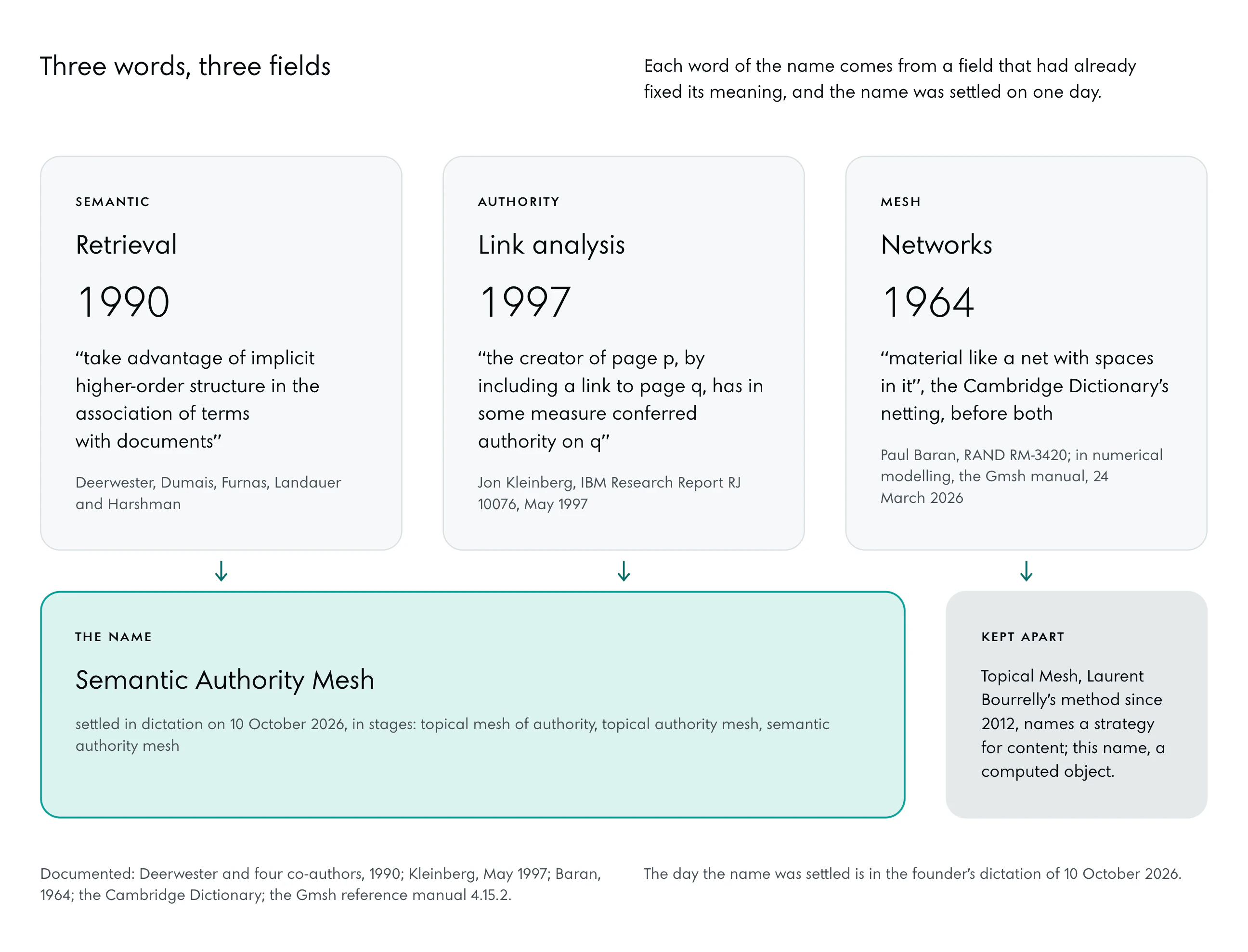
Authority entered retrieval research as a computed property. Jon Kleinberg’s paper on hyperlinked environments, first circulated as an IBM research report in May 1997, rests on one view of what a link is, that “the creator of page p, by including a link to page q, has in some measure conferred authority on q”. His algorithm then finds, for one broad topic at a time, the pages that many good sources point to, and the rule behind it takes a line, “a good hub is a page that points to many good authorities; a good authority is a page that is pointed to by many good hubs”.
Three properties of that sense survive in the studio’s term. Authority is conferred by others, and it holds on a subject. It is also computed from a structure, which is why the term names the structure and leaves the verdict to the engine.
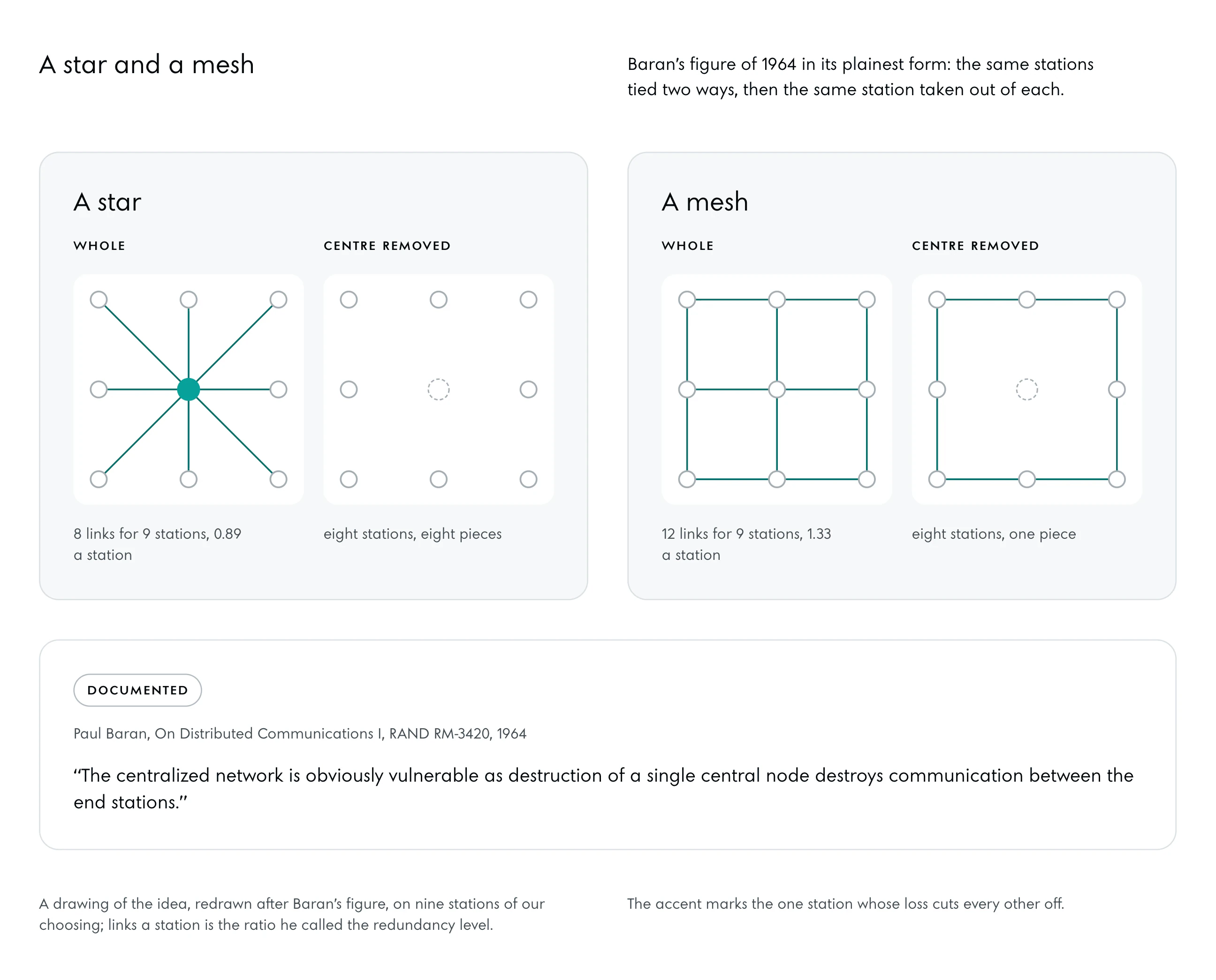
Mesh is the plainest of the three words and has been borrowed twice by engineers. In ordinary English it is netting, “(a piece of) material like a net with spaces in it, made from wire, plastic, or thread” in the Cambridge Dictionary’s wording. Paul Baran used it in 1964 for a kind of network, and his RAND memorandum on distributed communications sorts every network into two components, “centralized (or star) and distributed (or grid or mesh)”, and says plainly why the difference matters, “The centralized network is obviously vulnerable as destruction of a single central node destroys communication between the end stations.” Numerical modelling took the word a third way, and the reference manual of Gmsh, an open mesh generator, defines a finite element mesh, in the manual dated 24 March 2026, as “a tessellation of its geometry by simple geometrical elements of various shapes”, “arranged in such a way that if two of them intersect, they do so along a face, an edge or a node, and never otherwise”.
Beside the word topical, the noun was already at work. Laurent Bourrelly publishes a method under the name Topical Mesh, “Carefully crafted since 2012” in the words of its page, and he is credited for it among the neighbours in a later part. His term names a strategy for a site’s content and ours names a computed object, so the two are kept apart throughout.
Four Commitments of a Net
In each of the fields that own the word, a mesh has the same few properties. There are four, and the name binds the term to all of them.
No node is the centre. Baran’s star dies with its hub; his mesh has no hub to lose. With any one page removed, the mean of a site moves a little and the body remains.
A site built as a mesh has a centre of meaning all the same, which is a computed place, and no page has to stand on it.
Ties exceed the minimum. Baran’s measure for this was a redundancy level, the ratio of links to nodes. He reported that “Redundancy levels on the order of only three permit withstanding extremely heavy level attacks with negligible additional loss to communications”, a finding about stations and lines under attack.
Whether it carries over to pages and their ties is argued in a later part, and until then the step is ours and is held as theory.
Elements meet only along what they share. Two pages touch at a link, or at a defined term that both carry. That is the Gmsh manual’s rule carried over, and its last three words forbid overlap, since two elements may touch at a node or along an edge and may never cover the same area.
And the ban on overlap is the demand, stated on the term’s page, that every page earns its place with first-hand content.
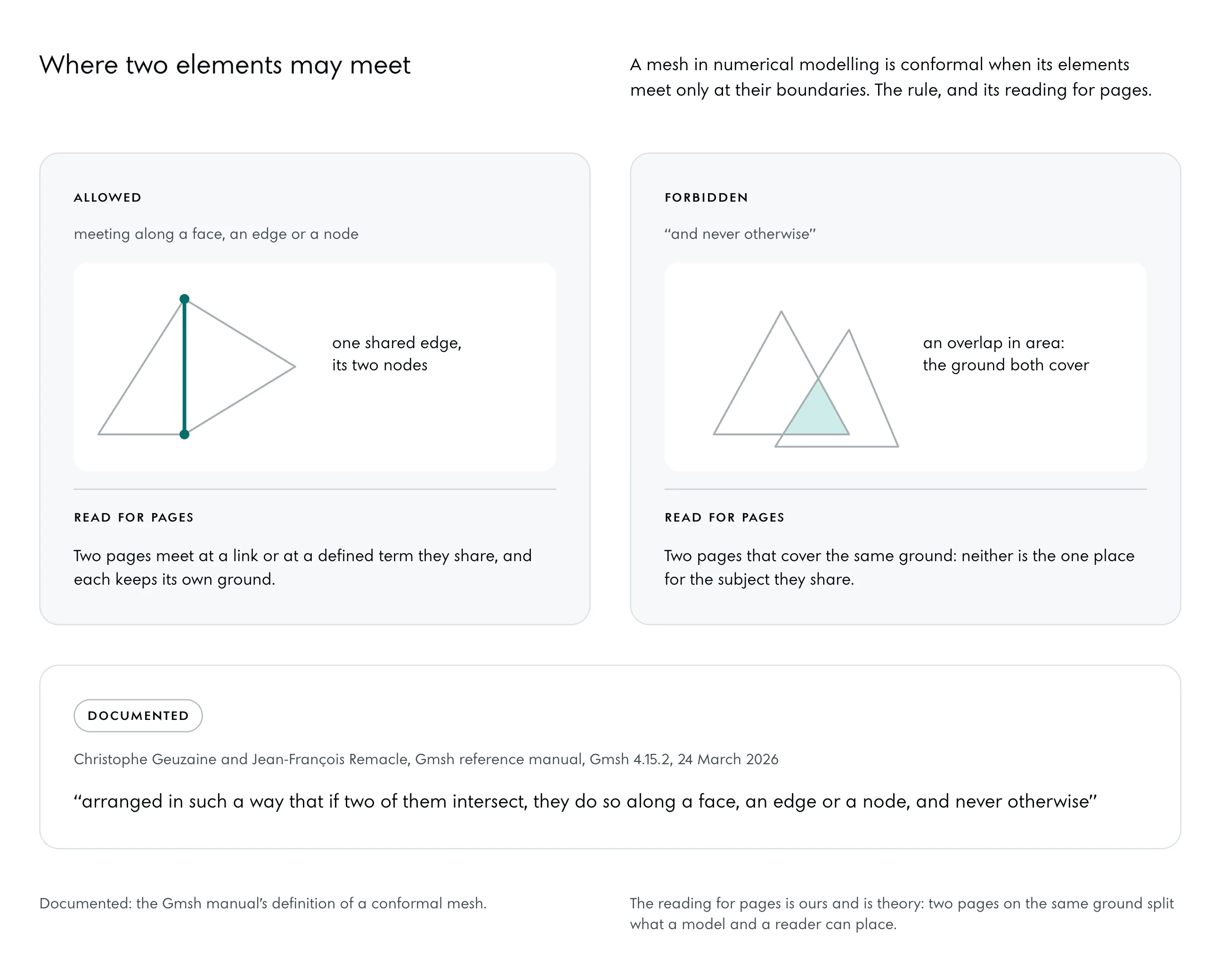
A mesh is laid over something. In the finite element sense it tiles a geometry, so it covers the model fully and leaves no hole. For a site the geometry is its subject, and a mesh of pages covers that subject piece by piece, each page on its part.
None of the four says anything about ranking. They describe what a site is built as, and they give four things to check on a site that claims the name, whether there is a page the body cannot lose, how many ties a page holds, whether two pages cover the same ground, and whether any part of the subject is left bare.
Labels carry over from the first paper unchanged. Documented marks a source opened with its date, and measured marks a figure the studio took, with its method and its window. Theory is kept for what we hold, and it always comes with the test that would break it.
Google’s published word and the internal documentation that leaked in 2024 stay under separate labels, as they did there. A field name from it is quoted as a note on what is stored, and as nothing more.
02A Page as One Point
Whatever text it is given, a title or ten thousand words, an embedding model returns one vector.
Between the text and the vector there is a step that the model builders describe in a line, and that step is an average in which every token of the text gets one vote. So a text that keeps to one subject lands in a sharp place, and a text that covers two lands between them. What a site can show of itself to an engine that reads meaning is settled first at this step, before any link is counted or any other site cites a page.
Three Decades of Document Vectors
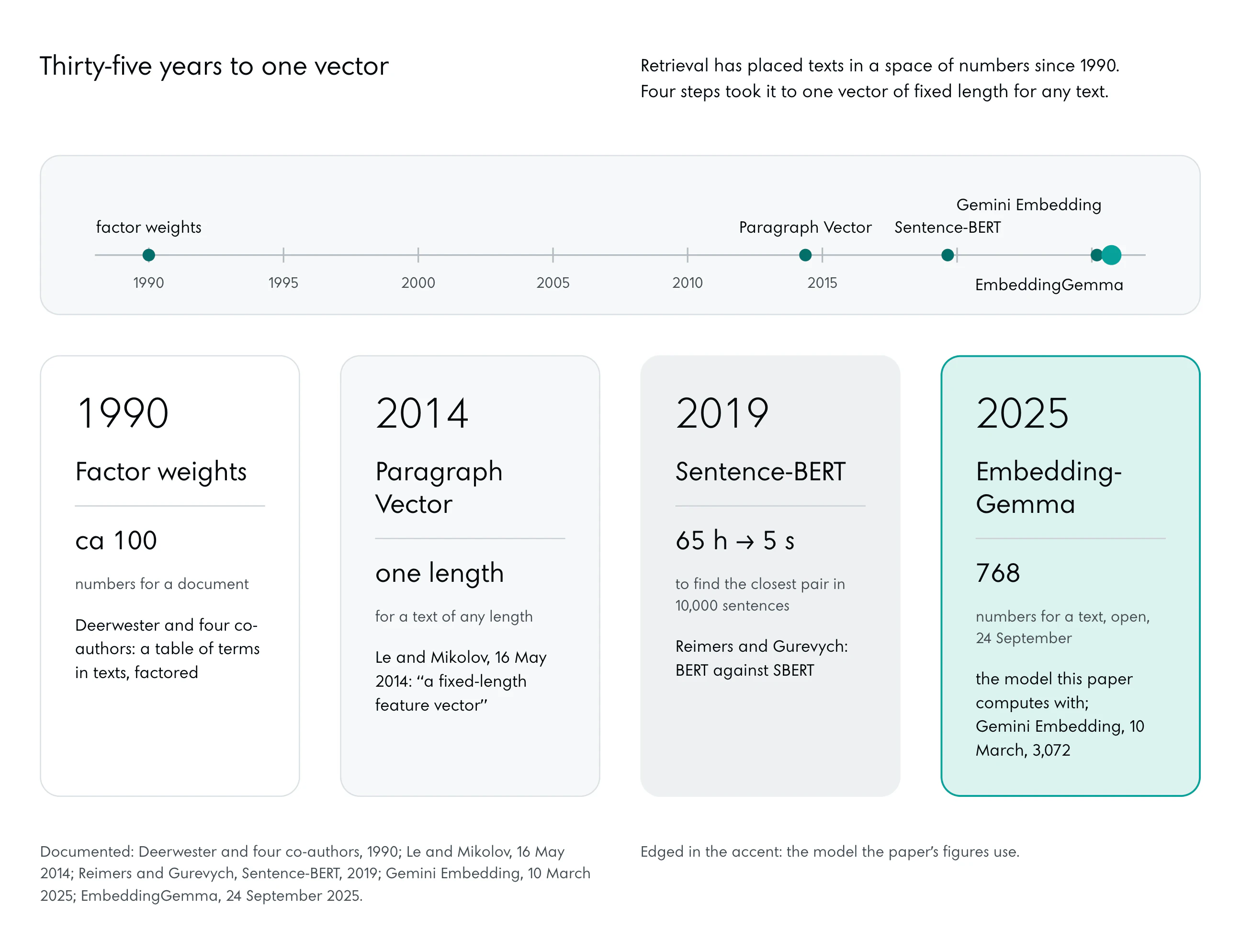
Retrieval has placed texts in a space of numbers since 1990. In the method of Deerwester and his co-authors, named in the part before this one, “Documents are represented by ca 100 item vectors of factor weights.” Their hundred numbers came from factoring a table of which terms occur in which texts, and a query was placed in the same space, so that nearness could stand in for a match of words.
Quoc Le and Tomas Mikolov gave, in May 2014, the reason that every later design shares, “Many machine learning algorithms require the input to be represented as a fixed-length feature vector.” Their Paragraph Vector learned “fixed-length feature representations from variable-length pieces of texts”. After that the length of a text stopped mattering to the machine that compares. A sentence and a book each became a row of the same width.
Five years on, Nils Reimers and Iryna Gurevych counted what it costs to go without such a vector, “Finding the most similar pair in a collection of 10,000 sentences requires about 50 million inference computations (~65 hours) with BERT.” Their Sentence-BERT of August 2019 was built “to derive semantically meaningful sentence embeddings that can be compared using cosine-similarity”, and its abstract puts the same search at about 5 seconds. That gap, hours against seconds, is the plain reason for computing a vector once and keeping it.
By 2025 the design sits in the models Google publishes. The report on Gemini Embedding, dated 10 March 2025, says that the vectors it generates “can be precomputed and applied to a variety of downstream tasks including classification, similarity, clustering, ranking, and retrieval”. EmbeddingGemma followed on 24 September 2025, described by its authors as “a new lightweight, open text embedding model based on the Gemma 3 language model family”.
It is open, so anyone can compute with it, and it belongs to the family whose tokenizer cut the first paper’s sentences into pieces.
Pooling Along the Sequence
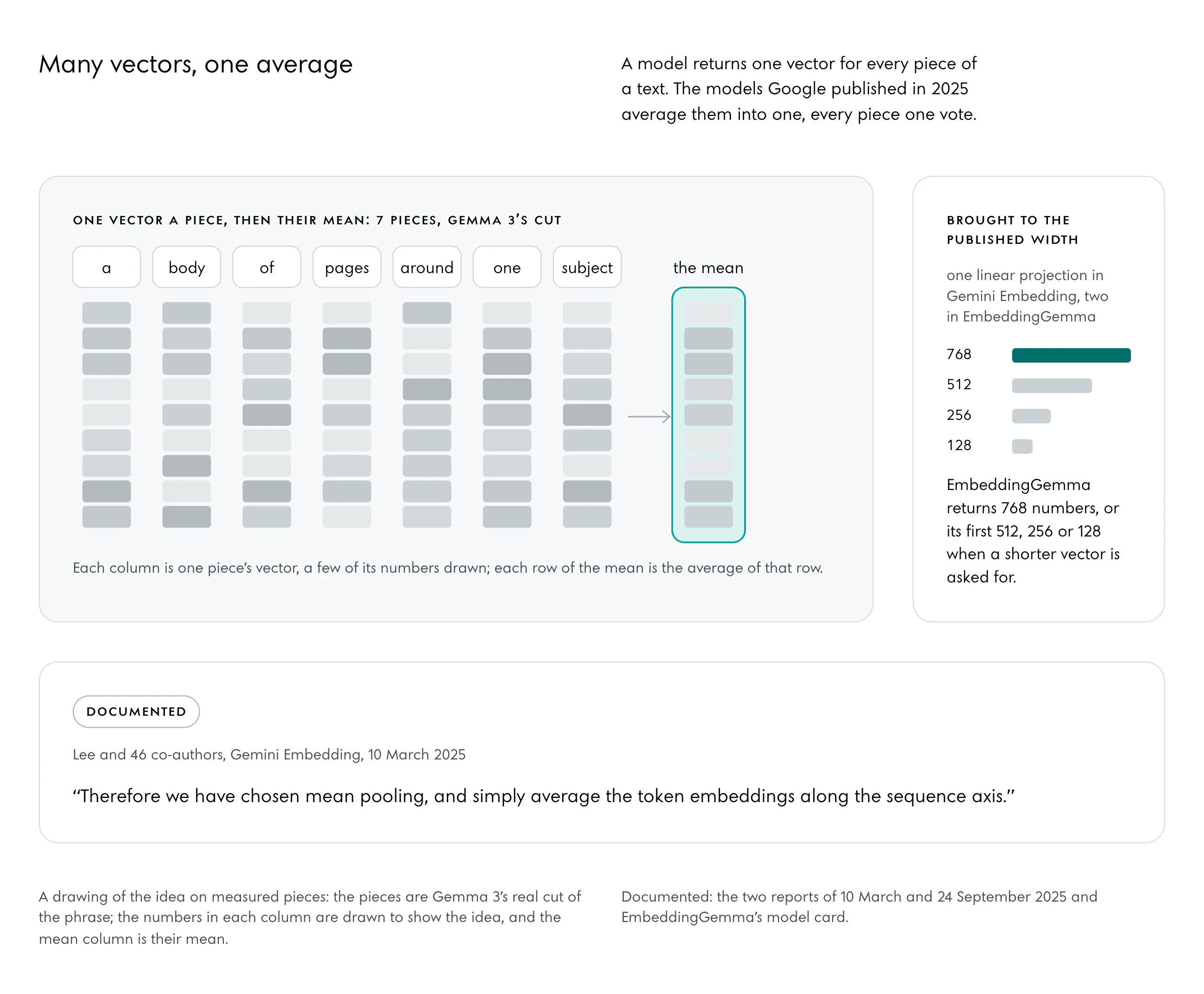
For each token it is given a transformer returns one vector, so a text of 600 tokens comes back as 600 vectors. Which of them stands for the text, or what blend of them all? Sentence-BERT’s authors give their answer in a line of the paper already cited, “SBERT adds a pooling operation to the output of BERT / RoBERTa to derive a fixed sized sentence embedding.” They tried three ways of pooling and kept the plainest as the default, “computing the mean of all output vectors (MEAN-strategy)”.
Google’s two reports of 2025 choose the same arithmetic. Gemini Embedding’s authors write, “Therefore we have chosen mean pooling, and simply average the token embeddings along the sequence axis.” EmbeddingGemma’s describe a pooling step “which averages the token embeddings along the sequence axis to generate a single embedding representing all the information in the input”. After the mean the vector is brought to its published width by linear projection, in one step for Gemini Embedding and in two for EmbeddingGemma, whose card gives that width as “768, with smaller options available (512, 256, or 128)”.
A page’s vector is an average, and every token on the page has a vote in it.
At the pooling step every token counts once. What follows from that is arithmetic, and the step from it to a site is our inference. Text that repeats on every page of a site, a long menu or a block of legal lines, votes on every page, so unless it is stripped before the page is embedded it pulls every point of the site the same way.
An owner who computes with an open model decides what text goes in, and that choice belongs beside every figure that comes out.
Windows and Their Passages
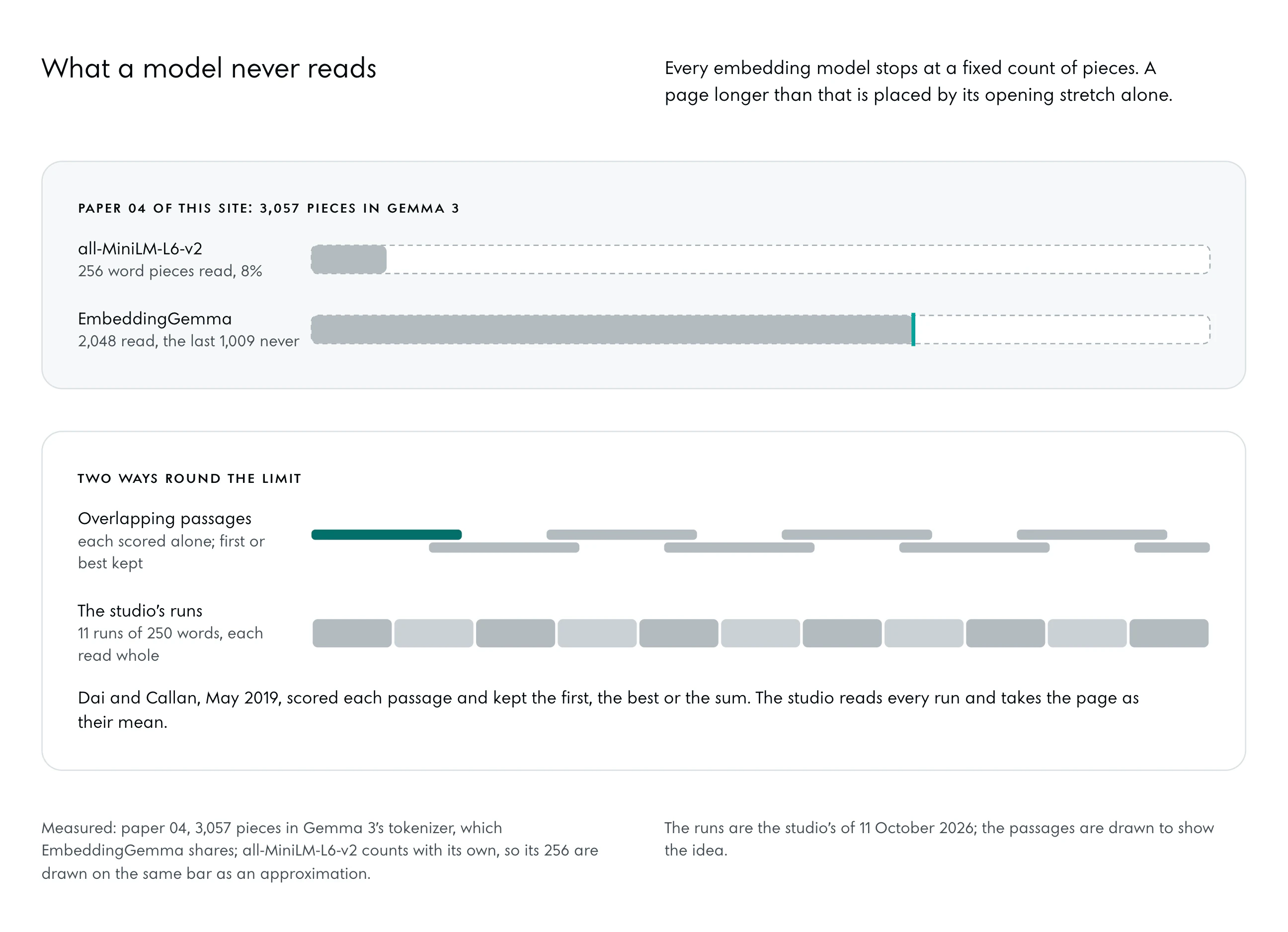
Every embedding model stops reading at a fixed count of tokens. The card of all-MiniLM-L6-v2, a small open model of the Sentence-BERT line, states its limit in one sentence, “input text longer than 256 word pieces is truncated.” What it does read it maps to “a 384 dimensional dense vector space”. EmbeddingGemma’s card gives a “Maximum input context length of 2048 tokens”.
A page that comes to 3,000 pieces, counted by each model’s tokenizer, is read by the smaller model for less than its first tenth, and a menu or a cookie notice may fill much of that share. With the larger window roughly two thirds of such a page is read and the last third never is.
Either way the point that stands for the page is always the point of its opening stretch, whatever the page’s length.
Research on ranking met the same limit and answered by cutting. Zhuyun Dai and Jamie Callan described the cut in May 2019, “We split a document into overlapping passages. The neural ranker predicts the relevance of each passage independently.” A document’s score was then taken from “the first passage (BERT-FirstP), the best passage (BERT-MaxP), or the sum of all passage scores (BERT-SumP)”.
To a system built this way a long page is a small set of passage points with a rule for combining them, and the page can stand or fall on its first or its best passage.
Which unit does an engine embed, the page or the passage, and with which model? Google’s pages on ranking have so far left both unsaid, and the leaked module quoted in the next part names a page embedding beside a site embedding, with no passage embedding among its five attributes. The parts that follow therefore compute with one vector per page, and they assume none of the models that Google has published.
An owner who measures per passage gets a finer view and takes the page’s place as the mean of its passages.
What the Average Keeps
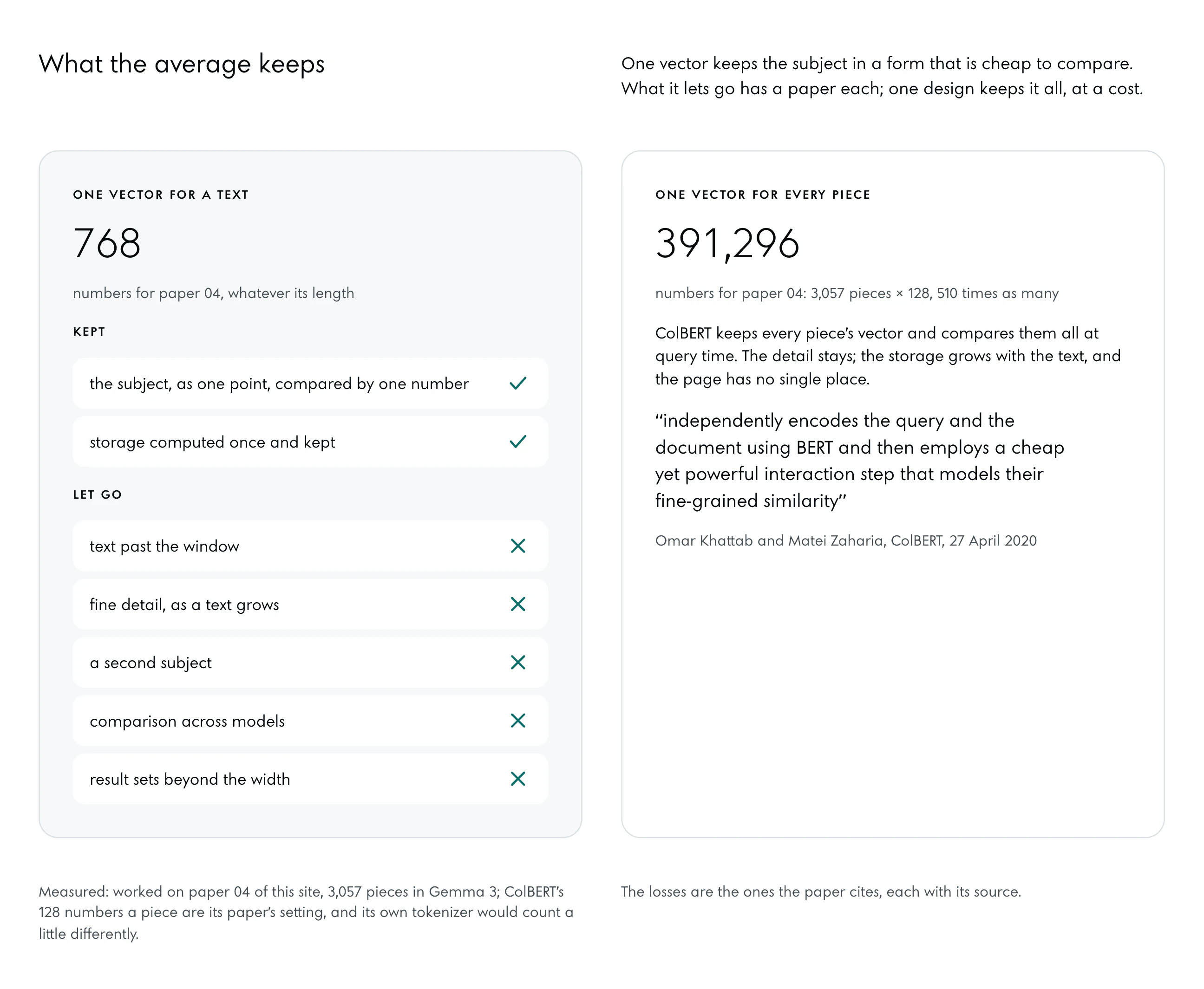
A single vector holds on to the subject of a text, in a form that is cheap to compare. Two texts on one subject usually land near each other whatever words they use, and their nearness is one number, a cosine. Storage is the second gain, since the vector is computed once and kept, which is the property Gemini Embedding’s report names with the word precomputed.
What it lets go is a longer account, and each loss has its paper.
- Text past the window is never read, so it has no vote, and the page’s place is the place of the part that was read.
- Fine detail often thins as a text grows. Yi Luan and three co-authors reported in May 2020 results “suggesting limitations in the capacity of fixed-length encodings to support precise retrieval of long documents.”
- A second subject moves the point off both. Two unit directions at a right angle average to a direction whose cosine with each is 0.71, where a page on one of them alone would hold 1.00 with it.
- Comparison across models is lost entirely, because each model has a space of its own. Even inside one model the space can be uneven, as Li and five co-authors found in November 2020 of an earlier encoder, “We find that BERT always induces a non-smooth anisotropic semantic space of sentences, which harms its performance of semantic similarity.”
- Result sets are bounded by the vector’s width. Weller, Boratko, Naim and Lee showed in August 2025 that “the number of top-k subsets of documents capable of being returned as the result of some query is limited by the dimension of the embedding.”
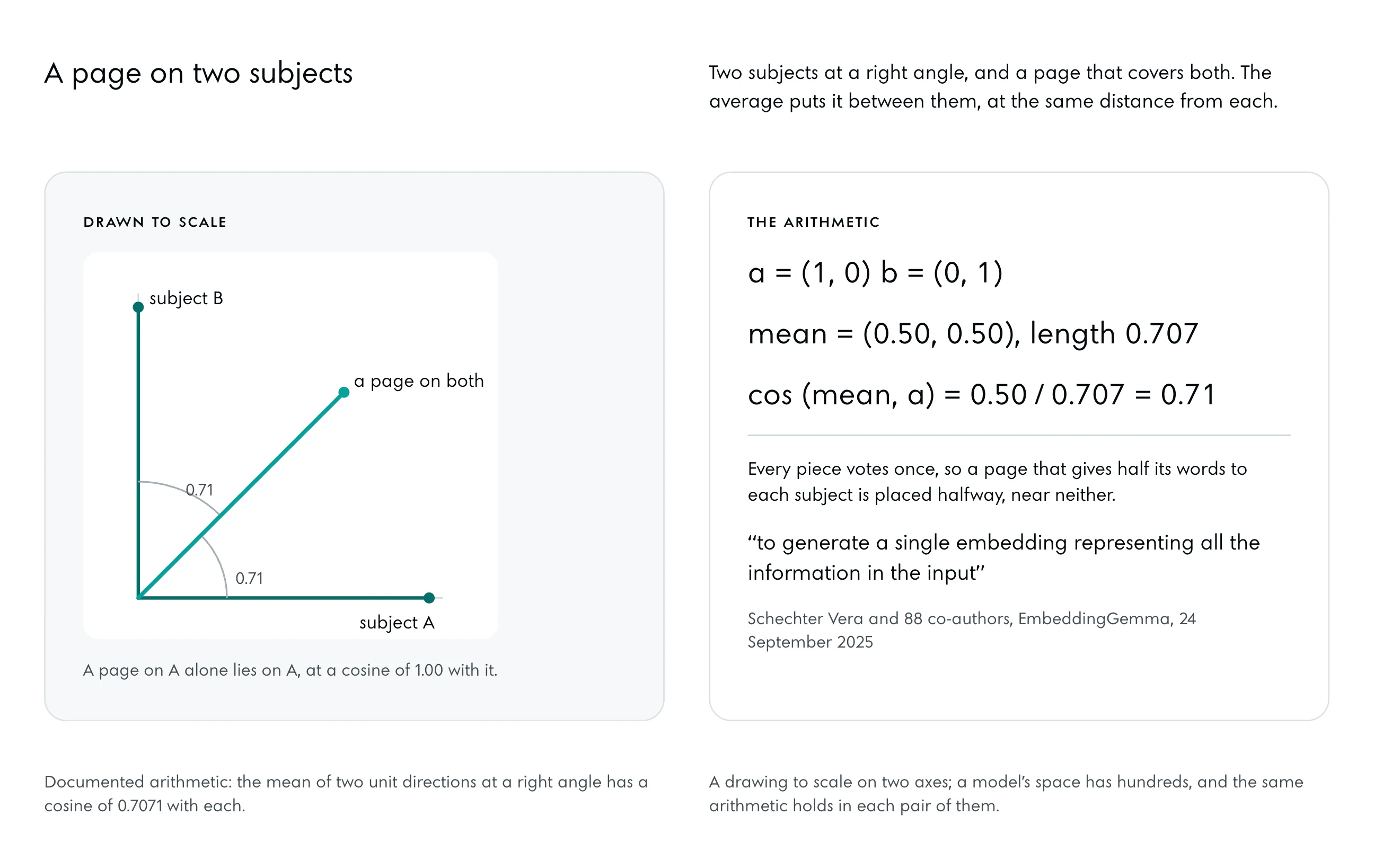
One design keeps what the mean discards. ColBERT, published in April 2020 by Omar Khattab and Matei Zaharia, “independently encodes the query and the document using BERT and then employs a cheap yet powerful interaction step that models their fine-grained similarity”. In practice it stores a vector for every token and compares them all.
That costs storage that grows with the text, and it leaves a page with no single place. But a centre and a spread need one place for each member, so the single vector stays the unit of a mesh.
From the arithmetic a rule follows for the page, and it is short.
One page, one subject.
A page that keeps to one subject gives the mean nothing to blur, which is documented arithmetic. That an engine rewards such a page is theory, and a site whose two-subject pages were retrieved for both subjects as often as its one-subject pages for one would break it.
A point in the space shows where a text sits among other texts. It cannot show whether the text is true or first-hand, and it says nothing of who else points at the page. Those are carried by edges, which no vector holds.
03The Centre and the Spread
Once every page has its vector, a site is a set of places in one space, and for any set two things can be computed, where its middle lies and how far its members sit from it.
Each takes a line of arithmetic. The documentation that leaked in 2024 names a stored value for both, and for unit vectors summarised by plain means the two values turn out to be one number seen from two sides.
Site Pages and Their Mean
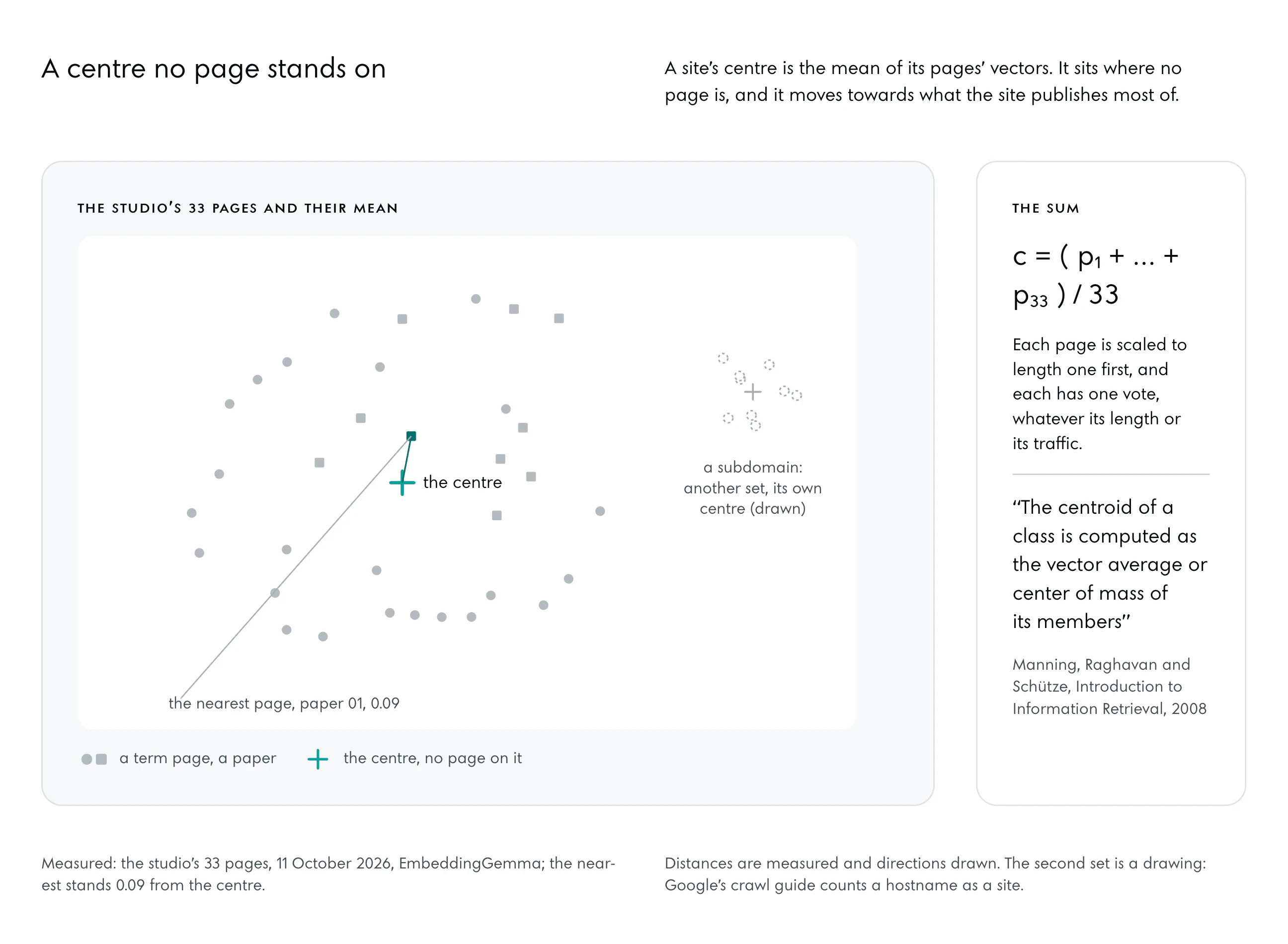
Centroids are the oldest summary retrieval has for a group of texts. For a site the members of the group are its pages. Manning, Raghavan and Schütze define the centroid in their textbook of 2008, “The centroid of a class is computed as the vector average or center of mass of its members”.
The vectors of the pages are added coordinate by coordinate and divided by the number of pages, and the result is a place in the same space, often one that no page occupies.
Texts compared by cosine have their length thrown away first, and then the mean is scaled too. No other direction sits nearer to the members taken together. Inderjit Dhillon and Dharmendra Modha set this out in a paper first issued in February 1999, where every document vector is scaled to length one and each cluster gets “a concept vector that is the centroid of the cluster normalized to have unit Euclidean norm.” They show why it is the natural centre, the concept vector being “the vector that is closest in cosine similarity (in an average sense) to all the document vectors in the cluster”.
What counts as a site, for this sum? Google’s guide to crawl budget for large sites, updated on 22 July 2026, gives a rule for that one system, “In this context, Google’s crawling infrastructure defines a site as a unique hostname.” Separately, the files that leaked in 2024 have a field named siteChunk, described as “Primary NSR sitechunk. In most of the cases it’s same as HOST_LEVEL_V3 sitechunked canonical url of the document.” Where a unit is named at all, then, it is most often the host, and a subdomain is another set with another centre.
Every page has one vote in the mean, whatever its length or its traffic. Forty short pages at the edge of a subject outvote ten long ones at its heart, and the centre moves towards the forty.
So the centre of a site is decided by what the site publishes most of.
How Far Each Page Sits
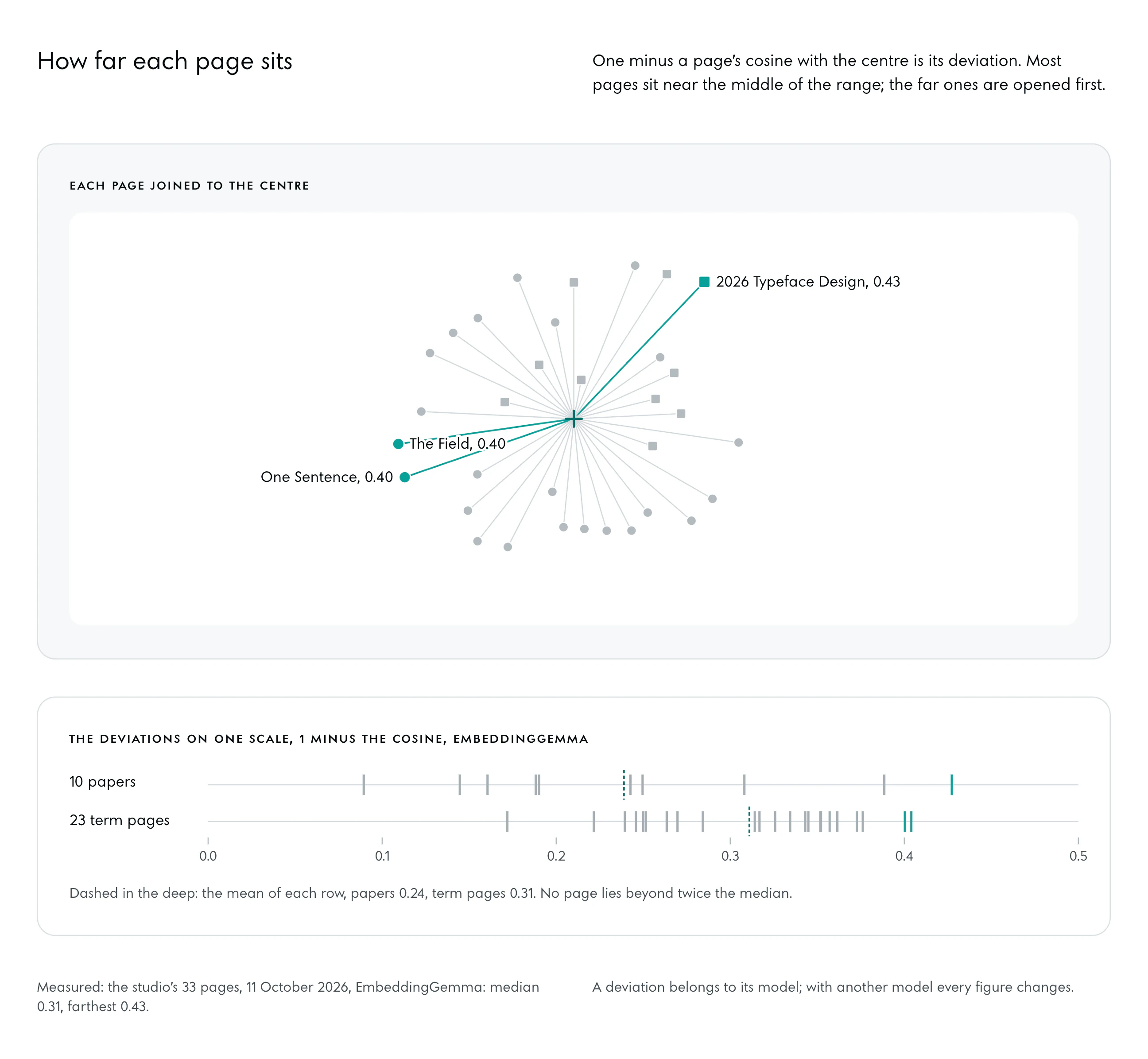
Distance in this space is read from an angle. One number comes out for each page. The cosine between a page’s vector and the centre is 1 when the two point the same way and 0 when they stand at a right angle, and the deviation of the page, which is how far it sits from the centre, is 1 minus that cosine.
A site’s deviations have a shape. Most of them are probably small, at least on a site built around one subject. The few pages that sit far out are the ones to open first, since a far page is usually off the subject or on a part of it that the site has barely covered.
FlowHunt’s audit tool draws this as a view of drift and tells its user that “Pages in the Drift view colored orange/red are furthest from their section centroid”. Its centroid is that of a section, a smaller set inside the site, and the arithmetic is the same.
Each deviation belongs to the model that produced the vectors; with another model the space is another space and every figure changes. A deviation of 0.20 from one model says nothing about 0.20 from the next. So a figure is quoted with its model’s name, or it is no figure.
Flat maps of these places, with each page as a dot, are made by squeezing hundreds of dimensions into two. FlowHunt names its method, a “2D UMAP projection of content embeddings”, and the authors of UMAP claimed for it in February 2018 that it “arguably preserves more of the global structure” than t-SNE, the method it was set against. Distances on such a map differ from the distances in the space.
So the map serves to find the far pages, and the arithmetic stays with the vectors.
Focus and Radius as Arithmetic
Two numbers summarise the deviations of a site. Their mean is the first, and the open tools call it the radius. One minus that mean is the second, which they call the focus.
DEJAN published a calculator in open code that embeds the words of each address in a sitemap, never the text of the page, and takes their mean as the centre. Two lines of that code read “site_radius = np.mean(deviations)” and “site_focus_score = max(0, 1 – site_radius)”. FlowHunt’s audit prints the same pair with a gloss on each, “1.0 = laser focused” for the focus and “lower = tighter spread” for the radius.
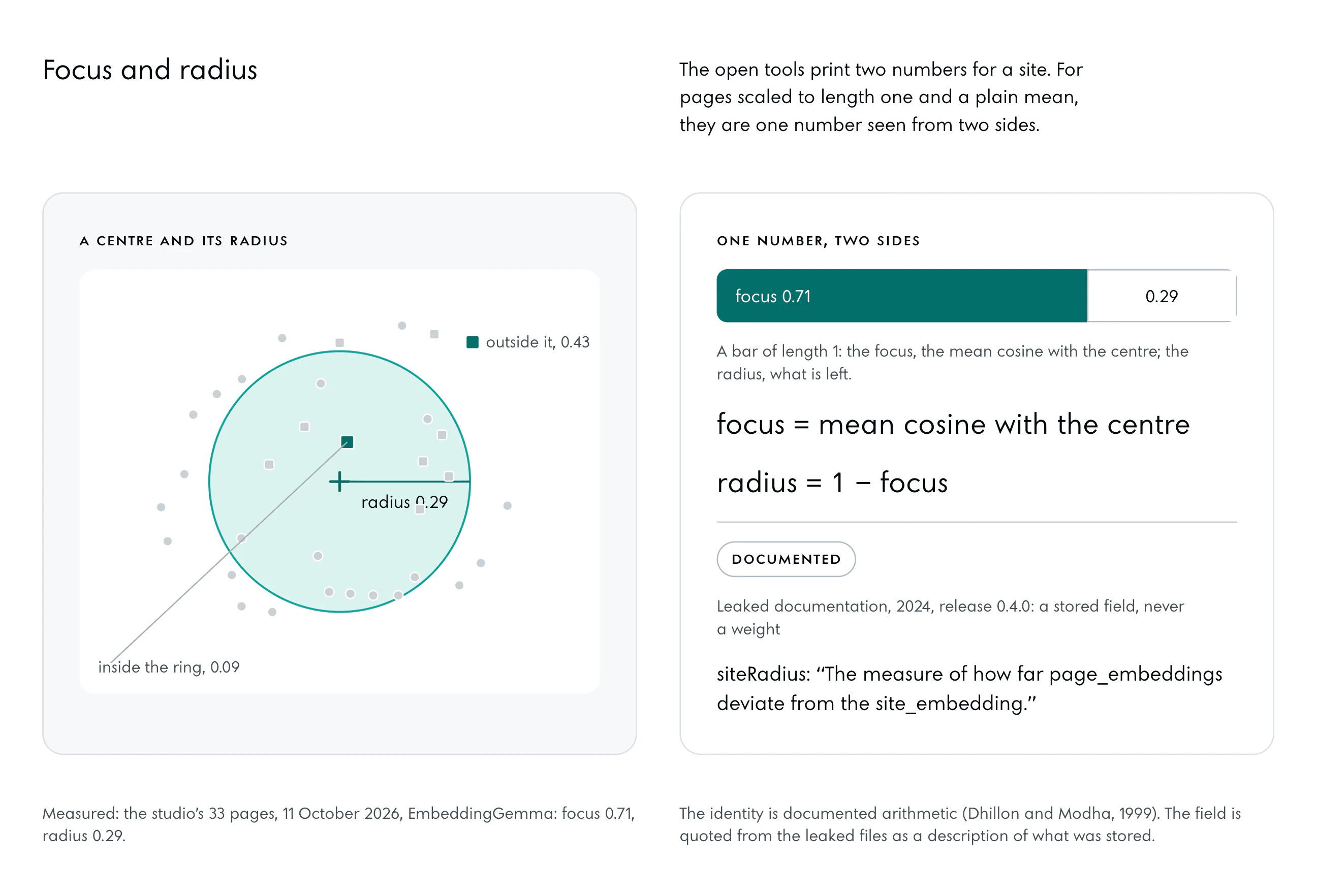
For unit vectors and a plain mean the two are one number. The mean cosine between the pages and the direction of their centre equals the length of the mean vector, an identity that takes one line to derive. Dhillon and Modha measure the average coherence of a cluster by that length and say how it behaves, “if all document vectors in a cluster are identical, then the average coherence of that cluster will have the highest possible value of 1. On the other hand, if the document vectors in a cluster vary widely, then the average coherence will be small, that is, close to 0.” Statistics of directions has a name for it as well, and SciPy’s manual, in version 1.18.0, gives it, “The mean resultant length is a value between 0 and 1 used to quantify the dispersion of directional data”. So focus is the length of the mean vector and radius is what is left of 1.
A tool that prints both prints one number twice.
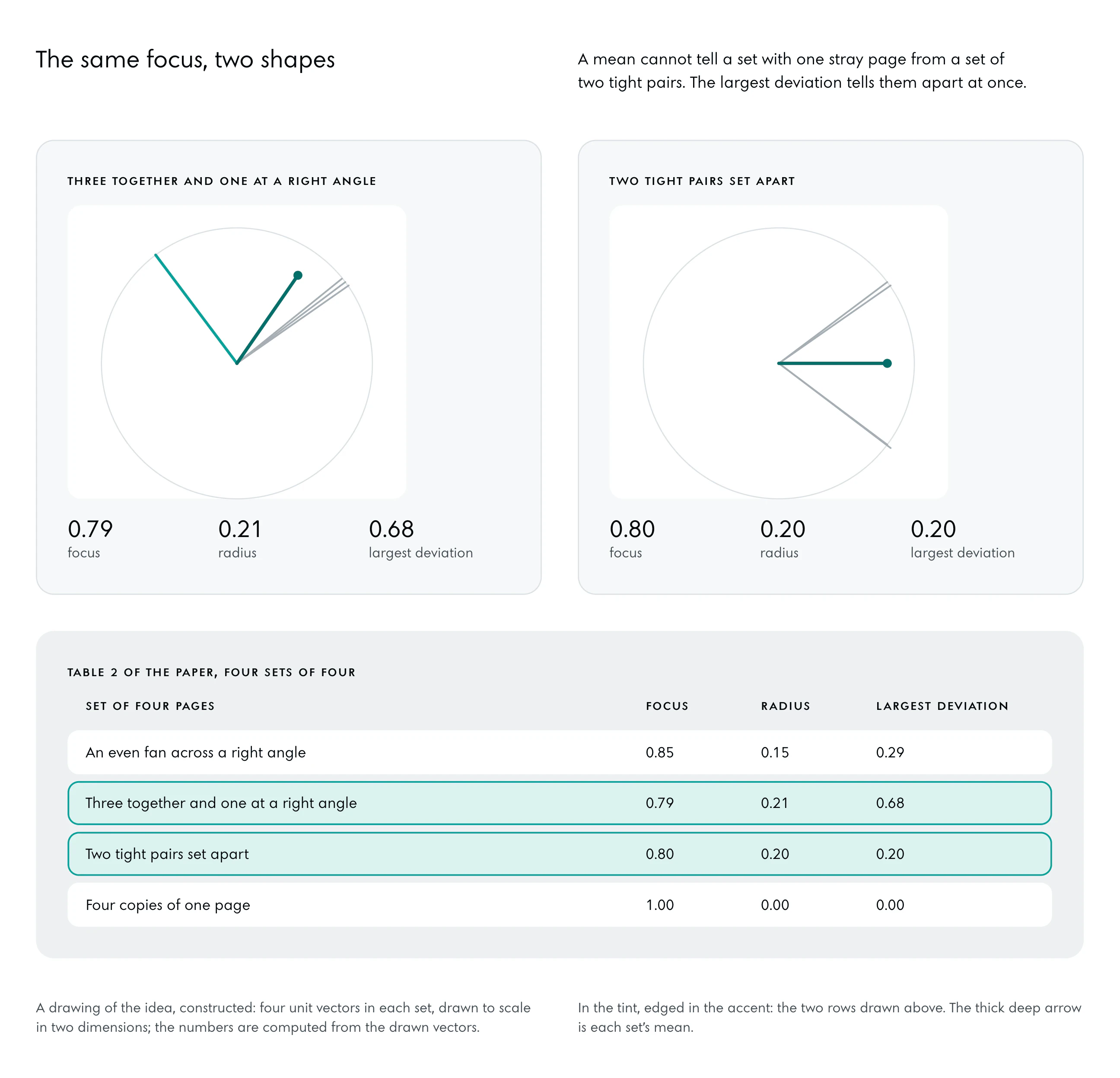
Table 2 is built by hand in two dimensions, four sets of four unit vectors each, to show what a mean hides.
| Set of four pages | Focus | Radius | Largest deviation |
|---|---|---|---|
| An even fan across a right angle | 0.85 | 0.15 | 0.29 |
| Three together and one at a right angle to them | 0.79 | 0.21 | 0.68 |
| Two tight pairs set apart | 0.80 | 0.20 | 0.20 |
| Four copies of one page | 1.00 | 0.00 | 0.00 |
Rows two and three differ by 0.01 in focus. A mean can never tell them apart. One of them holds a page that stands at a right angle to the other three, and the next holds two tight pairs and no stray at all.
The largest deviation separates them at once, 0.68 against 0.20, which is why a second number worth storing would describe the shape of the distances.
Row four is the ceiling. Focus reaches 1.00 only when every page is the same page, so the number, chased alone, rewards copies. Salton, Wong and Yang measured the opposite pull in a Cornell report issued in July 1974, “it appears that the best indexing (property) space is one where each entity lies as far away from the others as possible; that is, retrieval performance correlates inversely with space density.” The cluster hypothesis of the 2008 textbook pulls the first way, “Documents in the same cluster behave similarly with respect to relevance to information needs.”
A site wants its pages near enough to be one cluster and far enough apart to be told from each other.
Both pulls hold at once, since pages too far apart stop being one cluster and pages too close stop being told apart, which is the conformal rule of the first part put in numbers. We set no threshold between the two, and no source opened for this paper gives one. A threshold would in any case belong to one named model, as every deviation does.
Fields Stored for a Site
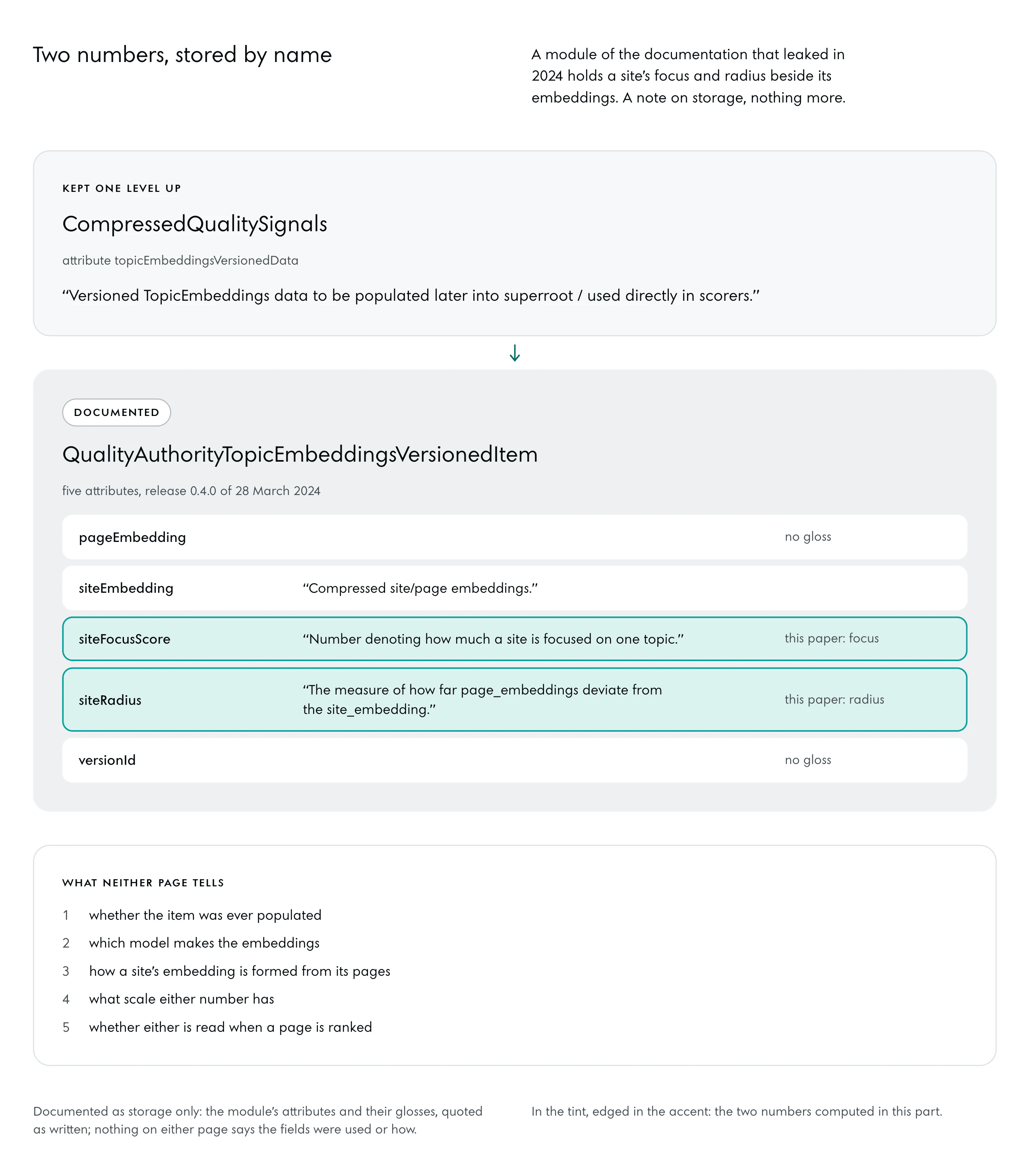
Both numbers are held by name in a module of the documentation that leaked in 2024. For those files the rule that the first paper set stands here, that a name in them describes what was stored and nothing else. The module is QualityAuthorityTopicEmbeddingsVersionedItem, and it has five attributes.
It stores a pageEmbedding and a versionId, both without a gloss, and a siteEmbedding glossed as “Compressed site/page embeddings.” The attribute siteFocusScore is the “Number denoting how much a site is focused on one topic.” And siteRadius is “The measure of how far page_embeddings deviate from the site_embedding.” That second line holds the arithmetic set out above in one clause, page embeddings measured against a site embedding by how far they deviate.
Where the item is kept is told one level up. In CompressedQualitySignals the attribute topicEmbeddingsVersionedData is glossed as “Versioned TopicEmbeddings data to be populated later into superroot / used directly in scorers.”
Neither page tells whether the item was ever populated, which model makes the embeddings, how a site’s embedding is formed from its pages, what scale either number has, or whether either is read when a page is ranked.
Why would a schema keep two numbers where one gives the other? If focus were always one minus radius, as it is in the open tools, a schema short of space would probably keep one of them, and this schema is short of space by its own account. Another module says of a neighbouring field, site2vecEmbeddingEncoded, that it is an “Encoded site2vec embedding (to be used in superroot) since the full embeddings take too much space.” Two stored numbers therefore suggest two ways of computing, perhaps a focus taken from something other than the mean cosine, or a radius that measures spread where the tools take a mean.
This is our inference and it is held as theory. It cannot be tested from outside, and a published account of either field would settle it.
The same files store other summaries of a site as a level and a spread. In the module just linked, chardScoreVariance is the “Site-level Chard Variance for all pages of a site”, and the gloss on siteQualityStddev ends on the “spread of the page-level PQ ratings of a site.” So a spread across a site’s pages is a kind of value this schema holds more than once.
Google’s published word is kept apart from all of this. Its ranking guide, after the two sentences quoted in the first part, adds a warning, “Having some good site-wide signals does not mean that all content from a site will always rank highly, just as having some poor site-wide signals does not mean all the content from a site will rank poorly.” And its page on helpful content, updated on 5 October 2026, asks every owner “Does your site have a primary purpose or focus?”, with the same word that names the stored number and with no published line that joins the two.
What the gloss on siteRadius changes is small and exact. Before it, the centre and the spread of a site were arithmetic that an outsider could do. Since 2024 they are also arithmetic that one engine’s schema has names for.
04Links as a Directed Graph
Long before any engine read meaning, it could count the ties that authors draw from one page to another.
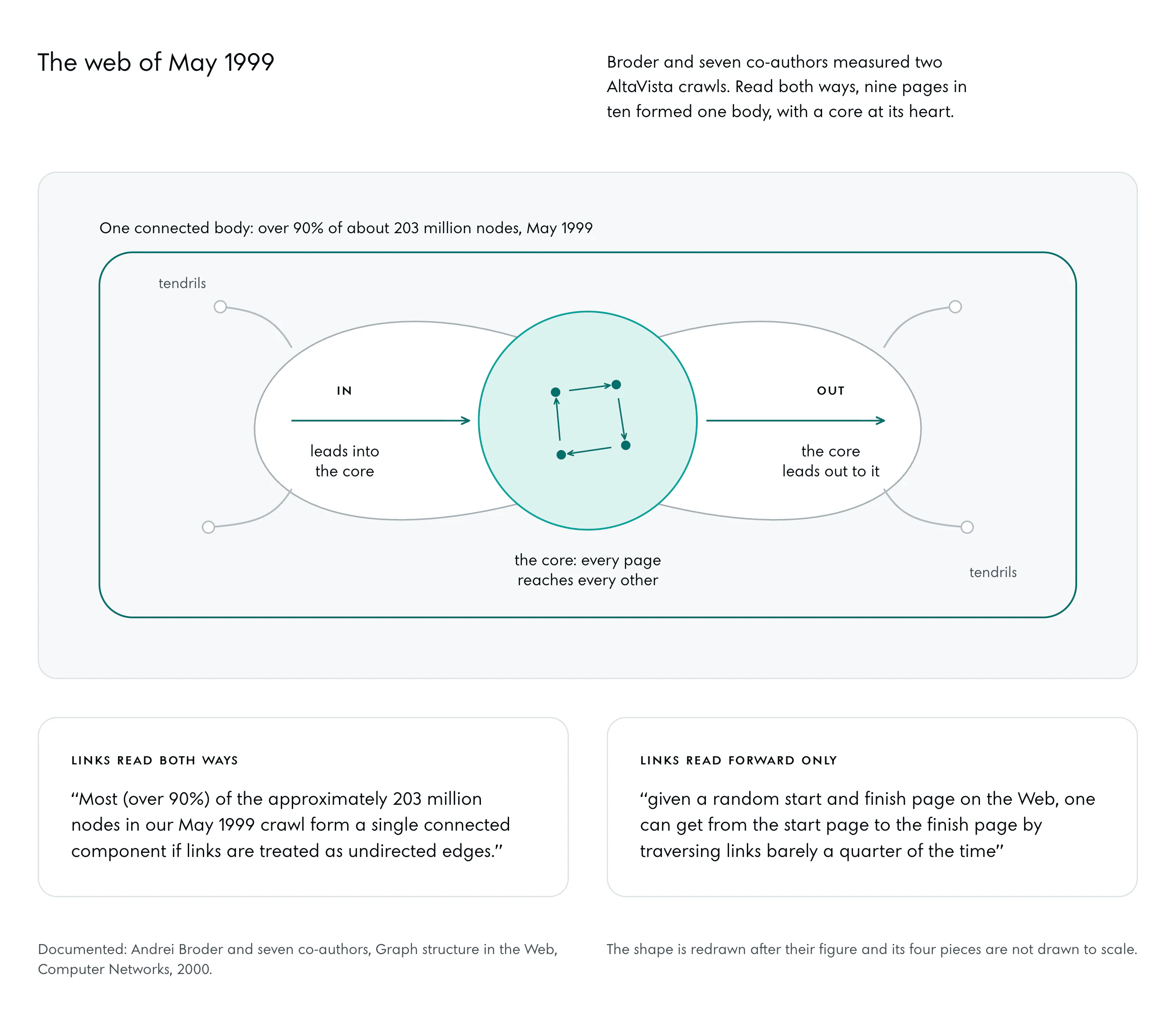
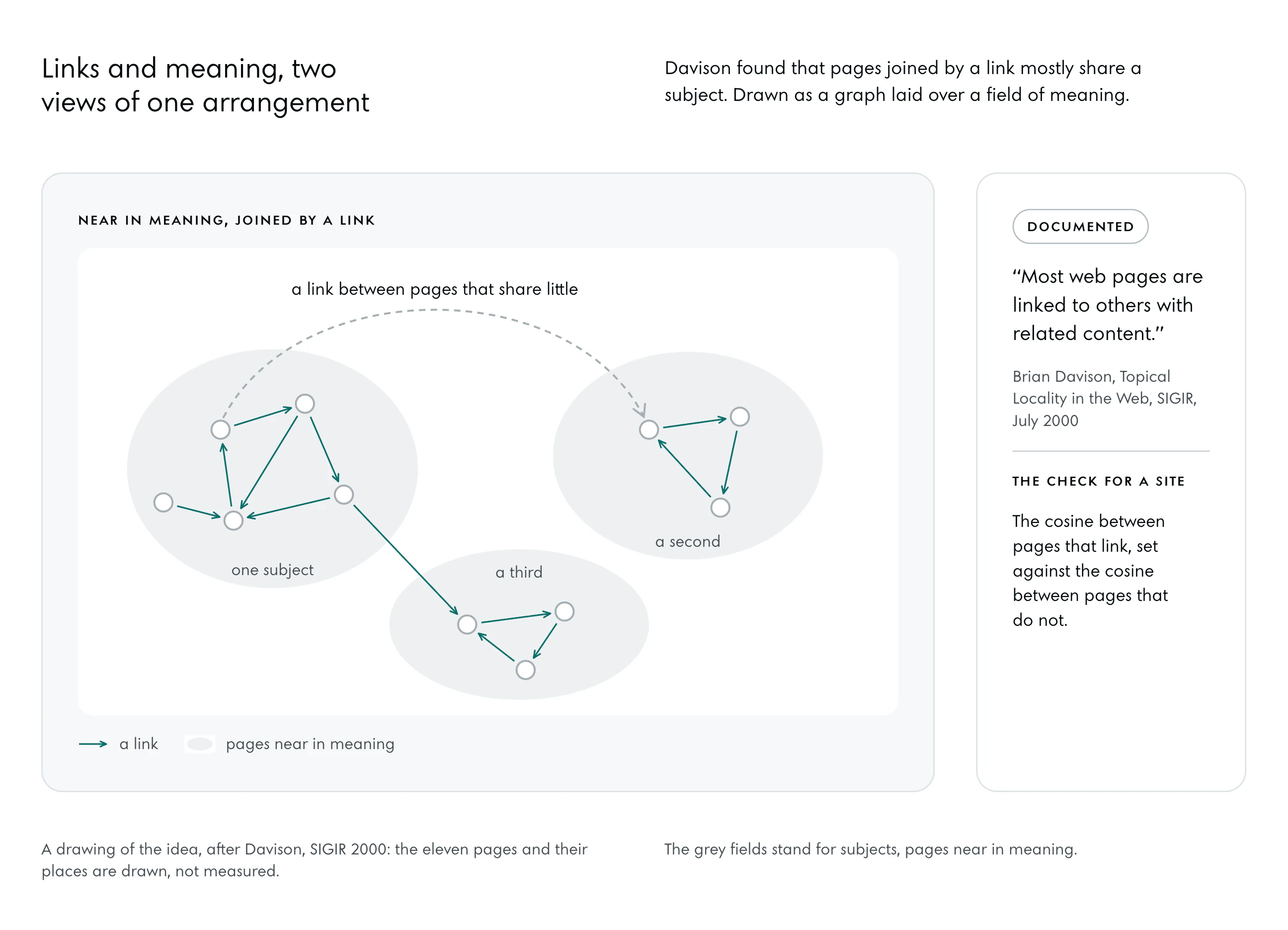
It read each of them two ways, as a vote for the page pointed to and as a short gloss on that page written by somebody else. Measured as a graph, the web of 1999 held together as one body with a core at its heart. And pages joined by a link mostly share a subject, so the lines a site draws between its pages and the places its vectors take are two views of one arrangement.
Counted Citations Between Pages
Search engines took the link over from the study of scholarly references. Google’s founders said so at the start. Sergey Brin and Lawrence Page opened their account of it in 1998 with the debt, “Academic citation literature has been applied to the web, largely by counting citations or backlinks to a given page.” What they added was a weight, and PageRank, in the words of the same paper, “extends this idea by not counting links from all pages equally, and by normalizing by the number of links on a page”.
Both halves of that sentence matter to a site. A link from a page that many others point to carries more than a link from a page that no other page points to. Whatever a page has to give is then divided among the links it holds, so a page with a hundred of them passes on a hundredth through each, and the authors summed the scheme up as a chance, “The probability that the random surfer visits a page is its PageRank.”
They read the words of a link as well. An anchor is a few words about a page that sit on another page. On the open web they are mostly written by somebody who is not its author.
Brin and Page kept the text of every anchor with the page it points to, and the first reason they gave was that “anchors often provide more accurate descriptions of web pages than the pages themselves”. Jon Kleinberg had put the general case a year before, in the abstract of the paper quoted in the first part, “The network structure of a hyperlinked environment can be a rich source of information about the content of the environment, provided we have effective means for understanding it.”
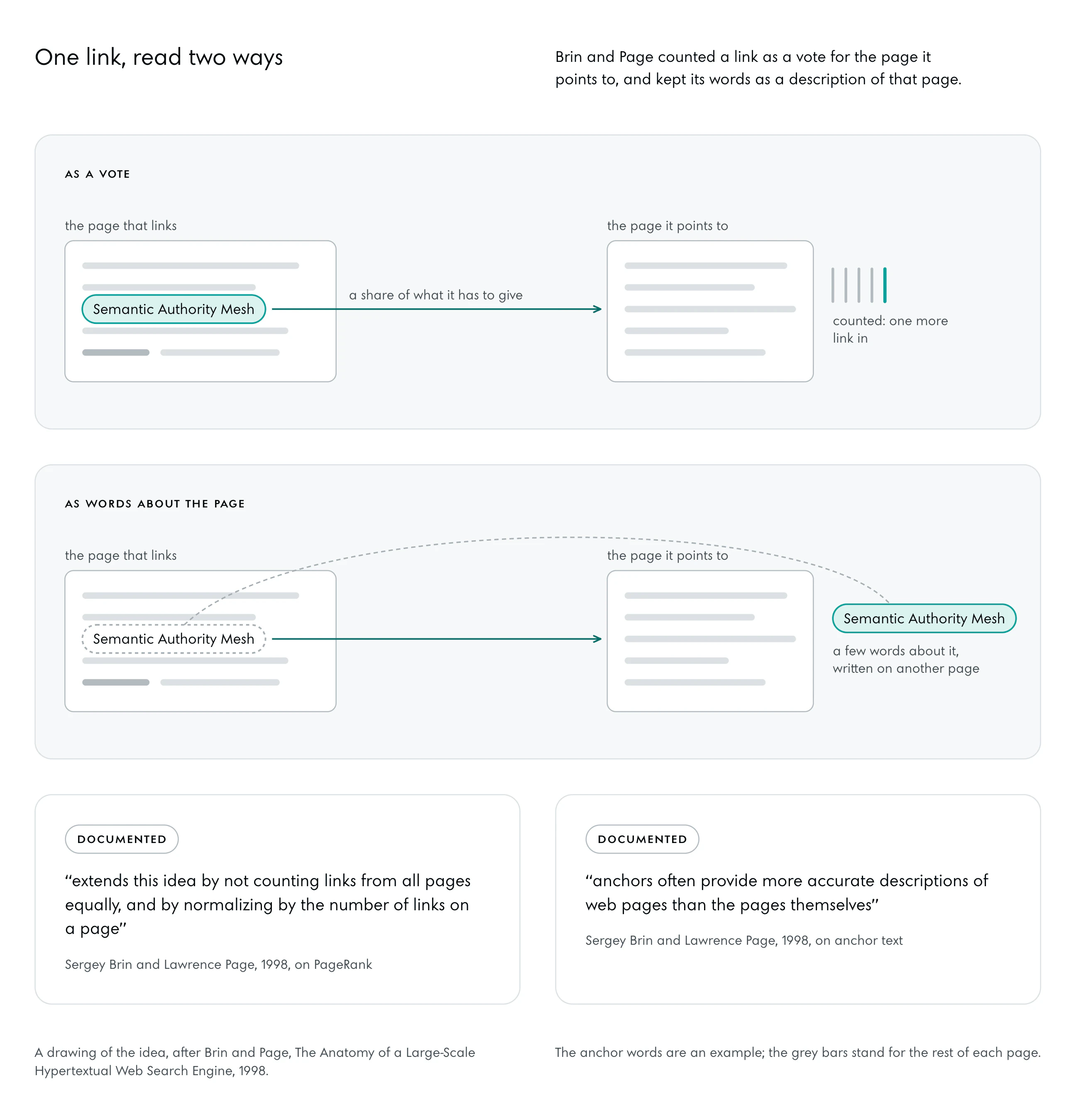
Google still reads links, by its own account, and its guide to ranking systems, in the version of 10 December 2025, has an entry on link analysis which says, “We have various systems that understand how pages link to each other as a way to determine what pages are about and which might be most helpful in response to a query.” Of the algorithm of 1998 it adds, “How PageRank works has evolved a lot since then, and it continues to be part of our core ranking systems.” Both lines are documented, as Google’s word, and they name two uses of a link, to tell what a page is about and to tell which page helps.
First Measurements of the Web
By 1999 a crawl could hold enough public documents to be studied as one object. Andrei Broder and seven co-authors did that with two AltaVista crawls and published what they found in Computer Networks in 2000, “Most (over 90%) of the approximately 203 million nodes in our May 1999 crawl form a single connected component if links are treated as undirected edges.” That connected body, they went on, “breaks naturally into four pieces”, and one of the four is a core in which every page can reach every other by following links forward, a core which in their words “is at the heart of the Web”. Direction changes the result entirely, since with the arrows ignored nine pages in ten belonged to one body; once the arrows were kept, the same paper found that “given a random start and finish page on the Web, one can get from the start page to the finish page by traversing links barely a quarter of the time”.
A site can be asked the same two things. Do its pages form one body when links are read in both directions, and can a visitor who starts on any of them reach any other by going forward only? Neither needs an engine, since both can be settled fully from a crawl of the site’s own HTML, and the second is the stricter because a page that is linked to and links to nothing sits inside the body and yet leads nowhere.
In July 1999 Réka Albert, Hawoong Jeong and Albert-László Barabási showed that the large shape can be had from small counts, “we use local connectivity measurements to construct a topological model of the world wide web, allowing us to explore and characterize its large scale properties.”
They counted the links one page at a time. That was enough to model the distances across all of it.
Linked Pages and Shared Content
Brian Davison asked in 2000 whether an author’s pointer and a common subject go together, and he measured it on text. His paper for the SIGIR conference of July 2000 opens its abstract with what he found, “Most web pages are linked to others with related content.” The detail follows in the same abstract, “we find that the likelihood of linked pages having similar textual content to be high; the similarity of sibling pages increases when the links from the parent are close together; titles, descriptions, and anchor text represent at least part of the target page”. Two pages that an author joins are usually near each other in meaning.
Links that sit close together on a page usually lead to pages that are near each other as well.
So the graph and the space mostly agree.
The second of those findings is about where on a page a link is put. A few links inside a paragraph on one subject say more about likeness than the same links scattered through a menu. For a site this gives a check that anyone can make.
The cosine between pages that link to each other can be set against the cosine between pages that do not, and Davison’s finding says the first should be higher. Where it is lower, the links are probably drawn by menus and templates, and they tell an engine little about which pages belong together. That last step is our inference.
It stays theory until both cosines have been taken on a site and compared.
Google’s page of advice on links, updated on 10 December 2025, asks for the same agreement at the anchor, “Good anchor text is descriptive, reasonably concise, and relevant to the page that it’s on and to the page it links to.” An anchor that fits both of its ends states what the two pages have in common, where a machine can read it.
Measures a Site’s Graph Allows
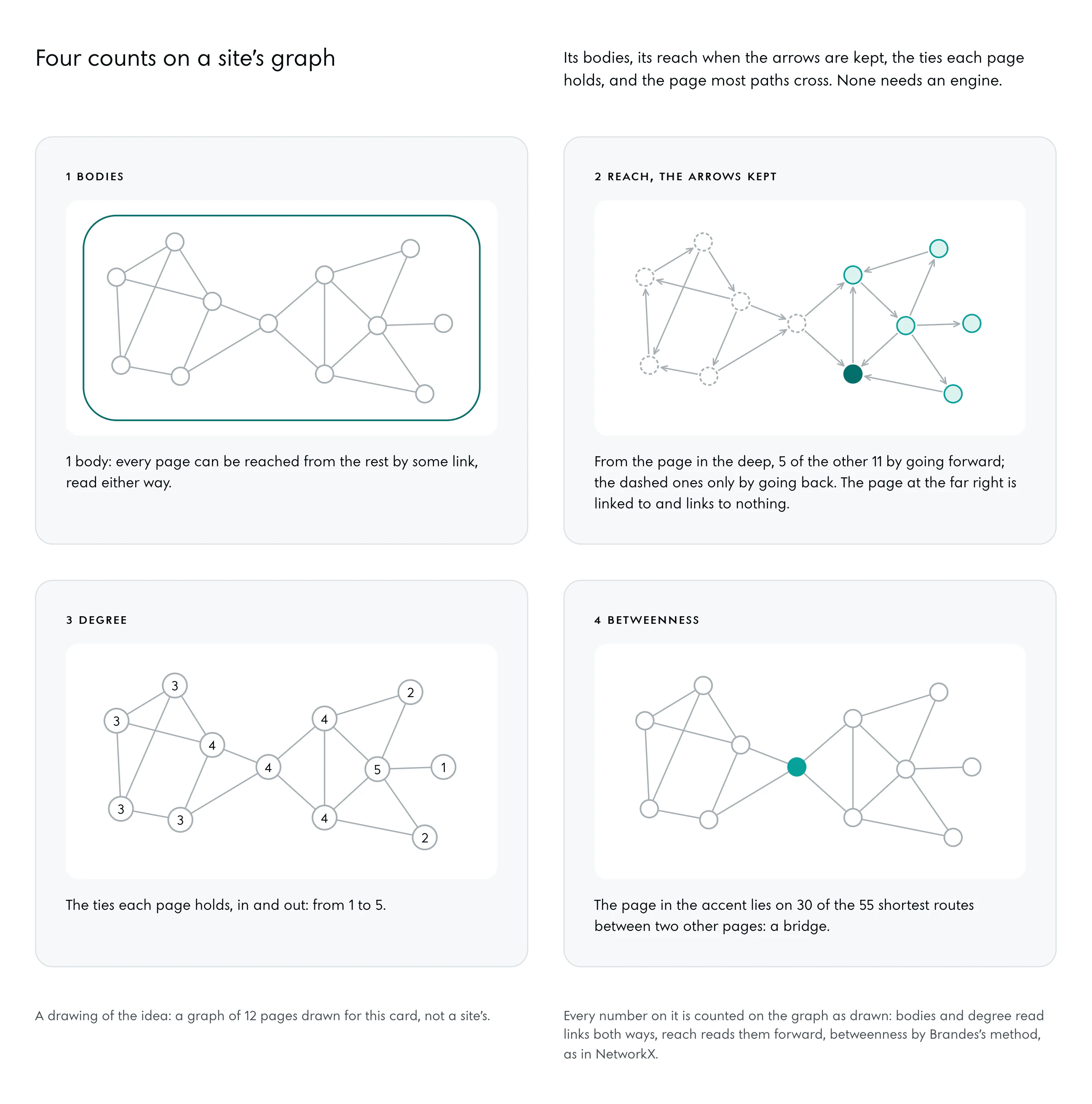
Taken as nodes and arrows, the pages of one host can be counted with no help from an engine. Four numbers are worth having.
There is first a count of bodies. NetworkX, an open library for work on graphs, has a function for it which, by its manual, “Returns the number of connected components.” A site built as a mesh always comes back as one. If it comes back as two or more, some of its pages can be reached from the rest by no link at all.
The stricter count keeps the arrows, as Broder’s paper did, and tells how much of the site can be reached from any page by going forward. Degree is the third number, the count of ties a page holds, in and out. Google’s advice sets a floor for it, “Every page you care about should have a link from at least one other page on your site.” One link in is the least a page needs to be found; it is far below what Baran meant by redundancy.
How much more a mesh asks for is taken up in the part on why a structure holds.
Last comes the number that finds the pages which hold a body together. Betweenness, in the manual of the same library, is for any node “the sum of the fraction of all-pairs shortest paths that pass through” it. A page with a very high figure is a bridge.
And if most paths on a site cross one page, the site is plainly a star with a hub, whatever its owner calls it.
Counts of this kind are also held for a page in the files that leaked in 2024. A module there named QualityNsrPQData lists linkIncoming and linkOutgoing among its attributes, and beside them numOffdomainAnchors, all without a gloss. The names say that counts of links were stored for a page, and nothing in them tells how the counts were used.
A graph of links has one blind side. It never sees a tie that an author did not write. Two pages that carry the same defined term and never link are strangers to it, though an engine that reads meaning finds them close together.
05Ties Made by Defined Terms
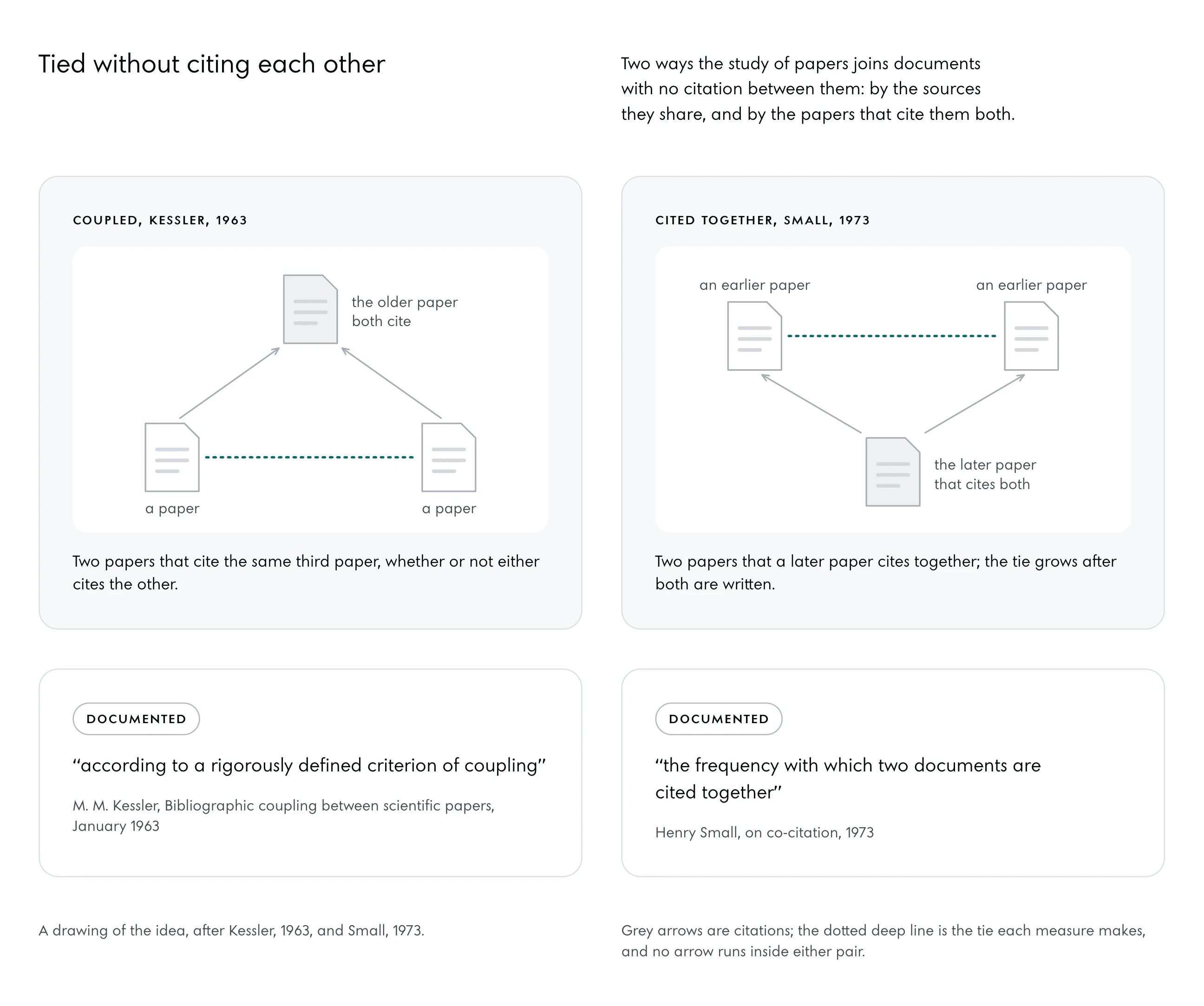
Since 1963 the study of scholarly papers has joined documents that never cite each other by what they hold in common. A word kept to one sense and spelling across a site does the same between its pages.
In structured data that word becomes a node with one identifier, which any number of pages can name. When we counted them on the studio’s pages on 11 October 2026, the two kinds of edge together joined 33 pages into one body through 116 pairs.
Coupling Without a Link
Kessler’s paper of January 1963 grouped scientific papers by the references they have in common. Two papers that cite the same third paper were coupled, in his word for it, whether or not either of them cites the other. He ordered a body of papers into groups “according to a rigorously defined criterion of coupling” and then looked at what the groups held, “An examination of the papers that constitute the groups shows a high degree of logical correlation.” So papers that drew on the same sources were mostly about the same thing.
Ten years later Henry Small turned the tie around, and his measure of 1973, which he called co-citation, is “the frequency with which two documents are cited together”. It is made entirely by later authors, so it can go on growing after both documents are finished, and the abstract reports that “Co-citation patterns are found to differ significantly from bibliographic coupling patterns, but to agree generally with patterns of direct citation.”
Libraries had another way, and in it an author never has to cite anybody. A controlled vocabulary ties every document that is filed under one of its headings to every other document under it. The National Library of Medicine describes its Medical Subject Headings as “a controlled and hierarchically-organized vocabulary” that is “used for indexing, cataloging, and searching of biomedical and health-related information”.
So two documents can be tied by anything they hold in common that a machine can count.
On a site that thing is a term. The first paper’s Term Map gives each term one spelling and one page that defines it. That makes the term a heading in the librarian’s sense, and every page that uses it is filed under it.
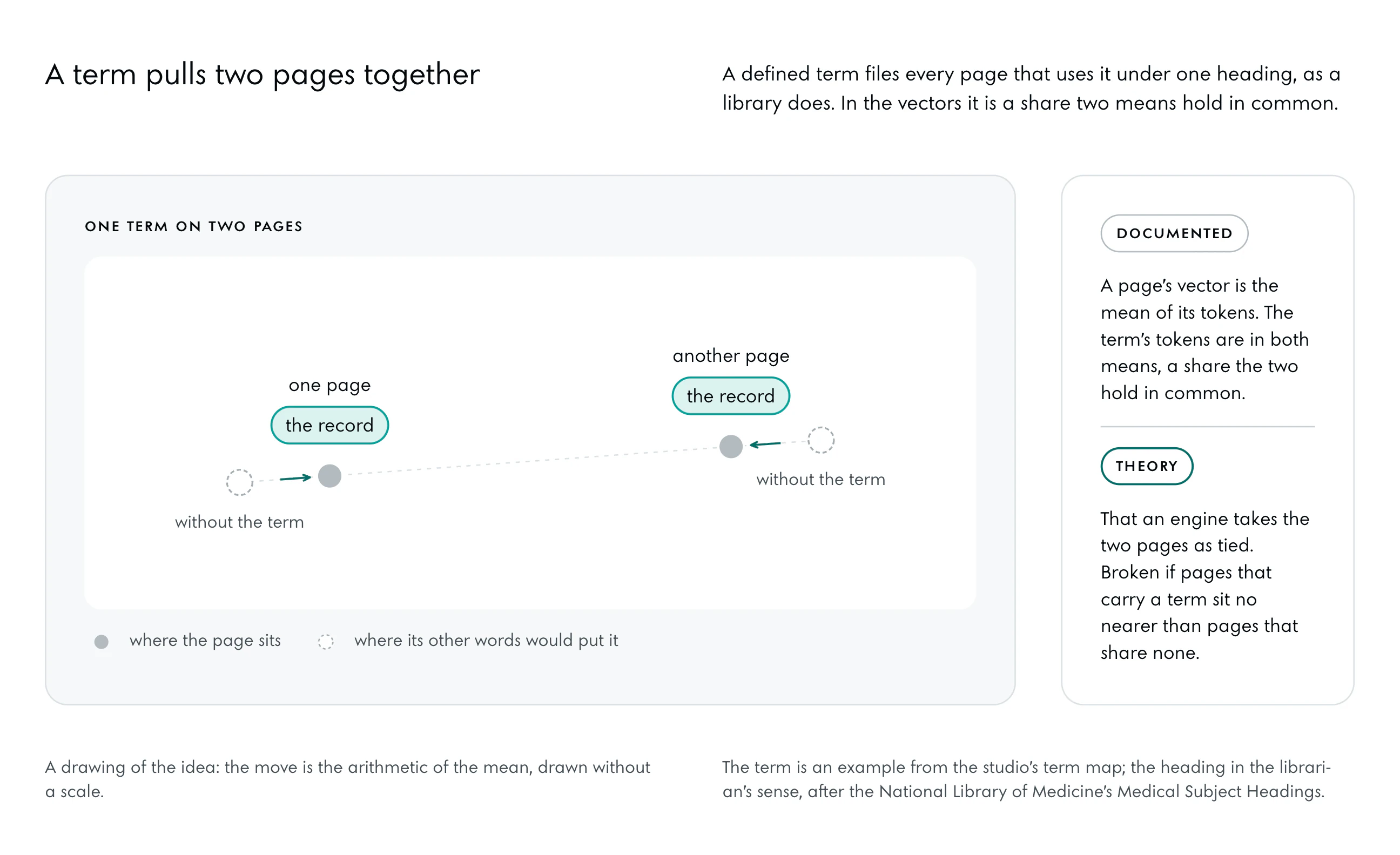
What follows for the vectors was set out with the pooling step, since the tokens of a term vote in the mean of every page that carries it, so that two such pages hold a common share and sit a little nearer to each other for it. So much is documented arithmetic; that an engine treats the two pages as tied is theory, and it would be broken if pages that carry the same defined term sat no nearer to each other in a model’s space than pages of the same site that share none.
Identifiers Named From Many Pages
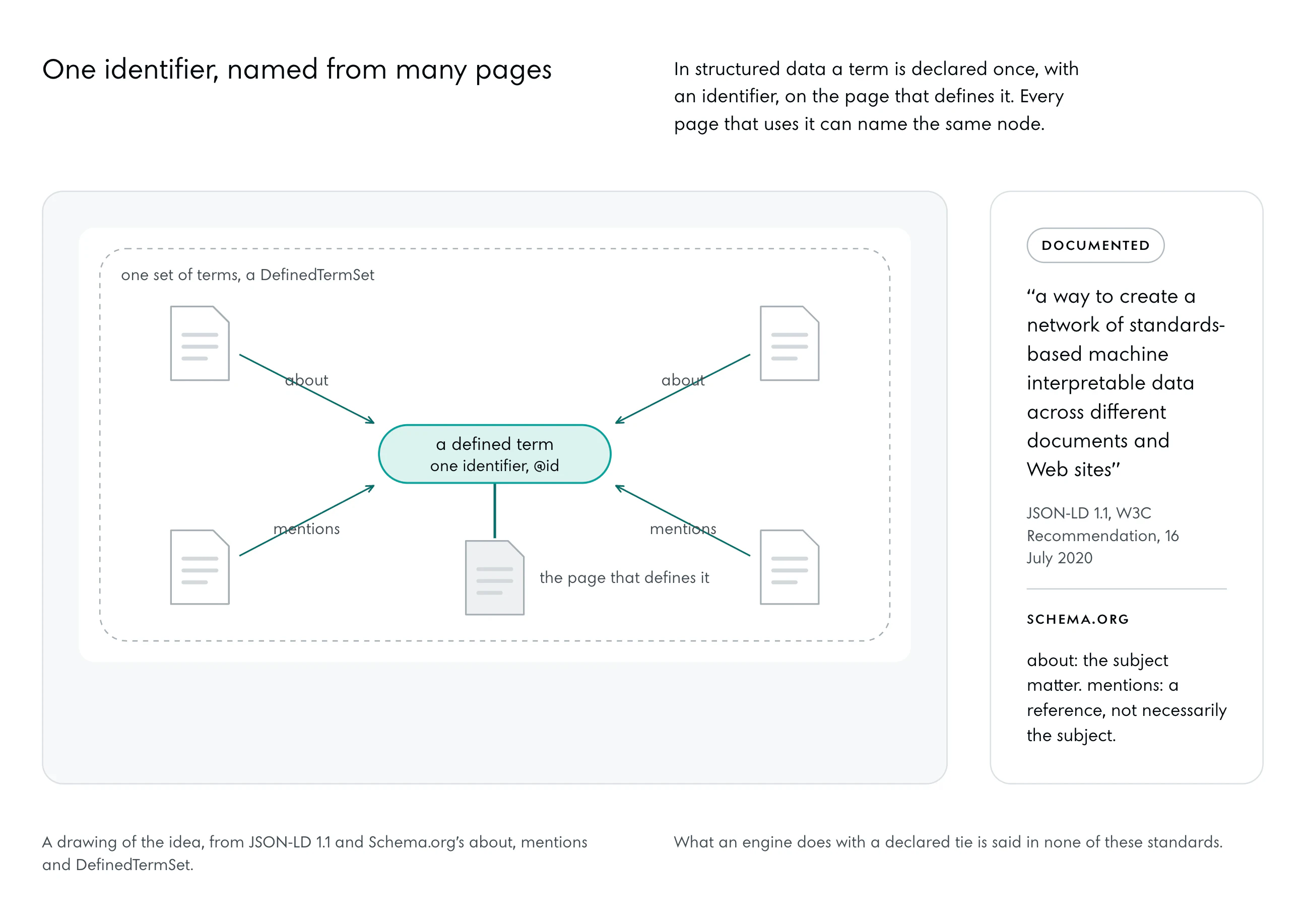
Structured data turns the shared word into an object, and the format most of it is written in, JSON-LD, which has been a W3C Recommendation in its version 1.1 since 16 July 2020, was designed as “a way to create a network of standards-based machine interpretable data across different documents and Web sites”. The same text gives the rule that makes such a network possible, “To be able to externally reference nodes in an RDF graph, it is important that nodes have an identifier.” A term that is declared once with an identifier, on the page that defines it, can then be pointed at from every page that uses it, and all of those pages are naming one node.
Schema.org has two properties for the pointing. Its page for about, at version 30.1 of 16 September 2026, glosses the first as “The subject matter of an object”, and the weaker of the two is mentions, which “Indicates that the CreativeWork contains a reference to, but is not necessarily about a concept.” A set of terms has a type too, DefinedTermSet, “A set of defined terms” by its gloss. The first paper used the type for a single term; the lines between terms and pages are this paper’s matter.
Relations between the terms themselves can be declared too. A term page that lists its related terms is doing that in public.
All of it is documented as what a site can declare.
The W3C’s SKOS Reference of 18 August 2009 calls its semantic relations “links between SKOS concepts, where the link is inherent in the meaning of the linked concepts”, and it keeps one property for relatedness, which is there “to assert an associative link between two SKOS concepts”. What a search engine does with a declared tie between two pages is said in none of these standards.
Wikipedia as a Public Example
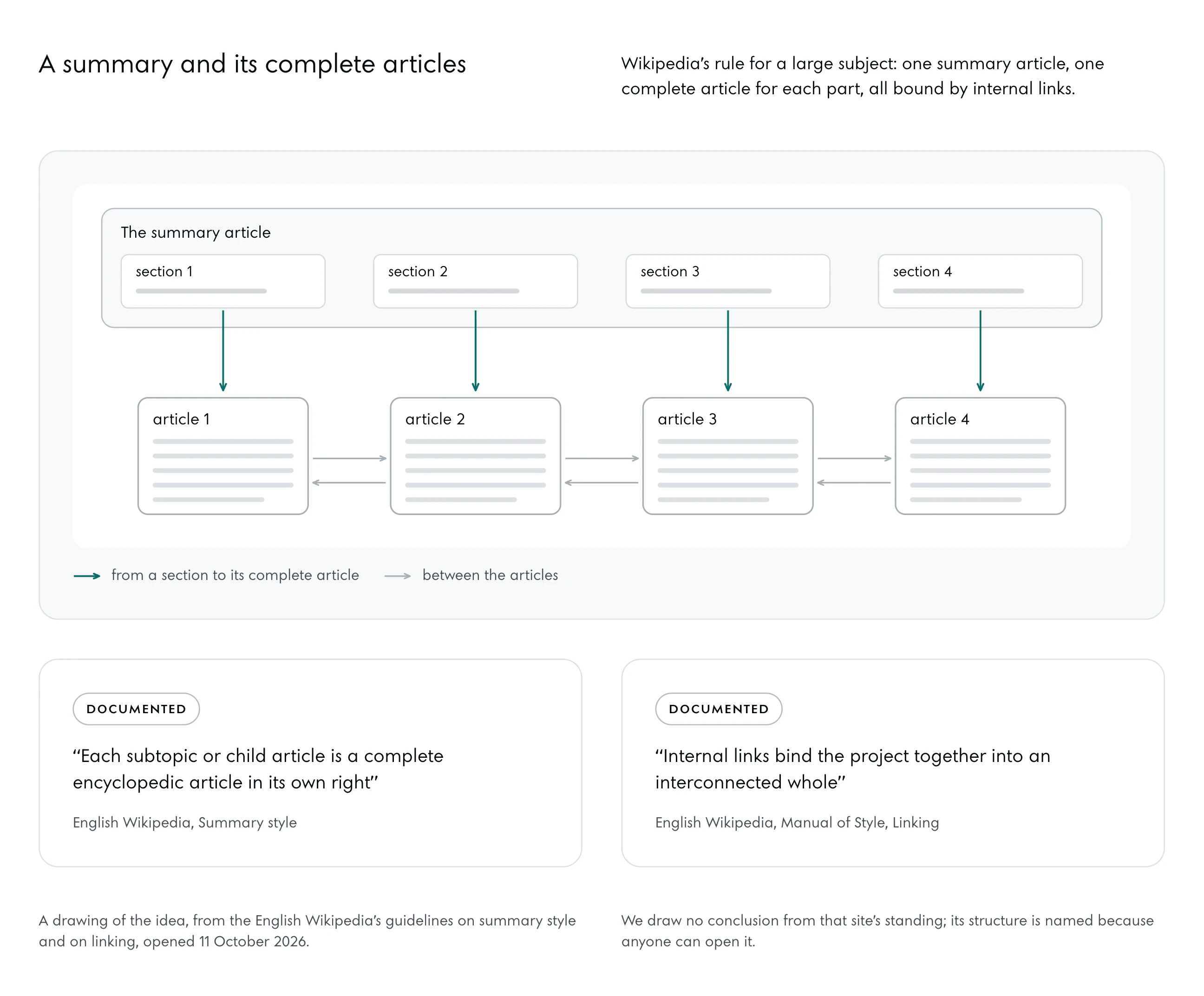
Anyone can open the largest site built on this pattern and inspect it. The English Wikipedia’s guideline on linking says in one line what its links are for, “Internal links bind the project together into an interconnected whole”, and its guideline on summary style has the rule for the pages, “Each subtopic or child article is a complete encyclopedic article in its own right”. One subject gets one complete article, and a mention of a subject that has its article becomes a link to it, which is the conformal rule of the first part in an editor’s words.
We draw no conclusion from that site’s standing, which has many causes. It is named here because its structure is fully open. A reader can check on any article how often the anchor of a link is the title of the article it leads to.
Thirty-Three Points and Their Ties
We counted the same structure on the studio’s own site on 11 October 2026. There were ten papers and 23 term pages in public that day. Between them there were ties of three kinds.
A paper carries a term in 44 cases. In 57 a term page names another term as related. The remaining 35 are links written in the text.
That makes 136 ties, and because some pairs are tied in more than one way they join 116 distinct pairs. Every one of the 33 pages belongs to a single connected body, so no page stands alone, and a page is tied to 7.03 others on average. Nothing was left out of the count, and nothing was added to the site for it.
All of these figures are measured.
33 pages, 116 tied pairs and one body, counted on 11 October 2026 over the studio’s pages alone.
The one that is most tied of the 33 is a term, “the record”, and it has 15 pairs. After it come the paper Presence Is a Structure and the term “AI answer”, with 14 each. The three terms coined on 10 October 2026 hold five ties each, all of them to other terms, so a new term probably enters through the terms it is related to, before any paper carries it.
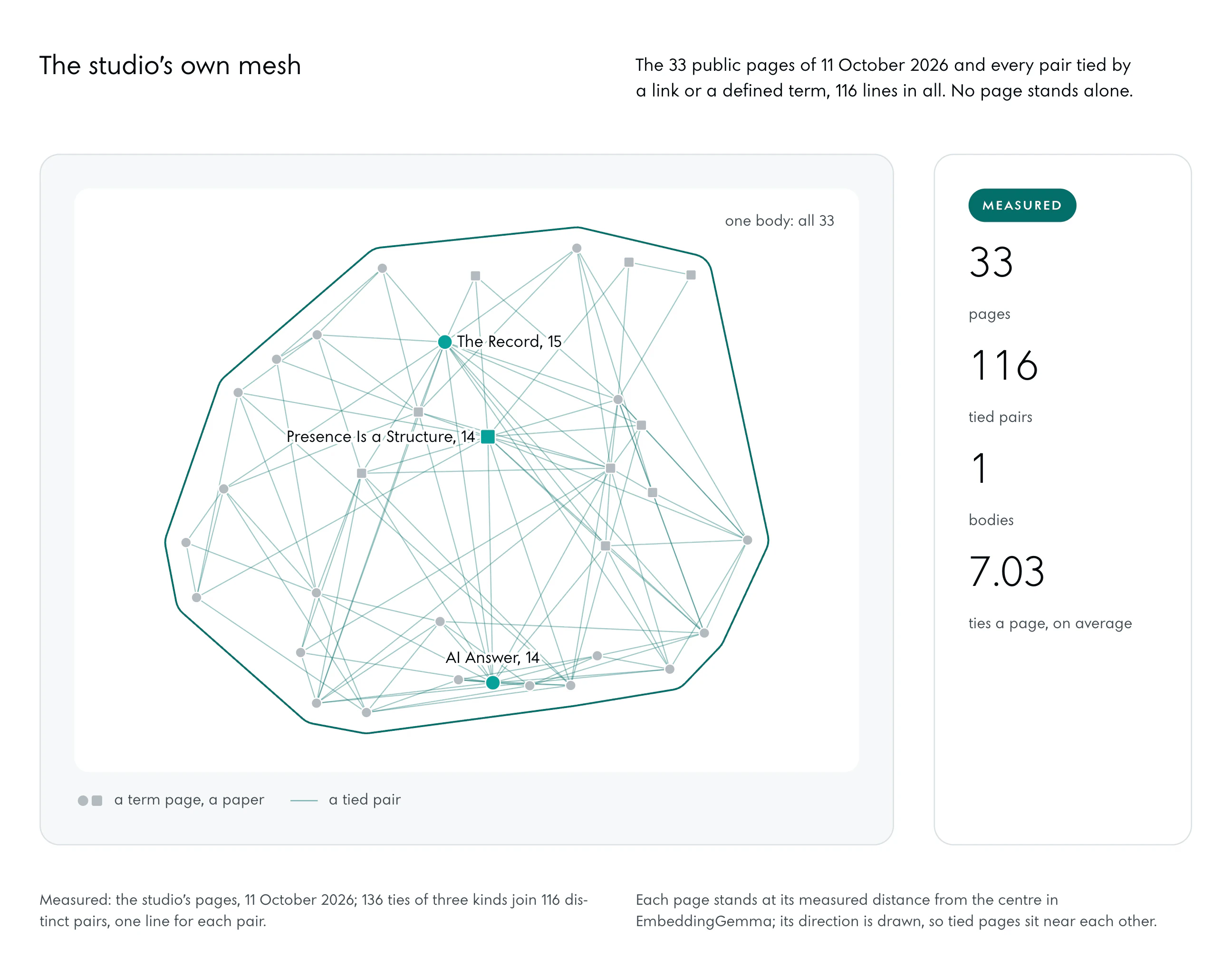
In the drawing there is one line for each tied pair, 116 in all, whichever of the three kinds made it.
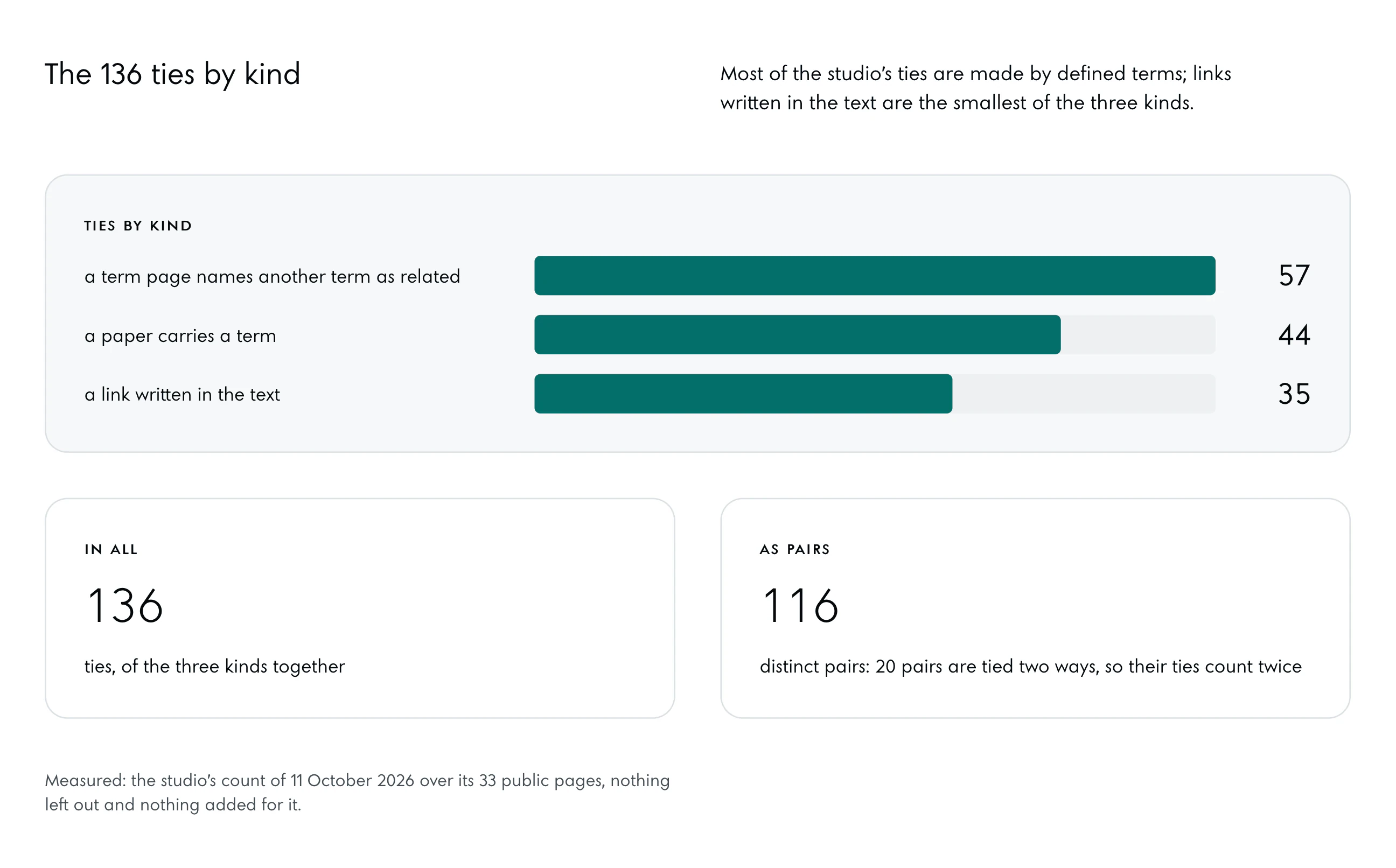
A count like this has plain limits. Thirty-three pages are few, and a larger site would perhaps show another shape. It tells what was built and nothing of how any engine takes it, which stays theory under the test given above.
And it shows a weakness, since “the record” touches 15 of the 32 other pages, which is roughly half of them, and a body that leaned on one term much more than that would be turning from a mesh into a star.
06Citations From Outside the Site
Other people’s pointers are the oldest evidence of standing that a machine can count, and they now arrive in two forms, a link on another publisher’s page and a source named under a generated answer.
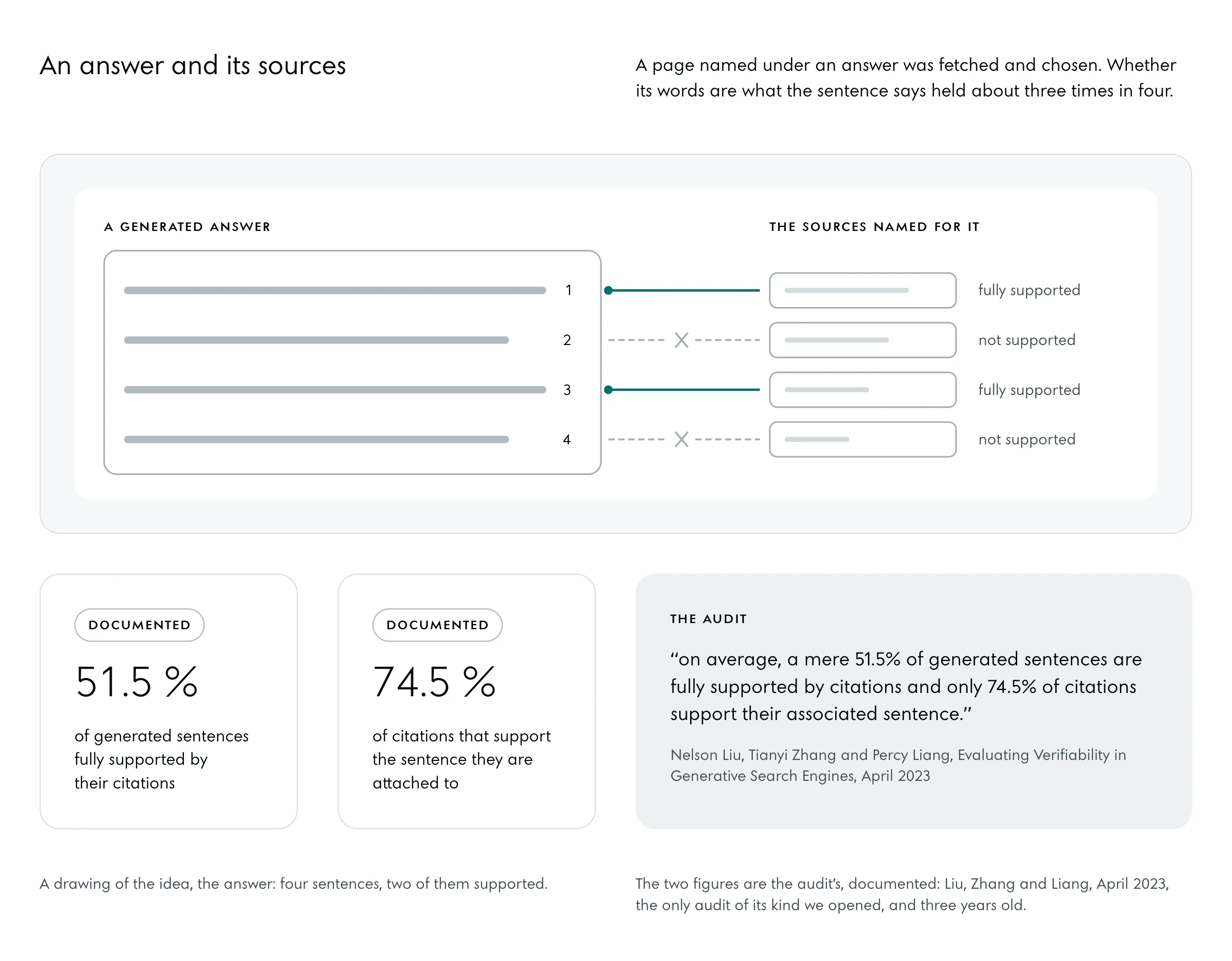
Google has said how it reads the first of them, though only for news. Of the second, the engines’ own pages show a retriever that picks passages before a sentence is written. An audit of 2023 found that roughly half of the generated sentences were fully supported by the sources named for them.
Indexes of Who Cites Whom
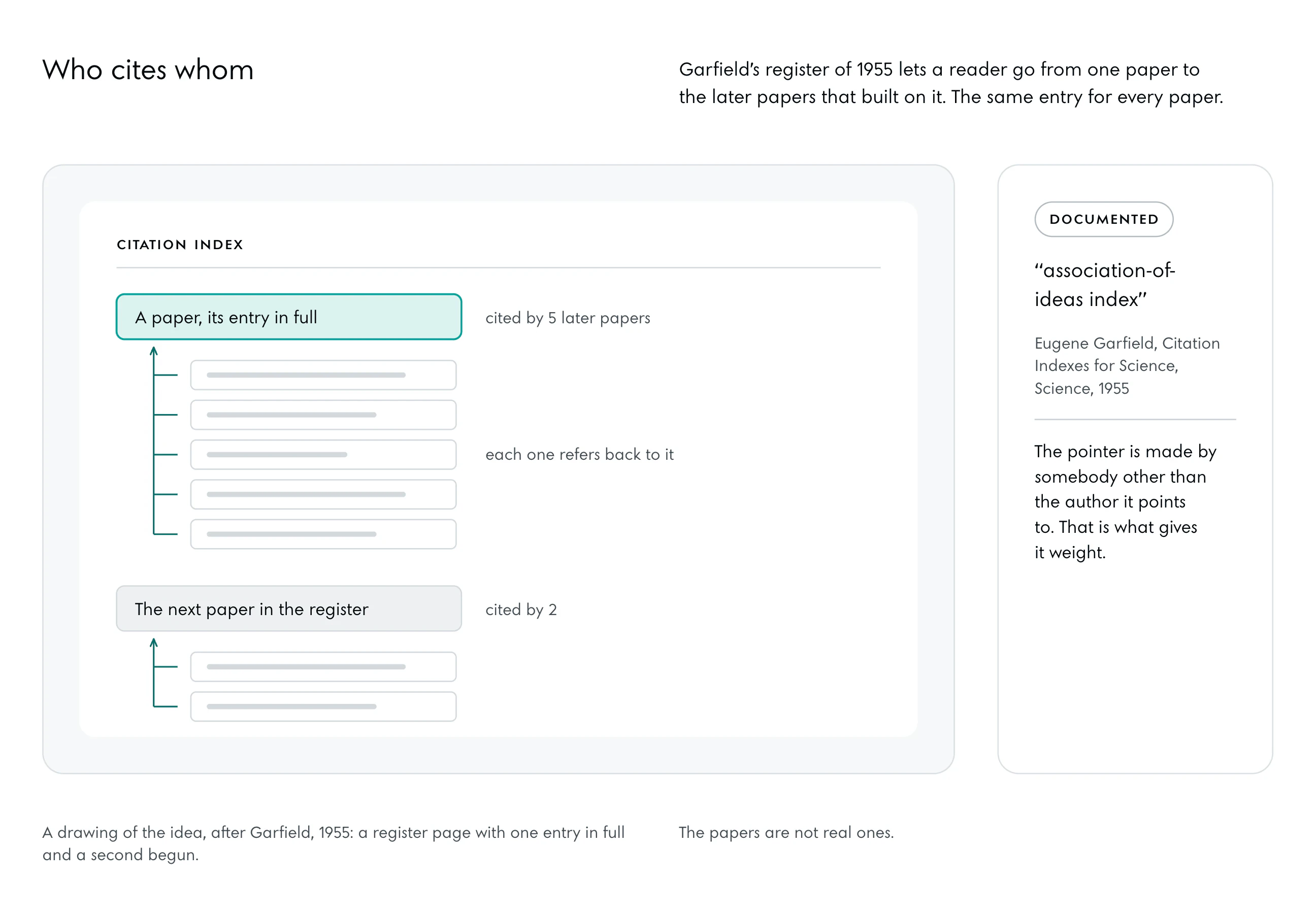
Eugene Garfield proposed in Science in 1955 a register of which paper refers to which. He described it as an “association-of-ideas index”, since it lets a reader go from one paper to the later ones that built on it. The pointer in such a register is usually made by somebody other than the author it points to, and that is what gives it weight.
Brin and Page counted links in that line of work, as the part on links showed, and Kleinberg’s sentence on conferred authority carries the same rule. A link from a site to its own page is a tie inside the body. In his sense it confers nothing at all.
That takes a pointer from another host. It is why the studio’s sentence keeps the two apart, with links and terms in its second clause and “cited by others on that subject” in its third.
Today the pointer comes in two forms. One is the link on somebody else’s page; the other is newer, a page named as a source beside a sentence that a machine wrote.
Google’s Account for News
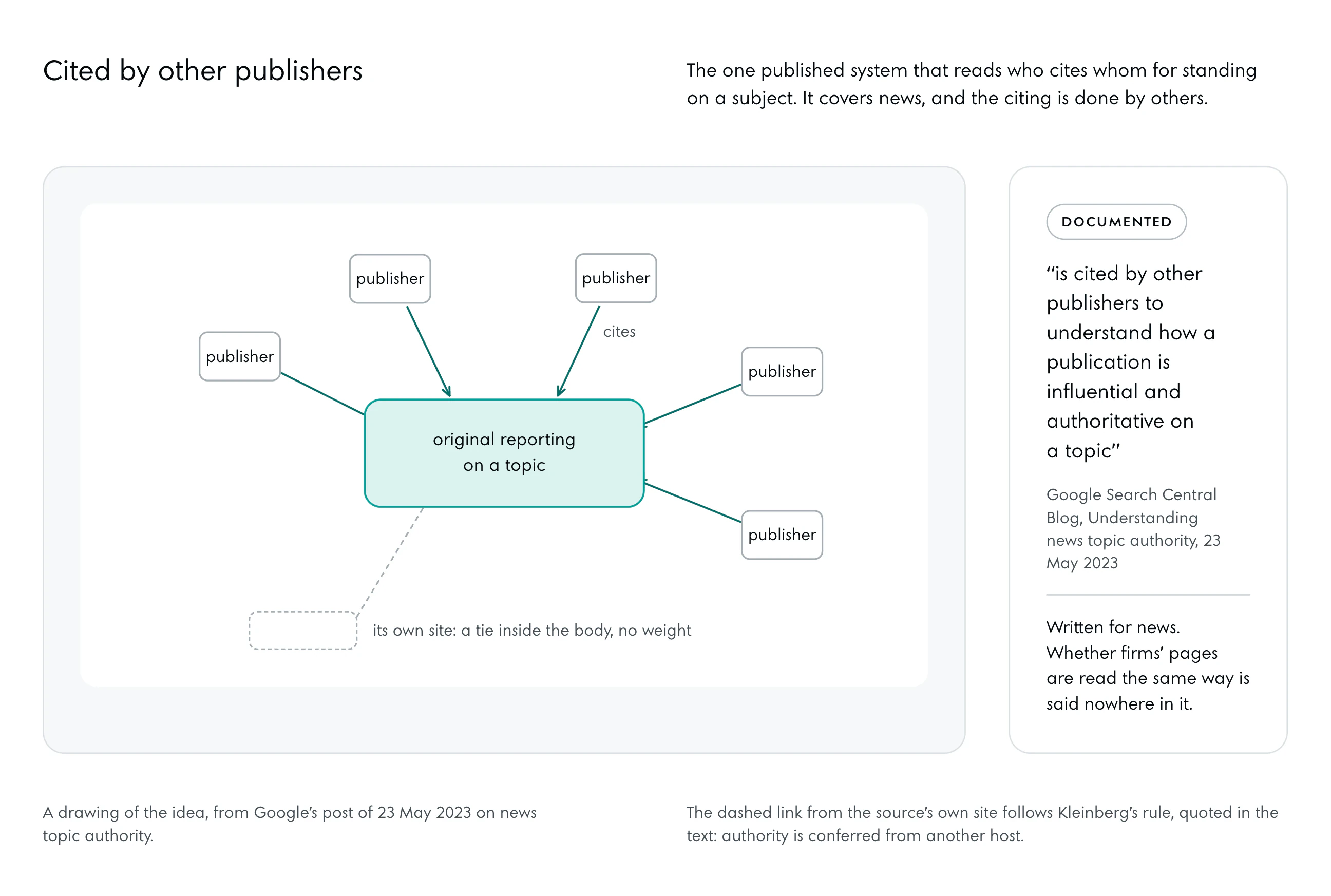
Only one published system that we could open reads who cites whom for standing on a subject, and it covers journalism. In a post of 23 May 2023 on what it calls topic authority, the company says that its system looks at how original reporting “is cited by other publishers to understand how a publication is influential and authoritative on a topic”. The same post puts the purpose more broadly, “The topic authority system looks at a variety of signals to understand the degree of expertise a publication has in particular areas.” And the ranking guide’s entry on original content states the aim from the other side, “We have systems to help ensure we are showing original content prominently in search results, including original reporting, ahead of those who merely cite it.”
Others do the citing in the first of those lines, and a topic bounds it; what the system takes from it is authority. It is the nearest thing in print to the third clause of our term.
So the cited page is meant to stand ahead of the page that cites it.
All of these lines are documented, as Google’s word, and all are about news. Whether the same is done with the pages of a firm is said nowhere in them, and we do not assume it.
Retrieval Before an Answer
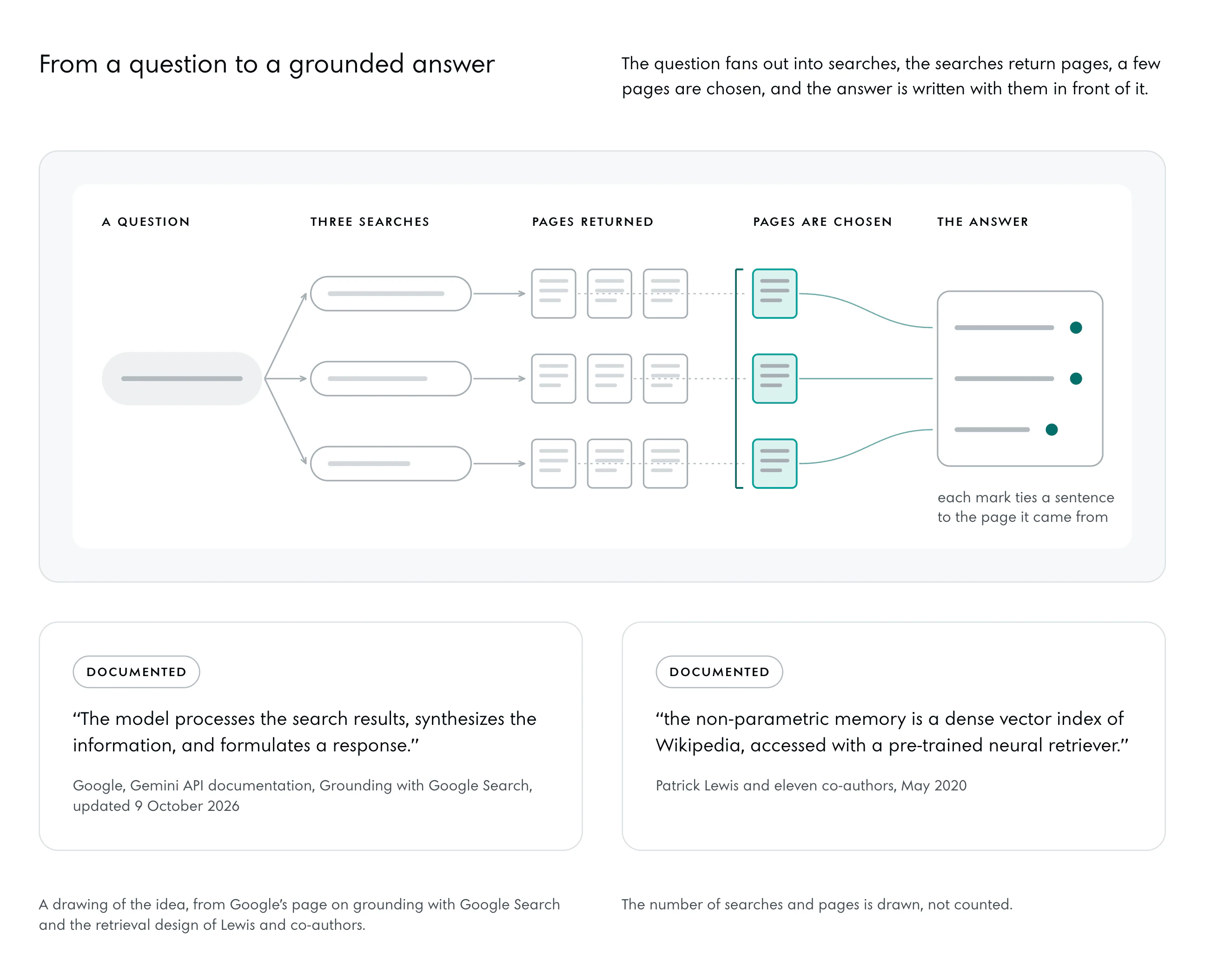
Generated text is assembled from passages that were fetched first. Patrick Lewis and eleven co-authors gave the design its name in May 2020 and described its store in a line, “the non-parametric memory is a dense vector index of Wikipedia, accessed with a pre-trained neural retriever.” A retriever takes from that index the passages whose vectors lie nearest to what was asked, and a generator then writes with them in front of it. So the unit that gets chosen is a passage.
It is always chosen by how near it lies, in a space of the kind that the first parts of this paper set out.
Google’s pages for developers show the same steps as a product. Its page on grounding with Google Search, updated on 9 October 2026, says that after the searches “The model processes the search results, synthesizes the information, and formulates a response.” Sources are then attached, “When a response is successfully grounded, the model’s text output includes inline annotations directly on the text content block”, and those notes tie parts of the reply to the pages they came from. How one query becomes several searches was the first paper’s matter; Elizabeth Reid wrote of that step on Google’s blog on 14 May 2024 that the splitting is done for the user, so that “you can ask your most complex questions, with all the nuances and caveats you have in mind, all in one go”.
What a source under an answer is worth as evidence was audited in April 2023 by Nelson Liu, Tianyi Zhang and Percy Liang, who reported that “on average, a mere 51.5% of generated sentences are fully supported by citations and only 74.5% of citations support their associated sentence.”
So a page named under an answer was plainly fetched and chosen. That its words are what the sentence says was true about three times in four. It is the only audit of its kind that we opened, and it is three years old.
For the owner of a site, then, the count of such sources tells how often the site was fetched. It says less about whether the page was read with care.
Many Questions Meet One Body
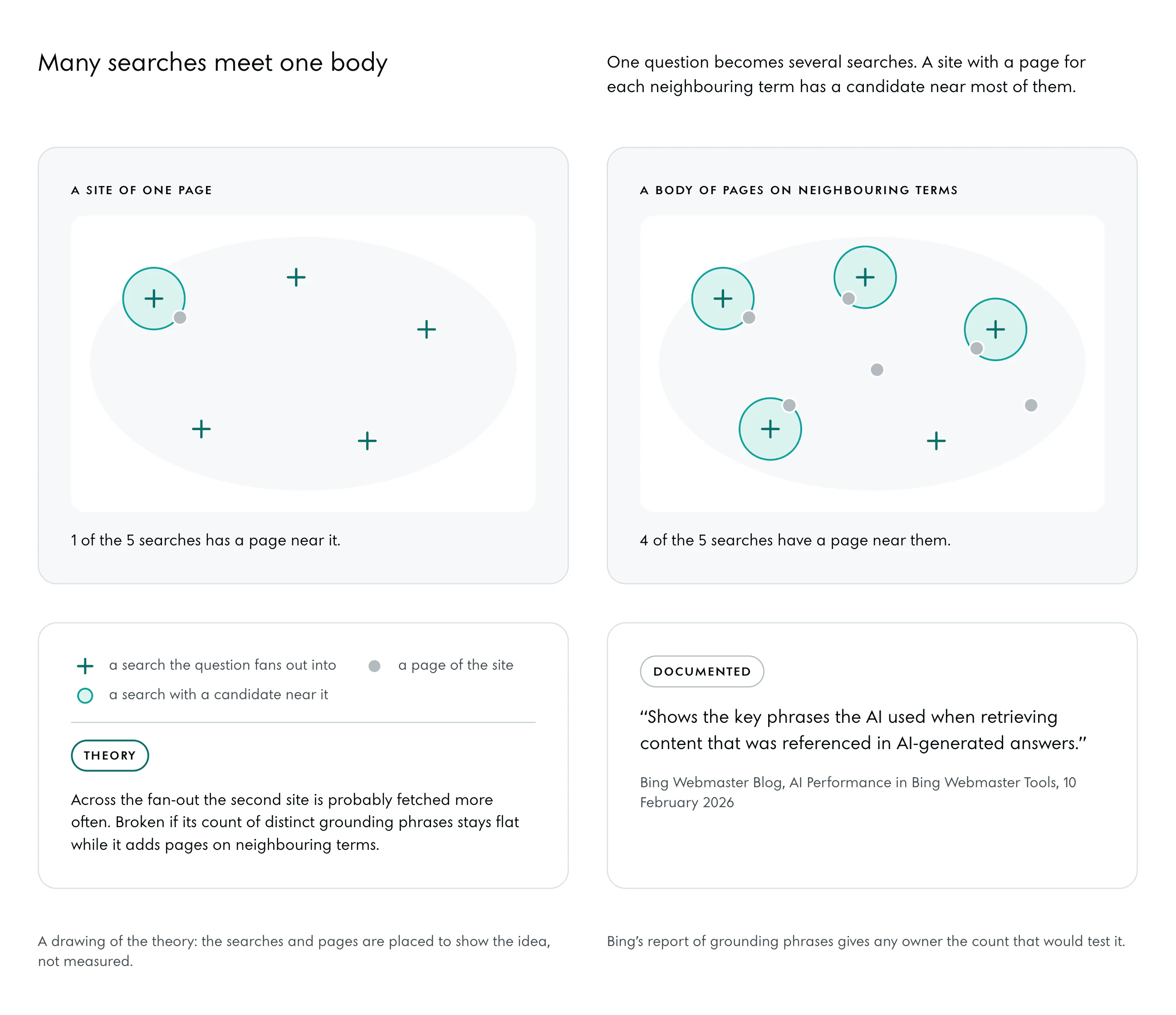
Bing shows the owner of a site the phrases that its AI searched with. The report came in public preview on 10 February 2026, as AI Performance in Bing Webmaster Tools, and it has a column for what it calls grounding queries. That column, in the words of Microsoft’s post, “Shows the key phrases the AI used when retrieving content that was referenced in AI-generated answers.” Microsoft then gives the owner something it has seen, “Pages cited for specific grounding query phrases often reflect clear subject focus and domain expertise”, and a piece of advice to go with it, “Deepening coverage in related areas can reinforce authority.” The post uses the word focus as Google’s page on helpful content does, with no published line that joins the word to a number.
Both of its sentences are a vendor’s word and are documented as that.
From there to a body of pages the step is ours.
What a person asks is split into several searches, and each of them fetches the passages nearest to it. One page on a subject offers one candidate to all of those searches, where a site with a page for each neighbouring term has a candidate that lies near most of them. So across the fan-out the second site is probably fetched more often, and each fetch is a chance to be named.
We hold that as theory, and it would be broken by a site whose count of distinct grounding phrases stayed flat while it added pages on the neighbouring terms of its subject.
Bing’s report puts that count in any owner’s hands.
The one broad study we opened warns against carrying a figure from one field to another. Pranjal Aggarwal and five co-authors, in a paper of November 2023 that was accepted to KDD 2024, describe engines that “typically satisfy queries by synthesizing information from multiple sources and summarizing them using LLMs”. Of the methods they tested for being shown in such answers they write, “we show the efficacy of these strategies varies across domains”.
What we have counted on one site is given with that site, in the part on the limits that a person sets.
07Why a Structure Outlasts a Page
Whoever wants the place of a single document needs a single better document.
To have the place of a body of them, a rival has to write its points again and draw its ties again, and then wait for other sites to cite the result, which no site can do for itself. The arithmetic of a mean gives a second reason. Each page that joins a body shifts its centre by a share that shrinks as the body grows.
A large body near one subject is hardly moved by any one page, its own or anybody else’s.
Displacing One Page
Ranking is done on documents taken singly, by the guide quoted in the first part, so a place in a list of results can always be lost to a better document. A rival can study the page that holds the place and then go past it on every count. What stands when that happens is everything the loser was part of.
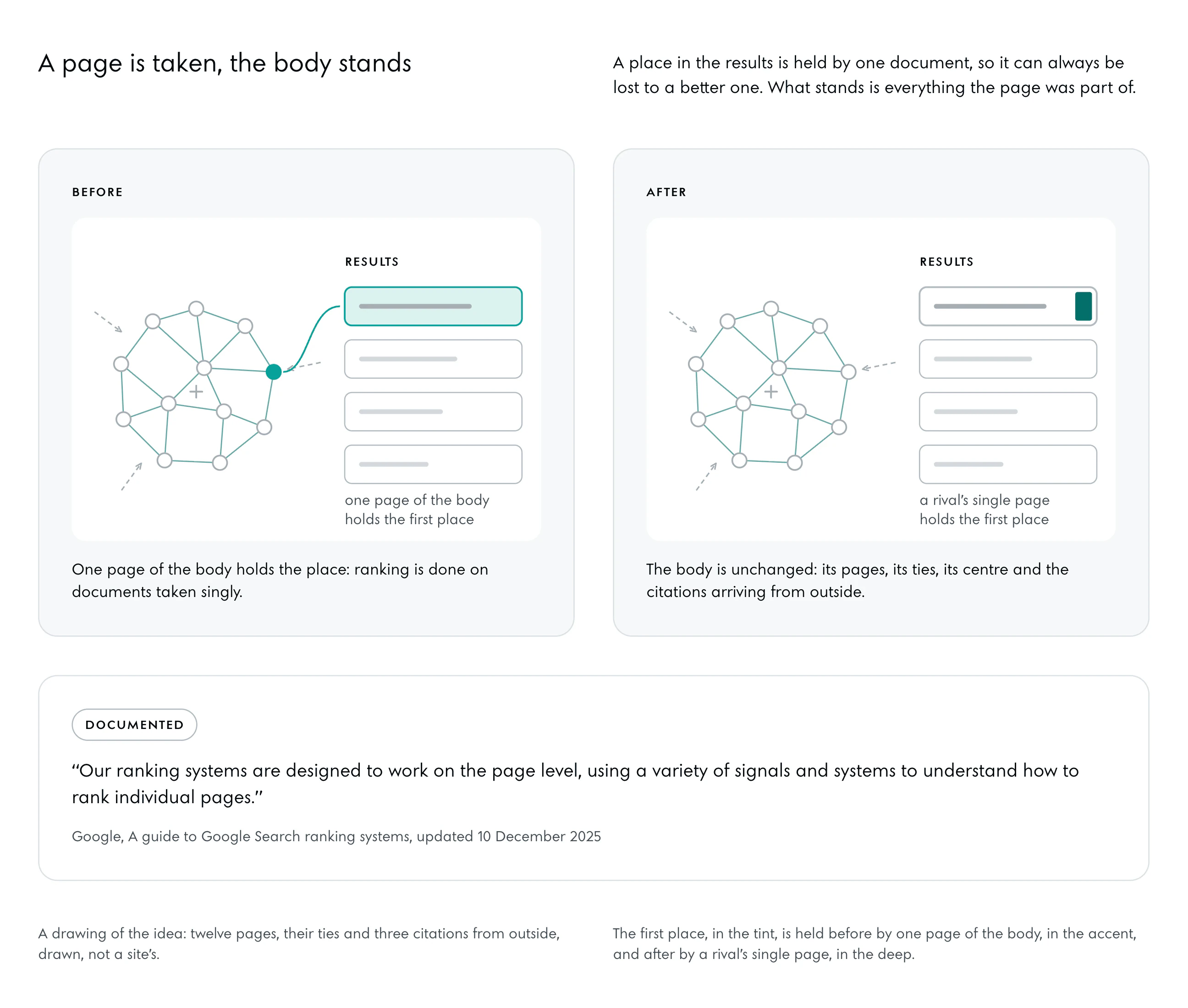
A body has four things that a rival would have to make again, and each of them has its price.
- Its points have to be written, a page for each part of the subject and each different from the rest, at a price of months of first-hand work.
- Links between them have to be drawn so that the pages form one body with no hub in it, and that takes a plan.
- Shared terms need a vocabulary that is kept to on every page, and a copyist usually gets the words at once and the habit of keeping to them much later.
- Citations from outside cannot be made by the rival at all, since they are given by others, on the subject, at the pace of other people’s work.
So the page is the cheap unit, and the body is the dear one.
Redundancy Under Random and Targeted Loss
Engineers asked sixty years ago how much of a network can be destroyed before the rest of it stops working. Baran’s measure, named with the word mesh in the first part, was a ratio, “Redundancy level is equivalent to link-to-node ratio in an infinite size array of stations.” He found that “extremely survivable networks can be built using a moderately low redundancy of connectivity level”, and that they fail in a way of their own, “the survivability curves have sharp break-points. A network of this type will withstand an increasing attack level until a certain point is reached, beyond which the network rapidly deteriorates.” In August 2000 Albert, Jeong and Barabási put the same test to networks shaped like the web, in which a few nodes hold most of the ties, and such networks, they wrote, “display an unexpected degree of robustness, the ability of their nodes to communicate being unaffected by even unrealistically high failure rates.” But the same networks “are extremely vulnerable to attacks”, by which the authors mean the removal of the few nodes that do the most to hold a network together.
So a loss at random is borne, and the loss of the most tied nodes is ruinous.
An engine’s view of a site always has pages missing from it. Some have not been crawled yet, and others were crawled and left out of the index. If the hub of a star is among the missing pages, the body the engine holds falls into pieces.
A mesh has no page whose absence does that.
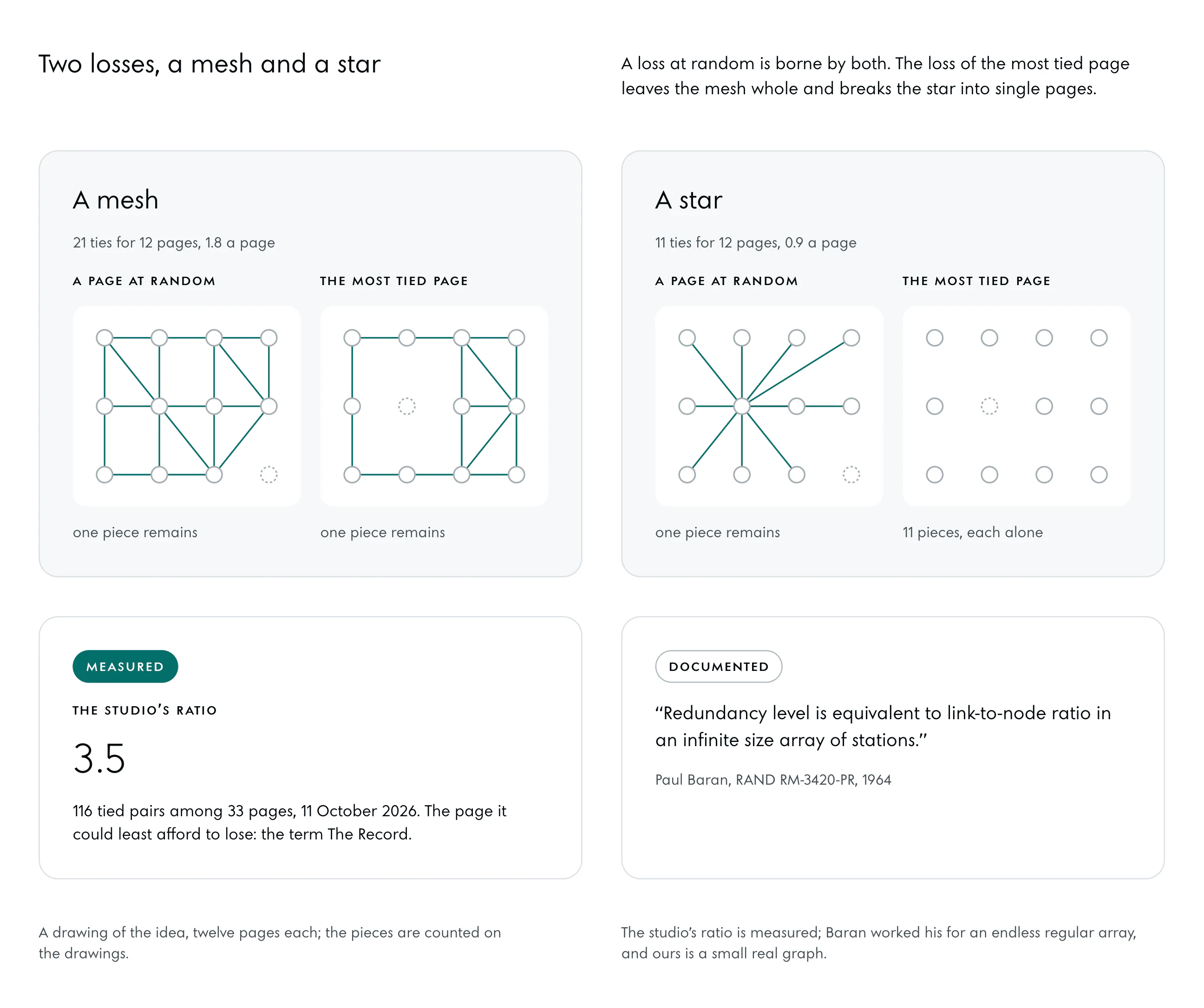
The studio’s count gives 116 tied pairs among 33 pages, a ratio of 3.5, which is roughly the order Baran named; his figure was worked out for an endless regular array, and ours is a small real graph with one page, the term “the record”, that it could least afford to lose. How far the finding carries from stations to pages depends on what is claimed, and as a claim about what an engine concludes it is theory, promised in the first part and argued here, which would be broken by a meshed site that lost its standing on a subject when a single page of it dropped out of the index.
As a claim about graphs it carries over fully. An owner can test it by deleting the most tied page from the graph of the site. The bodies that remain are then counted.
Every New Page Moves the Centre
When a member joins a set, the mean shifts by a fixed rule. With n pages whose mean sits at c, a page p that joins puts the mean at the old sum plus p, divided by n plus one. Worked out, the centre shifts by the difference between p and c, divided by the count after p has joined.
A tenth page shifts the centre of nine by a tenth of that difference, and the thousandth shifts the centre of 999 by a thousandth, always towards the page that came.
That difference is what the founder had in mind when he spoke, of this paper, about “that delta between the new added pages and the other ones”. It is a vector, so it has a length and it has a direction, and both of them can be computed before a page is published. The spread changes with it, because for unit vectors the focus of the second part is the length of the mean, and one more page raises it or lowers it by where the page sits, with the dividing line a little under the focus itself.
With nine pages at a focus of 0.800, that line falls at a cosine of 0.775. A tenth page whose cosine with the centre is 0.95 lifts the focus to 0.816, and one at 0.40 lowers it to 0.766. In a body of 99 pages at the same focus the same two pages give 0.802 and 0.796.
So the same difference counts for roughly ten times less in a body ten times the size.
One difference therefore measures two things at once, how far the centre goes and whether the body tightens or loosens.
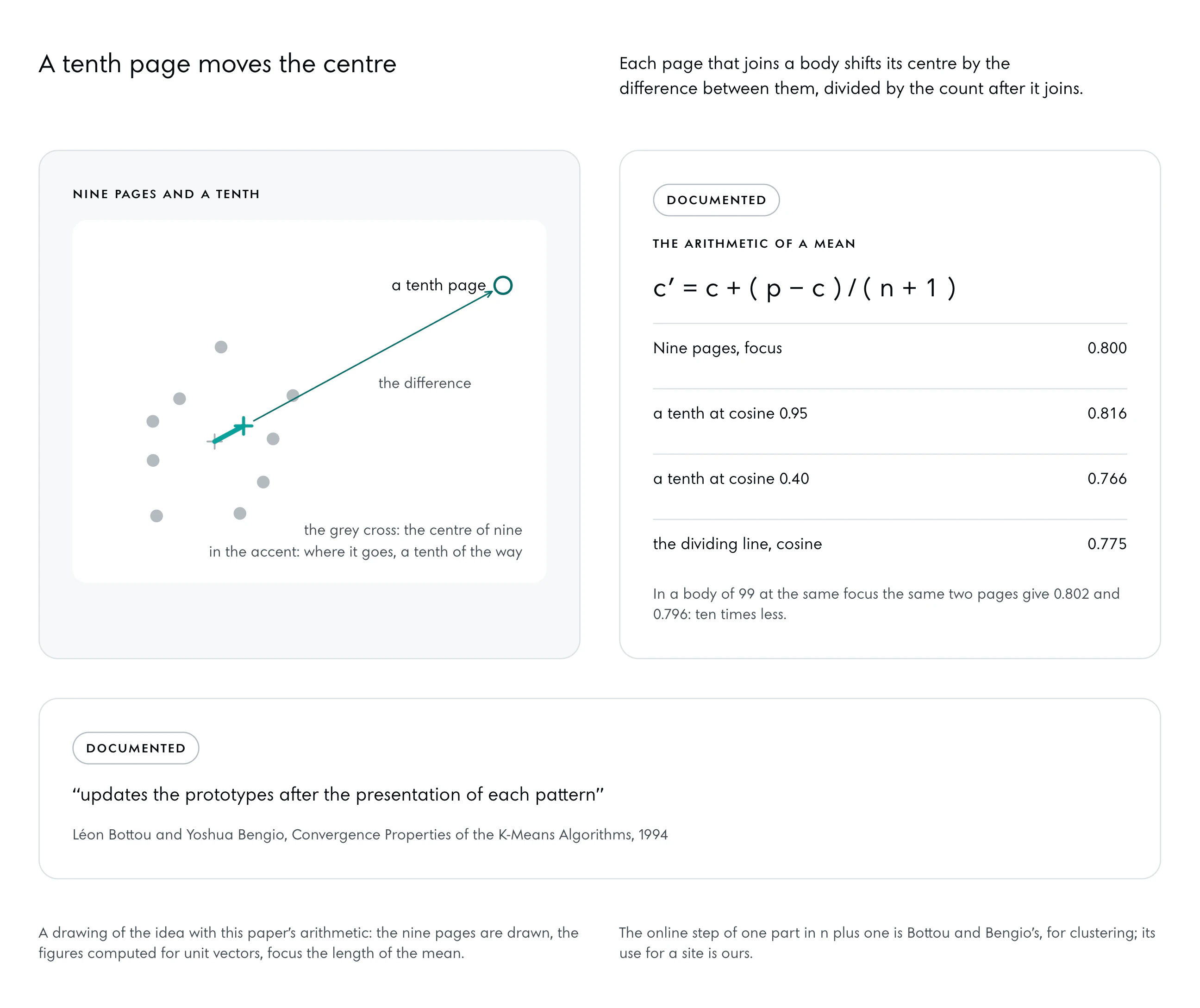
His phrase for a body that grows this way was “almost like a gradient vector”, and there is a literal sense to it. Léon Bottou and Yoshua Bengio gave k-means, the usual way of finding centres, an online form in 1994 “which updates the prototypes after the presentation of each pattern”, a prototype there being a centre and a pattern a member. In that form a centre moves towards each new member by one over the number of members it has counted, which is the step of one part in n plus one worked out above.
So the view of each new member as a step taken along the difference is theirs, for clustering, and its use for a site is ours.
Shape Beyond One Number
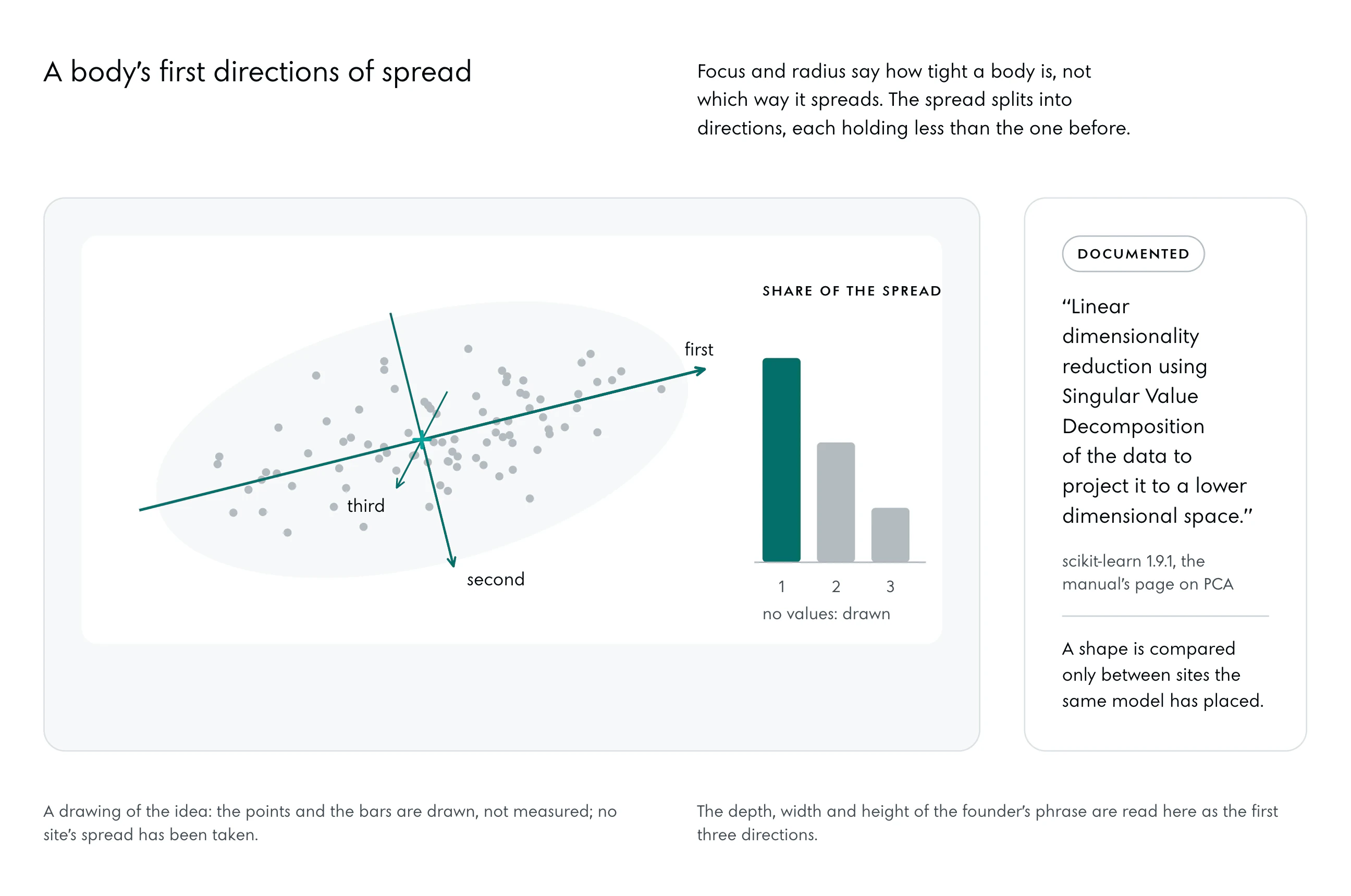
Focus and radius say how tight a body is, and they are silent on which way it spreads. The pages of a site can lie far apart along some axes of the space and hardly apart at all along others. To find them the usual tool is principal component analysis, which the manual of scikit-learn, in version 1.9.1, describes as “Linear dimensionality reduction using Singular Value Decomposition of the data to project it to a lower dimensional space.” For each one it finds, the tool reports the “Percentage of variance explained by each of the selected components.” So the spread around a centre can be split into directions, and they can be ranked by the share of the spread that each one holds.
The founder sees the body as having a shape, and he said of it, “There is a depth, width, and the height of the layer”. We take those words, perhaps too literally, as the first directions of spread, in the order of their shares, since the space itself has hundreds of axes and no three of them are special. A body whose first two hold nearly all of its spread is close to flat, and a third strong one gives it thickness.
Some of any shape belongs to the model. Li and his co-authors, cited with the losses of a single vector, found the space of one encoder uneven before any site was placed in it. So a shape is compared only between sites that the same model has placed.
His words for what such a body does are “attractor” and “gravity”. The textbook cited for the centroid uses the second of them in the same sense, “The ideal cluster in K-means is a sphere with the centroid as its center of gravity.” Of the two pulls that this paper keeps apart, the first is arithmetic, the pull of a mean on where the next step lands, and it belongs to the structure; the second is an effect that shows in answers, and the studio keeps another name for it, Answer Gravity, whose page draws the line in one sentence, “the mesh is the structure, and answer gravity is its pull”. That term stays outside the family of three.
Nothing in this part is folded into it.
Our position follows, and it is theory. An engine that holds the centre of a site and its spread has what it needs to weigh a new page against the body it joins, before the page has earned anything alone. We hold that it does so, and that a page with a small difference from a settled body is placed sooner than a page with a large one.
It would be broken if new pages near the centre of a settled site were indexed and shown no sooner than new pages far from it.
Can a Structure Be Taken?
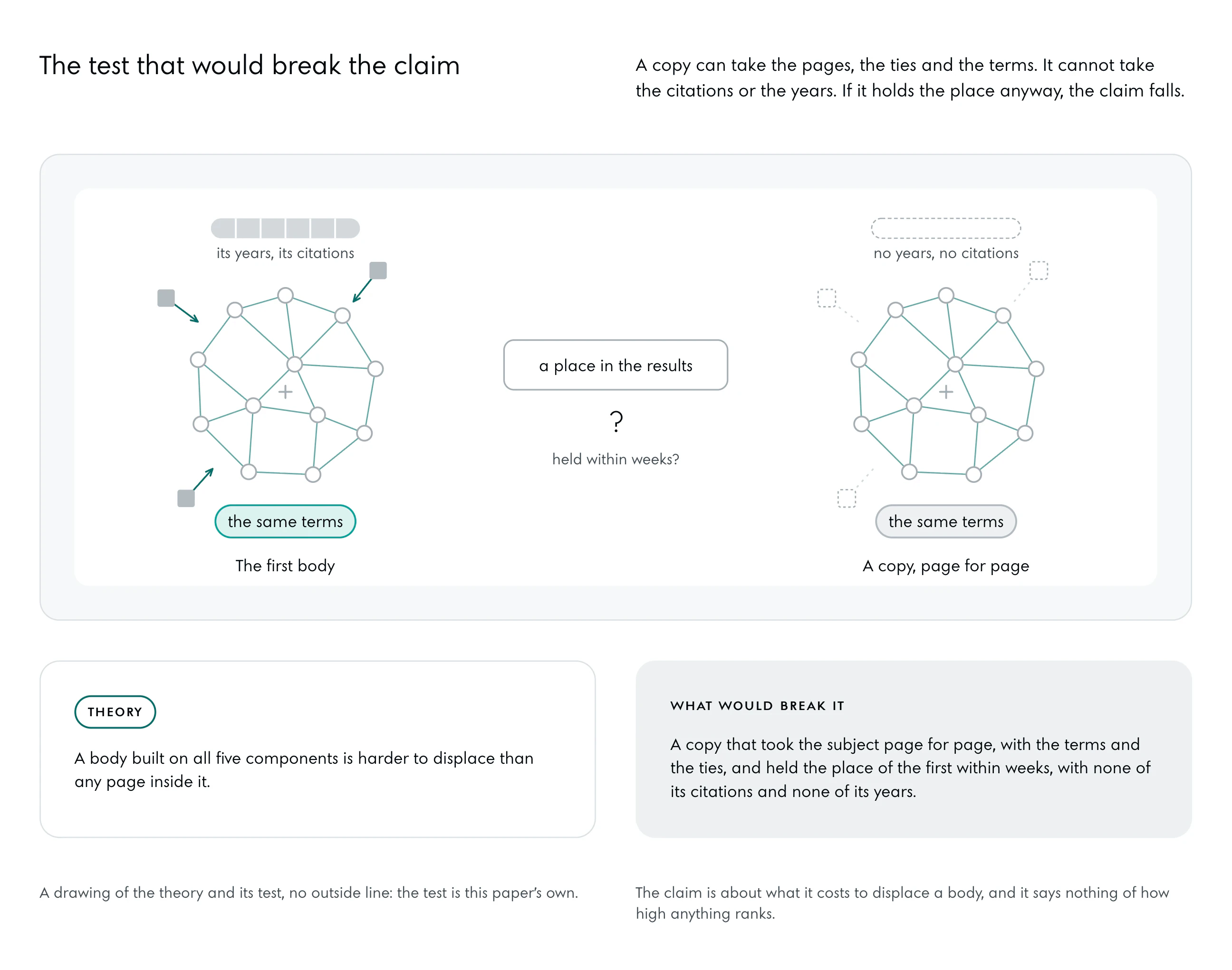
Any rival with enough time can rebuild the first three things in the list above, and the fourth probably follows in the end from being the better source, so nothing in this part makes a body safe for good. We hold, as theory, the claim at the head of this paper, that a body built on all five components is harder to displace than any page inside it. One thing that would break it is a copy, a site that took the subject page for page, with the terms and the ties, and held the place of the first within weeks, with none of its citations and none of its years.
The other is a meshed site that fell entirely when one of its pages was outranked. What the argument gives is an order of cost. Google’s published lines bound it from above.
The guide’s warning, quoted with the stored fields, applies in full, since a good signal for a site promises no page of it a place. So the claim is about what it costs to displace a body, and it says nothing of how high anything ranks.
08Costs of Reading a Site
Engines ration each stage of their work on a host, the fetching, the rendering, the choosing of what to keep and the placing of what is kept, and Google’s pages say so in plain terms.
Markup weighs on the earlier stages, and whatever of it survives into the text then takes room in a window that is bounded. On the studio’s reference network the short plain pages were the ones the index took first, which is given below as an observation and as nothing more.
Budgets for Each Hostname
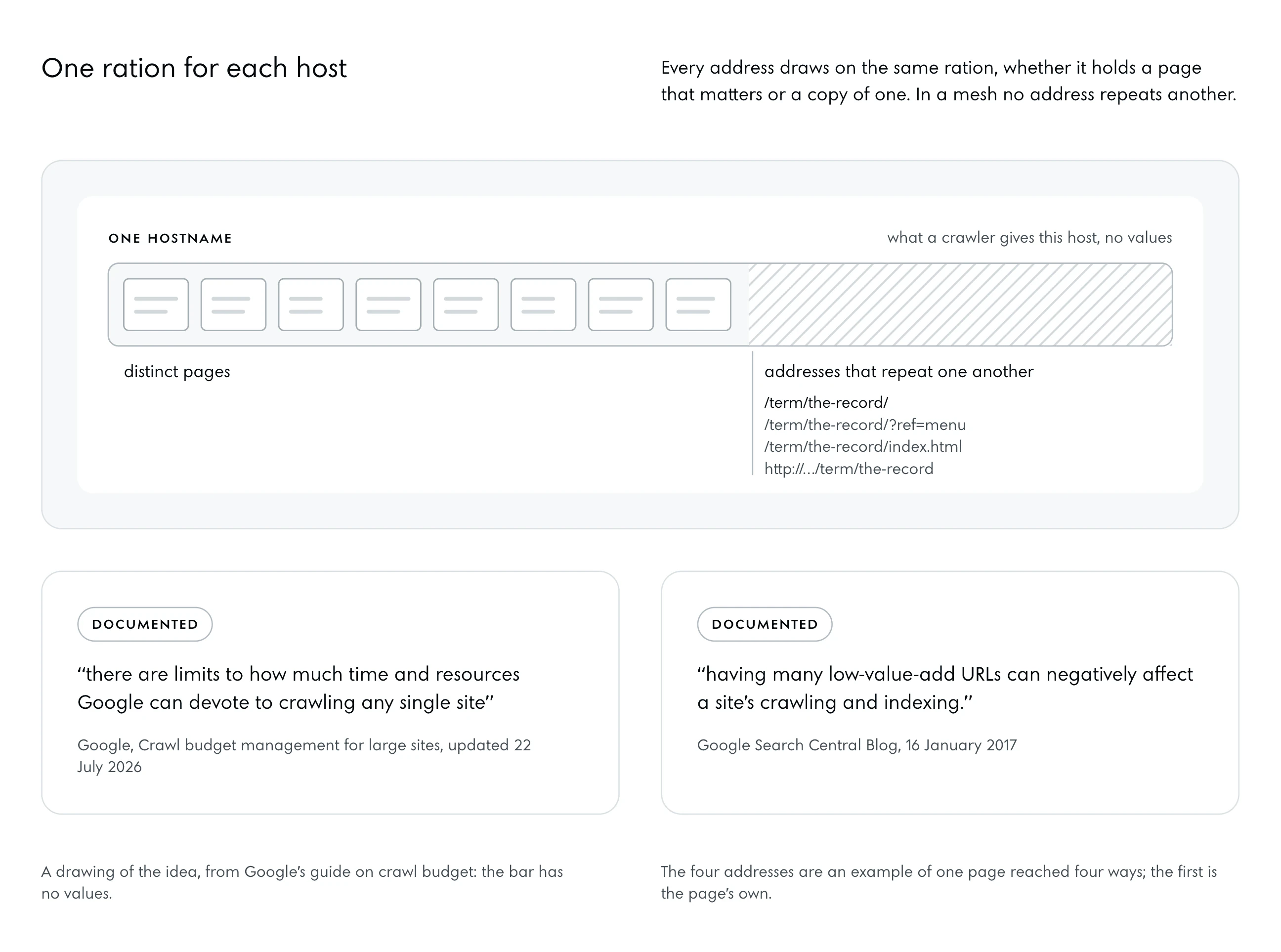
Google rations its crawler in so many words. The unit it rations by is the host. Its guide for large sites, quoted in the second part for what a site is, says that “there are limits to how much time and resources Google can devote to crawling any single site”, and that the share a site is given “is commonly called a site’s crawl budget”.
What a site publishes decides how that ration is spent, and the guide says of addresses that repeat one another or lead nowhere, “this wastes a lot of Google crawling time on your site”. An older post on the company’s blog, of 16 January 2017, went further, “having many low-value-add URLs can negatively affect a site’s crawling and indexing.”
So every address draws on one ration, whether it holds a page that matters or a copy of one. The conformal rule of a mesh is a rule of thrift as well. Two addresses never cover the same ground in it; nothing is fetched twice for one piece of matter.
Crawled and Then Chosen
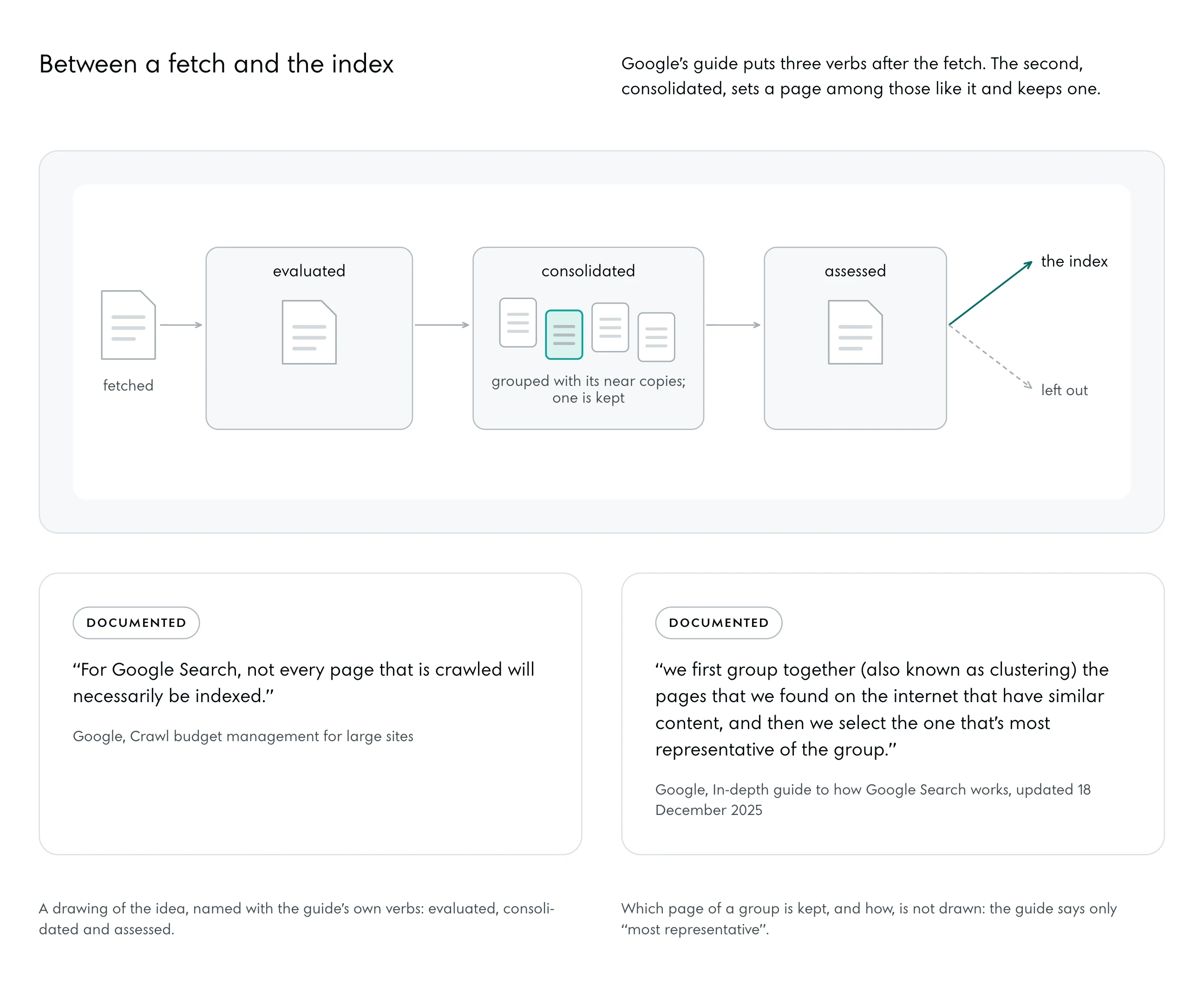
Nothing is promised to a page by its being fetched. Google’s guide is plain about it, “For Google Search, not every page that is crawled will necessarily be indexed.” After the fetch a page is, in the guide’s next words, “evaluated, consolidated, and assessed to determine its suitability for the index”. It is the one of the three that a site can do something about, because it turns on how like each other its pages are.
The middle verb is spelt out in the company’s account of how Search works, updated on 18 December 2025, “we first group together (also known as clustering) the pages that we found on the internet that have similar content, and then we select the one that’s most representative of the group.”
Between a fetch and the index Google’s guide puts three verbs, and the second of them, consolidated, compares a page with its neighbours.
Likeness between pages has been a computed quantity since at least 1997, when Andrei Broder defined two measures for it, resemblance and containment, to capture what his paper calls the informal notions of “roughly the same” and “roughly contained”.
Pages that come out roughly the same are grouped, and one of the group is kept. This is the rule of thumb of the second part, met from the engine’s side. Pages of one site that sit too close are probably the ones that get folded together.
Markup Ahead of the Text
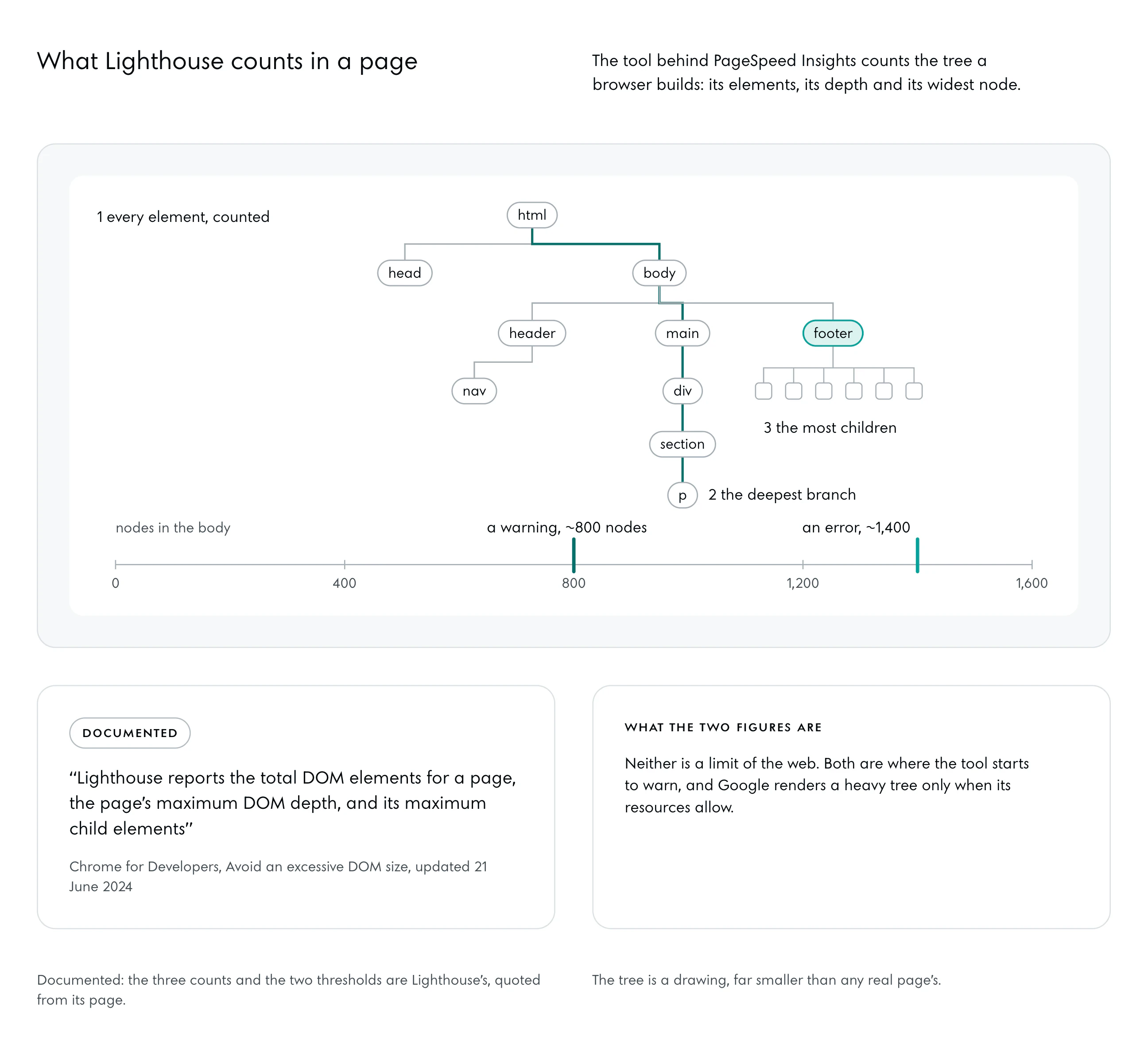
Lighthouse, the open tool behind Google’s PageSpeed Insights, counts what a browser has to build from the HTML of a page. Google’s note on the service, updated on 21 October 2024, gives the link between the two, “PSI uses Lighthouse to analyze the given URL in a simulated environment”. The tool’s page on the size of the DOM was last updated on 21 June 2024, and the audit it describes has since moved into an insight, as of Lighthouse 13.
It says what is counted, “Lighthouse reports the total DOM elements for a page, the page’s maximum DOM depth, and its maximum child elements”. A page draws a warning “when the body element has more than ~800 nodes”, and it draws an error at “more than ~1,400 nodes”. Neither figure is a limit of the web, and both are only where the tool begins to complain.
The reason it gives is the cost to a browser and to a visitor, since a large tree, it says, “unnecessarily increases data costs for your users and slows down load time”.
That is what the founder meant by “the DOM complexity”. But the tool says nothing of vectors, and his reason was another one, “because of the limit of how it computes the vectors”, so three more sources are needed to get from the tree to the window.
Google builds the tree too, and its page on JavaScript, updated on 4 March 2026, says that “Once Google’s resources allow, a headless Chromium renders the page and executes the JavaScript”, and that “Google also uses the rendered HTML to index the page.” A neighbouring page, on content that loads late, updated on 10 December 2025, adds a limit, “Google Search does not interact with your page.” So a heavy tree is built when resources allow, and whatever waits for a click cannot be counted on to be there.
Text is then taken out of the tree, because a vector is computed from words. Jiejun Tan and five co-authors described the usual practice in November 2024, which is to fetch the HTML of each result and then, as they put it, to “extract plain texts from the HTML sources”. They also measured what gets thrown away, and in their first experiments a real HTML document came to over 80K tokens on average, of which “over 90% of the tokens are CSS styles, JavaScript, Comments, or other meaningless tokens”.
The sorting is a field of its own, and Adrien Barbaresi put its aim in a line in August 2021, “An essential operation in web corpus construction consists in retaining the desired content while discarding the rest.” Google sells the same step to firms that build their own search, and its Cloud page on parsing, updated on 9 October 2026, tells them that “you can exclude boilerplate or sections such as navigation menus, headers, footers, or sidebars”. That product is not Google Search; the page says nothing of how Search does it.
An extractor is never perfect, and what it lets through is always text.
A menu or a footer that survives is read as words, and it takes room in the window before the page’s own matter does. Windows are bounded, at 256 word pieces and at 2,048 tokens in the two cards quoted for a single page, and at “long documents of up to 8,192 tokens” in the M3-Embedding paper of February 2024. What a token costs and where the crawler stops fetching were the first paper’s matter, with the limits of Google’s own models, and none of it is gone over again.
Two things follow for the point that a page becomes. Past the window nothing has a vote, so a page whose opening is all template may be placed entirely by its template. Inside the window every token that survived votes, as the part on pooling showed, so the repeated blocks of a site pull all of its pages towards one spot and blur what each of them is about.
It is the share that matters here, and a share can be read off any page by anyone who takes out its text and counts.
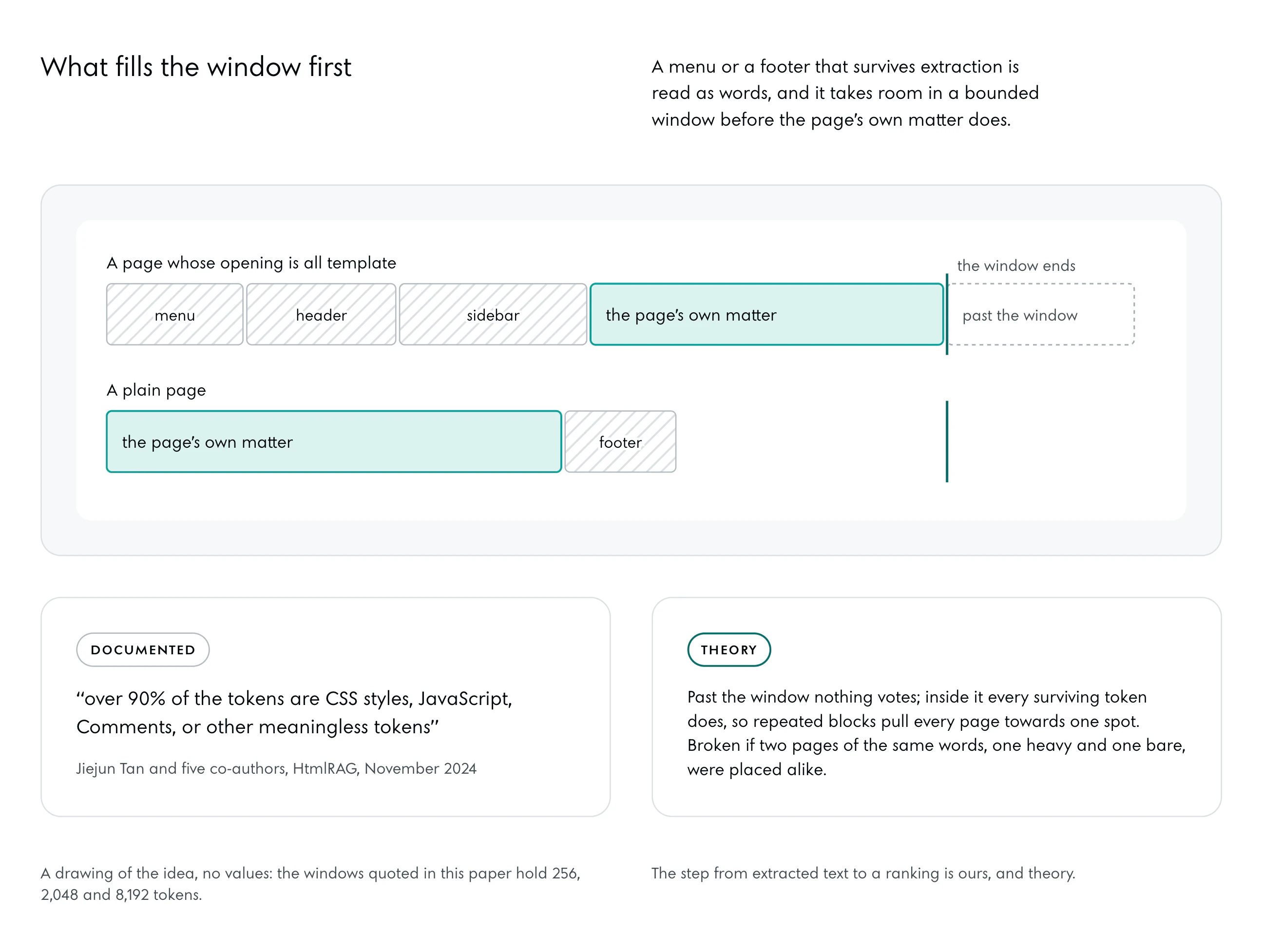
Each of those sources is documented. The step from them to a ranking is ours and stays theory, since no engine has published that its index embeds extracted text inside such a window. It would be broken by two pages of the same words, one heavy with markup and one nearly bare, that were taken in and placed alike.
Short Pages Entered First
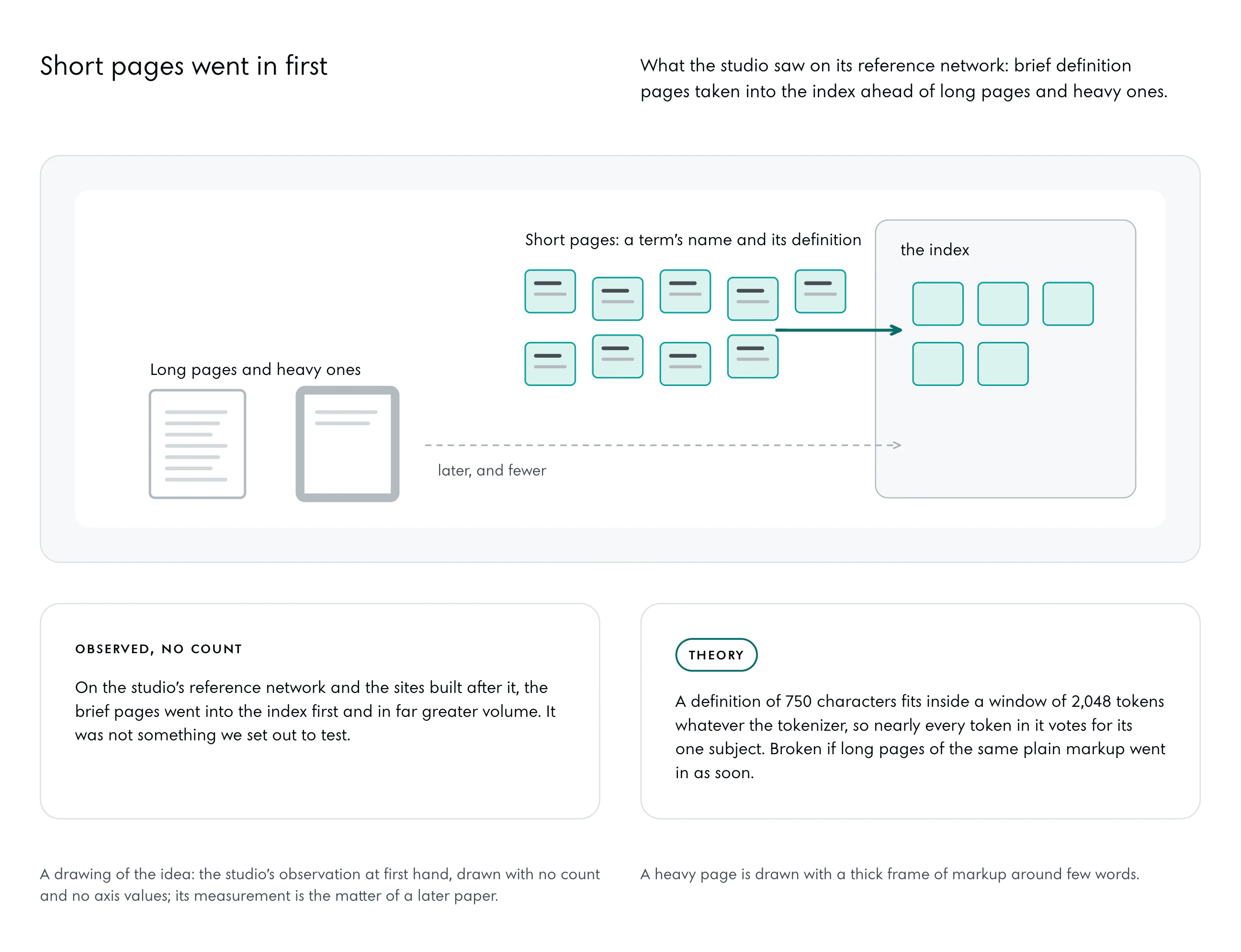
Across the studio’s reference network we watched which documents the index took soonest. They were the brief ones, and by a wide margin. It was the same on the sites that we built later, and it was not something we had set out to test.
A brief page here is one that held the name of a term and a definition of a few hundred characters, under 500 to 750. Such pages went in before the long pieces and in far greater volume. Heavy pages did worse, and by heavy we mean those put together with a page builder, where the markup around the words outweighs the words.
Then we moved to a template that flattened the DOM and left almost pure text. By the founder’s own count a page under that template came to about 12 kB as it loaded; the figure is his, at first hand, it was not weighed again for this paper, and all it is used for here is that there was less for any engine to fetch and less for it to strip away.
This is what we saw at first hand, and it is an observation. It comes with no count of pages; how the pages are made is not set out here. Its measurement is the matter of a later paper.
We take the pattern through the window. A definition of 750 characters fits inside a window of 2,048 tokens whatever the tokenizer, since a token is never shorter than a character. So such a page is read fully, and nearly every token in it votes for its one subject.
That it went in sooner for that reason is theory. It would be broken by long pages of the same plain markup, on the same sites, going in as soon and in the same volume as the brief ones.
Subject as a Crawler’s Guide
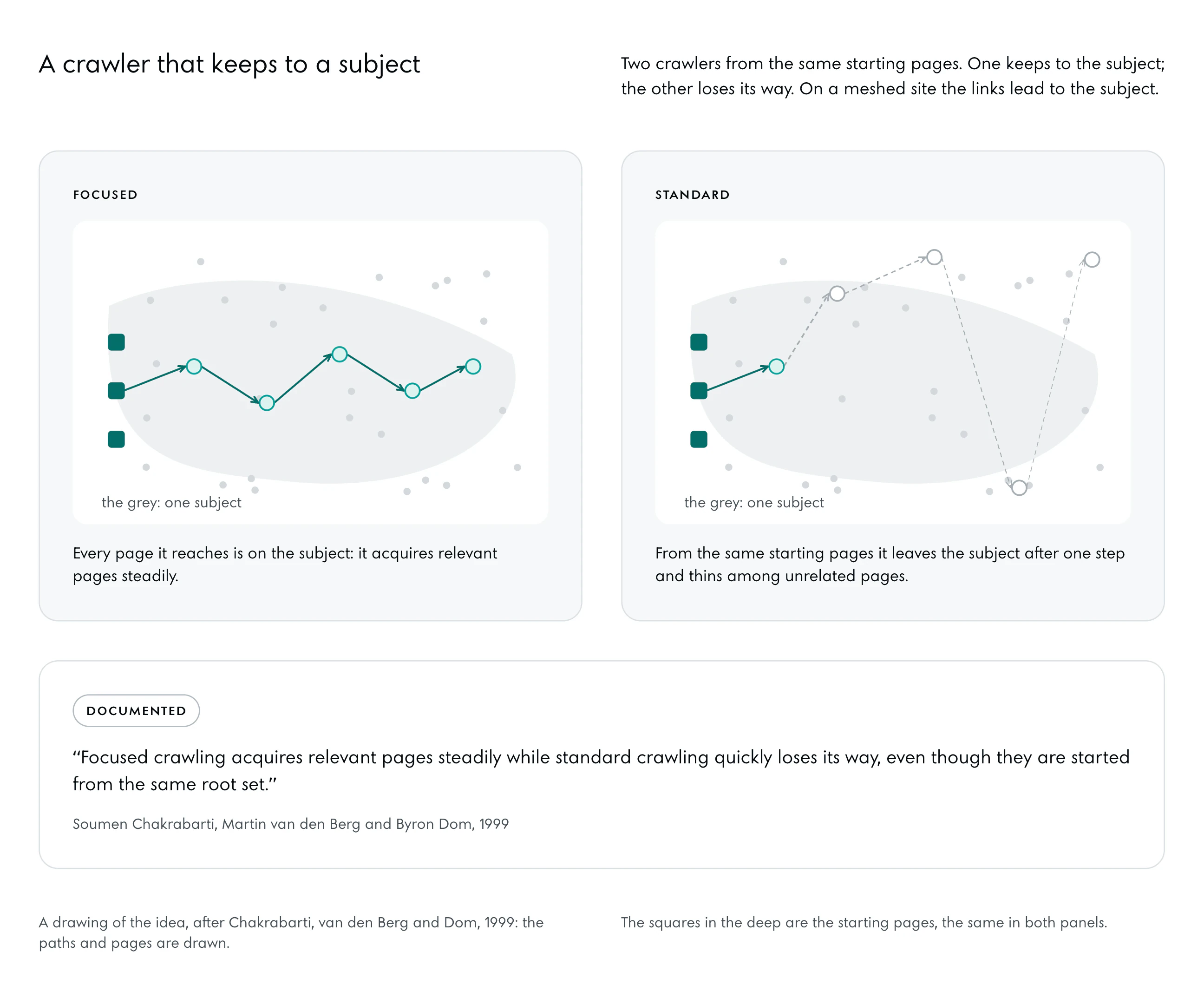
Chakrabarti, van den Berg and Dom showed in 1999 what a fetcher gains by keeping to a topic. Their paper states the aim, “The goal of a focused crawler is to selectively seek out pages that are relevant to a pre-defined set of topics.” It also reports what happened, “Focused crawling acquires relevant pages steadily while standard crawling quickly loses its way, even though they are started from the same root set.” Davison’s finding, in the part on links, is the reason it works. On a site that links where meanings meet, a crawler that lands on a page is led by its links to more of the same subject.
Placing is a walk among neighbours as well, and in the design that Malkov and Yashunin published in March 2016 an index of vectors is searched through “navigable small world graphs with controllable hierarchy”, so that a new point is reached by stepping from one near neighbour to the next. Which design any search engine uses for its index is not published, and we assume none.
Our position is that a mesh is the cheap kind of site to read. Its addresses do not repeat, its pages are far enough apart to survive being grouped, its markup leaves the text nearly bare, and its links lead a crawler from one relevant page to the next. We put no figure of energy or of money on it, since none of the sources opened gives one for a site.
What would count against it is a pair of sites alike in subject and size, one meshed and plain and the other neither, that were crawled and indexed at the same pace.
09New Domains on Empty Ground
Hosts with no history give the plainest view of what a body of pages earns before anybody has cited it.
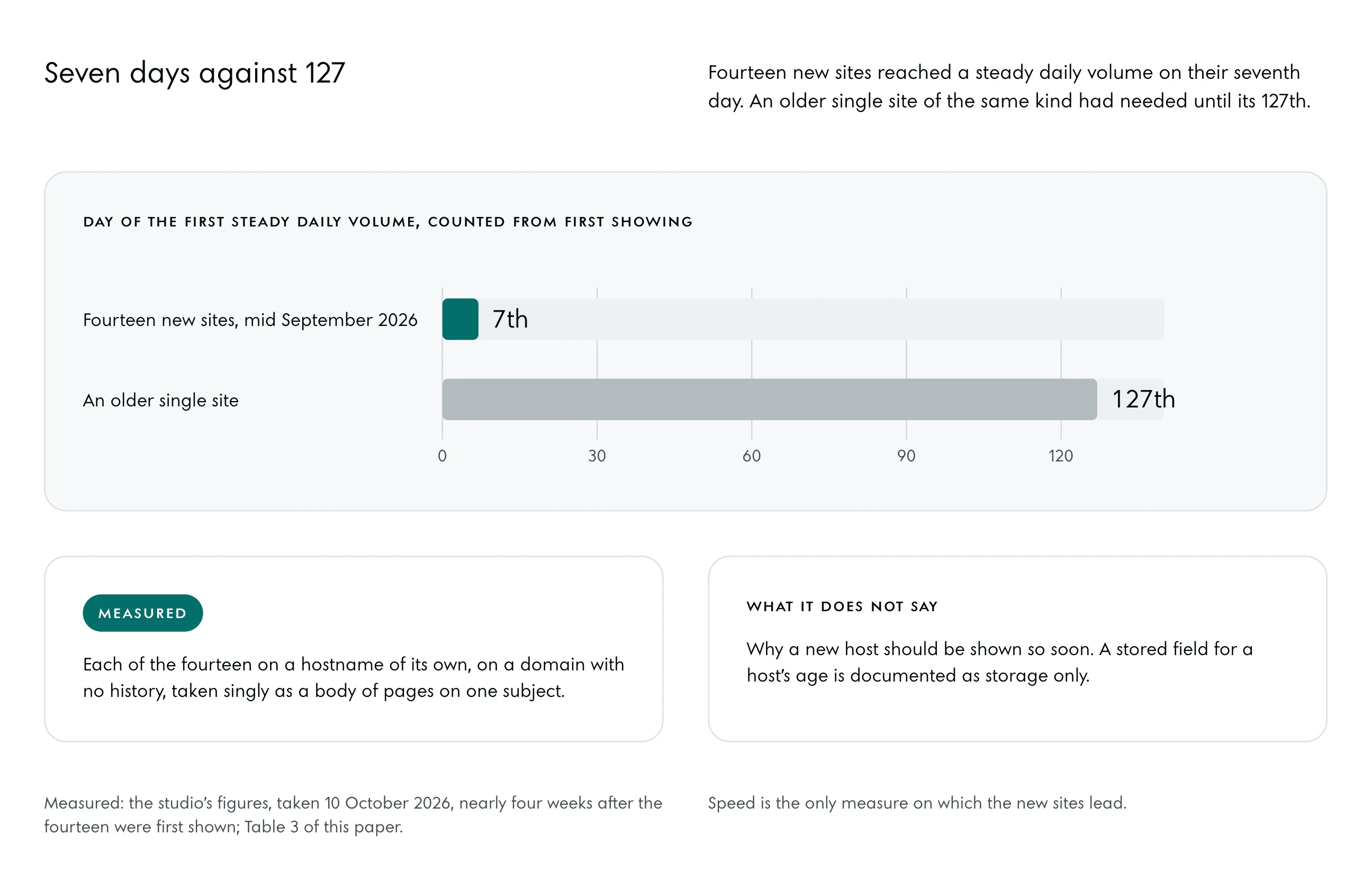
Fourteen such sites, first shown in mid September 2026, reached a steady daily volume on their seventh day, where an older single site of the same kind had needed until its 127th. Three weeks in, their impressions fell by more than half. Both facts are measured, and what they leave unsettled is said in the part on sources and what stays open.
Seven Days Against 127
Figures for these sites were taken on 10 October 2026, nearly four weeks after Google first showed them. Each of the fourteen sits on a hostname of its own, on a domain that had no history, and each is taken here singly, as a body of pages on one subject.
They were first shown in mid September 2026. From the seventh day the set held a steady daily volume. The comparison is an older single site of the kind the studio calls a Satellite.
It needed until its 127th day to reach the same state. Why a new host should be shown so soon, we cannot say.
The files that leaked in 2024 show only that the age of a host was a stored value, and the module PerDocData glosses its field hostAge as “The earliest firstseen date of all pages in this host/domain. These data are used in twiddler to sandbox fresh spam in serving time.” That gloss is two years old and belongs to a file, and it tells nothing of how these fourteen were treated.
Fourteen Sites Against One
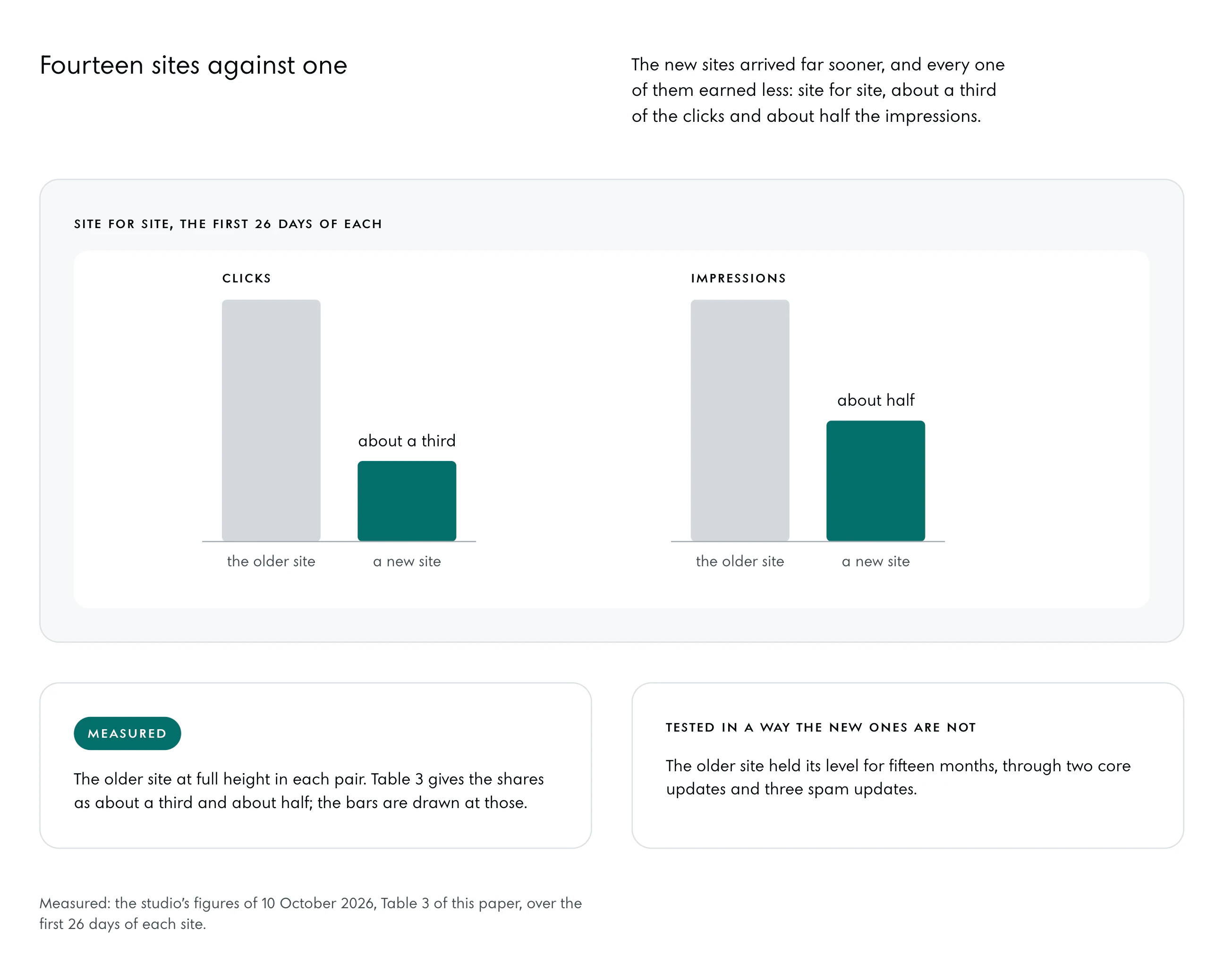
Speed is the only measure on which the newcomers lead. The set arrived far sooner than the older site did, and every member of it earned less.
Table 3 gives each figure with its window.
| What was measured | Figure | Window |
|---|---|---|
| Day of the first steady daily volume, fourteen new sites | 7th | counted from first showing, mid September 2026 |
| The same day for the older single site | 127th | counted from its first showing |
| Clicks of a new site against the older one, site for site | about a third | the first 26 days of each |
| Impressions of a new site against the older one, site for site | about half | the first 26 days of each |
| Fall in impressions of the first set from the 18th day | 56 % | three days at the peak against three days a week later |
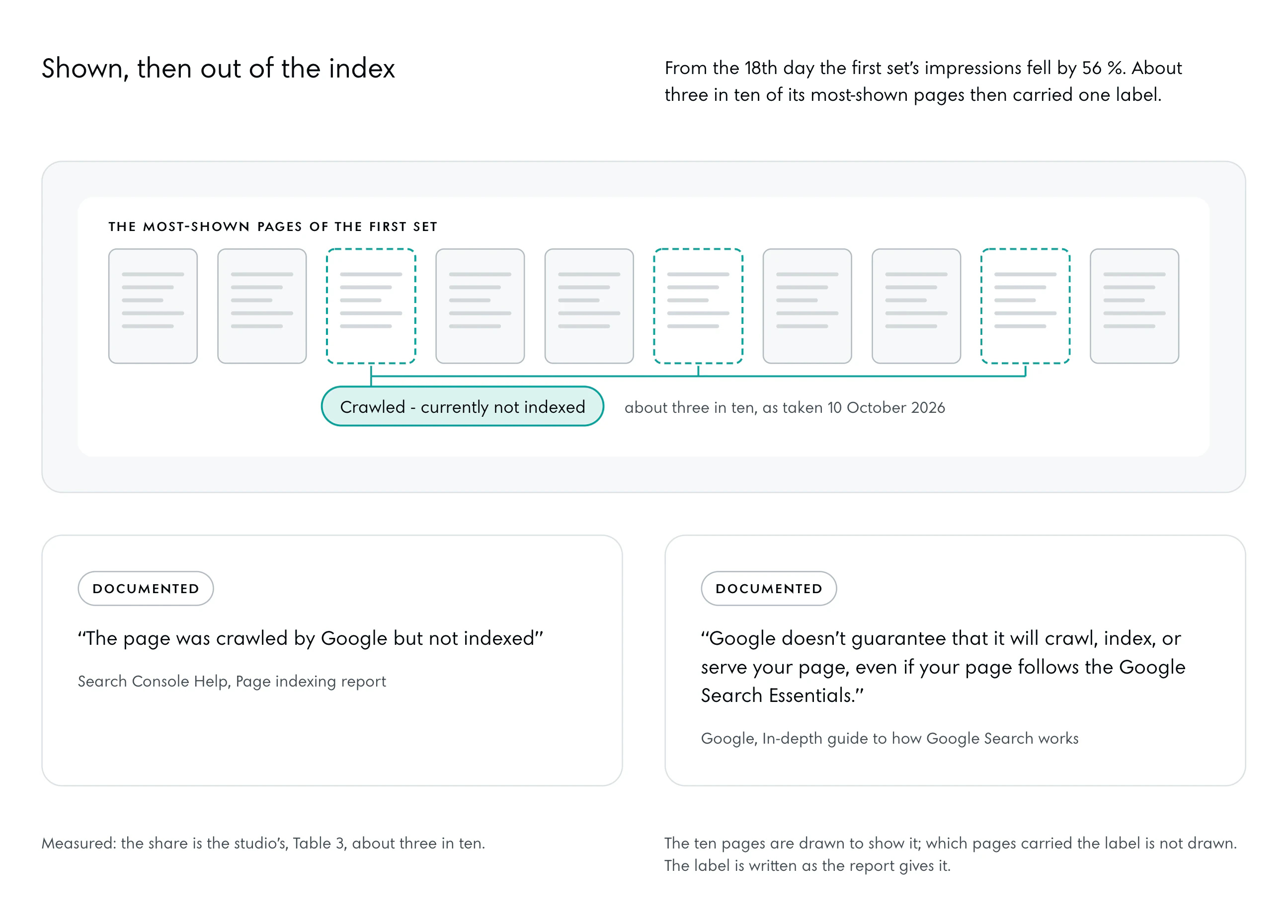
| Most-shown pages marked as crawled and currently not indexed | about three in ten | as taken on 10 October 2026 |
| Pages of the first set shown at least once | 11 % | after four weeks |
| Pages of the second set, six sites, shown at least once | 3 % | as taken on 10 October 2026 |
| Level held by the older single site | fifteen months | through two core updates and three spam updates |
Site for site, over the first 26 days of each, a new site drew about a third of the clicks of the older one and about half of its impressions. The older site has also been tested in a way that the new ones have not, since it held its level for fifteen months, through two core updates and three spam updates, the spam update of September 2026 among them.
Crowded Subjects and Open Ones
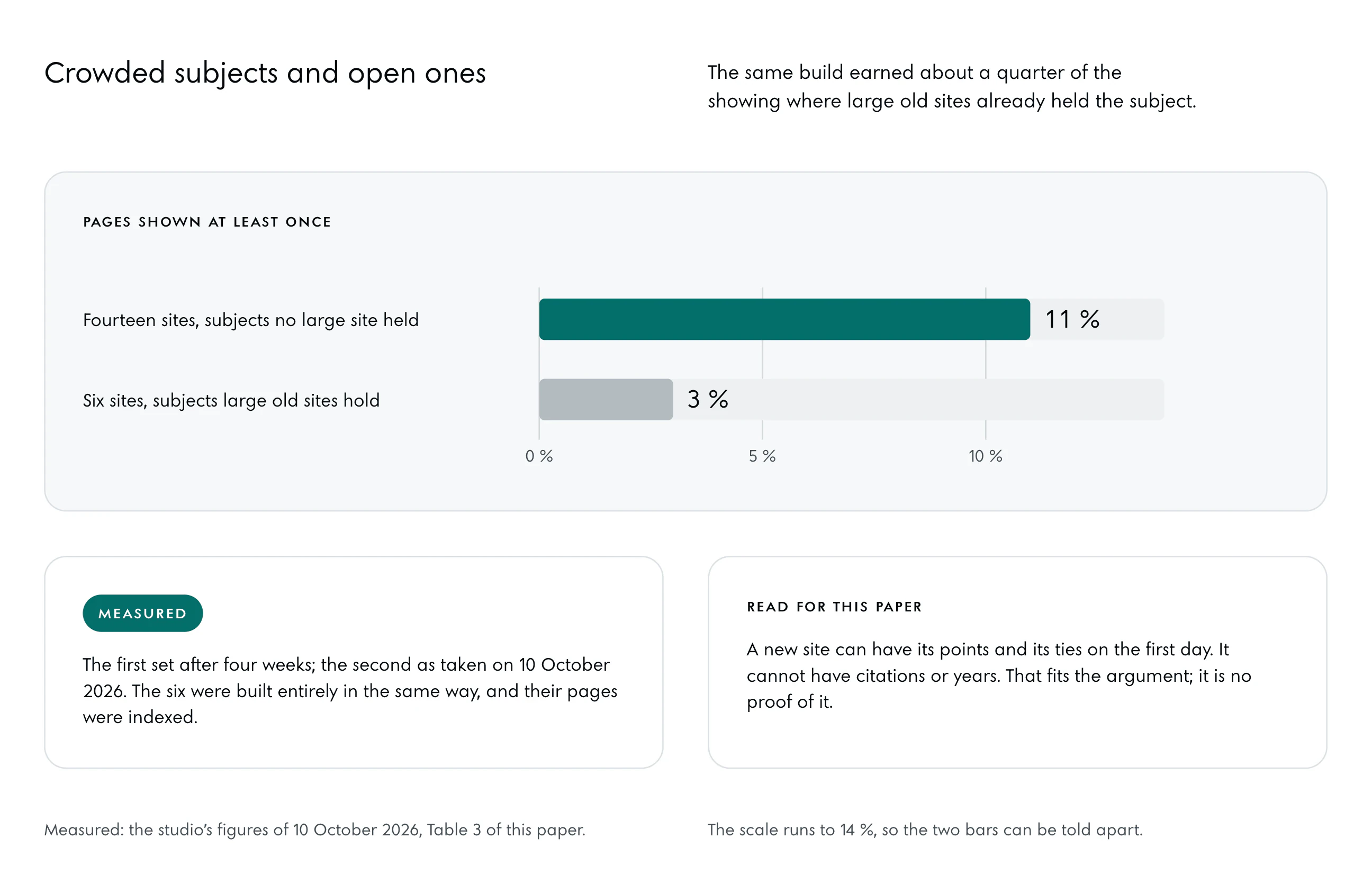
Between the first set and a second set of six, the difference was who already held the topic. The fourteen were built where no large site stood. After four weeks 11 % of their pages had been shown at least once.
The six were built entirely in the same way, on subjects that large old sites hold, and though their pages were indexed only 3 % of them had been shown.
So the same build earned about a quarter of the showing where the subject was already taken.
That fits the argument of this paper; it is no proof of it. A new site can have its points and its ties fully in place on the first day. It cannot have citations or years; that is probably why the old sites on a held subject stay ahead of it.
Unknowns After Four Weeks
From the 18th day the impressions of the first set fell by 56 %, measured as three days at the peak against three days seven days later. About three in ten of the pages that had been shown most carried the label “Crawled – currently not indexed” when we looked, and Google’s help page for the report says what the label means, “The page was crawled by Google but not indexed”, adding of such a page that it “may or may not be indexed in the future”. So pages that had been shown were out of the index a few weeks later, which the company’s general account allows for in one line, “Google doesn’t guarantee that it will crawl, index, or serve your page, even if your page follows the Google Search Essentials.”
It is a fall, and it is never called anything else here. One stored field would fit the shape of a quick start and a fall.
In the module quoted for a site’s spread, nsrdataFromFallbackPatternKey is glossed as true when “we do not have NSR data computed for the chunk”, in which case, the gloss goes on, “the data is coming from an average of other host chunks”. A host with no values yet was, by that line, given an average of other hosts’ values until some were computed for it. That such a step lies behind what we saw is our guess, and it is theory of the weakest kind.
No count taken from outside can break it, and only a published account of the field would settle it.
10Limits a Person Sets
Everything described so far is computed, and above the computing there is a policy that people apply.
It asks why pages were made and what they give a visitor, and it can close a host that the engines go on reading. The studio has a network on which both verdicts fell in the same year, and its figures mark most plainly where a mesh ends.
Purpose and Value in Policy
Scaled content abuse is the name that Google’s spam rules give the offence, in the version of 28 August 2026. They define it by intent, “Scaled content abuse is when many pages are generated for the primary purpose of manipulating search rankings and not helping users. This abusive practice is typically focused on creating large amounts of unoriginal content that provides little to no value to users, no matter how it’s created.” There are two tests in those sentences.
One is why the pages were made; the other is what a visitor gets from them. How many there are is no test by itself, and neither is the tool, which the last five words rule out. Among the examples the same page lists is “Creating multiple sites with the intent of hiding the scaled nature of the content”, so it is the hiding that offends there, and several sites are no offence in themselves.
Google’s spam rules judge a page by what it gives a visitor, never by how it was built.
A structure is therefore never a defence. Pages can sit close to one centre, be tied by links and terms, and still give a visitor almost nothing, and a body like that is what the policy describes.
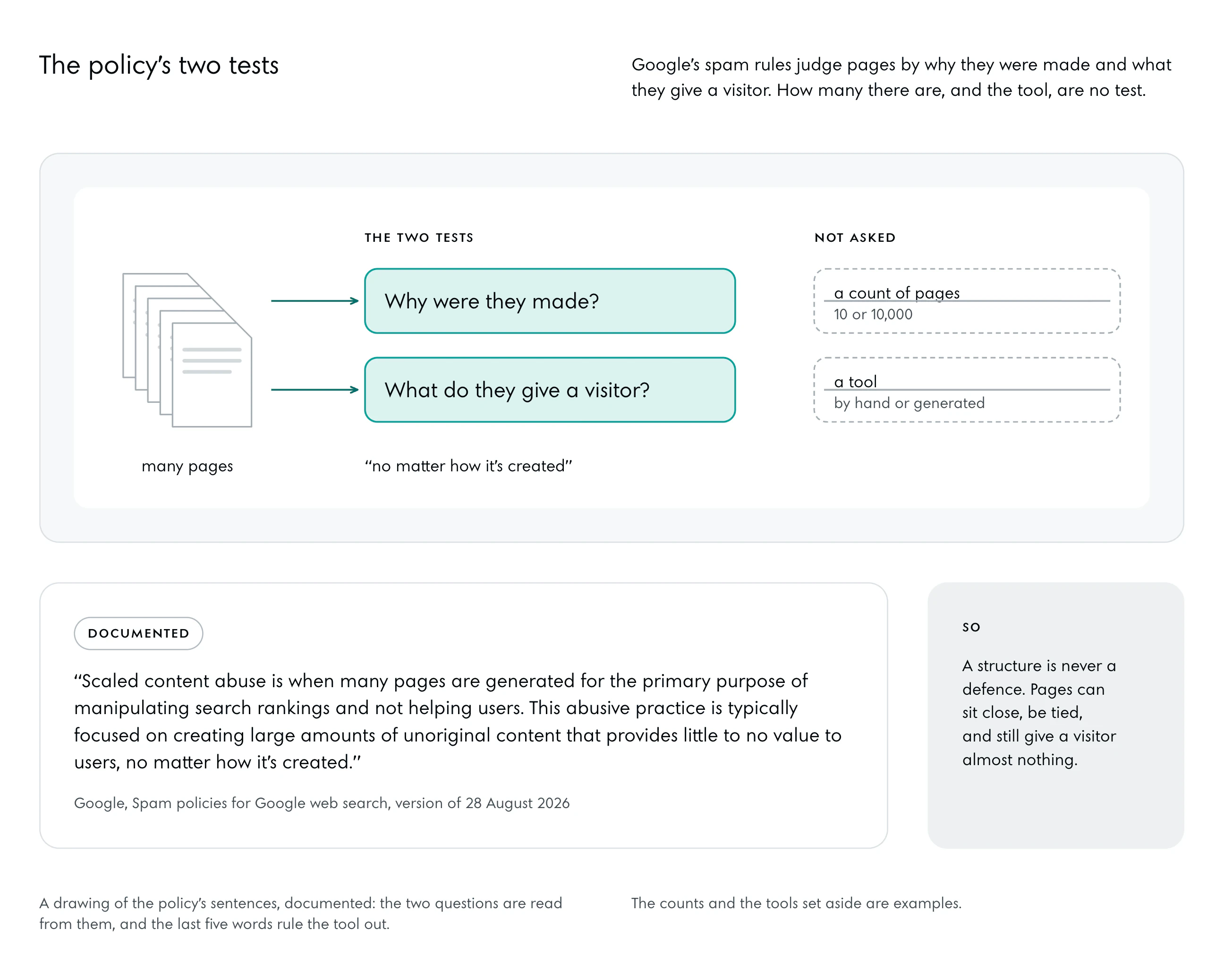
This is why the term’s page adds a clause that the arithmetic does not need, that every page earns its place with first-hand content. Google’s page on helpful content puts the same demand as questions to the owner, “Does the content provide original information, reporting, research, or analysis?”, and whether it shows “first-hand expertise and a depth of knowledge”. And it is the conformal rule once more, since a page that only repeats its neighbours covers ground that is already covered.
The files that leaked in 2024 hold a field that bears on it, contentEffort, in the module quoted for link counts, and its gloss reads “LLM-based effort estimation for article pages (see landspeeder/4311817).” An estimate of effort was stored for article pages, then, and the file is silent on what was done with it.
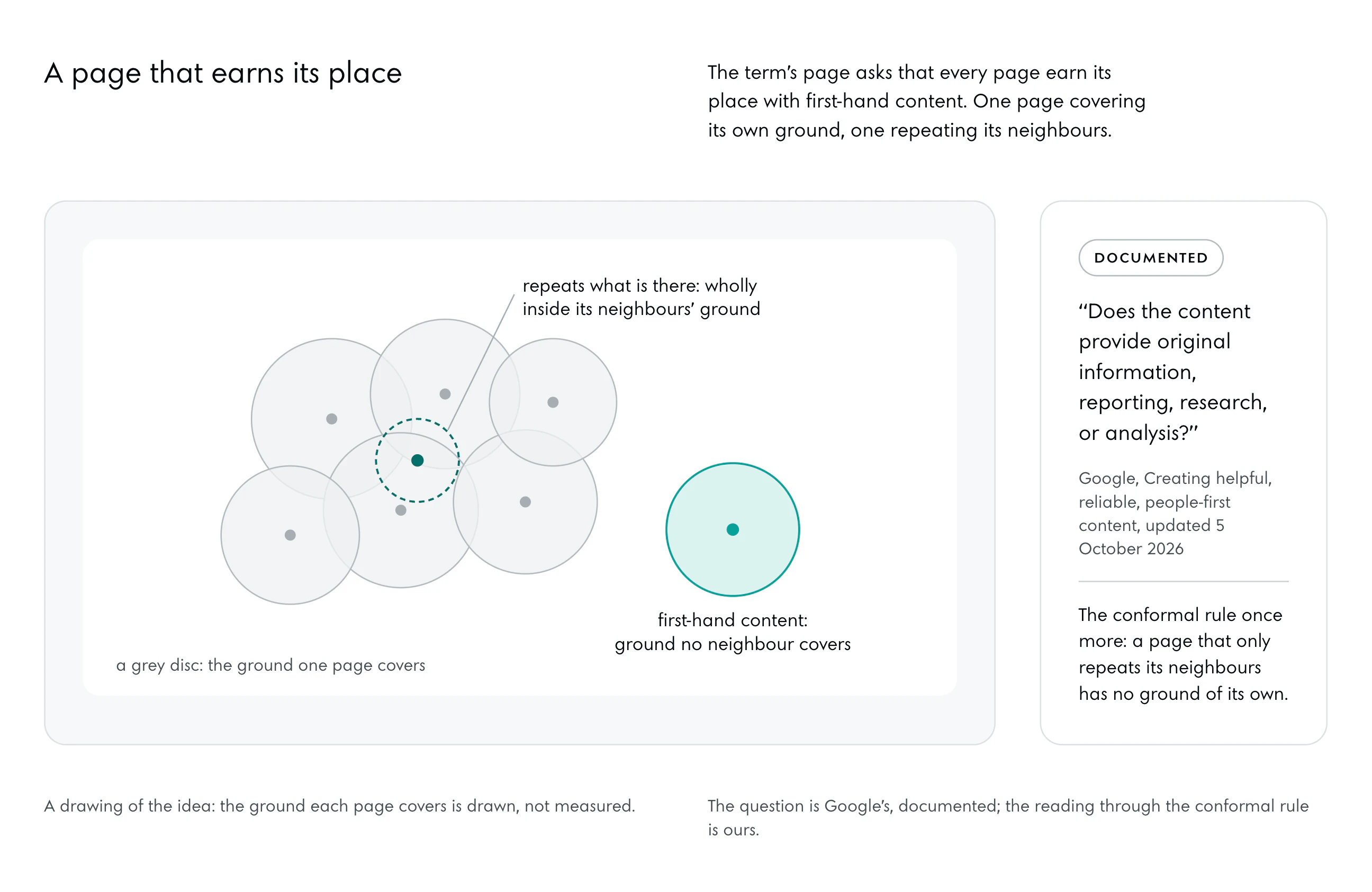
Two Judges of One Site
Our reference network, the Sustainability Directory, met both verdicts in 2026. Its figures are those of the studio’s paper Every Engine Keeps Its Own Record, and they are given here once.
Google took manual action against all of the domain on 30 May 2026. It had sent 370,755 clicks in March 2026; in the four months that followed it sent one. By 25 September 2026 none of the Directory’s pages was left in Google’s index.
Bing, for its part, sent between 31,000 and 39,000 clicks in each of the months from February to September 2026. Copilot, which answers from Bing’s index, cited the Directory about 24,800 times a day in November 2025 and about 124,000 times a day by September 2026, and half of those citations went to pages that define one term. None of these figures is ours to explain away, and we do not try.
So a person closed the site, and the engines that read it went on reading it.
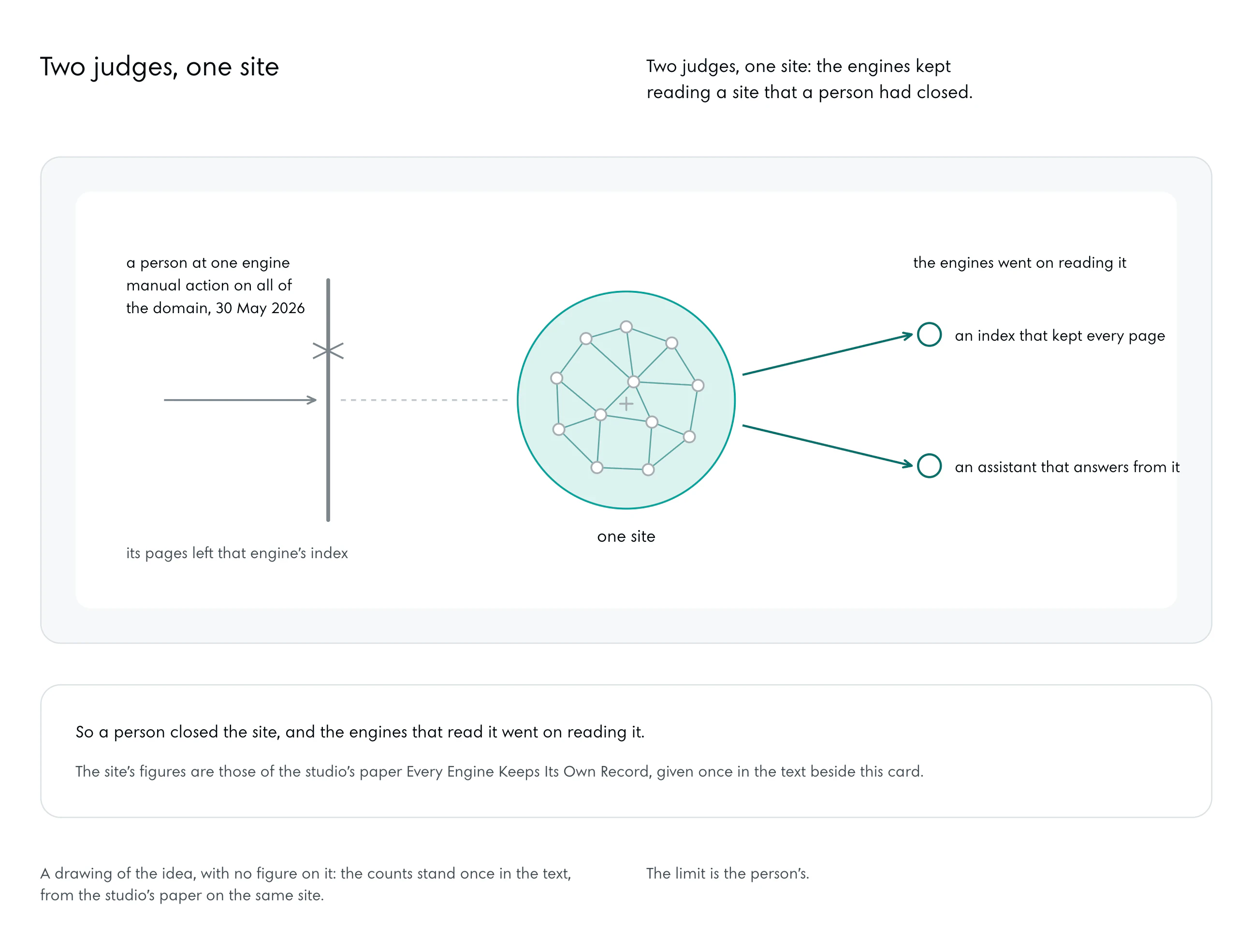
Both verdicts bear on this paper. The limit is the person’s. We pushed that site too far.
It is not a lost cause, and what is done with it next will be done with care. But nothing in its structure spoke for it when a reviewer asked, as a reviewer probably will of any such site, what its pages were for. As for the engines, theirs is the measured case for the third clause of the term, since a body of pages was cited more and more often, and half of what was cited were pages that each define a single term.
A mesh ends, then, where a page stops earning its place. It is the one part of the term that no count in this paper can check for an owner, because it turns on what a page gives to the person who lands on it.
11The Gradient at the Size of a Site
Placed as points, the pages of a body built round one subject usually lie thick near their centre and thin out towards its edge, and the rate at which they thin is a slope.
Our name for that slope is the Semantic Gravity Gradient, a term Noo–Studio coined in October 2026, and its page defines it in one sentence, “The slope of the pull towards a centre of meaning in the space where engines place text: it is set by terms written one way, shaped by the terms around them, and read twice, as the descent of tokens towards that centre and, in its mirror, as the ascent of a position in search.” Each quantity this paper has computed for a site can be read in those words. A site’s centre and spread give the well a place, a width and a depth. Each page’s deviation becomes its height on the wall, and the mirror becomes the place a site holds for the searches around its subject.
One picture serves at three sizes in this set of papers. The first paper reads it for the uses of one term, in its part The Gradient at the Size of a Term, and the third, Semantic Entanglement Optimisation, reads it for everything under one name; that paper’s part Gravity and Its Gradient also sets out what the term takes from physics and what it leaves there, and none of it is told again here. Below, the arithmetic is documented, since it is the arithmetic of the centre, the spread and the new page, worked in earlier parts.
Reading it as a well is theory, and so is every claim about what an engine does with the well, each given with the test that would break it.
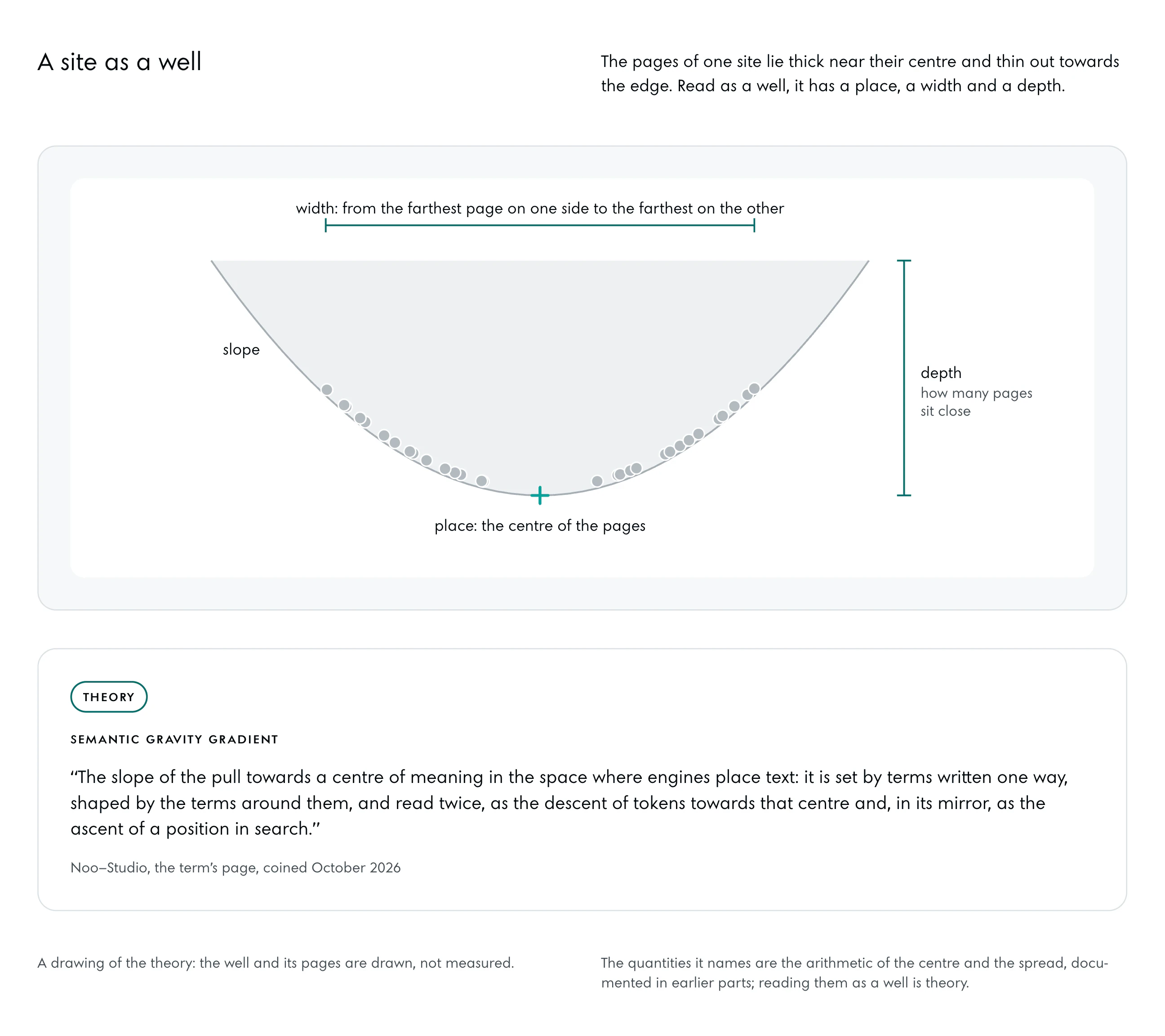
Place, Width and Depth of the Well
All three readings are held by one vector, the sum of a site’s page vectors taken before it is divided by their count. Its direction is the centre, the place where the well sits. Depth is its length, and for unit vectors that length equals the sum of every page’s cosine with the centre, an identity that takes one line to derive, so a page standing on the centre adds 1, a page at a right angle adds nothing, and a page that points away takes a little off.
So depth counts the pages that sit close, each by how close it sits. Width is the radius of the earlier parts, the mean deviation, and it comes to 1 minus the depth divided by the number of pages.
Nine pages at a focus of 0.800, the body worked through in the part on why a structure outlasts a page, make a well 7.2 deep and 0.200 wide. A tenth page at a cosine of 0.95 takes the depth to 8.16 and brings the width down to 0.184. One at 0.40 deepens it too, to 7.66, and widens it, to 0.234.
So every page on the subject adds depth, roughly its own cosine, and only a page above the line found in that part narrows the well as it deepens it. Ten pages at a focus of 0.80 and a hundred at the same focus have one width and depths of 8 and 80, and by the arithmetic of that part a new page moves the larger body roughly ten times less.
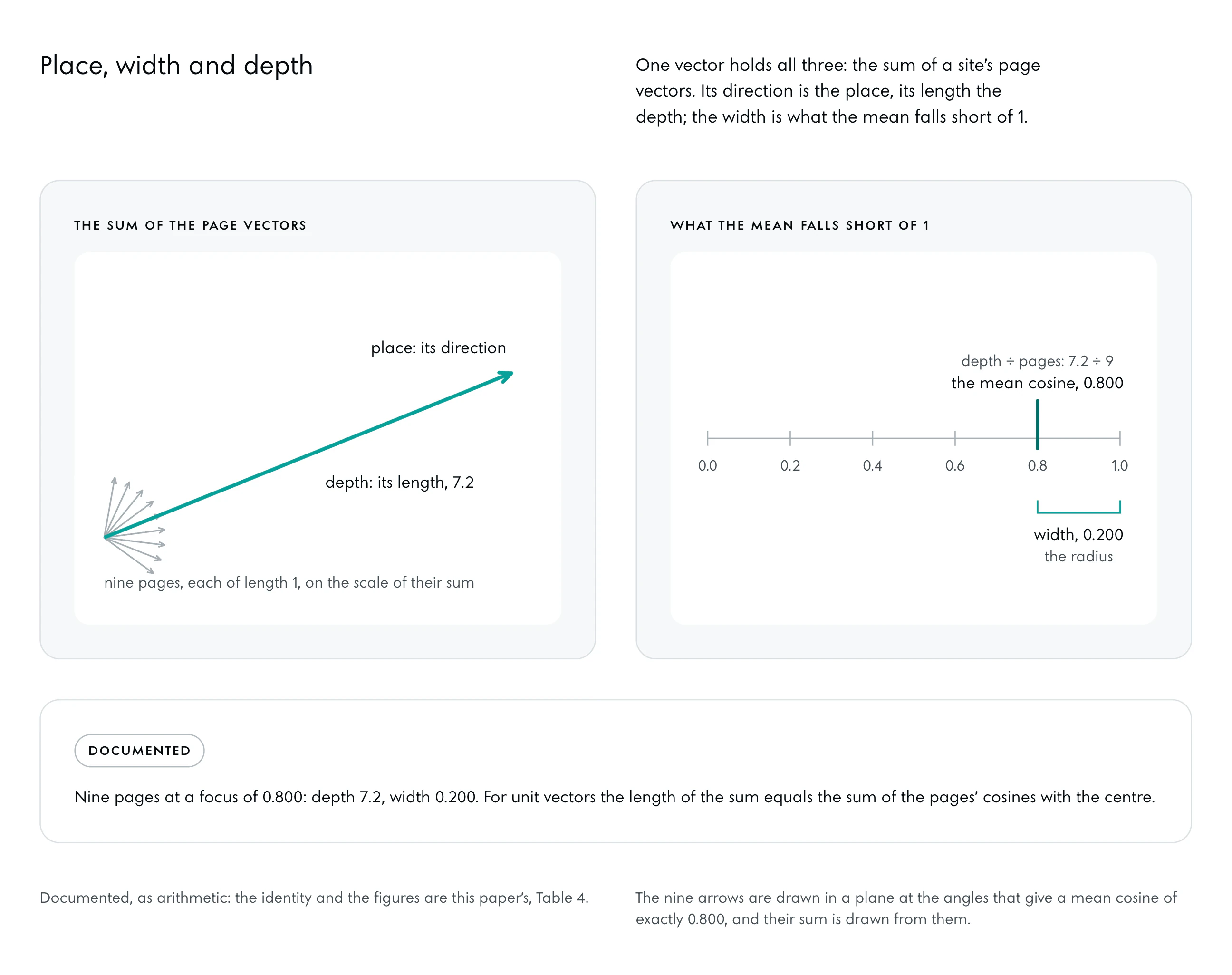
What sets each reading is already in this paper. The place follows what the site publishes most of, as the part on the centre and the spread found, and the terms written one way on every page hold it there, since the tokens of a term vote in the mean of every page that carries it. Width comes from the pages set around those terms, each on its own part of the subject, which spread the points on purpose; Table 2’s fourth row showed where that spread goes to nothing.
The founder’s three words for the body, depth, width and height, were read in the part on why a structure outlasts a page as its first directions of spread, a thickness that describes how the points lie inside the well. Depth here is another quantity, how far the well sinks, and the two are kept apart.
A slope is read from the whole list of deviations. Where most pages sit low and a few sit high, the wall is steep near the bottom; where the pages climb the wall evenly, it is shallow. Table 2 held two sets that a mean cannot tell apart, and this is what tells them apart.
We give the slope no number, and the term’s page gives it none, so it is read as the shape of the distances was read in the part on the centre and the spread.
Copies give the cheapest deep, narrow well that arithmetic allows, and an engine undoes it. Four copies of one page stand at a depth of 4 and a width of 0, the ceiling of Table 2. Google groups pages that are the same or nearly so and keeps one, a step met in the part on the costs of reading a site and set out below in Google’s own words, so to that engine a well of copies would be one page deep.
We hold, as theory, that an engine reads depth after that grouping, and so a well deepens only with pages that each hold a place of their own. It would be broken if a site that added near-copies of its central page rose for the searches around its centre as far as a site of the same size that added pages each on its own part of the subject.
Table 4 sets each reading beside what it is for a site and how it is found.
| Reading of the well | What it is for a site | How it is found | Label |
|---|---|---|---|
| Place | The centre of the site’s pages | Direction of the sum of the unit page vectors | Documented, as arithmetic |
| Depth | How many pages sit close, each by how close | Length of that sum, equal to the sum of the pages’ cosines with the centre | Documented, as arithmetic |
| Width | How far the pages range from the centre | 1 minus the depth divided by the number of pages, the radius | Documented, as arithmetic |
| A page’s height | How far that page sits from the centre | 1 minus its cosine with the centre, its deviation | Documented, as arithmetic |
| Slope | How fast the pages thin out from the centre | Read from the whole list of deviations, never one number | Theory |
| Mirror | The site’s best position for a search | Set against the search’s cosine with the site’s centre | Theory |
Height of a Page on the Wall
Deviation, one minus the cosine with the centre, is in these terms a distance up from the bottom of the well. It was set out as arithmetic in the part on the centre and the spread, with the advice to open the far pages first, and it keeps that sense here. A page low on the wall sits where the site’s pages crowd.
One high on it stands where the well of this site is shallow, and where some other site’s well may be deep. So a page’s deviation, its distance from the site’s centre, is its height in the well.
Whether a page about to be published lands low or high can be known before it goes out. The part on why a structure outlasts a page worked out the line, a cosine a little under the focus, above which a new page tightens the body and below which it loosens it, and the last step of the build in the next part takes that count before anything is published. In the well’s terms a page above the line deepens and narrows, and a page below it deepens and widens, as the figures of the section before showed.
The founder put the order plainly for a single page, in his narration of 14 October 2026: a target phrase is the centre of gravity, and enough neighbouring words of meaning have to stand round it, in proportion to the page’s tokens. At the size of a site the same order holds one level up. Its term, written one way, is the centre, and its pages are the neighbours, each set on a nearby part of the subject so that together they give the well its width.
We hold, as theory, that the pages low on the wall carry a site’s place for the searches around its centre, and that a page high on it adds mostly at the edge of the subject. It would be broken if the pages a site was shown for, across the searches nearest its centre, sat no lower on the wall than the rest of its pages.
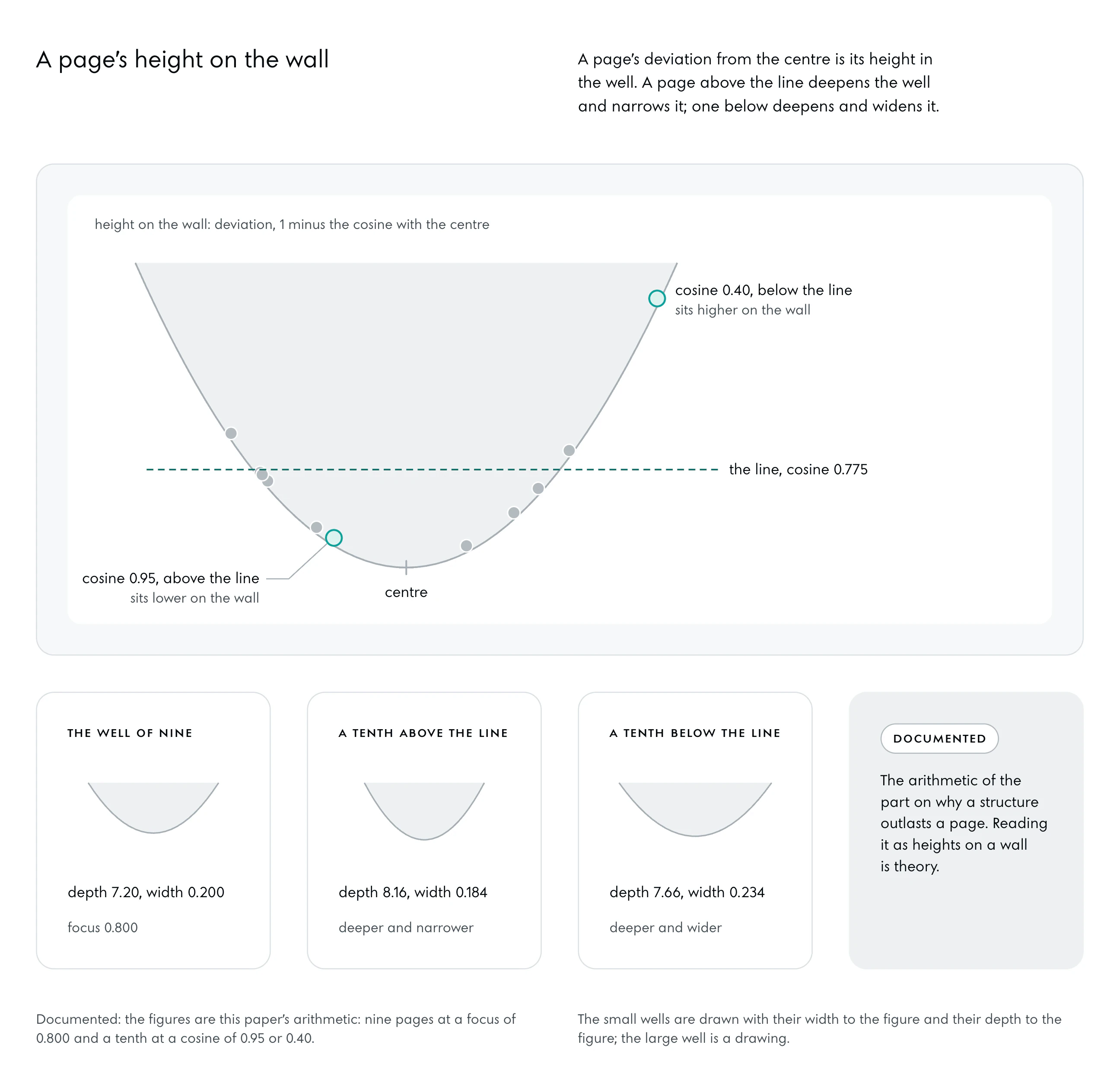
Uncommon Pages and Re-Told Ones
Text taken from other sources and set in new words lands near where those sources land. An embedding model, as the part on a page as one point showed, usually places two texts on one subject close together whatever words they use, so the change of words named in Google’s spam policies under scraping, “Copying content from other sites, modify it only slightly (for example, by substituting synonyms or using automated techniques), and republish it”, leaves the new page at a cosine near 1 with the page it came from. In the well’s terms the copy stands low in another host’s well and holds no place of its own.
That step from the policy to the vectors is ours.
What an engine does with pages that come out alike is set down in Google’s pages on canonical addresses. The page on canonicalization, updated on 20 August 2026, says that “If Google finds multiple pages that seem to be the same or the primary content very similar, it clusters them together.” One of the group is then chosen as “objectively the most complete and useful for search users” and marked as the canonical, and “duplicates are crawled less frequently in order to reduce the crawling load on sites.” Its companion on consolidating duplicate addresses, updated on 10 July 2026, gives the test, that Google “will decide which pages (if any) are duplicates, based on similarity of content”, and says what a stated canonical gathers, letting engines “consolidate the signals they have for the individual URLs (such as links to them) into a single, preferred URL.” Across the results of one search, the ranking guide’s entry on deduplication makes the same kind of choice at the last step, where “our systems show only the most relevant results to avoid unhelpful duplication”. All of it is documented, as Google’s word.
Duplication is handled by choosing, and Google’s page on canonicalization says so in as many words, “Some duplicate content on a site is normal and it’s not a violation of Google’s spam policies.” So a folded page has broken no rule; it has only lost its place in the results to the page chosen. That choice is the step the part on the costs of reading a site found in the verb consolidated, named here from Google’s side.
Everything else this needs is already in the paper. By the line quoted under Google’s Account for News, original reporting is put ahead of the pages that only cite it, and the scaled content of Purpose and Value in Policy is unoriginal content made in volume. Google’s page on helpful content, quoted there for its question on original information, puts the re-told page to its owner as a question of its own, “If the content draws on other sources, does it avoid simply copying or rewriting those sources, and instead provide substantial additional value and originality?” In its version of 5 October 2026 the same page lists what its raters are trained to judge in a page’s main content, and originality is among them, “The extent to which the content offers unique, original information or perspectives that aren’t already available on other websites.”
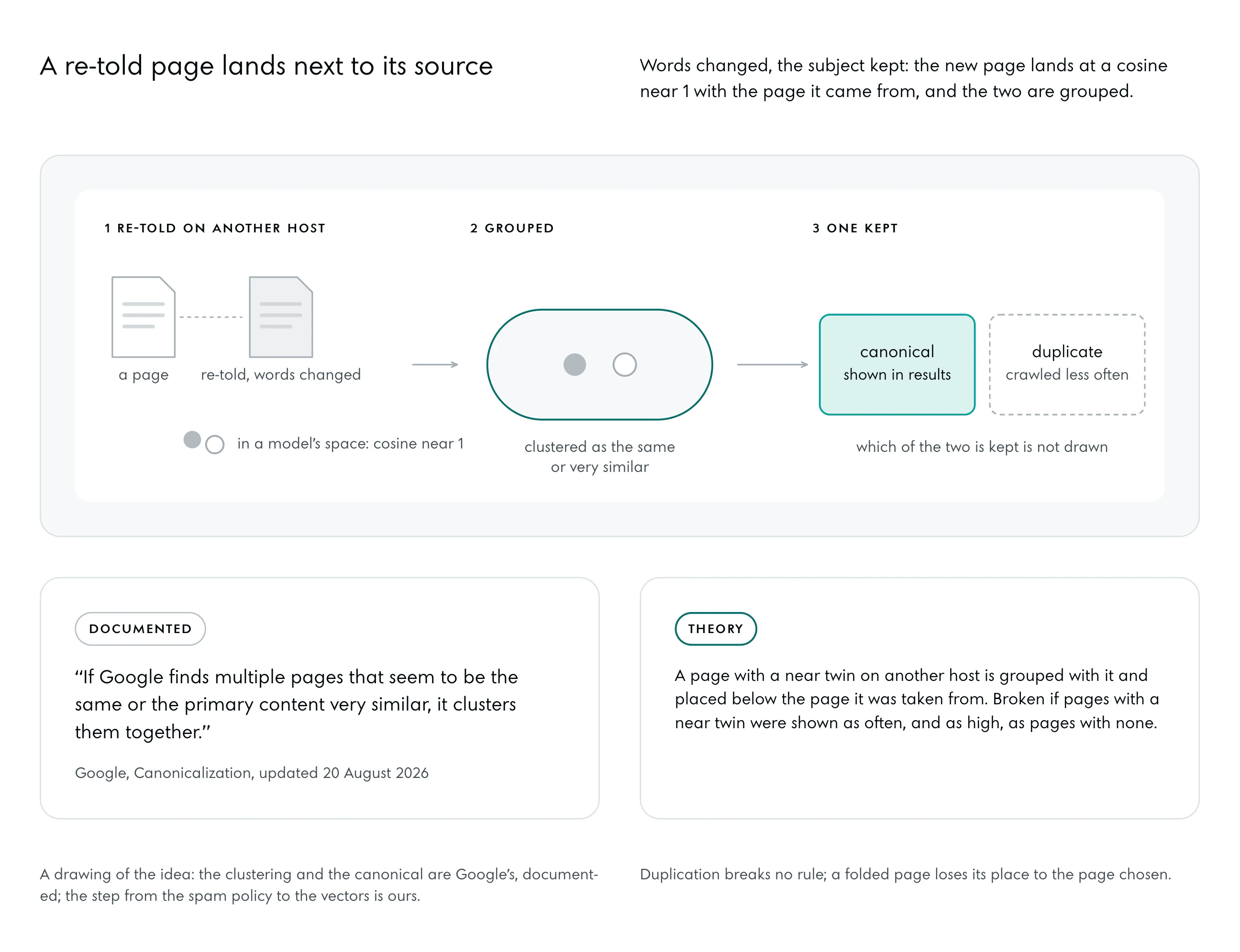
The founder reads uniqueness in combinations of words. On his account a page that holds a combination no other page holds is the one an engine keeps, and text re-told from other sources repeats combinations that its sources already hold, so an engine takes it for a duplicate and sets it below them. What such combinations do inside a model, and how uncommon a string of words is to it, are questions at the size of a term; the first paper measured one open model’s surprise at each mention of a term on the studio’s term pages, in its section What Reading a Name Costs, and it is not measured again here.
His account is theory, and at the size of a site it becomes two distances for each page. One is the deviation, its distance from its own site’s centre, which a mesh keeps small. The other is the distance to the nearest page on another host, which a page that earns its place keeps large.
A page with both stands low in its own well and alone at its spot in the space, where a re-told page stands low in somebody else’s.
We hold as theory that a page whose nearest page on another host sits at a cosine near 1 is grouped with that page and placed below the page it was taken from, and that a page with no near twin elsewhere is the one kept, shown and cited. An owner can test it with an open model, setting each of a site’s pages against the pages of other hosts that stand in the results for its searches. It would be broken if pages with a near twin on another host were shown as often, and as high, as pages with none.
Position in the Mirror
Searches are placed as points too, in the same space as the pages that answer them. Ranking is done page by page, by the guide quoted in the first part, so a site’s place for a search is the place of its best page for it, and retrieval, as the part on citations from outside showed, takes first the passages that lie nearest to what was asked. A search near the centre of a site has many of its pages close by, where the well is deep.
One far out meets a single page high on the wall, or none.
The definition reads the slope twice, and at this size both readings belong to one site. Its descent is the site’s tokens, page by page, settling towards their centre as more pages sit close. In its mirror the site’s position climbs for the searches near that centre.
We hold, as theory, that a site’s best position for a search rises as the search lies nearer the site’s centre and as the well there grows deeper, and that it falls as the search moves out to ground where the wells of other sites are deeper. The part on new domains holds a case that fits the second half, since the same build was shown far less where large old sites already held the subject, which in these terms is a well dug where others were already deep.
Any owner can make the test. Each search a site is shown for, with the average position its engine reports, is embedded with the same open model as the pages, and its cosine with the site’s centre is set beside its position. The claim would be broken if, across the searches of one site under one model, position showed no relation to that cosine, or the reverse of the one held here.
Where this paper’s own term stood in the days it was written is given in the closing part, Testing and Validation, and is not read here.
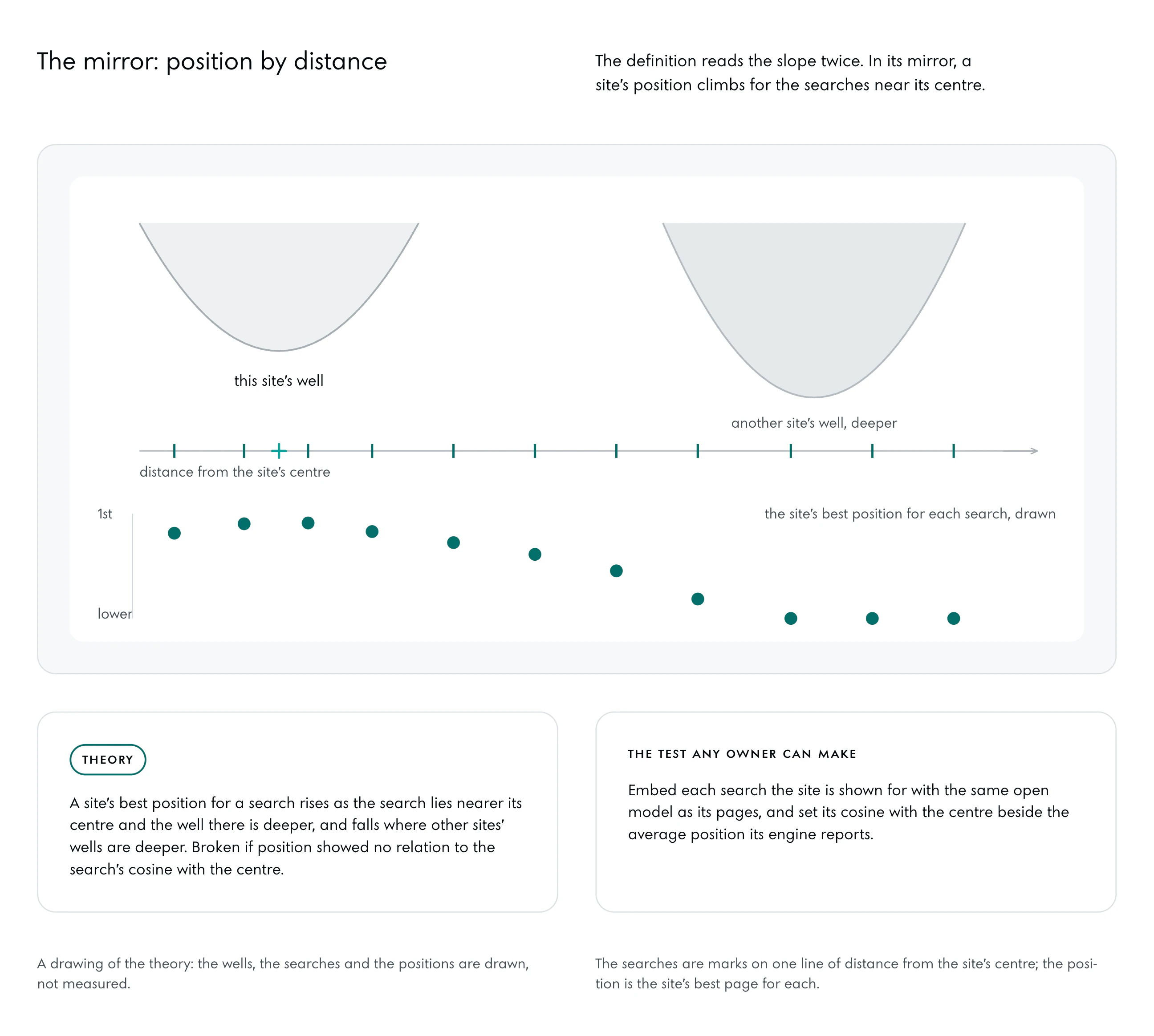
At this size the slope that others write is the third clause of the mesh, citations on the subject from other sites, and authority is where two slopes agree, the firm’s own and the one others write. What the mirror names is a position in a list of results. The pull that a firm’s defined words have on AI answers keeps its own name, Answer Gravity, set apart in the part on why a structure outlasts a page, and nothing here is folded into it.
12Steps to Build and Measure One
Open tools are enough for everything set out below, and no figure is needed that an engine would have to hand over.
A mesh is made in an order that the parts of this paper have already argued for, and it is checked with open models and an open library for graphs. What comes out is a handful of figures that belong to one site and one model, and they are never compared with another site’s.
Order of the Build
Six acts go into one, and each of them was argued in a part of its own.
- The subject and its terms come first, each term with one spelling and one page that defines it, which is the first paper’s Term Map carried over as it stands.
- One page for each part follows, complete and alone on its ground, so that no two pages of the site answer the same question.
- Links where meanings meet are written into the text, with the term as the anchor wherever a page uses a term that has a page to itself.
- Shared nodes in the data are declared next, an identifier for each term and the two properties that point a page at it.
- Light markup keeps the text nearly bare, so that the words of a page, and little else, fill the window a model reads it through.
- A count before each new page closes the loop, the difference between that page and the body it is about to join, taken before anything is published.
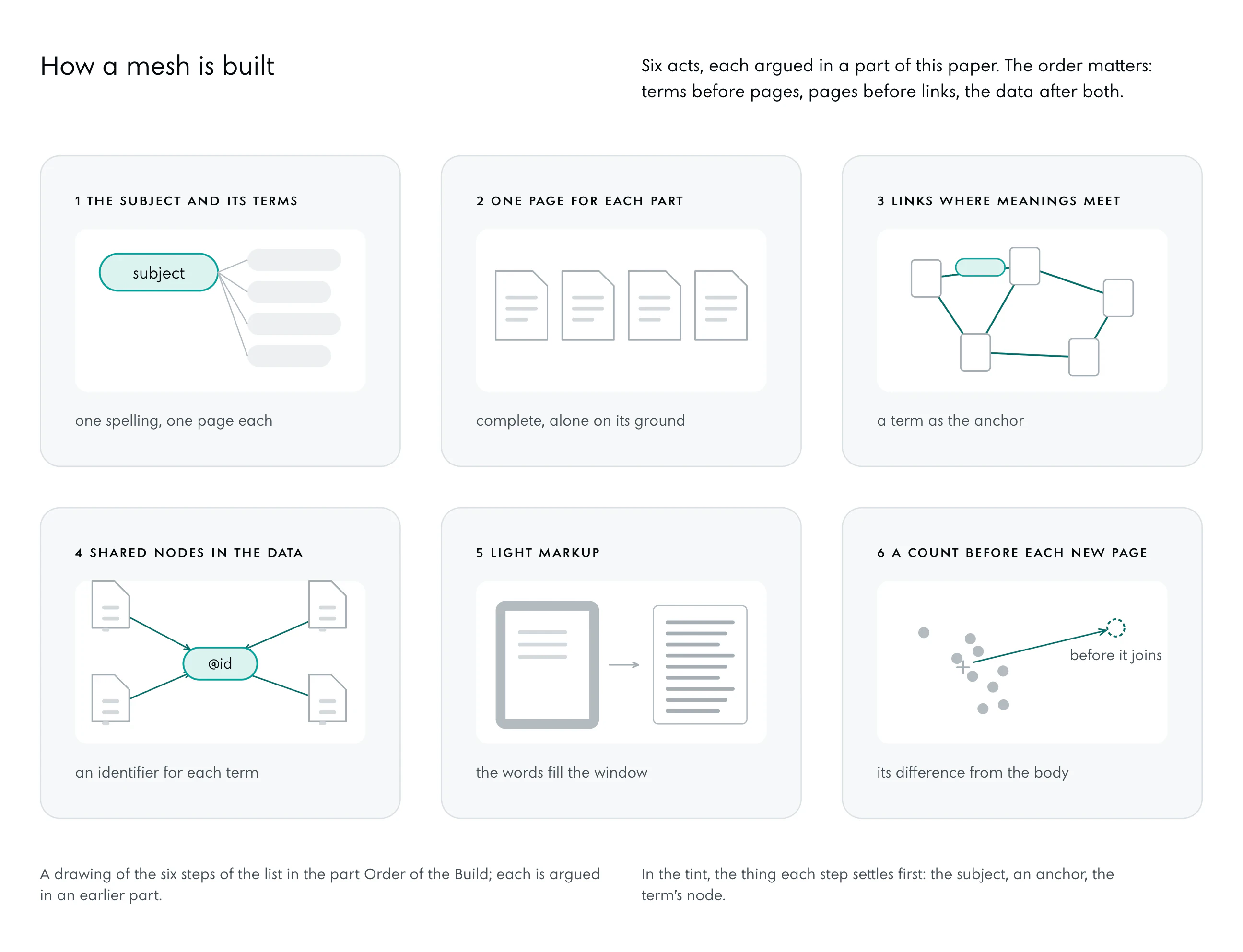
What the list adds to the parts is only the sequence, in which terms come before pages because a page is written entirely in them. Pages come before links, since a link needs two ends and its anchor needs a term; the data comes after both, as it declares what the text already does.
Embedding Every Page
To check the result, the text of each document is first turned into a vector by an open model. The two cards quoted in the part on the point will do, EmbeddingGemma with its 2,048 tokens and all-MiniLM-L6-v2 with its 256 word pieces, and the Sentence Transformers library loads either of them and compares vectors by cosine unless it is told otherwise, by its documentation. DEJAN’s open code and FlowHunt’s audit already do this work in public, and both were credited with the arithmetic, the first for embedding the words of each address and the second for embedding the content and printing the same pair of numbers.
Every figure then carries the choices that were made on the way to it, and the model is the first of them. Google’s documentation for its embedding models, updated on 9 October 2026, shows plainly how much hangs on that choice, “The embedding spaces between gemini-embedding-001 and gemini-embedding-2 are incompatible.”
Vectors from two models of one maker cannot be compared, so the figures from two tools cannot be either. A figure is always quoted with its model. The text that went in is the second choice.
And the unit is the last, a page or its passages.
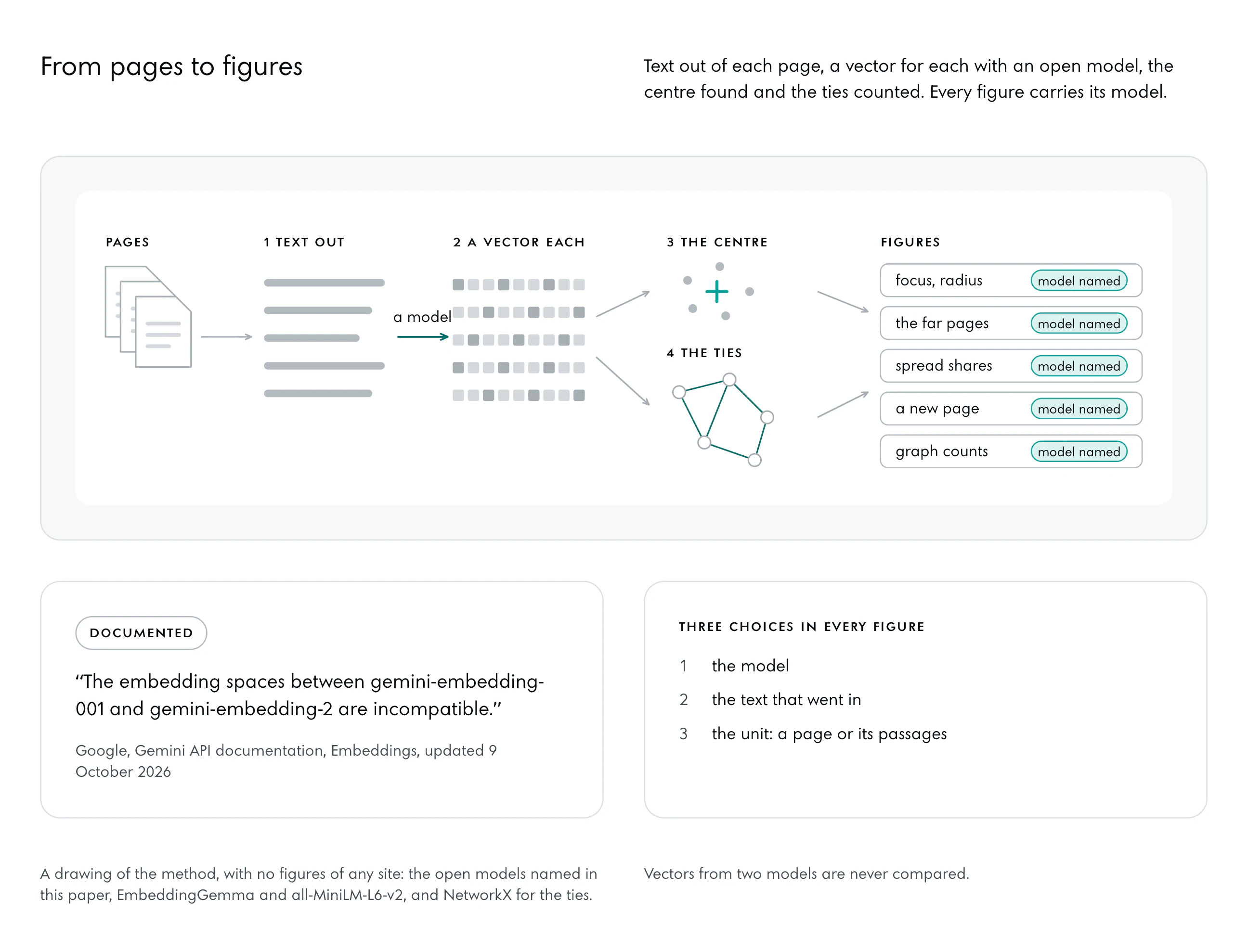
Numbers Taken for the Site
Five figures come out of the vectors, and all of them were defined above. Focus is the length of the mean vector, with the radius as what is left of 1. The largest deviation names the page that sits furthest out and brings with it the short list of far pages to open.
Along the first directions, the shares of spread tell whether the body is flat or thick. And for a page not yet published there is its cosine with the centre, set against the line a little under the focus.
One more figure joins the vectors to the links, the mean cosine between pages that link to each other set against the mean cosine between pages that do not.
A flat map is drawn last, if at all; it is often useful for finding the far pages by eye, and it is no place to read a distance from, as the part on the centre said of every such map.
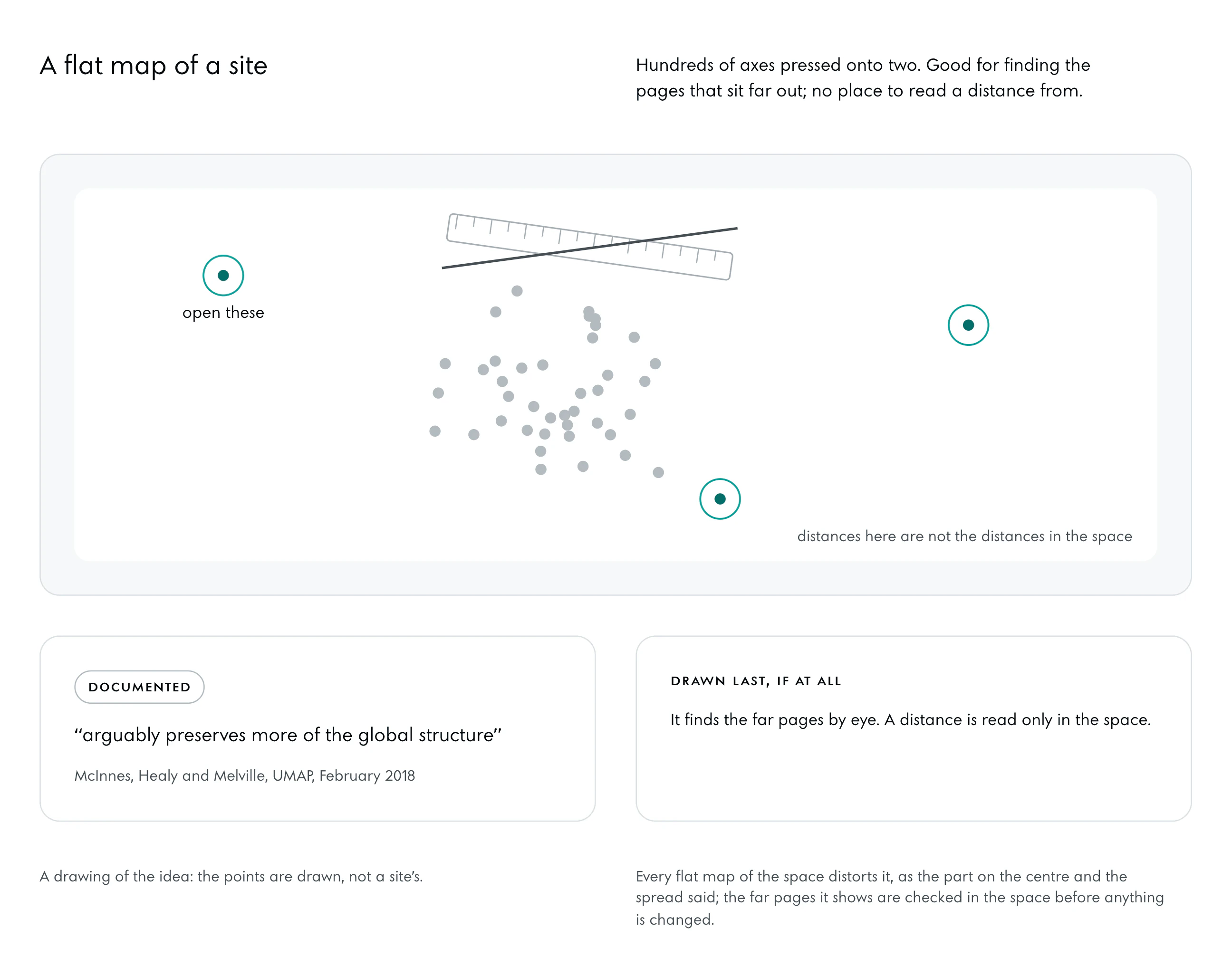
We give no target for any of these figures, since none of the sources opened gives one, and a figure is compared only with the same figure for the same site, under the same model, at an earlier date. Whether it rose or fell after a page was added is what the arithmetic of the delta had already said.
Graph Measures of the Ties
NetworkX, the library cited for components, does the other half of the audit, with the pages as its nodes and both kinds of join as its edges, counted as pairs in the way the studio counted them for its pages.
Four things are read from it. One body is the count to expect. The pairs for each page can be set beside Baran’s ratio, as a rough guide.
Ours came to 3.5. Betweenness finds the page that most paths cross, which is the page a mesh can least afford to lean on.
Last is the grouping that the ties make by themselves, and the usual method for it is the one that Vincent Blondel and three co-authors published in March 2008, “We propose a simple method to extract the community structure of large networks. Our method is a heuristic method that is based on modularity optimization.” Those groups can then be laid over the groups that the vectors make. Where the two agree, the links of the site follow its meaning, which is what Davison found of the web at large; where they part, either a link is probably missing between pages that belong together or a link joins pages that do not.
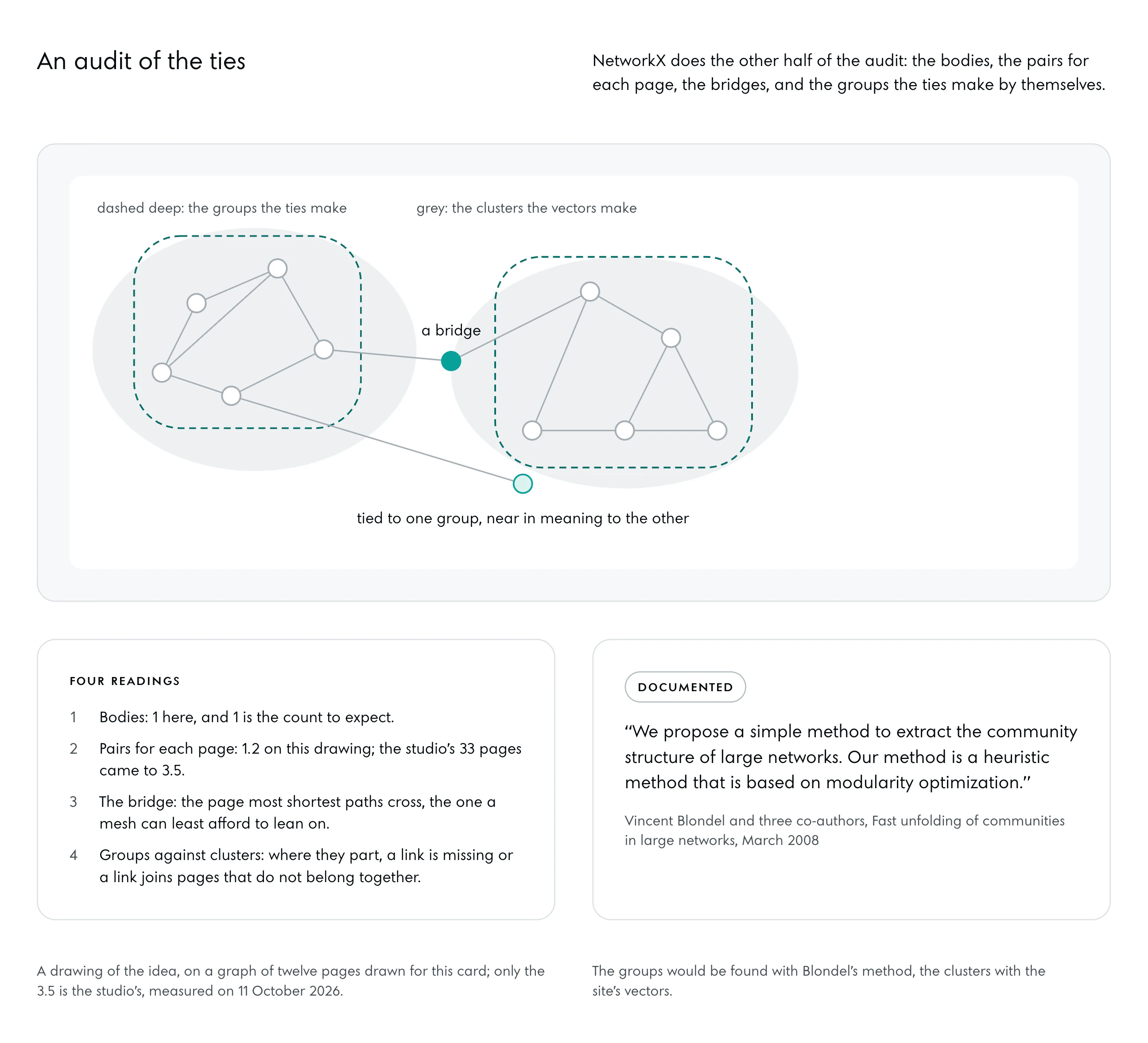
13Earlier Names Beside This One
Nearest to the studio’s term stand two phrases of the trade, near enough to be taken for it, and a third comes from the studio.
Each of them was there first, and each is credited below from the page that carries it. What the term adds to them is only a body that anyone with the pages can compute.
Topical Mesh and Topical Authority
Laurent Bourrelly put the noun to work on a site’s content years before the studio reached for it, as the opening part said, and his page presents the method as “designed to create a strong Semantic SEO foundation” and dates the craft from 2012. A method of that kind usually tells an owner what to write and how to join it. We share the noun with him and claim nothing of the method.
Our term names what stands on the site once such work is done. Somebody who never saw the plan can still count it. The second phrase has travelled further, and Koray Tuğberk Gübür’s case study for Oncrawl, dated 11 February 2021, carries it in the title next to semantic SEO and holds a forecast, “Topical Authority and Semantic SEO will be discussed more frequently with the concept of Structured Search Engine in the coming years.” In the trade the phrase most often names a standing, which is what a practitioner hopes a site will be granted, and Google’s published account of it, which covers news, was quoted in the part on citations from outside.
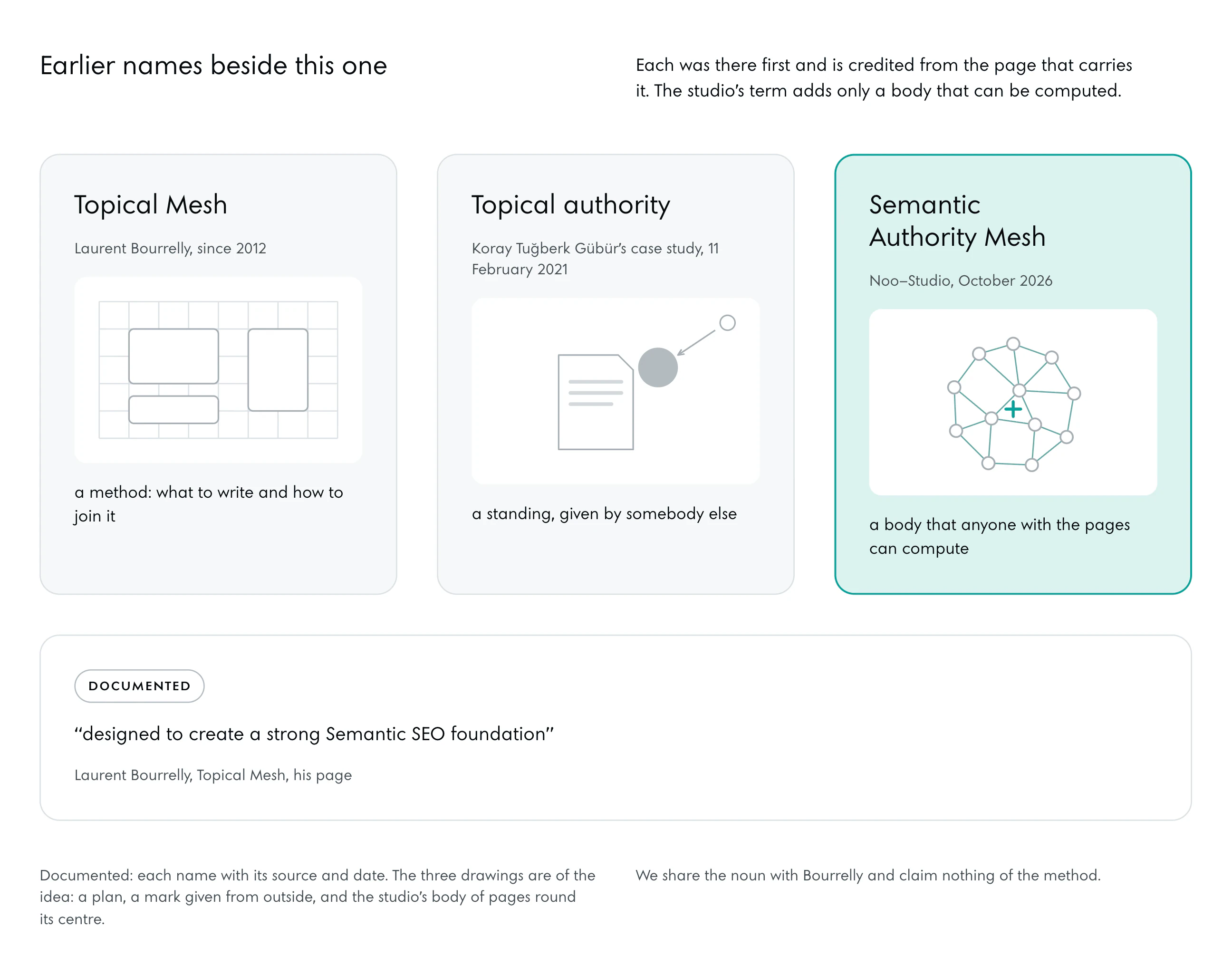
A standing is granted by somebody else, and a mesh is built. And the two words answer different questions about one site. Authority in the studio’s name keeps the sense that the opening part took from Kleinberg, a property computed from who points to whom.
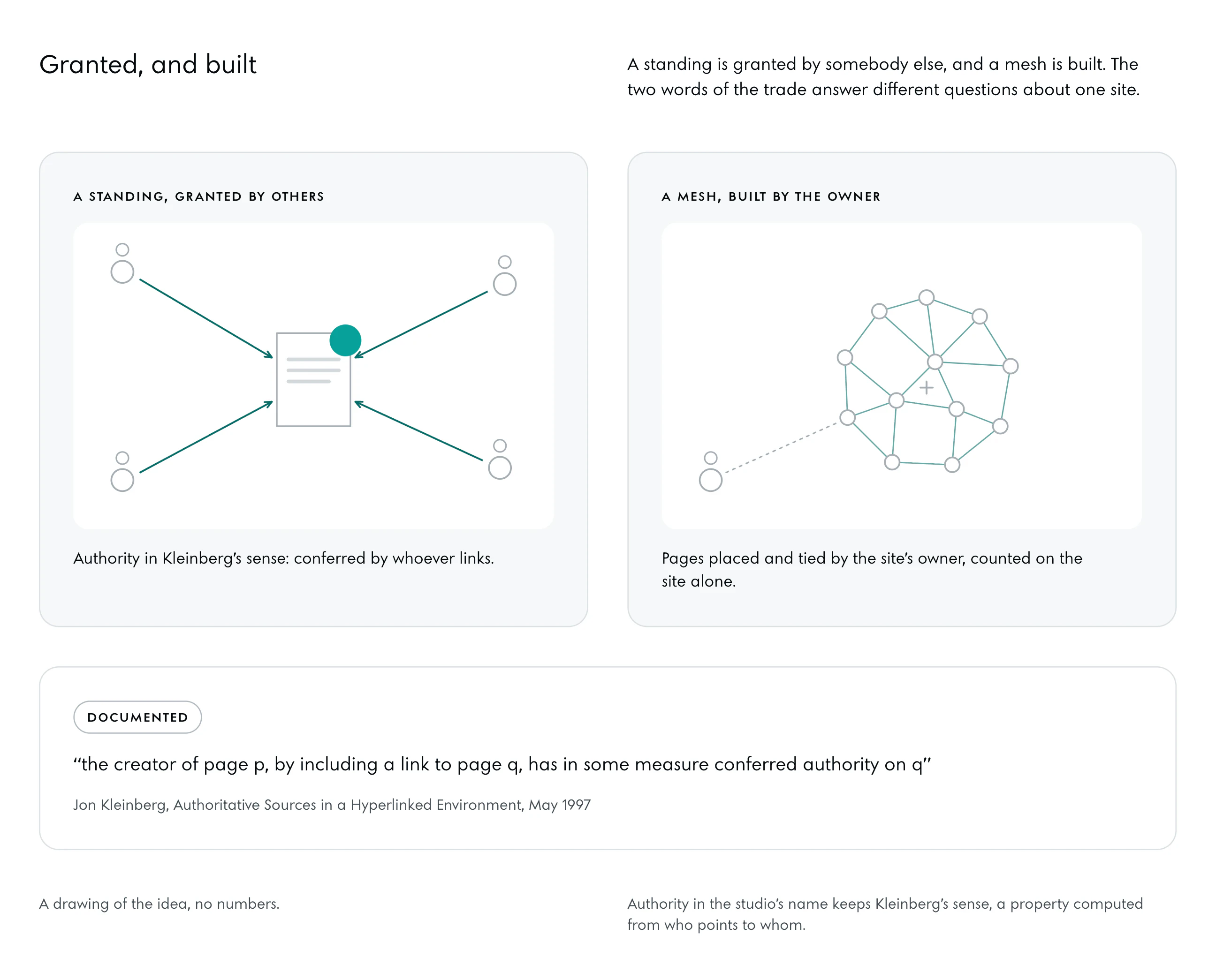
Effect Named Apart From Structure
Answer Gravity came before the mesh in the studio’s vocabulary, and its page defines it as “The pull a firm’s own words have on search engines and AI answers once each term it uses is defined on one page, used the same way by every piece, and linked back, so the machines place the firm at the centre of what those words mean.”
A pull is always seen from outside, in the pages that an answer cites and in where an engine places a firm among its neighbours, whereas four of a mesh’s five components are counted from inside, on the site’s pages alone, and only the fifth waits on anybody else.
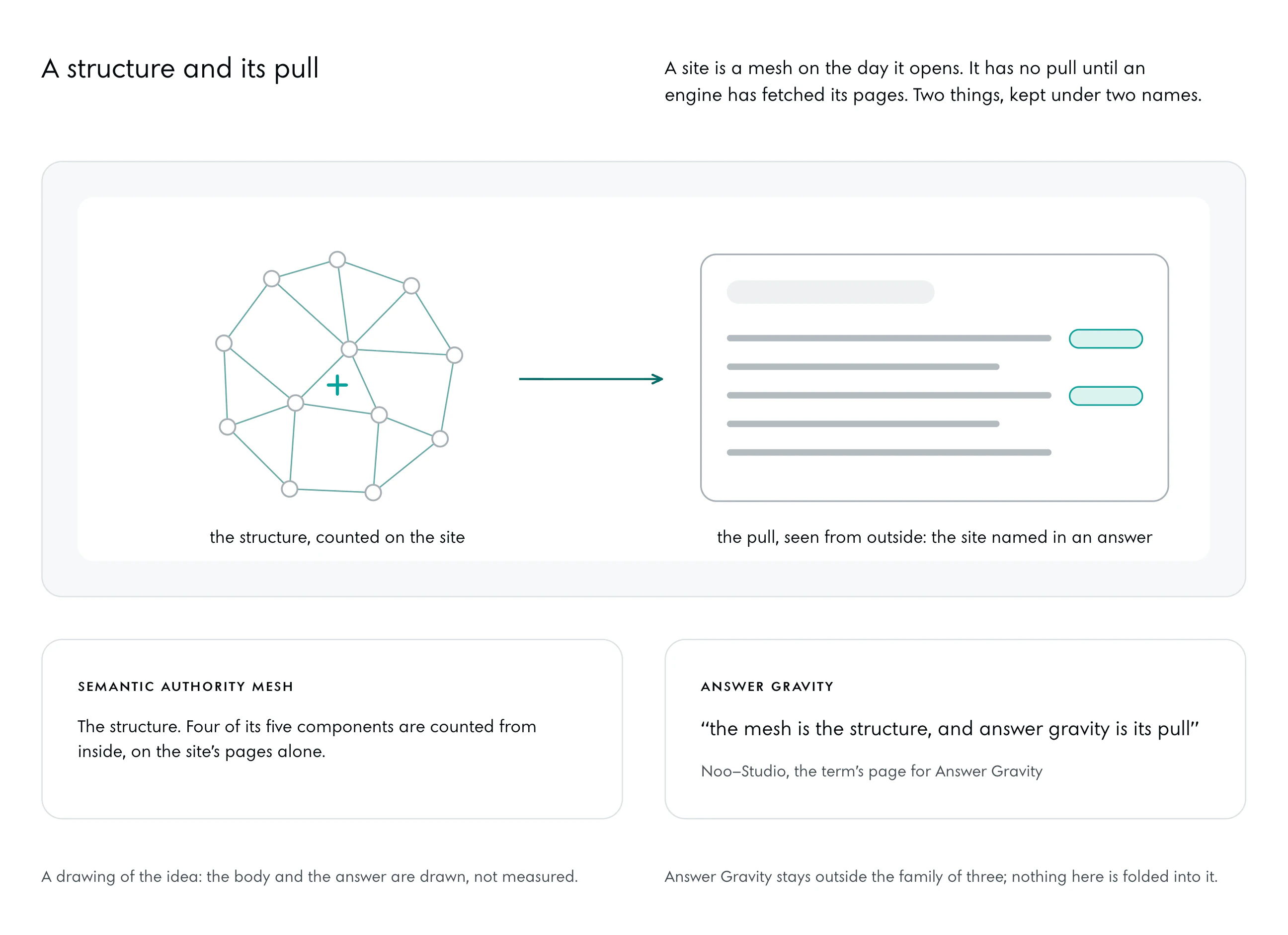
So the two can part company. A site is a mesh on the day it opens; it has no pull until an engine has fetched its pages. The fourteen new sites of an earlier part were in that state for a time.
We keep both names for that reason, one for what is built and one for what follows from it.
14Sources and What Stays Open
Quoted lines from outside the studio were seen on their pages on 11 October 2026, and those added for the part on the gradient, with the line kept from Bottou and Bengio, on 14 October 2026.
Each figure of the studio’s carries the day it was taken and the span it covers. What was left unmeasured is said in this part, once, and the documents are counted by kind.
Dates and Windows of Each Count
Poland time is the clock for every figure the studio took. A page that shows no date is cited without one, and it was read on 11 October 2026 unless this part names another day.
The ties among the studio’s pages were taken on 11 October 2026 from the 33 that stood published that day, ten papers and 23 term pages. They are a census, with no span to it. Figures for the fourteen new sites, and for the second set of six, were taken on 10 October 2026, and each row of Table 3 names the stretch of days that it covers.
The Directory’s figures were not taken again. They stand as the studio’s paper on the engines printed them, with the days given there. Two sets of numbers are neither of these; the body of nine pages at a focus of 0.800, with the depths and widths that the part on the gradient works from it, and the four sets of Table 2 are arithmetic on vectors made for the purpose, and they describe no site.
What we saw of short pages is labelled an observation; it carries no count, and its one figure, a page of about 12 kB, is the founder’s own.
The positions in the closing part were read by hand on 12 October 2026, between 05:33 and 05:41, and the rows of Search Console on 14 October 2026, between 12:07 and 12:08, for the days from 10 to 14 October. That report gave the term’s page a last crawl on 10 October 2026 at 12:24.
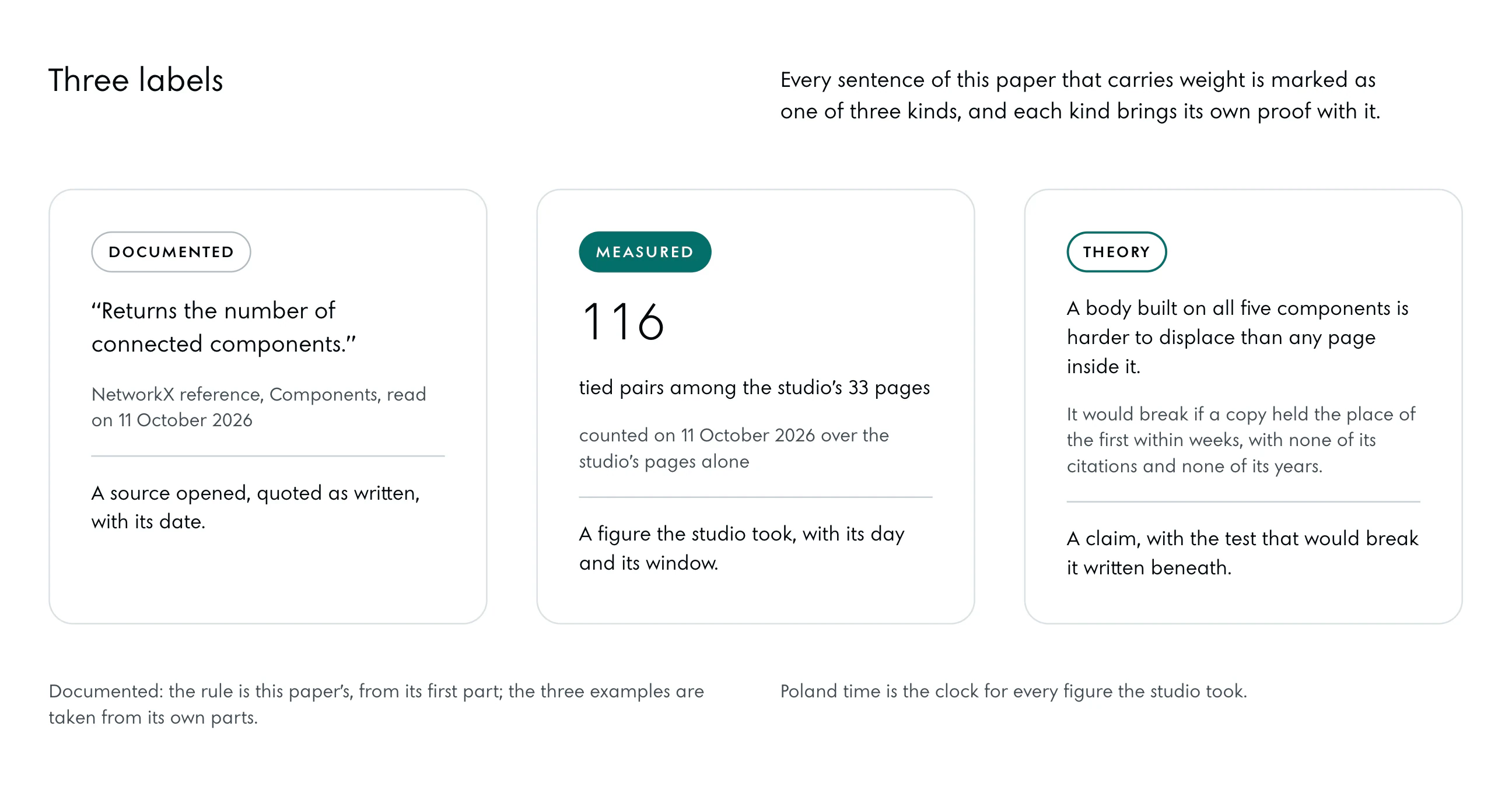
Two things are not measured, and they are said here once. We have not computed the focus and the radius of the studio’s new sites for this paper. So every such number above is arithmetic and nothing else.
Four weeks cannot tell where the new sites settle. The fall might deepen or the level after it might hold, and we do not know which. Whether the share of pages shown grows from 11 % is unknown as well.
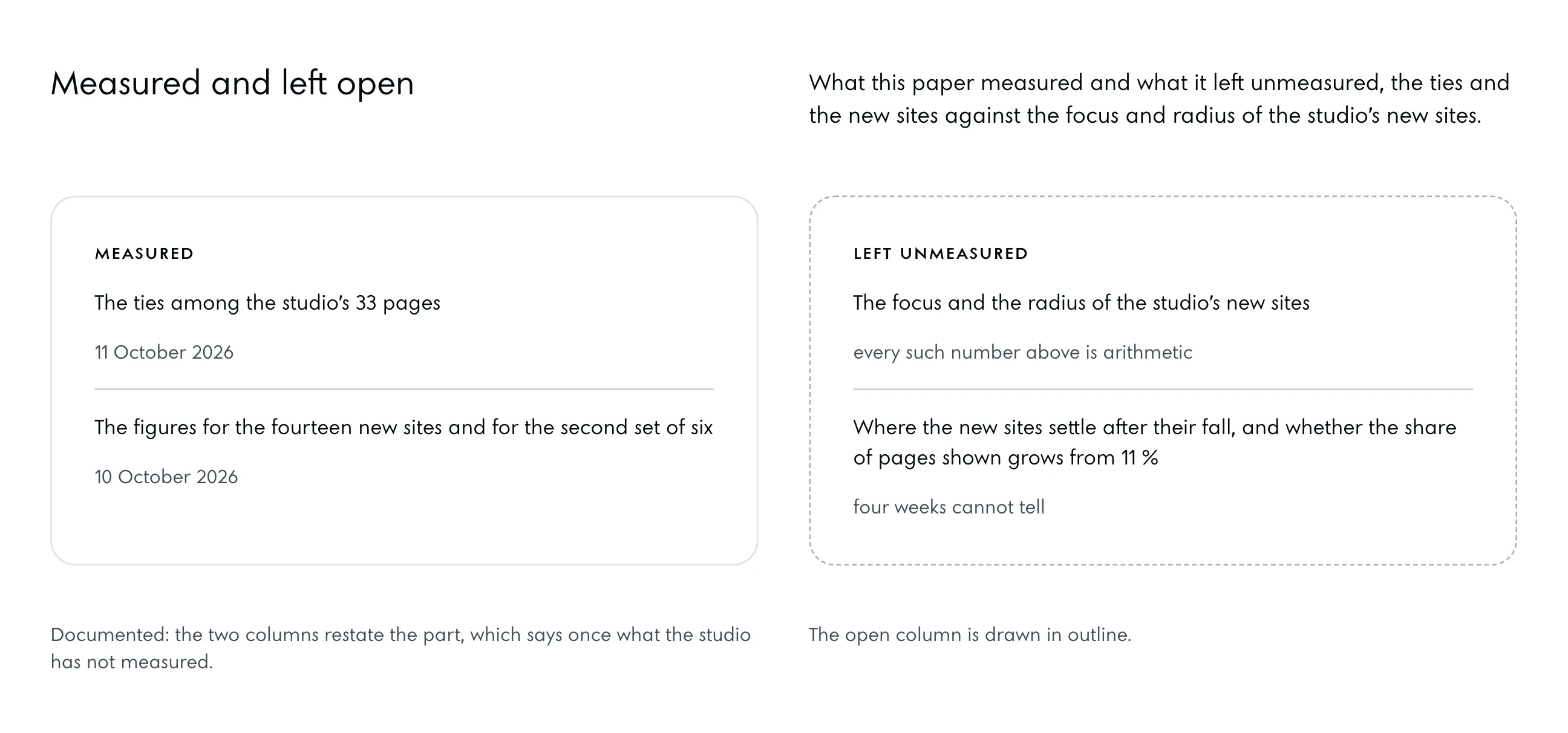
Each position marked as theory stands beside the test that would break it, and none of those tests has been made here. But two of them have no test that an outsider could make, the inference from the two stored numbers and the guess about hosts with no values. Both are plainly marked where they stand, with what would settle them.
Papers Opened and Pages Refused
Seventy-nine documents from outside the studio are cited, each at the place where its line is used.
Table 5 sorts them by kind and names the label that each kind is cited under.
| Kind of document | How many | Cited as |
|---|---|---|
| Research papers and reports, with one textbook | 35 | documented |
| Standards and reference pages | 7 | documented |
| Google’s and Bing’s published pages on search | 15 | documented, as the engine’s word |
| Google’s documentation for developers | 5 | documented |
| Manuals of open libraries and model cards | 8 | documented |
| Modules of the files that leaked in 2024 | 5 | stored fields, never weights |
| Pages and tools of the trade | 4 | credited by name |
Beside them stand eleven of the studio’s pages, seven that define a term and four papers, and they are cited as the studio’s word.
Some addresses gave nothing, and each of them is named here. Etymonline, Merriam-Webster, Collins and the Oxford English Dictionary served no entry for mesh, so the dictionary sense of the word is cited from Cambridge alone. Screaming Frog’s notes for its version 22 refused twice, and that tool is never cited.
At Cornell the file of the report by Salton and two co-authors did not come, so nothing is quoted beyond its abstract page. Kessler and Small are quoted from the abstracts in RePEc’s records, the publisher’s pages never having been tried. A paper of 2010 by Kohlschütter and two co-authors, on telling a page’s text from its boilerplate, was tried at six addresses and came from none of them, and the matter is carried by the two papers that did.
Two more were read and left out, web.dev’s page on the size of the DOM, which carries no date, and the Web Almanac’s chapter on markup, whose median measures something other than the weight at issue. The record of MacQueen’s paper of 1967 showed no text, so k-means is cited from the textbook and from Bottou and Bengio. One page came late, the help page for Search Console’s report on indexing, which would not open for a second reading on 11 October; it opened on 14 October, and both lines quoted from it stand on it.
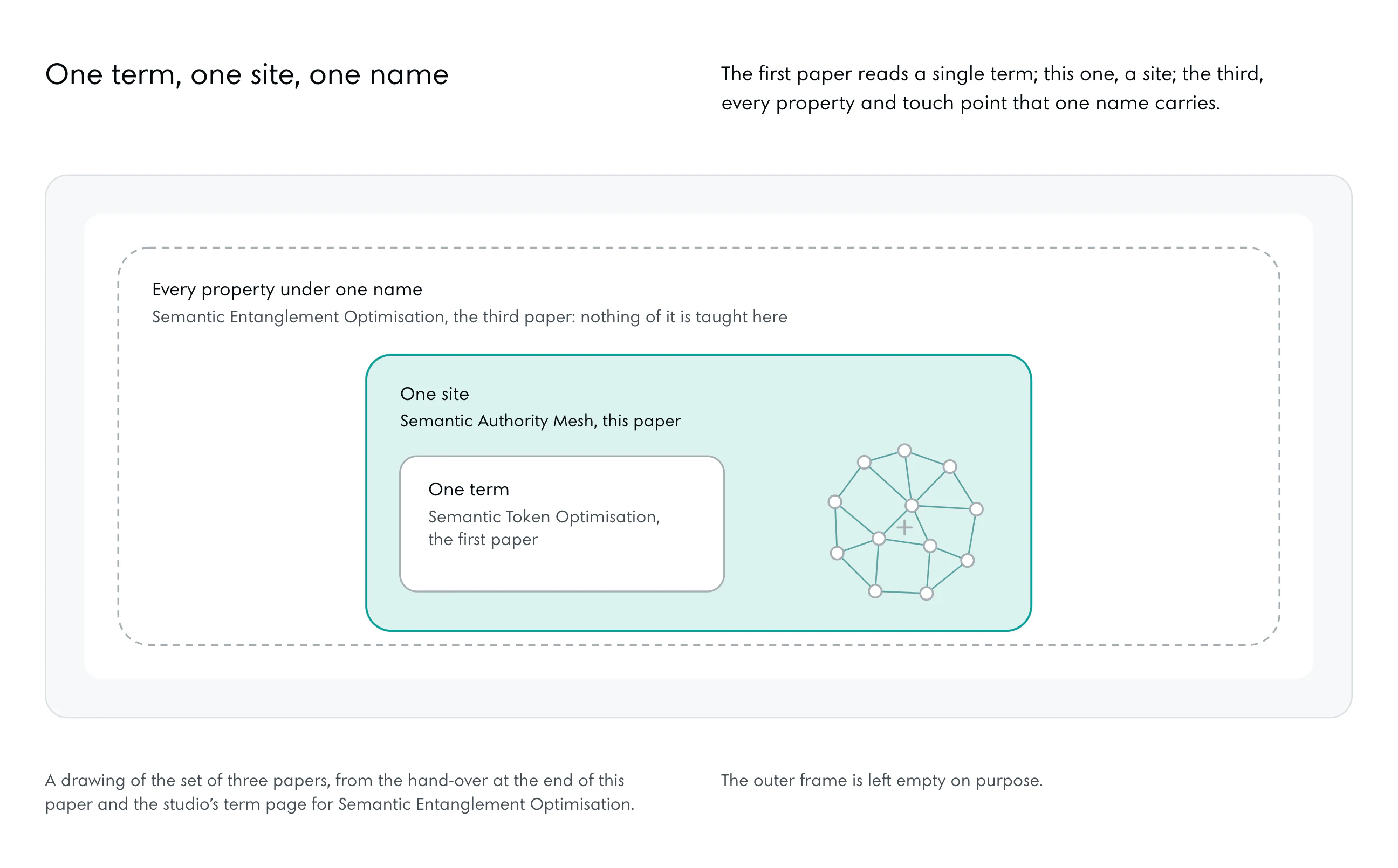
A site is the largest thing this paper describes, and for a client the studio builds such a body as part of System. What is said here of one site is taken up for several sites under one name in the third paper of the set, which describes every property and touch point that a name carries; its term is Semantic Entanglement Optimisation, and nothing of it is taught here.
15Testing and Validation
This part was written on 14 October 2026, while the page that defines the Semantic Authority Mesh was four days old and before this paper, or either of the two beside it, had been published.
By then two instruments had been read for the term, a search made by hand and Google’s own report for the site. They measure different things, and they are given apart. No figure below is an outcome; those wait for the dated readings at its end.
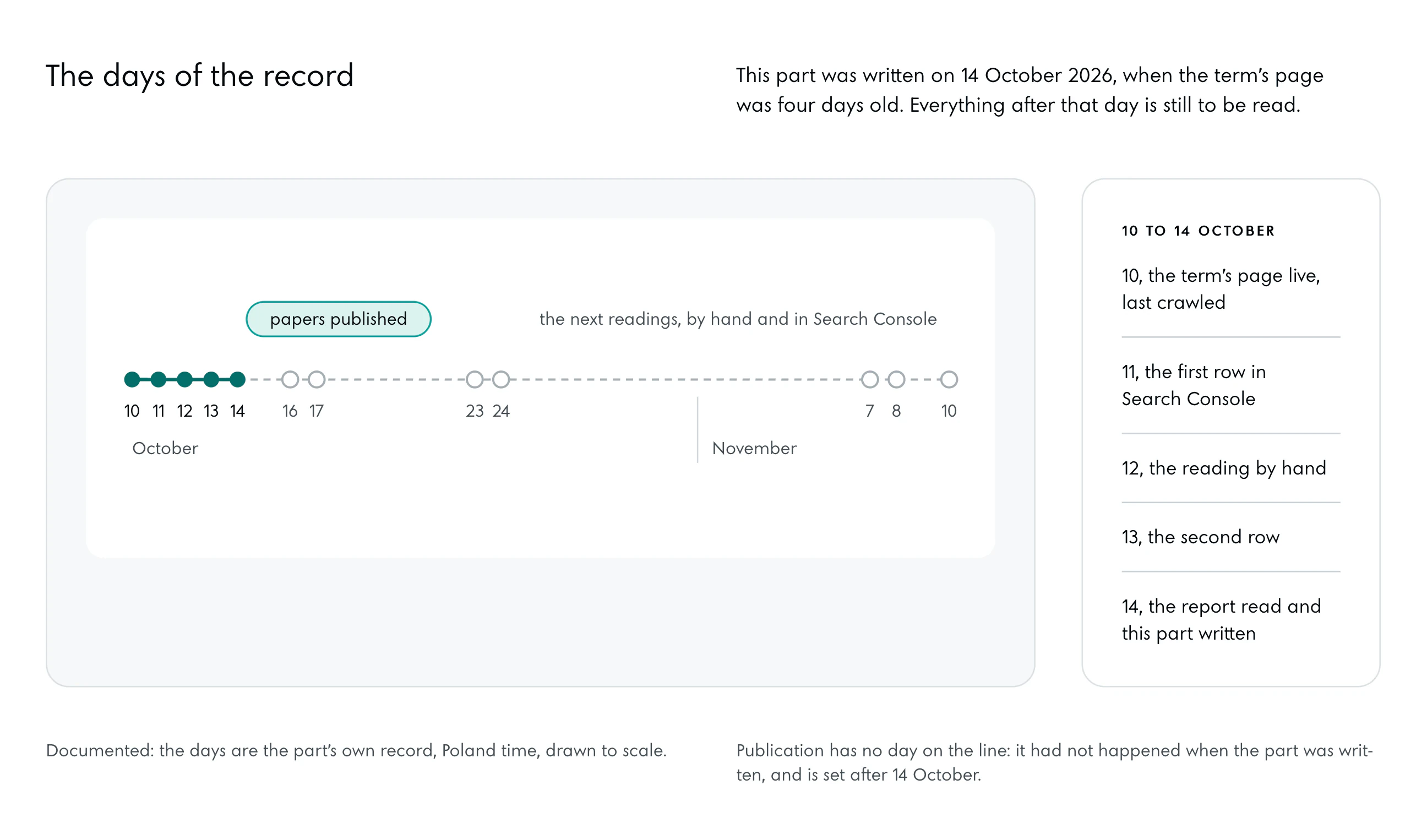
Positions Read by Hand
Each query of 12 October 2026 was made in a browser, one at a time, in English, with the country set to the United States and personalisation switched off, a setting the foot of every results page confirmed. A place was taken as the order of the studio’s first link among the titled links of the first page, so a video or another titled block counted as one link, and the second page was not read.
The full name brought the page up first, and so did its three words in another order. Its first and last words, semantic mesh, put it at the 11th link of the first page. Neither semantic authority nor authority mesh brought it onto that page, and nor did semantic search mesh, a neighbouring search with a fourth word set inside the term.
That last search moved with the market alone, for with personalisation still off and no country set the page stood first for it.
These places are measured, on one morning, for a page two days old. A coined name meets no rival pages, so first place for it shows that the page was found and little more; the shorter forms are where a reading starts to say something. Read through the mirror of the part on the gradient, the morning gave the shape that part expects at a single moment, the full name first and its shorter forms falling away where other sites hold the words.
A single reading shows a shape, and only the later ones can show it move.
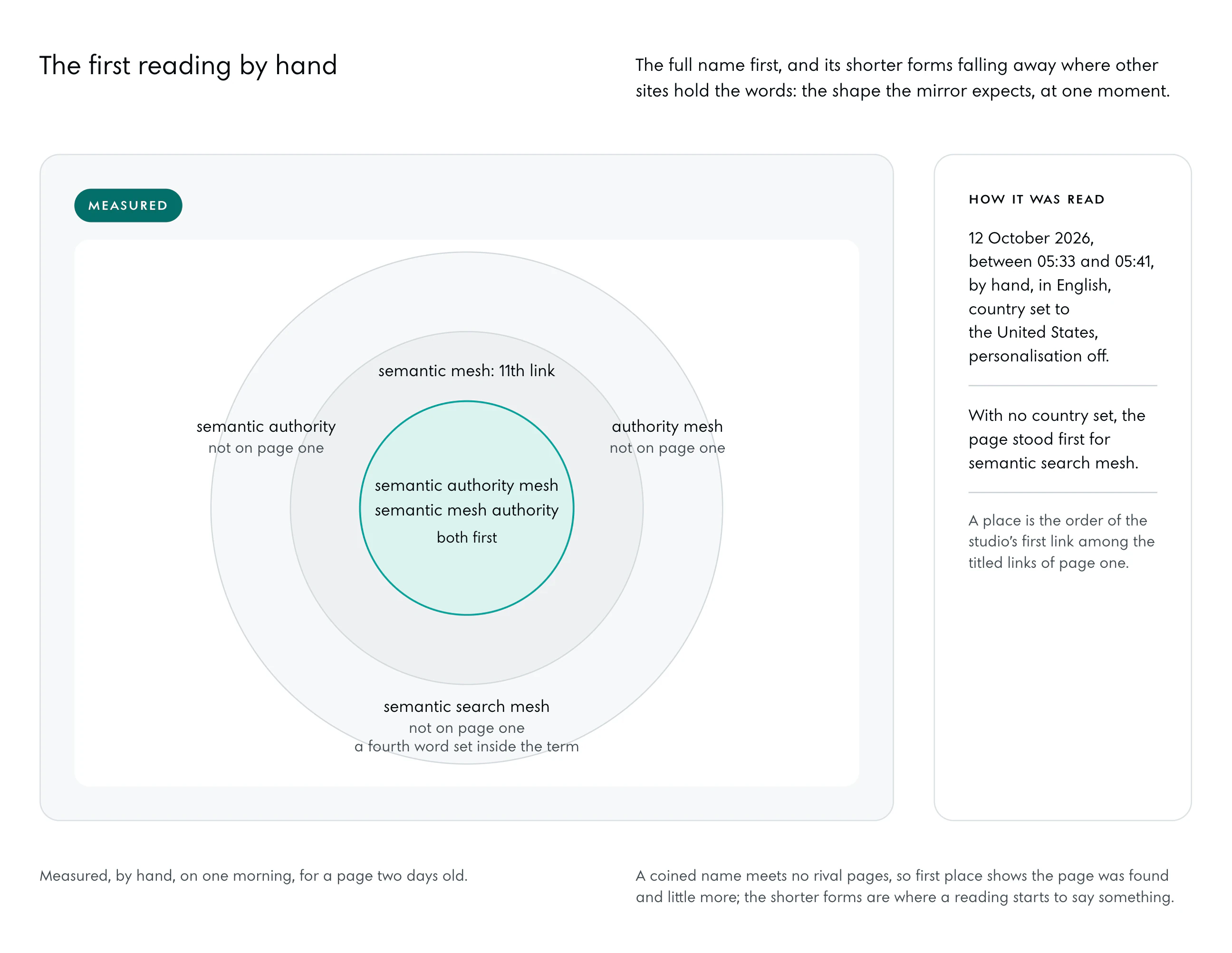
Rows in Search Console
Google’s own report for the site was read on 14 October 2026 for the days from 10 to 14 October, the last of them not yet complete. It lists the term’s page as “Submitted and indexed”, last crawled on 10 October 2026, with the canonical that Google chose the same as the one the page declares, which is the choice of the part on the gradient with nothing to fold. Two rows name a search for the page, both for semantic mesh, three impressions on 11 October at an average position of 5.3 and one on 13 October at position 1, with no click.
The rows for the other three term pages, and Google’s own line on the searches it holds back, stand in Table 5 of the third paper, in its section Index Status and First Rows, and they are not repeated here.
No search for the full name has a row yet, though the reading by hand found the page first for it, so searches that few are either not yet counted or held back. Four impressions support nothing and break nothing.
Search Console counts each day on its own clock, keeps back some searches, and averages a page’s position over everyone who made the search, wherever they were. A reading by hand is one search from one market at one moment, counted in titled links. So the 11th link of 12 October and the 5.3 of 11 October come from two instruments, and they are never added, averaged or read as one series.
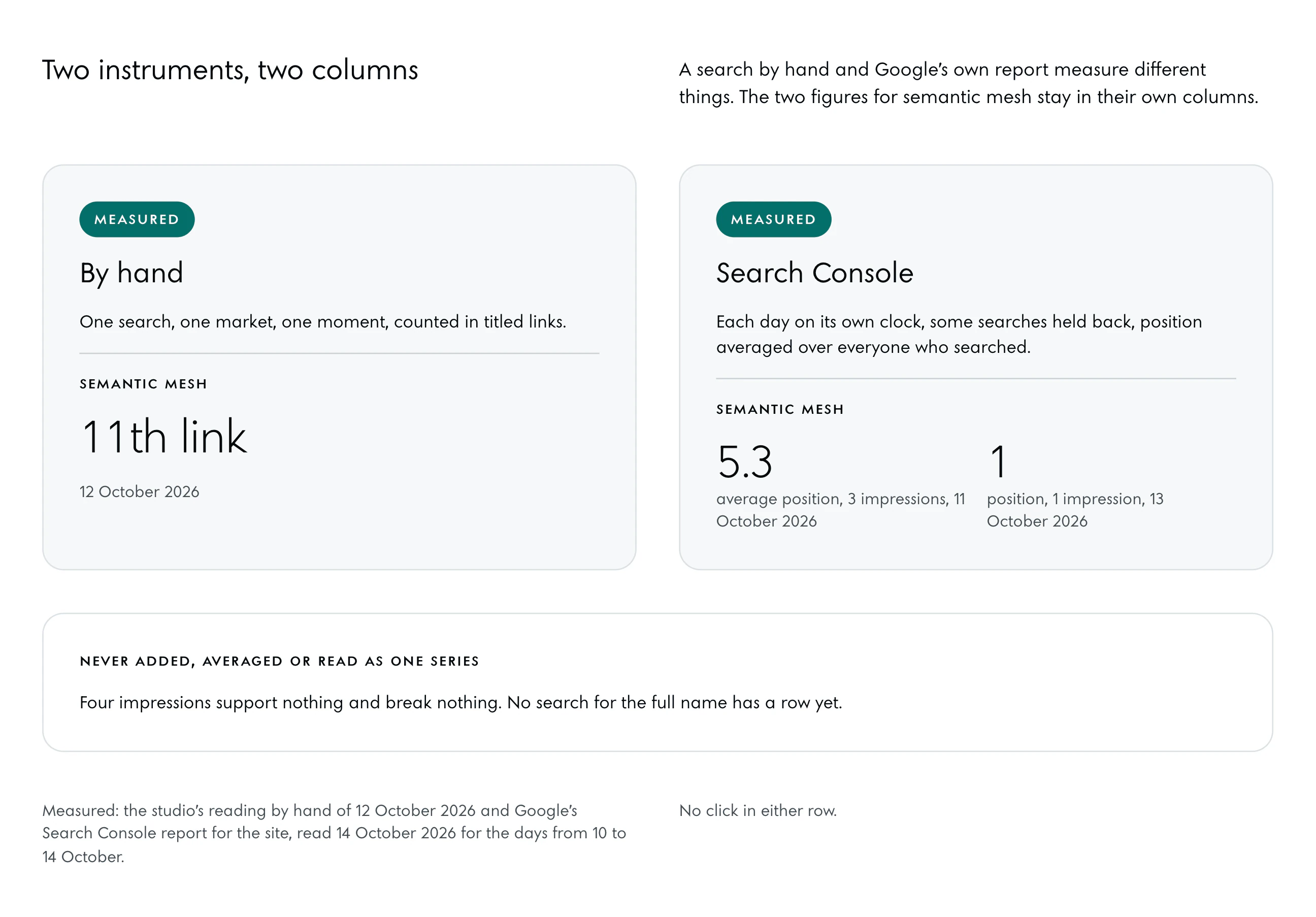
Shift Expected After Publication
Publishing the long papers moves the slope, in the founder’s account. From then on, as he sees it, the studio’s pages begin to be shown for the searches one level down, shorter and made by more people, while the full names keep first place. Read at the size of a site, this paper is a long page set on the centre of its term, and in the terms of the part on the gradient it deepens the well where the term sits; the climb he expects is the mirror of that.
This is theory, set down on 14 October 2026 before the event.
For this paper’s term, support would be semantic authority, authority mesh or semantic search mesh reaching the first page in the reading by hand, semantic mesh rising from its 11th link, and the full name keeping first place, at the readings of a week and of a month. In Search Console it would be rows for more of the shorter forms, and for the full name, read in their own columns. It breaks if none of those searches moves, or if the full name loses first place.
On 16, 17, 23 and 24 October and on 7, 8 and 10 November 2026 the same searches are read again in the same way, with Search Console’s rows under the same filters. The readings of 12 and 14 October stay as they are written here, and each later one is set beneath them.