
01Your Text as Numbered Pieces
On 11 October 2026 the title of this paper went through the tokenizer of Gemma 3, the open model Google publishes, and came back as a row of figures, 154,550, then 30,121, then 31,880, then 5,305.
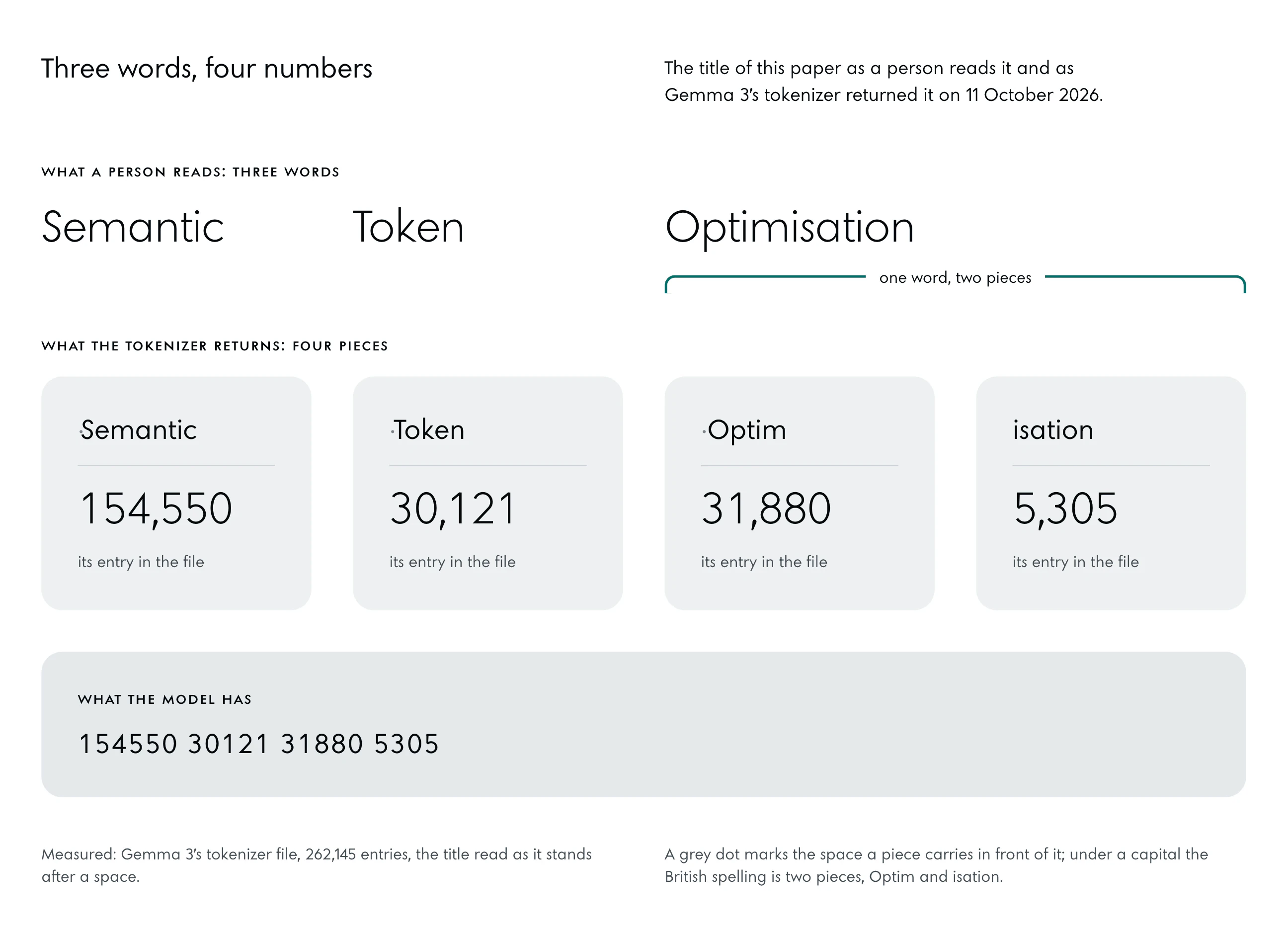
The run was made on a machine in the studio. That row is what the model has where a person sees three words. The same cut is made on your firm’s name and on the words for what you sell, each time a language model reads one of your pages, by whichever list that model was given.
What does your name come out as? How many figures, and are they the same ones on your home page as in your footer? Few owners have ever been shown the result.
Here we follow one sentence through that cut, give the question that the paper grew from, state its position in one paragraph and only then give it a name. We close on the labels that each later sentence carries, so that a published fact can be told from a measurement, and either of them from a theory, at a glance.
A Sentence Cut and Numbered
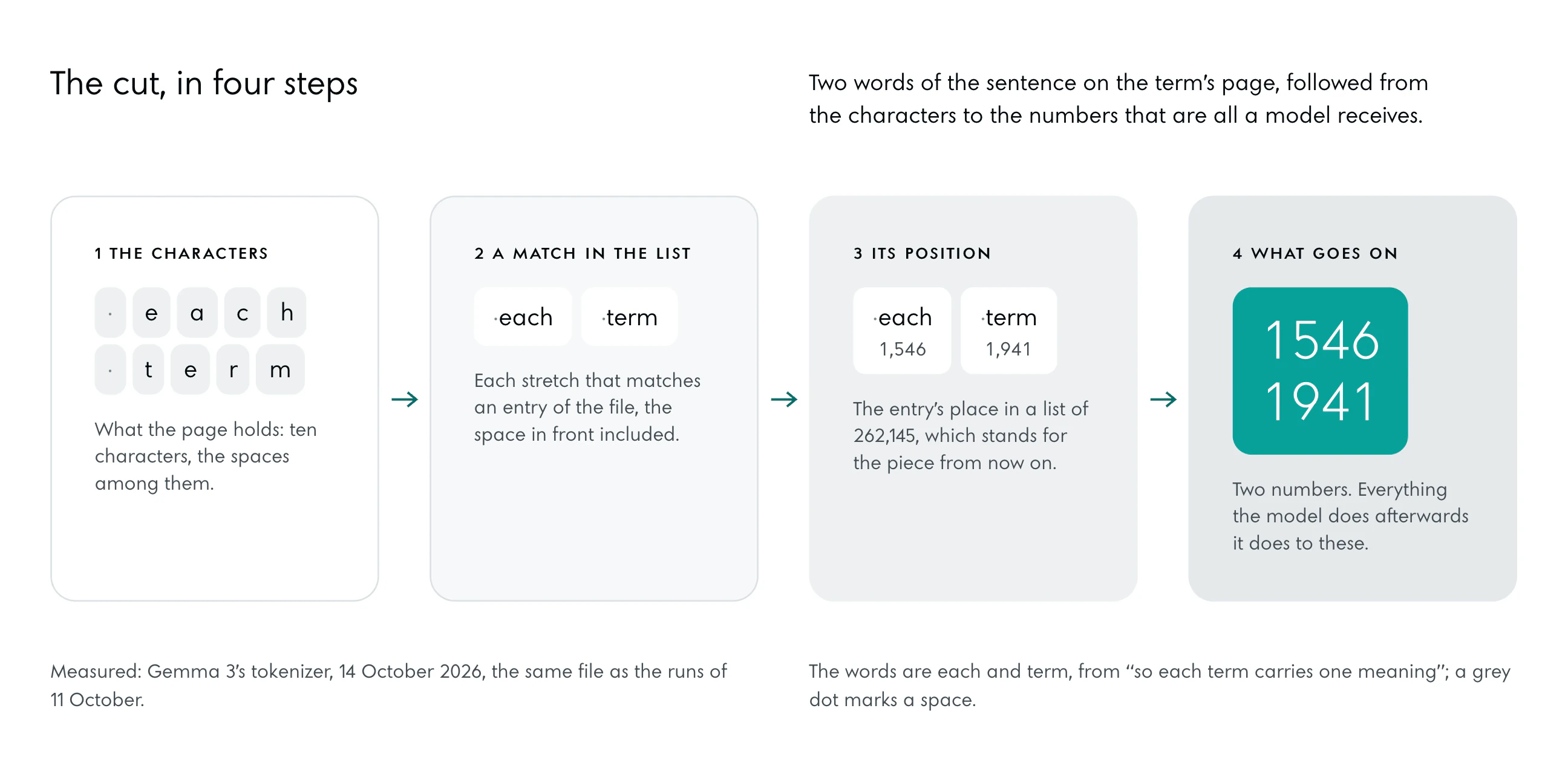
Take one line from a live page of noo-studio.com and follow it into the machine. It stands under the name of the term on its page, “Writing a site so each term carries one meaning on every page, for the models that read text as tokens.” A person meets it as 20 words with spaces between them, and on 11 October 2026 Gemma’s tokenizer returned 22 pieces for it. The tokenizer, the small program that stands at the front of each language model, meets the same characters and cuts them against a fixed list it was handed when the model was made.
Where a stretch of characters matches an entry in that list, the stretch becomes one piece, and the piece is replaced by the position of that entry in the list. What is left of the language after that first step is a row of numbers. Everything the model does afterwards it does to that row.
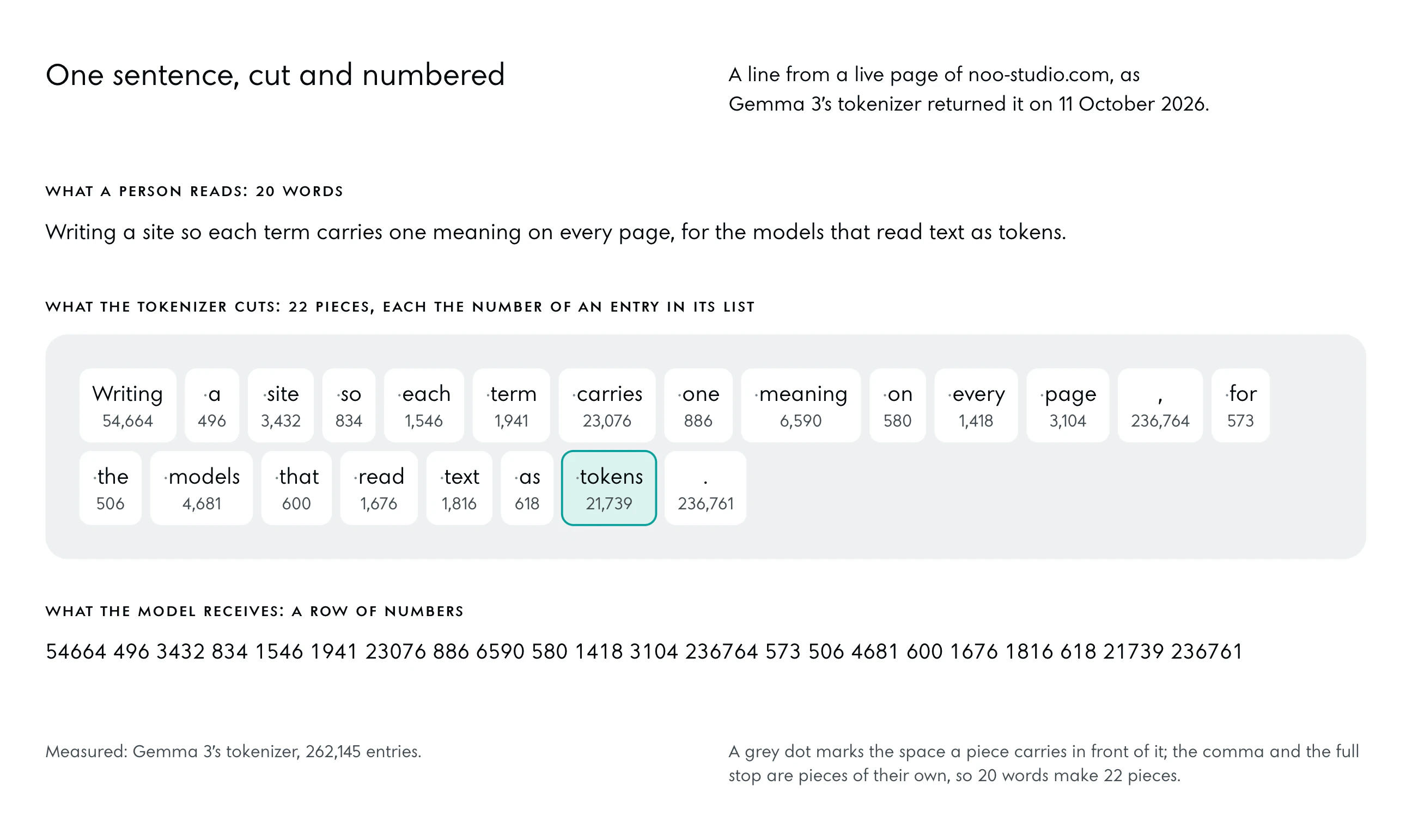
A piece of that kind is called a token. Common words tend to come out as one piece each. A rarer word comes out as two or more, and a capital letter, a hyphen, a plural or a different spelling can change which pieces a word becomes, which a later part of this paper measures on our names.
Would the writer of a page ever notice? Nothing shows there, and the page looks identical to its author whether the machine received three numbers or five, and that is probably a fair explanation of why the cut has gone unexamined for so long in a trade that examines everything else about a page.
All of that is settled; that text is cut into pieces from a fixed list is documented in the research that introduced the method and in Google’s report on the model that we ran, both opened in the next part. The four figures in the opening lines are measured. Any machine always returns the same figures from the same file, on any day.
The Day-Zero Thought
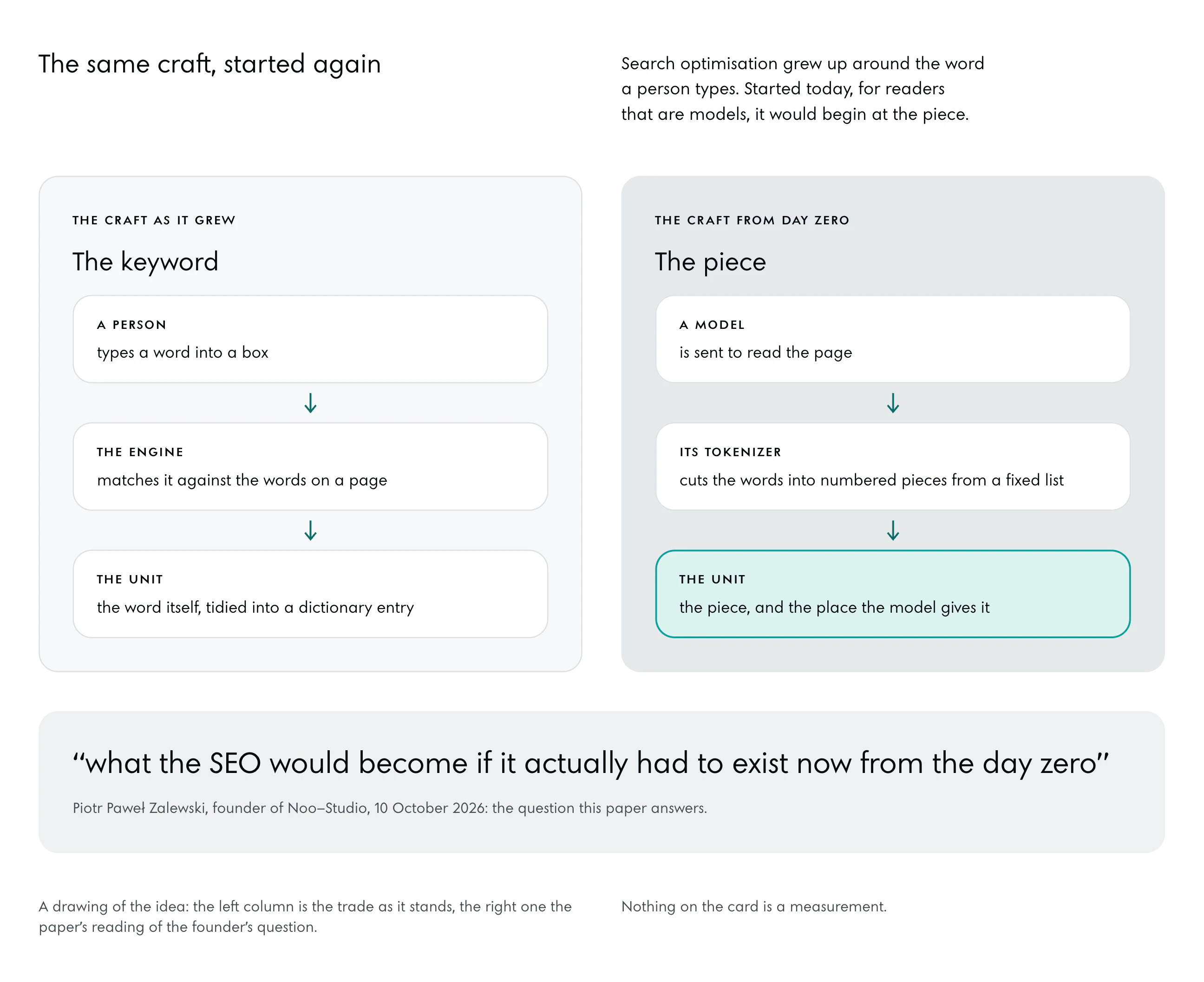
Search optimisation grew up around the keyword. A person types a word into a box, and the engine matches it against the words on a page. On 10 October 2026 our founder asked what becomes of that craft once the reader is a model, and he put it as a question about one fact, “knowing that the keyword turn into tokens”.
The words are kept as he dictated them. A few minutes later he gave the larger version, which is the one this paper answers, and asked, in his phrase, “what the SEO would become if it actually had to exist now from the day zero”.
Invented today, for readers that are models, the craft would begin at the piece. The piece is what those readers receive. Its first questions would be about the cut, how a firm’s words are divided and if they are divided the same way each time.
Next would come the question of where the pieces land. His summary of the ground ran to four words, “This is all math.” He also holds a view that this paper treats as his position and tests as theory, that of all that an engine weighs “the text is the core of the ranking, and still will be for a long time”.
The question has a commercial edge. Firms have paid for over two decades to have the right words placed on their pages. If the reader at the far end now takes those words apart before it does anything else with them, what exactly was placed?
And who, of the people that a firm pays, has checked?
The Claim and Its Name
Here is the position, stated once and plainly. A model reads a page as a sequence of numbered pieces, and it places each piece, and each run of pieces, at a location in a space of numbers where near locations hold near meanings. Any term that a firm coins, or an ordinary word that a firm uses in a sense it has chosen, is missing from its list, so for the model the term exists as an exact sequence of pieces and as the company that sequence keeps on the pages where it appears.
So a firm that writes each of its terms one way, gives each one meaning, defines each on one page and repeats the same names in its structured data hands the model one thing to place. A firm that writes one term several ways hands over as many sequences and leaves the model to work out that they are one. The first firm’s terms are probably easier to place and easier to tie to the firm that defined them.
That final sentence is theory. The sentences before it are documented or measured, and the parts below say which is which.
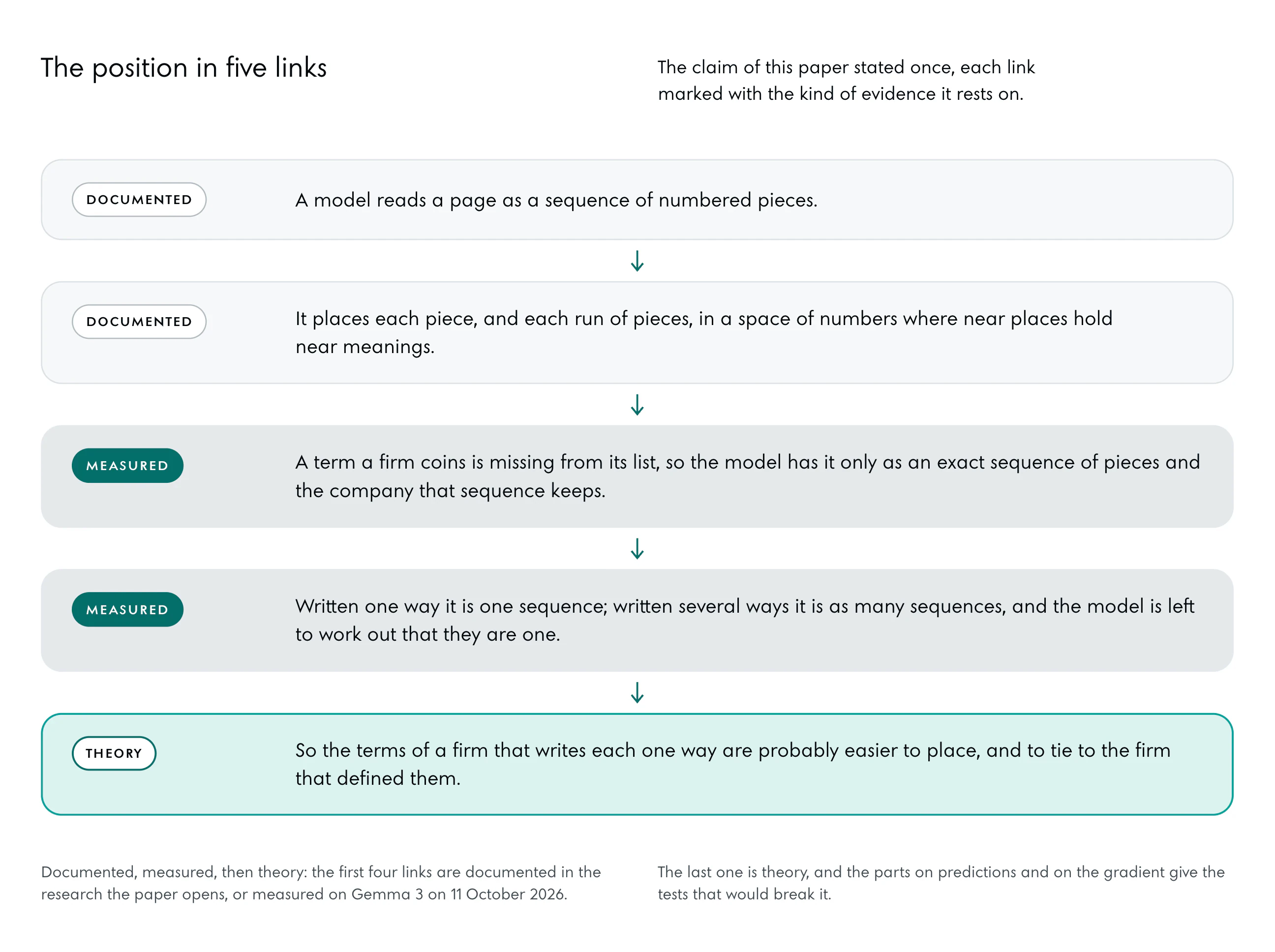
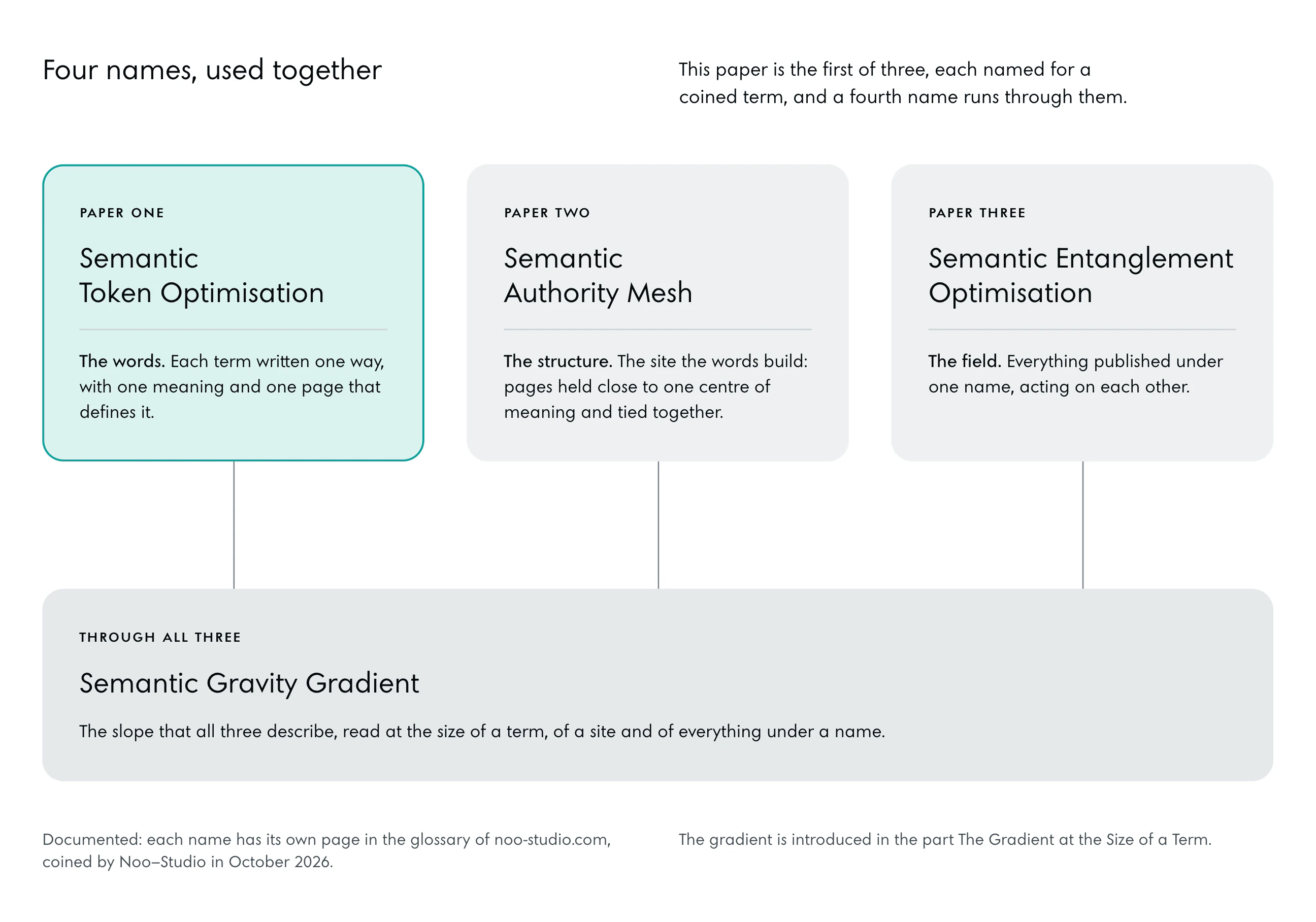
What do we call it? The practice is Semantic Token Optimisation, STO for short, a term Noo–Studio coined in October 2026. Its page defines the term in one sentence, “Writing a site so that each of its terms carries one meaning, used the same way on every page, so that the models which read text as numbered tokens place each term at one point and tie it to the firm that defined it.” In working shorthand the practice comes down to one term, one meaning, one page that defines it.
The words “place each term at one point” carry the theory, and a later part bounds them honestly, because a modern model gives a word a slightly different location in each sentence that it appears in.
It belongs to a set of names that we use together. The Semantic Authority Mesh names the structure the words build. Semantic Entanglement Optimisation names the field that they work in.
Each has a paper of its own, and this is the first of the three. A fourth name, for the slope that all three describe, is introduced in the part The Gradient at the Size of a Term. This paper stays with the words themselves.
And it names a practice of the studio; no engine has published that it scores a site that way, and nothing below treats the term as a ranking factor.
Documented, Measured or Theory
From here on, each sentence belongs to one of three kinds. The paper marks which. Documented means that a source was opened for this paper and says the thing, with its date; it may be a research paper, a textbook, a page of Google’s documentation or a court’s opinion.
Measured means that we ran it, on a named day with a named method, and you could run it again. Theory means our position on what the documented and the measured add up to, written with the test that would break it.
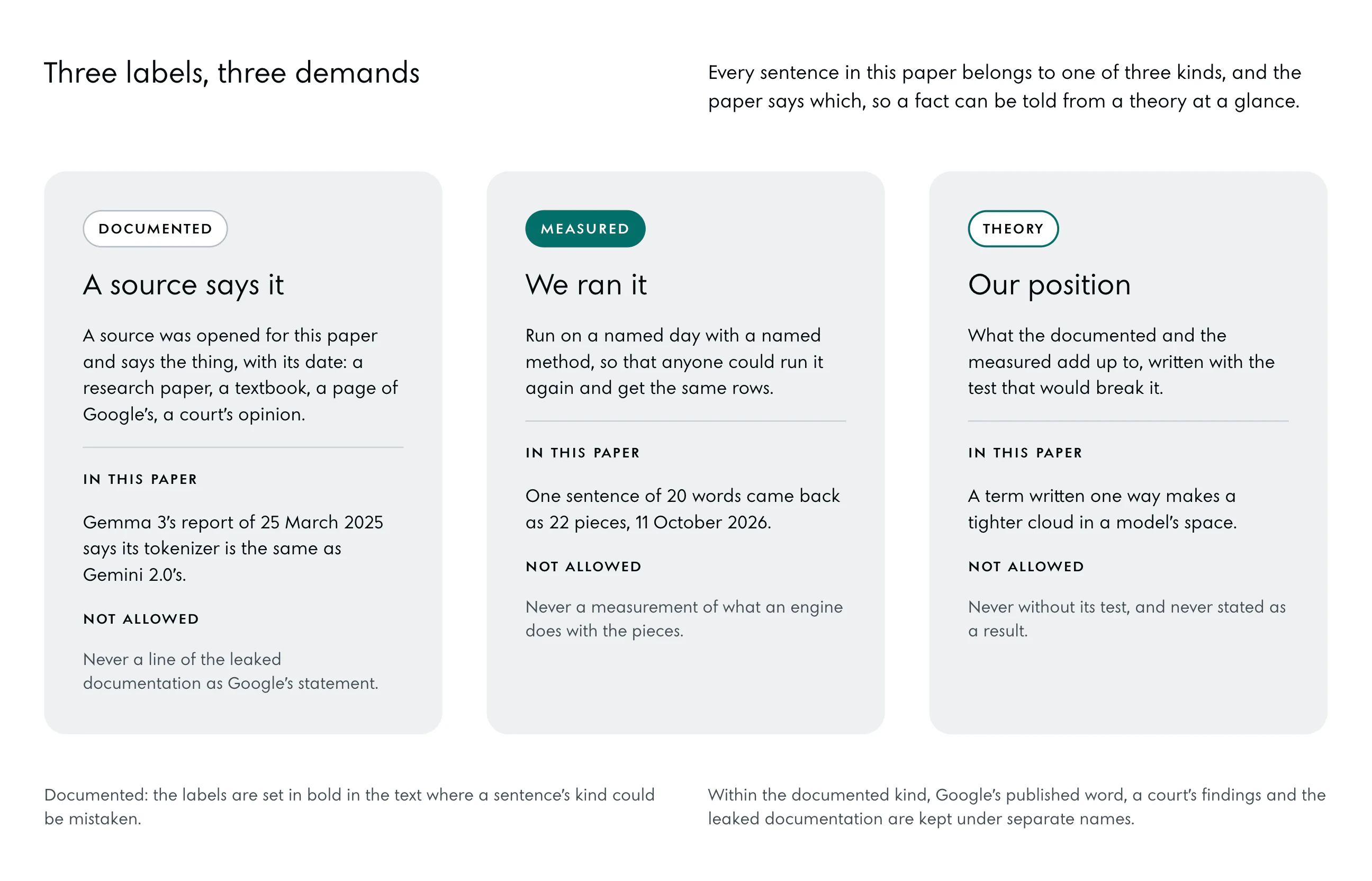
Two of the documented sources come from the same company and are kept entirely apart. What Google published is Google’s word. The internal documentation of Google’s that leaked in 2024 is a dated file of what its systems stored, and it is quoted here by field name, as a description of storage.
No line of it is treated as Google’s statement or as a weight in a ranking. A court’s finding is cited as a court’s finding. One card in a later part lays the kinds out together.
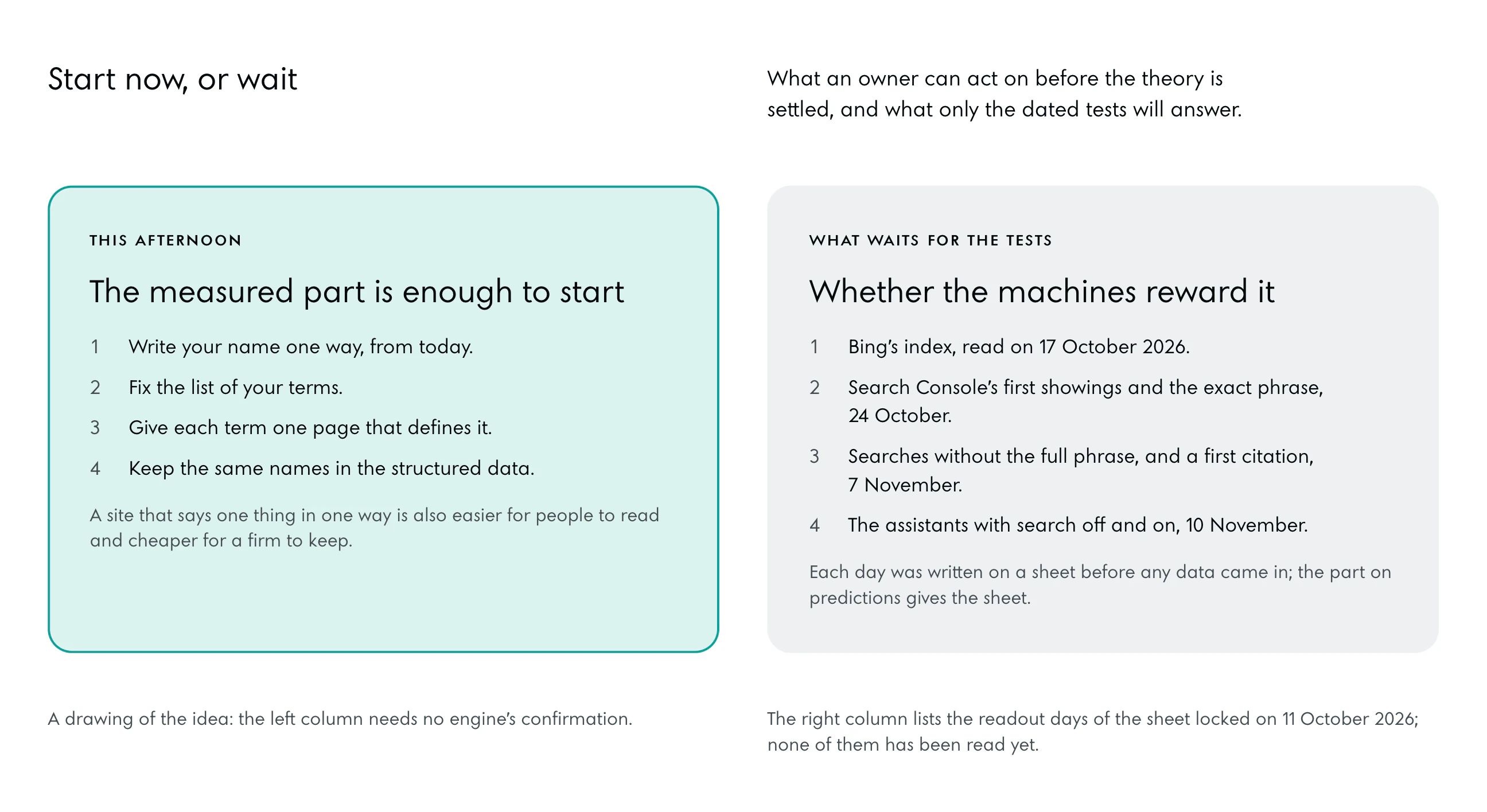
What can an owner act on before the theory is settled? The measured part, which is enough to start. Your name can be written one way from this afternoon.
The list of your terms can be fixed, each with a page that defines it, without waiting for any engine to confirm anything, because a site that says one thing in one way is also easier for people to read and cheaper for a firm to keep. Whether the machines reward it is the open question, and the tests that would answer it are dated in the part on predictions.
One sentence travels through each part below. A token is one entry in the fixed list of pieces that a language model cuts all text into, and the model knows each piece only by its number.
02What a Token Is
Text is cut into pieces, the pieces are numbers, the numbers have places, and near places mean near things. Those four statements describe the model’s side of each page that you publish.
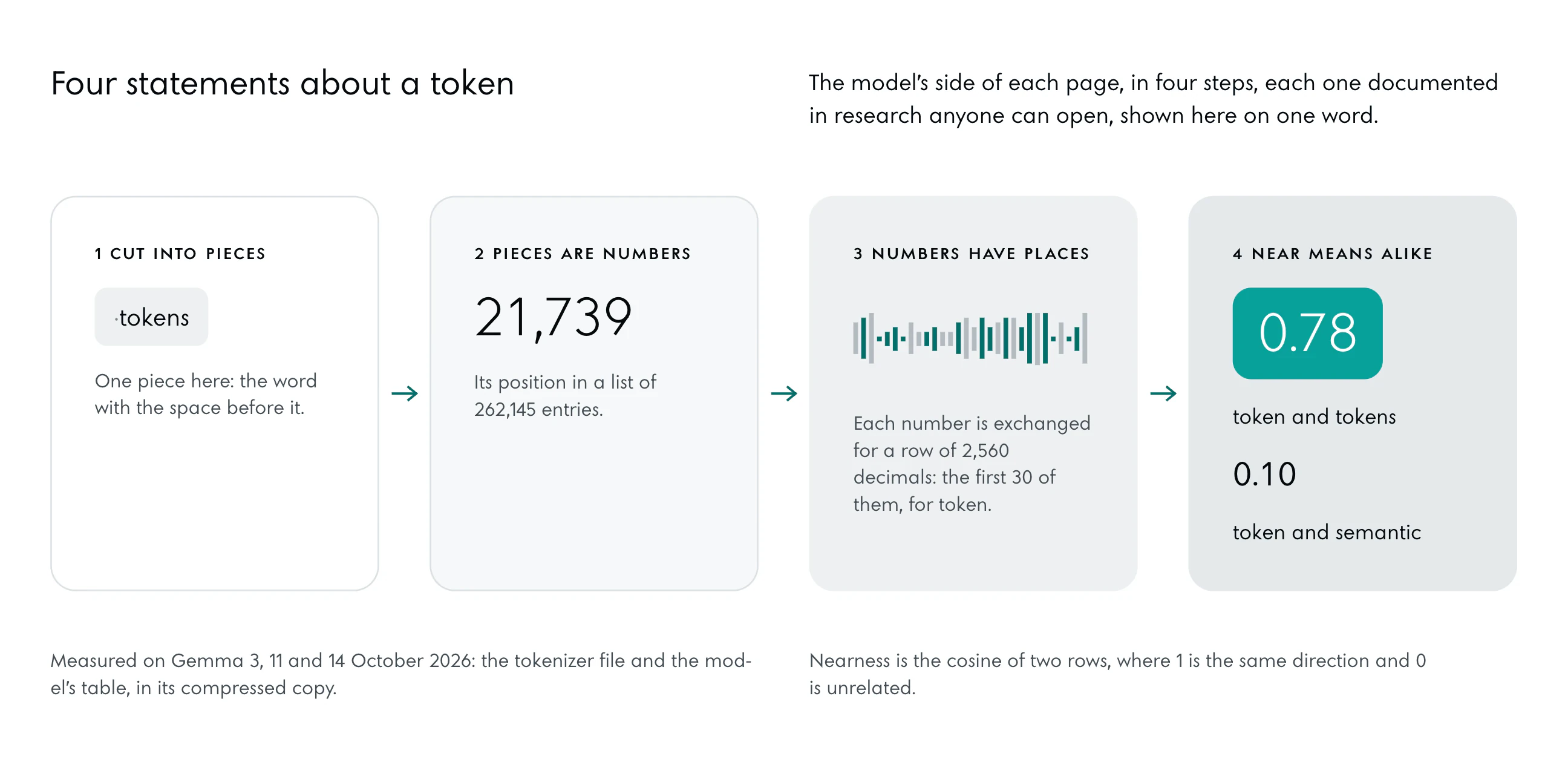
Each is fully documented in research that anyone can open. Here we take them in order and show the first two on our three terms, and we end on what they did to the keyword.
Pieces From a Fixed List
Gemma 3’s tokenizer file has 262,145 entries. What is an entry? It is a short string of characters, a common word together with the space in front of it, the front or the back of a longer word, one letter, a digit, a punctuation mark.
Google’s technical report on the model, posted on 25 March 2025, describes the file in one line, “We use the same tokenizer as Gemini 2.0: a SentencePiece tokenizer with split digits, preserved whitespace, and byte-level encodings”, and gives its size in another, “The resulting vocabulary has 262k entries.” Both sentences are documented. A table caption in the same report says 256k, and the file that we ran has 262,145, which is one small reason this paper counts from the file and quotes the report only for what it alone can say.
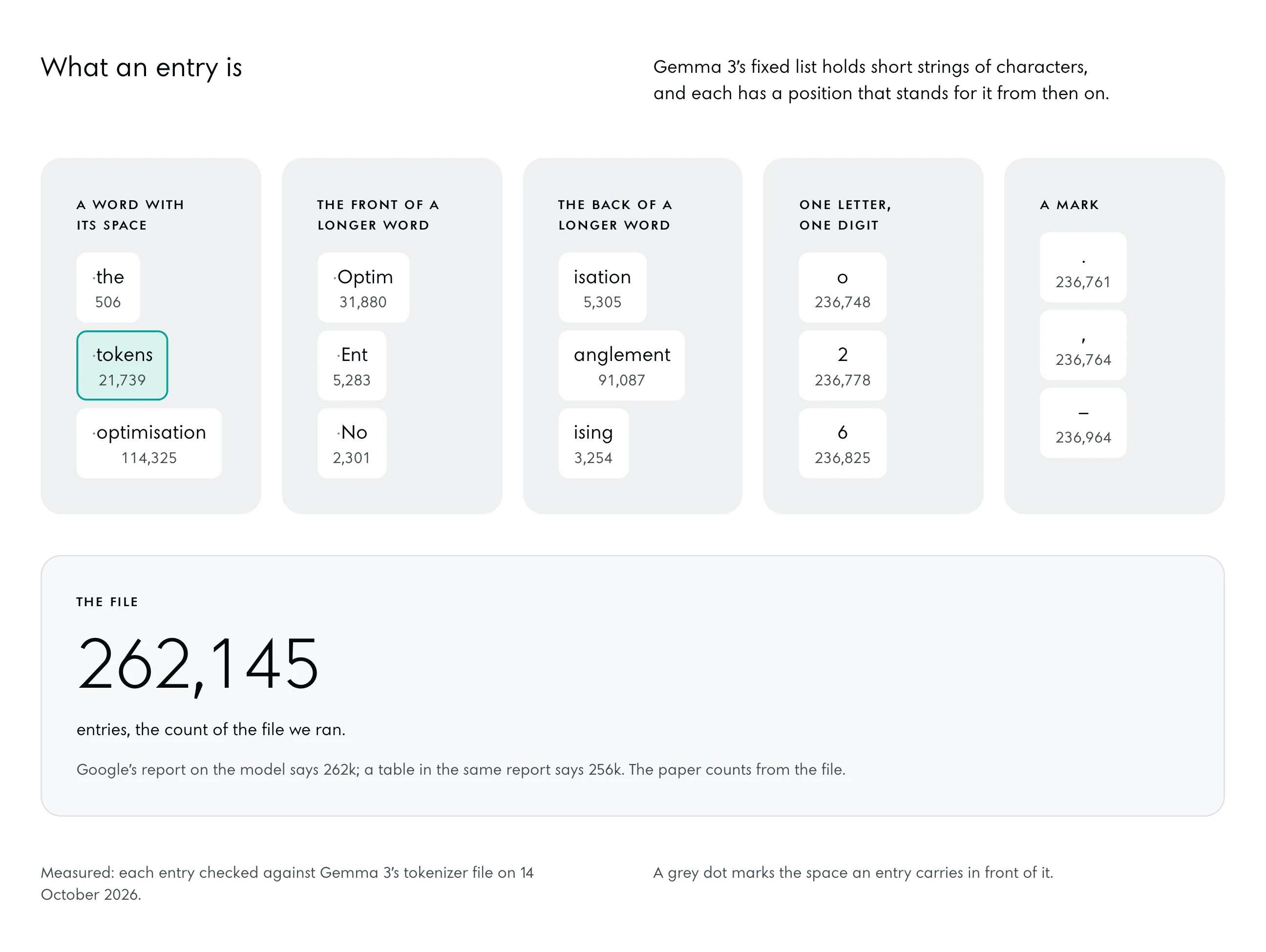
One thing the report can say and the file cannot is that the open tokenizer cuts text the way Gemini 2.0’s does. The sentence is the only ground for calling the cut Google’s, and it reaches no further; it is silent on later Gemini versions and on what Search does with the pieces.
In lower case, as each stands in a sentence after a space, our three terms come out as three entries apiece, semantic (52,322), token (8,369), optimisation (114,325) for the first, then semantic, authority (9,747), mesh (18,990), and for the last of them semantic, entanglement (115,991), optimisation. The number by each word is the position of that entry in the file.
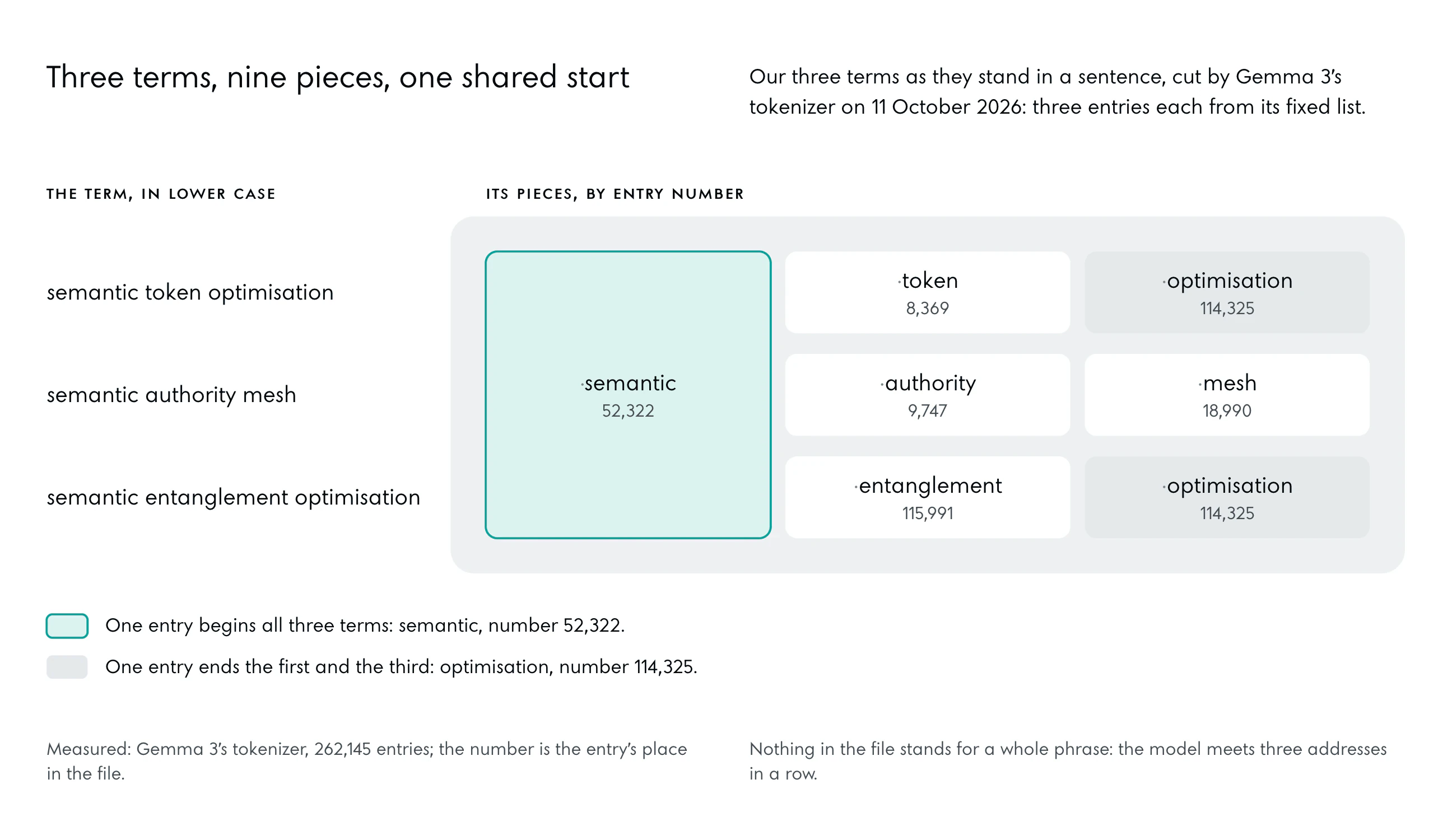
A position such as 52,322 works as an address, the place where the model keeps what its training taught it about that one string of characters, and the model will find the same address each time the same string arrives. So when the model meets “semantic token optimisation” it has three addresses in a row. Nothing in the file stands for the phrase.
Each piece of our three terms was sitting in Gemma’s file already, as an ordinary English word.
The Open-Vocabulary Problem
Why cut words at all? A model can only hold so many entries. Language is always making new strings, such as names, compounds, coinages and borrowed words.
In a paper first posted on 31 August 2015, Rico Sennrich, Barry Haddow and Alexandra Birch put the difficulty in a sentence, “Neural machine translation (NMT) models typically operate with a fixed vocabulary, but translation is an open-vocabulary problem”. They proposed the answer that language models have relied on, in one variant or another, ever since, which is “encoding rare and unknown words as sequences of subword units”. Their method borrowed a compression routine that is called byte pair encoding.
It starts from the characters on their own and joins the pair that occurs together most often into a new entry, over and over, until the list reaches the size that its makers chose. Frequent words end up as one entry, and rare ones are spelled out from smaller entries.
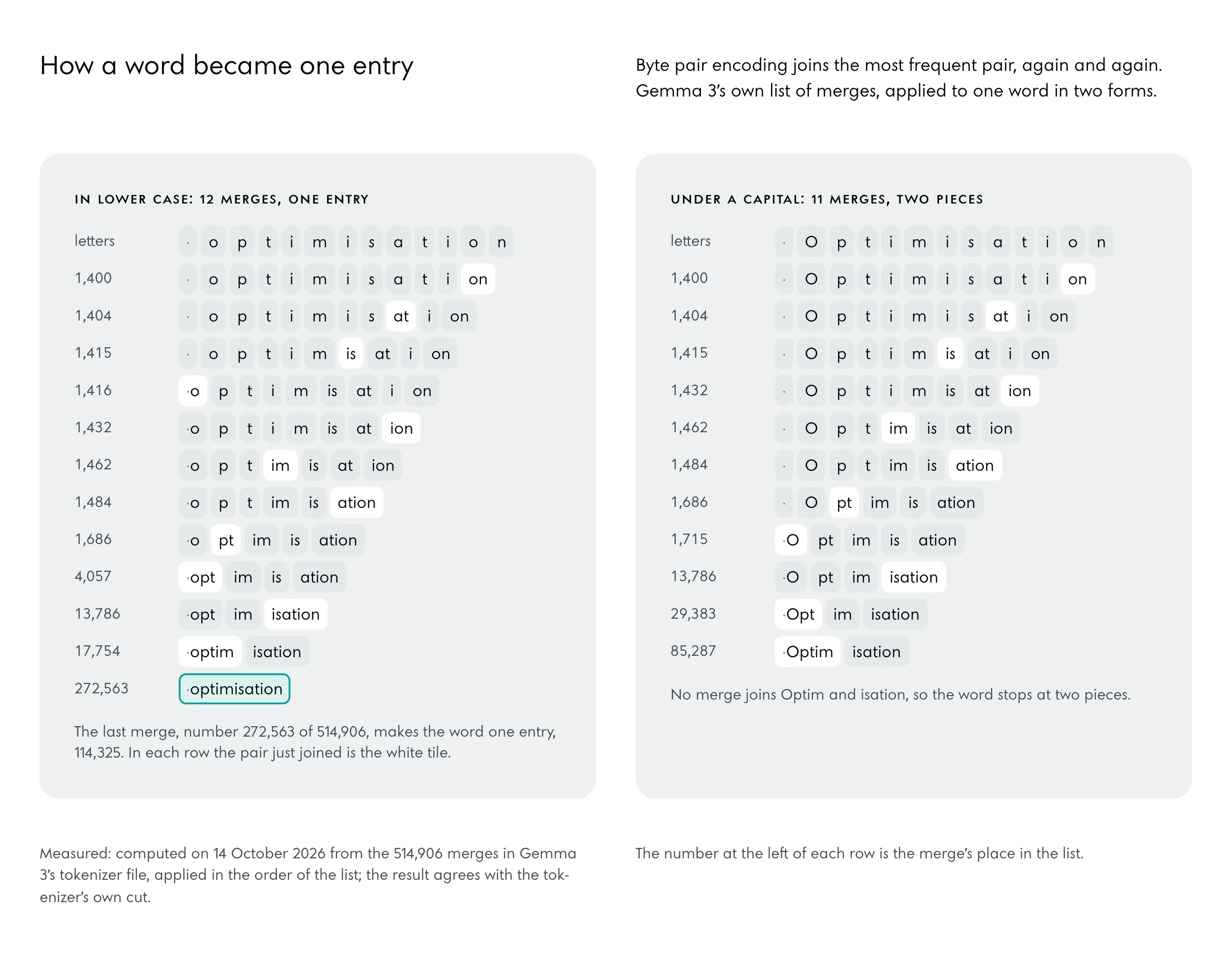
A printer’s type case ran on the same economy, a fixed set of metal sorts from which any word could be set, with a few frequent pairs of letters cast together as one sort.
The tool named in Gemma’s report came three years later. Taku Kudo and John Richardson posted SentencePiece on 19 August 2018, noting that it “can train subword models directly from raw sentences”, with no earlier step that splits the text into words. What becomes of the space between two words?
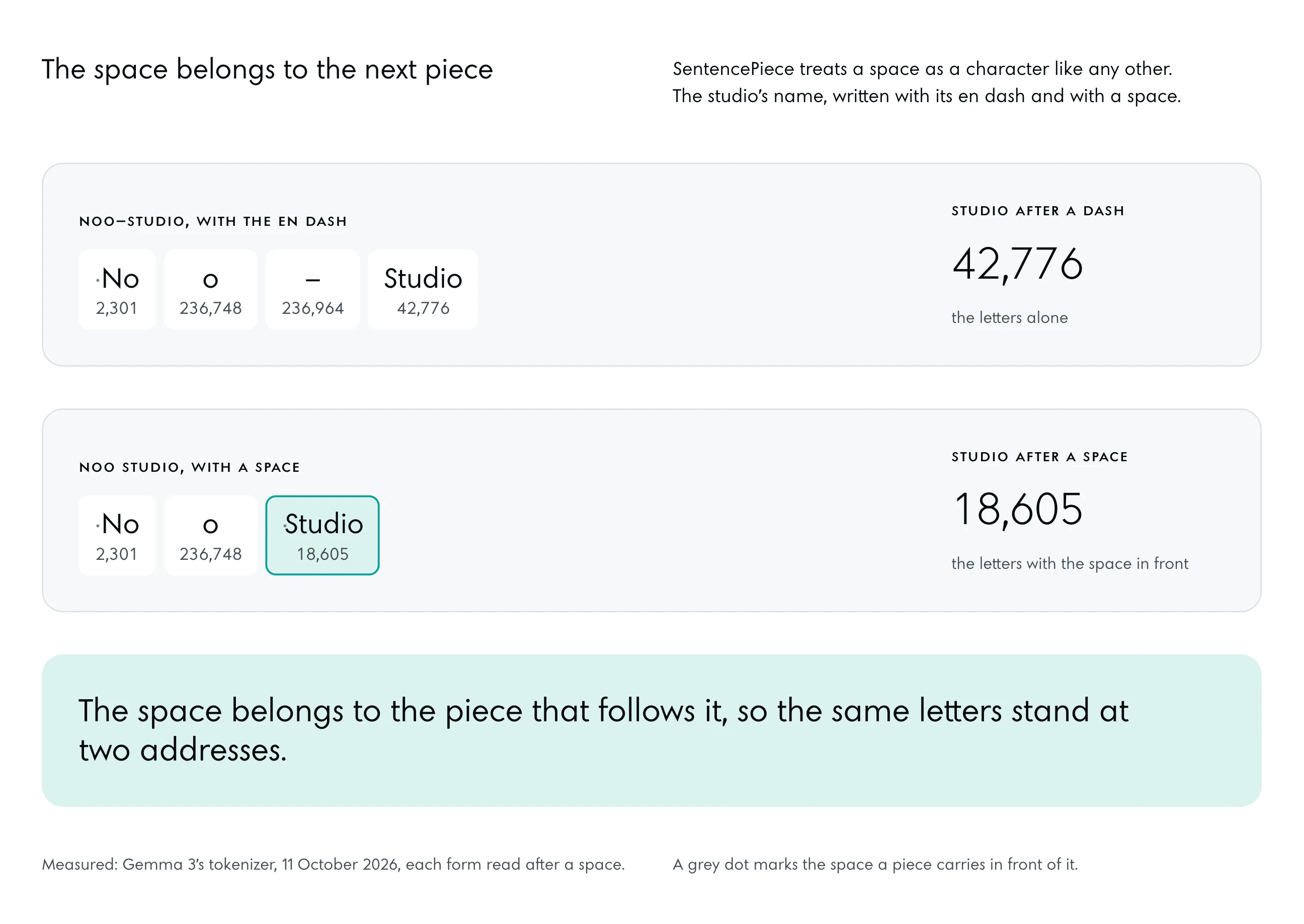
It is a character like any other and it belongs to the piece that follows it, a detail that matters to anyone who writes names. In our run the word Studio after a dash was entry 42,776, and Studio after a space was entry 18,605, the same letters at a different address.
By 2025 the idea had reached a courtroom. The opinion of 2 September 2025 in United States v. Google, drawing on sworn expert testimony, describes language modelling as “the task of predicting the most likely next token in a sequence given a prior sequence of tokens” and adds that a token can be thought of “as a short word or small unit of language”.
That is a court’s finding, and it is a fair plain-words definition to hand a board.
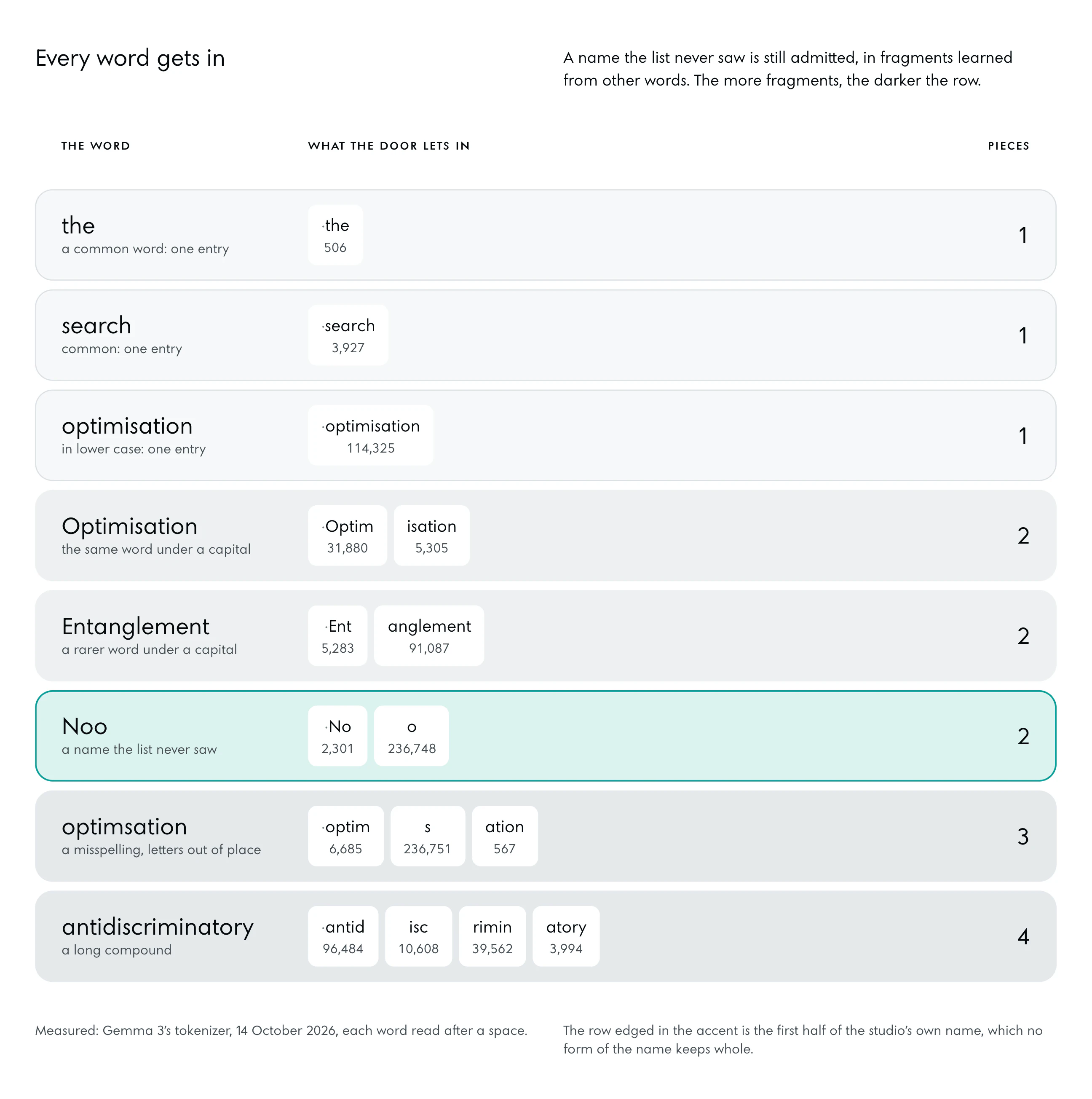
A name the list never saw is still let in, because the door takes any word. An invented name, a product code, a misspelling or a rare surname is admitted in fragments, and the model is left to assemble a meaning from fragments that were learned from other words.
From Numbers to Places
A position in a file is an accident of how the file was built. Two entries that sit next to each other there are neighbours by position only. So where does meaning come in?
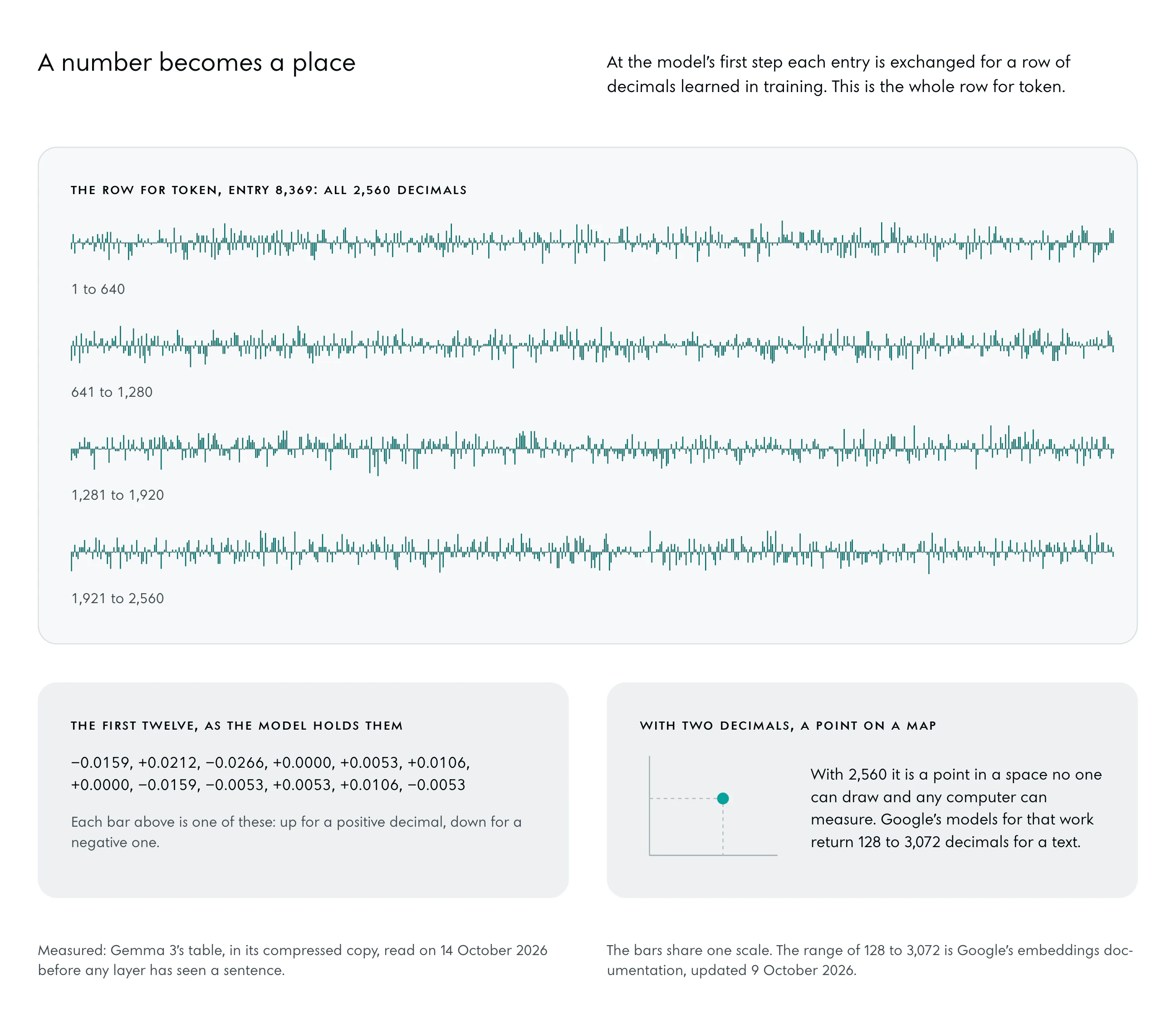
At the next step, where each entry is exchanged for a long row of decimals that the model learned in training, called a vector or an embedding. A vector is a location. With two decimals it would be a point on a map.
The models Google offers for that work return between 128 and 3,072 decimals for a text, by their documentation as last updated on 9 October 2026, which makes a space that no one can draw and that any computer can measure.
Behind it there is a founding result, documented in a paper that Tomas Mikolov, Kai Chen, Greg Corrado and Jeffrey Dean posted on 16 January 2013. They proposed “two novel model architectures for computing continuous vector representations of words from very large data sets” and reported that “these vectors provide state-of-the-art performance on our test set for measuring syntactic and semantic word similarities”. Locations that were learned from nothing but a great deal of text came out arranged by sense, so that words used in similar company sat close together.
The model worked out which words were alike from one kind of evidence only, the company that each word kept.
How near is near? The usual measure is the angle between two vectors, or the straight distance between two points, and either comes back as one figure that can be compared from pair to pair. That is the sense in which our definition speaks of a term placed “at one point”.
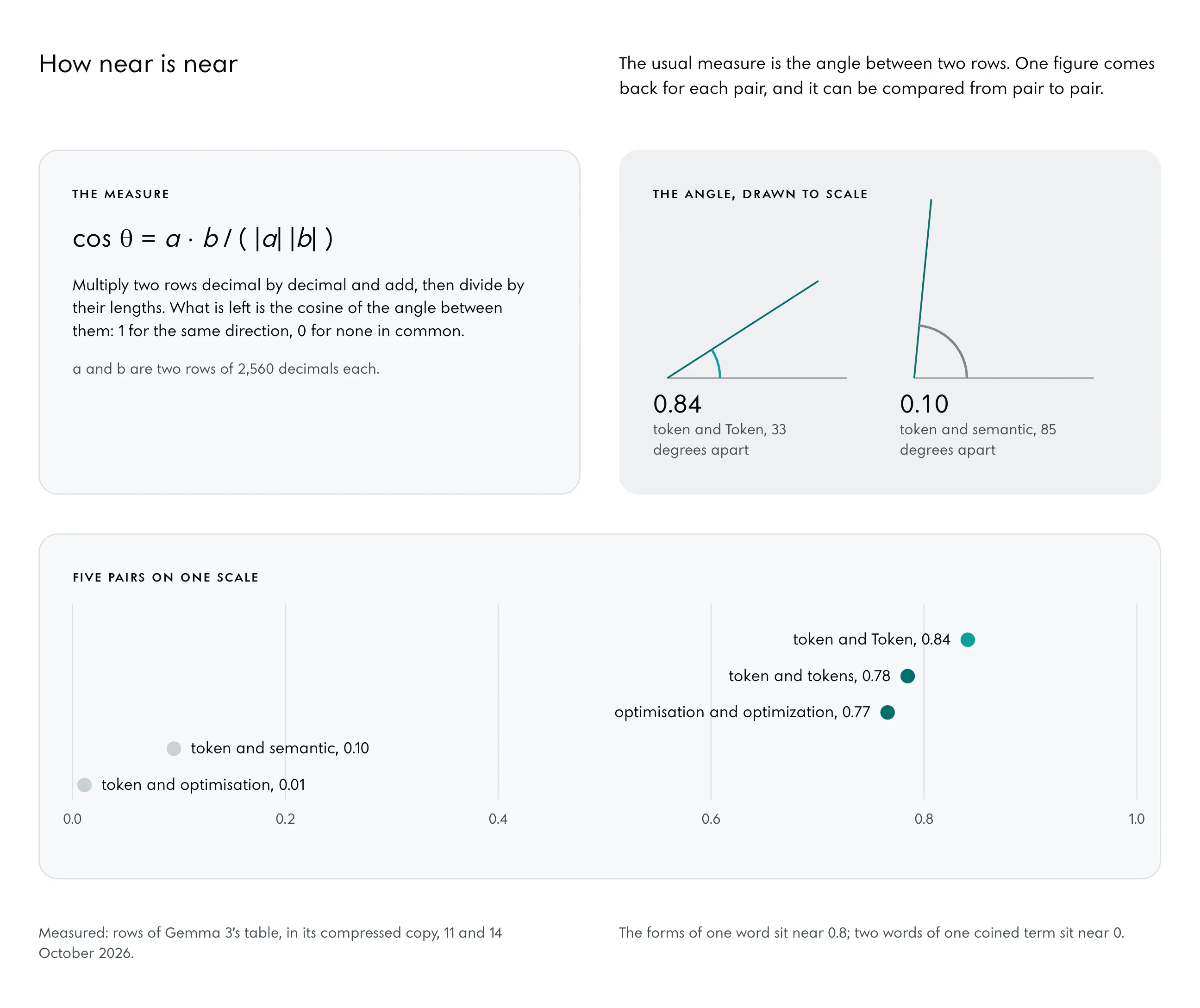
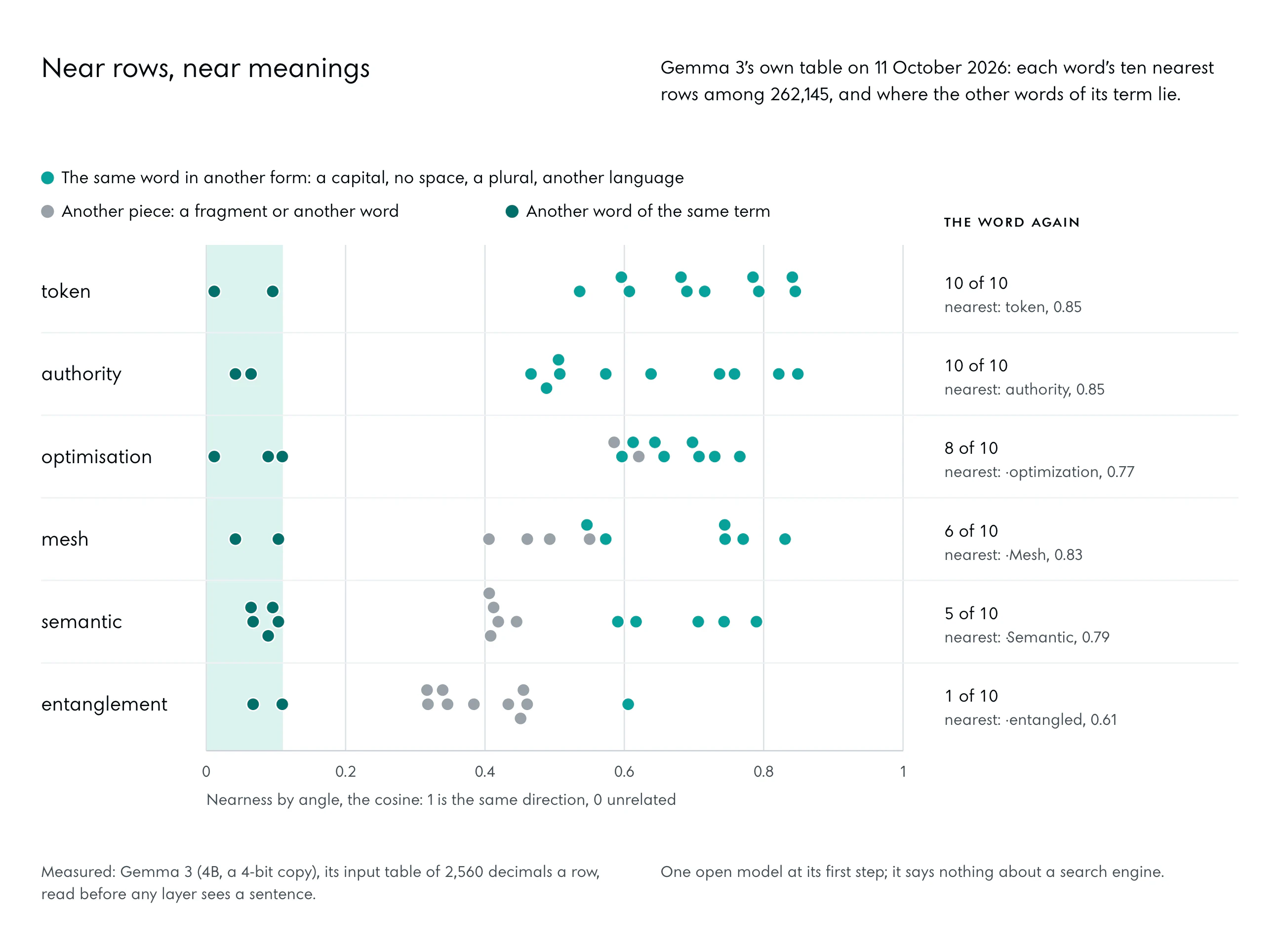
On 11 October 2026 we took that measure on our own pieces, in the table of Gemma 3. It is the table of the step just described, with one row of 2,560 decimals for each of the 262,145 entries, read before any layer of the model has seen the sentence. For each word of the three terms we listed the ten entries whose rows lie nearest to its own by angle, on a scale where 1 is the same direction and 0 is unrelated.
The sheet, locked before the run, expected a word’s neighbours to be the same word in other forms.
What came back is measured. All ten neighbours of token, and all ten of authority, are that word again, with a capital, without its space, in the plural or in another language. Eight of ten hold for optimisation, six for mesh and five for semantic.
Nearest of all to the British optimisation is the US spelling, at 0.77.
Entanglement broke the pattern. Only one of its ten neighbours is a whole word, entangled, and the others are fragments such as Ent and anglement. Its nearest neighbour sits at 0.61, against 0.85 for token.
The sheet had expected at least five of ten for each word, and for that one it was wrong; a rare word has a thin neighbourhood.
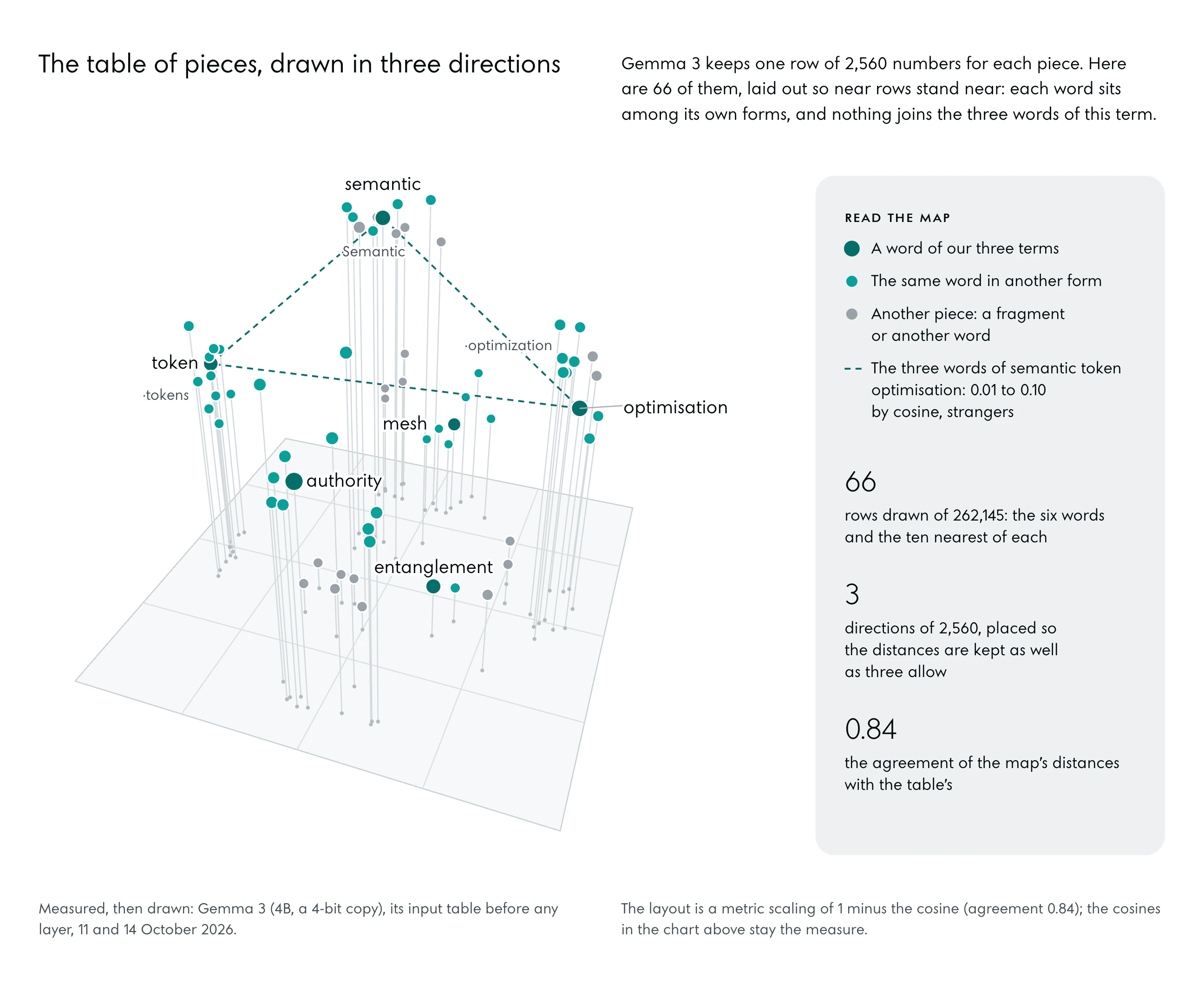
Set against each other, the words of one term are truly strangers. For the eight pairs inside the three terms, semantic with token, token with optimisation and the rest, the measure runs from 0.01 to 0.11, and no word comes nearer than place 1,485 in another’s list of 262,145. So the table keeps each word of a coined term beside its own variants and has nothing that joins the three.
Whatever makes them one term is made later, by the layers, from the sentence around them. That limit holds for the run as well, which reads one open model, in a compressed copy, at its first step, and has nothing to say about a search engine.
A Word in Its Sentence
The table of 2013 gave each entry one location, fixed for good. On 12 June 2017 Ashish Vaswani and seven co-authors posted the design that current language models are built on, “We propose a new simple network architecture, the Transformer, based solely on attention mechanisms, dispensing with recurrence and convolutions entirely.” In a Transformer each piece starts from where the table put it and is then moved, layer after layer, by the pieces around it. The model that Google later put into Search under the name BERT was described by its authors, in a paper posted on 11 October 2018, as “designed to pre-train deep bidirectional representations from unlabeled text by jointly conditioning on both left and right context in all layers”.
Left and right context means the words before and the words after.
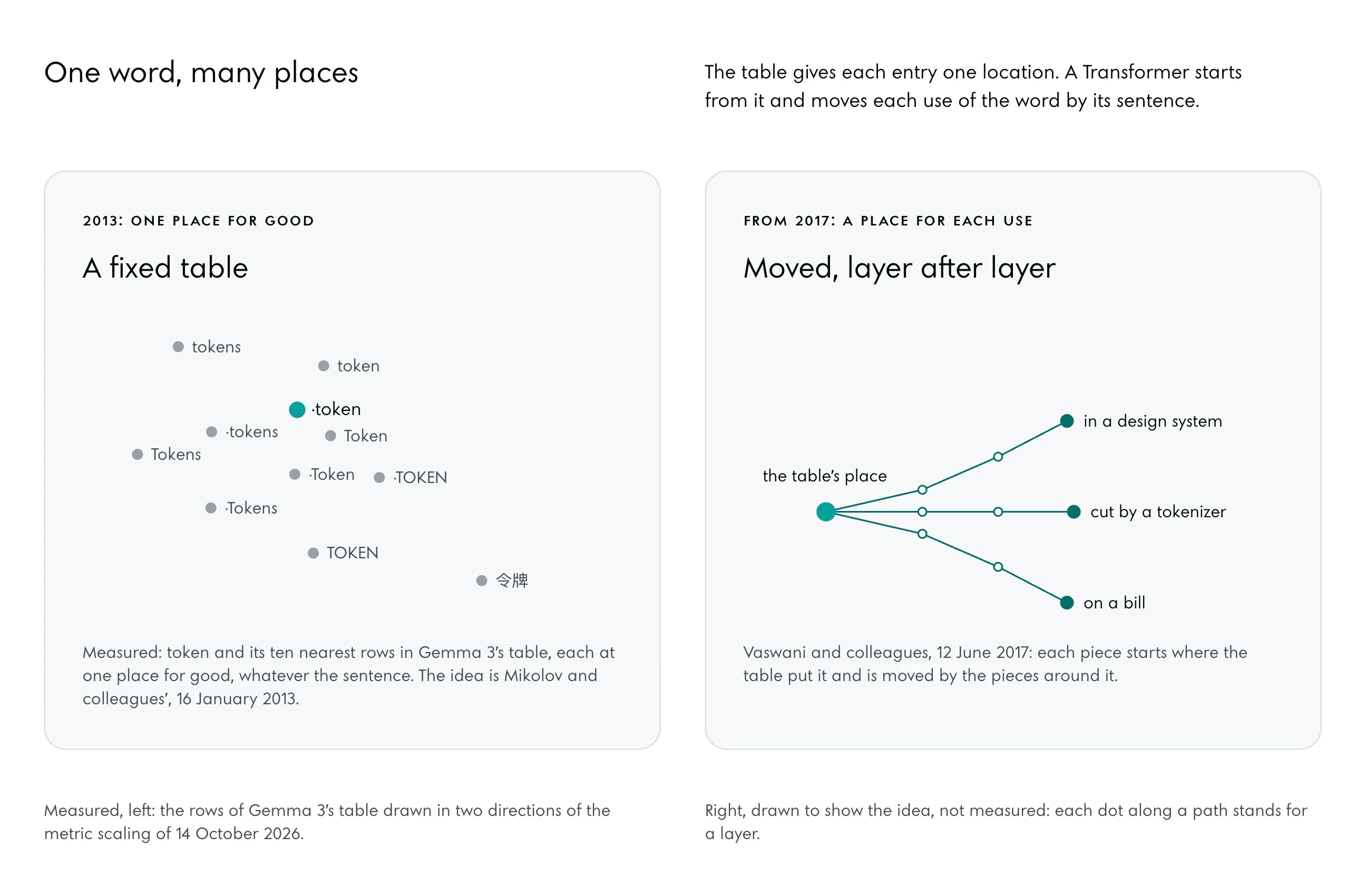
So one word now has many places. How far apart do they drift? Kawin Ethayarajh measured exactly that in a paper posted on 2 September 2019, on three models of the time.
His finding has two halves, and both matter here. One is that “representations of the same word in different contexts still have a greater cosine similarity than those of two different words”. The other reads, “on average, less than 5% of the variance in a word’s contextualized representations can be explained by a static embedding for that word”.
A word in a modern model is a cloud of locations, one for each use, and the cloud of one word stays tighter than the gap between two different words.
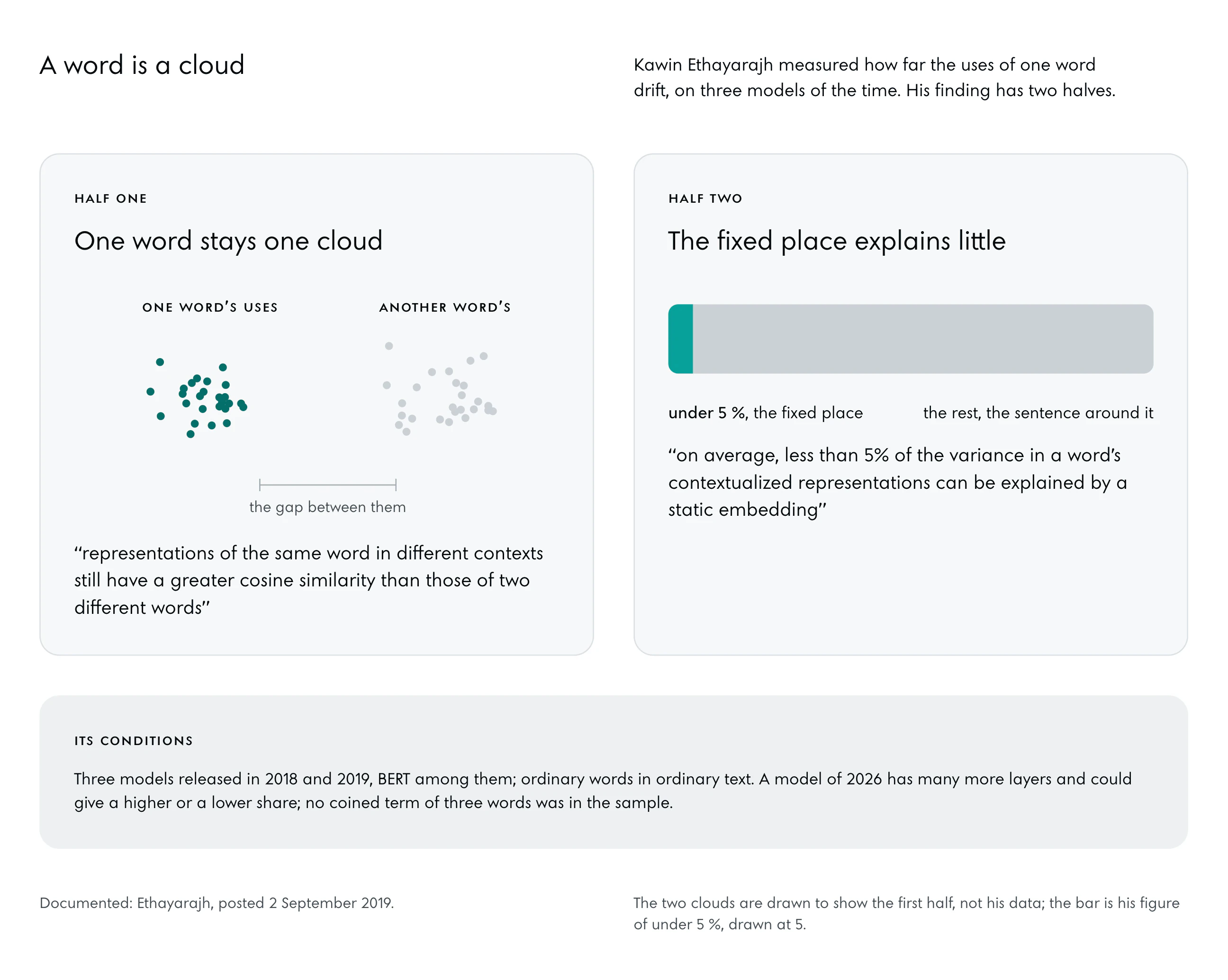
That figure of 5% deserves its conditions. It rests on three models released in 2018 and 2019, BERT among them, and on ordinary words in ordinary text. Would a model of 2026 give the same share?
It has many more layers and was trained differently, and the share could sit higher or lower there. What the paper cannot show is how a coined term of three words behaves, because no such term was in its sample.
Here the words “place each term at one point” get their honest bound. That point is the centre of a cloud, and the claim of this paper, held as theory, is that a term written one way and used in one sense makes a tighter cloud than the same term written and used loosely. Anyone could check it by placing each use of a term in an open model’s space and measuring the spread, a run that has yet to be made.
The Keyword After Tokens
The standard textbook of the older trade drew its units with care. In Introduction to Information Retrieval, published by Cambridge University Press in 2008, Christopher Manning, Prabhakar Raghavan and Hinrich Schütze define a token as “an instance of a sequence of characters in some particular document” and a type as “the class of all tokens containing the same character sequence”. A term, in their words, is “a (perhaps normalized) type that is included in the IR system’s dictionary”.
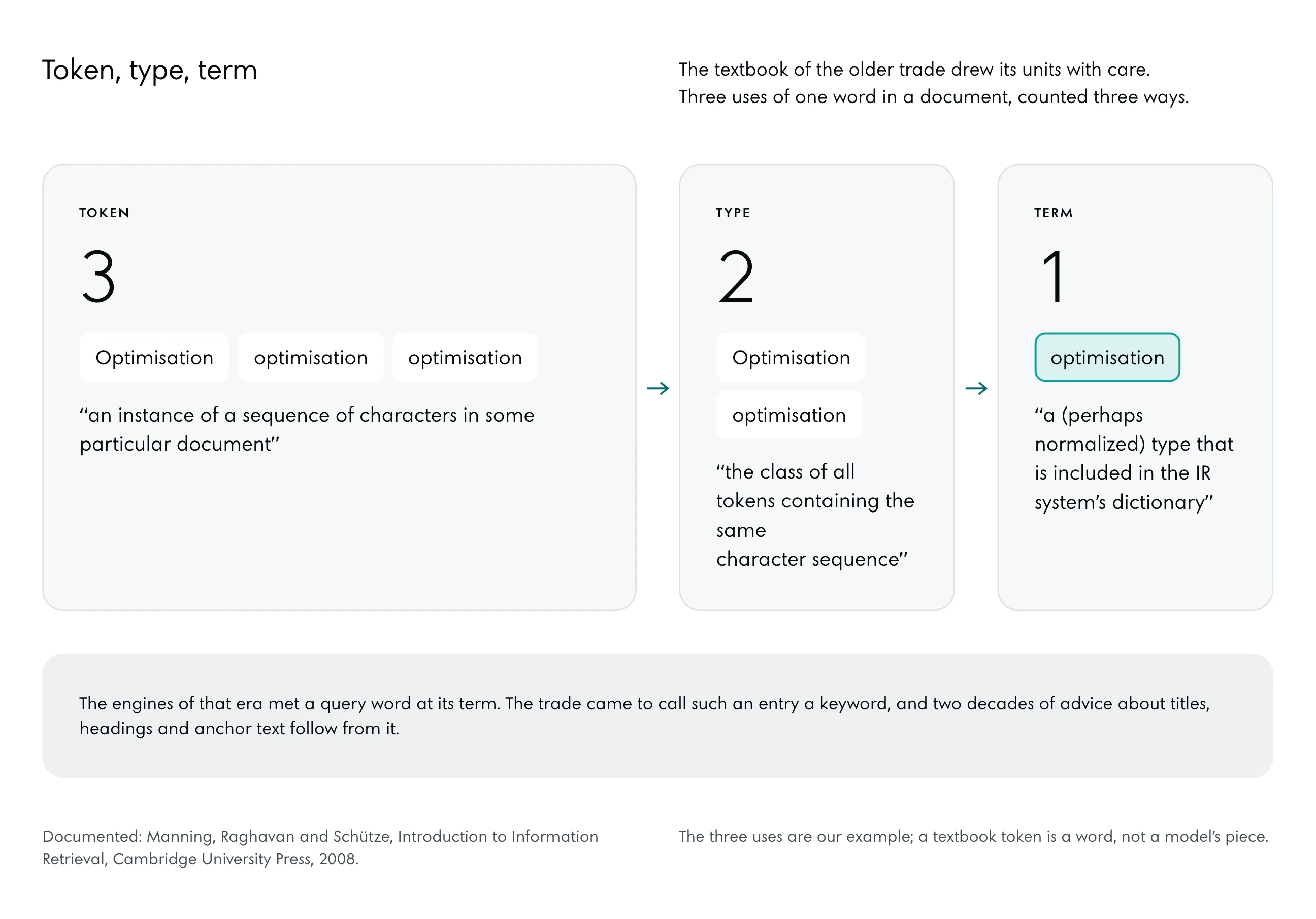
What, then, was the classic engine’s unit? It was the term, a word tidied into a standard form and kept in a dictionary beside the list of documents that contain it. A query word met its entry in that dictionary, or the search came back completely empty.
The trade came to call such an entry a keyword, and two decades of advice about titles, headings, body copy and anchor text follow from it.
A second route to a page arrived with the vectors. In a paper posted on 10 April 2020, Vladimir Karpukhin and seven colleagues wrote that “traditional sparse vector space models, such as TF-IDF or BM25, are the de facto method” for finding passages, and then showed that “retrieval can be practically implemented using dense representations alone”. On the question-answering sets they tested, their retriever beat a strong word-matching system “by 9%-19% absolute in terms of top-20 passage retrieval accuracy”.
A passage could now be found by where it sat in the space, with no word shared between the question and the answer.
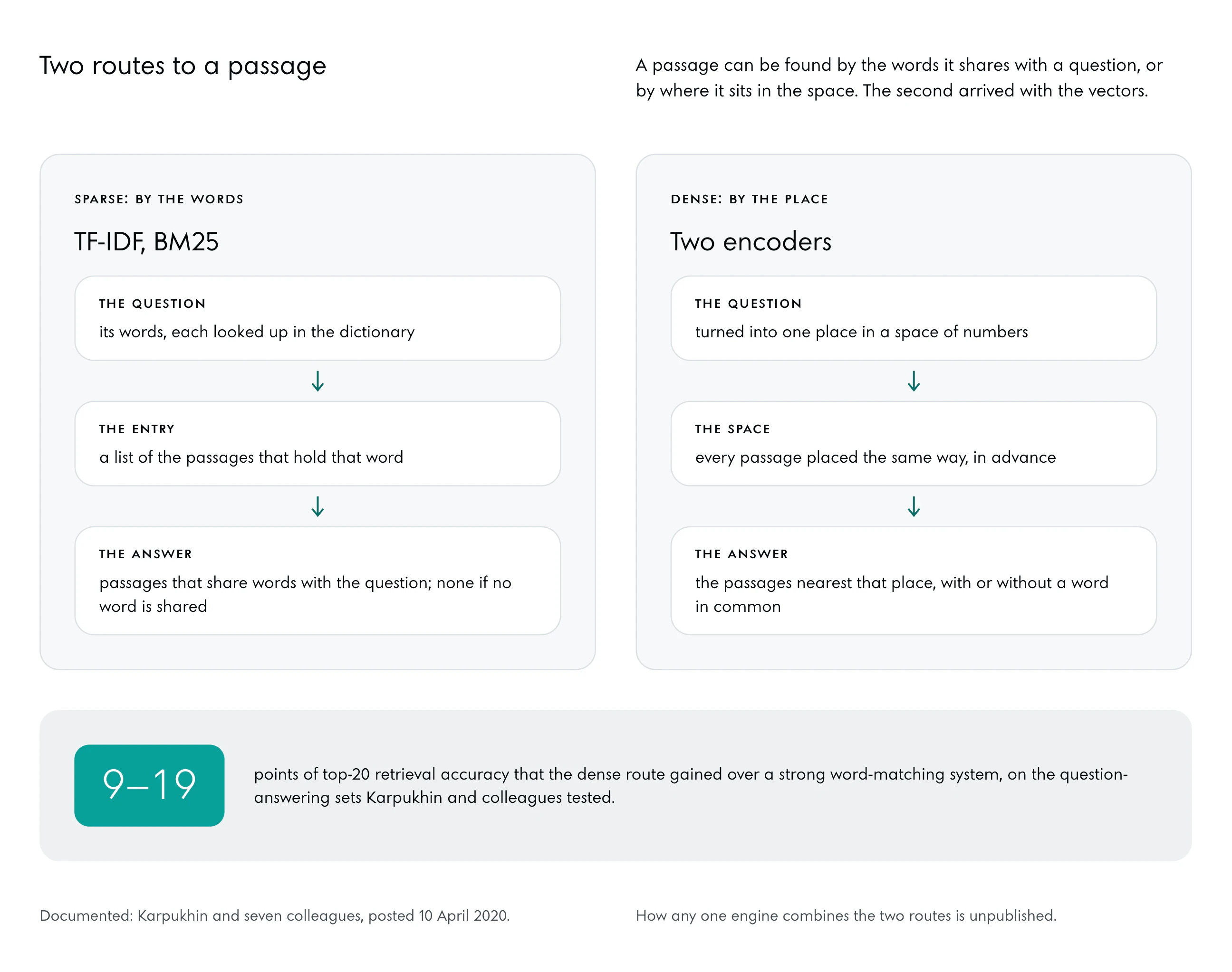
That answers his question in one plain sentence; the person typing still thinks in keywords, and the model that reads the page receives pieces and works with locations. How does any one engine combine the old route with the new? That is unpublished, and this part leaves the gap open.
A keyword is what a person types, and a token is what a model receives, one numbered piece from a fixed list, placed among its neighbours by meaning.
03Three Senses of One Word
In one meeting a designer, a machine-learning engineer and the person who pays the bill for an AI service can all say token and mean different objects.
These are the three senses of token: the design system’s named decision, the model’s numbered piece of a word, the unit that an engine spends to read. Set beside each other below, they turn out to share one skeleton, which is why we could borrow the word for a practice about the terms of a firm.
The Design System’s Named Decision
Open the stylesheet of a carefully built site and the colours are missing, and in their place there are names. The format that the Design Tokens Community Group published as a final report on 28 October 2025 states the idea in one line, “A (Design) Token is information associated with a human readable name, at minimum a name/value pair.” Its first example pairs the name color-text-primary with the value #000000. The purpose is put just as plainly, “Design tokens are a methodology for expressing design decisions in a platform-agnostic way so that they can be shared across different disciplines, tools, and technologies.”
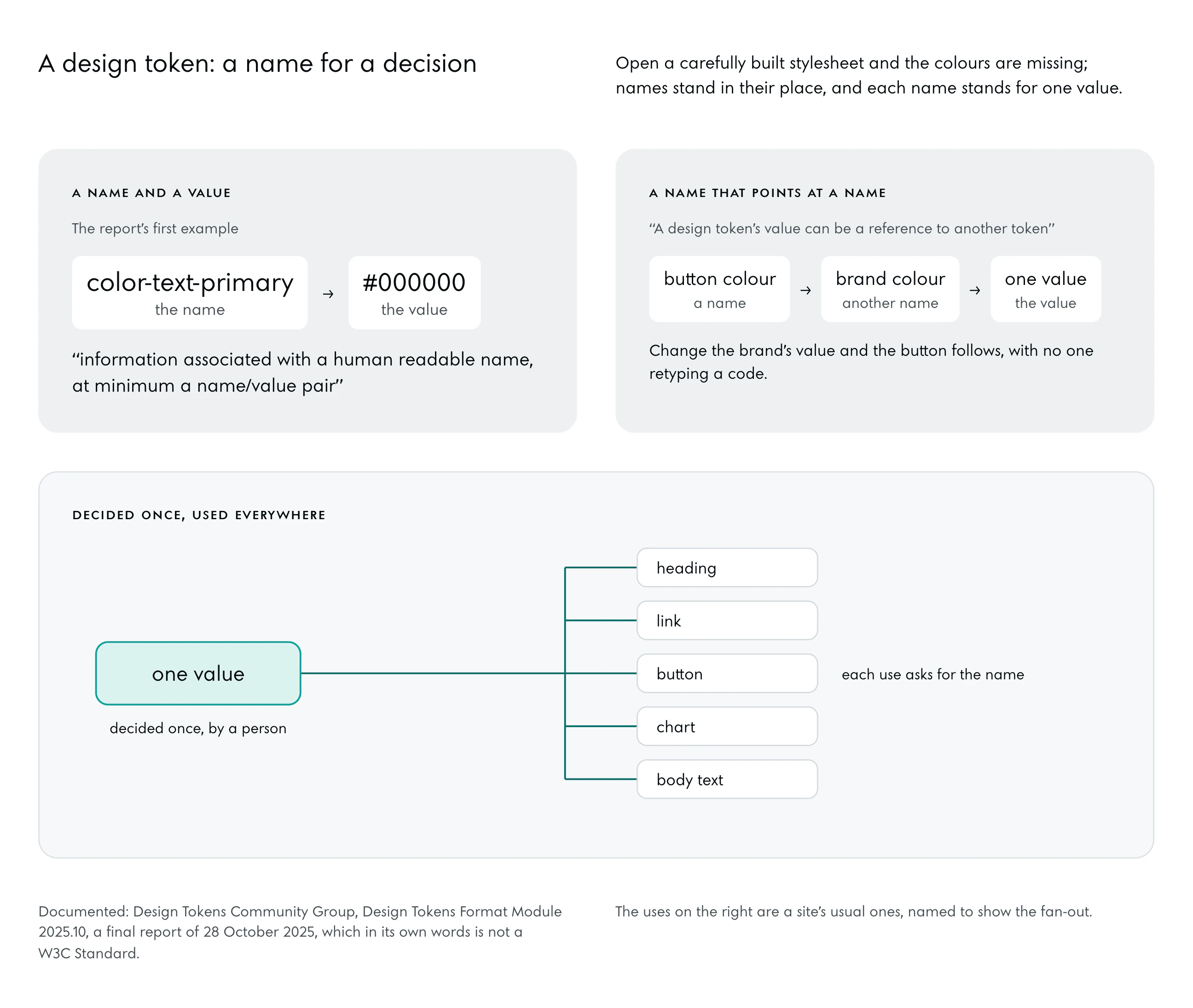
What standing does that document have? It is a community group’s report, and in its own words, “It is not a W3C Standard nor is it on the W3C Standards Track.”
What does the name buy? The colour of body text is decided once, by a person, and from then on each heading, link, button and chart asks for the name and receives the value. No one retypes a colour code, so no one mistypes one.
Change the value in one place and each page follows. The format even lets one name point at another, in the words of the report “A design token’s value can be a reference to another token”, so that a button’s colour can be declared as the brand’s colour and inherit any later change to it.
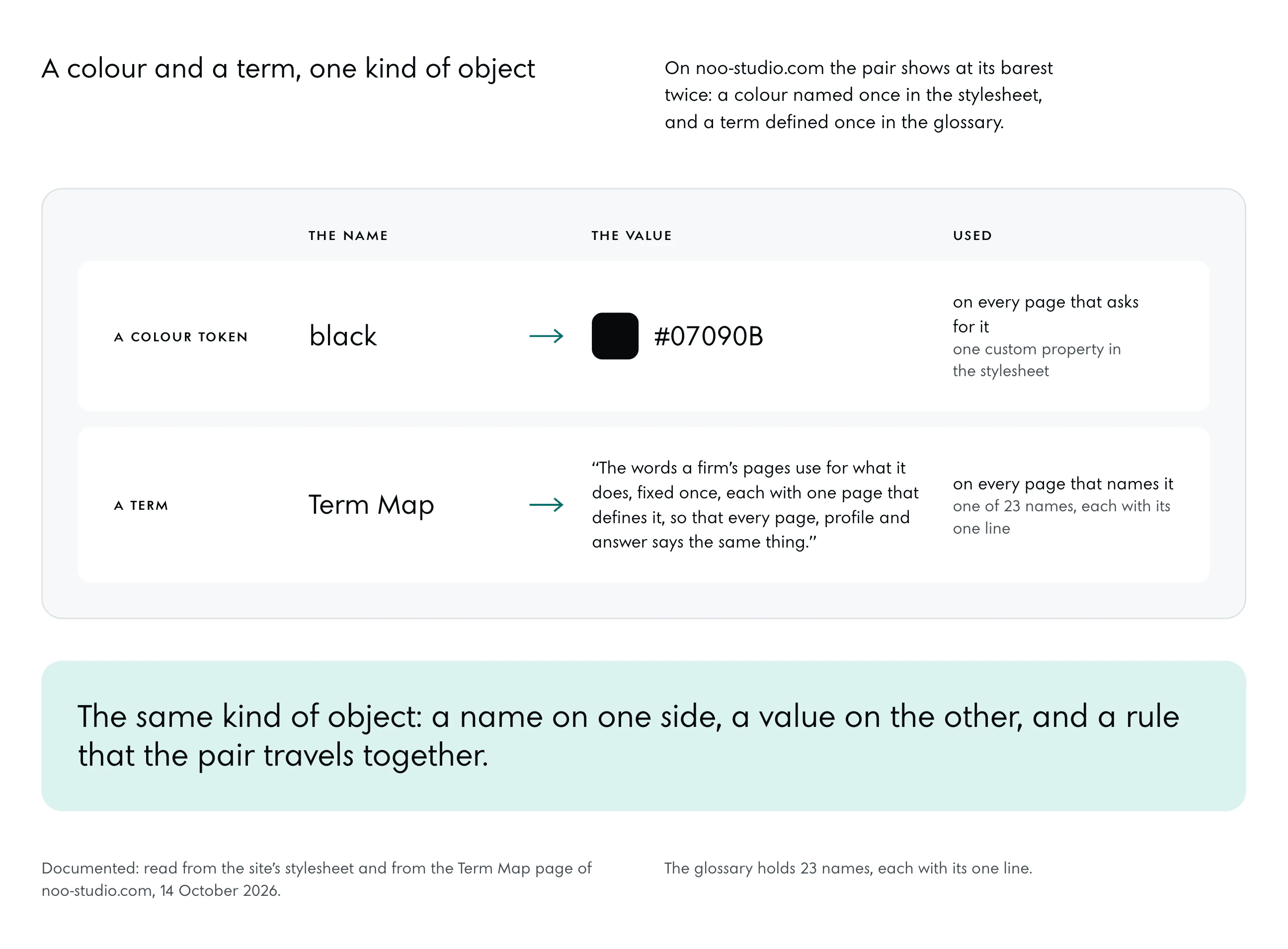
On noo-studio.com, set beside it, the name Term Map stands for one line of definition, “The words a firm’s pages use for what it does, fixed once, each with one page that defines it, so that every page, profile and answer says the same thing.” The site has 23 such names, each with its one line, and each page that uses a name is meant to carry that meaning and no other. A colour token and a term are the same kind of object, with a name on one side and a value on the other, bound by a rule that the pair travels together. On the site’s own stylesheet the pair shows at its barest, where a custom property named black stands for the value #07090B on each page that asks for it.
The Model’s Numbered Piece
We laid out the second meaning in the part before this one, and one property of it earns a closer look. The cut of a tokenizer is also a decision, taken once, on the day the file was trained, and carried unchanged from then on. That is why our runs of 11 October 2026 give the same rows each time; the same string always returns the same numbers on any machine and any day, for as long as the model keeps that file.
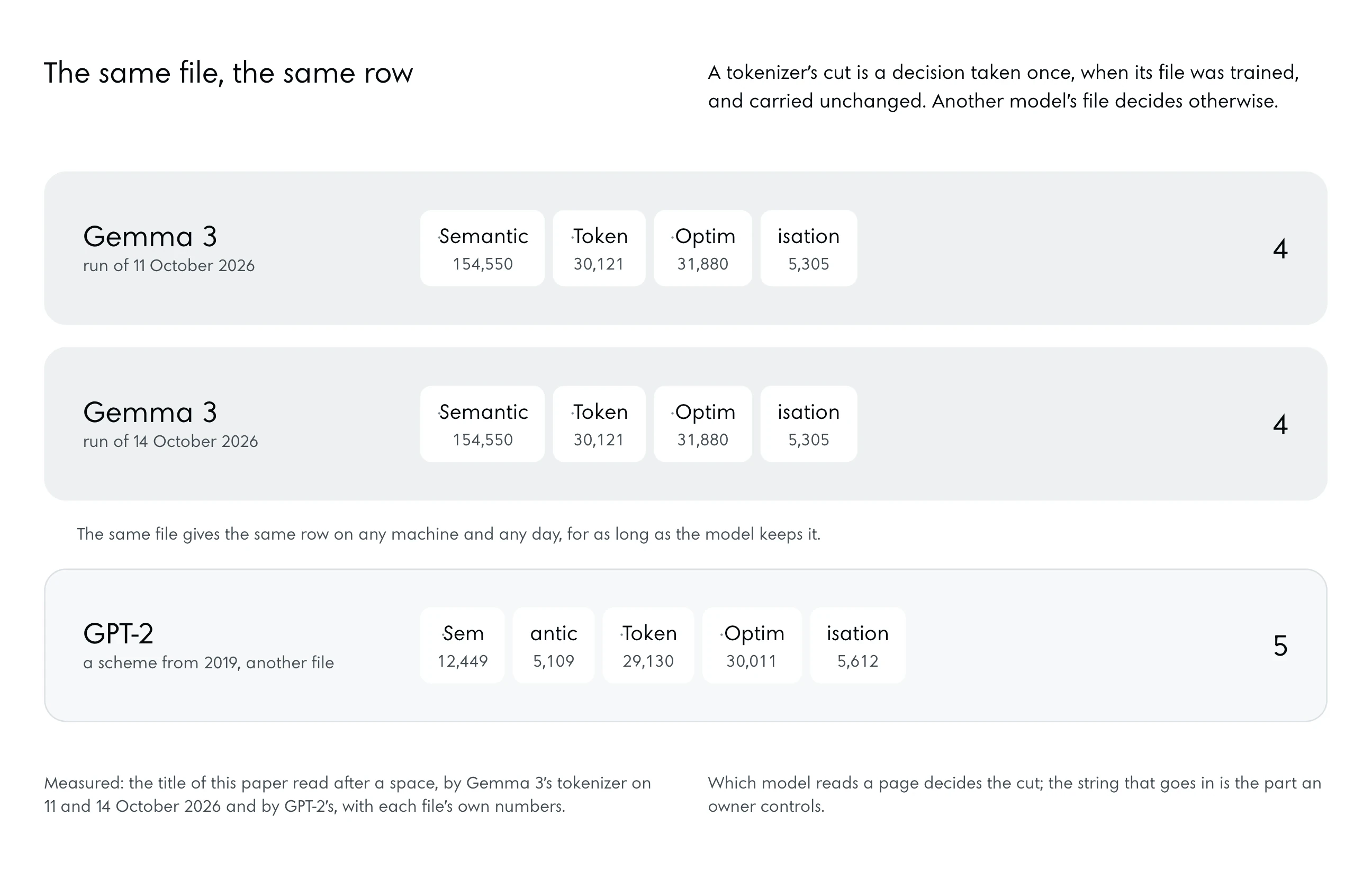
Seen that way the position of the entry is its name and the vector that the model learned for it is its value. The pair holds everywhere; whatever page the string turns up on, in whatever year, the model always starts from the same address.
A token always belongs to some model’s file, and files differ. Beside Gemma’s tokenizer we also ran GPT-2’s, a scheme from 2019, and the British word optimisation in lower case, one entry in Gemma’s file, came out of the older scheme as two. Which model reads your page decides how your words are cut.
That choice belongs to the reader, and the string that goes in is the part that an owner controls.
The Unit an Engine Spends
Any service that reads text on your behalf keeps a meter, and it counts tokens. Google’s documentation for developers, last updated on 23 September 2026, gives the exchange rate as a rule of thumb, “For Gemini models, a token is equivalent to about 4 characters. 100 tokens is equal to about 60-80 English words.” The same page says what the count is for, “When billing is enabled, the cost of a call to the Gemini API is determined in part by the number of input and output tokens.”
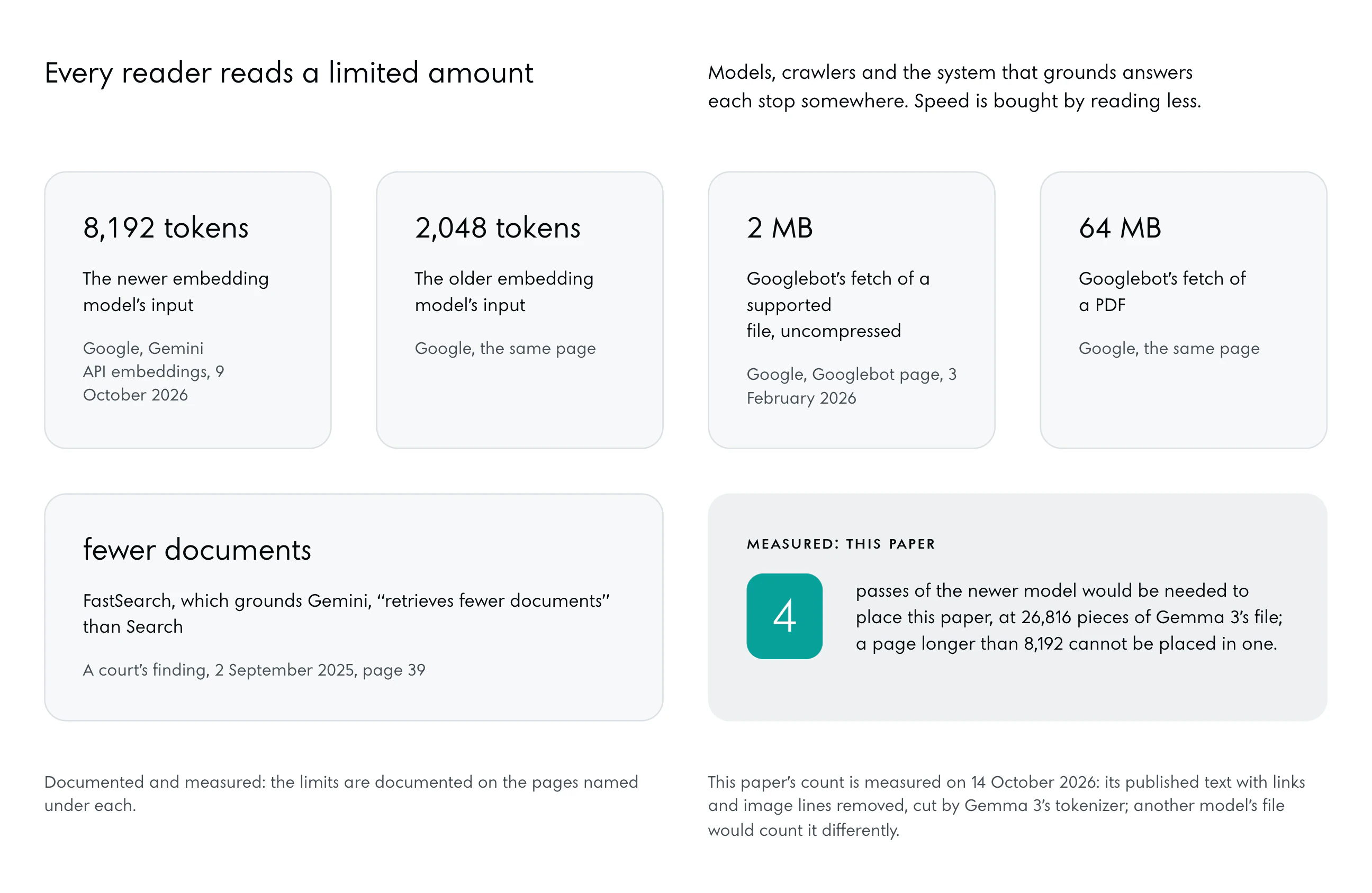
How much can a model take at once? The models that turn a text into one location take, by Google’s documentation of 9 October 2026, 8,192 tokens at most for the newer one and 2,048 for the older, so a page longer than that cannot be placed in one pass.
Crawlers keep a budget of the same kind in a different currency. Google’s page on Googlebot, last updated on 3 February 2026, says that the crawler fetches the first 2MB of a supported file and the first 64MB of a PDF, that “Once the cutoff limit is reached, Googlebot stops the fetch”, and that “The file size limit is applied on the uncompressed data.” And the court’s opinion of September 2025 found that the system that Google uses to ground its Gemini models, FastSearch, “delivers results more quickly than Search because it retrieves fewer documents”. So speed is bought by reading less.
What of energy, the last line on the bill? One published figure exists, in a measurement paper from Google posted on 21 August 2025, which reports that “the median Gemini Apps text prompt consumes 0.24 Wh of energy”. The figure was taken by Google on its own machines, for one product and its median request.
It has nothing to say about a crawl, an index, a page or one token, and this paper puts no energy figure on any of those.
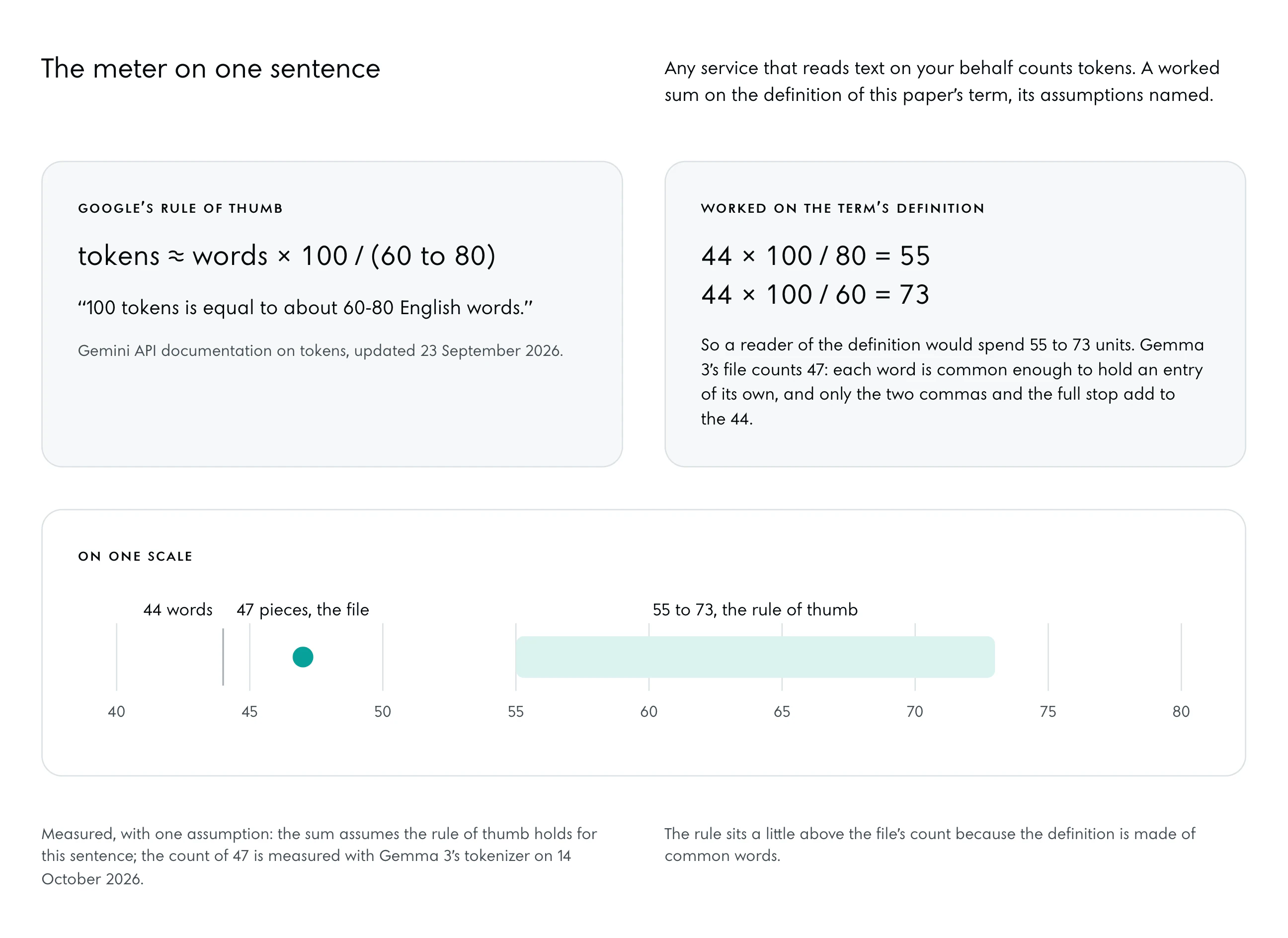
What would the meter read for one sentence? A worked sum shows it, and the sum is a construction with its assumptions named. Take the definition quoted in the opening part, which runs to 44 words.
Assume that Google’s rule of thumb holds for it. At 80 words to the hundred tokens the sentence costs 55 tokens, and at 60 words to the hundred it costs 73. So a reader that meets the definition spends somewhere between 55 and 73 units on it, and the count that Gemma’s file returns for that exact sentence is 47, under the bottom of that range.
Each word of the sentence is common enough to hold an entry of its own, so only the two commas and the full stop add to the 44. Our ten papers are measured against the same rule in a later part.
Will a cheaper page win? No one outside an engine can say. We hold, as theory, that a site whose terms are stable is likely to be cheaper to place than a site that leaves its reader to reconcile variants, and no published figure prices that difference.
One Rule Under All of Them
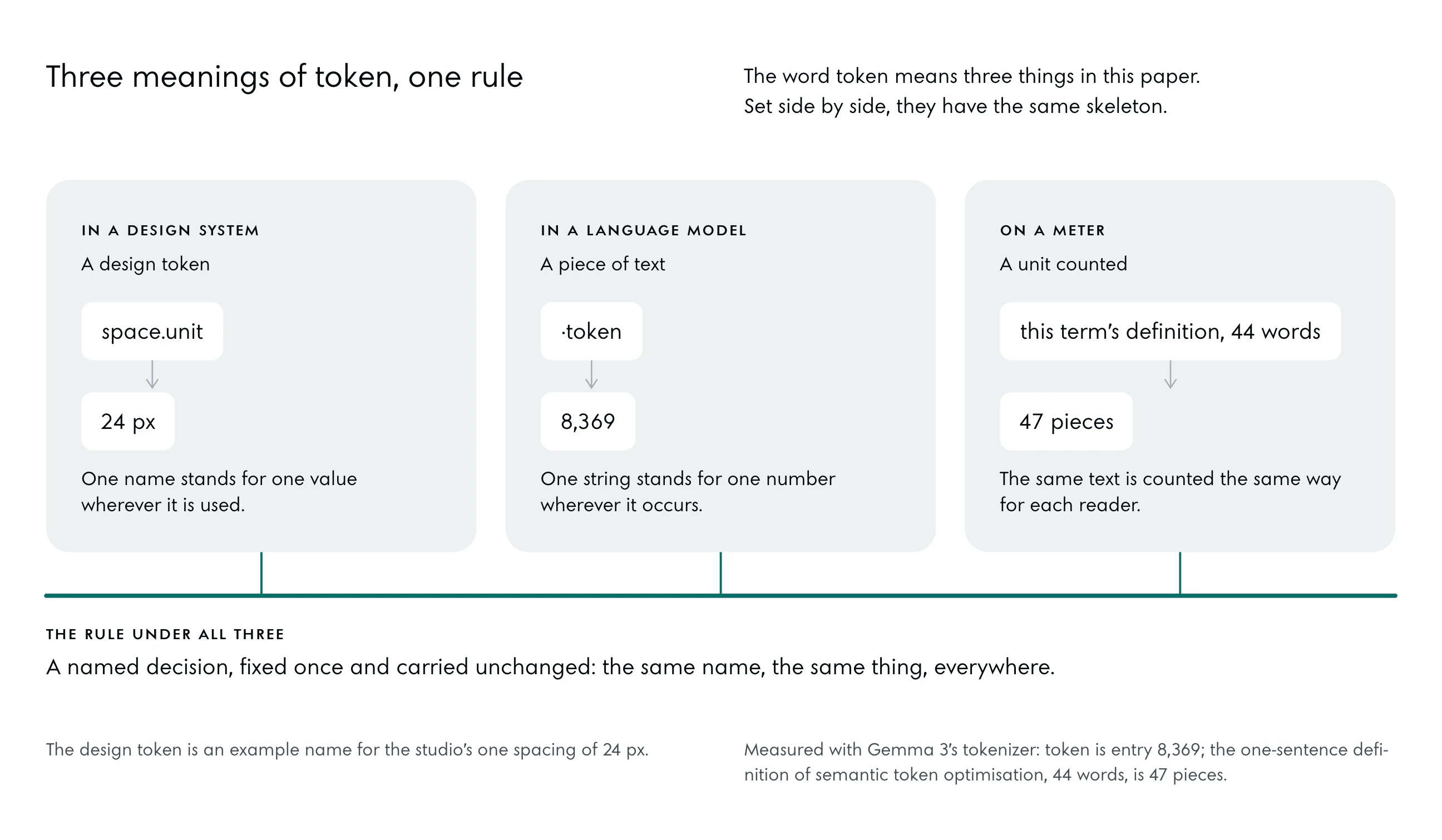
Set the meanings on one sheet and the family likeness shows. In the design system a name stands for one value wherever it is used. The model’s skeleton is identical, with a number standing for one string wherever that string occurs.
And the meter’s part is to count those numbers, the same way for each reader.
Our founder joined the first two in his earliest note on the subject, saying that “semantic tokens merge the system architecture”. That remark is the root of the name of this paper. A firm’s term is a third object with the same skeleton, a name and a meaning that travel together, and the practice asks of a firm’s terms what a design system already asks of colours.
The saving has the same form in both. A design system without tokens often drifts into near-misses of one blue, and someone is paid to find and repaint them. Without a term map a site drifts the same way in the names of its terms, and the firm pays again each time a writer, an editor, an agency or a new page settles a question that was settled before.
So a named decision buys an owner the right to stop deciding.
The rule reaches as far as the term and stops there. A design system fixes each colour and leaves any layout free to use it, and a term map fixes the form of each term and leaves the words around it free to vary, which they should; the part The Gradient at the Size of a Term says why.
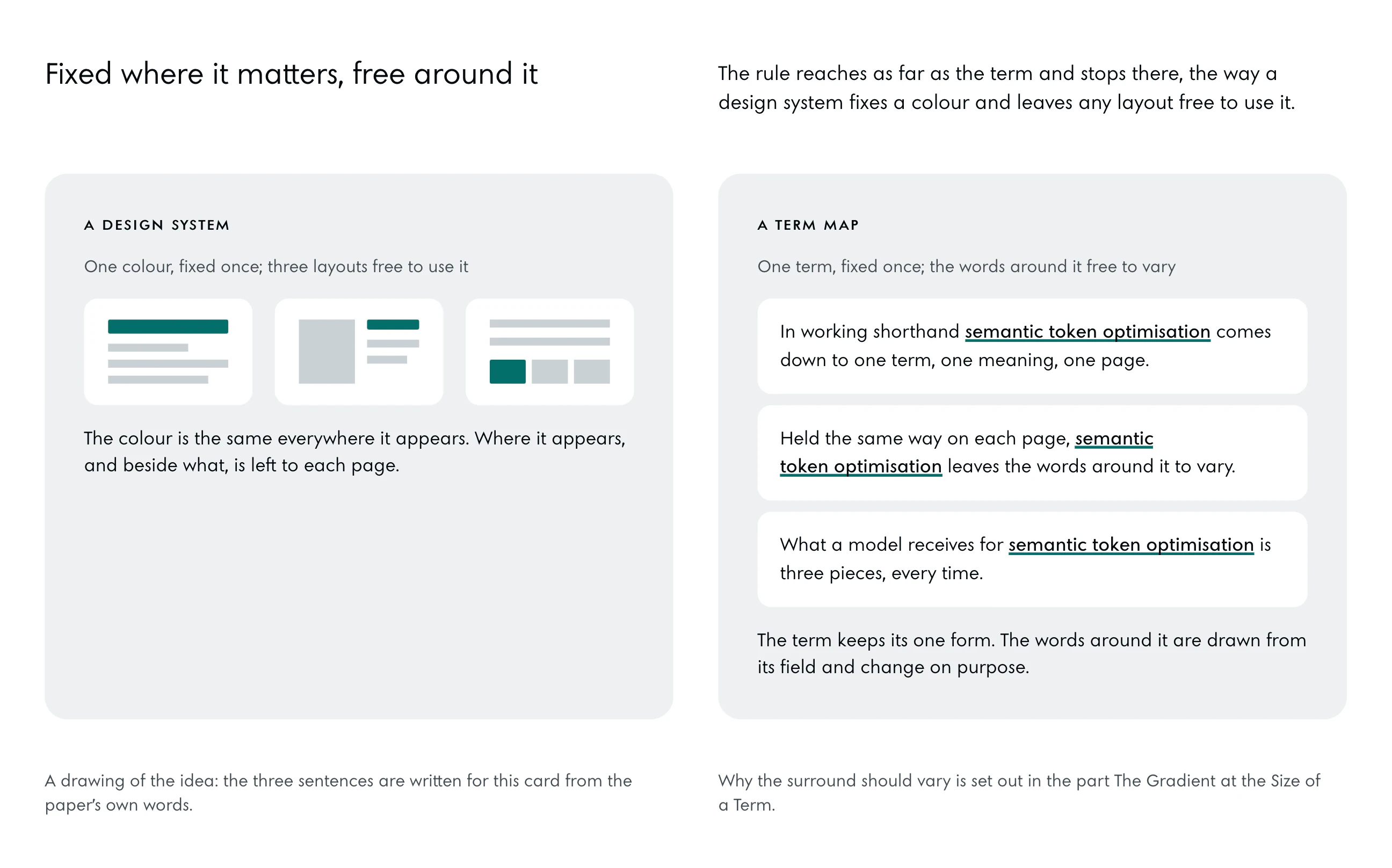
In all three senses a token is a named decision, made once and used unchanged wherever it appears.
04A Coined Name Has No Unit
We made up three phrases in October 2026 and then asked a model’s tokenizer what it had been given.
What came back, measured on 11 October, begins with an absence; a coined term has no unit of its own and exists only as its exact sequence. Two differences follow, because a capital letter changes the pieces and four ways of writing one name are four sequences. From those we draw one line of theory, that a term’s identity is the same words, the same way, each time.
The measurements and the theory are kept apart below. Where the theory could fail, the place is marked.
Borrowed Entries and Nothing New
Before the run we wrote down that we expected four to seven pieces for each phrase. The guess came from a reasonable picture, in which a phrase that had never been written would be shredded into fragments the way a rare surname is. It was entirely wrong.
Each phrase is built from ordinary words, the file has each of those words in lower case as one entry, and so each phrase came back as three.
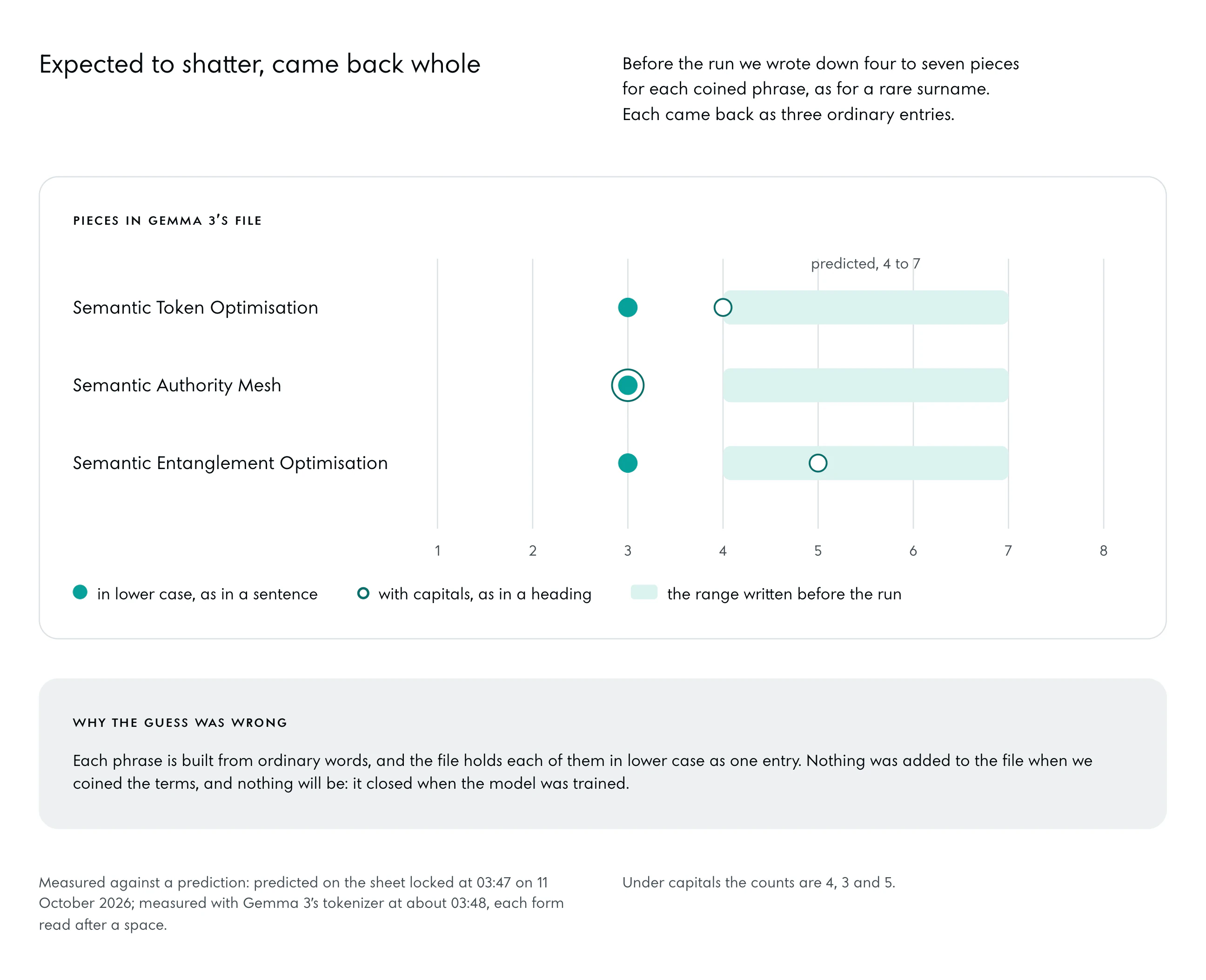
That result is less comfortable than it sounds. A phrase that shattered into odd fragments would at least be distinctive, and one made of three common entries is, at the door, indistinguishable from any other sentence that happens to put those words in that order. Nothing was added to the file when we coined our terms, and nothing will be, because the file was closed on the day the model was trained.
So where does the meaning of a multi-piece name live? It lives inside the model, and it is assembled on the way through. Sheridan Feucht, David Atkinson, Byron Wallace and David Bau, in a paper posted on 28 June 2024, start from the same observation, that “individual tokens are often semantically unrelated to the meanings of the words/concepts they comprise”, and that the meaning of a named entity or a multi-word expression cannot “be directly inferred from their constituent tokens”.
Working on two open Llama models, they found that at the last piece of such a name the model’s early layers show what the authors call an erasure effect, “where information about previous and current tokens is rapidly forgotten”. Their reading is that the model packs the pieces into one working unit there, an item of an implicit vocabulary that no file lists.
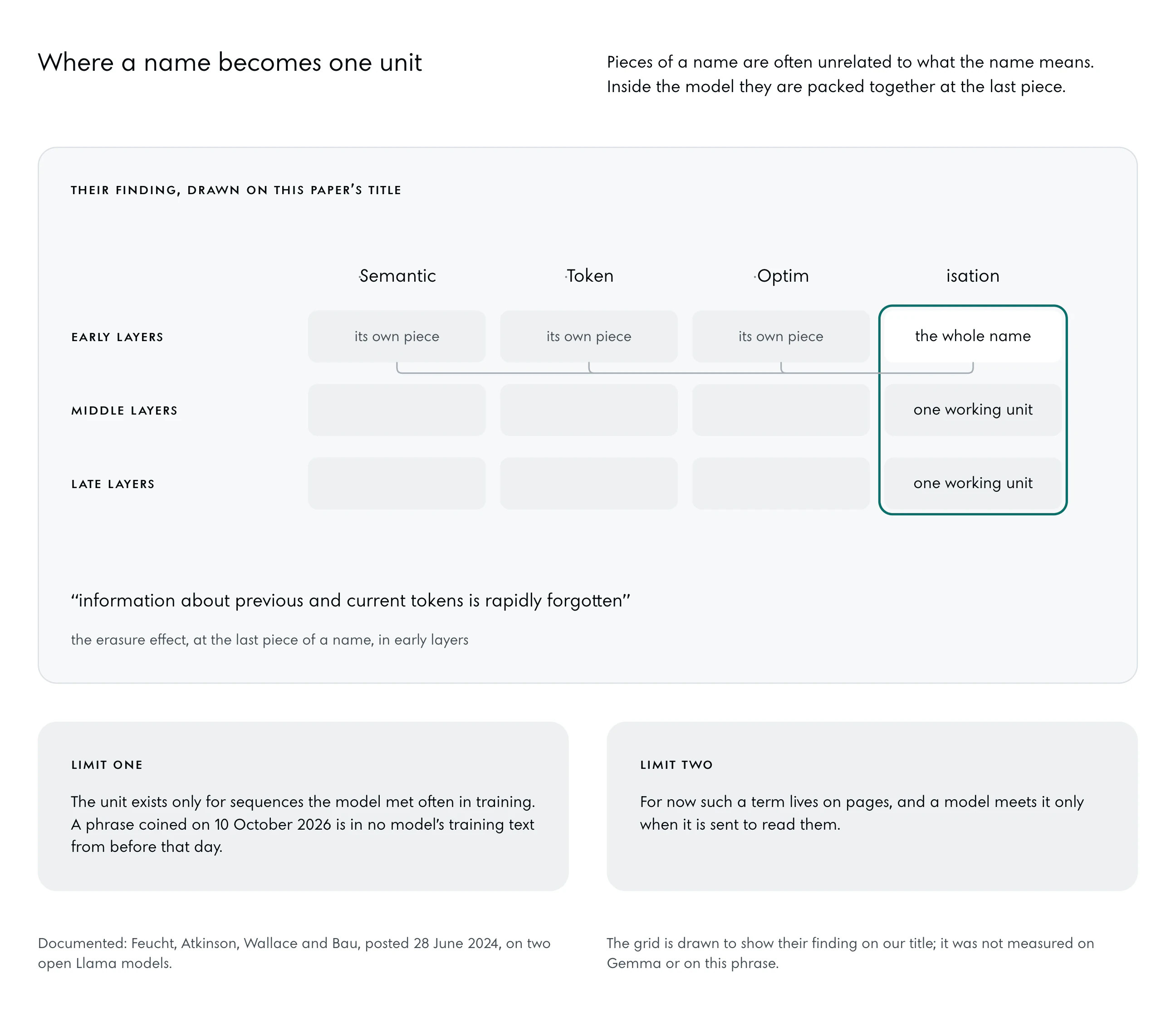
Two limits follow, and both bear on a firm. The implicit unit exists only for sequences the model met often enough in training, and a phrase coined on 10 October 2026 was in the training text of no model released before that day. For now that leaves such a term on pages, and a model meets it only when it is sent to read them.
What a Capital Does
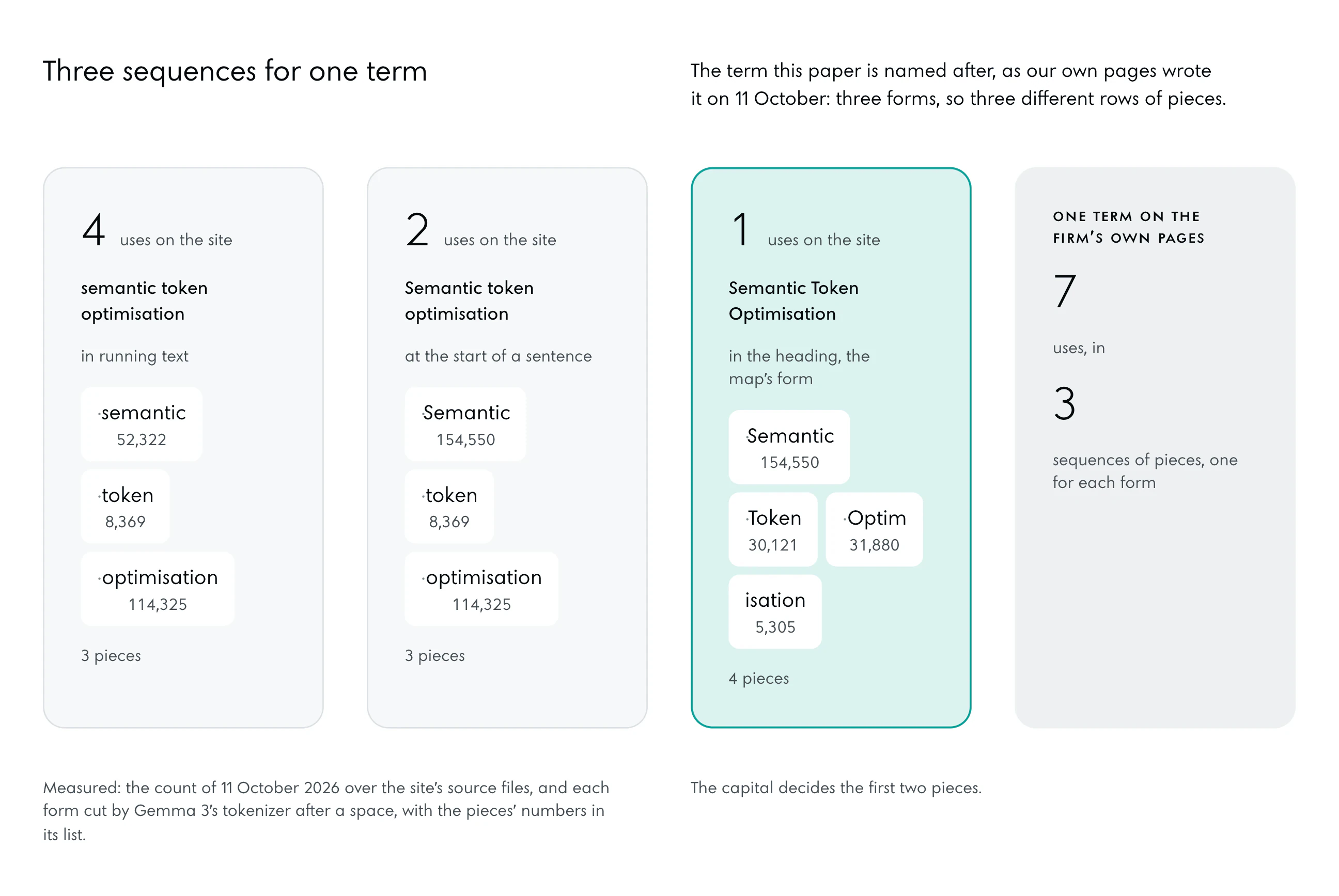
Headings are where a site writes its terms most carefully, and it is in headings that the cut changed. With its capitals, Semantic Token Optimisation is four pieces, Semantic (154,550), Token (30,121), Optim (31,880) and isation (5,305). Set that row against the one in lower case from the earlier part.
Semantic Authority Mesh is still three pieces, though not the same three as before, while Semantic Entanglement Optimisation goes from three pieces to five.
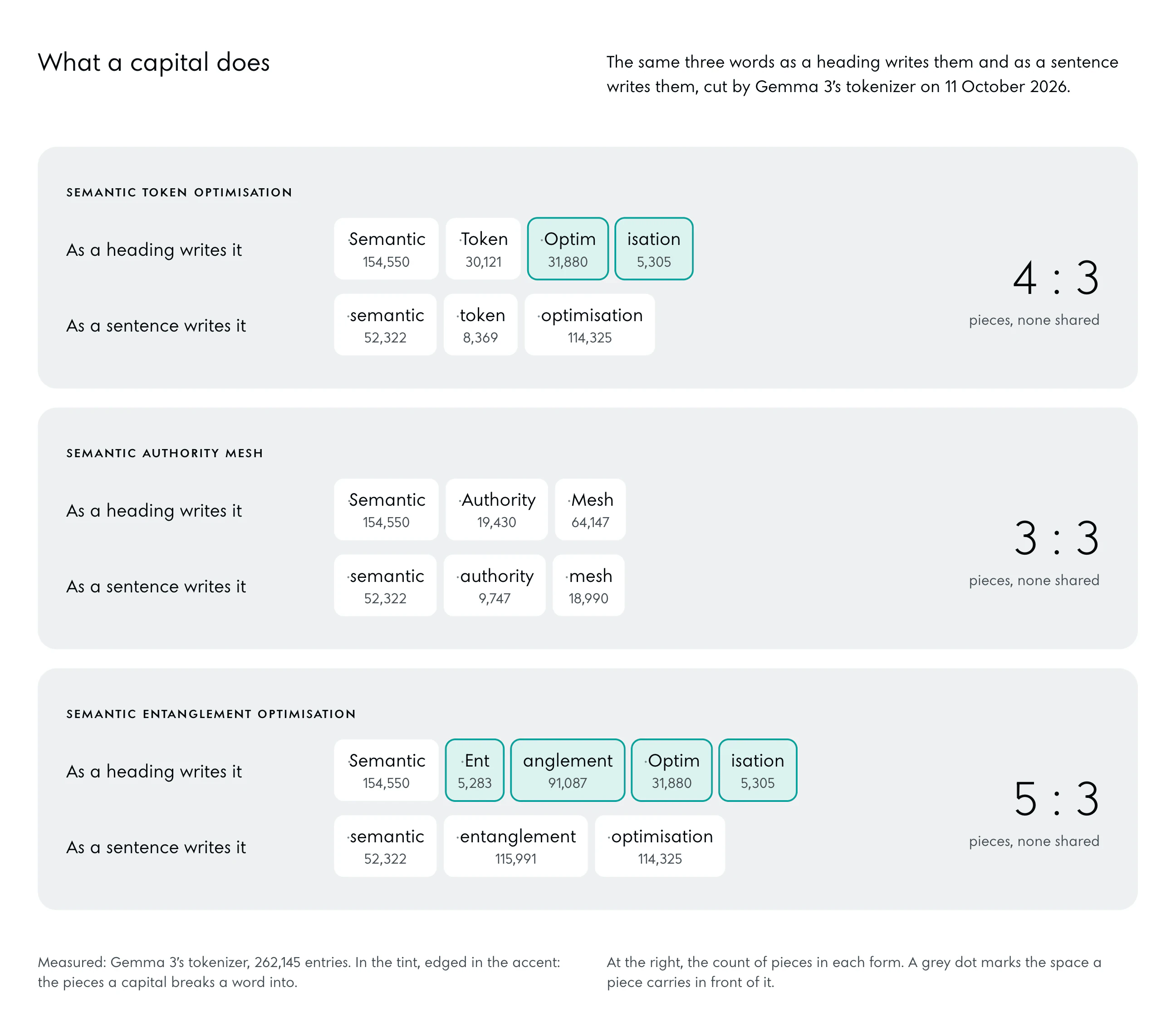
With capitals the title is four pieces, in lower case three, and no piece is shared between the two rows.
The three terms as Gemma 3’s tokenizer cut them on 11 October 2026, each form read as it stands after a space, with each piece’s position in the file beside it.
| Term as written | Pieces and their positions | Count |
|---|---|---|
| semantic token optimisation | semantic (52,322), token (8,369), optimisation (114,325) | 3 |
| Semantic Token Optimisation | Semantic (154,550), Token (30,121), Optim (31,880), isation (5,305) | 4 |
| semantic authority mesh | semantic (52,322), authority (9,747), mesh (18,990) | 3 |
| Semantic Authority Mesh | Semantic (154,550), Authority (19,430), Mesh (64,147) | 3 |
| semantic entanglement optimisation | semantic (52,322), entanglement (115,991), optimisation (114,325) | 3 |
| Semantic Entanglement Optimisation | Semantic (154,550), Ent (5,283), anglement (91,087), Optim (31,880), isation (5,305) | 5 |
Why would one letter do that? The file of a tokenizer is a census of what was frequent in the text it was trained on. Written in lower case after a space, the word was frequent enough to earn an entry, and the capitalised British spelling apparently was less so, which is why the tokenizer builds it from two smaller entries it does hold.
That explanation follows from how such files are made, as the research in the earlier part describes. It is an inference about the file, because the training text is unpublished.
British and American Spellings
We write optimisation with an s, and before the run we expected to pay for it everywhere. Would the British spelling cost more? The sheet said that the US form would take fewer pieces in each position.
Half of that held. In lower case the British word (114,325) and the US word (18,088) are one piece each. So in a sentence the choice is free.
With a capital the British word breaks in two, Optim and isation, while the US word stays whole at entry 62,840.
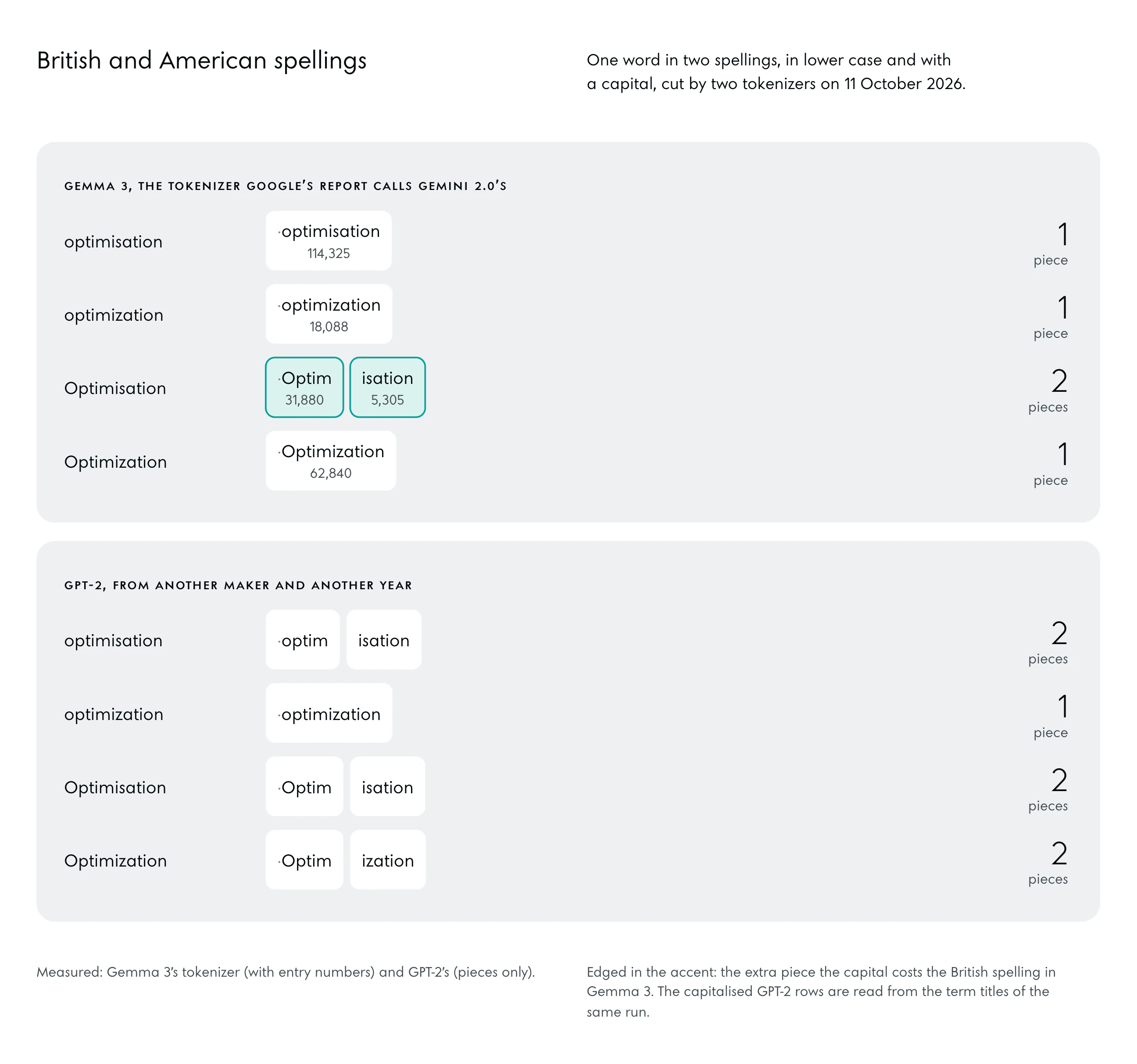
GPT-2’s scheme, from another maker and another year, treats the British word in lower case less kindly, with two pieces there against one for the US form. So the cost of a spelling depends on the reader. A firm publishes for readers that it will never get to choose.
An owner should take from one piece in a title mostly a lesson about identity. The decision that matters is to choose one spelling and hold it, because a site that mixes the two has doubled the forms of each term that contains the word.
One Name in Several Forms
An en dash sits between Noo and Studio. Almost no one outside the firm types one. People write a hyphen or a space, and some put the first half in capitals.
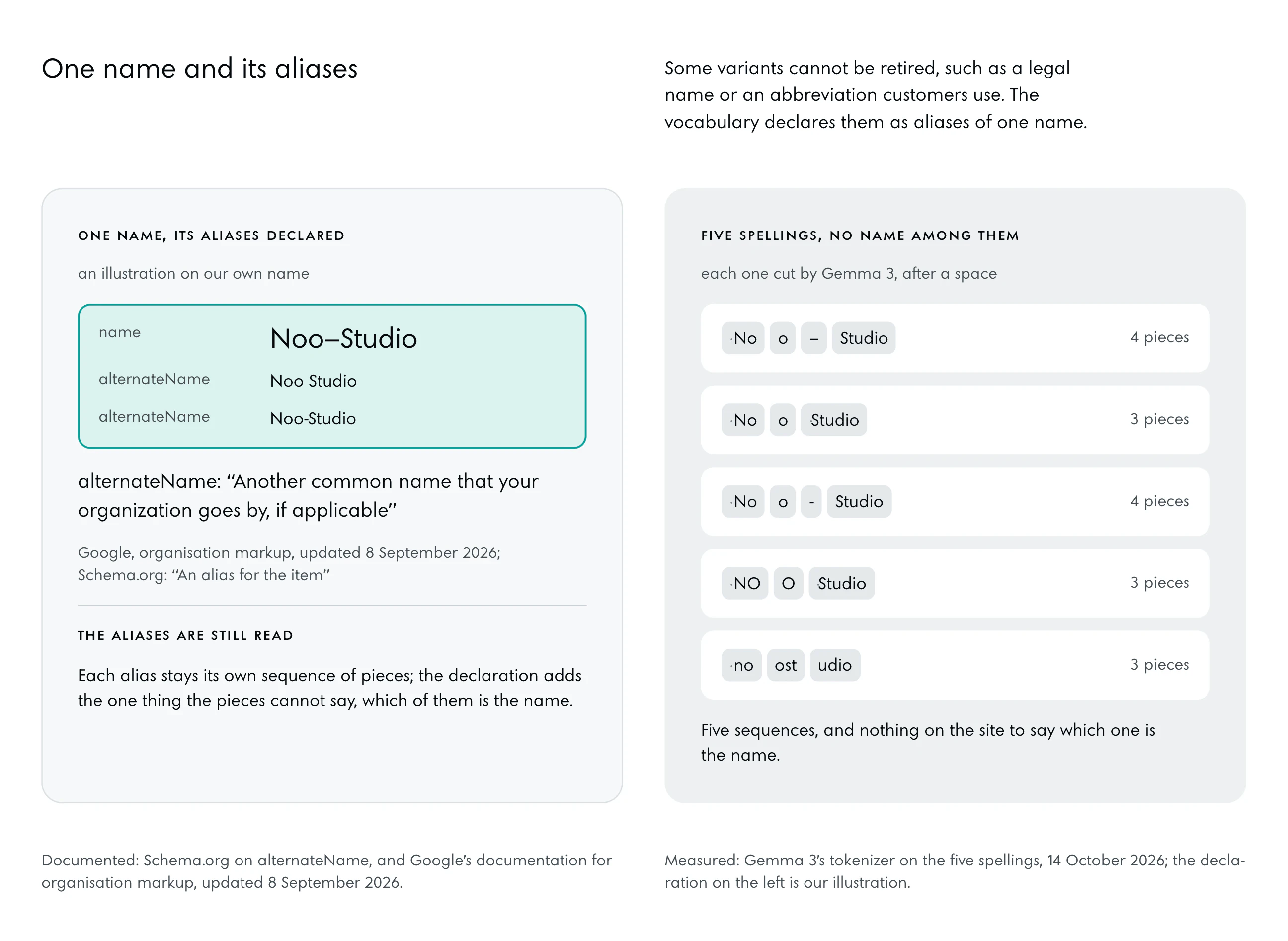
What did each of those give the tokenizer? With the en dash the row is No (2,301), o (236,748), the dash (236,964), Studio (42,776). A hyphen leaves that row as it is except for the hyphen itself (236,772).
Written with a space the name is No, o and then Studio read together with its space (18,605), and in capitals with a space it becomes NO (9,424), O (236,806), Studio (18,605).
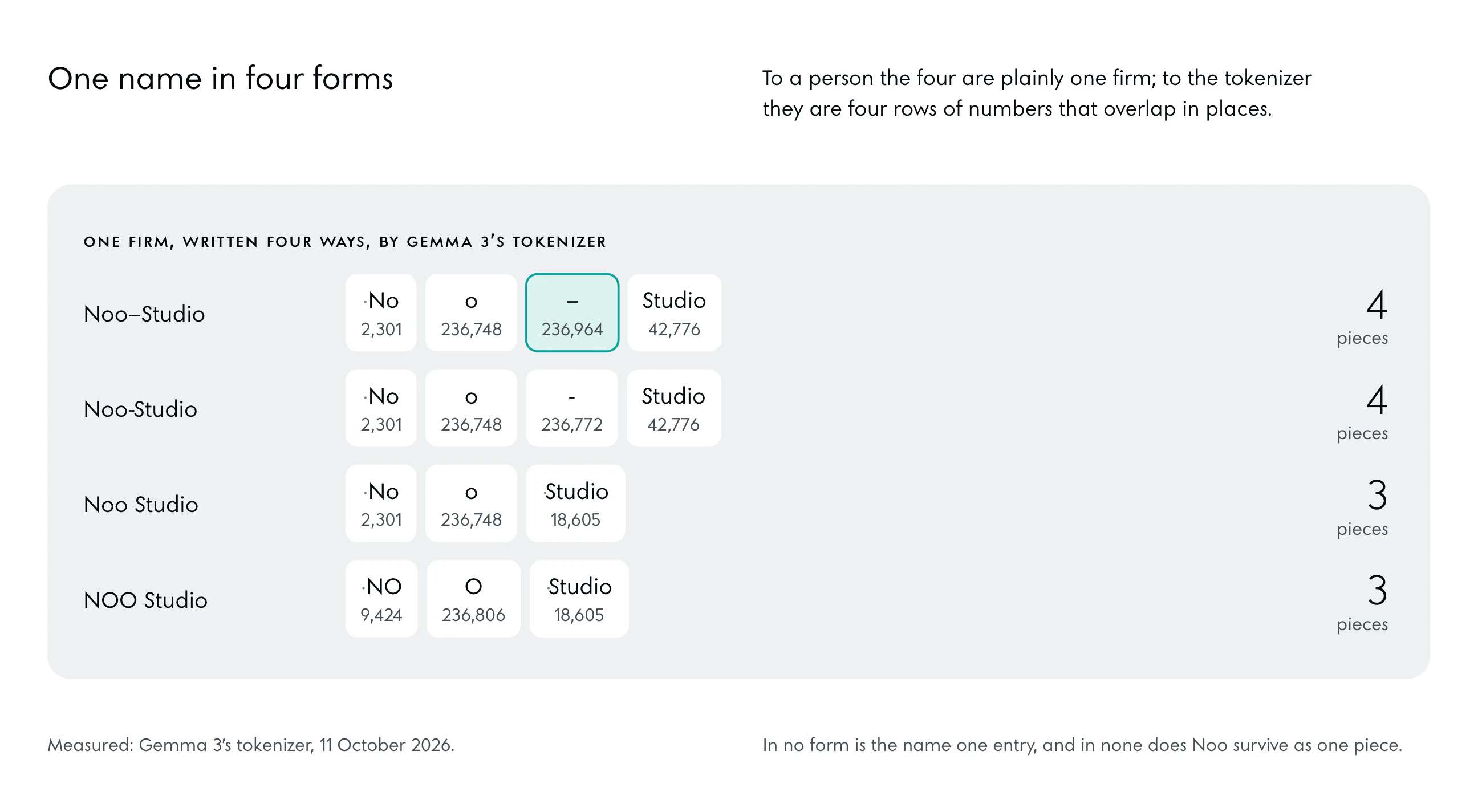
The dash and the hyphen give four pieces and the two spaced forms give three, with no two rows alike. Notice also what never happens; in none of the forms is the name one entry, and in none does Noo survive as one piece. To a person the four are plainly one firm, and to the tokenizer they are four rows of numbers that overlap in places.
Has the model, further in, learned to treat the rows as one? Training text decides that, and a name so young has had little of it.
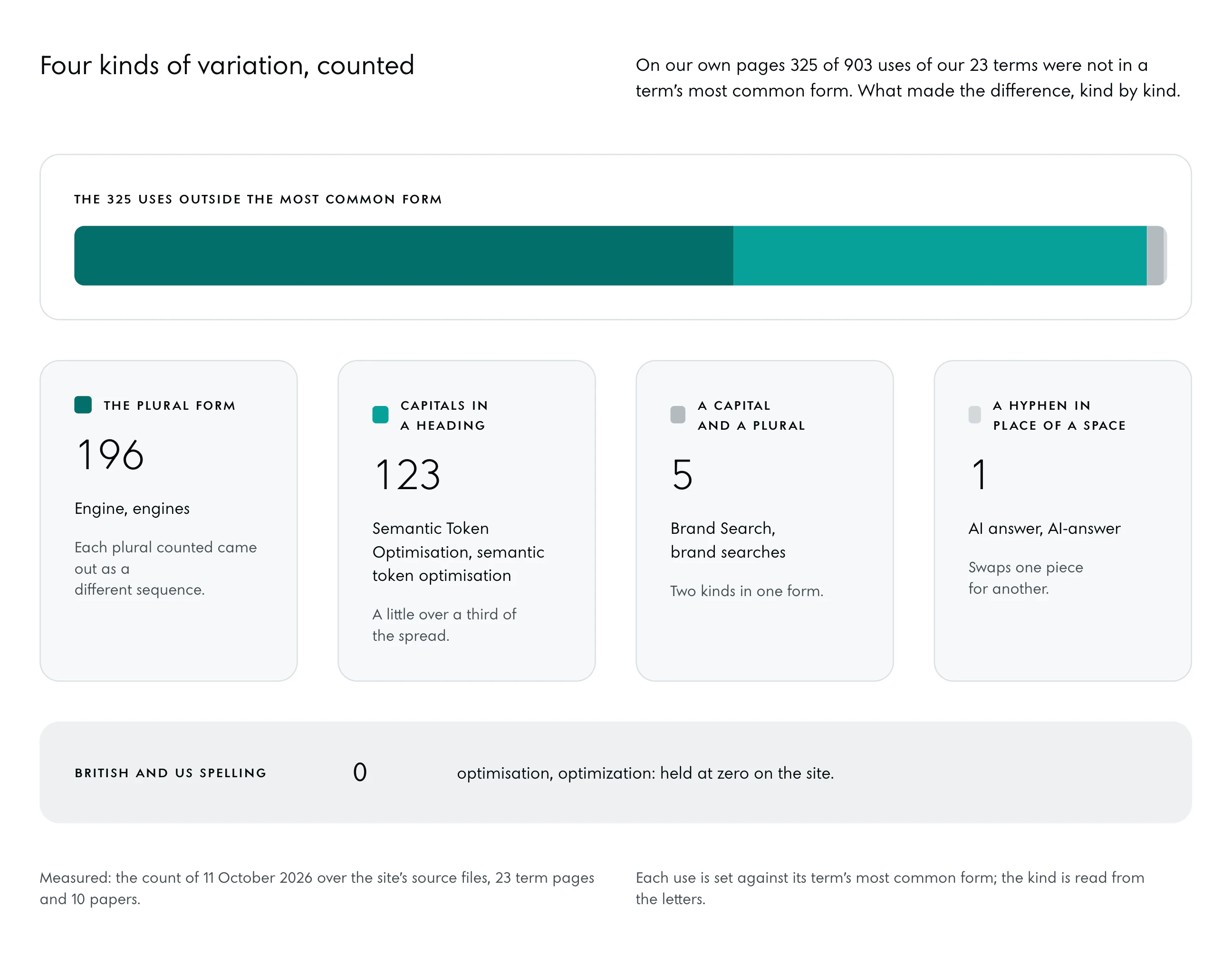
How many rows does your own firm have? Think of the legal suffix that appears on invoices and vanishes on the home page, the ampersand that turns into the word and, the product name set in capitals on the packaging and in lower case in the help pages, the brand that is one word in its logo and two in its web address. The kinds of variation are very few; counting our pages, as a later part reports, we kept meeting the same ones.
- Capitals in a heading against lower case in a sentence make a little over a third of the spread counted on our pages.
- The plural form accounts for most of the rest, and each plural counted came out as a different sequence.
- A hyphen or a dash in place of a space swaps one piece for another, as our name shows.
- British and US spelling of one word is the only kind the site holds at zero, and mixed spelling doubles each term that carries the word.
Each kind on that list is a form of the name itself, and the count was made on those forms alone. The words a firm writes around its name, and around each of its terms, were never counted here and fall outside the rule; they vary on purpose, for reasons the part The Gradient at the Size of a Term sets out.
What the Older Engines Tidied Away
A search system of the textbook era would have erased most of these differences before anyone saw them. The 2008 textbook quoted earlier calls the step “normalization”, which it defines as “the process of canonicalizing tokens so that matches occur despite superficial differences in the character sequences of the tokens”, and gives a hyphen as its example, “the tokens anti-discriminatory and antidiscriminatory are both mapped onto the term antidiscriminatory”. For capitals the same book describes case-folding, “reducing all letters to lower case”, notes the price, that “Many proper nouns are derived from common nouns and so are distinguished only by case”, and still concludes that “lowercasing everything often remains the most practical solution”.
In that world the engine did a firm’s housekeeping. A hyphen here and a capital there ended up as one dictionary entry. Careless sites were forgiven at the door.
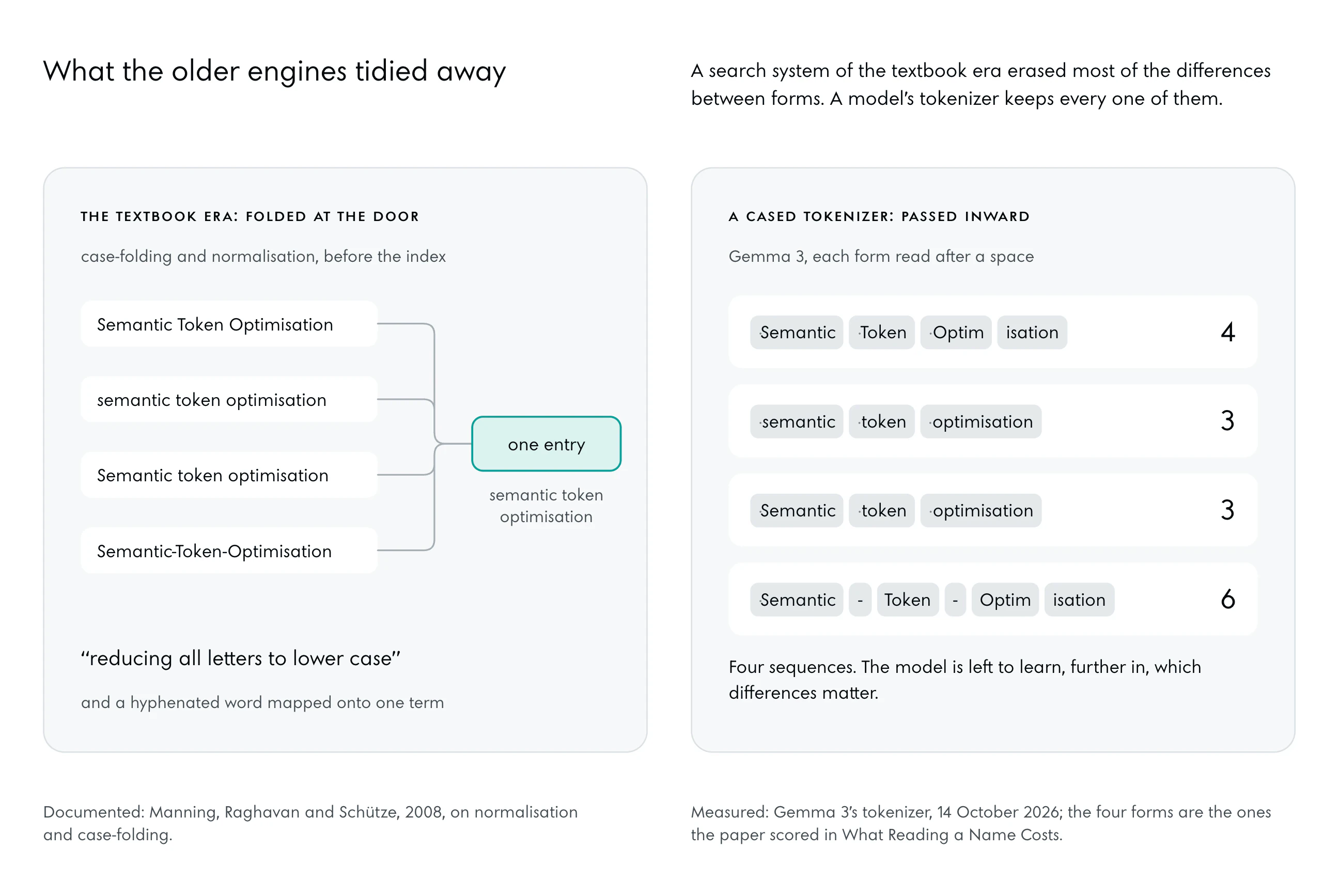
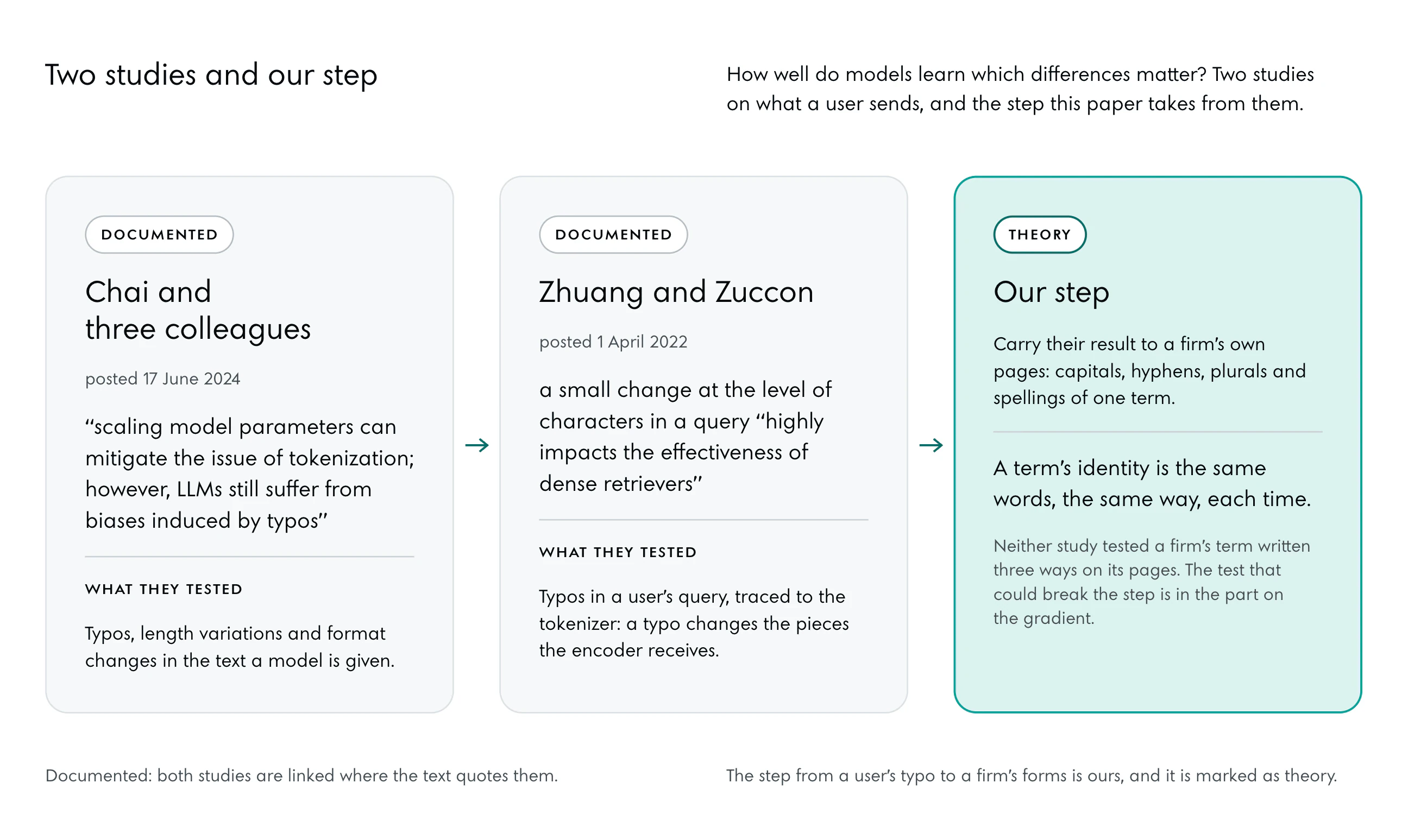
A cased tokenizer passes each difference inward and leaves the model to learn which differences matter. How well do models learn it? Yekun Chai and three colleagues, in a paper posted on 17 June 2024, describe tokenisation as “inherently sensitive to typographical errors, length variations, and largely oblivious to the internal structure of tokens”.
What they found is mixed, and in their words “scaling model parameters can mitigate the issue of tokenization; however, LLMs still suffer from biases induced by typos and other text format variations.” Shengyao Zhuang and Guido Zuccon, in a paper posted on 1 April 2022, found that a small change at the level of characters in a query “highly impacts the effectiveness of dense retrievers”, and traced the cause to the tokenizer, where a typo changes the pieces that the encoder receives.
Both studies concern typos and format changes in what a user sends. Neither tested a firm’s term written three ways on its pages. Carrying their result over to capitals, hyphens, plurals and spellings is our step, and it is theory; a term’s identity is the same words, the same way, each time, and a site that holds to that probably gives a model less to reconcile.
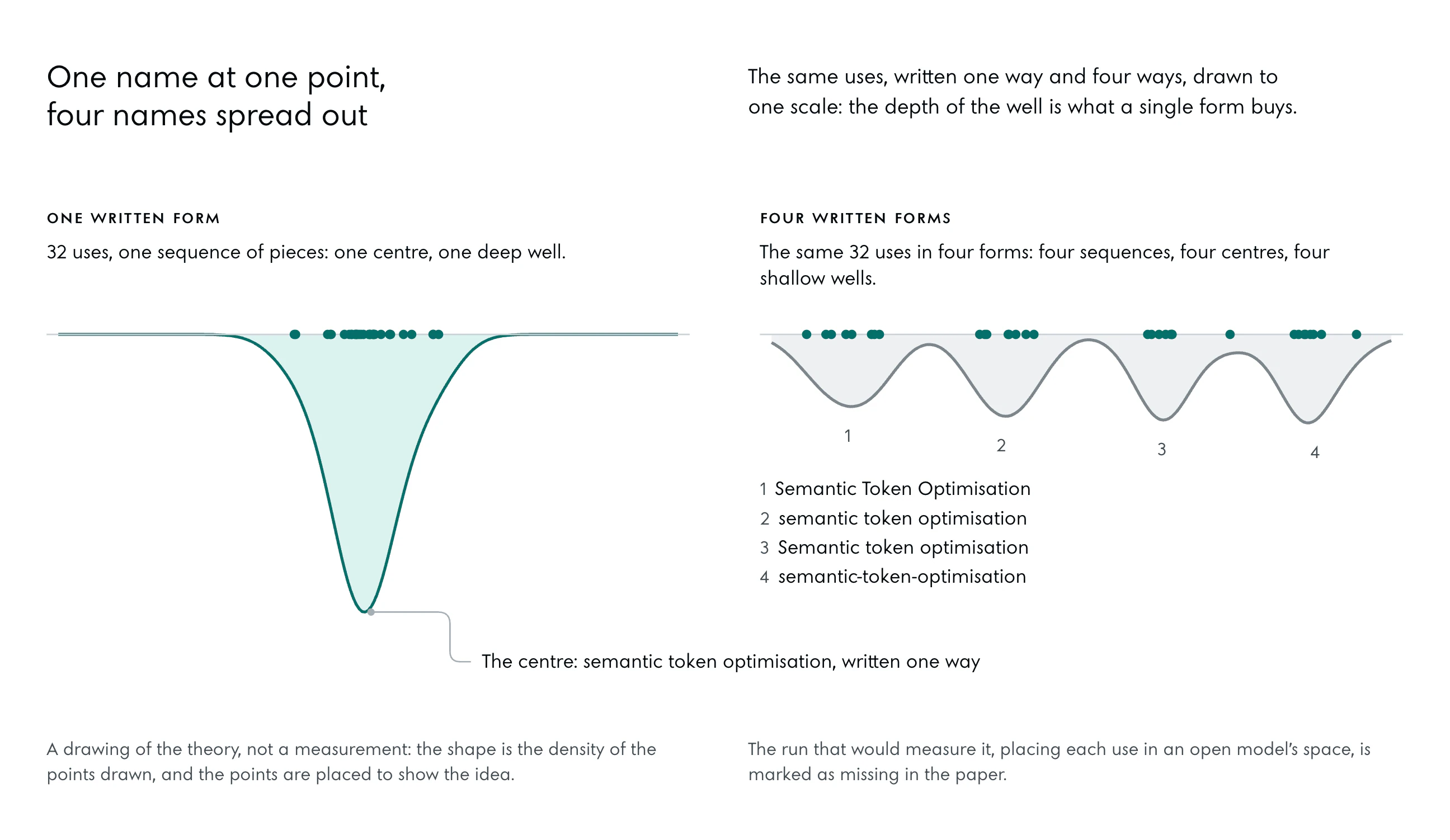
[NEED: uses placed in an open model’s space, one written form against several.] The drawing above shows the idea and is labelled as a drawing until that run has been made. It is also the test that could break the theory, because if four written forms of a name land as close together as four uses of one form, then the model has already done the old engine’s housekeeping, and the letter of a term matters less than this part supposes. And what does any engine do with two sequences for one term?
Only the engines can say, and this paper leaves the matter open.
A coined term has no entry in a model’s fixed list, so the model has it only as an exact sequence of pieces, and a capital, a hyphen, a plural or another spelling makes a different sequence.
05Evidence Kept Under Separate Labels
Google has described, in public and under its name, a search system that works on meaning. A court has described the same system from sworn testimony.
And a file of internal documentation that reached the public in 2024 names some of what that system stored. Here we quote each for what it says and keep the kinds apart, and none of them shows a weight.
Google’s Published Word
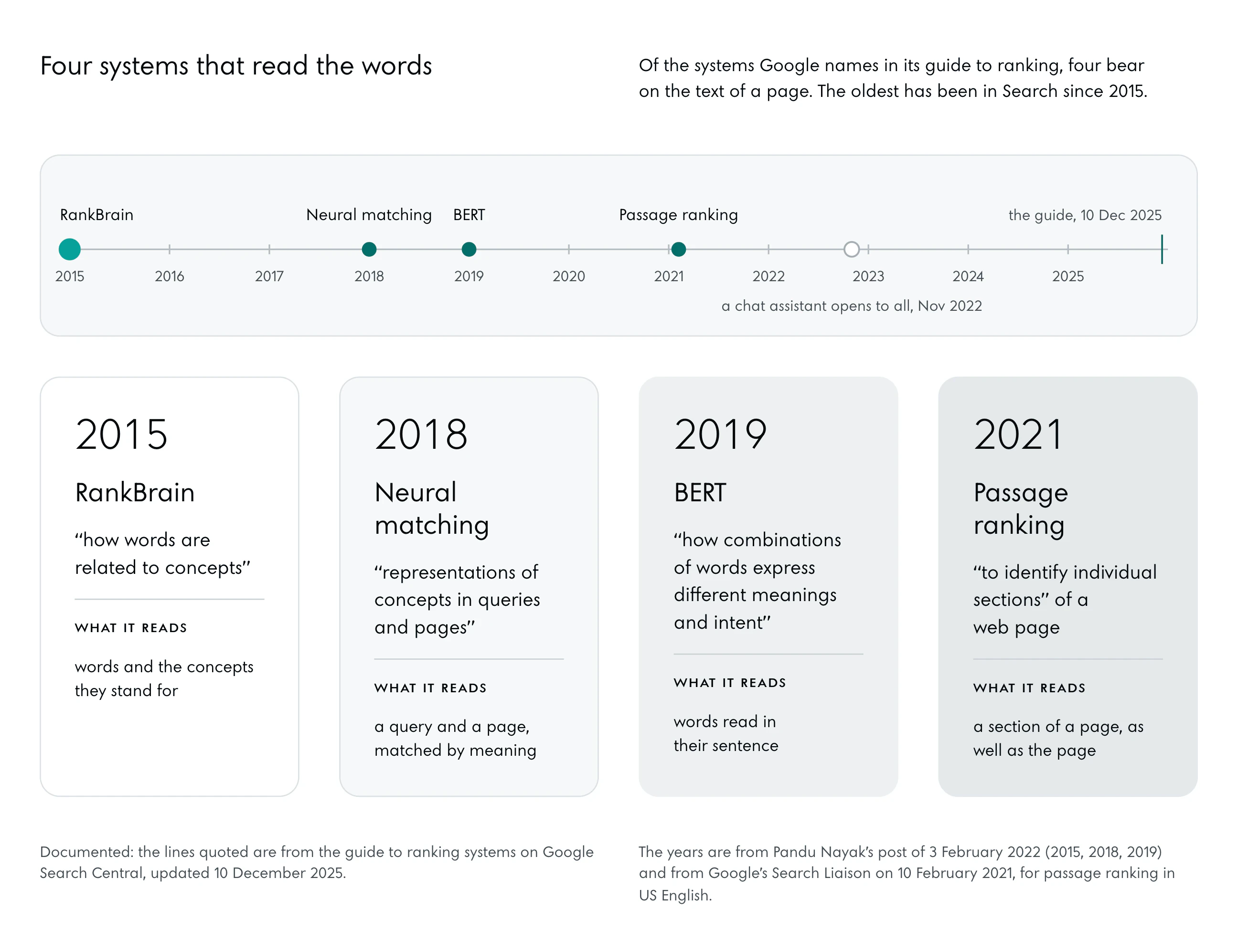
The guide to ranking systems on Google Search Central, last updated on 10 December 2025, is the list of systems that Google is willing to name. Which of its entries bear on the text of a page? Four do, and the oldest is put this way, “RankBrain is an AI system that helps us understand how words are related to concepts. It means we can better return relevant content even if it doesn’t contain all the exact words used in a search, by understanding the content is related to other words and concepts.” The next reads, “Neural matching is an AI system that Google uses to understand representations of concepts in queries and pages and match them to one another.” BERT is described as “an AI system Google uses that allows us to understand how combinations of words express different meanings and intent.” And passage ranking is a system used “to identify individual sections” of a web page, which the guide calls passages, “to better understand how relevant a page is to a search”.
How old is it? Older than the chat assistants by some years. Pandu Nayak, a Google Fellow and the company’s Vice President of Search, wrote on 3 February 2022 that “When we launched RankBrain in 2015, it was the first deep learning system deployed in Search”, and that it “helped us understand how words relate to concepts”.
In the same post he adds, “Today, BERT plays a critical role in almost every English query.” The founder’s remark that Search “was using already AI systems way before AI was accessible to the public” is, on that point, simply what Google published.
Answers are the subject of the newest published line. Google’s page on AI features, also updated on 10 December 2025, says that AI Overviews and AI Mode may use a technique that it calls query fan-out, “issuing multiple related searches across subtopics and data sources” to develop a response. The developer documentation for Gemini shows the same behaviour from the other side.
When a model is allowed to search, “the model automatically generates one or multiple search queries and executes them”. One question from a person becomes several questions from a machine, and each of them lands on some page.
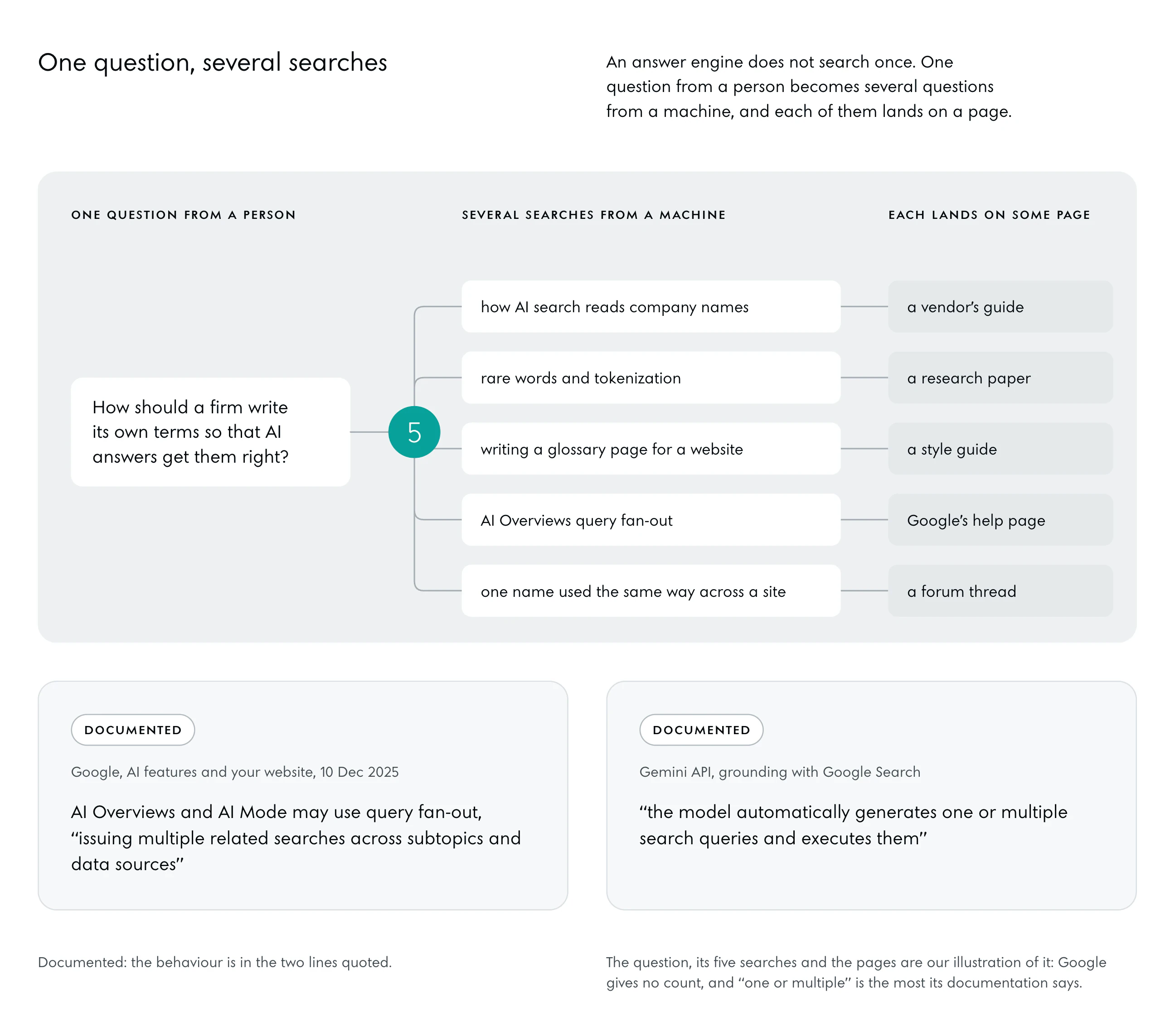
These lines are documented, and what they say is that the systems relate words to concepts, they judge a section of a page as well as the page, one question can fan out into many searches, and the first of those abilities has been in production since 2015.
What a Court Found
Why should a judge’s opinion have a label all of its own? Sworn testimony is not the same kind of source as a help page, because the witness can be cross-examined and a judge decides what was proved. The memorandum opinion filed on 2 September 2025 in United States v. Google, 230 pages long, has findings on a ranking model that Google’s own public pages do not name. Page 158 reads, “RankEmbed and its later iteration RankEmbedBERT are ranking models that rely on two main sources of data”, namely a share of 70 days of search logs, with the share itself blacked out in the public copy, and scores from human raters. The opinion continues, “The RankEmbed model itself is an AI-based, deep-learning system that has strong natural-language understanding. This allows the model to more efficiently identify the best documents to retrieve, even if a query lacks certain terms.” It also quotes an exhibit in support, “Embedding based retrieval is effective at semantic matching of docs and queries”.
Two further findings connect that model to the answers an assistant gives. On page 39 the court found that “To ground its Gemini models, Google uses a proprietary technology called FastSearch”, that FastSearch “is based on RankEmbed signals”, and that it “generates abbreviated, ranked web results that a model can use to produce a grounded response”. And on page 162 the court quotes Nayak’s testimony, “RankEmbedBERT was again one of those very strong impact things, and it particularly helped with long-tail queries where language understanding is that much more important.”
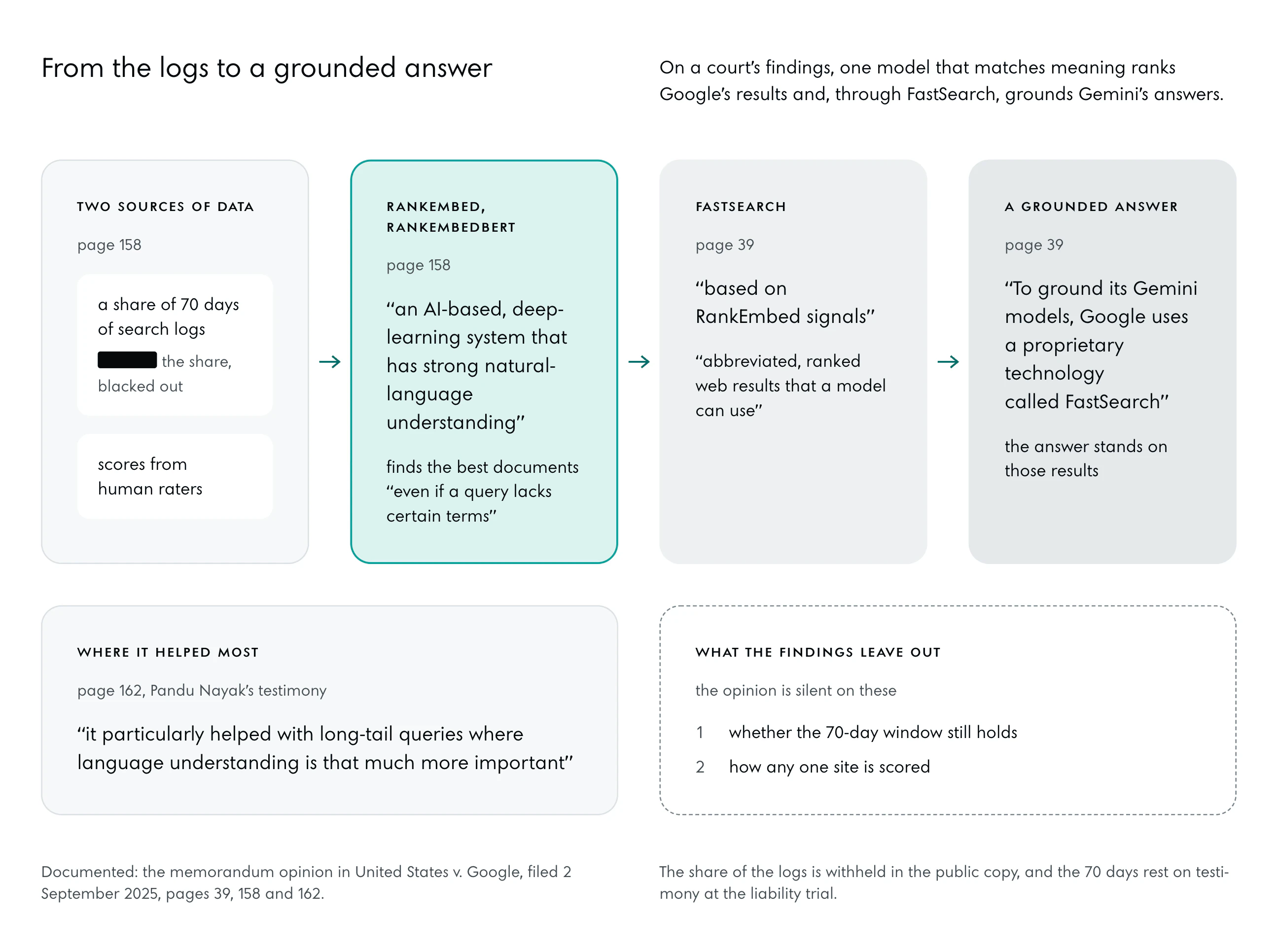
That testimony meets something our founder said about where the practice does its work, on what he called “informational queries, which, you know, consistently AI is consuming”. With long questions, asked once in the asker’s phrasing, an exact keyword match is least likely to exist, and there, on the court’s finding, the model that matches meaning helped most.
How far can the figure of 70 days be leaned on? It rests on testimony given at the liability trial, and the share of the logs is withheld. Whether the window is the same today, the opinion leaves unsaid.
What the findings give is narrow and solid. Google ranks with a model that matches meaning where the words differ, and its assistant’s answers are grounded through signals of that same model. On how any one site is scored, the findings quoted here are entirely silent.
The Documentation That Leaked
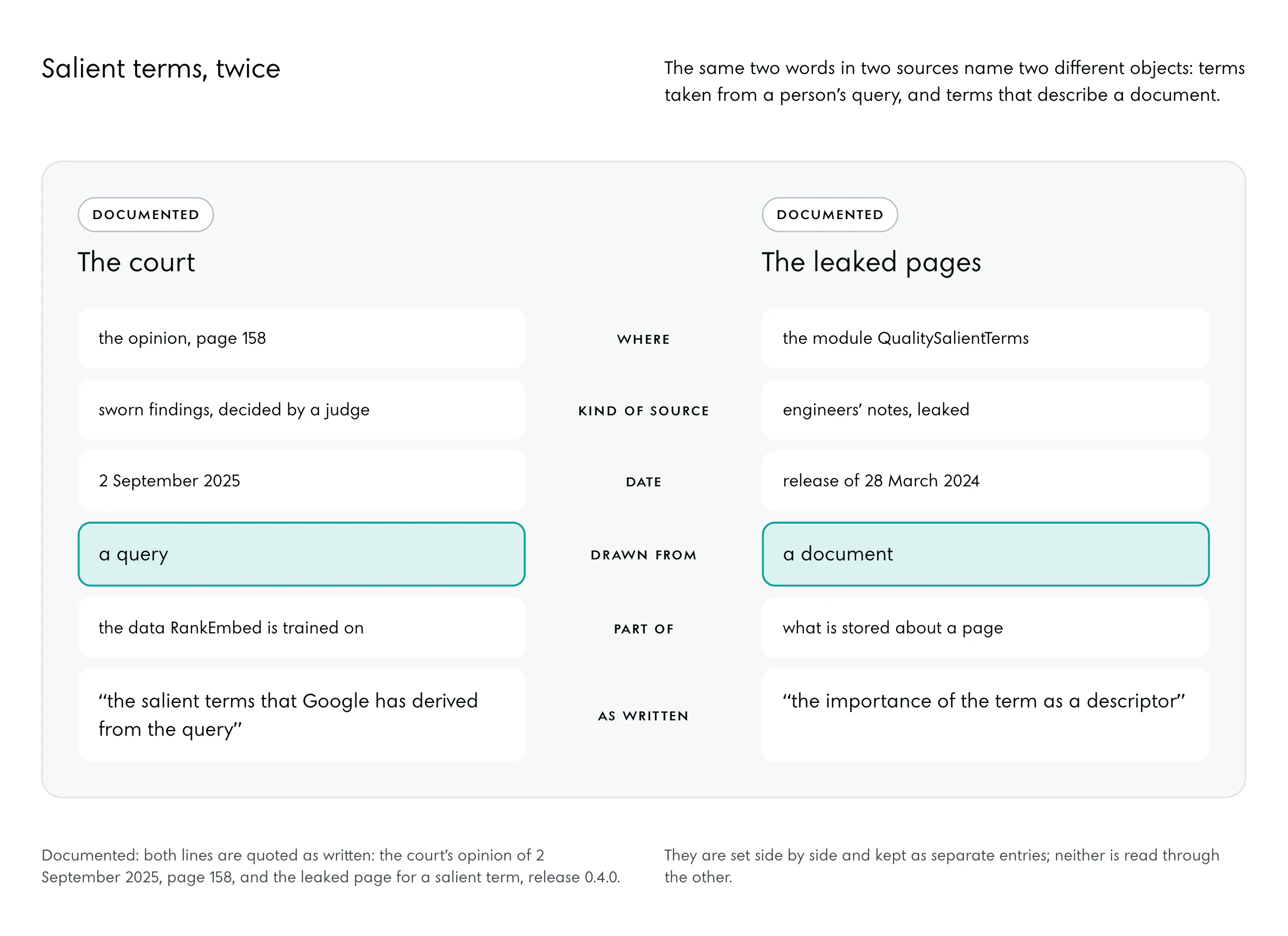
Around 13 March 2024 an automated account committed a set of reference pages to a public code repository of Google’s, and with a commit of 7 May 2024 they were taken out again. They describe an internal interface, which is called Content Warehouse. A package registry, Hex, still serves the release that is dated 28 March 2024, version 0.4.0, and when we parsed that release it had 2,593 model modules and 14,031 attributes.
Are they what they appear to be? Google is reported to have confirmed them as genuine; Mezha’s report of 30 May 2024, which credits The Verge, quotes a spokesperson cautioning against “inaccurate assumptions about Search based on out-of-context, outdated, or incomplete information”.
The caution is fair, and this paper follows it fully. What do the pages hold? Field names and one-line descriptions, written by Google’s engineers, of what the systems stored about a document and a site in March 2024.
Weights are absent, and so is any word on which fields were in use. So each line below is quoted as a description of storage on that date and as nothing further.
One module describes what it calls salient terms. Its page lists a normalised term and then, in a second field, “the different ways we found this normalized term in the signals”. A third field is a salience, “the importance of the term as a descriptor”, given as a number between 0 and 1, and a fourth holds data that the page calls signal-specific, with body text and anchors among its examples.
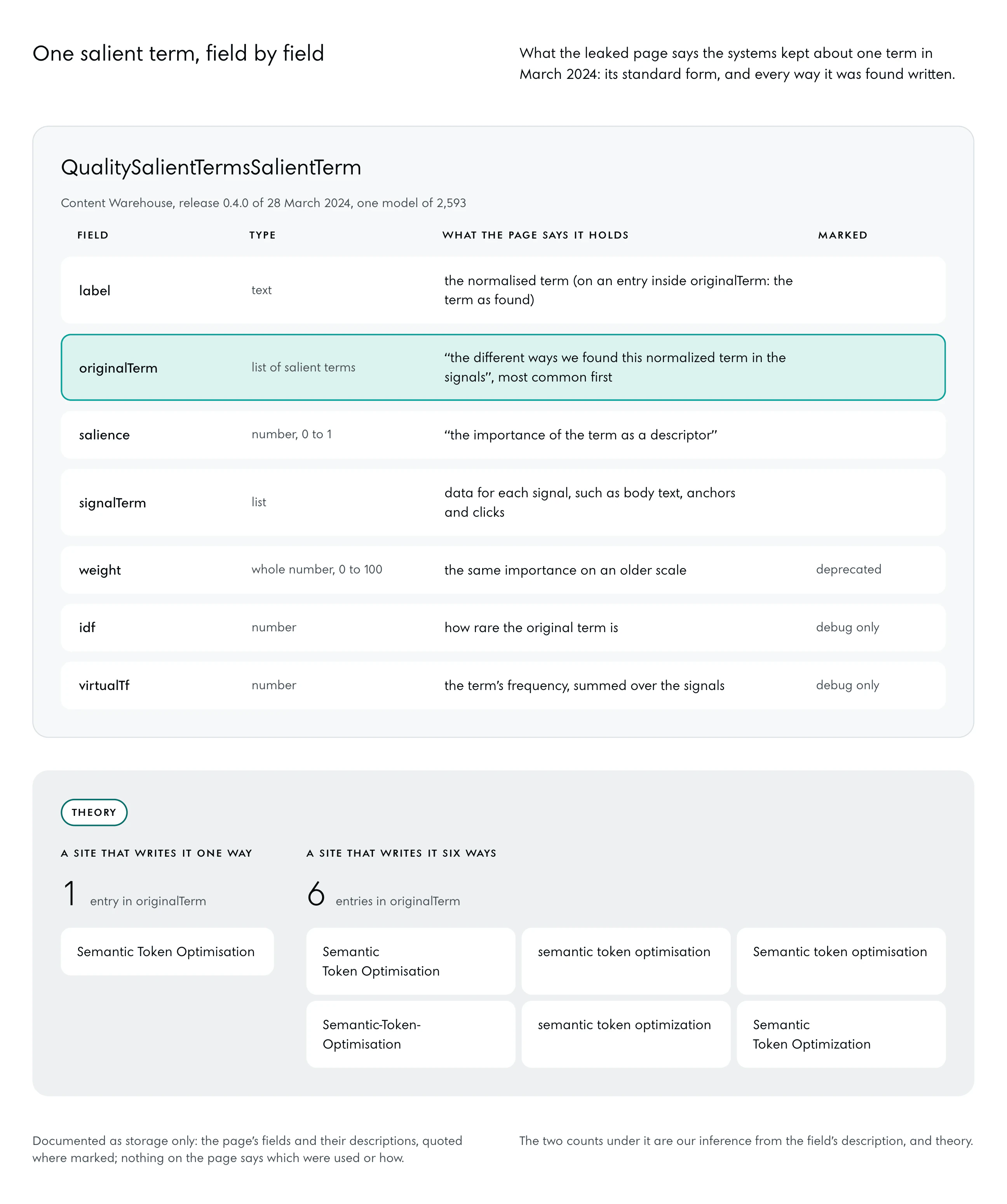
Read as plain storage, that is the textbook’s dictionary term with a memory attached, one standard form with each way the form was found written beside it. What would the habits of a site add to such an entry? On that description a site that writes a term one way would add one item to the second field, and a site that writes it six ways would add six.
The inference is ours. What the systems did with a long list or a short one, the page leaves unsaid.
A second module, the one that holds data for each document, carries a line that touches the subject of this paper by name, “The body words over tokens ratios for the beginning part and whole doc.” So a ratio of words to tokens was stored for the body of a document. Which tokenizer produced those tokens, and what the ratio was used for, the page omits. A similar ratio, measured on our papers in a later part, borrows nothing from that line except the thought that somebody found the ratio worth storing.
As for how current any of it is, the file describes March 2024. AI Overviews opened to everyone in the United States two months later, and AI Mode arrived in 2025. No one outside Google can say which fields still exist or how they are weighted, let alone what has replaced them.
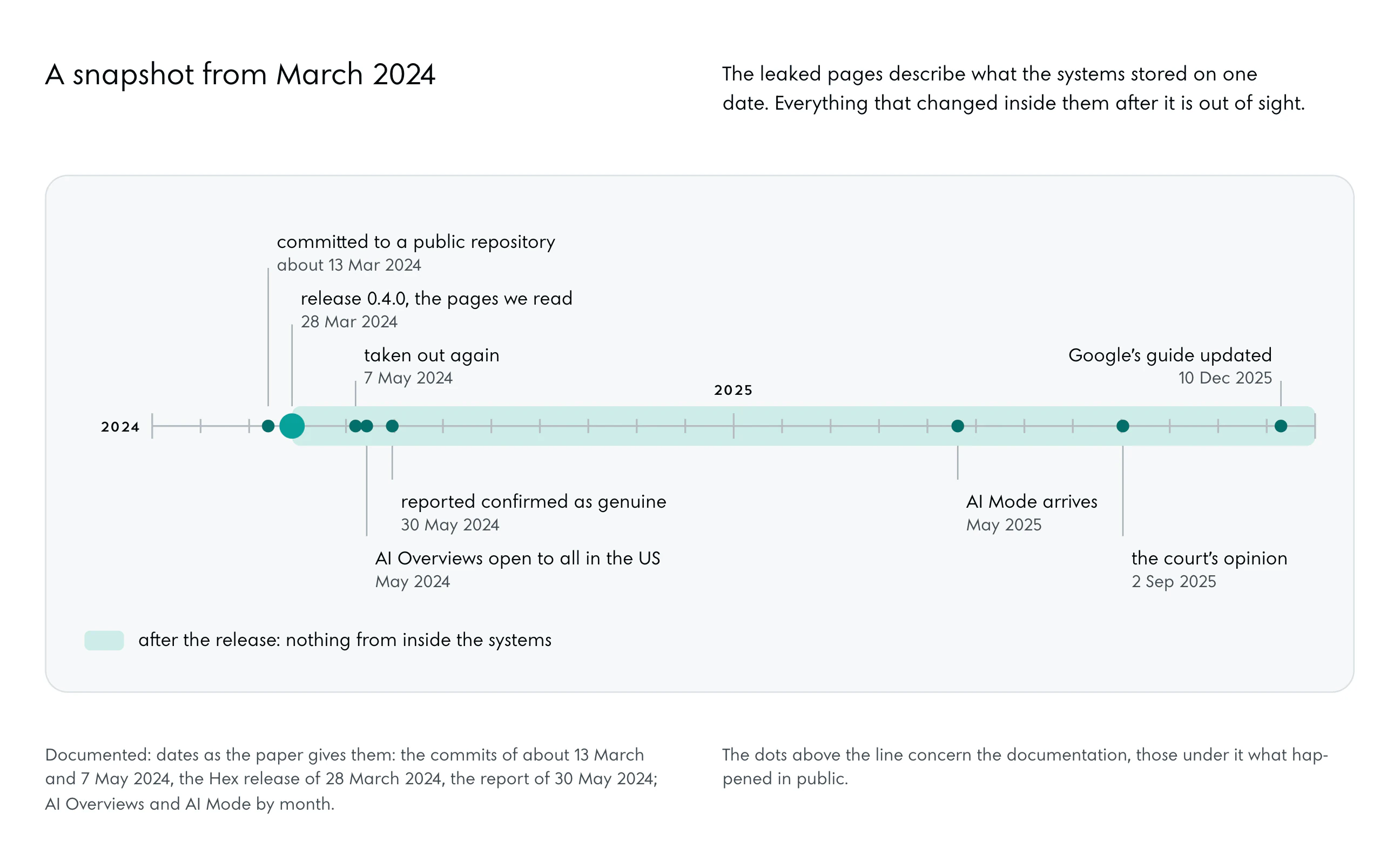
One coincidence of vocabulary has to be handled with care. The court’s opinion, on page 158, also speaks of “the salient terms that Google has derived from the query” among the data that RankEmbed is trained on. It is the same two words for a different object under a different label; the court describes terms drawn from a query, in sworn findings, and the leaked page describes terms that characterise a document, in engineers’ notes.
They are set beside each other here and kept as separate entries.
What No Outsider Can See
Put the kinds on one card and the gaps are as plain as the lines.
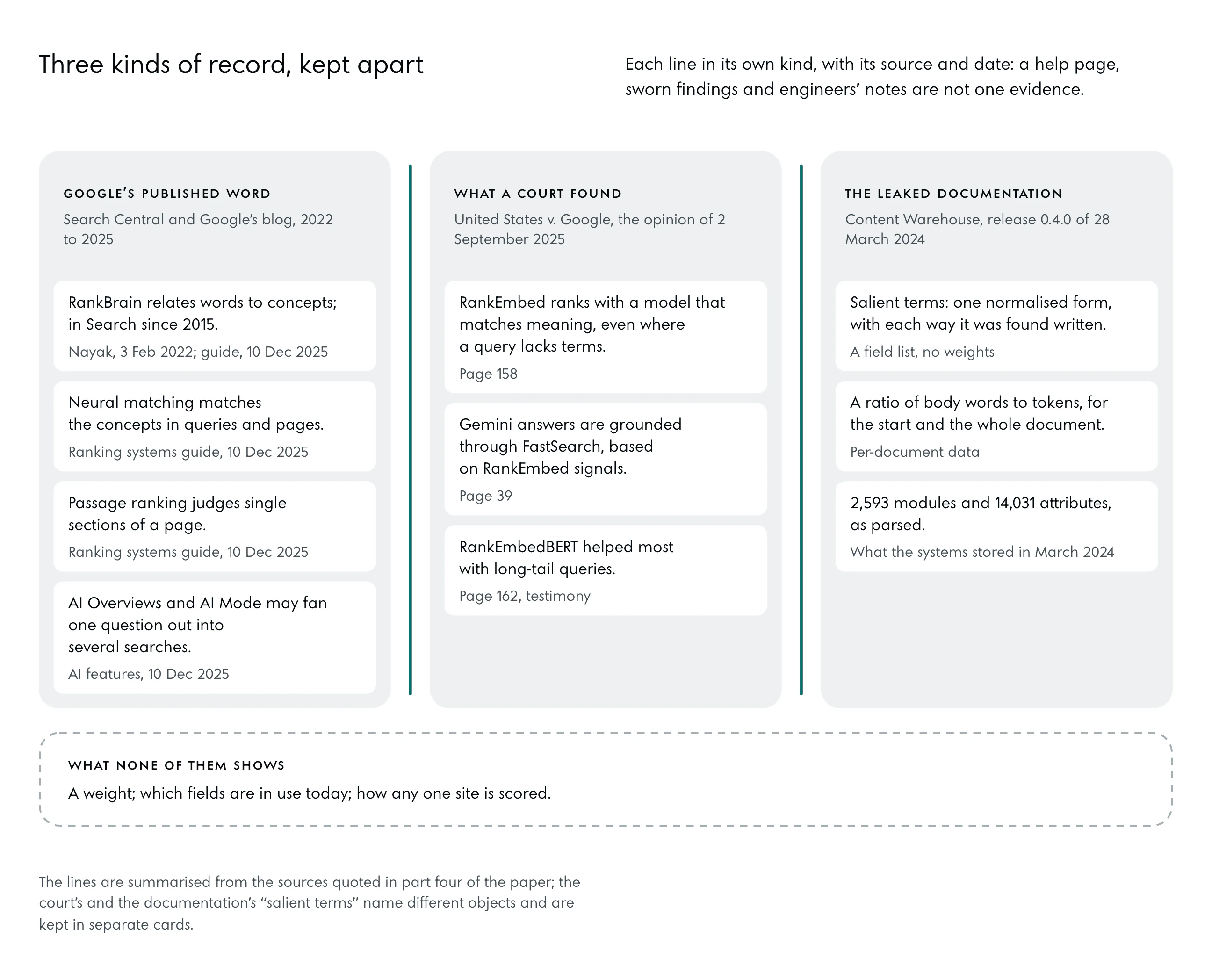
Each line this part has quoted, with its kind and its date, beside the part of the practice that it sits next to.
| Line as written | Kind of source and its date | Practice it sits beside |
|---|---|---|
| “how words are related to concepts” | Google’s published guide, updated 10 December 2025 | one term, one meaning |
| “to identify individual sections” of a page | Google’s published guide, updated 10 December 2025 | one page that defines each term in one line |
| “issuing multiple related searches across subtopics and data sources” | Google’s published page on AI features, updated 10 December 2025 | the same words in every piece |
| “even if a query lacks certain terms” | A court’s finding, filed 2 September 2025 | a meaning that holds when the wording changes |
| “the different ways we found this normalized term in the signals” | Leaked internal documentation, release of 28 March 2024 | one way of writing each term |
| “the importance of the term as a descriptor” | Leaked internal documentation, release of 28 March 2024 | a page whose subject is one term |
The right-hand column is our pairing and is theory from top to bottom. No line in the left-hand column says that a site written that way is scored higher, and the middle column is there so that no one mistakes an engineer’s field note for a company’s statement.
The strongest published line against making too much of any of it comes from Google itself. Its page on AI features says it plainly, “There are no additional requirements to appear in AI Overviews or AI Mode, nor other special optimizations necessary.” The same page asks that a page be indexed and eligible to appear with a snippet, and it lists among its recommendations “Making sure your structured data matches the visible text on the page”. Where does that leave the practice in this paper?
It is a way of writing a site, one that asks for nothing that page rules out and promises nothing that page withholds. Whether it earns anything beyond a clearer site is what the tests in a later part are for.
Missing from the card, first, are weights. Next, any word on which of the stored fields were in use. Then any statement of how the written forms of a term are treated once they are stored, and anything at all dated after March 2024 from inside the systems.
An owner who is handed a chart of ranking factors with percentages, drawn from the leaked pages, is looking at field names with numbers that somebody else added.
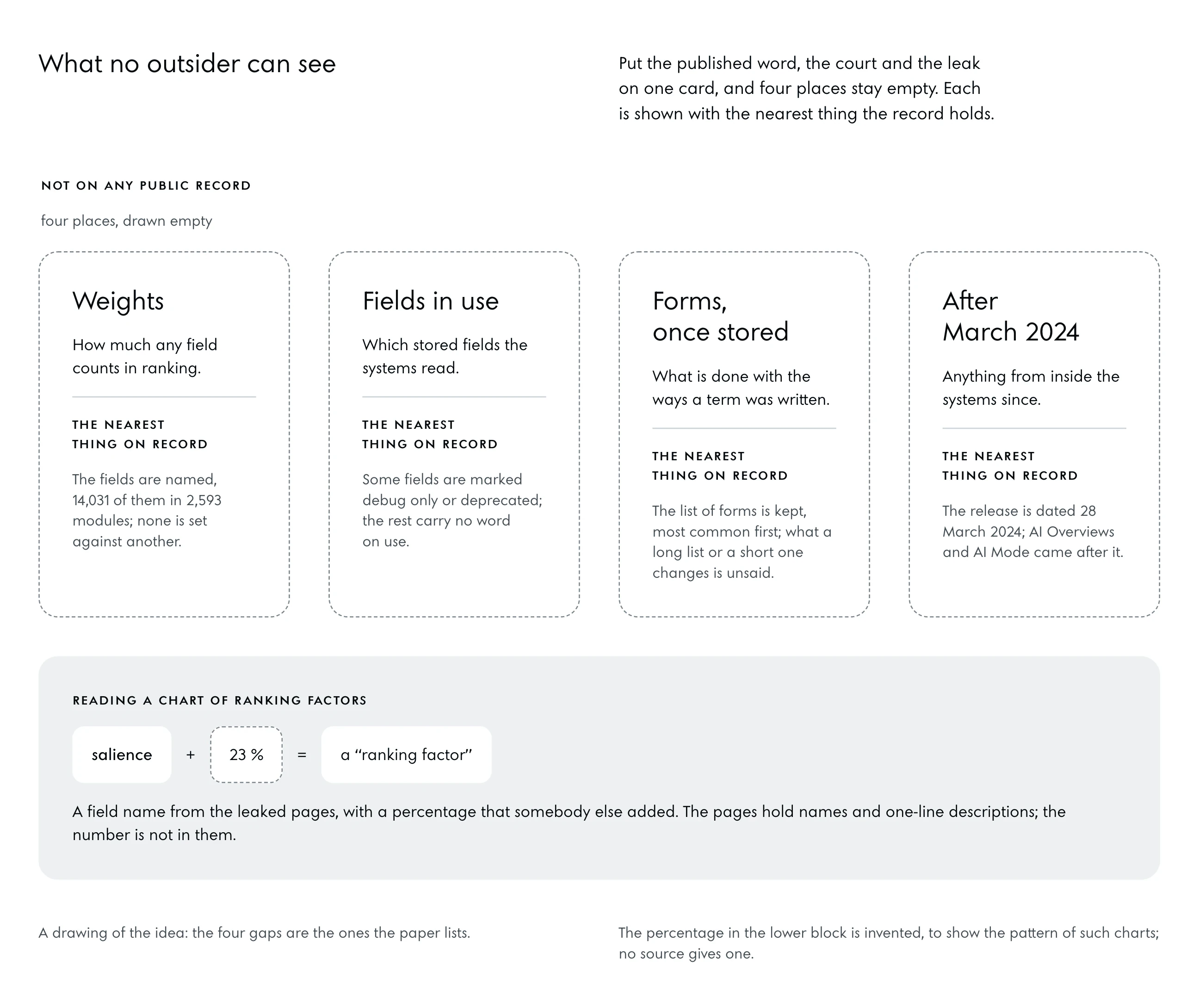
Google has published that its systems relate words to concepts and a court has found that it ranks with a model that matches meaning where the words differ, while no public source states how any site is scored.
06The Term Map at Work
Everything so far has described what a machine does with words. What does a firm do about it?
Fix the terms, give each one a page, repeat them unchanged in the text and in the structured data, and hold the same line on each property that the firm publishes. In our shorthand that is one term, one meaning, one page that defines it. The running example is noo-studio.com as it stood on 11 October 2026.
It is a description of a practice, with one figure from some other site in support, and it is written so that you could start yours this week.
One Row for Each Term
The map itself is a very short document. Most firms could draft theirs in an afternoon. It lists the words that the firm uses for what it does, which are its services, its products, its methods, its name and any phrase it has coined.
Each word gets a row, and that row answers the questions an editor will ask on a deadline.
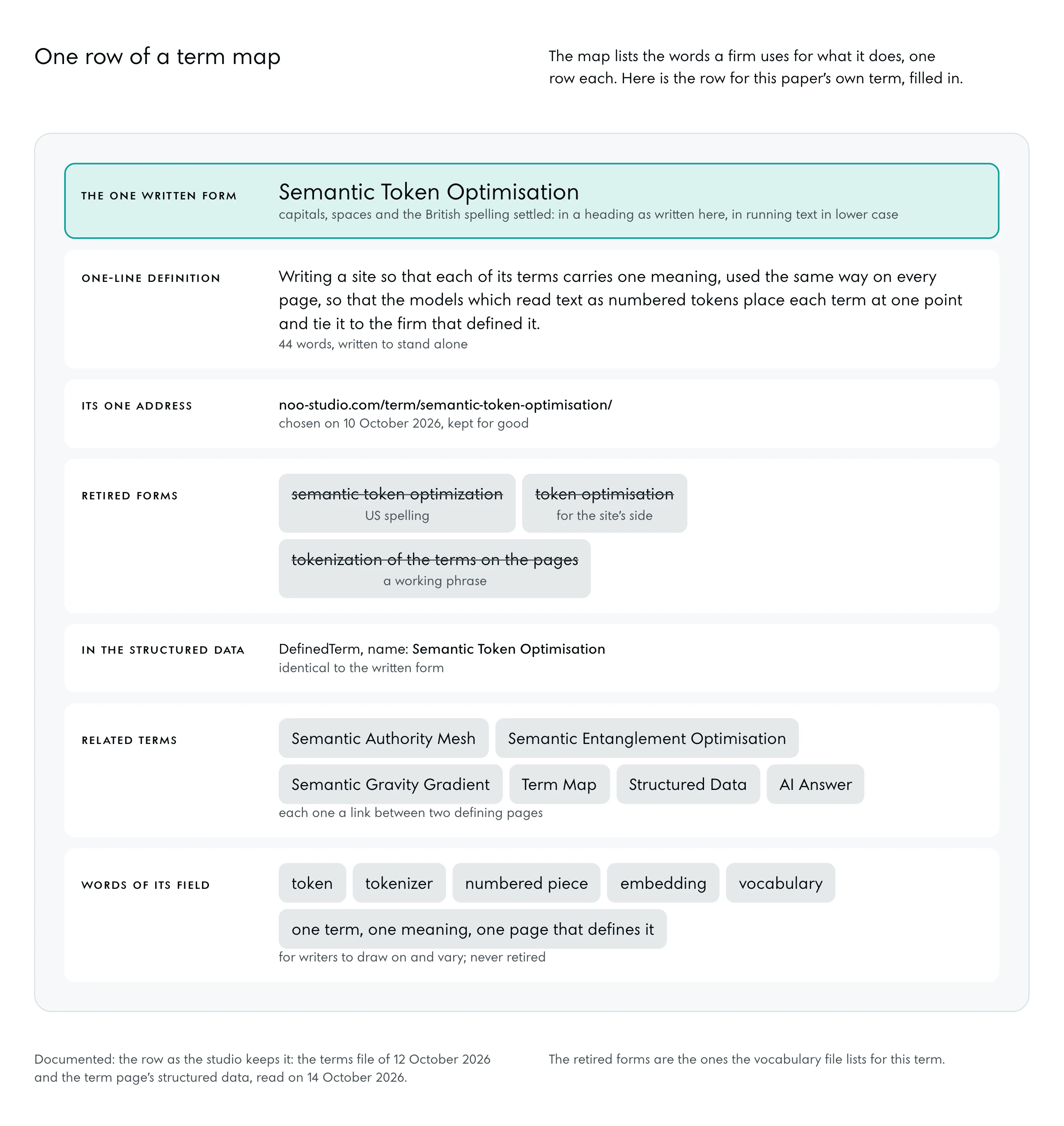
- The term in its one written form, letter for letter, with the capitals, the hyphen or space, the plural and the spelling settled.
- A one-line definition that can stand alone, written to survive being lifted by a machine that takes that line and nothing else.
- One address for the page that defines it, chosen once and kept for good.
- Retired forms of the term itself, listed so an editor can search for them, such as the plural used as a name, the old spelling, the hyphenated variant and the abbreviation no one agreed on.
- Its name as the structured data will carry it, identical to the written form.
- Related terms, by name, which become the links between the defining pages.
- The words of its field, its shorter runs, its neighbours in meaning and the vocabulary of its subject, listed as a range for writers to draw on and vary, and never retired.
Which words belong on the map? Fewer than you might list at first, and ours has 23. Seven of those are ordinary words, engine and satellite among them, that the site uses in a defined sense.
Ordinary words are the hard rows, because the language goes on using them loosely, whatever the map may say.
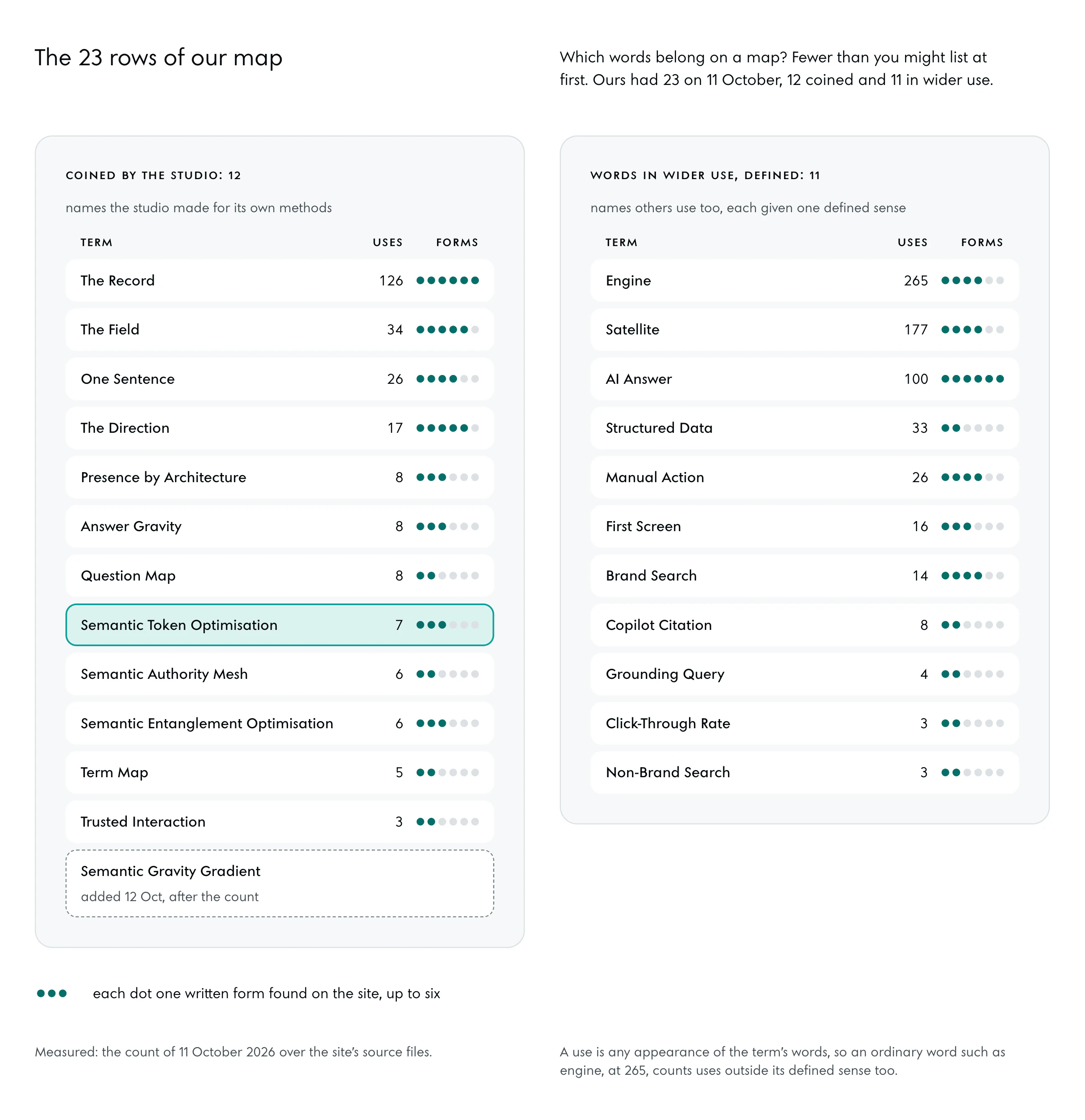
The firm writes it; an agency can draft it, and a good one will, but each row is a decision about what the firm calls a thing that it sells, and that decision has an owner inside the business. What the map replaces is the small argument, repeated on each new page, about what to call the service this time.
A Page That Defines It
One figure from another site explains why each definition gets an address of its own. On the Sustainability Directory, in Bing’s lists of the pages that Copilot cited, a page that defined one term drew 53.5 citations on average and a tag page drew 17.1. Term pages made up 36 % of the pages listed and drew 50 % of the citations.
The figures come from our paper The Page the Machine Quotes, which gives their window. They are the account of one site in the report of one engine. A page that defined one term in one line was the page that a machine quoted there, and the figures cannot show why.
On noo-studio.com each of the 23 terms has a page under the glossary. Each such page defines its term in one line and then explains it. The glossary lists all 23 with that same line.
Related terms are named on each page and linked.
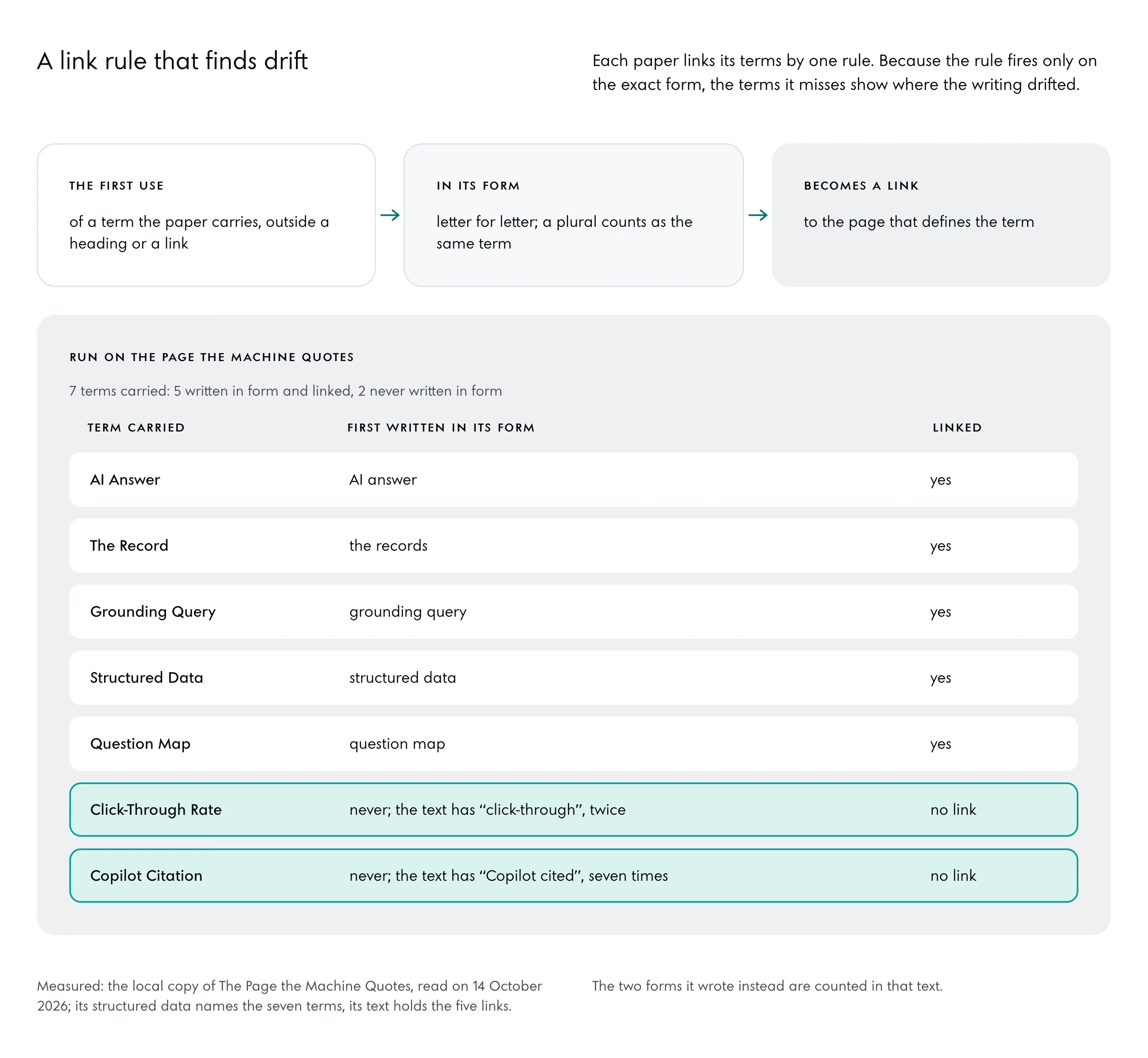
A paper on the site meets its terms by rule. The first time a paper writes one of its terms outside a heading or a link, those words link to the page of the term, and a plural counts as the same term. Does the rule always fire?
On The Page the Machine Quotes seven terms are carried. Five are written in the form of the term and linked. Two are never written in that form at all, so they get no link.
A rule that fires only on the exact form doubles as a detector for the places where the writing drifted.
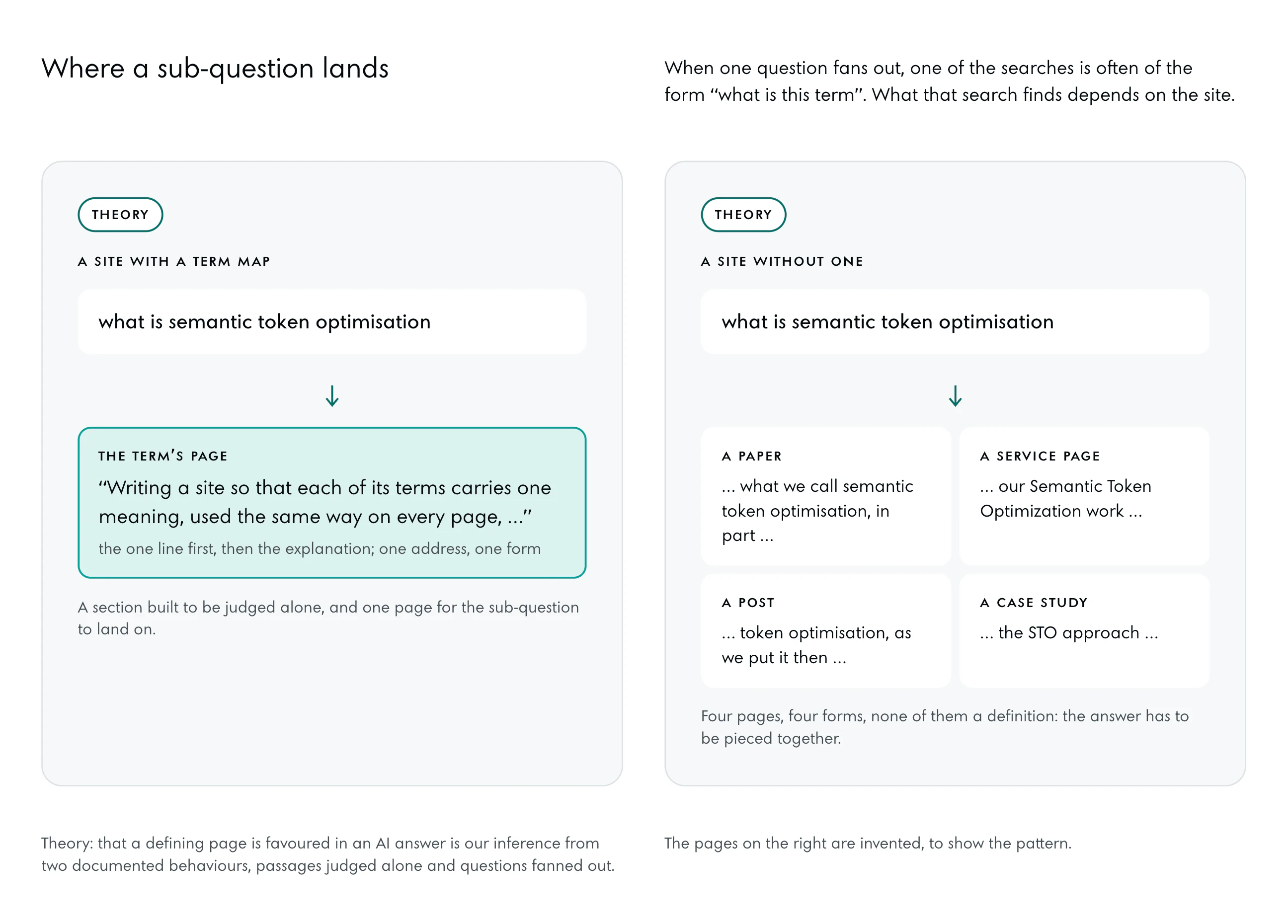
Why would a machine prefer such a page? The documented part is short; Google’s guide describes a system that judges individual sections of a page, and its page on AI features describes one question fanning out into several searches. A one-line definition is a section built to be judged alone, and a sub-question of the form “what is this term” has, on a site with a term map, exactly one page to land on.
That those two facts favour the defining page in an AI answer is theory. The Directory’s figure is consistent with it and proves nothing about cause.
The Same Names in the Data
Schema.org, the shared vocabulary of structured data that search engines read in a page’s code, has a type for exactly that object. It defines DefinedTerm as “A word, name, acronym, phrase, etc. with a formal definition”, and gives it a property, inDefinedTermSet, for “A DefinedTermSet that contains this term”. So a glossary can be declared to a machine as a set, and each entry as a member with its name and its definition.
What does an engine do with such a declaration? Google’s introduction to structured data, updated on 10 December 2025, says that they are used “to understand the content of the page, as well as to gather information about the web and the world in general”.
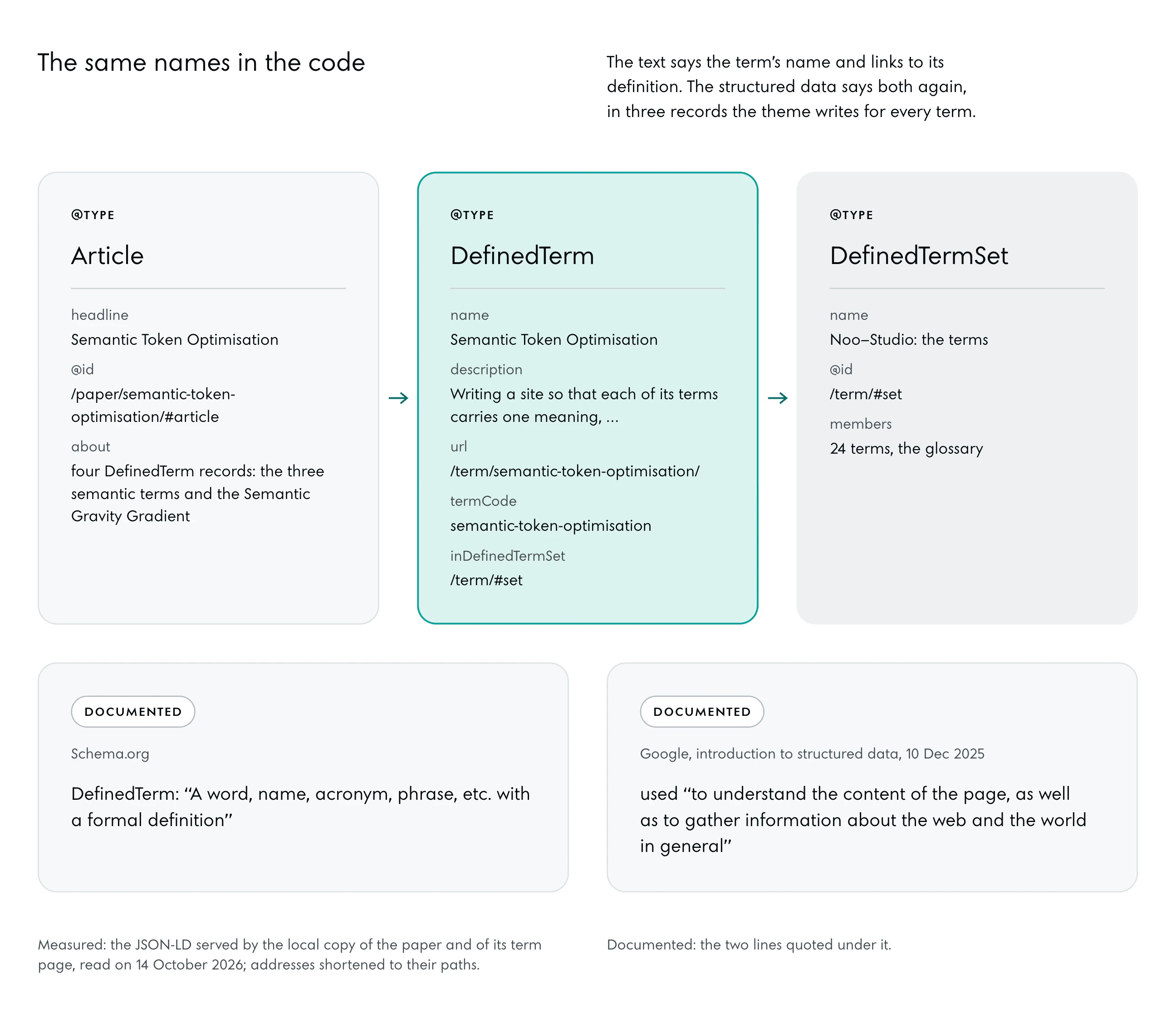
On noo-studio.com the theme always writes it for each term without anyone remembering to. Each term page carries a DefinedTerm with the name of the term and its one-line definition, as a member of one DefinedTermSet, the glossary. Every paper lists the terms that it carries, and its Article data names each of them under the property about, by the address of the term page’s entry.
So the text says the name and the link under it points to the definition, and the code repeats both. That is the practice’s second carrying phrase made literal, the same words in each piece and the same names in the structured data.
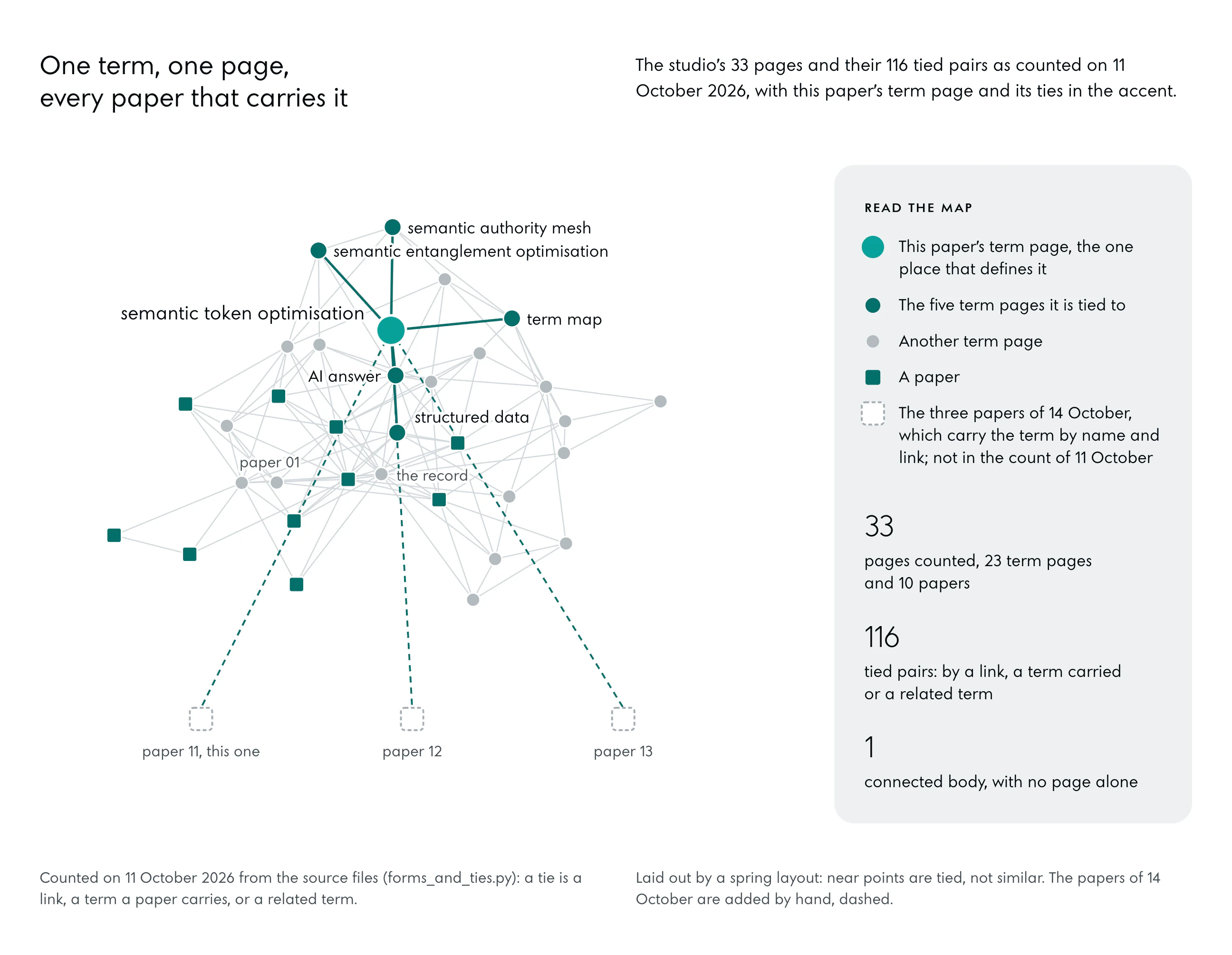
The numbers
| Point | Kind | Ties |
|---|---|---|
| the record | term | 15 |
| presence is a structure | paper | 14 |
| AI answer | term | 14 |
| every engine keeps its own record | paper | 13 |
| presence by architecture | term | 11 |
| what are you actually paying for | paper | 10 |
| the page the machine quotes | paper | 9 |
| question map | term | 9 |
| satellite | term | 9 |
| copilot citation | term | 8 |
| engine | term | 8 |
| structured data | term | 8 |
| satellites smaller sites that lead home | paper | 7 |
| manual action | term | 7 |
| term map | term | 7 |
| built from public records | paper | 6 |
| answer gravity | term | 6 |
| click through rate | term | 6 |
| the direction | term | 6 |
| architecture removes a category of decisions | paper | 5 |
| first screen | term | 5 |
| grounding query | term | 5 |
| one sentence | term | 5 |
| semantic authority mesh | term | 5 |
| semantic entanglement optimisation | term | 5 |
| semantic token optimisation | term | 5 |
| trusted interaction | term | 5 |
| brand search | term | 4 |
| non brand search | term | 4 |
| designing icons with ai | paper | 3 |
| written once read in fifteen languages | paper | 3 |
| the field | term | 3 |
| 2026 typeface design what is possible | paper | 2 |
Schema.org lets a term be declared with its name and definition, so a glossary reaches a machine in the words a visitor reads.
Some variants cannot be retired, such as a legal name on contracts or an abbreviation that customers really use. The vocabulary has a slot for that as well. Schema.org describes alternateName as “An alias for the item”, and Google’s documentation for organisation markup, updated on 8 September 2026, describes name as “The name of your organization” and alternateName as “Another common name that your organization goes by, if applicable”.
One name, with its aliases declared as aliases. Five spellings scattered over a site, with nothing to say which of them is the name, are a different situation.
A Site Rewritten in Order
The work has a sequence, and the sequence is where the saving is.
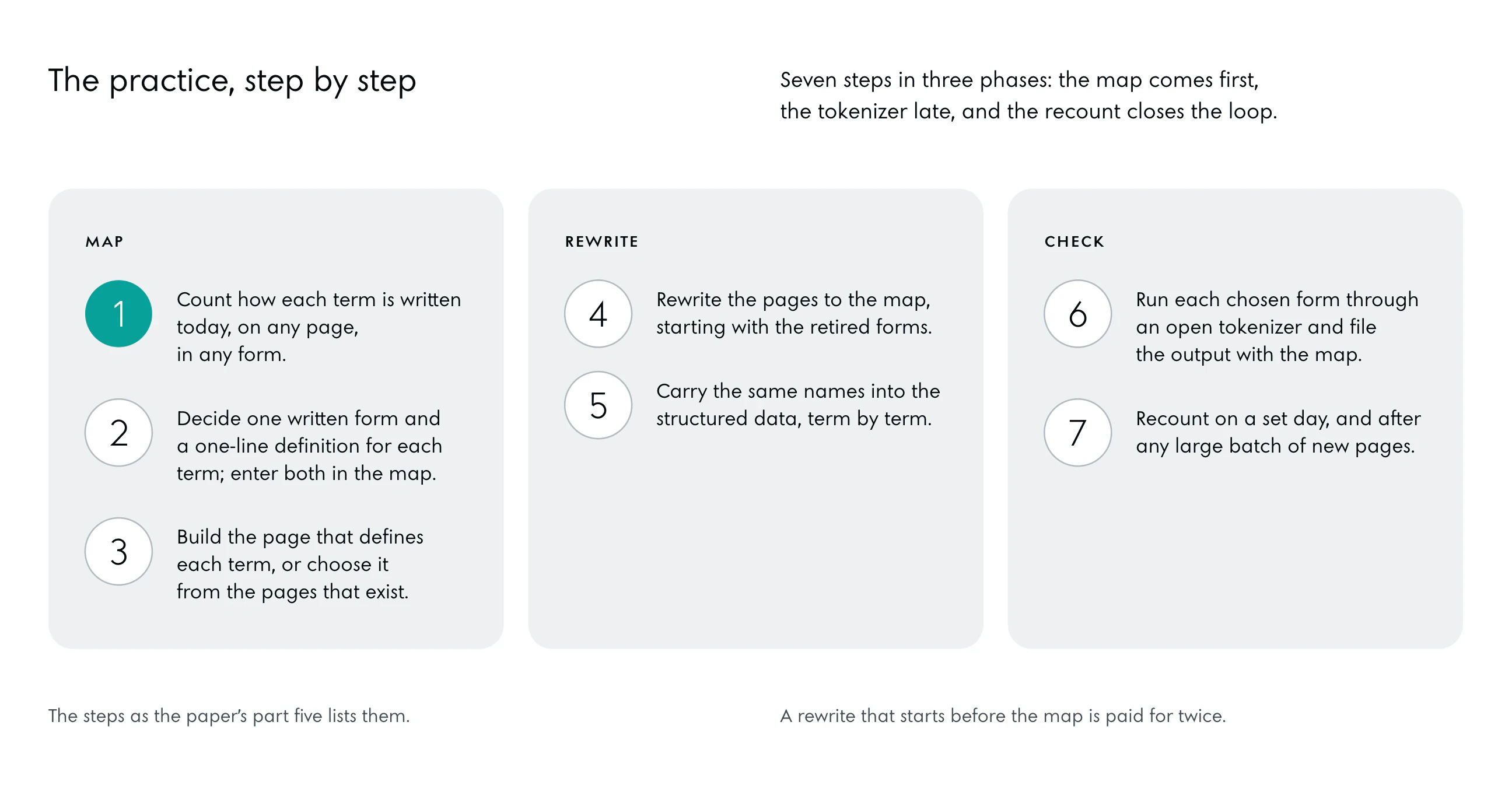
- Count how each term is written today, on any page, in any form.
- Decide the one written form and the one-line definition of each term, and enter both in the map.
- Build the page that defines each term, or choose it from pages that exist.
- Rewrite the pages to the map. Start with the retired forms, which a search finds in minutes.
- Carry the same names into the structured data, term by term.
- Run each chosen form through an open tokenizer and file the output with the map.
- Recount on a set day, and after any large batch of new pages.
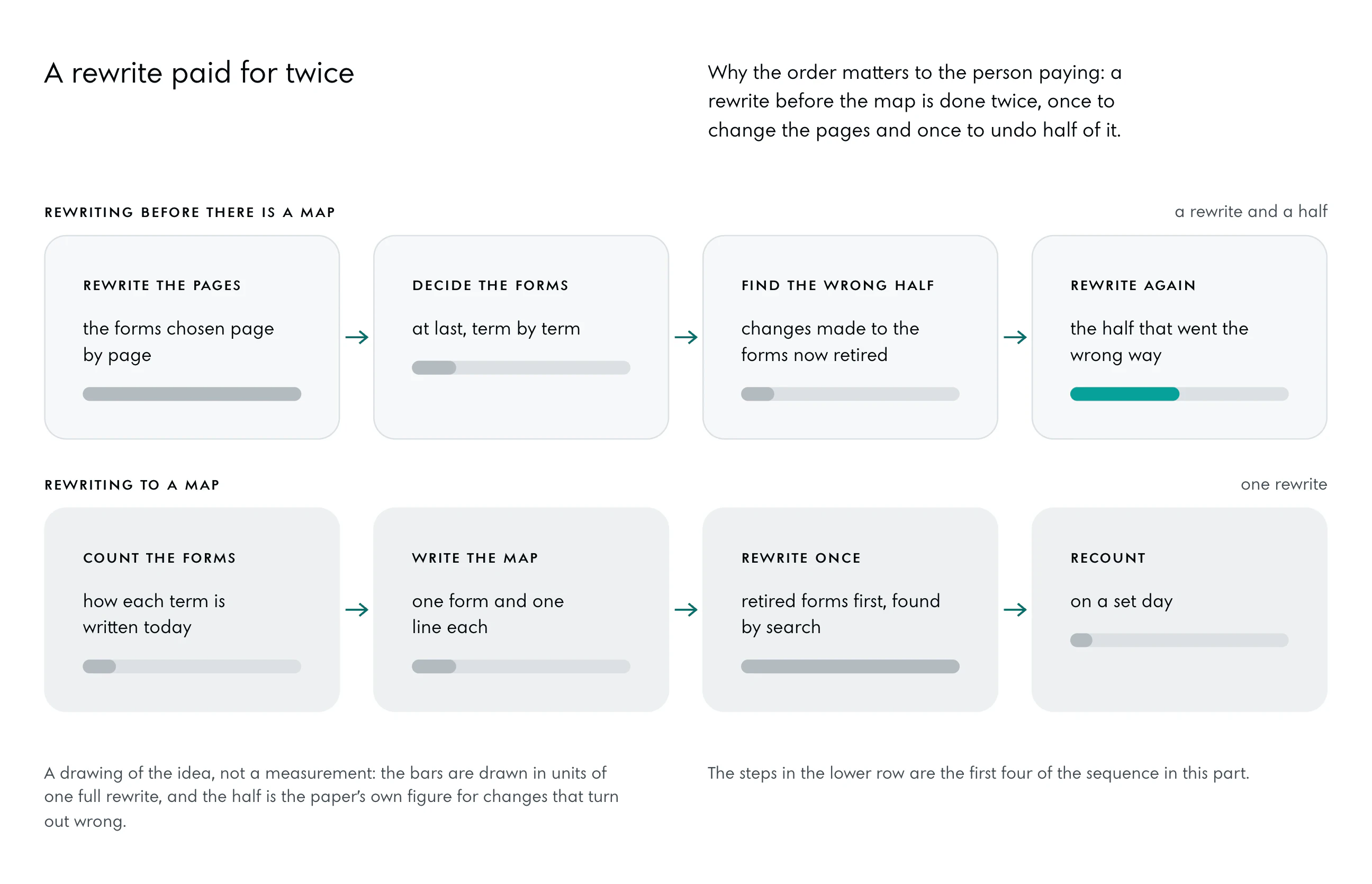
Why does the order matter to the person paying? Because a rewrite that starts before there is a map is paid for twice, once to change the pages and again when the forms are finally decided and half the changes turn out wrong. The count comes first for the reason a builder measures before ordering.
And the tokenizer run comes late on purpose, because it informs a choice between two forms that are otherwise equal. The form that your customers know outranks it.
Once the map exists the saving recurs, because the map is a brief that can be handed unchanged to an agency, a translator, a new member of staff or an AI writing tool. Each of them would otherwise invent a slightly different name for what the firm does, and each invention would be invoiced.
The founder describes the alternative from the trade’s side, “When they publish one page and they think it’s going to rank amazingly, and then another better AI writer comes and steals their position, and it’s like Wild Wild West”. One page can be out-written by one better page. Held the same way on each page of a site, with a varied field of words around each term, a vocabulary is perhaps a harder thing to copy in an afternoon, and that, too, is theory until the tests come in.
Every Property Under the Name
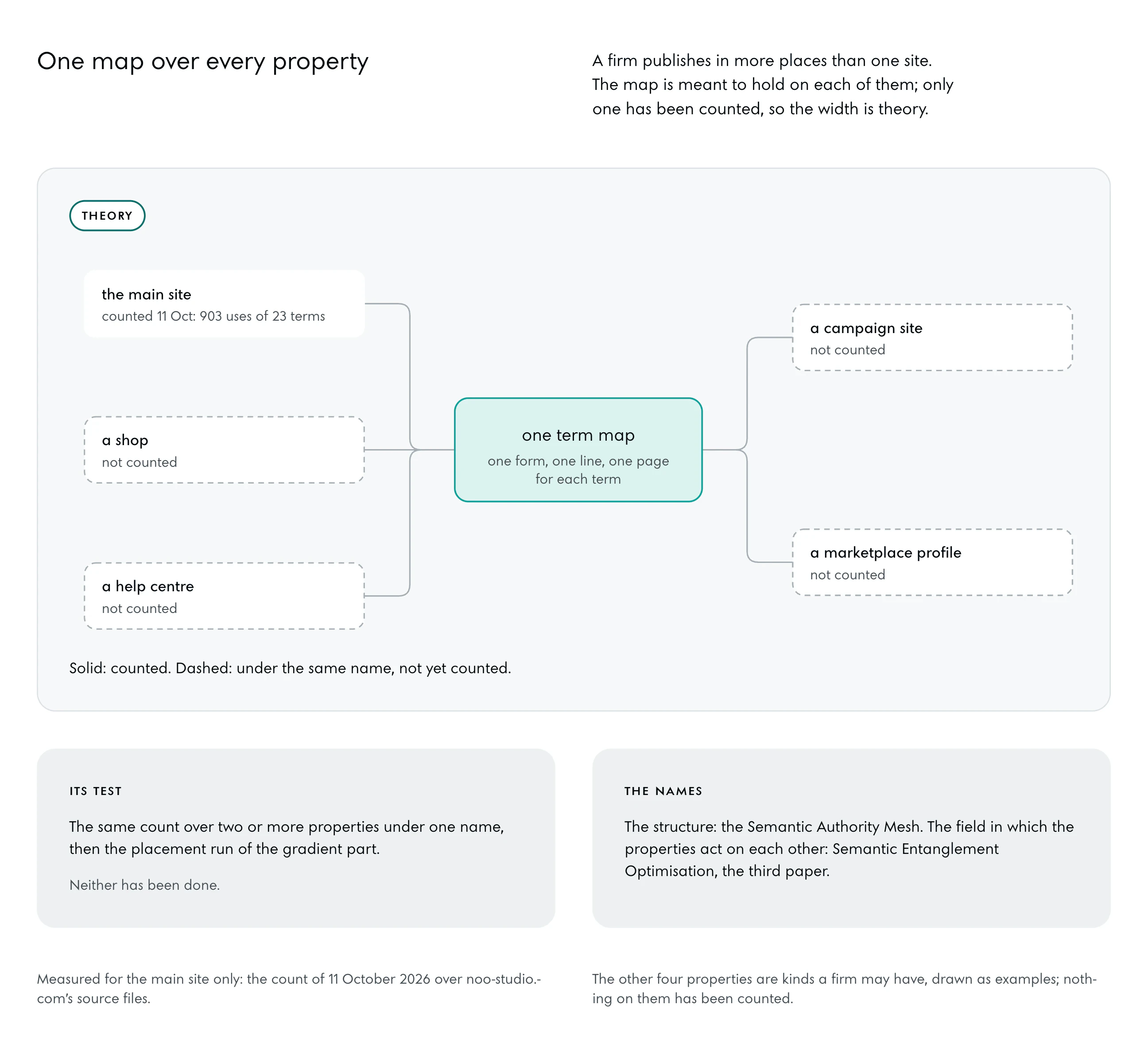
Most firms publish in more places than one. There is the main site, and then a shop, a help centre on a subdomain, a campaign site, a profile on a marketplace. The founder was explicit that the theory is as wide as that, saying “It could be a Shopify shop that is connected to the main website.
It could be anything.” He called the result “the intertwined mesh of the network”. Our name for that structure is the Semantic Authority Mesh, and the field in which the properties act on each other is what it calls Semantic Entanglement Optimisation. In the third paper, Semantic Entanglement Optimisation, that width is worked through property by property.
How much of that width has been measured? None of it yet, and the gap is stated here so that no one has to find it. The counts in this paper come from the source files of one site on one day, and the width is theory.
Its test is the same count run over two or more properties under one name, followed by the placement run described earlier, and neither has been done.
Librarians solved a version of the problem long before there were search engines. The Library of Congress’s guide Understanding MARC Authority Records, dated 28 October 2005, describes authority records as “tools used by librarians to achieve consistency among bibliographic records”. A catalogue settles on one form of a name, uses “that form whenever the name is needed as an access point”, and points each variant at it with a see reference.
The purpose was retrieval, so that a reader who asks for an author under any form of the name is led to one shelf.
Seen from the library, a term map is a firm’s authority file. The row is the authorised heading and the retired forms are its see references, with the alias in the structured data serving as the see reference written for a machine. Held on each property, a structure of that width is what we build under the name System.
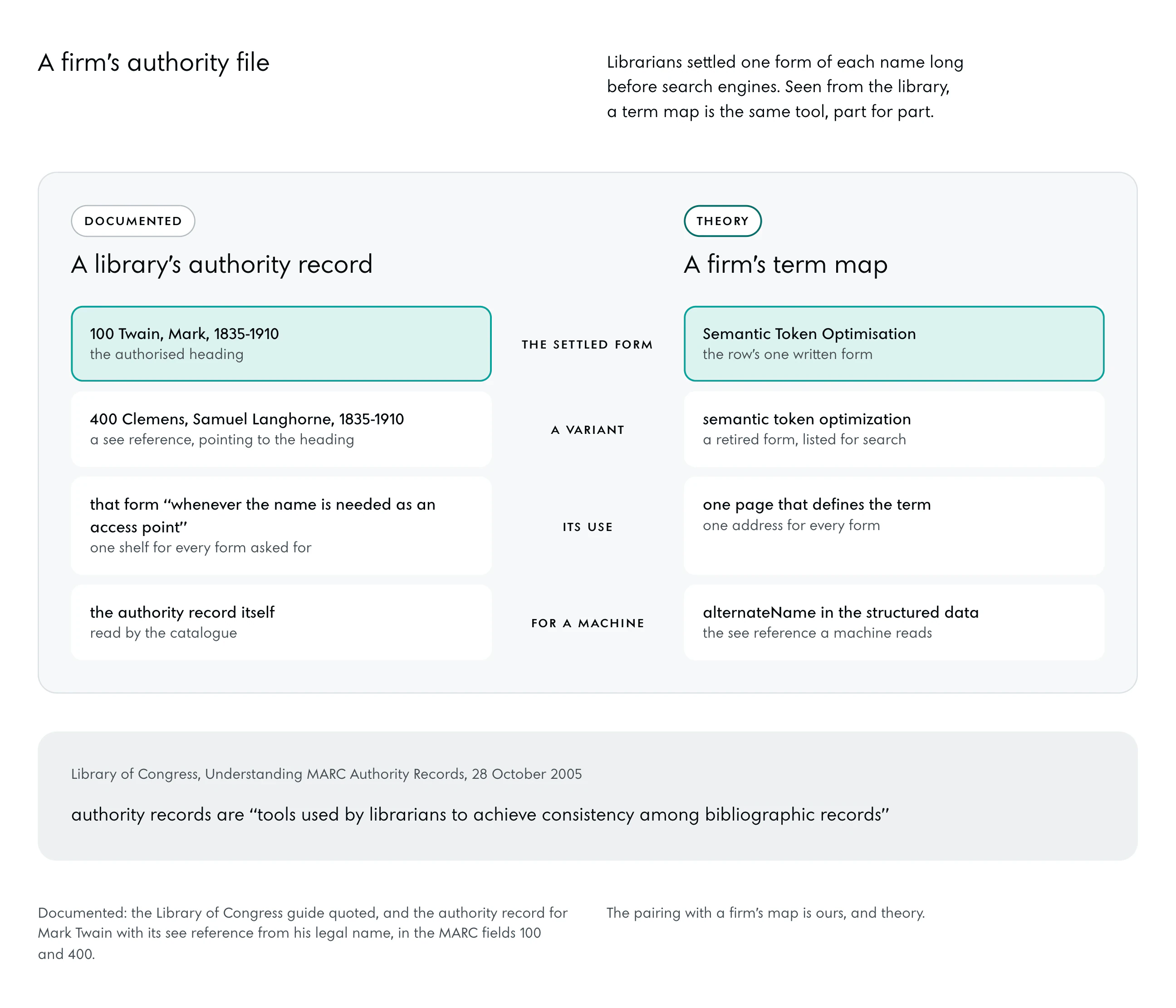
A term map is a firm’s list of its terms, each fixed in one written form with one meaning and one page that defines it, and repeated unchanged in the text and the structured data of each property under the name of the firm.
07Predictions Written Before the Run
No firm deciding where to spend can use a theory that cannot lose. So each test behind this paper began with a sheet on which the expected result was written, and locked, before any data was read.
Here we give the sheets and what came back. The tests still running follow, each with the day it will be read. It also names the outcomes that would count against the studio.
Two wrong guesses turn out to be its most useful lines.
The Sheet and Its Fingerprint
The method is the one a careful trial uses, which is to say what you expect, lock the statement and only then look. How is a statement locked? We wrote each set of predictions to a file and took its SHA-256 code, a short string that changes completely if one character of the file changes.
The code then went onto the founder’s dated work log. Anyone holding the file can recompute the code and confirm that the predictions stayed as written after the results arrived.
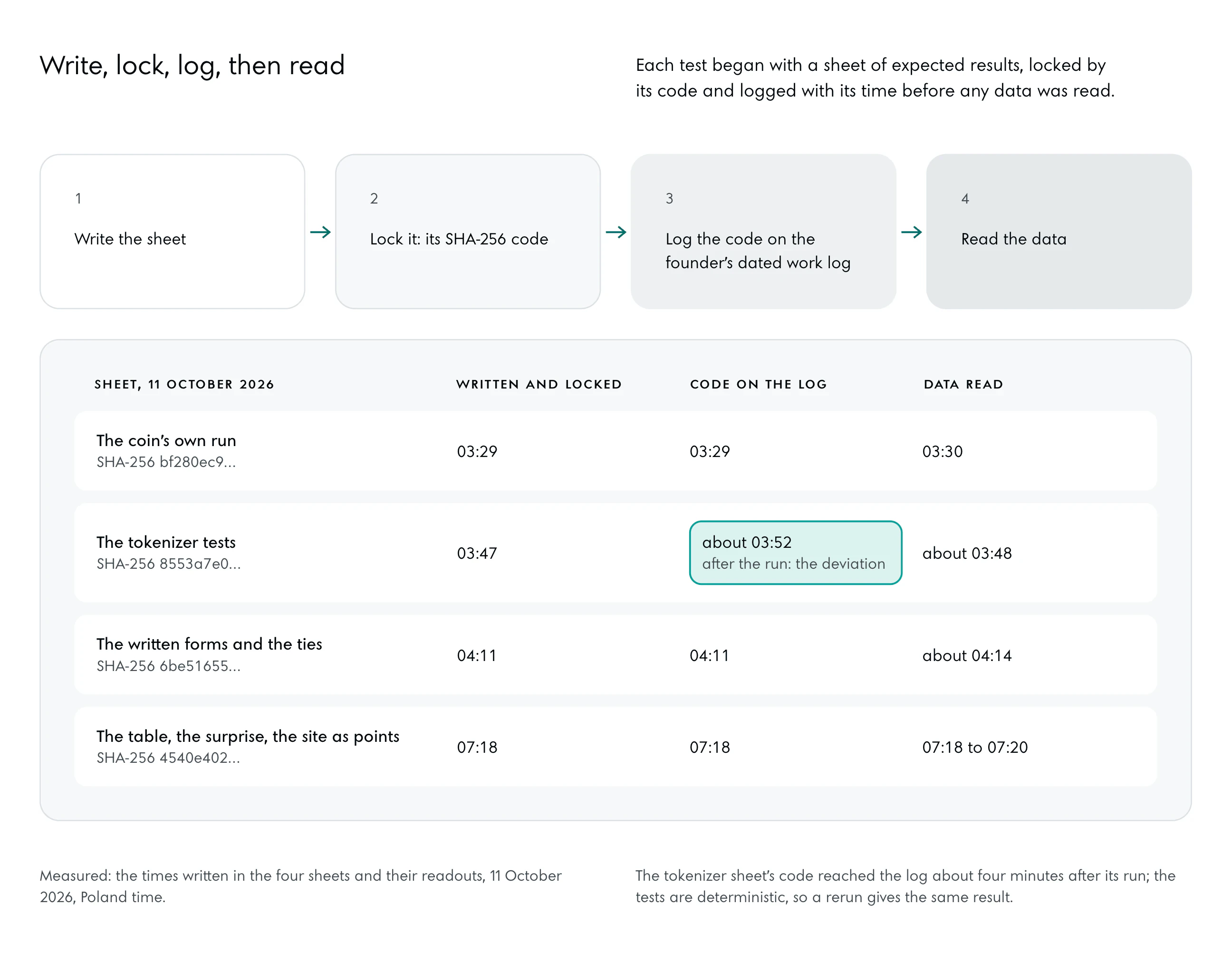
One deviation is part of the account; for the tokenizer tests the code reached the log a few minutes after the run had finished. Did the slip change what was measured? The test is deterministic, so the same file always returns the same result on a rerun.
It is stated because a locked sheet is only as good as the candour about when it was locked.
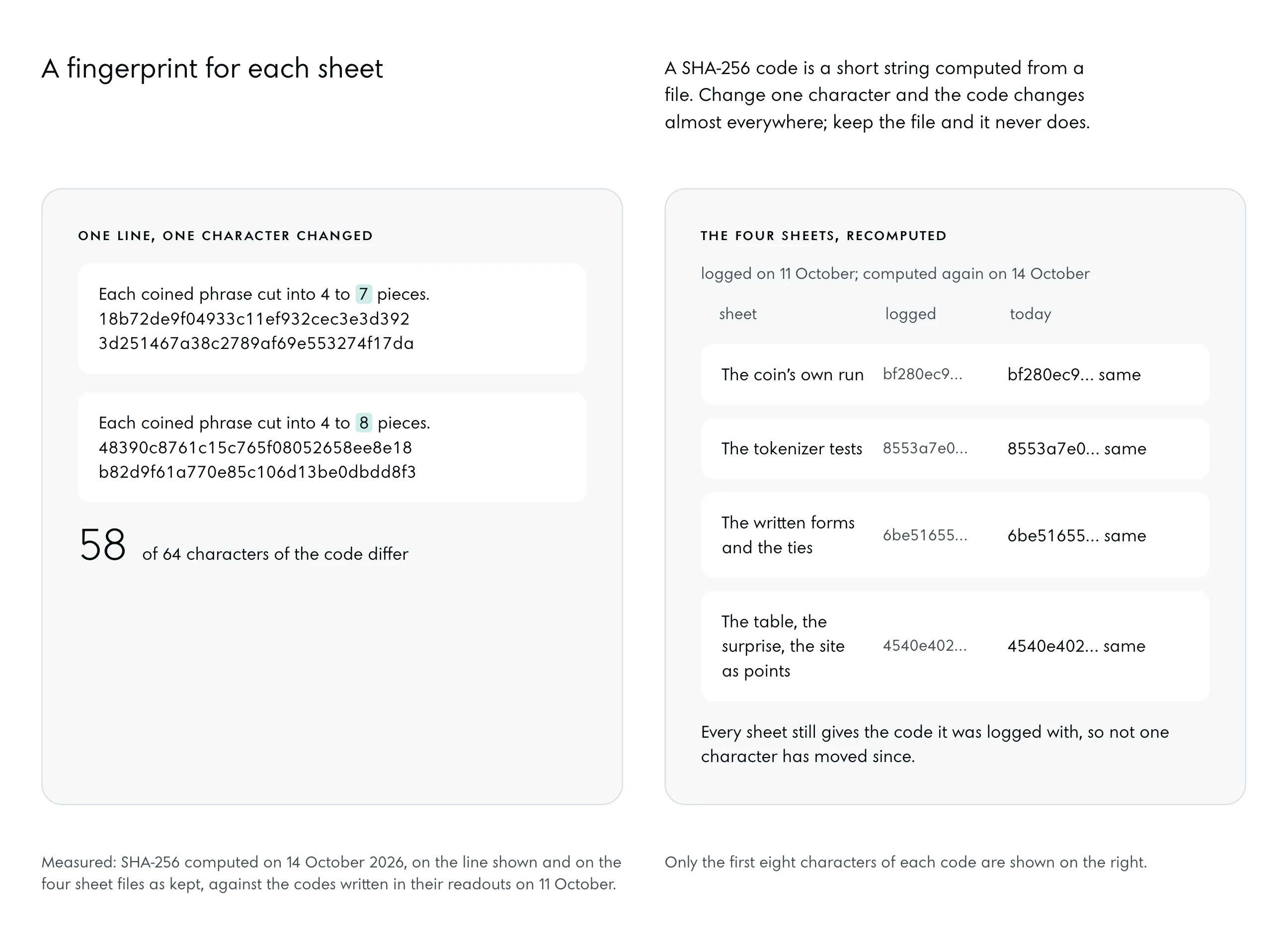
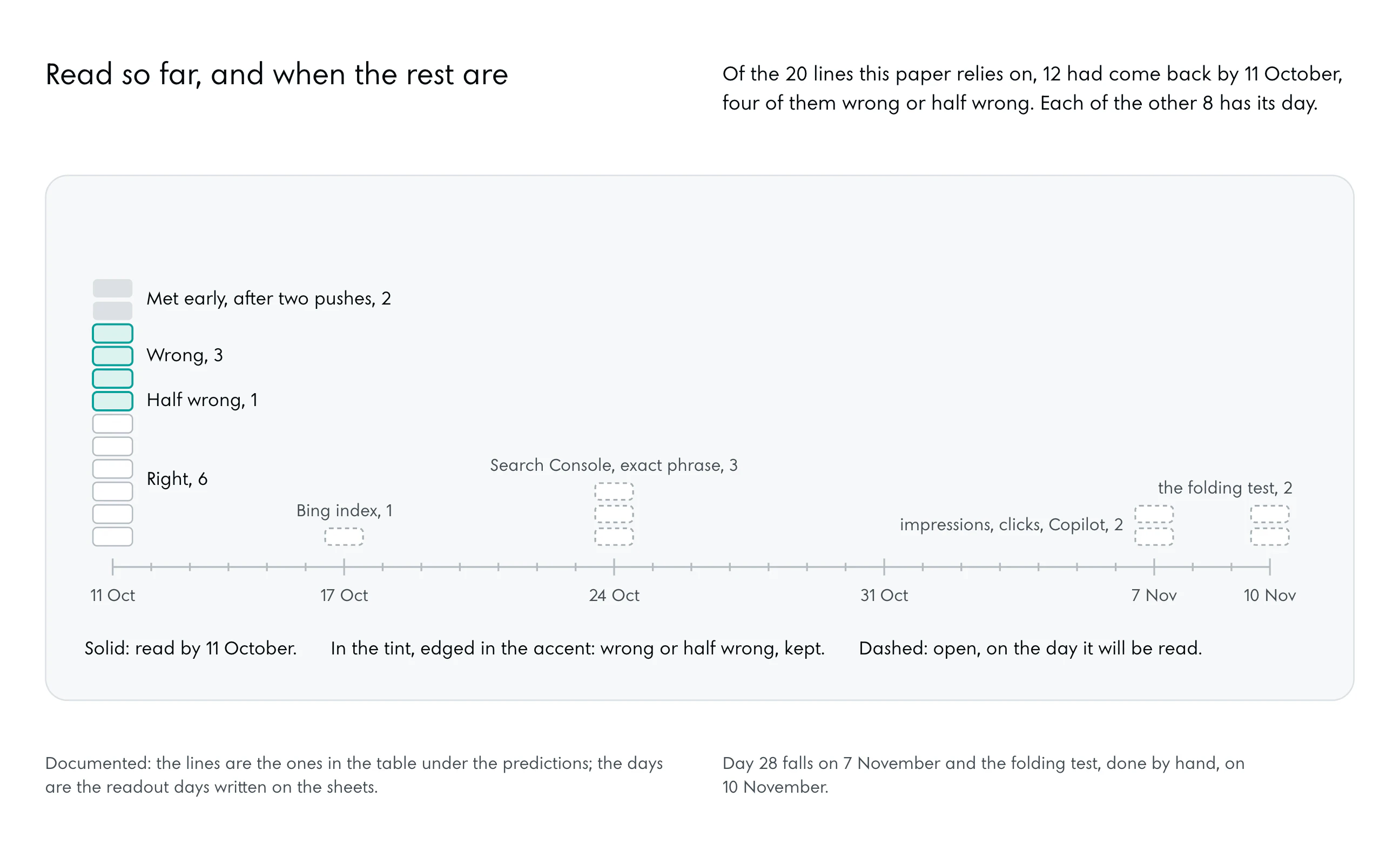
The tokenizer sheet had six lines, and four came back right. One was half wrong and one wrong, and those two are the ones this paper has leaned on. The coined phrases were expected to shatter and came back as three ordinary entries each, while the British spelling was expected to cost a piece everywhere and costs one only under a capital.
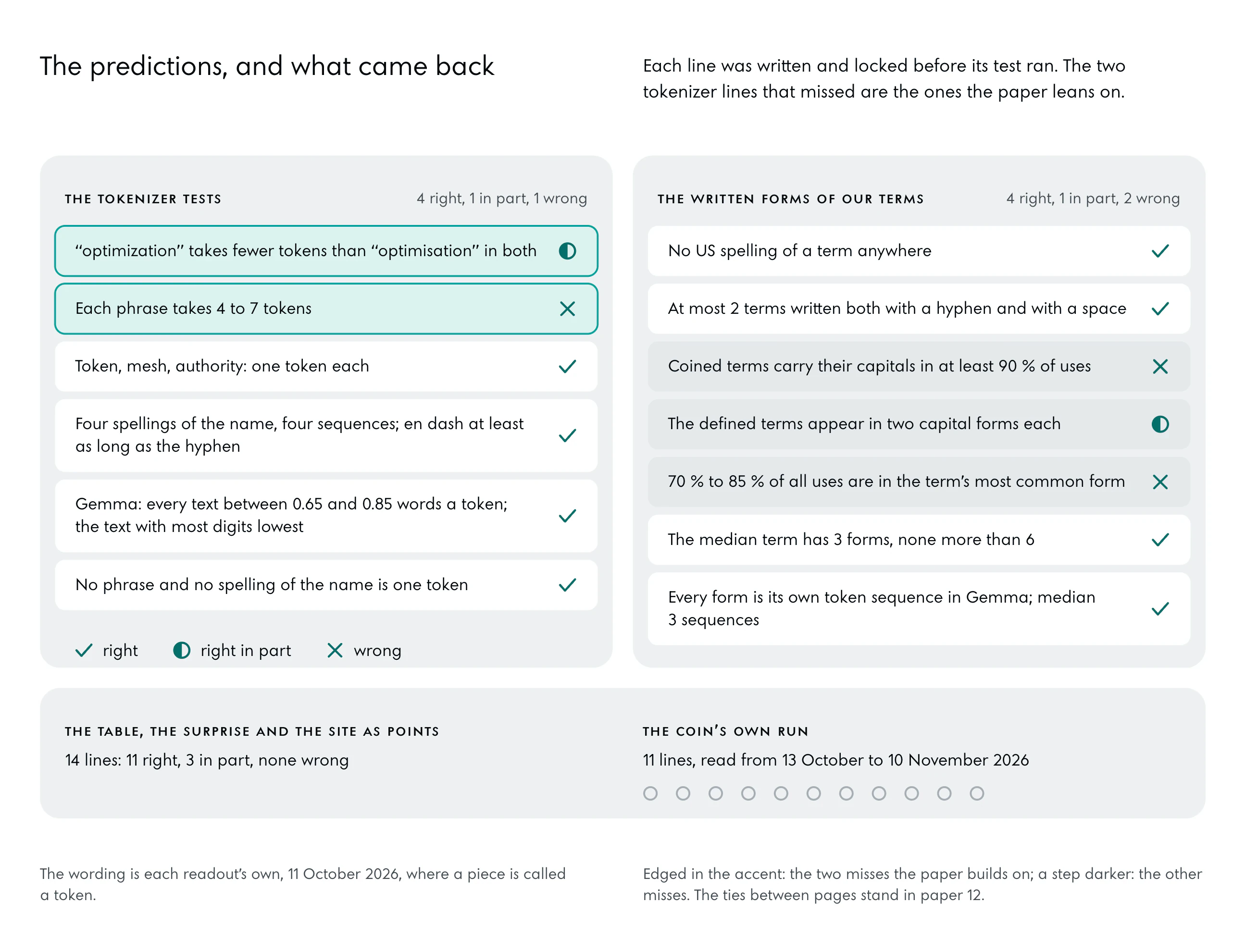
Below are the predictions this paper relies on, each with what had come back by 11 October 2026, and with a marker where the day of the readout is still ahead.
| What was predicted | What came back | Verdict |
|---|---|---|
| Each coined phrase cut into 4 to 7 pieces | 3 pieces each, in lower case | Wrong |
| The US spelling takes fewer pieces everywhere | Equal in lower case, one fewer under a capital | Half wrong |
| Every paper between 0.65 and 0.85 words a piece, the one with most digits lowest | 0.68 to 0.82, lowest for the paper with most digits | Right |
| No US spelling of a term on the studio’s pages | 0 uses in 903 | Right |
| Several written forms for a term, each a separate sequence | Median 3 forms, 6 at most, every form its own sequence | Right |
| 70 to 85 % of uses in a term’s most common form | 64 % | Wrong, under the line |
| Coined terms carry their capitals in at least 90 % of uses | 17 to 50 % | Wrong |
| A word’s ten nearest entries in Gemma’s table are mostly the same word in other forms | 5 to 10 of ten for five words, 1 of ten for entanglement | Right for five of six |
| The words inside one coined term sit far apart in that table | The eight pairs between 0.01 and 0.11 | Right |
| With several written forms, later mentions of a term cost at least 1.5 times the surprise | 2.2 to 3.7 times, on three pages | Right |
| All three term pages crawled by day 3 | Crawled on day 0 | Met early, after two pushes |
| All three indexed in Google by day 7 | Indexed by day 1 | Met early, after two pushes |
| All three indexed in Bing by day 7 | [NEED: readout 17 Oct 2026] | Open |
| Each term page shown at least once in Search Console by day 14 | [NEED: readout 24 Oct 2026] | Open |
| The studio’s page first for the exact phrase in quotes, days 14 and 28 | [NEED: readout 24 Oct 2026] | Open |
| By day 28, more impressions without the full phrase than with it, and fewer than 10 clicks | [NEED: readout 7 Nov 2026] | Open |
| At least one Copilot citation by day 28, held at about one chance in three | [NEED: readout 7 Nov 2026] | Open |
| Search off: every assistant folds the phrase into names it holds | [NEED: folding test 10 Nov 2026] | Open |
| Search on: the studio’s definition and name, for at least two terms in at least half the assistants | [NEED: folding test 10 Nov 2026] | Open |
The Count on the Studio’s Pages
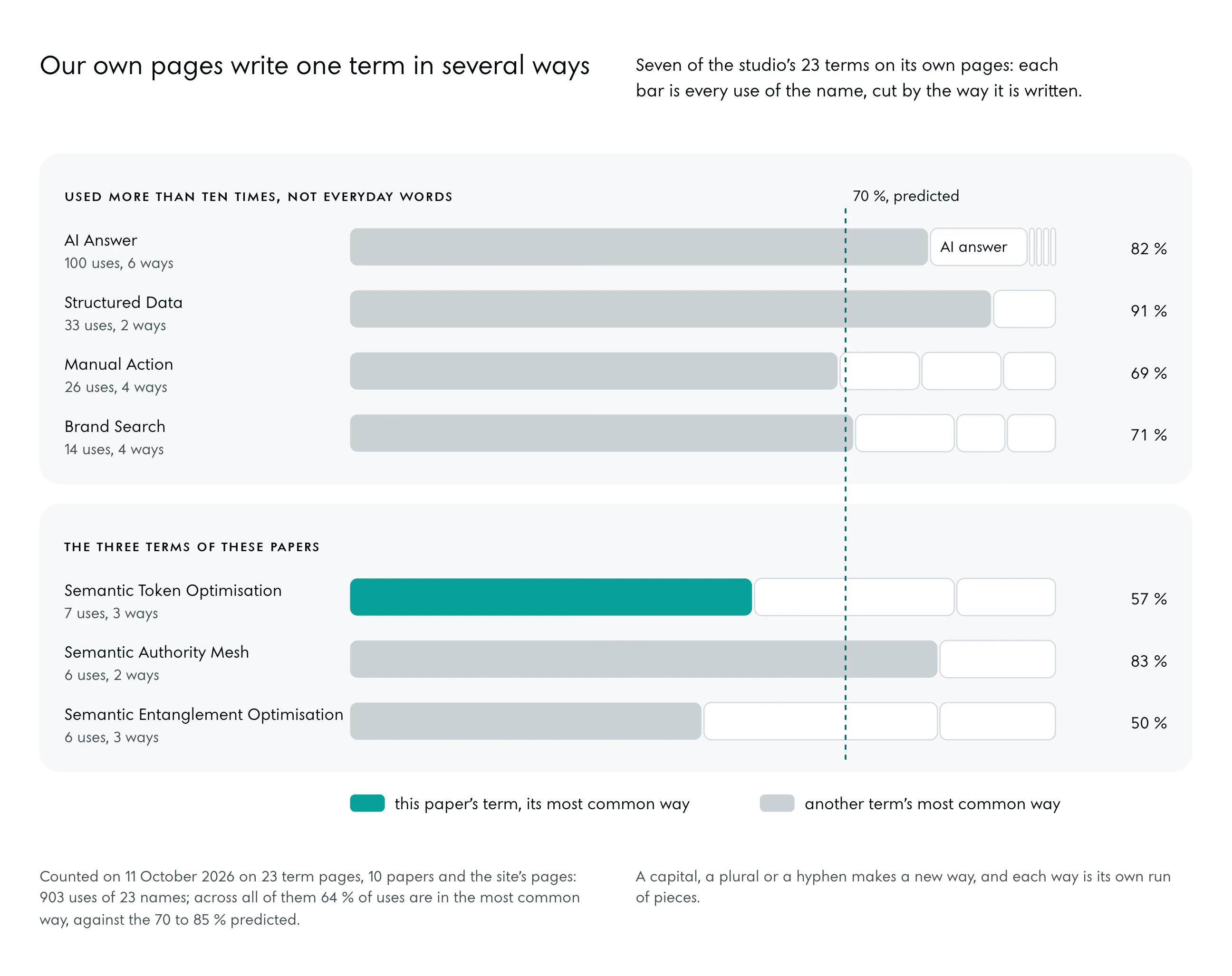
Is the rule kept by the firm that wrote it? To find out we counted each use of the names of our 23 defined terms over the whole site, its 23 term pages and its 10 papers included, and there were 903 uses, taken from the source files on 11 October 2026. Each written form of each name was then cut by the Gemma 3 tokenizer, and every form came out as a separate sequence.
Part of the sheet held; no term is spelled the US way anywhere, 0 uses in 903, and the median term is written in 3 forms and the most varied in 6.
Two lines failed; we predicted that 70 to 85 % of all uses would be in the most common form of a term. It came out at 64 %. The coined terms were predicted to carry their capitals in at least 90 % of their uses, and they carry them in 17 to 50 %.
Where did the capitals go? The pages, it turns out, write a coined term in lower case in running text and with capitals in its heading, a habit that arrived without a decision, the way sentence case always does. It means that the term this paper is named after appears on those pages as “semantic token optimisation” four times and as “Semantic token optimisation” twice at the start of a sentence.
Once, in the heading, it is “Semantic Token Optimisation”. Three sequences of pieces for one term, on the site of the firm that coined it.
The numbers
| Term | Uses | Ways | Most common way | Its share |
|---|---|---|---|---|
| AI Answer | 100 | 6 | AI answers | 82 % |
| Structured Data | 33 | 2 | structured data | 91 % |
| Manual Action | 26 | 4 | manual action | 69 % |
| Brand Search | 14 | 4 | brand searches | 71 % |
| Semantic Token Optimisation | 7 | 3 | semantic token optimisation | 57 % |
| Semantic Authority Mesh | 6 | 2 | semantic authority mesh | 83 % |
| Semantic Entanglement Optimisation | 6 | 3 | semantic entanglement optimisation | 50 % |
After the run we looked at one thing the sheet had left out, which is what is left once capitals are set aside. The median term then has 2 forms, and 78 % of uses are in the most common one. So capitals account for a little over a third of the spread, and the plural for most of the rest.
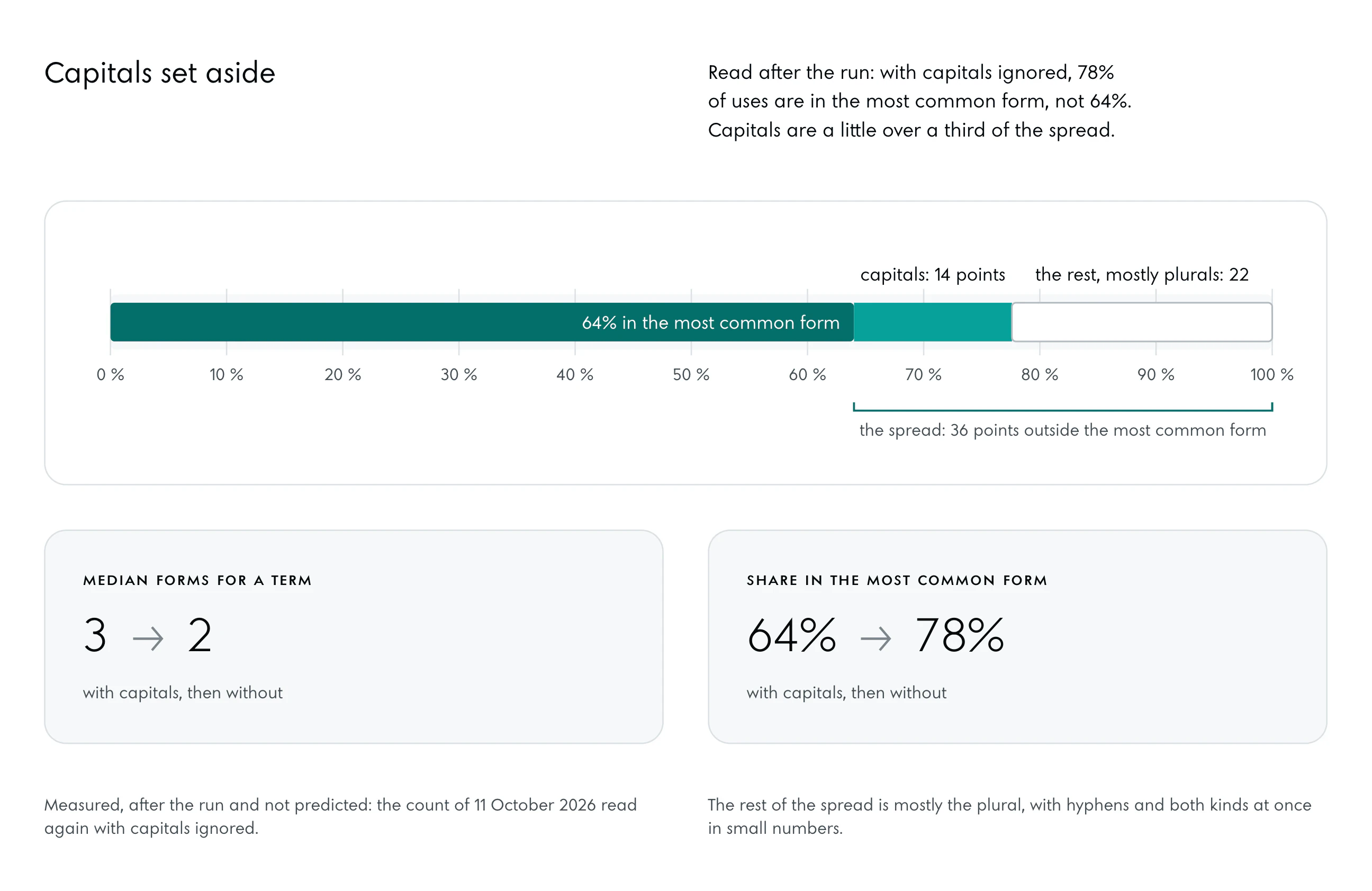
The 64 % can bear less weight than it seems to. Seven of the 23 terms are ordinary words, and the count takes each use of such a word whether or not it is meant in its defined sense. The word engine alone accounts for 265 of the 903 uses.
A count restricted to the coined and technical terms, or to uses in the defined sense, would give a different share, and it could move in either direction. That narrower count has yet to be made, so no second figure is offered.
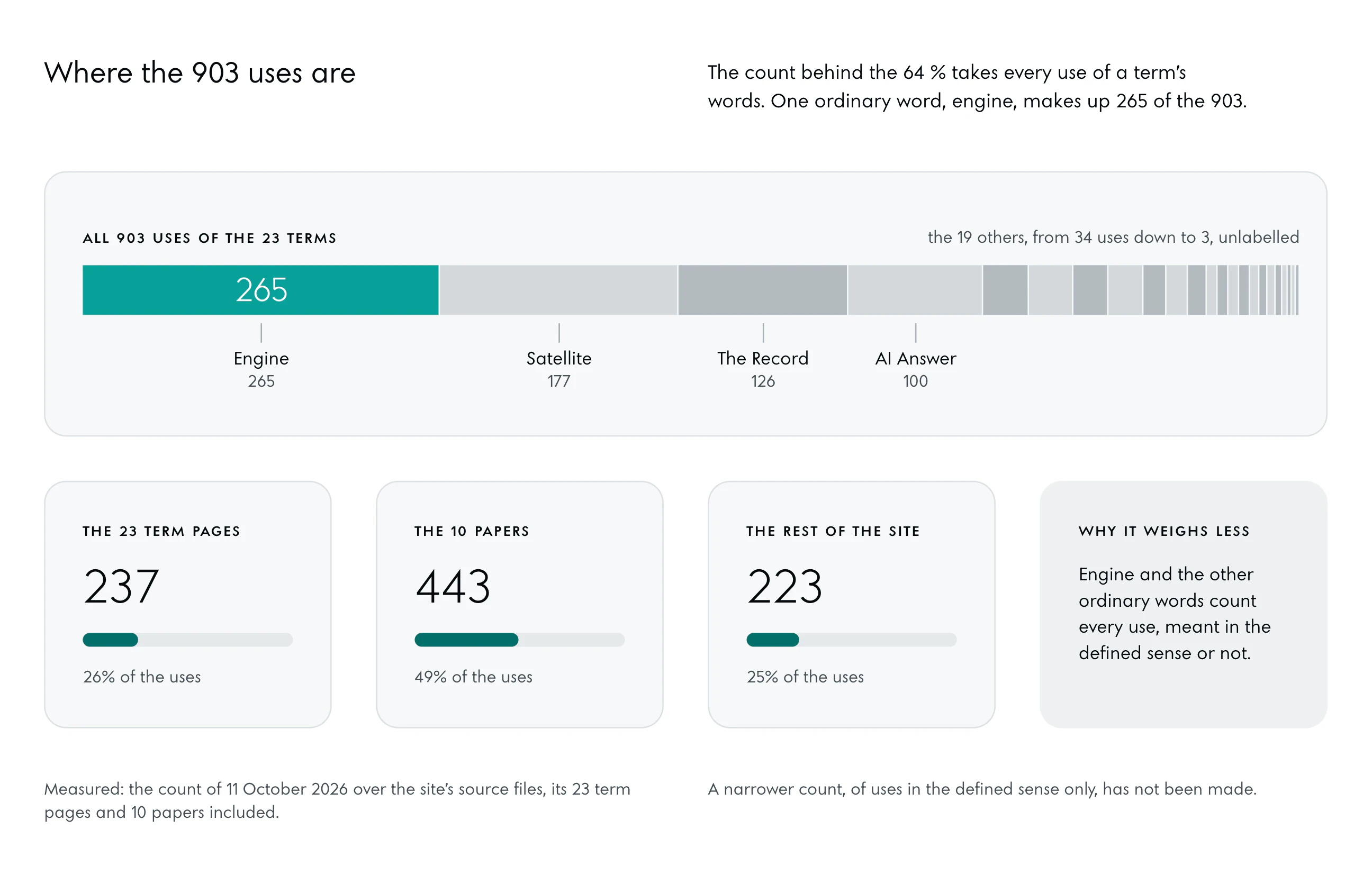
What holds on our pages, then, is one term, one page, one spelling. One way of writing, at the letter, fails to hold. Does the difference matter to any engine?
That is theory until the uses are placed in a model’s space. For its part this paper writes the name with its capitals each time it names the practice, and the lower-case forms printed in it are specimens.
Phrases With No Earlier Use
The cleanest way to test a claim about coined terms is to coin some. On 10 October 2026, day 0, we published three, each on one page that defines it, having found no earlier use of any of them. What each engine does with them is being read on fixed days, against predictions written before any data came in.
Where did the three start from? In the hour of publication Google’s inspection tool answered that each address was unknown to it. We then sent the addresses through IndexNow and asked Google to index each one.
Those two pushes are a confound, named as such on the sheet; a fast first crawl is logged and left out of the evidence. On day 1 each of the three read “Submitted and indexed” in Search Console, last crawled on day 0. There were no impressions yet in Search Console or in Bing, whose reports run about two days behind, so empty rows on day 1 say nothing at all.
How long does a crawl take with no push at all? The page for Answer Gravity, published on 4 October with no request to any engine, was crawled on 7 October. Three days unprompted, against hours with a push.
The predictions of a crawl by day 3 and an index entry by day 7 were therefore met early, and both are fully explained by the pushes.
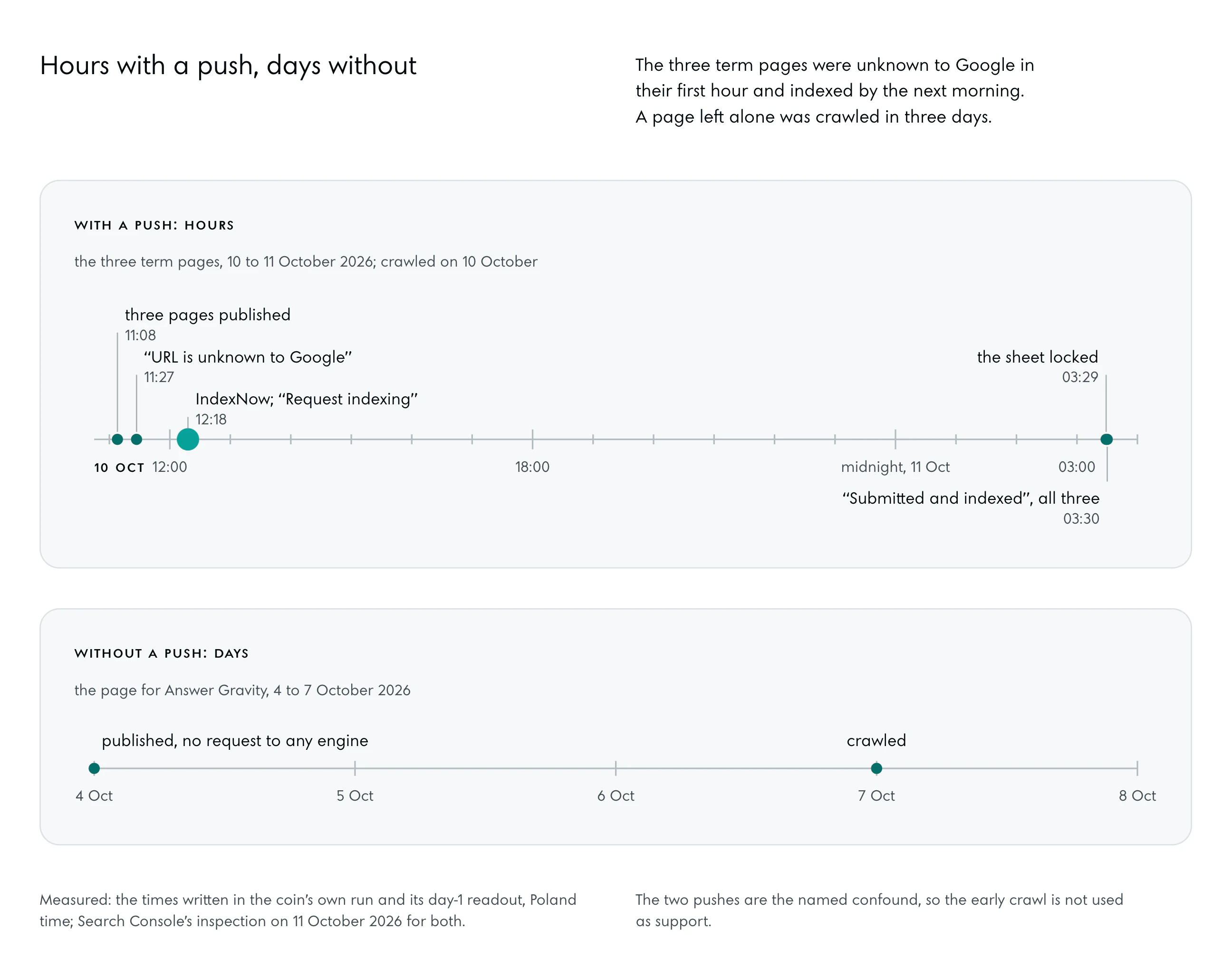
[NEED: readout 17 Oct 2026] [NEED: readout 24 Oct 2026] [NEED: readout 7 Nov 2026] The chart fills as those days pass. A first reading of positions, taken on 12 October, stands in the last part, Testing and Validation. What follows is what was written down for each of them.
By day 14 each term page is expected to have been shown at least once in Search Console. Four weeks in, on day 28, the expectation is more impressions on searches that lack the full phrase than on searches that hold it, and fewer than 10 clicks in all, most of them ours. We predicted so few so that a small number is read correctly later, because phrases with no search demand cannot draw a crowd.
For the exact phrase in quotes, searched by hand and signed out in Google and in Bing, the sheet expects our page first for each of the three on day 14 and on day 28, and expects the US spelling to lead to the same page by day 28. Bing is expected to have indexed all three by day 7.
One line carries a number that we cannot fully defend. The sheet gives Copilot about one chance in three of citing at least one of the terms by day 28. That fraction is a judgement with no data at all behind it, written down so that it can be scored.
What should an owner plan on for a new name? The index entry and the exact-phrase result, which any firm can check for itself, with a citation treated as a bonus that no one can promise by a date.
On 10 November comes the last test, done by hand. One question for each term, of the form “What is semantic token optimisation?”, is put to each assistant that the founder chooses, in a new conversation, once with web search off and once with it on. With search off the sheet expects each assistant to fold the phrase into names it already has and to leave the studio unnamed.
That arm is the control, because a model trained before 10 October cannot hold the coin. With search on, the sheet expects the answer to give our definition and to name or link the studio, for at least two of the terms in at least half of the assistants. [NEED: folding test 10 Nov 2026]
We call it folding because of what the tokenizer showed. A coined phrase arrives as ordinary entries, and a model with nothing else to go on will build a meaning for it out of what those entries meant elsewhere. With search on, the mechanism that the court describes takes over, in words a Google witness agreed to as the opinion quotes them, “grounding is when an LLM model uses some class of data, often from the web, in order to improve the accuracy of its response”.
The test asks if one defining page is enough data for that.
On the log as well is the founder’s belief going in, “somehow, even with the new domains, we managed to break through the authority and the citing method.” It is his claim about earlier sites, and whether it holds on a new one is still out.
What Reading a Name Costs
One more sheet was locked on 11 October, and it concerns a quantity the founder had named with a warning attached, “The perplexity in bursting is only one part of the idea, and it’s not necessarily validated”. Perplexity is a model’s surprise at a text. At each piece the model has an expectation of what comes next, and its surprise is large where the piece was unexpected and close to nothing where the model could have supplied the piece itself.
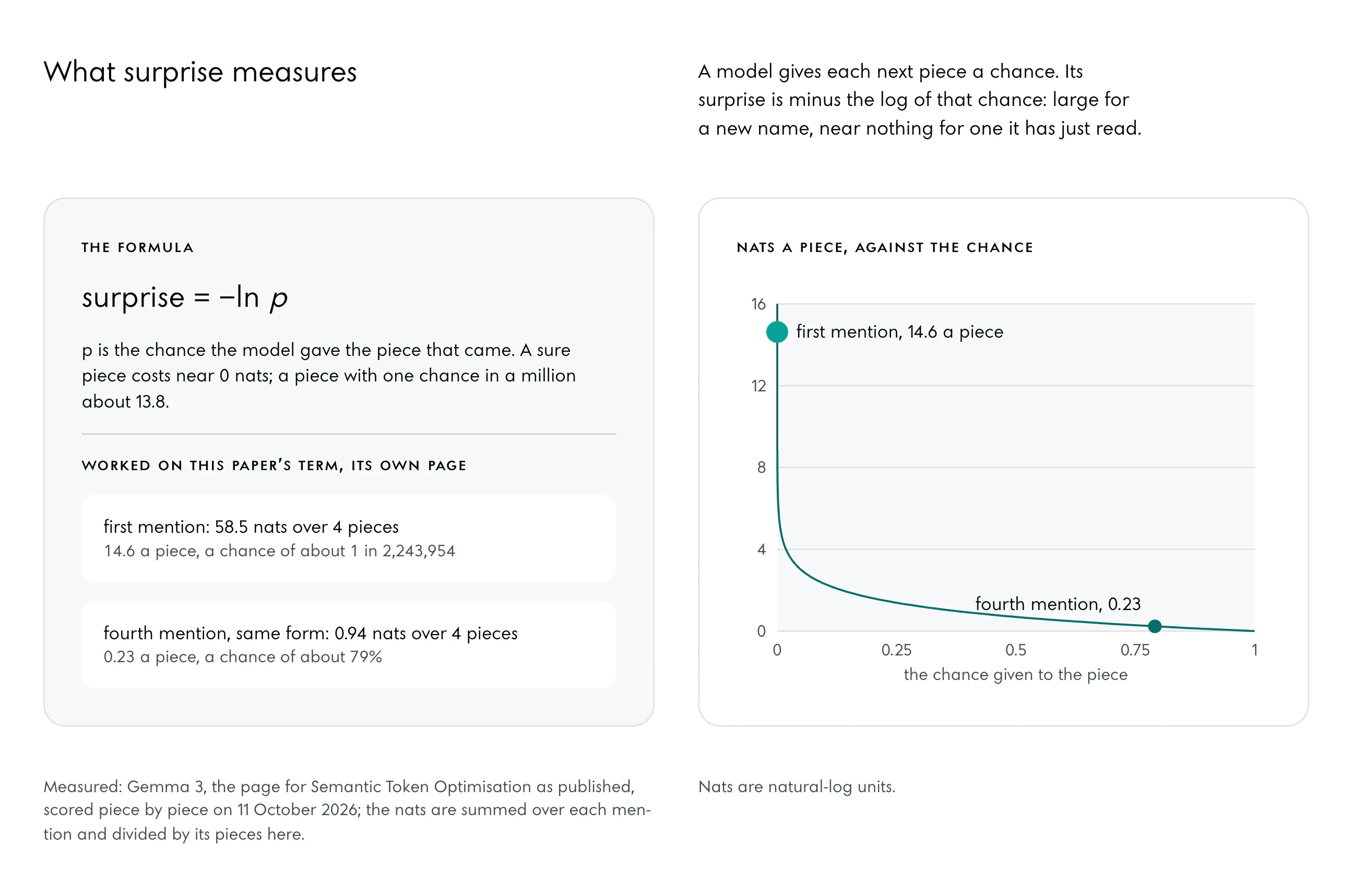
We scored the three term pages with Gemma 3, piece by piece, and added up the surprise over each mention of the page’s term, in nats, the unit such scores are counted in. Each page went through twice, and the first pass took it as published, with the term in one form. For the second, the later mentions were rewritten by rule into other forms, which were lower case, hyphens between the words and a capital on the first word only.
That second version was made for the test and has never been published.
The result is measured, on three pages that name their term three to five times each. A coined term’s first mention is very costly, as a new name should be, at 50 to 59 nats. Written the same way again, a later mention costs between 5 and 9 % of the first, so the model has learned the name inside the page.
Rewritten into the other forms, the later mentions cost 2.2 to 3.7 times what they cost in one form. Hyphens were dearest at 13 to 16 nats, where our form at the same place on the page cost about 3 or less. Over the whole page the difference all but vanishes, at under 1 %, because a name is a few pieces out of a thousand.
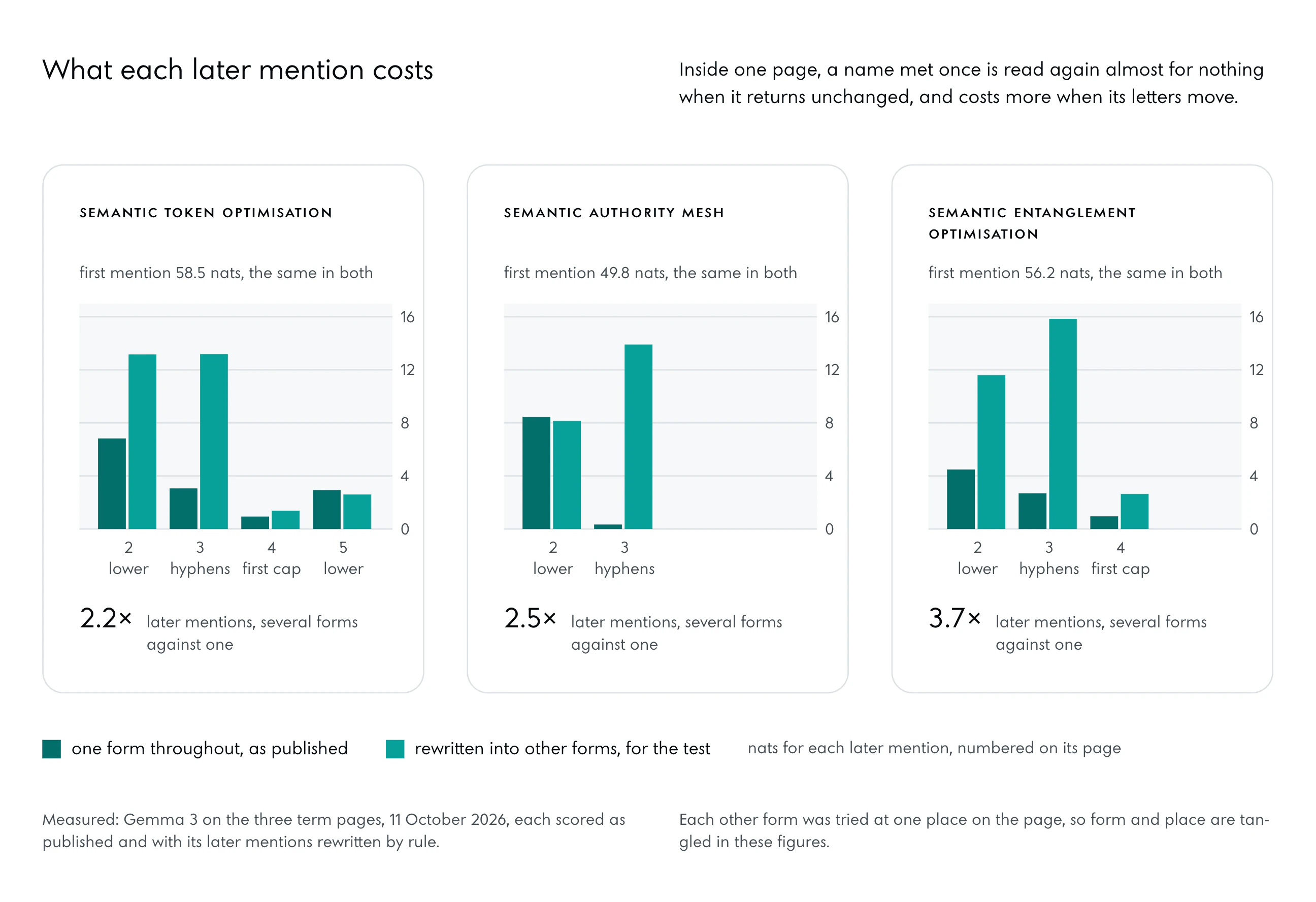
Three pages carry only so much. The sheet had expected a ratio of at least 1.5, and it held on each page. Each other form was tried at one place on the page, so form and place are tangled together in these figures.
And surprise in one open model is no measure of what a search engine rewards, which is the founder’s own bound. What the run adds is very small and exact; inside one page, the model reads a name it has just met almost for nothing when the name returns unchanged, and pays again when the letters move.
What Would Break the Claim
Two outcomes were named in advance as counting against the studio. One is some other site standing first for the exact phrase. The other is the assistants, with search on, still folding two or more of the terms into known names.
Either would mean that defining a term on one page, and holding to it, was insufficient to tie the term to the firm that coined it.
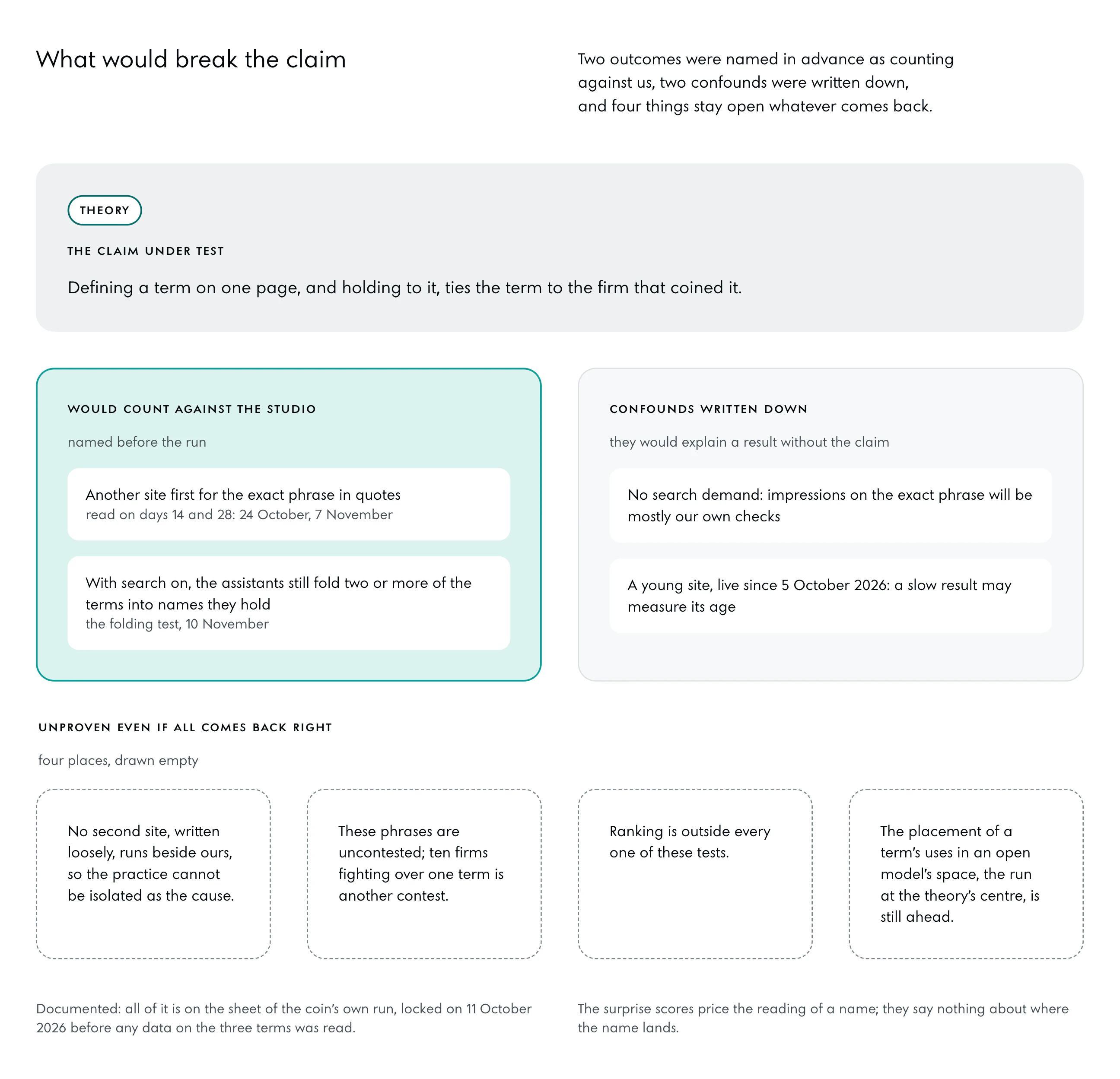
Two confounds were also written down before the run. The phrases have no search demand, so impressions on the exact phrase will be mostly our checks. And the site has been live only since 5 October 2026, so a slow result may well be a measure of how old the site is.
If each line comes back right, what is still unproven? No second site, written loosely, runs beside the first for comparison, so the practice cannot be isolated as the cause. These phrases are uncontested, which is a different contest from a term ten firms are fighting over.
Ranking is entirely outside each one of these tests. And the run that would test the theory at its centre is still ahead, the placement of the uses of a term in an open model’s space. The surprise scores above are a neighbour of that run and no substitute for it, because they price the reading of a name and have nothing to say about where the name lands.
The Same Test on Your Name
You can repeat the first measurement without the studio, and without any engine’s permission.
- Each way your firm’s name is written, collected from the site, the email footer, the invoices and the largest directory that lists you.
- The pieces of each form. Whoever builds your site can run the forms through an open model’s tokenizer in a few minutes and send back the rows.
- A count of forms for each term, taken from your source files or from a crawl, to set beside our starting median of three.
- One decision per name, so that where two forms cut equally you keep the one that your customers already type.
- Date of the recount, written into the map today so that the second count is owed.
A count alone is available from Google’s developer tools, whose documentation says to “Call count_tokens with the input of the request”. The pieces themselves, with their positions, come from the tokenizer file of an open model such as Gemma, which is how our rows were made.
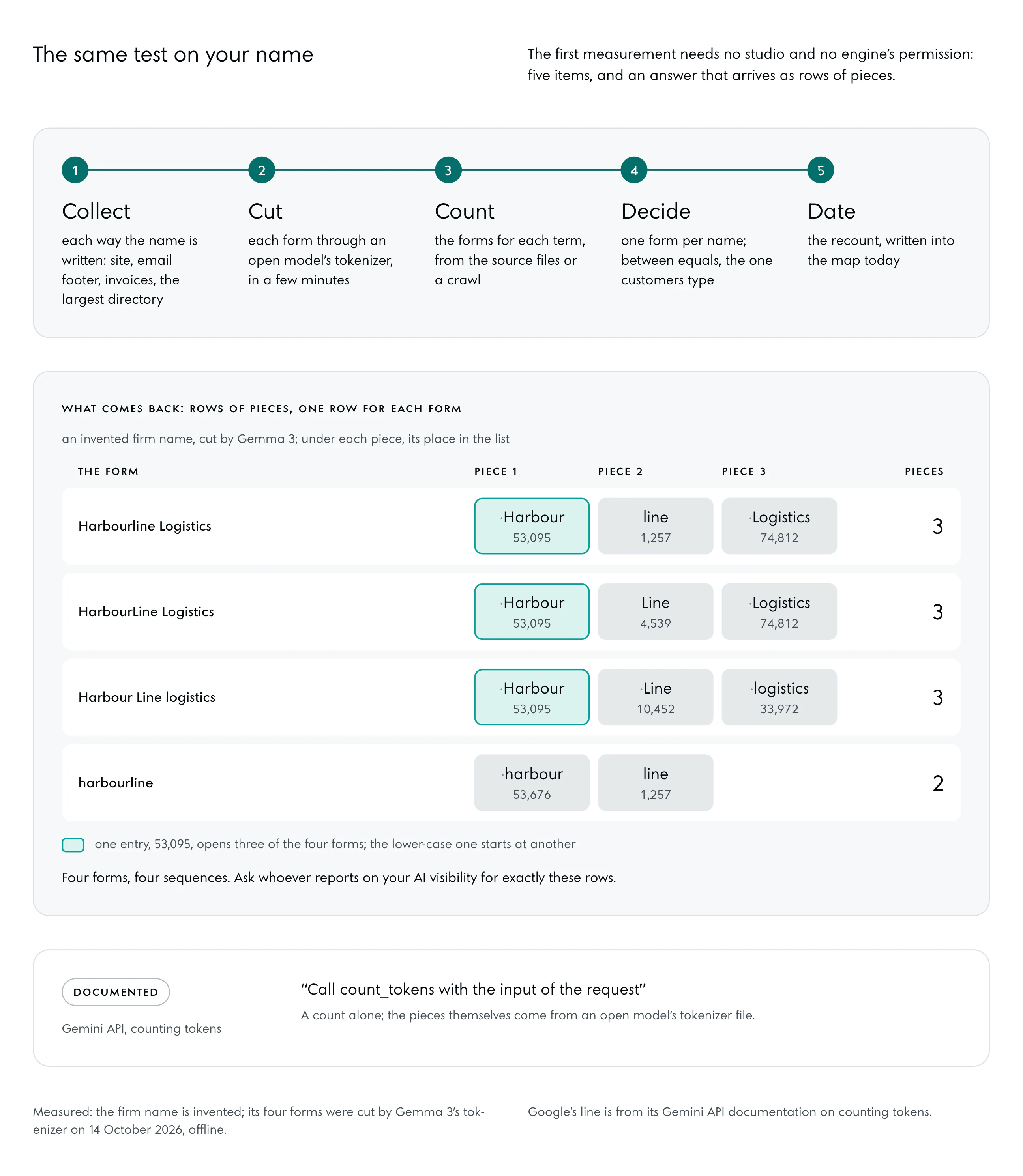
Then ask the people that you pay to report on your visibility in AI answers how many ways the name of the firm is written on its pages, and what a model receives for each. The answer you are looking for arrives as rows of pieces, one row for each form.
A prediction is evidence only when it was written down and locked, with its date, before the data was read, and a wrong one stays on the sheet.
08The Gradient at the Size of a Term
So far, each measurement has stayed at one scale, the uses of one name on a firm’s pages. The three papers of the set read one slope at three scales, and this part reads it at the smallest.
In the second paper, Semantic Authority Mesh, the same slope is read over the pages of a site, in its part The Gradient at the Size of a Site. The third, Semantic Entanglement Optimisation, reads it over all that a firm publishes under its name, and its part Gravity and Its Gradient sets out the physics that the word comes from; none of that is repeated here.
This slope has a name of its own, Semantic Gravity Gradient, a term Noo–Studio coined in October 2026. Its page defines it in a sentence that we quote whole, “The slope of the pull towards a centre of meaning in the space where engines place text: it is set by terms written one way, shaped by the terms around them, and read twice, as the descent of tokens towards that centre and, in its mirror, as the ascent of a position in search.” Two of its clauses belong to this part; “set by terms written one way” is what the earlier parts measured, and “shaped by the terms around them” is what they left out. The second reading, a position in search as the mirror of the first, is our theory, and the last part of this paper gives its first dated reading for this paper’s own term.
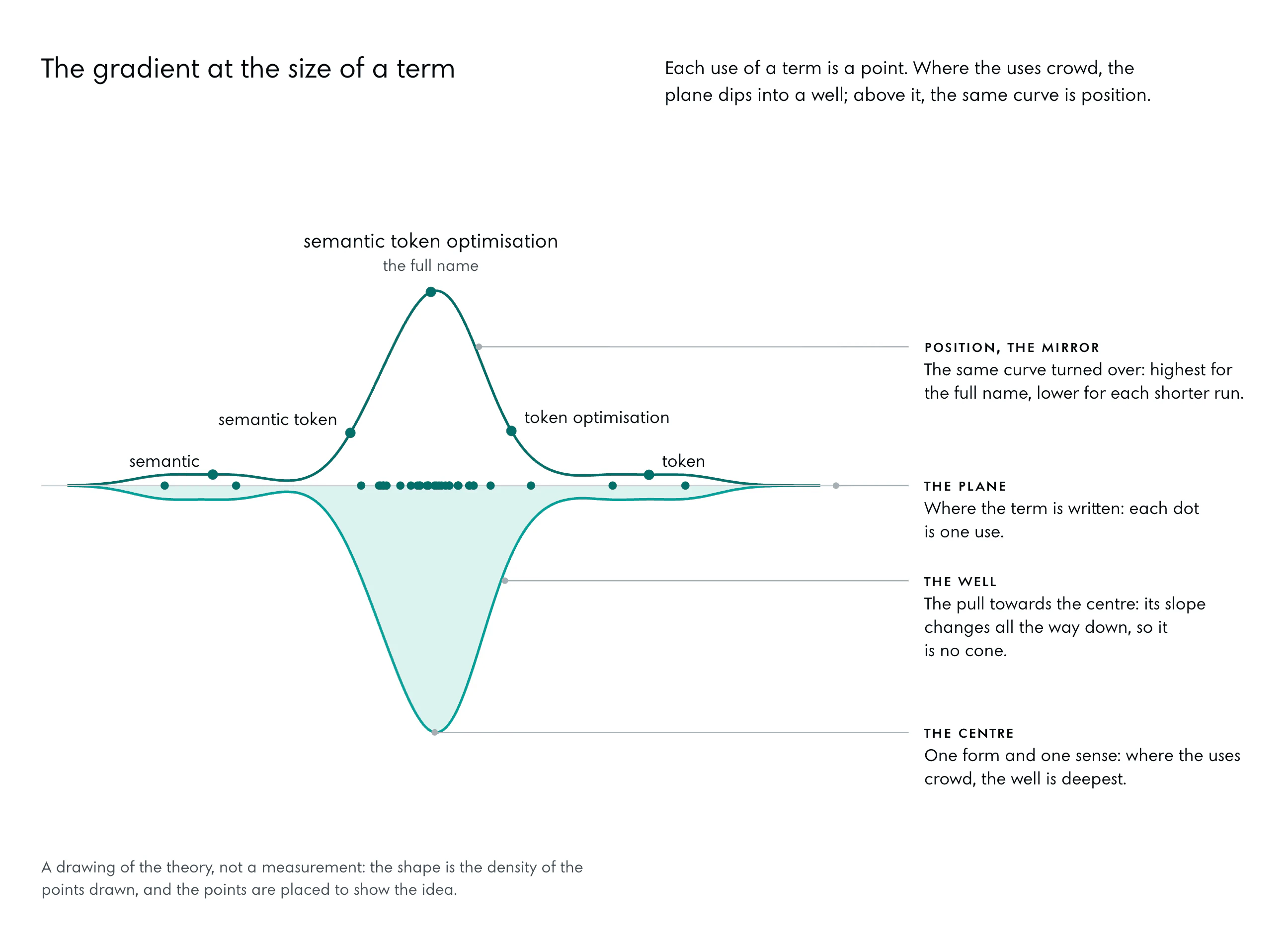
A Cloud for Each Name
A model gives each use of a word a place of its own. Kawin Ethayarajh’s finding, quoted in the part on what a token is, was that the places of one word lie closer to each other than to the places of a different word, so a word in a modern model is a cloud with one point for each time it is used. Read as a field, the uses of a term are points of that kind.
Where they crowd together the pull towards their centre is strong, and where they thin out it is weak. So a term written one way and used in one sense should gather its points close, into one narrow and deep well, while a term written four ways or used in two senses spreads them over two or more shallow wells, each with a centre of its own.
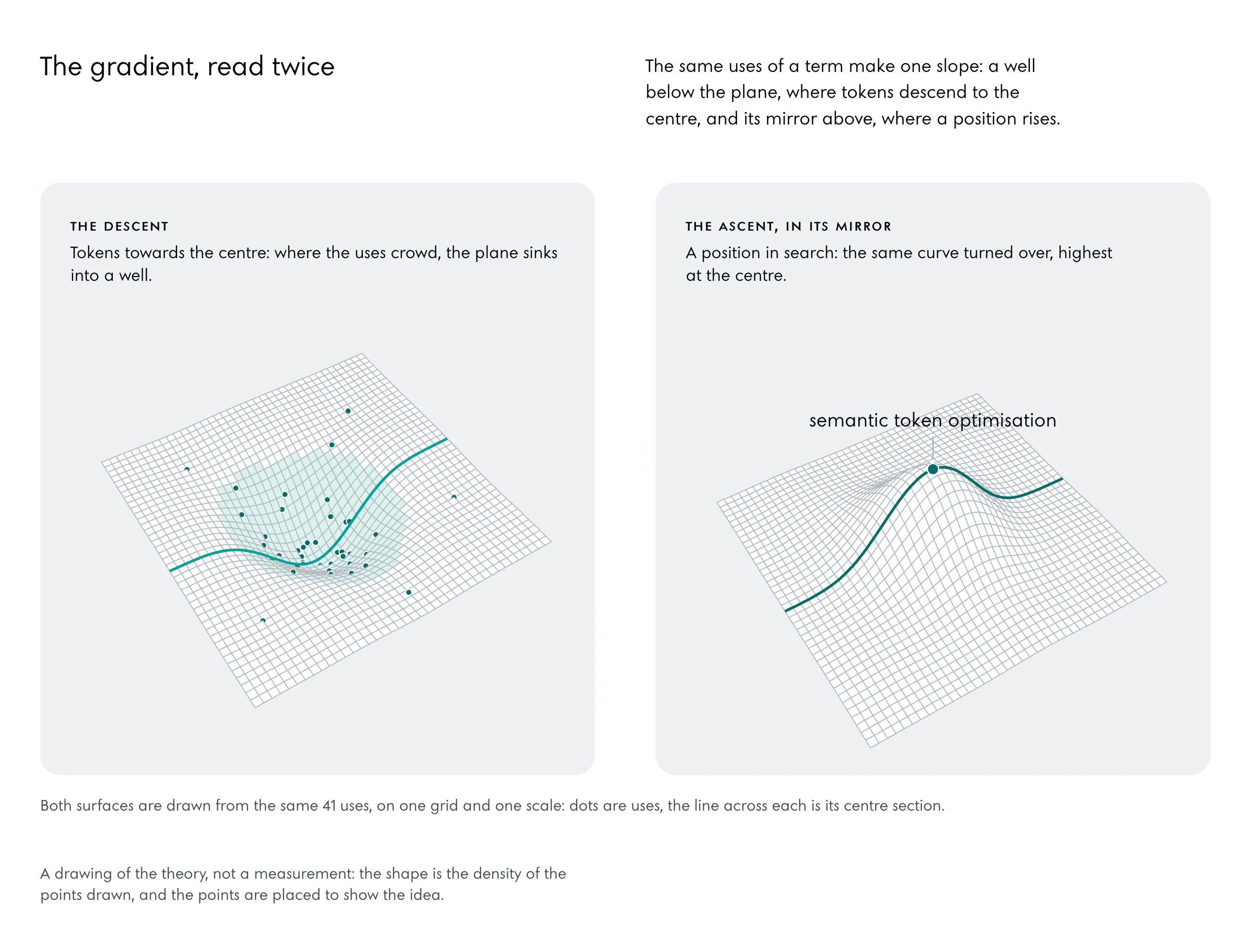
Two of this paper’s runs bear on the width of that well, and neither of them reaches it. In Gemma’s table the ten nearest neighbours of most of our words were that same word in other forms, so the forms of one word already sit near each other before any sentence moves them. Along the three term pages the model read a name almost for nothing when it came back in the same form, and it paid again each time the letters moved, as the part What Reading a Name Costs reports.
Both results are measured; neither places the uses of a term in the model’s space. The narrow, deep well is theory, and the run that would test it has been marked as missing since the part on coined names, which is to place each use of a term in an open model’s space and measure how far the places spread, one written form against several.
Form Held, Field Spread
That account stops at the letters of the term, and our first wording of this paper stopped there too. It measured what the other forms of one term cost, and it left out what the words around the term do for it. Piotr Paweł Zalewski, founder of Noo–Studio, corrected it on 12 October 2026.
The primary term keeps its one form, he said, while the terms around it vary on purpose and carry as much weight, because they set “how the curve is going into the space that you want to capture”.
So the rule at this scale has two halves, which we write as form held, field spread. The form is held, with one way of writing the term and one sense for it, and that fixes where the centre of the well lies. What is spread is the field, meaning the shorter runs of the term, its neighbours in meaning and the vocabulary of the subject that it belongs to, all of them varied on purpose over a page and over each property under the name.
Those words decide how wide the well is and towards which shorter searches its slope runs. A page that kept the form and wrapped it in the same surrounding words each time would fix the centre and leave the slope narrow, steep on one phrase and nearly flat everywhere else.
Nothing that the earlier parts measured is withdrawn. The forms of one name, its capitals, hyphens, plurals and spellings, are still separate sequences of pieces, and holding to one of them still costs a firm a decision and nothing more. What changes is how far the rule reaches.
It governs the term and stops there, and a varied surround is part of the work, never a lapse from it. The documented ground for that second half, that repeating one term gains less each time and that an engine reaches past the exact words on a page, is set out in the third paper, in its part Fixed Centre, Varied Surround, and it is pointed to here without being quoted again.
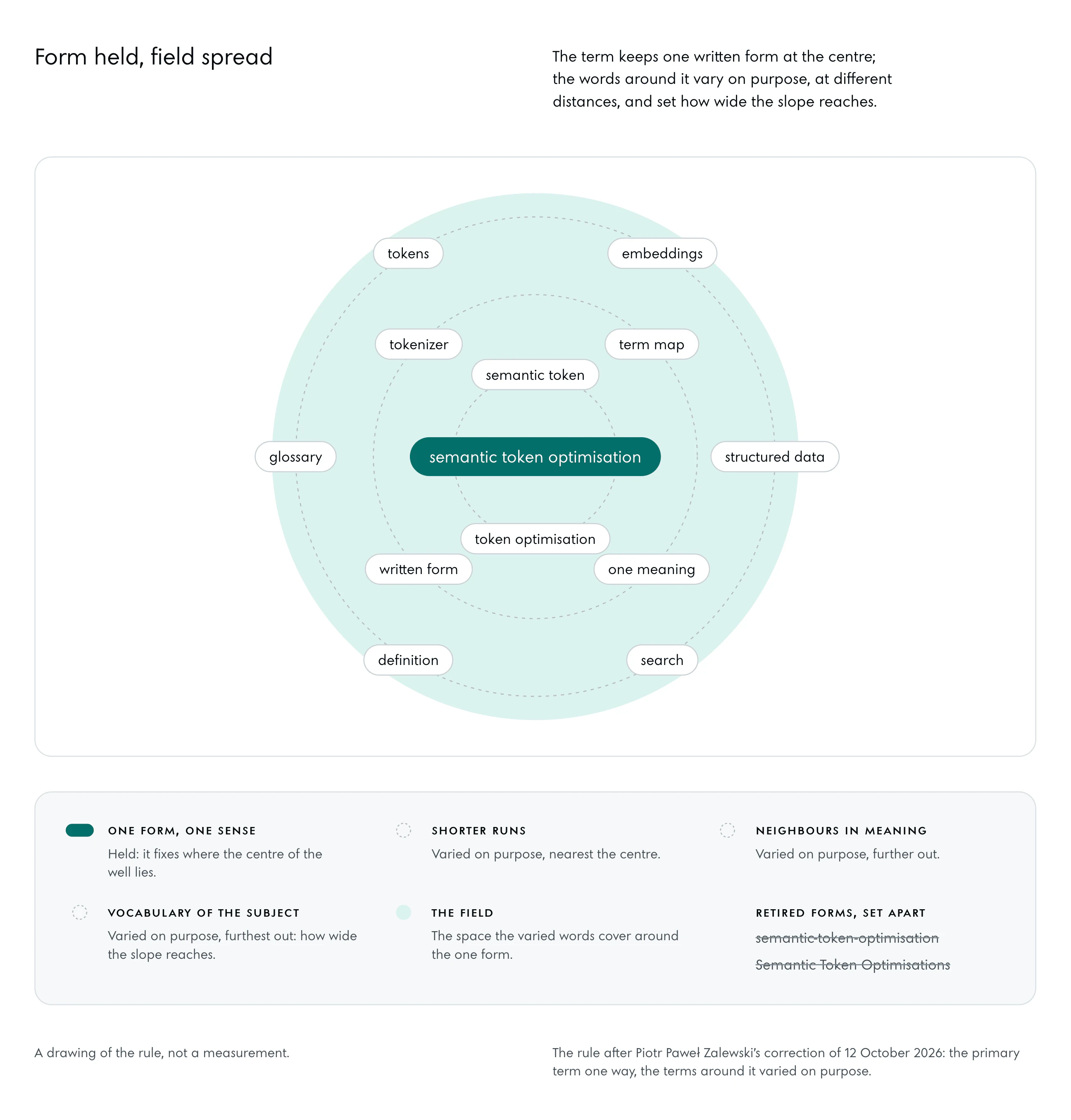
At this size the second half can be tested in an open model before any engine is asked. Write two versions of one page that hold the term in one form, one with a varied surround drawn from its subject and one that repeats the same wording around it, and place both in the model’s space beside the shorter runs of the term, semantic token and token optimisation among them. On this theory the varied page is likely to sit nearer to more of those runs.
If it sits no nearer, the second half of the rule fails at this size.
Rare Pieces and Common Ones
Which of the words around a term do the shaping? His answer, given in a narration of 14 October 2026, is that the weight sits in the uncommon ones. The short words that recur on each page, its articles, prepositions and conjunctions, carry its grammar and move its place in the space very little; the long and less frequent words, with the words that stand beside them, carry what the page is about.
That reading is his, and it has a long documented neighbour in the textbooks of the trade.
Engines of the textbook era met the common words first, and gave them a name. The 2008 textbook quoted in earlier parts says that “some extremely common words which would appear to be of little value in helping select documents matching a user need are excluded from the vocabulary entirely. These words are called stop words.” Its limit is marked on the same page.
“The meaning of flights to London is likely to be lost if the word to is stopped out,” it warns, and it reports that “Web search engines generally do not use stop lists.” So the common words stayed in, and the trade turned their weight down.
What turned it down is inverse document frequency, and it goes back to Karen Spärck Jones. She set out the idea in the Journal of Documentation in 1972, in a paper that we read in its reprint of 2004, and argued that “terms should be weighted according to collection frequency, so that matches on less frequent, more specific, terms are of greater value than matches on frequent terms”. The textbook’s page on inverse document frequency puts the result in a line, “the idf of a rare term is high, whereas the idf of a frequent term is likely to be low”, and the Karpukhin paper quoted in the part on what a token is still named TF-IDF in 2020 as one of the two standard methods of finding a passage by its words.
Spärck Jones also found that “frequently-occurring terms are required for good overall performance”. That finding is the documented bound on his reading; a common word weighs very little each time it appears, and it still does work.
Why are the common words also the short ones? Steven Piantadosi, Harry Tily and Edward Gibson, in a paper published on 28 January 2011, start from the old observation “that frequent words tend to be short”, which they credit to George Kingsley Zipf. They then show “across 10 languages that average information content is a much better predictor of word length than frequency.” On their result a long word is often long because it carries more, counted as how hard it is to predict where it stands.
That count is called surprisal, and John Hale gave it a working form in a paper of 2001. In it the difficulty of a word is its surprisal given the words before it, and in his worked example it is at the two nouns, banker and buy-back, that “a comparatively large amount of information is conveyed”. It is the same quantity this paper scored, piece by piece and in nats, along the three term pages in the part What Reading a Name Costs.
On the direction, then, the documented side and his reading agree. Rare words weigh more in the classic scoring, they tend to be the longer words, and where they stand they carry more information. What stays his theory is the step from that scoring to a model’s space, the claim that the place of a page there is set mostly by the pieces of its long and less common words and by their neighbours, and that the short common words move it little.
Its test is cheap to run; place a page in an open model’s space, then place it again with its short common words taken out, and once more with as many of its rarest words taken out. If the first cut moves the page as far as the second, the reading fails.
One part of his narration meets this paper’s own measurements and comes out of them changed. He holds that a tokenizer drops the endings of words, so that optimise and optimisation come out as variations of one set of numbers. The engines of the textbook era did drop endings, by a step that the textbook calls stemming, “a crude heuristic process that chops off the ends of words”.
Gemma’s tokenizer keeps them; in lower case optimisation is one entry of its own, and under a capital it splits into Optim and isation, as the part on capitals measured. His reading holds one step further in, in the model’s table, where the nearest neighbours of a word were mostly the same word in its other forms. So the forms of a word are kept apart at the cut and set side by side in the table.
Distance From the Likeliest Wording
His narration takes one more step, from the weight of each piece to the page as a whole. A page is unique, on his reading, when its wording stands far from the wording that a model would find most probable, and a page re-told from other sources stands close to that wording. What an engine does with pages that repeat others is taken up in the second paper, Semantic Authority Mesh, at the size of a site, in its section Uncommon Pages and Re-Told Ones; this part keeps to the measure.
Two documented findings point the same way, and the first is from Ari Holtzman and four colleagues, who in a paper first posted on 22 April 2019 compared text written by people with text that a model produced by always taking its likeliest continuation. They found that “Natural language rarely remains in a high probability zone for multiple consecutive time steps, instead veering into lower-probability but more informative tokens.” Sebastian Gehrmann, Hendrik Strobelt and Alexander Rush posted a tool that was built on the same fact on 10 June 2019. Its “underlying assumption” is that “most systems sample from the head of the distribution”, and the classifier that they trained on it learned “that real text samples from the tail of the distribution more frequently”.
Both papers are about telling text that people wrote from text that machines wrote, and neither says a word about ranking.
The quantity that both papers read is the one that this paper already has. In What Reading a Name Costs, a model scored the surprise along three pages piece by piece, and a name written the same way again cost it almost nothing, while the same name with its letters moved paid again. That result marks where his reading stops at this size.
Surprise rises at any departure from the likeliest wording, and a hyphen set where none belongs is a departure too. So the distance that would read as uniqueness, on his account, has to come from the field, from the less common words of meaning set around the term, and never from the form of the term itself, which is form held, field spread read as a measure. Nor can surprise tell a true sentence from a false one.
A page can stand far from the likeliest wording because it says something new or because it is wrong, and he says so himself.
The theory, in his name, is that a model which reads a page for uniqueness reads its distance from the likeliest wording, and that the distance which counts is carried by the words of meaning. Its first test needs only an open model; score a page written first-hand and a version of it re-told by a model from the same sources, both over their words of meaning alone, and if the re-told version is not the less surprising of the two, the reading fails at its first step. Whether an engine then treats such pages differently is a second test, and it belongs to the search records.
Temperature as Google Words It
The last step of his narration concerns how a model writes. At each step a model chooses the next piece from its probabilities, and a setting called temperature reshapes those probabilities first. Google’s page on the parameters of its models, on Google Cloud and last updated on 13 October 2026, defines the setting in one line, “Temperature controls the degree of randomness in token selection.” It adds that “A temperature of 0 means that the highest probability tokens are always selected”, that “Gemini models support a temperature value between 0.0 and 2.0”, and that “Models have a default temperature of 1.0.” Holtzman’s paper writes out the formula behind the setting, and by it a temperature below 1 “skews the distribution towards high probability events”, while a temperature of 1 leaves the probabilities as the model computed them.
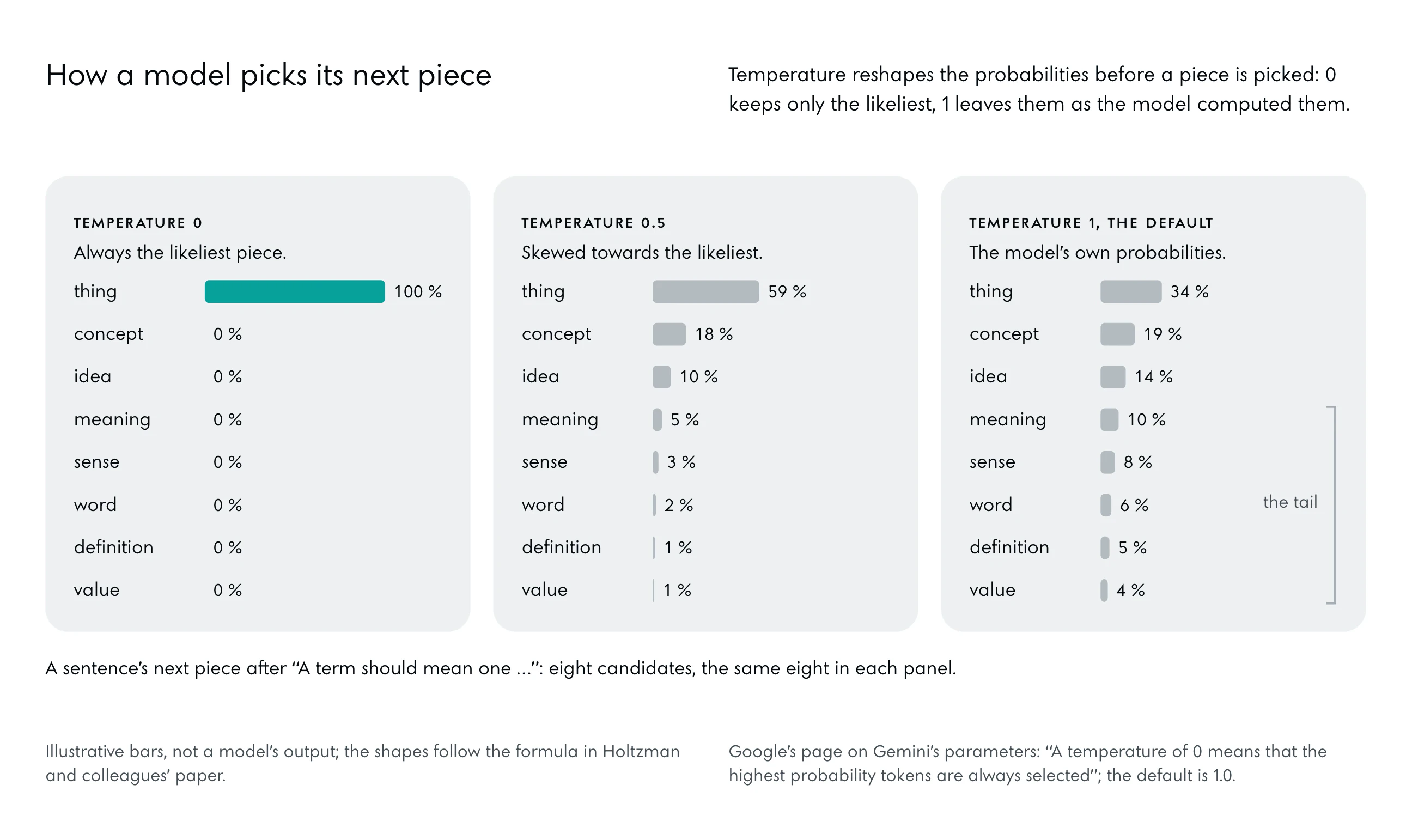
The numbers
| Next piece | Temperature 0 | Temperature 0.5 | Temperature 1 |
|---|---|---|---|
| thing | 100 % | 59 % | 34 % |
| concept | 0 % | 18 % | 19 % |
| idea | 0 % | 10 % | 14 % |
| meaning | 0 % | 5 % | 10 % |
| sense | 0 % | 3 % | 8 % |
| word | 0 % | 2 % | 6 % |
| definition | 0 % | 1 % | 5 % |
| value | 0 % | 1 % | 4 % |
Google’s reference for the Gemini API, updated on the same day, says of the setting that “This field is no longer supported and is silently ignored on Gemini 3.6 Flash and newer models.” Its page on prompting says that Gemini 4 and the models from Gemini 3.6 on “ignore custom values” for it and send back warnings of deprecation, so the two pages differ on whether a warning is sent. These lines are documented, and what they say is very narrow. A developer can no longer set the temperature of Google’s newest models.
Neither page says what those models use in its place, neither says that anything was removed, and neither says a word about Search.
Piotr Paweł Zalewski reads these lines as one setting held fixed for the models that write, at the default of 1, which is the midpoint of the range that Google gives. His theory follows from that reading, that a model held at one setting writes, again and again, from the same spread of likely words. So a page that departs from what such a model would write stands out to it as unique, whether or not what it says is true, and a page that keeps to that pattern reads as one more telling of the same thing.
We hold it as theory, with a bound and a test, and its bound is that temperature governs how a model writes, while no page Google publishes says that an engine scores what it reads by it. The test extends the one above, taking pages of both kinds that already stand on the web for one subject, the first-hand and the re-told. Score each with an open model for surprise over its words of meaning, and set the scores beside the places each page holds for the same searches on the same days.
If the pages near the likeliest wording are shown as often and as high as the pages that depart from it through their words of meaning, the theory fails.
In our theory, one written form of a term fixes where its centre lies, and the varied, less common words of meaning around it decide how far its slope reaches.
09Neighbours on the Same Ground
Other people work on these questions, some of them for far longer than we have. Here we place the practice among four of them.
They are keyword density, which it is sometimes taken for, the engineering work of trimming what a model spends, which shares a word with it, and entity consistency and topical authority, which are its near relations and are credited as such. Each is described in its own terms and then set beside the practice.
Is This Keyword Density Again?
The oldest advice in the trade was to repeat the phrase. An index that counted how often a term appeared in a document rewarded pages that said it often. Writers obliged, and the engines learned to count it against the page.
Google’s spam policies, last updated on 28 August 2026, still carry the result, “Keyword stuffing refers to the practice of filling a web page with keywords or numbers in an attempt to manipulate rankings in Google Search results.” One of the examples that the page gives is “Repeating the same words or phrases so often that it sounds unnatural.”
The leaked documentation, under its separate label, shows that the idea had a slot in storage in March 2024. Among the data its pages list for each document is a field described as “The keyword stuffing score is represented in 7 bits, going from 0 to 127.” A stored score, with no weight attached and no word on its use.
On its face a term map can look like the old advice in new clothes, yet the two concern different quantities. Density is a count of repetitions. A term map fixes the form and the meaning of each use, and leaves the number of uses to the writer.
One mention on a page can satisfy the map completely. What stands around that mention runs the other way from stuffing. Stuffing repeats one phrase, while the practice holds the phrase to one form and spreads the words around it, varied and drawn from the subject, where the less common of them carry the most weight; that is the field of the part The Gradient at the Size of a Term, and we hold it as theory with the tests given there.
And a site can use a word 265 times, as ours uses the word engine, and still fall short at the letter. Anyone who reads this paper as a licence to repeat a phrase has read a very different paper.
Cost Work on the Engineers’ Side
Among engineers who build on language models, token optimisation already has a meaning, and the meaning is about money, the trimming of what a model spends on a prompt. Huiqiang Jiang and four colleagues, in a paper posted on 9 October 2023, noted that prompts “are becoming increasingly lengthy, even exceeding tens of thousands of tokens” and set out “To accelerate model inference and reduce cost”. Their method, they reported, “allows for up to 20x compression with little performance loss”.
That is a field of its own, with a literature to match, and it fully deserves its name.
Telegrams were priced by the word, and senders learned to write to the tariff. The engineers’ discipline is that old habit with a new meter.
That field was in the founder’s view when he first described the idea. He spoke of the work that makes search companies “more efficient in the way that they retrieve the data”, set it against what search optimisation would become from day zero, and concluded that “in between those two spaces, there is a term that could be coined within the search space”. The term in this paper is the one that he meant.
One of our measurements belongs on the engineers’ side of that line. In our ten published papers, cut by the Gemma 3 tokenizer on 11 October 2026, a piece carries between 0.68 and 0.82 of a word. Which paper costs most?
The one with the largest share of digits, 4.4 % of its characters, has the lowest ratio, 0.68, and the paper with almost none, 0.3 %, has the highest, 0.82. Before the run the sheet said that each paper would fall between 0.65 and 0.85, with the most numerical one lowest, and it was right.
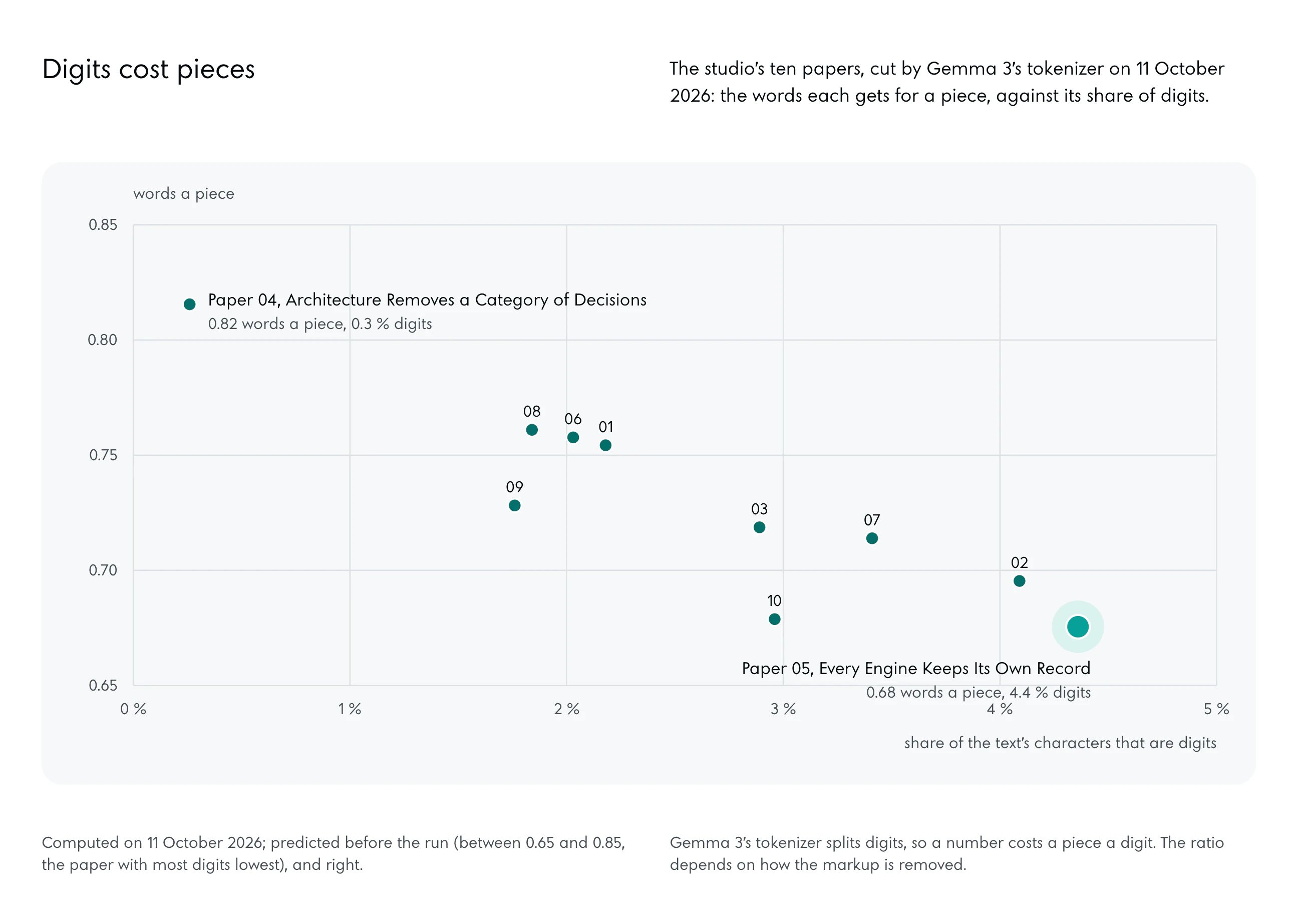
The numbers
| Paper | Digits | Words a piece |
|---|---|---|
| 04 Architecture Removes a Category of Decisions | 0.3 % | 0.82 |
| 09 Designing Icons With AI | 1.8 % | 0.73 |
| 08 Written Once Read in Fifteen Languages | 1.8 % | 0.76 |
| 06 Satellites Smaller Sites That Lead Home | 2.0 % | 0.76 |
| 01 Presence Is a Structure | 2.2 % | 0.75 |
| 03 The Page the Machine Quotes | 2.9 % | 0.72 |
| 10 2026 Typeface Design What Is Possible | 3.0 % | 0.68 |
| 07 Built From Public Records | 3.4 % | 0.71 |
| 02 What Are You Actually Paying For | 4.1 % | 0.70 |
| 05 Every Engine Keeps Its Own Record | 4.4 % | 0.68 |
Why digits? Because of a choice that Google documents. The Gemma report quoted earlier describes a tokenizer “with split digits”, so a year or a percentage is cut into two or more pieces where a word of the same length might be one.
And the range agrees with Google’s rule of thumb for Gemini, 60 to 80 English words to the hundred tokens, sitting at its upper end and a little beyond.
That range of 0.68 to 0.82 comes with conditions. It rests on ten papers from one site, in English, cut by one tokenizer, and it depends on how the markup is stripped before the count. A different stripping rule, a different model’s file, a page in another language or a site with more figures would each move it.
Whether any engine cares about the ratio, the range cannot say. A page full of figures costs a reader more pieces for each word, and we draw no advice from that, because figures are what a careful reader comes for.
So the two kinds of work share a unit, and not much else. Cost work shortens what one party sends to a model that it pays for. The practice in this paper leaves length entirely alone and concerns pages that are read at somebody else’s expense, where what the firm wants is to be placed correctly.
The Credit Owed to Entity Consistency
A longer history and a settled name belong to the nearest neighbour. Guides to entity SEO tell firms to write a brand identically wherever it appears, and the instruction is theirs. One recent guide, published by Superblog on 19 July 2026 and updated on 12 September, says that variant spellings of a brand “split signals across multiple entities”.
It is a vendor’s claim, and we treat it the way we treat our own, as something to test.
Write a name the way you want it found, and then write it that way everywhere it appears.
What is an entity, in that literature? A guide Ahrefs published on 11 September 2024 gives a serviceable definition, “An entity is any object or concept that can be distinctly identified.” Google’s documented side of the matter is its organisation markup, which the documentation says can help “disambiguate your organization in search results”. And the leaked file, under its label, lists for each document a field described as “WebRef entities associated to the document”, which is storage for entities found on a page and, once more, no statement of what is done with them.
Where does the practice in this paper stand beside that one? Close, and on a different unit. Entity consistency is about named things that a knowledge graph can hold, such as a firm, a person, a product or a place.
A term map covers each term that a firm defines, which takes in common nouns used in a defined sense and coined phrases that no graph holds yet, and it checks each at the level of the pieces that a model receives. Our count is the evidence for the difference in scope. Of 903 uses, 265 belonged to one ordinary word.
The Ahrefs guide carries a title that the trade argues about in earnest, “Stop Overcomplicating Things. Entity SEO is Just SEO”. An owner who has paid for a new acronym each year will sympathise.
What would make a new name earn its place? A measurement the owner can repeat, and a result that would embarrass its author.
Topical Authority Seen From the Machine
The other large idea of the trade is about subjects. Does a site that covers a subject thoroughly earn standing on it? The trade argues that it does.
Its tactics, in the Ahrefs guide that we quoted above, include the development of topical authority. The founder marked the difference in one clause, “there is this whole topical authority as a term within the SEO space, and topical connects to the topic”.
Google has published a near relative of the term, for one kind of search. On 23 May 2023 Jen Granito, a Group Product Manager for Search, described “a system called topic authority that helps determine which expert sources are helpful to someone’s newsy query”, with signals that include “How notable a source is for a topic or location” and “Source reputation”. That is documented for news, and the wider use of the phrase belongs to the trade.
This paper looks at the same ground from the machine’s side, where text arrives as tokens against a budget for how much is read and pages are placed in a space. From there a topic is a region and the pages of a site are points in or near it, so the question of standing becomes a question of where those points sit. Our name for the structure that results is the Semantic Authority Mesh, defined on its page as a site’s pages “held close to one centre of meaning, tied together by links and by the same defined terms, and cited by others on that subject”.
Terms are the joints of that structure, and they are all this paper has tried to measure.
How much of that view stands on evidence? The space and its points are documented in the parts above, and so is the budget. That the standing of a site on a subject can be read from the positions of its pages is theory, and its tests are set out in the second paper, Semantic Authority Mesh.
Keyword density counts repetitions, token cost work shortens prompts, entity consistency fixes the names of things, and Semantic Token Optimisation fixes the written form and the meaning of each term that a firm defines.
10Method and Sources
Before it was written, each claim above was sorted into one of three kinds, and this part gathers the rules and the times behind that sorting, with the documents listed by kind.
It also names what is still missing, so that a reader who wants to cite the paper can see at once which sentences are safe to lift.
How the Labels Were Applied
A sentence is called documented here only if its source was opened for this paper and answered with its content. Each quotation was checked against the page that it comes from. What happened when a page refused to open?
Its claim was dropped or carried by some other document that did open, and the substitution is stated. Google’s published pages and the court’s opinion were kept under separate names throughout, with the leaked documentation under a third, and no line of that documentation is presented as Google’s statement or as a weight in a ranking.
Measured means that we ran it. The tokenizer rows come from the tokenizer file of Gemma 3, which has 262,145 entries, run on one of our own machines, with GPT-2’s tokenizer beside it for contrast. Each form was read as it stands in a sentence, after a space, and the runs are fully deterministic.
What do the rows leave out? They have nothing to say about ranking or about what any engine does with the pieces. From the same model, in a compressed copy with four bits to a decimal, came the table of pieces, and that model scored the surprise along the three term pages; both runs are of 11 October 2026, on one sheet locked before them.
The count of written forms took each use of the names of our 23 defined terms over the whole site, its 23 term pages and its 10 papers included, 903 uses in the source files on one day. This paper’s term was read for its positions by hand in Google, and the rows of its page in Search Console through Google’s interface for programs; the last part gives the method of each. How noo-studio.com handles its terms was read in the rules of its theme and checked on two live pages, the term page for Semantic Token Optimisation and the paper The Page the Machine Quotes.
The leaked documentation was read in release 0.4.0 as the registry Hex serves it. We downloaded it on 10 October 2026, and its fingerprint matched the one that the registry publishes. Each line quoted from it was checked against the package on that day.
Theory means our position, and the paper has nine. A term written one way and used in one sense probably makes a tighter cloud in a model’s space. Stable terms make a site cheaper for a reader to place.
Each line of published evidence sits beside a part of the practice, as the table of lines and practices pairs them. One defining page is enough to tie a coined term to the firm that coined it. And the discipline carries over to each property under a name.
Four more come from the part on the gradient and the last part. The form of a term is held and its field spread, and the field decides how far its slope reaches. In a model’s space the place of a page is set mostly by its less common words.
Distance from the likeliest wording is what makes a page read as unique to a model, a reading that Piotr Paweł Zalewski ties to the temperature at which Google’s models write. Once the papers are live, the slope moves towards the shorter searches, as he expects. Which of the nine can be tested as things stand?
A test is described for the first, for the fourth and fifth, and for all four of the later ones. The second and the third have none yet.
All of the hours below are on Poland’s clock. The term pages for the coined phrases went live on 10 October 2026 at 11:08, at 11:27 Google’s inspection said that it did not know their addresses, at 12:18 they went through IndexNow, and indexing was asked for between 12:19 and 12:25. On 11 October at 03:30 all of them read as indexed.
The prediction sheets belong to that same night; the one for the coined terms was written at 03:29 and the one for the tokenizer tests at 03:47, with those tests running at about 03:48. For the written forms the sheet followed at 04:11 and the count of forms at about 04:14. The sheet for the table of pieces and the surprise scores was written at 07:17, its code was on the log at 07:18, and both ran between 07:18 and 07:20.
On the founder’s dated work log is the SHA-256 code of each sheet, and for the tokenizer sheet the code reached the log a few minutes after the run, as the part on predictions states. Positions were first read on 12 October 2026 between 05:33 and 05:41, and Search Console on 14 October between 12:07 and 12:08; its inspection gives the last crawl of this paper’s term page as 10 October at 18:38. The outside sources were opened and checked on 10 and 11 October 2026, and those that were added on 14 October were opened on that day.
What is still missing? Each gap is marked in place with the word NEED. The markers cover the placement of the uses of a term in an open model’s space, the readouts of 17 and 24 October and of 7 November, and the folding test of 10 November.
No sentence in the paper states a result for any of them.
Sources Opened and Sources Refused
Each outside document cited above is linked at the point where it is used. Grouped by kind, with the date each one carries.
| Kind | Documents and dates |
|---|---|
| Google’s published word | A guide to Google Search ranking systems, AI features and your website, the introduction to structured data (all updated 10 December 2025). Pandu Nayak, How AI powers great search results (3 February 2022). Understanding news topic authority (23 May 2023). Googlebot (updated 3 February 2026). Spam policies (updated 28 August 2026). Organisation markup (updated 8 September 2026). Gemini API pages on tokens (updated 23 September 2026), on embeddings and on grounding with Google Search (both updated 9 October 2026). Gemini API reference for generating content and its page on prompting strategies (both updated 13 October 2026). Google Cloud, the page on adjusting parameter values (updated 13 October 2026) |
| Google’s published word, as research reports | Gemma Team, Gemma 3 Technical Report (25 March 2025). Elsworth and eleven others, on the energy of a Gemini text prompt (21 August 2025) |
| A court’s findings | United States v. Google LLC, D.D.C., No. 1:20-cv-03010 (APM), Memorandum Opinion, Document 1436 (filed 2 September 2025), pages 21 to 22, 36, 39, 158 and 162 of 230 |
| Leaked internal documentation | Content Warehouse reference pages, release 0.4.0 on Hex (28 March 2024): the modules for salient terms and for data held on each document |
| A press report | Mezha, on Google’s confirmation of the leaked pages, crediting The Verge (30 May 2024) |
| Published research | Spärck Jones (1972, read in its reprint of 2004). Hale (2001). Piantadosi, Tily and Gibson (28 January 2011). Mikolov and three others (16 January 2013). Sennrich, Haddow and Birch (31 August 2015). Vaswani and seven others (12 June 2017). Kudo and Richardson (19 August 2018). Devlin and three others (11 October 2018). Holtzman and four others (22 April 2019). Gehrmann, Strobelt and Rush (10 June 2019). Ethayarajh (2 September 2019). Karpukhin and seven others (10 April 2020). Zhuang and Zuccon (1 April 2022). Jiang and four others (9 October 2023). Chai and three others (17 June 2024). Feucht and three others (28 June 2024) |
| A textbook | Manning, Raghavan and Schütze, Introduction to Information Retrieval (Cambridge University Press, 2008) |
| A community group’s report and a shared vocabulary | Design Tokens Community Group, Design Tokens Format Module 2025.10 (28 October 2025). Schema.org, DefinedTerm (page at version 30.1, 16 September 2026) |
| A library’s guide | Library of Congress, Understanding MARC Authority Records (28 October 2005) |
| Vendors’ guides | Superblog, on entity SEO (19 July 2026, updated 12 September 2026). Ahrefs, on entity SEO (11 September 2024) |
The Verge’s report of 29 May 2024, to which the confirmation of the leaked pages is credited, and a report by Search Engine Land refused to open, and neither is cited. Google’s statement itself was never opened either. That is why the paper writes that Google “is reported to have confirmed” the pages and quotes the caution from a report that did open.
On 14 October two publishers’ pages refused as well, the Journal of Documentation’s page for the paper of 1972 and the page of the Proceedings of the National Academy of Sciences for the paper of 2011; each paper is cited from a copy that opened, the first from its reprint of 2004 and the second from its copy in PubMed Central.
One limit outweighs the others, and it falls on the claim at the centre of the term. That claim, that a model places a consistently written term at one point, has been argued from research on other words and measured at the tokenizer’s door, in the model’s table and in the surprise along three pages. None of those places the uses of a term in a model’s space, and until that is done the claim that consistent writing puts a term at one point is a theory.
11Testing and Validation
This part was written on 14 October 2026, four days after the page that defines the term of this paper was published and before any of the three papers was.
It has two instruments, a reading of positions made by hand and the rows of Google’s Search Console, and they are kept fully apart throughout, because they count different things. Nothing in it is a result for the days still ahead.
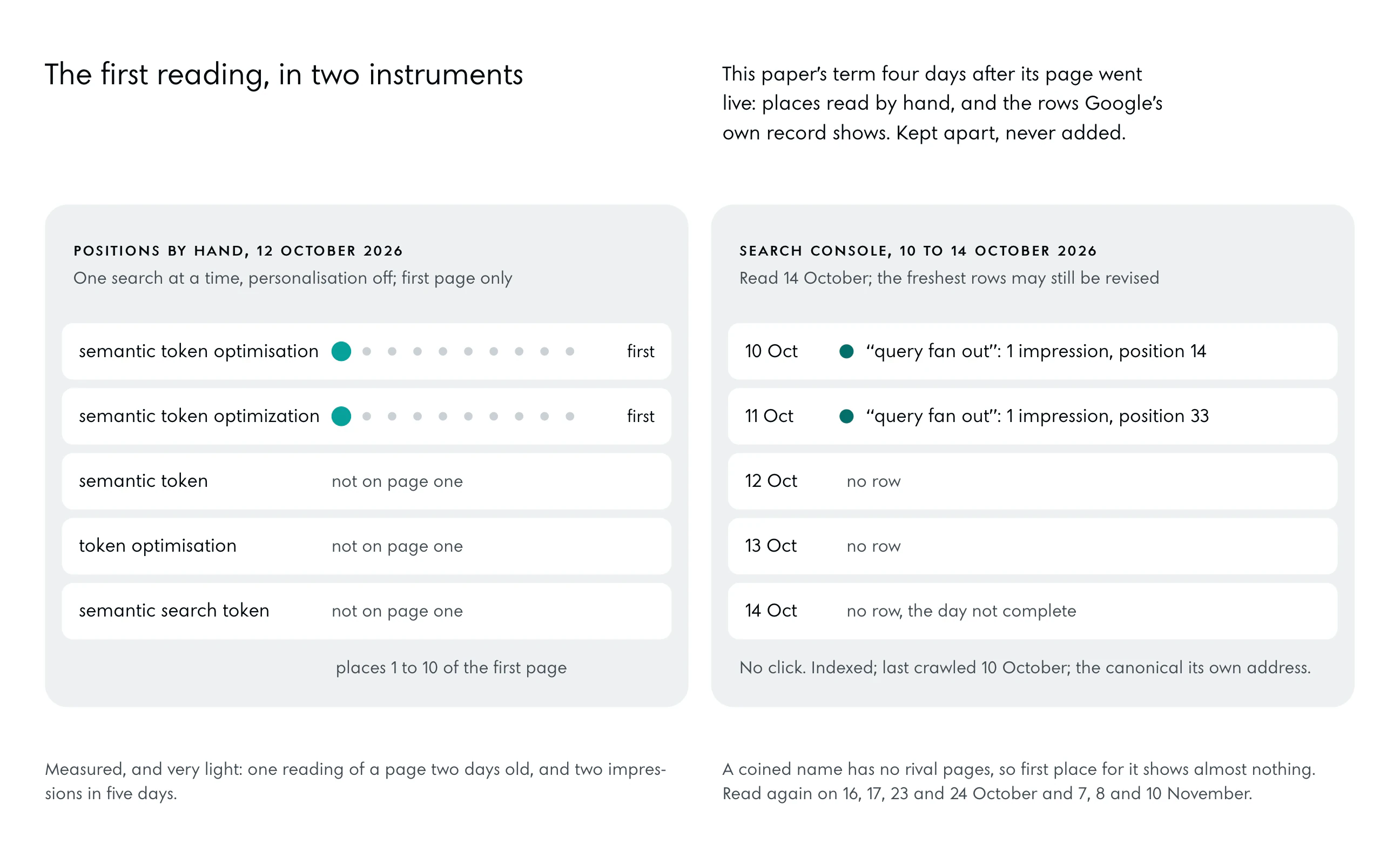
The numbers
| Instrument | Search | Date | Result |
|---|---|---|---|
| By hand | semantic token optimisation | 12 Oct | first |
| By hand | semantic token optimization | 12 Oct | first |
| By hand | semantic token | 12 Oct | not on page one |
| By hand | token optimisation | 12 Oct | not on page one |
| By hand | semantic search token | 12 Oct | not on page one |
| Search Console | query fan out | 10 Oct | 1 impression, position 14 |
| Search Console | query fan out | 11 Oct | 1 impression, position 33 |
Positions Read by Hand
On 12 October 2026 we searched Google in a browser, one search at a time, with personalisation off, which the foot of each results page confirmed, in English and with the country set to the United States. The place we record is that of the first link to noo-studio.com among the titled links of the first page, counted in page order; the second page was not read. For the term of this paper the full name stood first in both spellings, semantic token optimisation and semantic token optimization.
Neither of its two-word runs, semantic token and token optimisation, was on the first page, and neither was semantic search token, a neighbour with search set in the middle. The page was then two days old.
These figures are measured, and they bear very little weight. It was one reading, of a page two days old, on one connection, and a coined name has no rival pages for its exact words, so first place for the name is where any result starts and on its own shows almost nothing. The other two terms and their shorter runs are read in the second and third papers, each in its own part of this name.
Rows in Search Console
Google’s own record of the same page counts something else, the times that it was shown to people, whoever and wherever they were. We read Search Console on 14 October 2026 for the days from 10 to 14 October, with the freshest rows included, which Google may still revise; the 14th was not yet complete, and Search Console keeps each day on its own clock. Its inspection read the term page of this paper as Submitted and indexed, last crawled on 10 October, and the address that Google chose as canonical was the page’s own.
In those five days the page had two rows, both of them for the search “query fan out”, typed in quotes; it was shown once on 10 October at an average position of 14 and once on 11 October at 33, and it had no click. The rows of the other term pages stand in the third paper, in Table 5 of its section Index Status and First Rows, which also quotes Google’s own line on the searches that Search Console leaves out.
Two showings are a start and a very long way short of a sample; they support nothing yet, and they break nothing. No row has the term’s own name, though the reading by hand found the page first for it, so searches as few as those are either still uncounted or held back. The rows are also set apart from the positions above and never added to them, because Search Console averages over whoever searched while the reading by hand was one search at a time, in one market, with personalisation off.
Two lines of the sheet in the part on predictions touch these rows, and both stay open for their own days. One asks that each term page be shown at least once in Search Console by day 14 and is read on 24 October. The other expects, by day 28, more showings on searches without the full phrase than with it, and it is read on 7 November.
His Expectation, Set Down First
Piotr Paweł Zalewski, founder of Noo–Studio, wrote down what he expects on 12 October 2026, before any of the three papers was published. He expects the long papers to move the slope towards the shorter and busier searches once they are live, and on that day he put the reason in one sentence, “adding the long-form research pieces will start to shift that gradient into the right places where it will only strengthen that position.” For the term of this paper it means that semantic token, token optimisation and semantic search token, all three of them off the first page on 12 October, begin to reach it, while the full name keeps first place in both spellings. This is theory, and it was written down before the event, in his name.
Support would be some of those searches standing on the first page at the readings of a week and of a month after the papers go live, with the searches that stand there today keeping their places. It breaks if the same readings show that none of them moved, or if the name loses first place.
The same searches, made the same way, and the same rows, read with the same filters, are taken again on 16, 17, 23 and 24 October and on 7, 8 and 10 November 2026; four of those days are also readout days on the sheet. Each reading is added under the ones before it, and the readings of 12 and 14 October stay as they are written here.
On 12 October 2026, searched by hand without personalisation in the United States, Semantic Token Optimisation stood first in Google for its own name in both spellings, and none of its shorter runs was on the first page.