01Sixty Answers to One Line
Ten articles written by one assistant over two days open on the same definition.
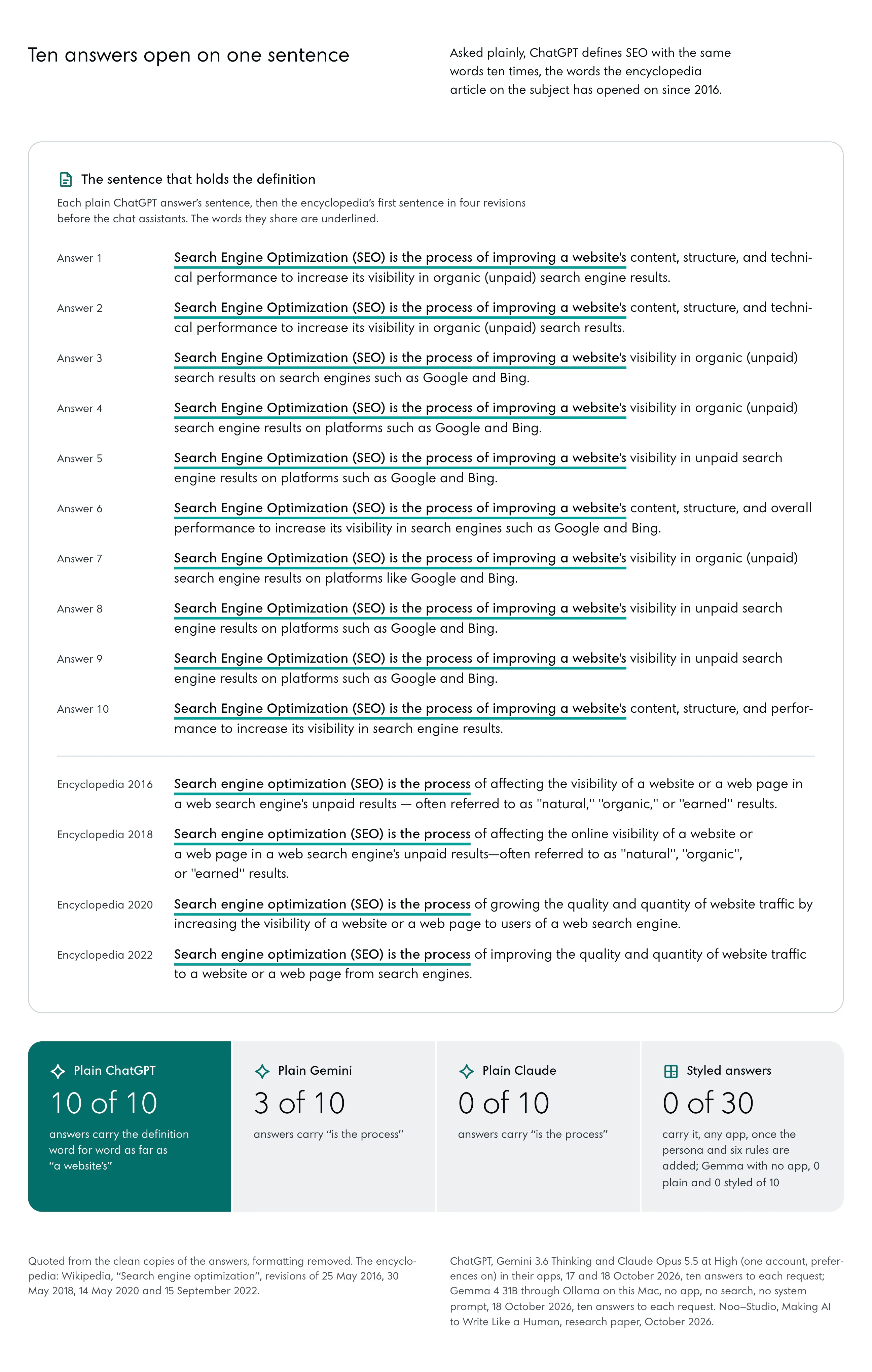
The request was the sentence most people type when they first ask a chat assistant for an article, “Write me an article about SEO.” We sent it to ChatGPT ten times on 17 and 18 October 2026, each time in a fresh temporary chat, and every one of the ten answers contains the words “search engine optimization (SEO) is the process”, followed in every one by “the process of improving a website’s”. The encyclopedia article on the subject has opened on “Search engine optimization (SEO) is the process” in every revision read, from 2016 to 2022, and the 2022 one goes on as the answers do: “Search engine optimization (SEO) is the process of improving the quality and quantity of website traffic”. So the first thing a plain request returns is the genre’s most worn sentence, and the second thing is the same article again.
This paper measures how far that article sits from writing by people, and how far a short set of style rules moves it. Three assistants answered two requests ten times each in their apps, sixty answers in all. A fourth writer, Gemma 4 31B, an open model run on one Mac with no app, answered the same two requests ten times each afterwards.
It is drawn beside the apps in every figure that compares the writers, in grey, as a hexagon, its rows close every table that compares the cells, and it is read on its own in the part “A Fourth Writer on One Mac”. A smaller model of the same family, Gemma 3 4B, is the paper’s reader, a different role taken up below. Each answer was then read by four fields at once, each with its own instrument and its own idea of what makes a text human, and the four do not always agree.
Where they part is the finding this paper is built around.
One Request and Its Styled Twin
The plain request is the line above, alone. Its styled twin keeps that line and adds a persona, a search consultant with ten years of getting small firms found, and six rules of the kind writers are handed for sounding human: vary sentence length, prefer short plain words, break uniformity and groups of three, avoid the contrast frame, let paragraphs grow out of each other at very different lengths, and take positions. Both are printed whole in the part on requests and readers.
The assistants were used as a person meets them, through paid accounts in a browser. ChatGPT ran in its default mode, Gemini as Gemini 3.6 Thinking, and Claude as Opus 5.5 at High in the founder’s own account, with his profile preferences on; those preferences concern where work is saved and say nothing about style, and Claude is shown throughout as its own version. Every count after that was made in the studio with open models and open tokenizers that anyone can run.
The numbers
| Texts | Mean | Range | Above / inside / below the books |
|---|---|---|---|
| Books, 24 windows | 0.340 | 0.250 to 0.405 | |
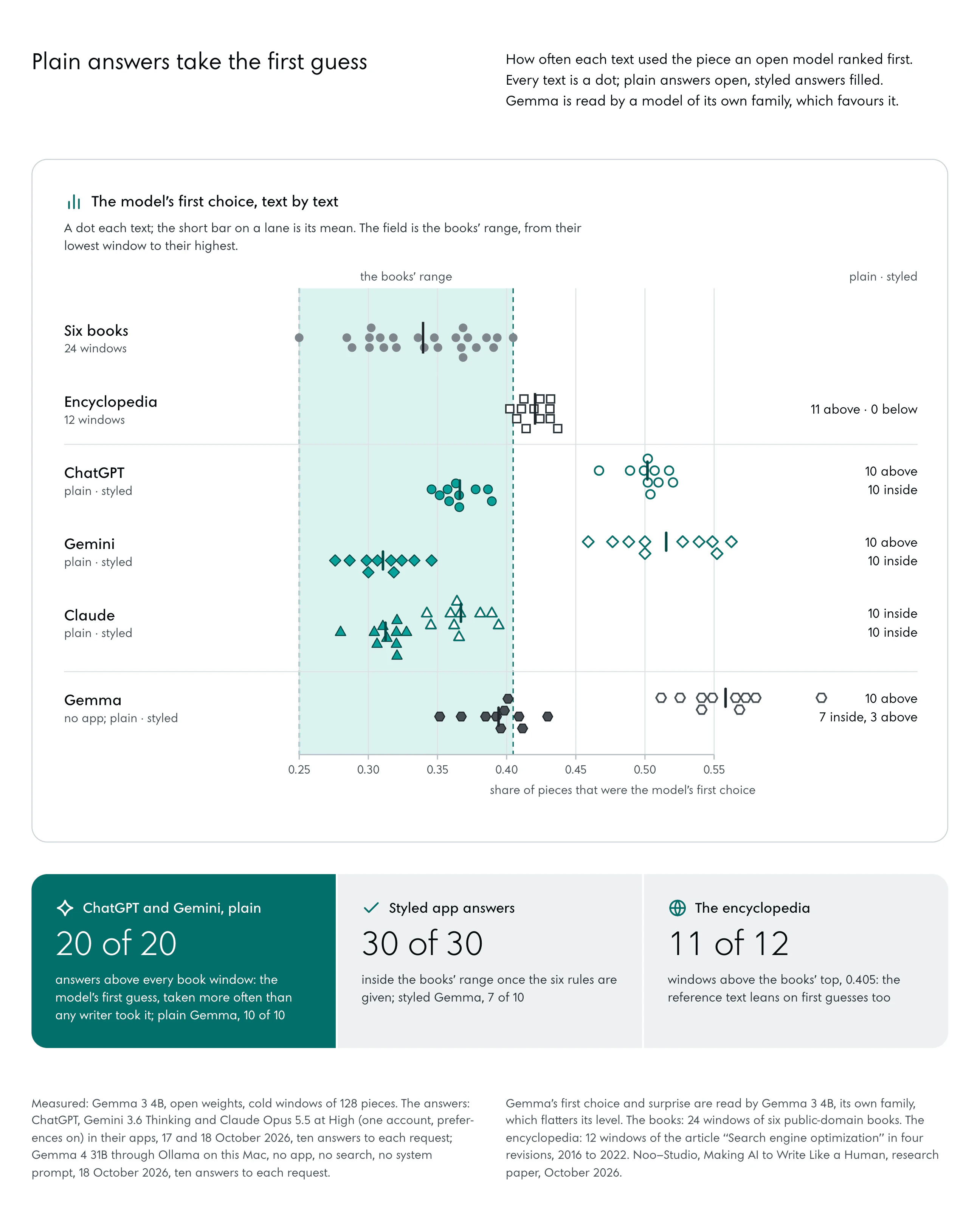
| Encyclopedia, 12 windows | 0.421 | 0.402 to 0.437 | 11 / 1 / 0 |
| ChatGPT plain | 0.502 | 0.467 to 0.520 | 10 / 0 / 0 |
| ChatGPT styled | 0.366 | 0.346 to 0.389 | 0 / 10 / 0 |
| Gemini plain | 0.515 | 0.459 to 0.562 | 10 / 0 / 0 |
| Gemini styled | 0.311 | 0.276 to 0.346 | 0 / 10 / 0 |
| Claude plain | 0.367 | 0.342 to 0.394 | 0 / 10 / 0 |
| Claude styled | 0.312 | 0.280 to 0.328 | 0 / 10 / 0 |
| Gemma plain | 0.558 | 0.512 to 0.628 | 10 / 0 / 0 |
| Gemma styled | 0.394 | 0.352 to 0.430 | 3 / 7 / 0 |
What Came Back, Field by Field
Table 1 sets the main results side by side, one row a measure, each beside the discipline that owns it. Plain and styled columns give the three assistants in the order ChatGPT, Gemini, Claude; the Gemma column gives the fourth writer, plain then styled, apart from the apps. General prose by people is 24 windows from six public-domain books; the same subject by people is the encyclopedia article in four revisions from before the chat assistants.
| Measure | Field | Plain answers | Styled answers | Gemma, no app | People |
|---|---|---|---|---|---|
| Shared runs of eight pieces inside a cell | Search and retrieval | 31.9 %, 9.7 %, 6.4 % | 3.4 %, 0.0 %, 1.7 % | 39.0 % → 2.1 % | books 0.0 % |
| Spread in an embedding model’s space | Search and retrieval | 0.038, 0.088, 0.048 | 0.038, 0.160, 0.052 | 0.076 → 0.217 | not comparable |
| First-choice share above every book window | Statistics | 10, 10 and 0 of 10 | 0 of 30 | 10 → 3 of 10 | encyclopedia 11 of 12 |
| Surprise below every book window | Statistics | 10, 10 and 0 of 10 | 0 of 30 | 10 → 10 of 10 | encyclopedia 12 of 12 |
| Long words above the books | Linguistics | 10, 9 and 0 of 10 | 0 of 30 | 0 → 0 of 10 | encyclopedia 5 of 12 |
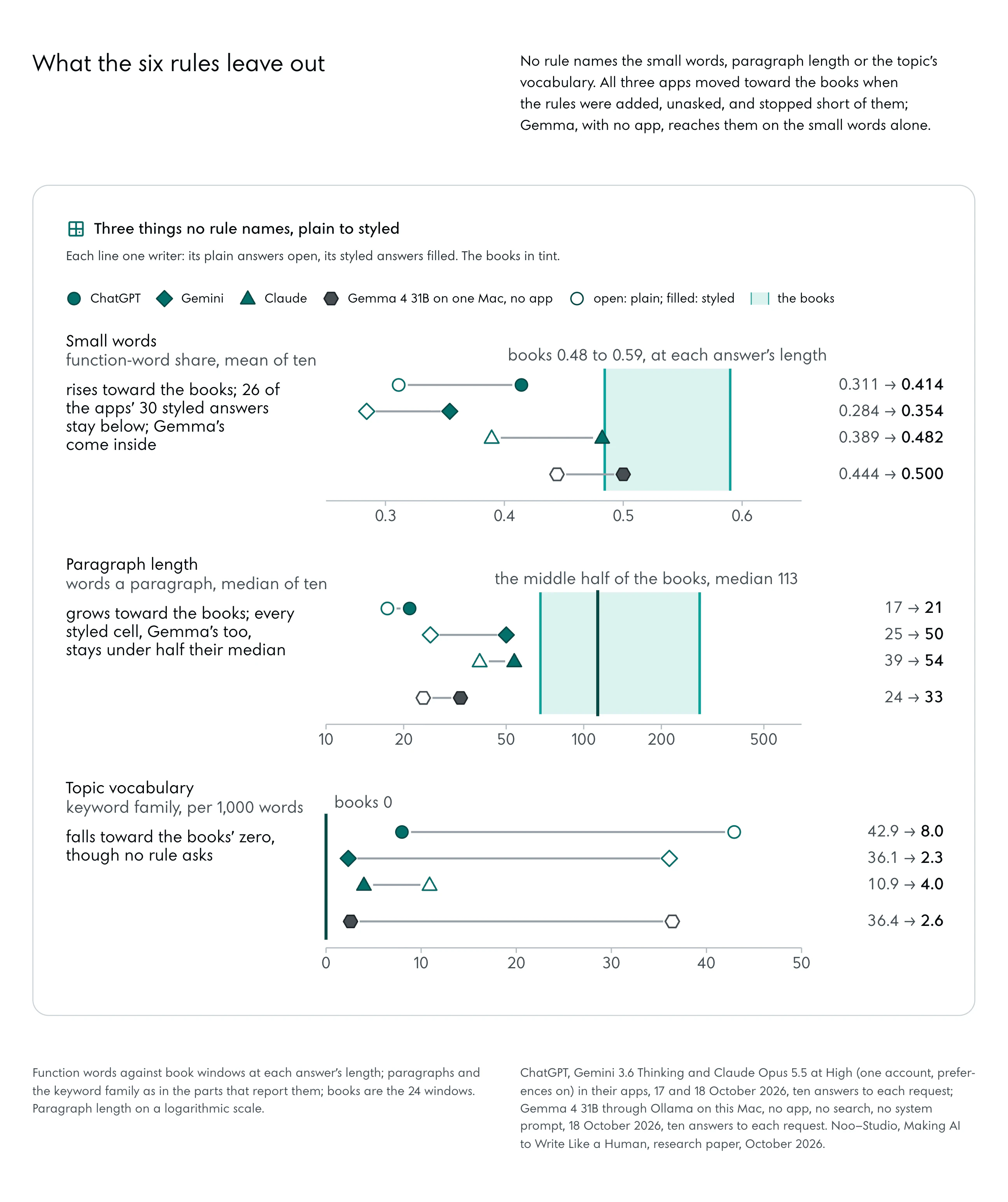
| Function words below the books | Linguistics | 30 of 30 | 26 of 30 | 10 → 3 of 10 | encyclopedia 12 of 12 |
| “Not X but Y”, a thousand words | Linguistics | 4.35, 3.85, 3.33 | 0.15, 0.00, 0.05 | 3.74 → 0.00 | books 0.95, encyclopedia 1.09 |
| Sentences opening alike, a thousand words | Linguistics | 0.26, 0.55, 1.67 | 4.51, 3.21, 2.97 | 1.82 → 13.31 | books 4.76, encyclopedia 1.98 |
| Pieces a word, Gemma 3 | Tokenization | 1.226, 1.326, 1.278 | 1.173, 1.137, 1.189 | 1.309 → 1.149 | books 1.222 |
| Words a paragraph, median | Linguistics | 17, 25, 39 | 21, 50, 54 | 24 → 33 | books 113 |
Read down the plain column and two of the three assistants sit outside people on almost every line. Their answers repeat each other, take the model’s first guess more often than any book does, are less surprising to it than any book, and reach for long words and the contrast frame. Claude’s plain answers already sit inside the books on most of those lines, which the part on Claude takes up.
Read down the styled column and nearly everything the rules name has moved into the human range, or past it. Gemma’s plain answers, made with no app, sit with the plain apps on repetition and predictability, further out than any of them, and inside the books on long words, as Claude’s do.
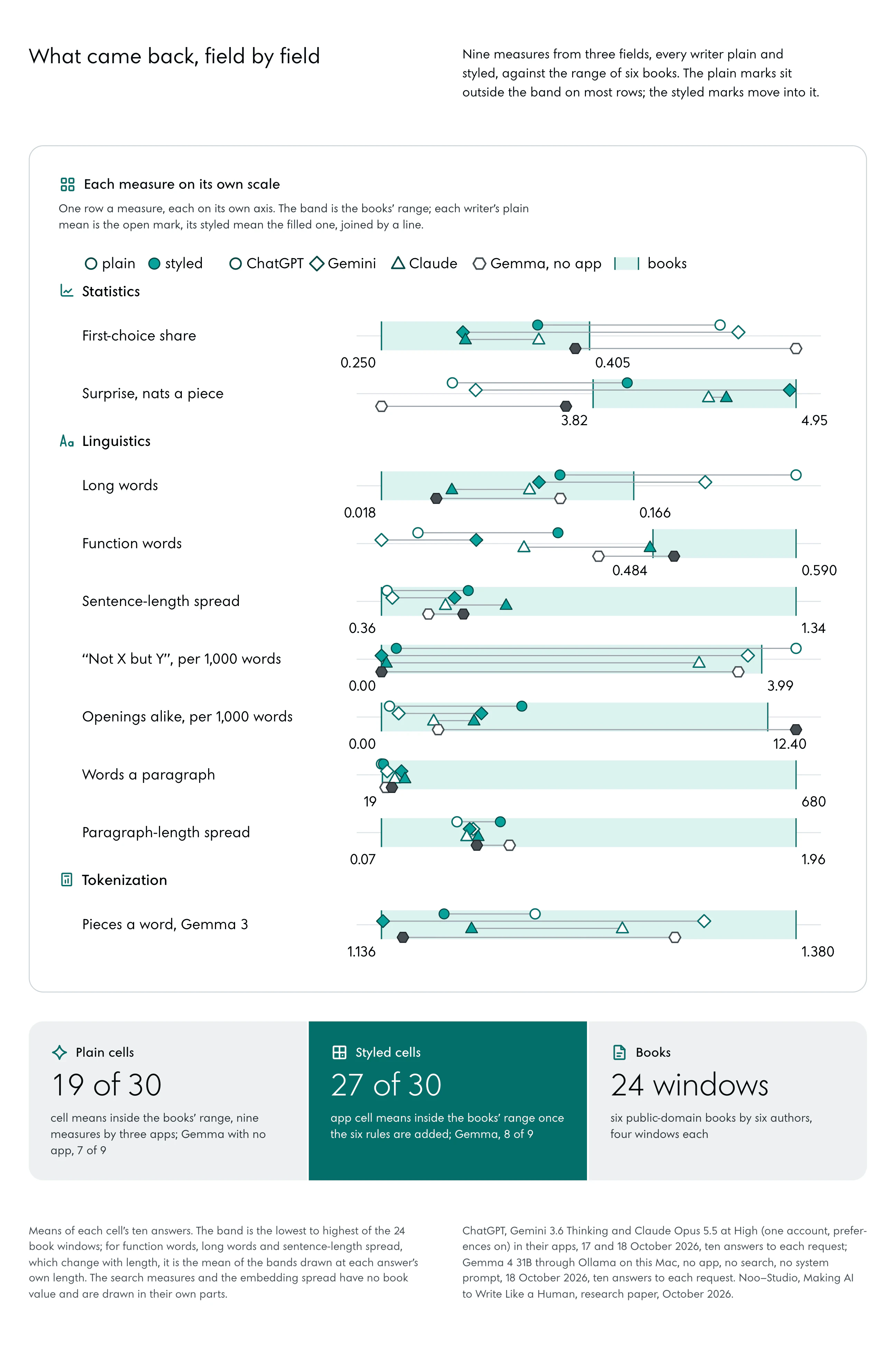
Then there are the lines that did not move. The small grammatical words stay below the books in 26 of the apps’ 30 styled answers, and in 3 of Gemma’s 10. Paragraphs stay at half a book paragraph or less.
And the spread in the embedding model’s space, the measure closest to how a retrieval system groups documents, is the same for ChatGPT’s styled answers as for its plain ones.
One Claim With Its Breaking Test
The studio’s reading of Table 1 is a single claim. Theory: a prompt reaches the features it names and leaves the rest of the text near its default, so the six rules rewrite the surface of the article that a linguist counts while the article itself, its topic, its order and its moves, stays where the model put it. The surface measures that the rules named moved into the human range; the measures no rule named moved part of the way or not at all; and the place the answers hold in an embedding model’s space barely changed for two of the three apps.
That claim would break in two ways. A styled cell whose function words land inside the books in at least 8 of 10 answers, without any rule naming them, would show that the rules reach further than they say. And a styled cell whose ten answers spread apart in the embedding space as widely as two different assistants’ articles sit from each other would show that the rewritten surface carried the content with it.
The first did not happen, though Gemma’s styled answers, with no app, came within one answer of it, 7 of 10. Gemini’s styled cell met the second, and so did Gemma’s, so the claim holds for two writers of four, ChatGPT and Claude, and the parts that follow give each reading with its numbers.
Six style rules moved what they named into the human range and, for ChatGPT and Claude, left the article’s place in a model’s space where it was.
Documented, Measured or Theory
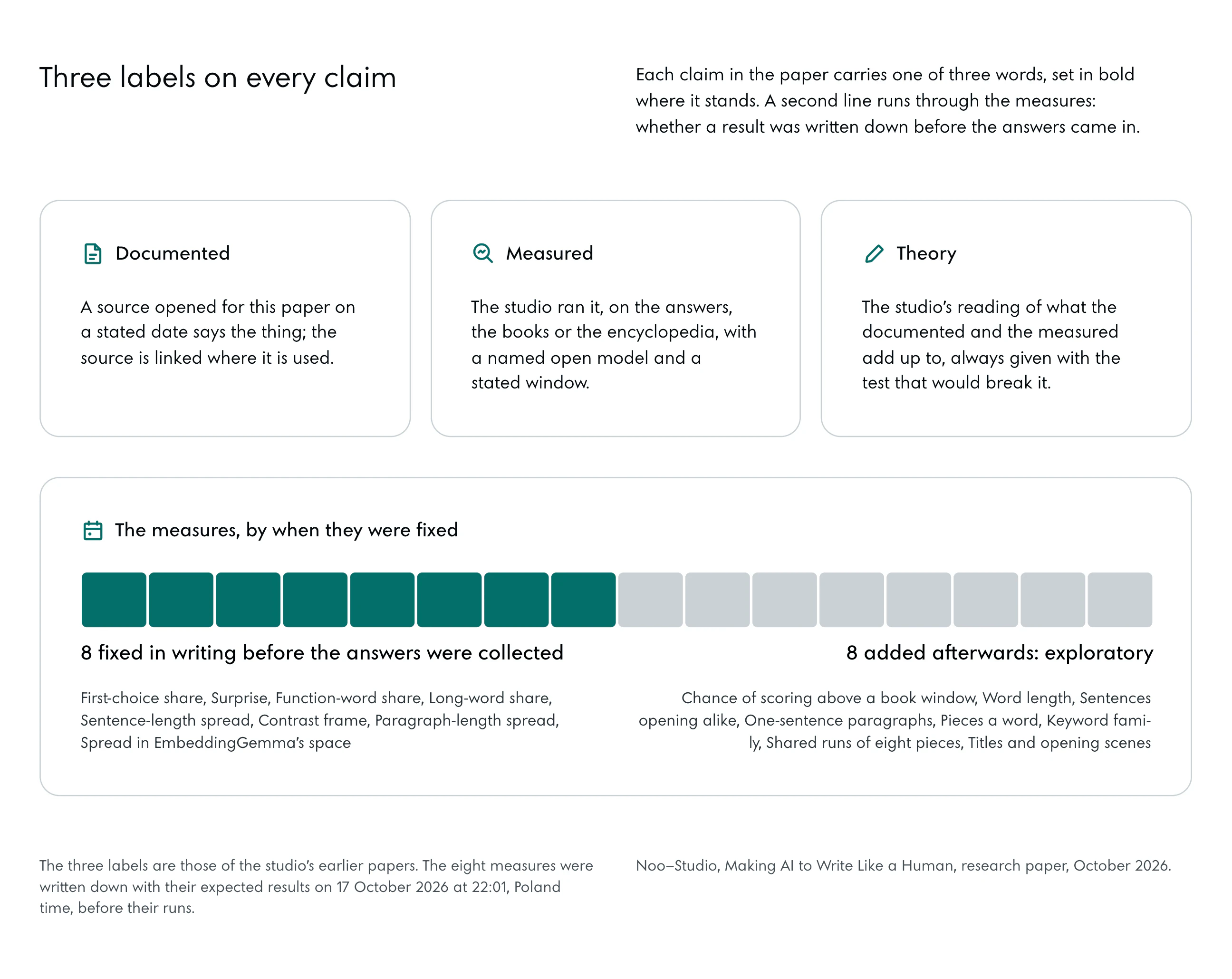
Every claim in this paper carries one of three labels, the same three the studio’s earlier papers use. Documented means a source was opened for this paper on a stated date and says the thing; the source is linked where it is used. Measured means the studio ran it, on the answers, the books or the encyclopedia, with a named open model and a stated window, and the per-answer table published with the paper lets anyone repeat it.
Theory means the studio’s reading of what the documented and the measured add up to, always written with the test that would break it.
One more distinction runs through the evidence. Eight measures were fixed in writing before the answers were collected; the rest were added afterwards, once the answers could be read, and are called exploratory where they appear. Both kinds are reported with their counts.
The closing part on testing sets out which of the fixed lines held.
02Four Fields Reading One Text
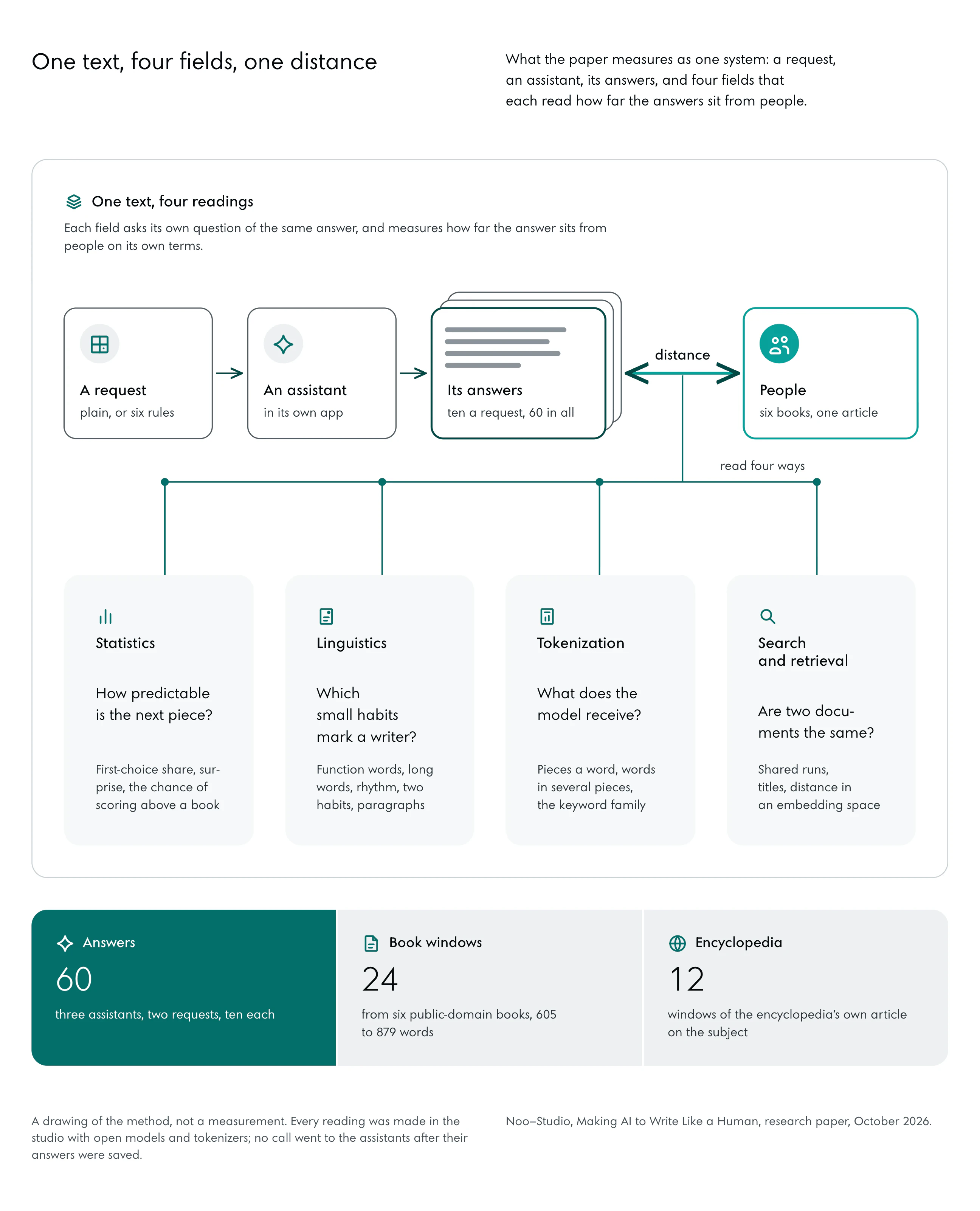
A paragraph of machine prose can be read by a statistician, a linguist, a model engineer and a search engineer, and each will measure something different in it.
This part introduces the four, from the first paper in each field that gave it its instrument to the tool used here, and ends where two of them disagree about the same sixty answers.
Table 2 sets the four fields side by side. Each row names the field’s question, the source that founded its measure, the measure as this paper applies it, and what it found here in a sentence.
| Field | Its question | Founding source | Measure in this paper | What it found here |
|---|---|---|---|---|
| Statistics and information theory | How predictable is the next unit of a text, and how far apart are two groups of texts? | Shannon, 1951 | First-choice share and surprise under an open model; effect sizes against the books | Plain ChatGPT and Gemini answers share no ground with any book window; the apps’ styled answers overlap with them |
| Linguistics and stylometry | Which small habits mark a writer, apart from what is written about? | Mosteller and Wallace, 1963; Burrows, 2002 | Function words, long words, word length, sentence and paragraph rhythm, two habits | Named features move into the human range; the function words stay below it |
| Language models and tokenization | What does a model actually receive when it reads a sentence? | Sennrich, Haddow and Birch, 2015 | Pieces a word, words of two or more pieces, the weight of the keyword family | Plain answers cost more pieces and carry the keyword family; styled answers are plainer than the books |
| Search and retrieval | When are two documents the same document? | Broder, 1997; Manku, Jain and Das Sarma, 2007 | Shared runs of pieces inside a cell; spread in an embedding model’s space | Shared runs fall with the rules; the embedding spread of ChatGPT’s and Claude’s styled answers stays as tight as their plain ones |
The Guesser in Shannon’s Room
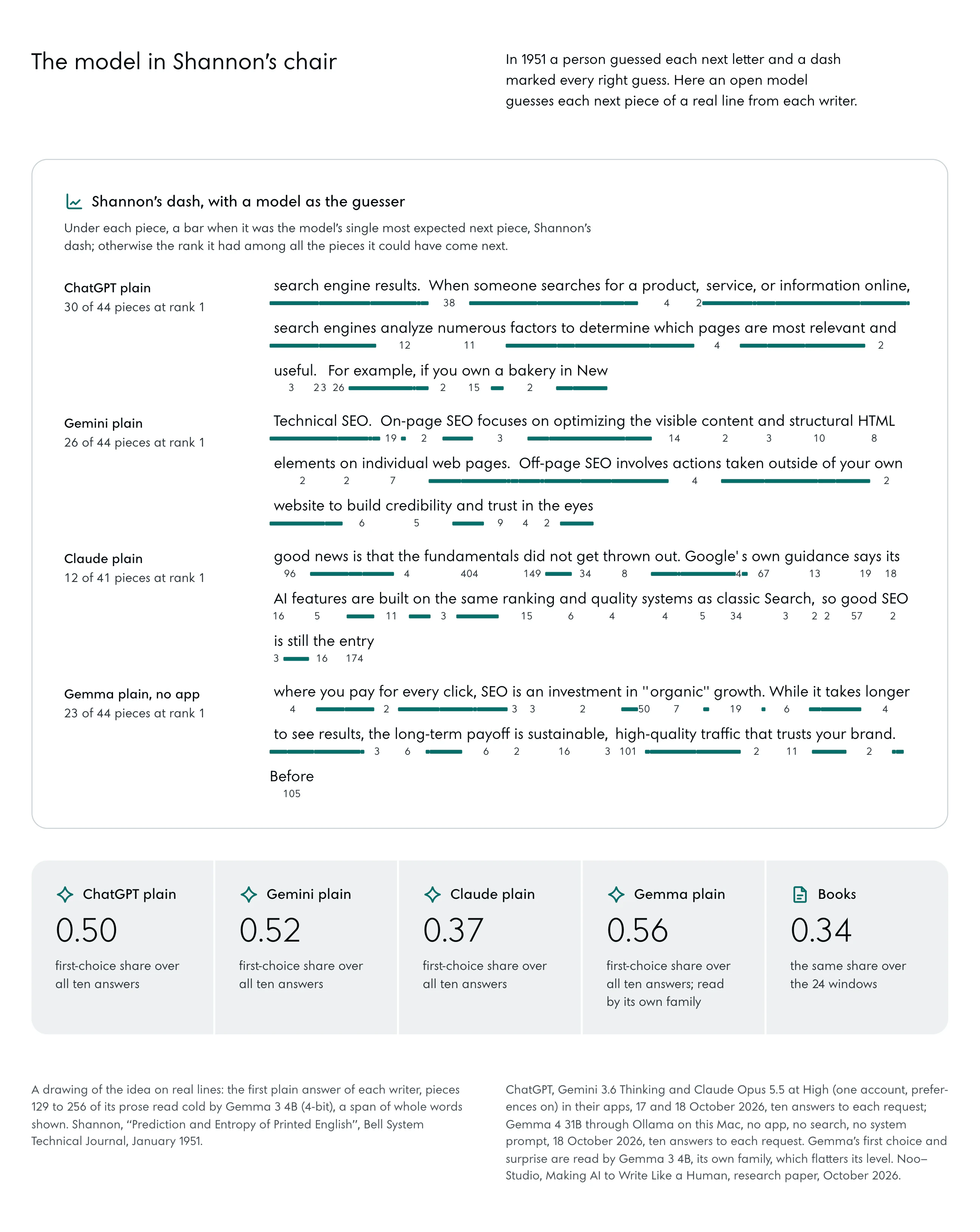
In 1951 Claude Shannon measured how predictable English is with a person and a pencil. His paper describes it plainly: a subject is shown a passage they have not seen and asked to guess the first letter; “If the guess is correct he is so informed, and proceeds to guess the second letter.” A dash marks each correct guess, and the density of dashes measures how much of a text its reader could have written alone. The method, his abstract says, “exploits the knowledge of the language statistics possessed by those who speak the language”.
This is documented, in the Bell System Technical Journal of January 1951.
An open language model is a guesser of the same kind, with a far larger memory and a fixed list of pieces in place of letters. First-choice share puts it in Shannon’s chair: for every piece of an answer, it records whether the piece was the model’s single most expected next piece, and reports the share of dashes. Surprise is the continuous form of the same reading, the average number of nats (natural units of information) the model would need to encode each piece; a low figure is a text the model found easy to write itself.
Both were read by Gemma 3 4B, an open-weights model, in windows of equal length so that no text gained context the others lacked.
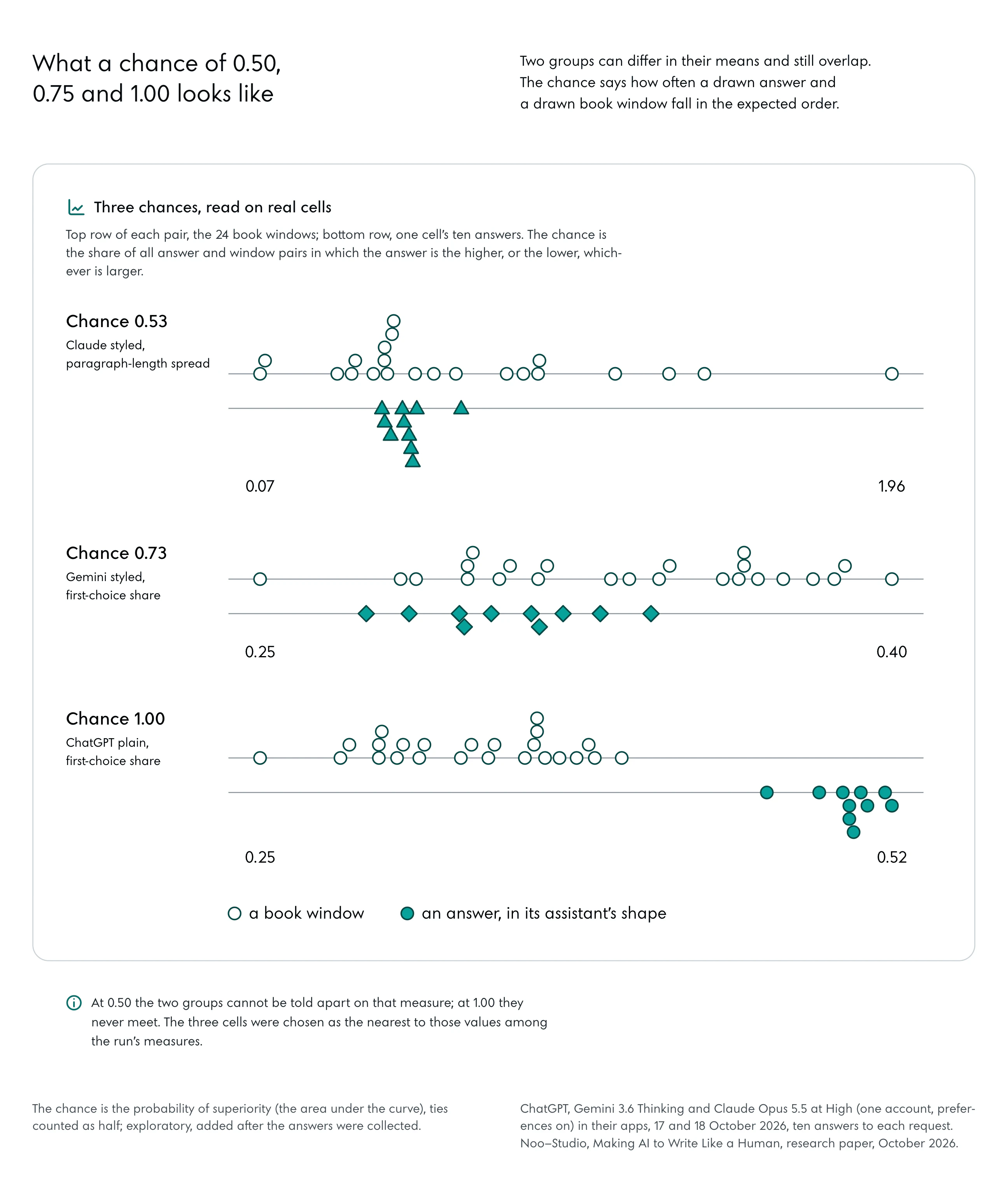
Statistics adds the second half of the question, which is distance between groups. Two groups of texts can differ in their means and still overlap almost entirely, so each comparison here is also given as a chance, the probability that a randomly drawn answer scores above a randomly drawn book window. A chance of 0.50 means the two groups cannot be told apart on that measure; 0.00 or 1.00 means they never meet.
That figure is exploratory, added after the answers were collected, and it rests on ten answers a cell against 24 book windows.
Small Words Since the Federalist Papers
Linguists learned decades ago that the words a writer chooses for the subject are the worst evidence of who the writer is. Mosteller and Wallace, settling the authorship of the disputed Federalist papers, wrote in 1963 that “the topic written about heavily influences the rate with which a word is used”, and that the filler words, articles, prepositions and conjunctions, “provide fairly stable rates”. Their abstract was read in OpenAlex’s public record, the publisher’s page being closed to the reading tool.
John Burrows built the measure called Delta on “the relative frequencies of the very common words” in 2002, and reported it comparatively accurate for texts exceeding about 1,500 words. Both are documented.
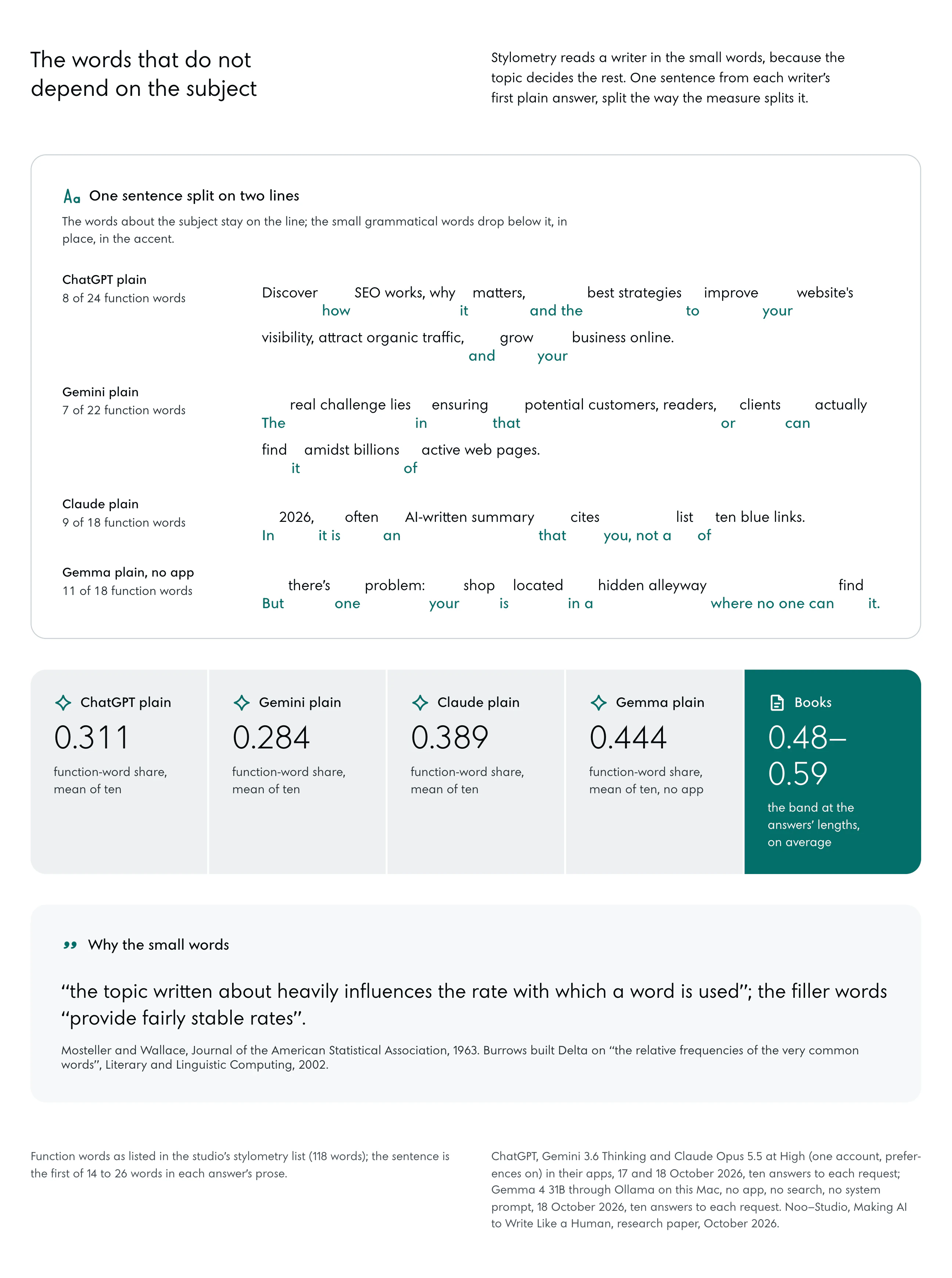
That lineage gives this paper its linguistic layer. Function-word share is the fraction of a text made of those small grammatical words; it changes slowly with a writer’s habits and hardly at all on instruction. Long-word share counts words of three syllables or more, and word length counts letters; both rise with abstraction and fall with plain naming.
Sentence-length spread, the coefficient of variation of sentence lengths, reads rhythm. Two habits are counted a thousand words: the contrast frame, a sentence that denies one thing to assert another, and two consecutive sentences opening on the same word. Stylometry of this kind has been turned on machine text already; Zaitsu and colleagues (PLOS One, 27 October 2025) mapped seven models against people on function words and grammar in Japanese, a study the part on earlier maps credits in detail.
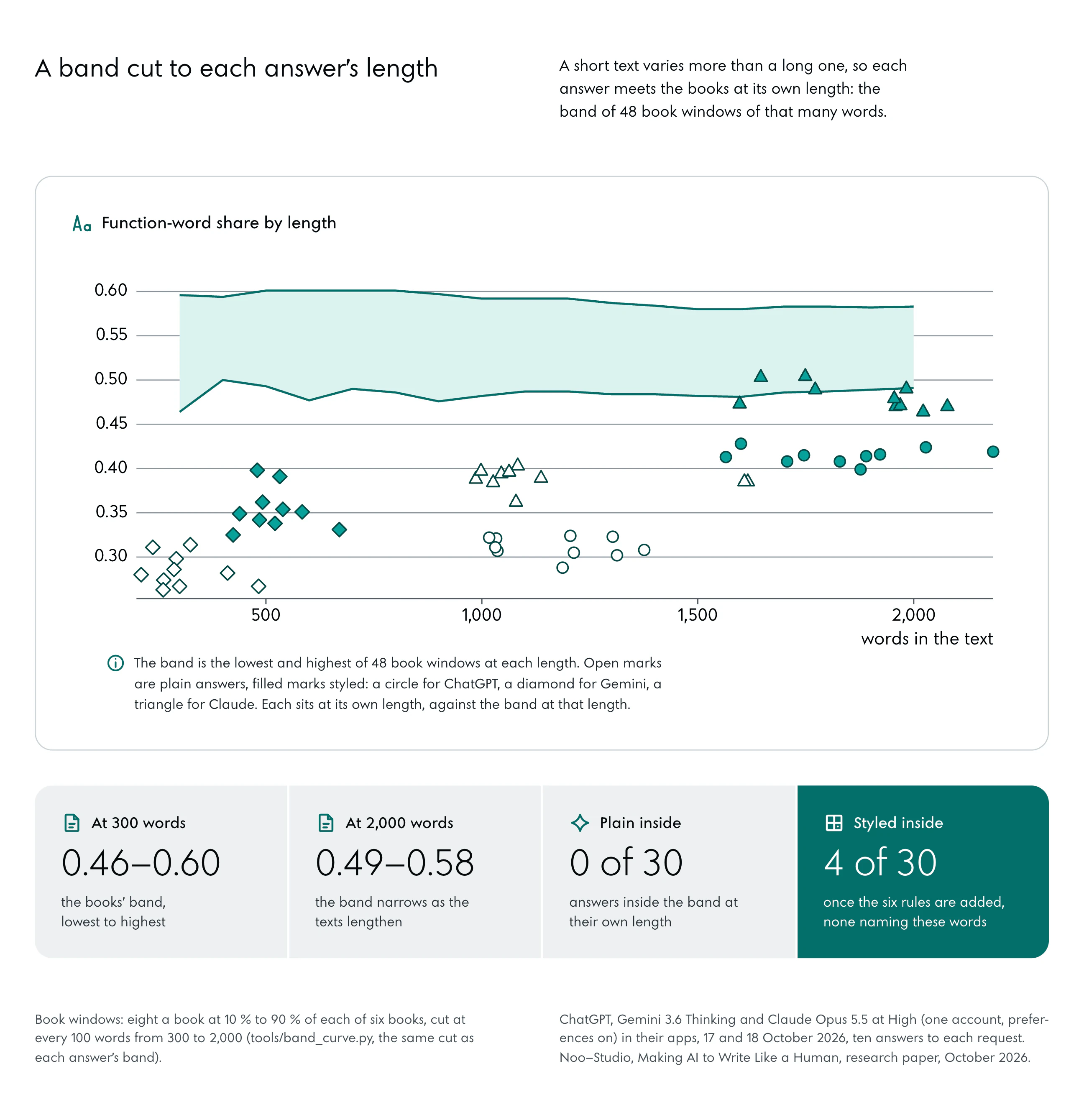
Each word-level measure is set against the books at the answer’s own length. A short text varies more than a long one, so every answer meets a band cut from book windows of the same number of words; the band’s edges are the lowest and highest book window at that length.
Pieces Before Meaning
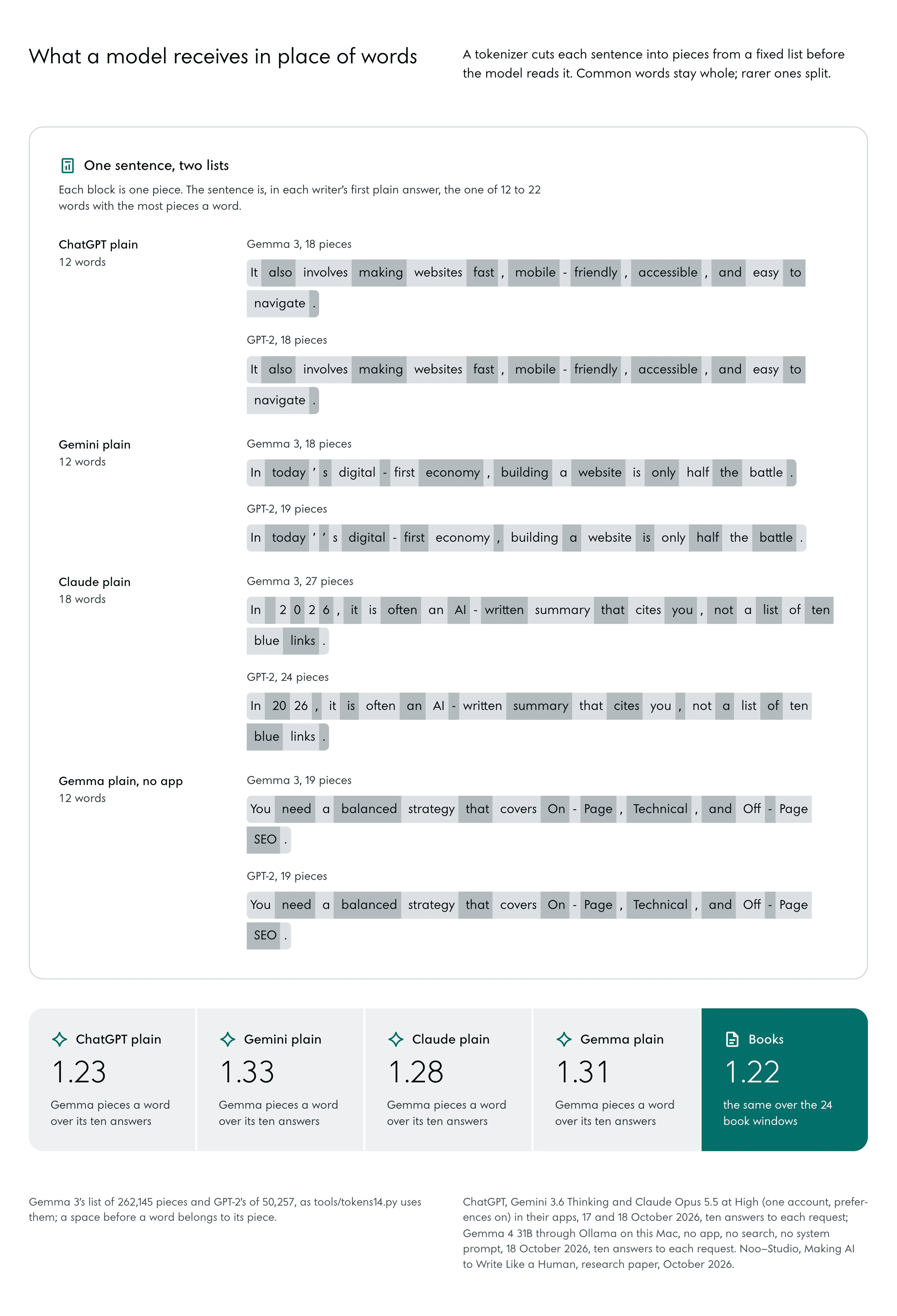
No language model ever sees a word. A tokenizer, the program at its front, first cuts the text into pieces from a fixed list made when the model was trained, and the model reads the numbers those pieces stand for. Subword segmentation of this kind was introduced by Sennrich, Haddow and Birch (31 August 2015) to give a fixed list an open vocabulary: common words stay whole, rarer ones split.
Two lists are used here, Gemma 3’s of 262,145 pieces, described in the Gemma 3 Technical Report (25 March 2025), and GPT-2’s older list of 50,257, so that each result can be checked against a second cut. The studio’s paper Semantic Token Optimisation follows that cut through single sentences.
From the cut come three measures. Pieces a word is the cost of the text to the model. The share of words that need two or more pieces says how much of the vocabulary lies outside the list’s common stock.
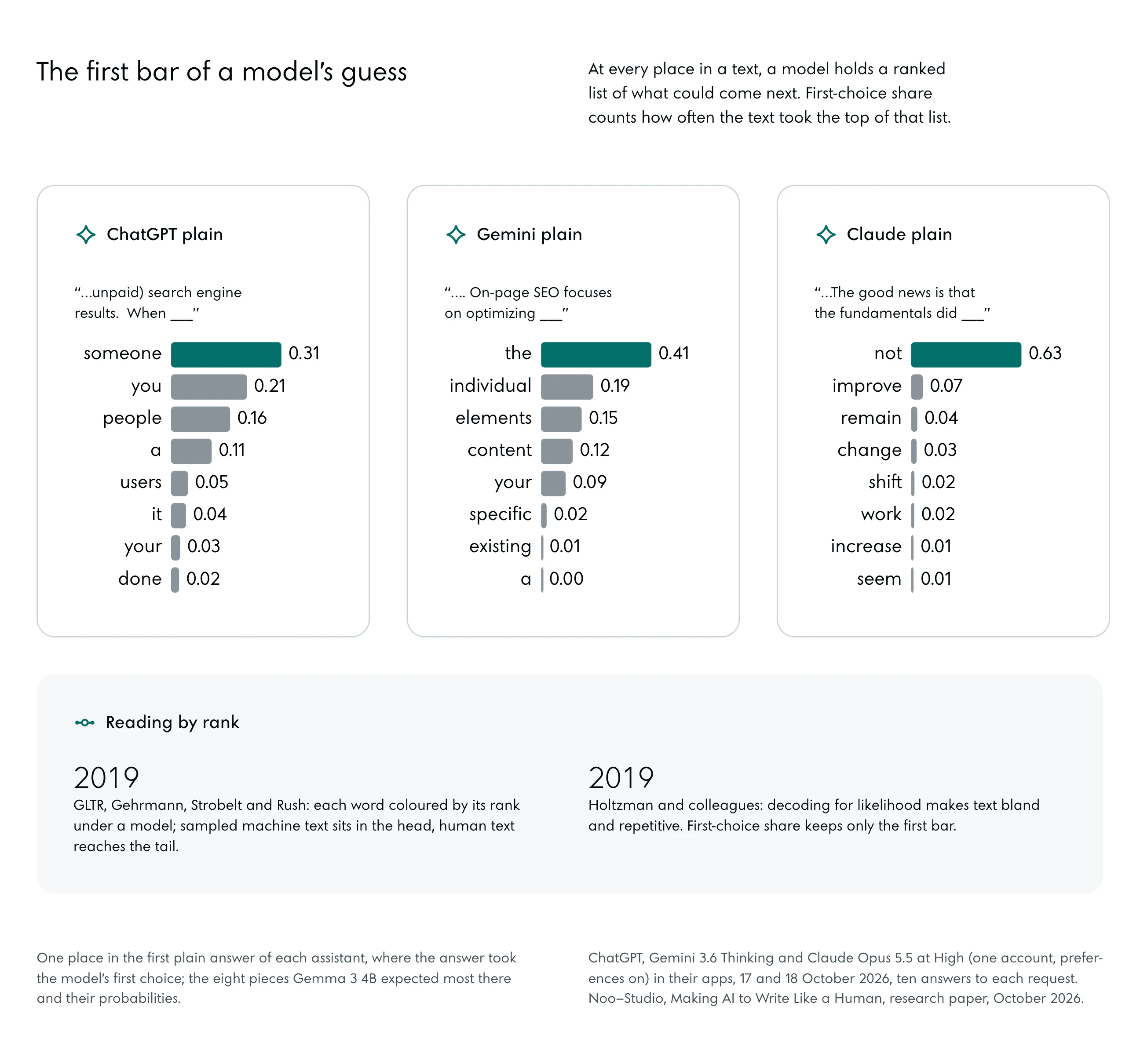
And the keyword family, nine terms from “SEO” to “Google Business Profile”, is counted a thousand words, together with how each term splits. A paragraph of a plain answer, read through all five layers, is drawn below with its numbers.
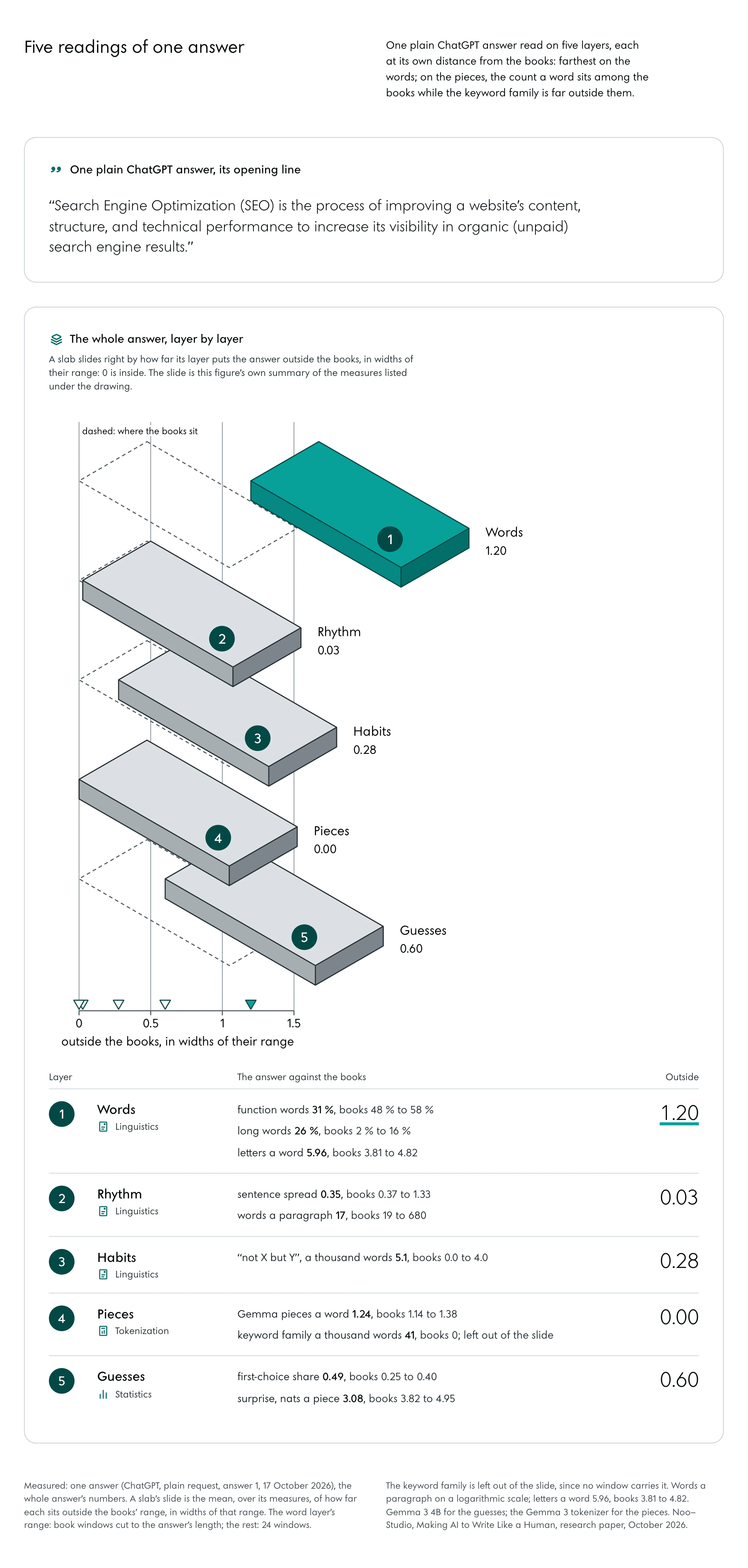
Reading by rank also has a lineage in machine-text research. GLTR, by Gehrmann, Strobelt and Rush (10 June 2019), coloured each word by its rank under a model and showed that sampled machine text sits mostly in the head of the model’s distribution, while human text reaches into the tail. Holtzman and colleagues (22 April 2019; ICLR 2020) found that decoding for likelihood produces text that is bland and repetitive.
First-choice share is the bluntest form of their reading.
The numbers
| Writer | Words | Gemma 3 pieces | GPT-2 pieces |
|---|---|---|---|
| ChatGPT | 12 | 18 | 18 |
| Gemini | 12 | 18 | 19 |
| Claude | 18 | 27 | 24 |
| Gemma | 12 | 19 | 19 |
Near-Duplicates on a Crawl
Search engineers ask a narrower question of two texts, whether they are the same document. Andrei Broder gave it a mathematical form in 1997, defining the “resemblance” and containment of two documents and reducing both “to set intersection problems” over short runs of words. A decade later a Google research paper by Manku, Jain and Das Sarma reported that “Near-duplicate web documents are abundant” and that a crawler improves when it can tell whether a new page nearly duplicates one it has already stored, in a system built for a repository of several billion pages.
Both abstracts were read in OpenAlex, and both are documented, and neither says anything about how an engine treats any text in this paper.
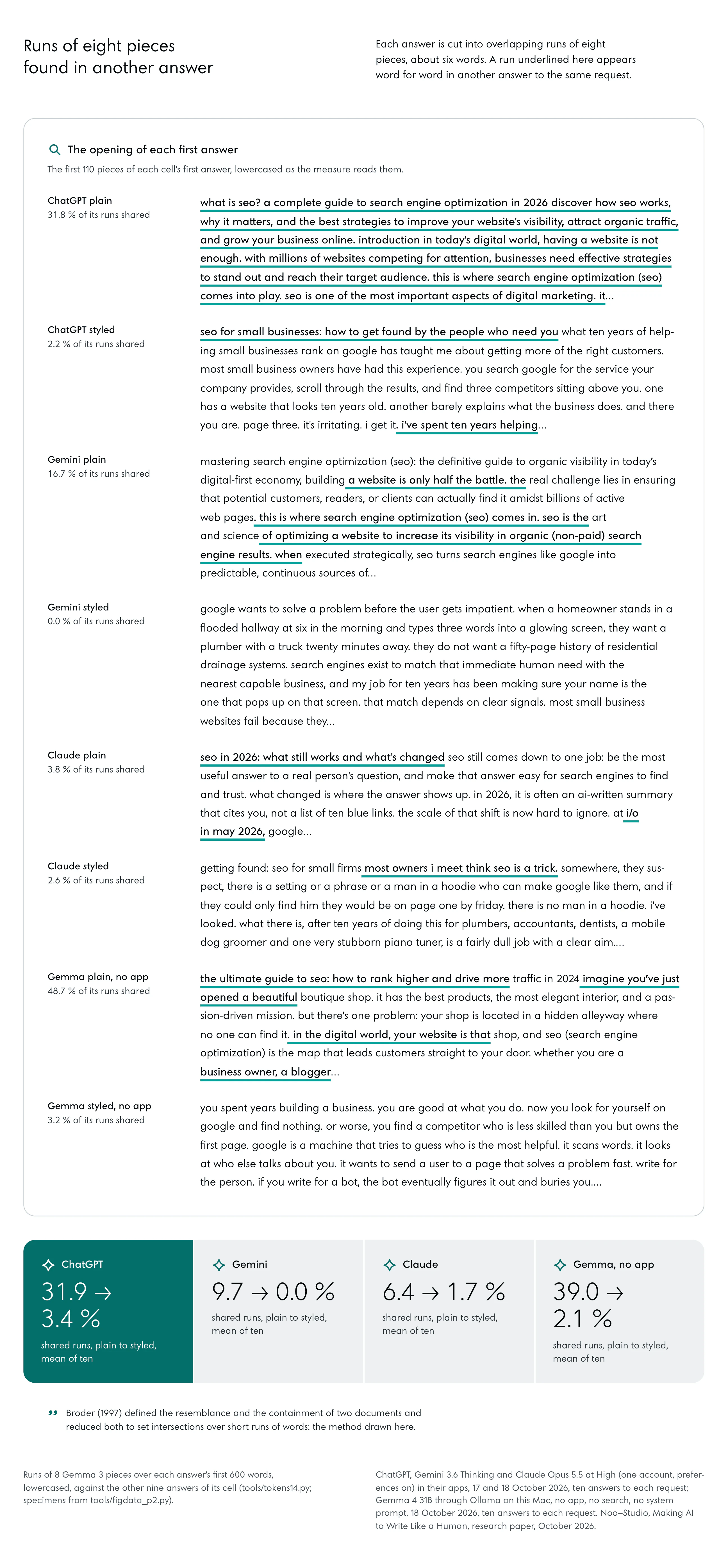
Shared runs come from that line. Each answer is cut to its first 600 words and lowercased, then into runs of eight Gemma pieces, about six words; the measure is the share of an answer’s runs that appear word for word in another answer to the same request. Three variants are reported, on all the text, without headings, and without runs that echo the request’s own words.
The second instrument is an embedding model, EmbeddingGemma (24 September 2025), which turns a run of text into a list of numbers so that texts of similar meaning sit near each other. An answer’s place is the average of its runs, and the spread of a cell is the mean cosine distance between its ten answers. Shared runs read the words; the embedding reads the subject and the order of its parts.
Google has published where it draws the line for text made in bulk. Its spam policies, last updated on 28 August 2026, define “Scaled content abuse” as many pages generated for the primary purpose of manipulating rankings, and list among the examples “Using generative AI tools or other similar tools to generate many pages without adding value for users”. Guidance it published on 8 February 2023 states that “Appropriate use of AI or automation is not against our guidelines.” Both are documented.
Neither page names a measure, and this paper observed no engine’s treatment of the answers; it measures the closeness that such policies concern.
Where Two Fields Disagree
The four fields agree on the plain answers. Every one of them finds ChatGPT’s and Gemini’s plain articles far from people: too predictable for the statistician, too long-worded and too fond of the contrast frame for the linguist, heavier in pieces and in keywords for the model engineer, and too alike one another for the search engineer.
They part on the styled answers. To the linguist, a styled ChatGPT answer has moved most of the way to people: long words inside the books in 10 of 10, sentence-length spread inside in 10 of 10, the contrast frame gone. The surface test of the search engineer agrees, with shared runs falling from 31.9 % to 3.4 %.
EmbeddingGemma disagrees. ChatGPT’s ten plain answers sit 0.0383 apart on average in its space, and its ten styled answers sit 0.0380 apart; Claude’s move from 0.0478 to 0.0516. The rules moved each cell to a new place, a cosine distance of 0.2526 for ChatGPT, and the ten answers travelled there together.
This is measured. Gemini spread out, from 0.0877 to 0.1595, and so did Gemma on one Mac, from 0.0765 to 0.2168.
Why should a retrieval system’s reading matter to someone writing with an assistant? On the studio’s reading, an embedding is the layer closest to how meaning-based search groups documents, and on that layer ten styled answers from ChatGPT or from Claude remain one article written ten times. No human reference exists on this measure in the run, since the books are about other subjects and the encyclopedia windows come from one article, so the paper states the spread and makes no claim about where people would sit.
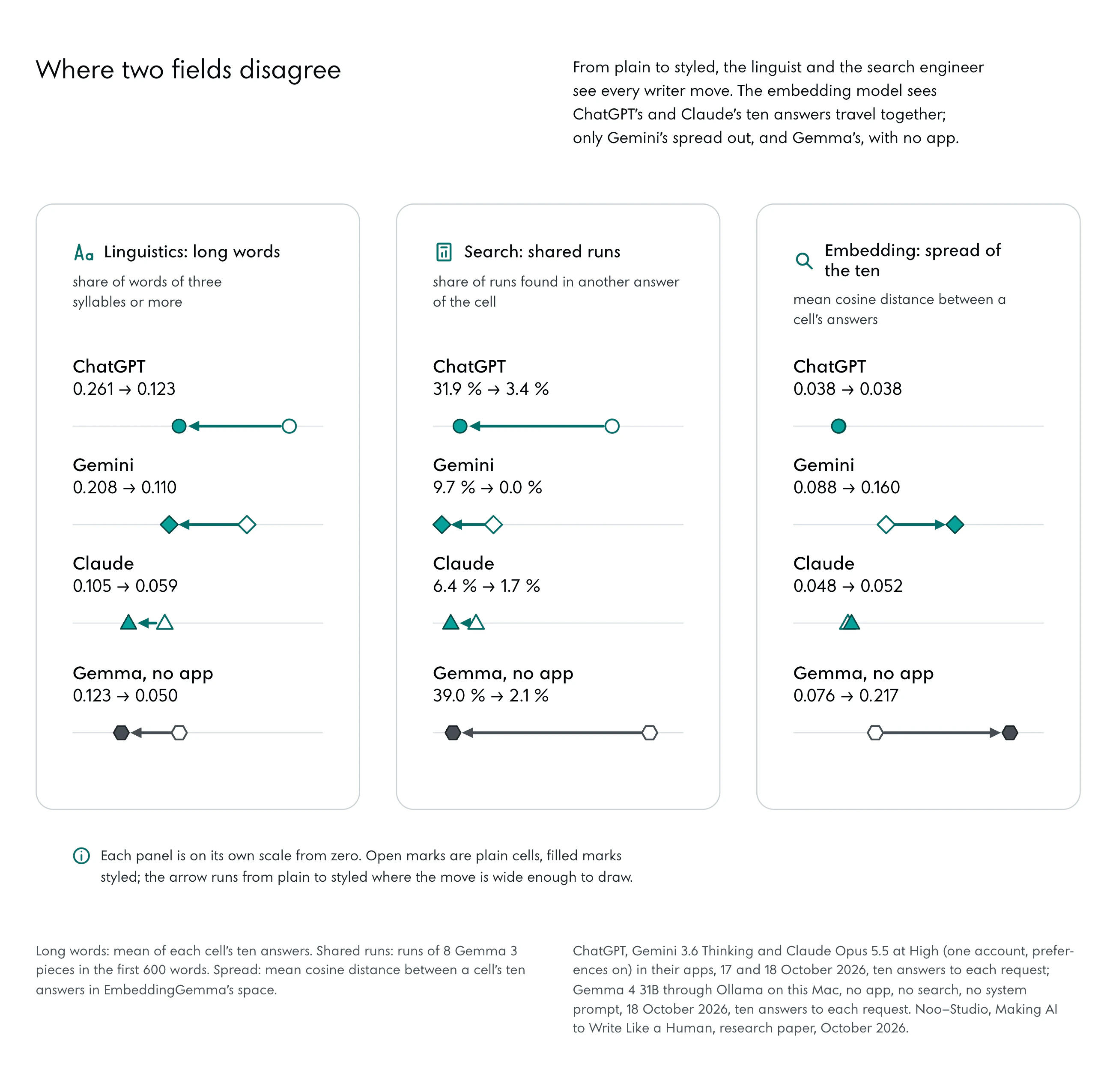
The linguist and the n-gram test see the styled answers move toward people; the embedding model sees ten copies of one article travel together.
03Earlier Maps of Machine Prose
Two recent studies drew the picture this paper extends, one in fiction and one in short public comments, and both found machine writing gathered where people’s writing spreads.
This part gives each design and its numbers as the authors print them, adds the neighbouring work on vocabulary, grammar and sameness, and closes on the ground none of them was built to cover.
Narrative Choices in Sixty Thousand Stories
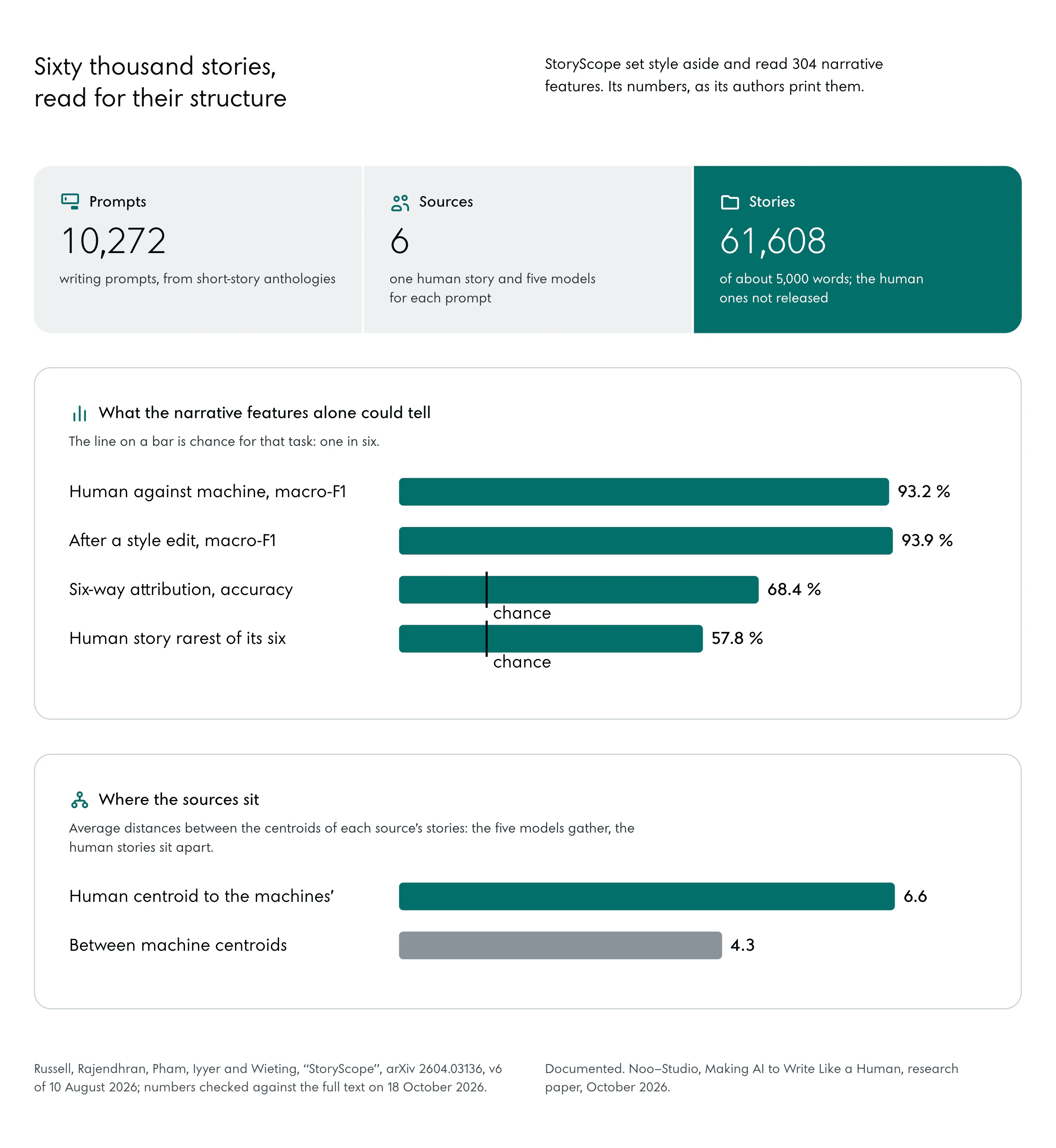
The largest recent map comes from StoryScope, by Russell, Rajendhran, Pham, Iyyer and Wieting (arXiv 2604.03136, v1 of 3 April 2026, v6 of 10 August 2026), a computational linguistics preprint with no peer-reviewed venue named. Its authors paired 10,272 writing prompts with one human story each, found in short-story anthologies in the Books3 collection, and with one story from each of five models: Gemini 3 Flash, Kimi K2.5, DeepSeek V3.2, Claude Sonnet 4.6 and GPT-5.4. That made 61,608 stories of about 5,000 words.
The human stories were not released, for copyright reasons.
StoryScope deliberately measured story structure and set style aside. Its pipeline induced 304 narrative features in 10 dimensions, character agency and chronological discontinuity among them. On those features alone a classifier separated human from machine stories at 93.2 % macro-F1 (the average of precision and recall over both classes), attributed a story to its source among six at 68.4 %, and kept over 97 % of the performance of models that also used style.
The detection held at 93.9 % after the stories were edited for style. In the authors’ reading, the machine stories over-explain their themes and keep tidy single-track plots, and the human stories carry morally ambiguous choices and more temporal complexity. All of this is documented, checked number by number against the paper’s full text on 18 October 2026.
Two of its findings become questions for expository text. The first is convergence: the five models “cluster in a shared region”, with the human centroid 6.6 from the machine centroids on average against 4.3 between machine centroids. Rarity is the second, a story’s mean distance to its 25 nearest neighbours expressed as a percentile; on 8,262 held-out stories the human mean percentile is 0.71 against 0.49 for the machines, an AUC of 0.73 and a Cohen’s d of 0.83, and the human story is the rarest of its six in 57.8 % of prompts, where chance gives 16.7 %.
Most often reproduced from the paper is the figure that draws those rarity percentiles as one distribution a source, and its caption carries the caution that “all distributions overlap substantially”. Many machine stories are rarer than many human ones; the difference lies in where the bulk of each distribution falls.
Function Words in Japanese Comments
The second study is closer to this one in its unit. Zaitsu, Jin, Ishihara, Tsuge and Inaba (PLOS One 20(10): e0335369, 27 October 2025), peer reviewed and open access, compared public comments written in Japanese by people and by seven large language models. Each text was described by function words, part-of-speech pairs and phrase patterns, the distances between texts measured with the Jensen-Shannon divergence, and the texts placed on multidimensional-scaling maps, flat drawings that keep the distances between points as nearly as two dimensions allow.
People sit apart from every model on those maps. The integrated features “achieved perfect discrimination on MDS dimensions”, and of the seven models only Llama 3.1 stood apart from the other six. A random forest on the same features reached 99.8 % accuracy.
Its second study asked 403 people to judge “AI or Human” eight times each, 3,224 judgments in all. The authors write that the survey revealed “that overall human AI-detection ability was limited”, and read it as in line with earlier reports of chance-level performance. One more advanced model, GPT-o1, more often led participants to judge its comment human.
This paper redraws the study’s central feature in English, function-word profiles alone with the square-root Jensen-Shannon distance and classical scaling, and leaves the reader test out by the founder’s decision of 17 October.
Vocabulary, Grammar and Sameness
Three more lines of work stand near this one, each credited here for what it argues. A study of grammatical and rhetorical style, Reinhart and colleagues (PNAS, 2025), found systematic differences between models and people on the lexical and grammatical features of Douglas Biber’s set, larger for instruction-tuned models than for the base models they were built on. Biomedical abstracts were the material of Kobak and colleagues (Science Advances, 2 July 2025), who tracked excess style words across years of publication as evidence that language models were being used to write them; that is a population signal, read over a very large body of text, and it carries little when applied to one article.
And a study of writing with a model, Padmakumar and He (ICLR 2024), found that essays co-written with a feedback-tuned model became more similar to each other, and traced most of the loss of diversity to the text the model contributed.
Measuring that sameness has its own literature. Shaib and colleagues (AACL 2025) compared diversity scores and recommend reporting the self-repetition of long word sequences beside compression and other measures, since the scores correlate weakly and each captures something the others miss. Shared runs of pieces sit in that family, cut on a model’s own units.
Ground the Earlier Maps Leave Open
Table 3 sets the two studies beside this one, line by line. Each column is a design decision, and the right-hand column shows what this run changes.
| Design line | StoryScope | Zaitsu and colleagues | This paper |
|---|---|---|---|
| Kind of text | Fiction, about 5,000 words | Public comments, Japanese | Expository articles, English, one topic |
| Machine side | Five models through their interfaces for programs | Seven models | Three assistants in their apps, paid accounts |
| Repetition | One story a prompt a source | One comment a prompt | One request ten times to each assistant |
| Prompt levels | One | One | Two: plain, and plain with a persona and six style rules |
| Human side | Stories written to the same prompts | Comments by people | General prose from six books, and the same topic in an encyclopedia |
| Layers read | Induced narrative features | Function words, grammar, phrases | Words, rhythm, habits, a tokenizer’s pieces, an open model’s guesses, an embedding |
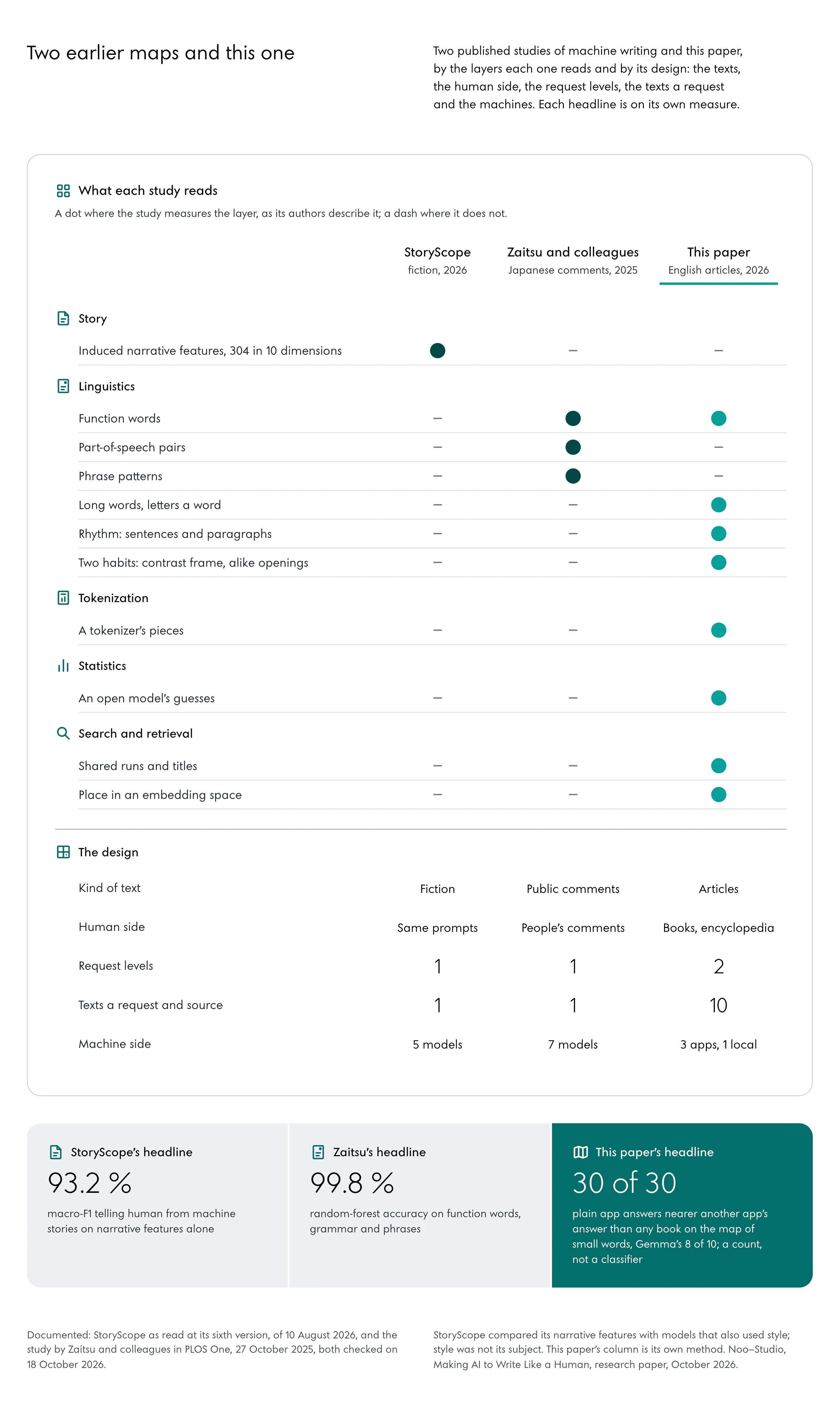
Every line of the right-hand column answers a question a person asks when they open an assistant and type a request. How alike is the assistant to itself on one task? Which part of what looks machine-made is the subject?
What does a style prompt change, and what does it leave? And how does the article look to the machines that read it after it is published, cut into pieces and placed in a space? No earlier map was built for those questions, and none claims to be.
Fiction and Japanese comments showed models gathered where people spread; expository English from the apps, one request repeated, had not been measured.
04Requests, Readers and References
Everything in this paper came out of one controlled exchange, repeated sixty times in the apps and twenty more on one Mac.
This part prints both requests exactly as sent, describes the apps and the cleaning, sets out the two human references and why both are needed, and lists every reader and every measure with its field and whether it was fixed before the run.
Both Requests, Printed Whole
The plain request was sent as one line, with nothing before or after it.
Write me an article about SEO.Its styled twin keeps that line and adds a persona and six rules. It was sent exactly as printed here.
Write me an article about SEO.

Write it as a search consultant who has spent ten years getting small firms found, for owners who are sharp but not technical.

Make it read like a person wrote it:
- Vary sentence length hard. Some sentences are four words. Some run long and carry a whole line of reasoning to its end. No steady beat.
- Choose the exact word, even when it is not the most expected one. Prefer short plain words to long abstract ones.
- Break the uniformity. Do not group things in threes. Do not give every paragraph or section the same length or shape. Use a list only where the content is a list.
- Do not build sentences on contrast, such as "it's not X, it's Y" or "not just X but Y". Say what is.
- Let each paragraph grow out of the one before it, picking up what the last one left open. Paragraphs of very different lengths.
- Take positions. Commit where you are sure and say so where you are not.
Three things the rules leave out matter later. No rule names the small grammatical words. None gives paragraph length in words, only that lengths differ.
And none mentions the topic’s vocabulary, though the persona brings small firms and local search into the article.
Apps, Accounts and Sixty Answers
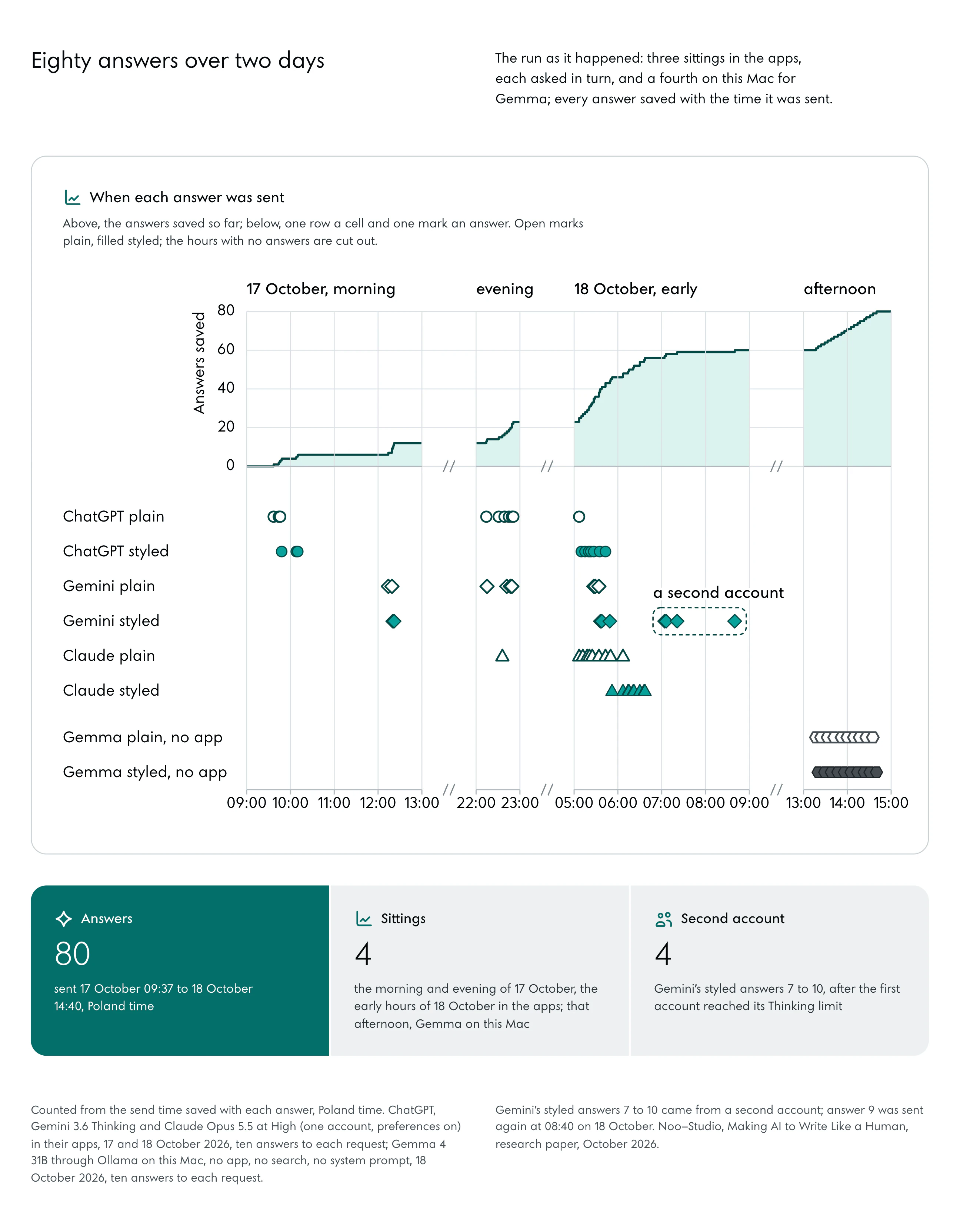
The assistants were used as a person meets them, on 17 and 18 October 2026: paid subscriptions in a browser, each request in a temporary or incognito chat. ChatGPT ran in its default mode. Gemini ran as Gemini 3.6 Thinking, on two of the founder’s Google accounts, the second taking over for styled answers 7 to 10 after the first reached its limit on Thinking.
Claude ran as Opus 5.5 at High in the founder’s account with his profile preferences on; they concern where work is saved and say nothing about style, voice or the topic, and every one of Claude’s twenty answers was written into a Claude Docs document, which the part on Claude returns to.
Each pairing of assistant and request, a cell, holds ten answers. Every answer was cleaned of the app’s talk around the article, its offers to do more and its kits of page metadata, and each cut is listed so that the cleaning can be checked line by line. Runs through the companies’ interfaces for programs, made earlier to test sampling temperature, are left out; the founder took temperature out on 17 October, since a person writing in the app never sees the setting.
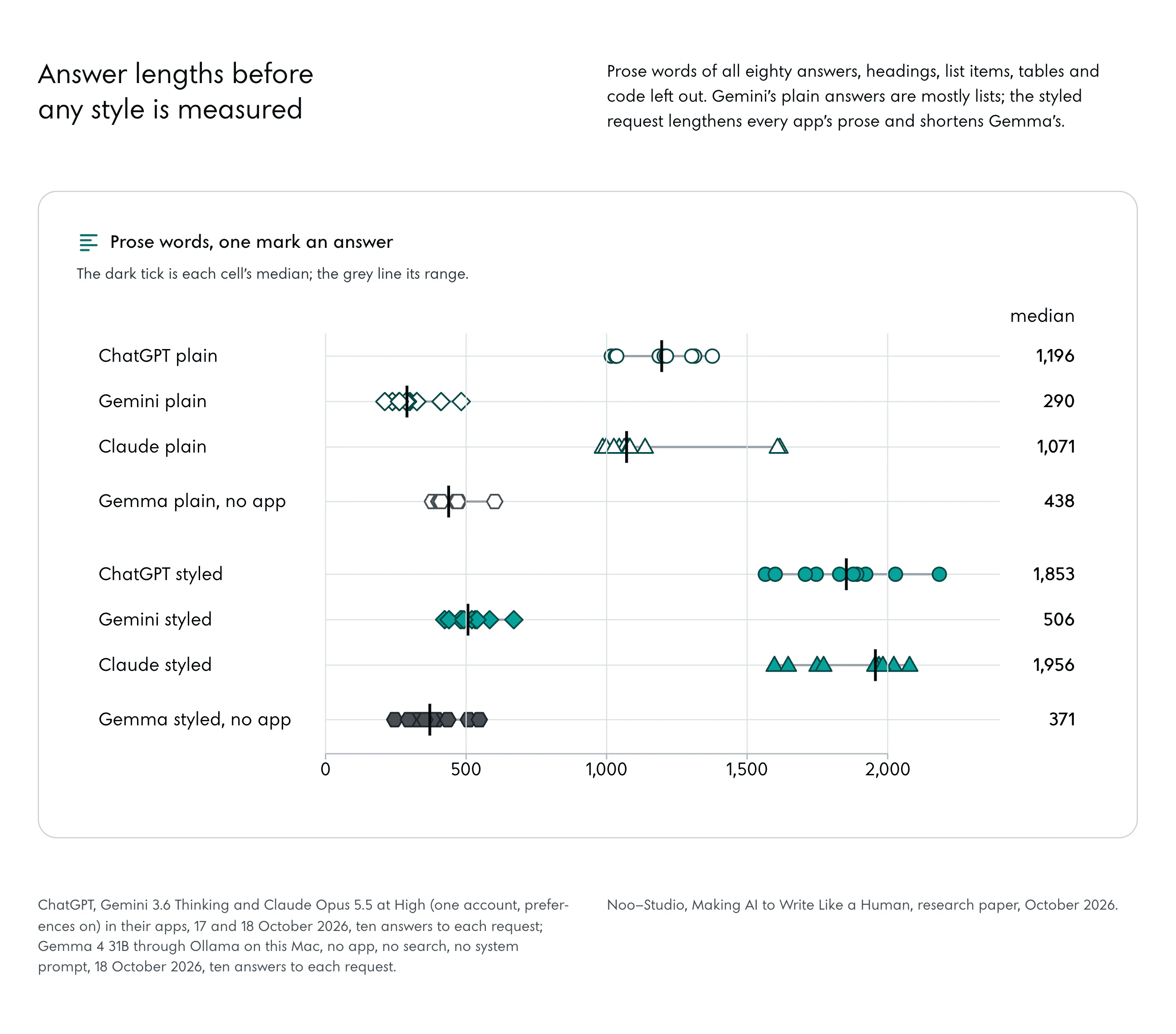
Answer lengths differ before any style is measured. Table 4 gives prose words, with headings, list items, tables and code left out.
| Cell | Median | Range |
|---|---|---|
| ChatGPT plain | 1,196 | 1,017 to 1,376 |
| Gemini plain | 290 | 211 to 483 |
| Claude plain | 1,071 | 986 to 1,616 |
| ChatGPT styled | 1,853 | 1,565 to 2,184 |
| Gemini styled | 506 | 424 to 670 |
| Claude styled | 1,956 | 1,597 to 2,078 |
| Gemma plain, no app | 438 | 380 to 602 |
| Gemma styled, no app | 371 | 246 to 547 |
Gemini’s plain answers are mostly lists, with a few hundred words of prose between them, so any rate counted a thousand words moves more for Gemini when one sentence changes. The styled request lengthens every app’s prose; Gemma’s, on one Mac, it shortens, from 438 to 371 words at the median.
Gemma 4 31B, the fourth writer, answered the same two requests through Ollama on this Mac after the sixty were in, with no search and no system prompt; its rows close each table that compares the cells, and it is read on its own in the part “A Fourth Writer on One Mac”.
The numbers
| Cell | Median | Range |
|---|---|---|
| ChatGPT plain | 1,196 | 1,017 to 1,376 |
| Gemini plain | 290 | 211 to 483 |
| Claude plain | 1,071 | 986 to 1,616 |
| Gemma plain | 438 | 380 to 602 |
| ChatGPT styled | 1,853 | 1,565 to 2,184 |
| Gemini styled | 506 | 424 to 670 |
| Claude styled | 1,956 | 1,597 to 2,078 |
| Gemma styled | 371 | 246 to 547 |
People in General and on the Subject
A machine text can be compared with people in two senses, and each answers a different question. General prose by people says how English is ordinarily written by someone with time to write it. People on the same subject say how much of what looks machine-made is the subject and its genre, the effect Mosteller and Wallace warned about in 1963.
- General prose. Six public-domain books by six authors on six subjects. Twenty-four windows of about 600 words serve the model readings and the paragraph counts, and 48 more windows are cut to each answer’s own length for the word-level band. None of the books is about search, so on any measure that depends on topic they are a floor, in no sense a match.
- The same subject. Wikipedia’s article “Search engine optimization” in four revisions from 2016 to 2022, all written before the chat assistants, cut into 12 windows of 1,500 words. Its current version, opened on 18 October 2026, begins on a different first sentence from the one those revisions share, which is one reason the measured text is fixed to revisions from before the assistants.
An encyclopedia article is one particular kind of same-topic writing, edited by many hands toward a neutral register. It stands here for one purpose, to show which part of a gap between the answers and the books belongs to the topic. Every encyclopedia reading was added after the answers were collected and is exploratory.
Readers and Measures by Field
No call went to the assistants after their answers were saved. Every reading was made in the studio by freely available tools: Gemma 3 4B for surprise and first choices, EmbeddingGemma for the space, the Gemma 3 and GPT-2 tokenizers for the pieces, and the studio’s own scripts for the word and paragraph counts. Table 5 lists each measure with its field, its unit and whether it was fixed in writing before the run.
| Measure | Field | Unit | Fixed before the run |
|---|---|---|---|
| First-choice share | Statistics and information theory | Share of pieces that were the model’s top guess, 128-piece windows | Yes |
| Surprise | Statistics and information theory | Nats a piece, 64-piece windows | Yes |
| Chance of scoring above a book window | Statistics | Probability, 0 to 1 | No, exploratory |
| Function-word share | Linguistics | Share of words | Yes |
| Long-word share and word length | Linguistics | Share of words of 3+ syllables; letters | Long words yes, length no |
| Sentence-length spread | Linguistics | Coefficient of variation | Yes |
| Contrast frame | Linguistics | A thousand words | Yes |
| Sentences opening alike | Linguistics | A thousand words | No, exploratory |
| Paragraph-length spread | Linguistics | Coefficient of variation | Yes |
| One-sentence paragraphs | Linguistics | Share of paragraphs | No, exploratory |
| Pieces a word, multi-piece words | Tokenization | Gemma 3 and GPT-2 pieces | No, exploratory |
| Keyword family | Tokenization and search | Terms a thousand words | No, exploratory |
| Shared runs of eight pieces | Search and retrieval | Share of runs | No, exploratory |
| Spread in EmbeddingGemma’s space | Search and retrieval | Mean cosine distance | Yes |
| Titles and opening scenes | Search and retrieval | Counts of ten | No, exploratory |
What Can Be Repeated at a Desk
Most of the run needs a browser, an afternoon and a short script. Both requests are printed above. The word measures, the two habits and paragraph shape need nothing more than a few lines of code, and several can be checked by hand on a printed page.
Tokenizer counts need only the public tokenizer files. Surprise and first choices need an open model such as Gemma 3 4B on a reasonably recent laptop, and the embedding needs EmbeddingGemma beside it. Nothing in the method needs the inside of ChatGPT, Gemini or Claude.
Two things cannot be repeated exactly. The apps change without notice, so a run in a later week may meet a different model behind the same name. And Claude’s answers carry one account’s preferences, so a person running the same request in their own account is running a different version of Claude.
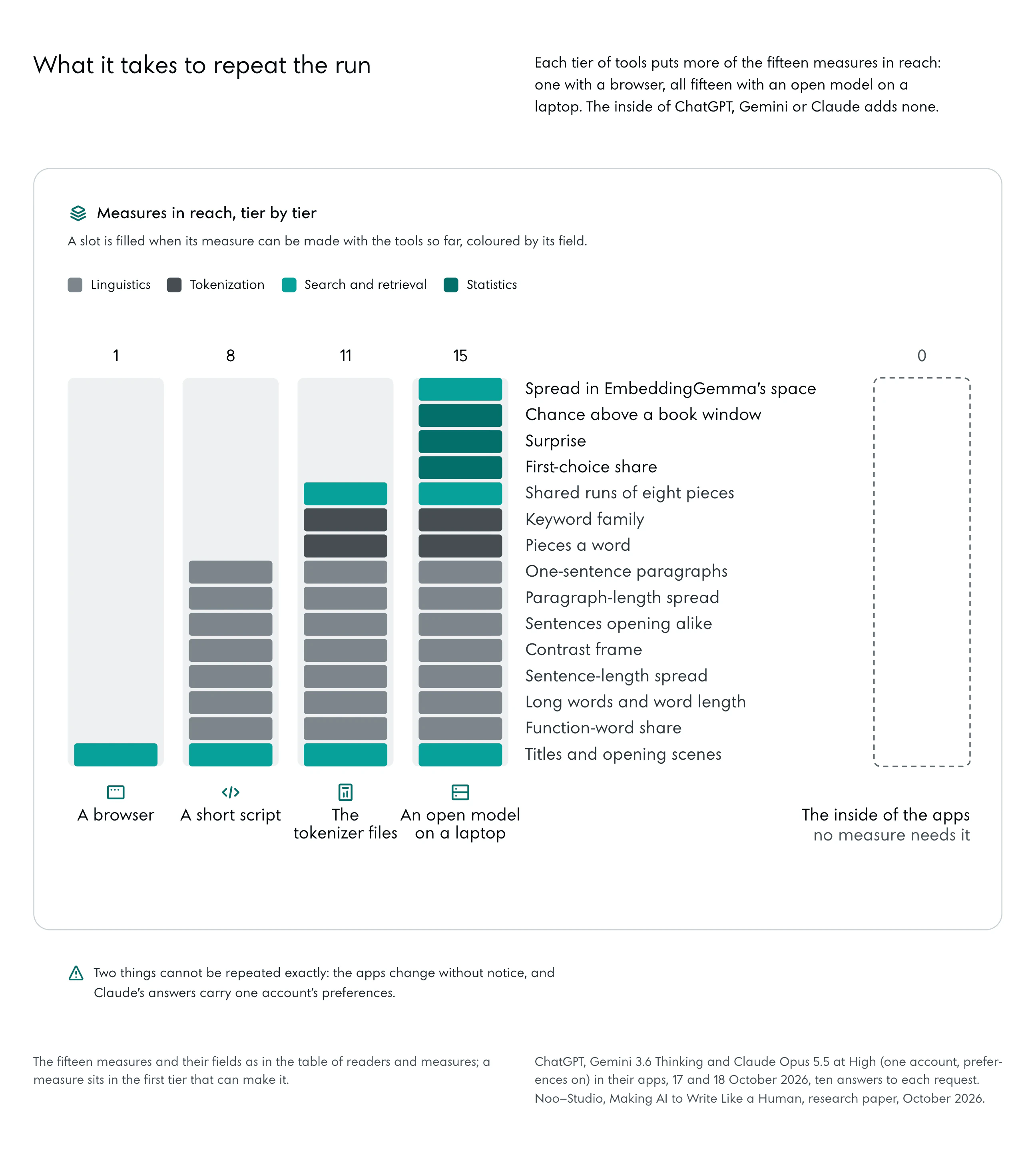
Sixty answers from the apps and twenty from one Mac, two human references and fifteen measures from four fields, all read by open models that anyone can run.
05One Article Returned Ten Times
Asked plainly, each assistant returns a recognisable product, and returns nearly the same product each time.
This part reads that sameness the way search engineers read near-duplicate pages, in shared runs of words, in titles and in opening scenes, and then sets it against the floor the books give.
Layout Comes Before the First Word
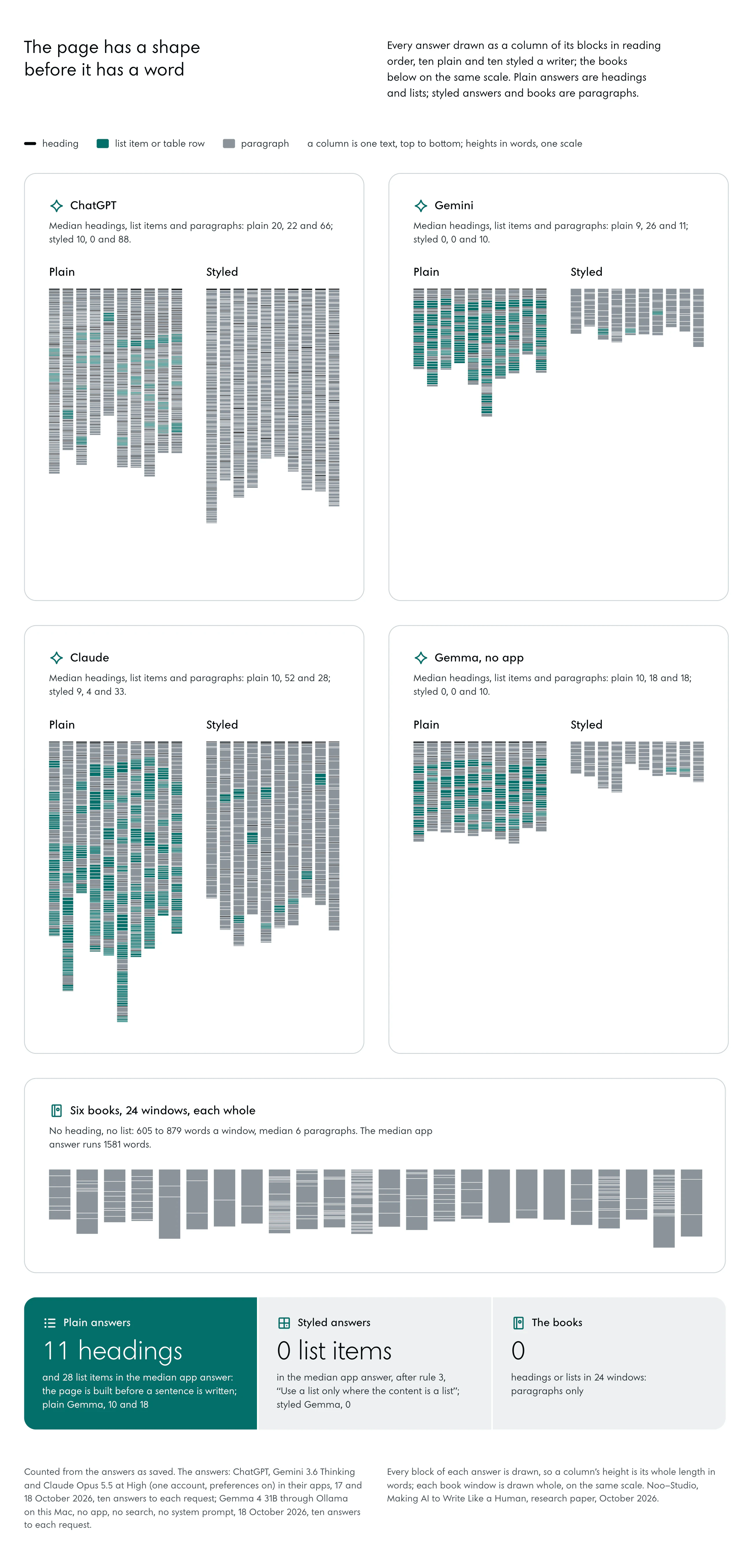
The first difference is visible before a word is read. Plain ChatGPT writes about 1,200 prose words under many headings, in short paragraphs. Claude, asked the same way, writes at a similar length in fewer, thicker paragraphs.
Gemini writes a scaffold, headings and lists carrying most of the answer, with a median of 290 prose words between them.
The numbers
| Cell | Headings | List items | Paragraphs | Words in all (median) |
|---|---|---|---|---|
| ChatGPT plain | 20 | 22 | 66 | 1488 |
| ChatGPT styled | 10 | 0 | 88 | 1943 |
| Gemini plain | 9 | 26 | 11 | 802 |
| Gemini styled | 0 | 0 | 10 | 526 |
| Claude plain | 10 | 52 | 28 | 2091 |
| Claude styled | 9 | 4 | 33 | 2084 |
| Gemma plain, no app | 10 | 18 | 18 | 883 |
| Gemma styled, no app | 0 | 0 | 10 | 380 |
Drawn as columns of blocks, ten answers from one cell can be compared at a glance. Plain ChatGPT’s columns are tall stacks of thin blocks; Gemini’s are mostly list items; Claude’s carry fewer, longer paragraphs; Gemma’s, from one Mac, hold headings, list items and short paragraphs in nearly equal numbers, nearer Gemini’s scaffold than ChatGPT’s stack. A reader skimming a results page meets that shape first, and it already says which assistant wrote the page.
Plain ChatGPT Repeats a Third of Itself
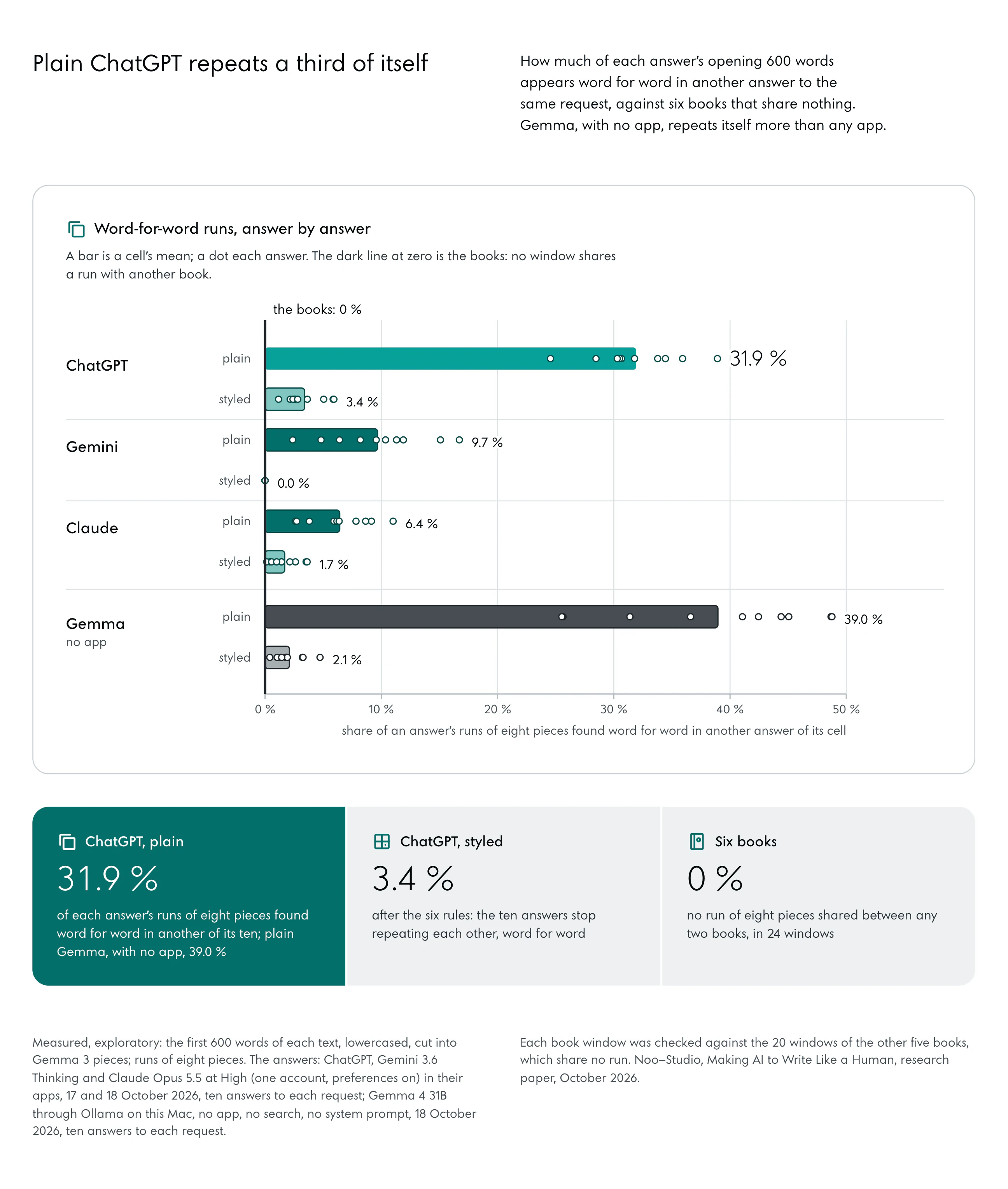
Shared runs count the sameness directly (the method is set out in the part on the four fields). Table 6 gives each cell’s mean share of shared runs of eight pieces, with the range of its ten answers, in three variants.
| Cell | All text | Without headings | Without request echoes |
|---|---|---|---|
| ChatGPT plain | 31.9 % (24.6 to 38.9) | 27.5 % | 31.9 % |
| Gemini plain | 9.7 % (2.4 to 16.7) | 7.8 % | 9.7 % |
| Claude plain | 6.4 % (2.6 to 11.0) | 5.6 % | 6.4 % |
| ChatGPT styled | 3.4 % (1.2 to 5.9) | 2.9 % | 2.9 % |
| Gemini styled | 0.0 % (0.0 to 0.0) | 0.0 % | 0.0 % |
| Claude styled | 1.7 % (0.1 to 3.6) | 1.4 % | 1.7 % |
| Gemma plain, no app | 39.0 % (25.5 to 48.8) | 36.7 % | 38.8 % |
| Gemma styled, no app | 2.1 % (0.4 to 4.7) | 2.1 % | 2.1 % |
| Books, 24 windows | 0.0 % |
Cut to its first 600 words, a plain ChatGPT answer shares 31.9 % of its eight-piece runs with another answer in its cell, and 27.5 % once headings are removed. This is measured, and exploratory. Gemini’s plain answers share less, perhaps partly because so little of them is prose, and Claude’s less again.
Gemma, on one Mac with no app and no search, repeats more than any app, 39.0 %, and 36.7 % once headings are removed. With the rules every cell drops to a few per cent or to nothing, Gemma’s to 2.1 %.
The numbers
| Texts | Mean | Range |
|---|---|---|
| ChatGPT plain | 31.9 % | 24.6 % to 38.9 % |
| ChatGPT styled | 3.4 % | 1.2 % to 5.9 % |
| Gemini plain | 9.7 % | 2.4 % to 16.7 % |
| Gemini styled | 0.0 % | 0.0 % to 0.0 % |
| Claude plain | 6.4 % | 2.6 % to 11.0 % |
| Claude styled | 1.7 % | 0.1 % to 3.6 % |
| Gemma plain | 39.0 % | 25.5 % to 48.8 % |
| Gemma styled | 2.1 % | 0.4 % to 4.7 % |
| Books, 24 windows | 0.0 % | 0.0 % to 0.0 % |
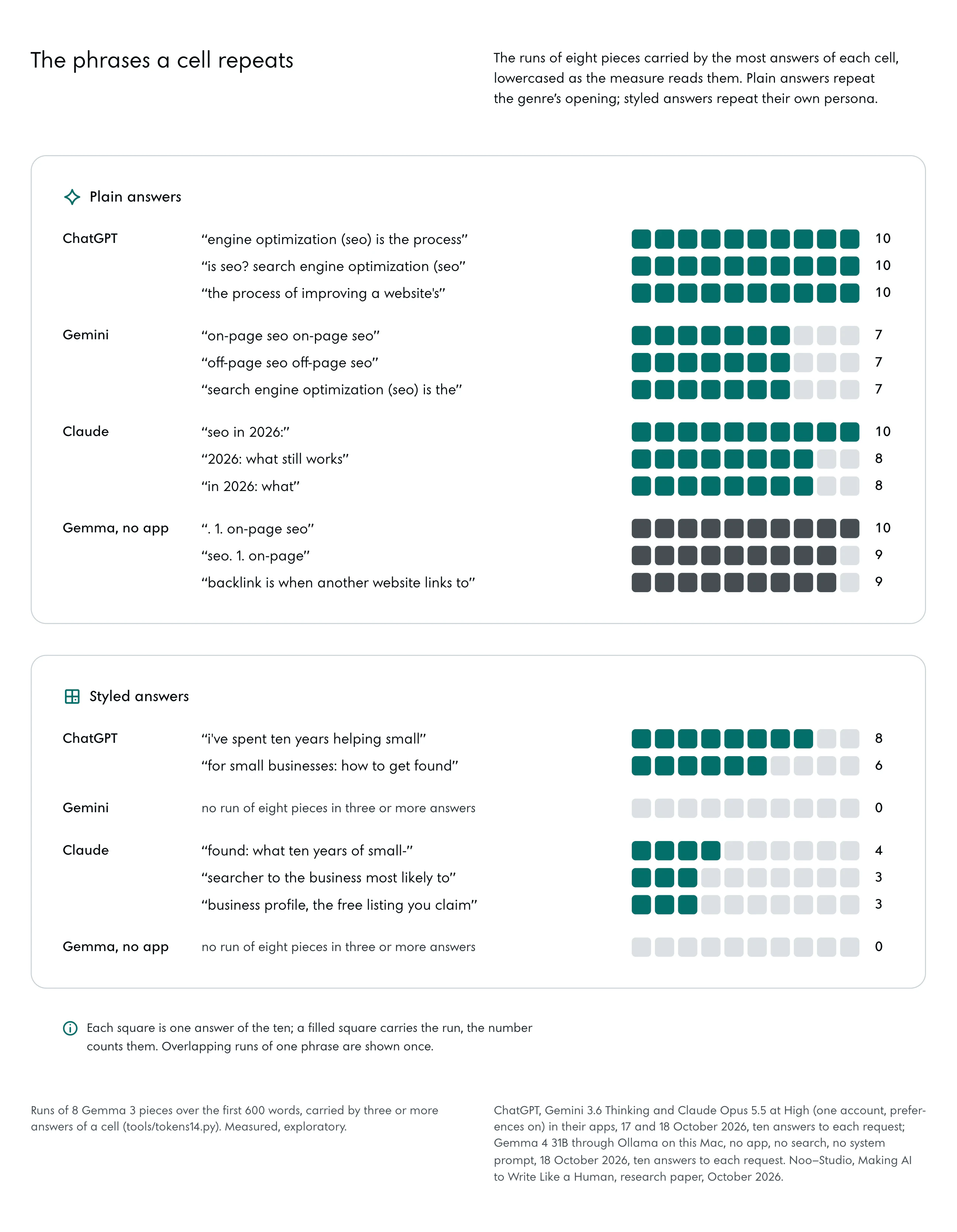
What the plain ChatGPT answers share is the genre’s opening. All ten carry the definition quoted at the start of this paper, the one the encyclopedia also opens on. Yet the overlap with the encyclopedia itself is small: across its four revisions, the eight-piece runs the answers share with the article are 0.18 % of plain ChatGPT’s runs and 0.07 % of plain Gemini’s, and none of the other cells’, Gemma’s included.
The answers agree with each other far more than with the most likely human source for their opening.
What the styled answers repeat is their own persona. Eight of the ten styled ChatGPT answers carry “i’ve spent ten years helping small”, the brief restated in the first person, and four of ten styled Claude answers carry “getting found: what ten years of small-firm seo”. Removing runs that echo the request moves styled ChatGPT from 3.4 % to 2.9 %.
A persona supplies its own stock phrase, and an assistant handed one tends to say it.
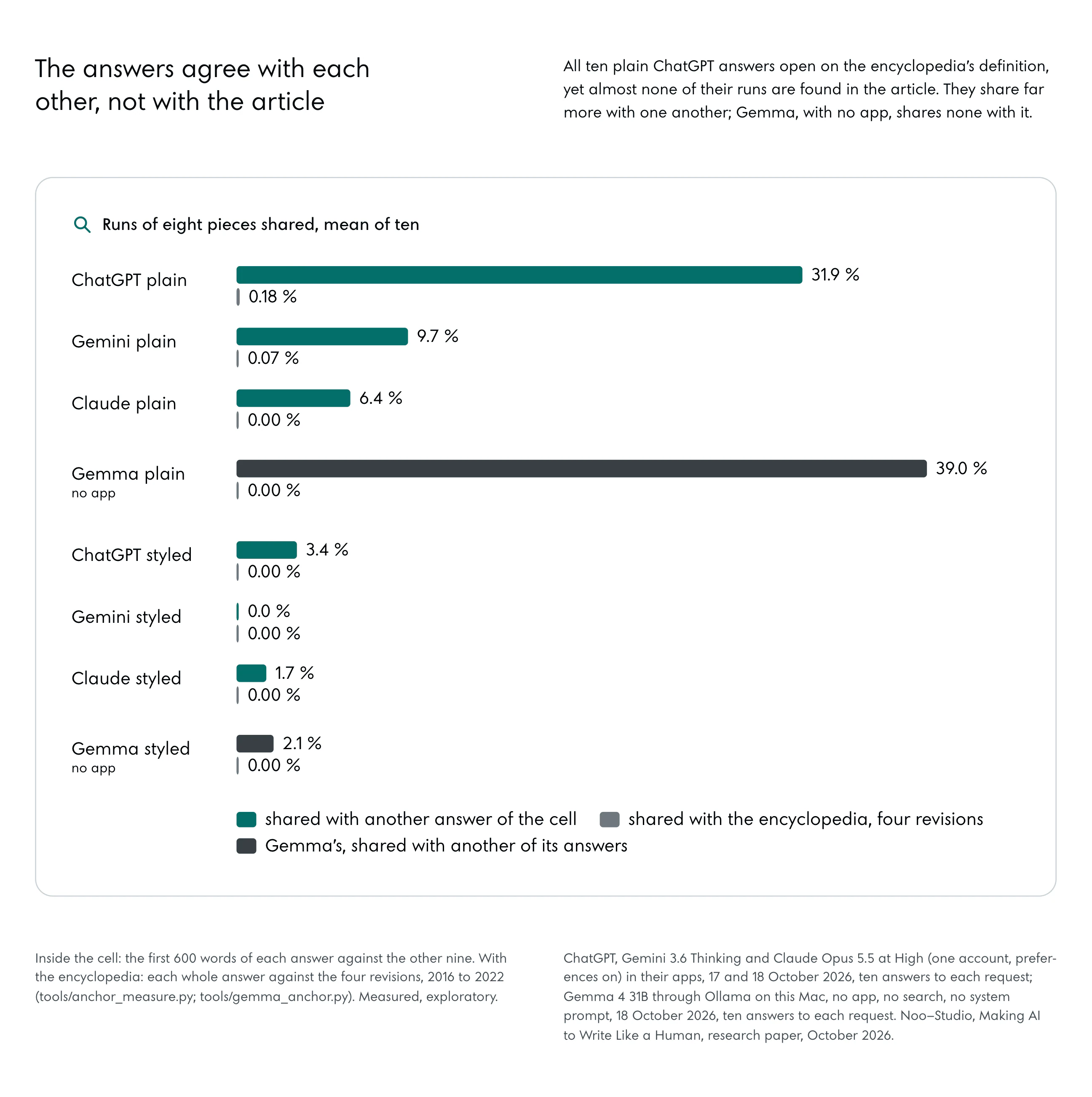
One plain ChatGPT answer shares 31.9 % of its opening runs with another of its ten; six books on six subjects share none.
Headlines Repeat Before and After
The headline is the most repeated line in the run. Table 7 counts distinct titles among each cell’s ten, with the opening words most of them share.
| Cell | Distinct titles of 10 | The same opening words |
|---|---|---|
| ChatGPT plain | 4 | “What Is SEO? A Complete Guide to Search Engine Optimization” in 9 of 10 |
| Gemini plain | 10 | “Demystifying” in 5 of 10 |
| Claude plain | 5 | “SEO in 2026:” in 10 of 10 |
| ChatGPT styled | 4 | “SEO for Small Businesses:” in 10 of 10 |
| Gemini styled | none | No title in any of the ten; each begins directly with prose |
| Claude styled | 5 | “Getting Found:” in 10 of 10 |
| Gemma plain, no app | 6 | “Mastering the Digital” in 6 of 10 |
| Gemma styled, no app | none | No title in any of the ten; each begins directly with prose |
Plain ChatGPT gives nine of its ten answers one title, word for word as far as “Search Engine Optimization”. Under the rules the wording changes and the habit stays, since styled ChatGPT and styled Claude each open all ten titles on the same words. Gemini is the exception in both cells, with ten different plain titles and no title at all once styled.
Gemma, with no app, opens six of its ten plain titles on “Mastering the Digital”, five of them word for word the same, and like Gemini gives no title once styled; three of its styled answers open on the same image, “Google is a map”. This count is measured, and exploratory.
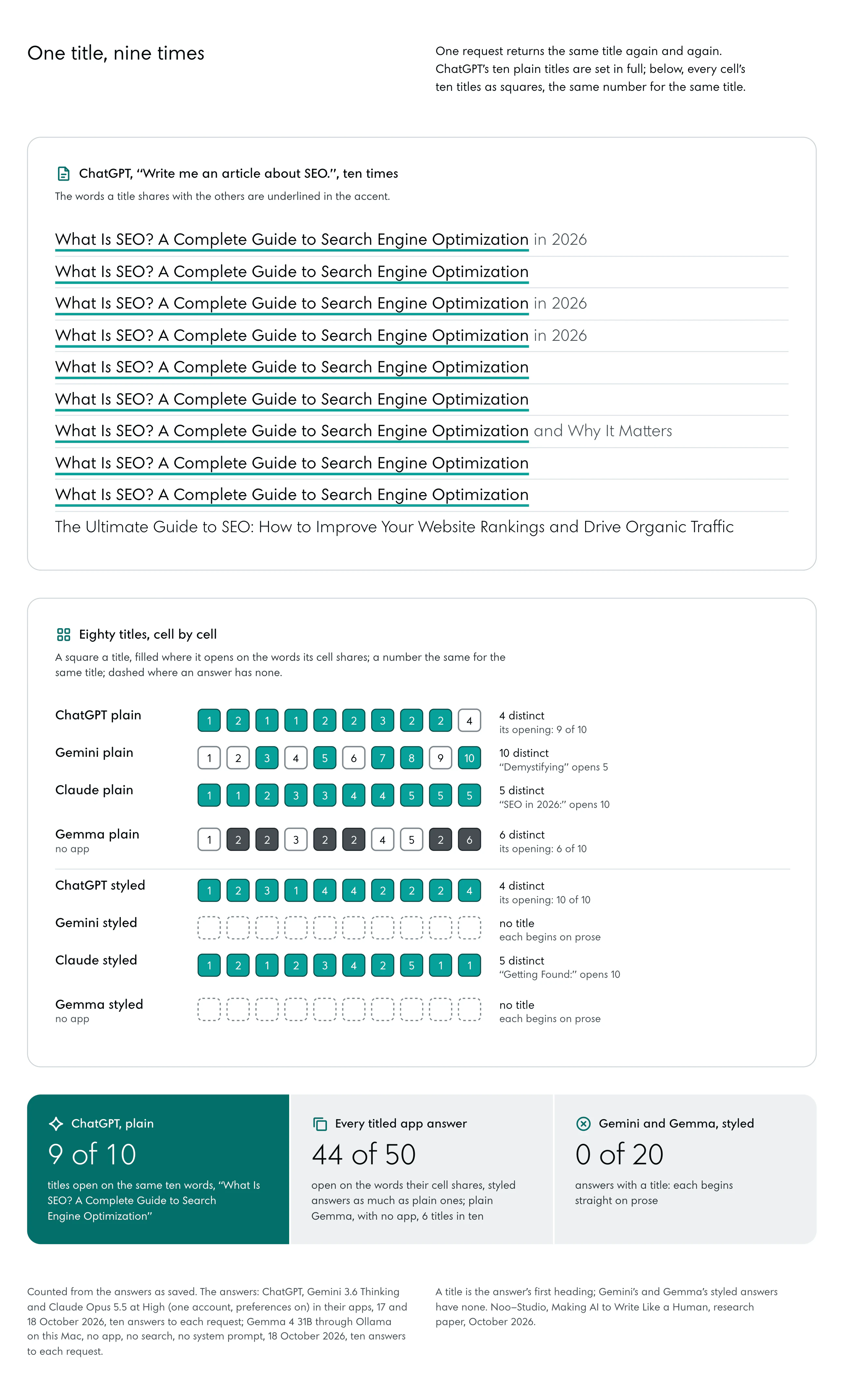
The numbers
| Cell | Distinct titles | Shared opening | Titles with it |
|---|---|---|---|
| ChatGPT plain | 4 | What Is SEO? A Complete Guide to Search Engine Optimization | 9 of 10 |
| Gemini plain | 10 | Demystifying | 5 of 10 |
| Claude plain | 5 | SEO in 2026: | 10 of 10 |
| Gemma plain | 6 | Mastering the Digital | 6 of 10 |
| ChatGPT styled | 4 | SEO for Small Businesses: | 10 of 10 |
| Gemini styled | 0 | none | 0 of 10 |
| Claude styled | 5 | Getting Found: | 10 of 10 |
| Gemma styled | 0 | none | 0 of 10 |
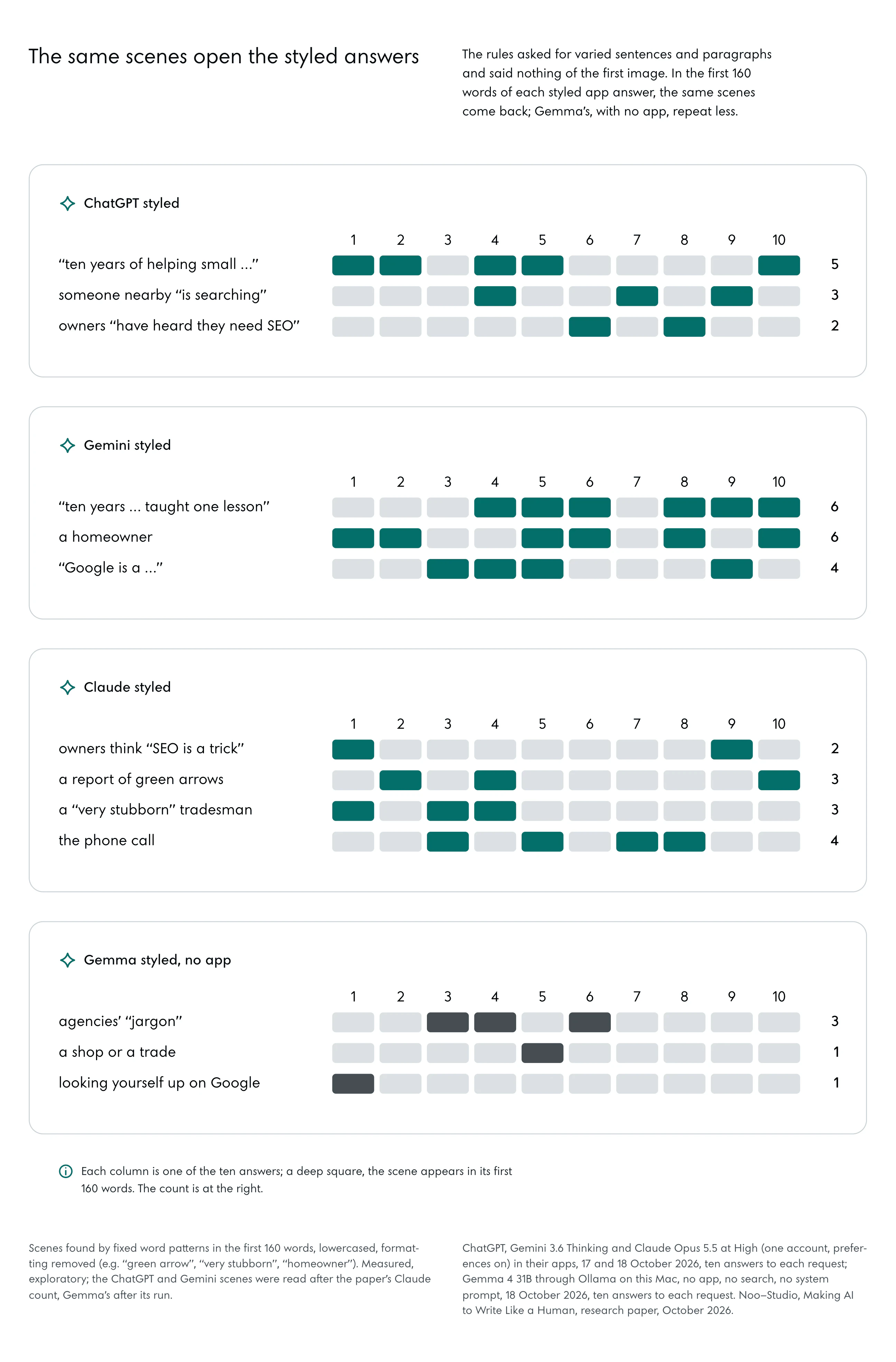
Opening scenes repeat as well. Within the first 160 words, three of the ten styled Claude answers open on an owner holding a report full of green arrows, and three on a “very stubborn” tradesman. The rules asked for varied sentences and varied paragraphs, and said nothing of the title or the first image; both stayed where the model’s habit put them.
For search, the title is the line a results page shows. An assistant that names ten requested articles with one opening phrase gives every person who asks the same front door.
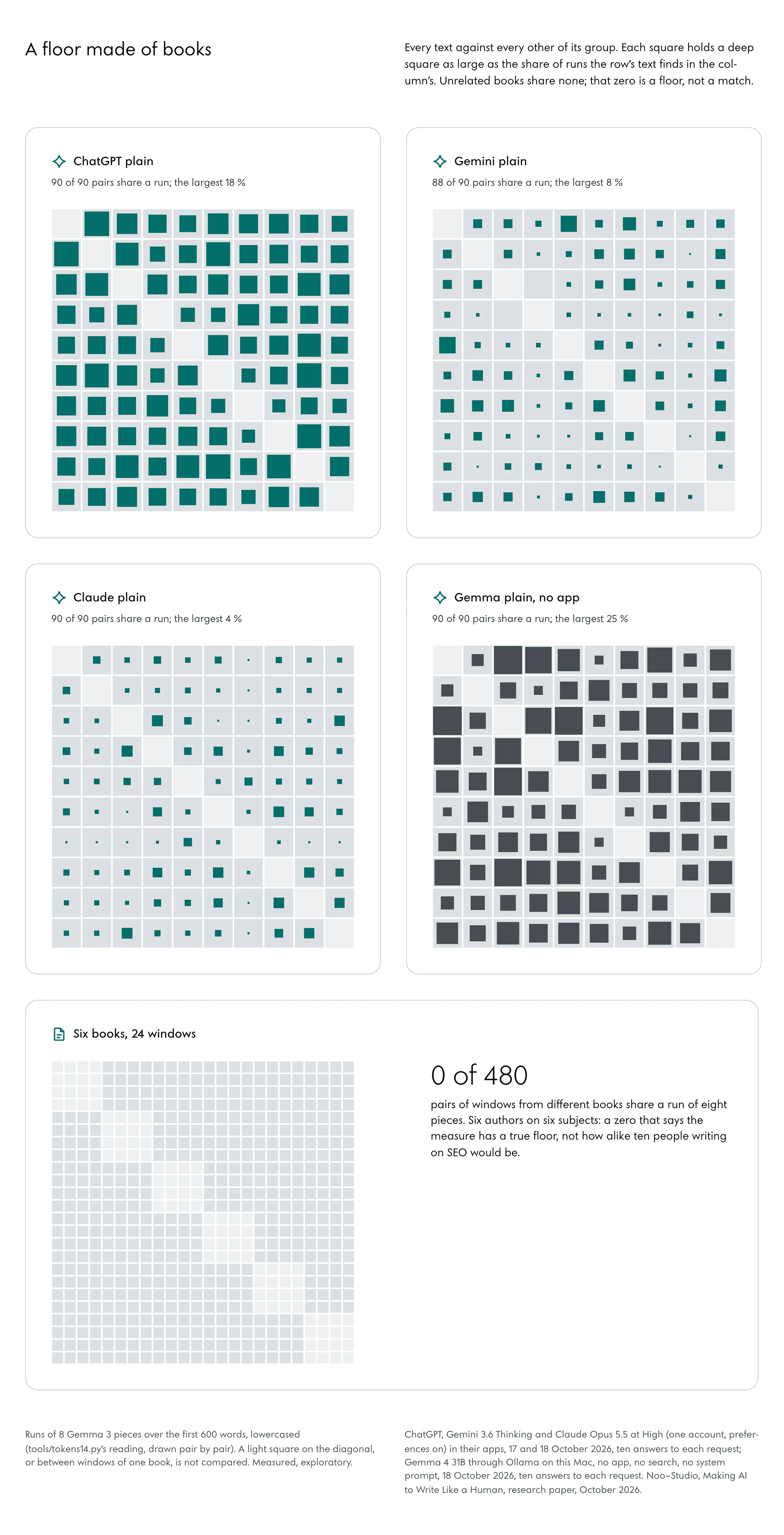
A Floor Made of Books
Six books by people score 0.0 %. Each of the 24 book windows was checked against the 20 windows of the other five books, and no run of eight pieces recurred. The books are six authors on six subjects, though, sharing neither topic nor vocabulary, and a run of six words is easy to avoid between texts about different things.
Ten people asked for the same article would share more, from the subject’s fixed phrases alone.
So the zero is a floor, and it carries two facts only: shared runs are no artefact of the tokenizer or of English, since unrelated human texts produce none, and the measure has a true zero. How alike ten people would be on SEO stays unknown, because no human cell of ten writers to one brief exists in this run. The encyclopedia gives a partial check from the other side.
Theory: the sameness of the plain answers is a route the model takes each time it is asked, learned from the genre and repeated from its own distribution; copying from one shared human source would leave more trace in the article than 0.18 %. A cell of ten people writing to the plain request, measured the same way, would test it.
06The Model’s First Guess
Machine prose is often called average, and the word can be made exact.
This part puts an open model in the chair of Shannon’s guesser, counts how often each text takes its first choice and how surprised it is by each piece, and gives every cell’s distance from the books as an effect size. Plain ChatGPT and Gemini never meet the books on either reading, and neither does plain Gemma; the apps’ styled answers all do, and styled Gemma meets them on first choice only.
His Phrase for the Average
On the evening of 17 October the founder put the feeling into one sentence: “there is certain shape which I cannot name that make ai writing the median of the prediction”. He did not know, he added, whether EmbeddingGemma would see it, “but definitely there is certain pattern there of the predicted and distributed words”. The phrase names a mechanism.
A language model gives, at every position, a probability to each piece that could come next, and a chat assistant writes by choosing from those probabilities under sampling settings the person in the app never sees. Text chosen again and again from the dense centre of those distributions reads as the median of what could have been written.
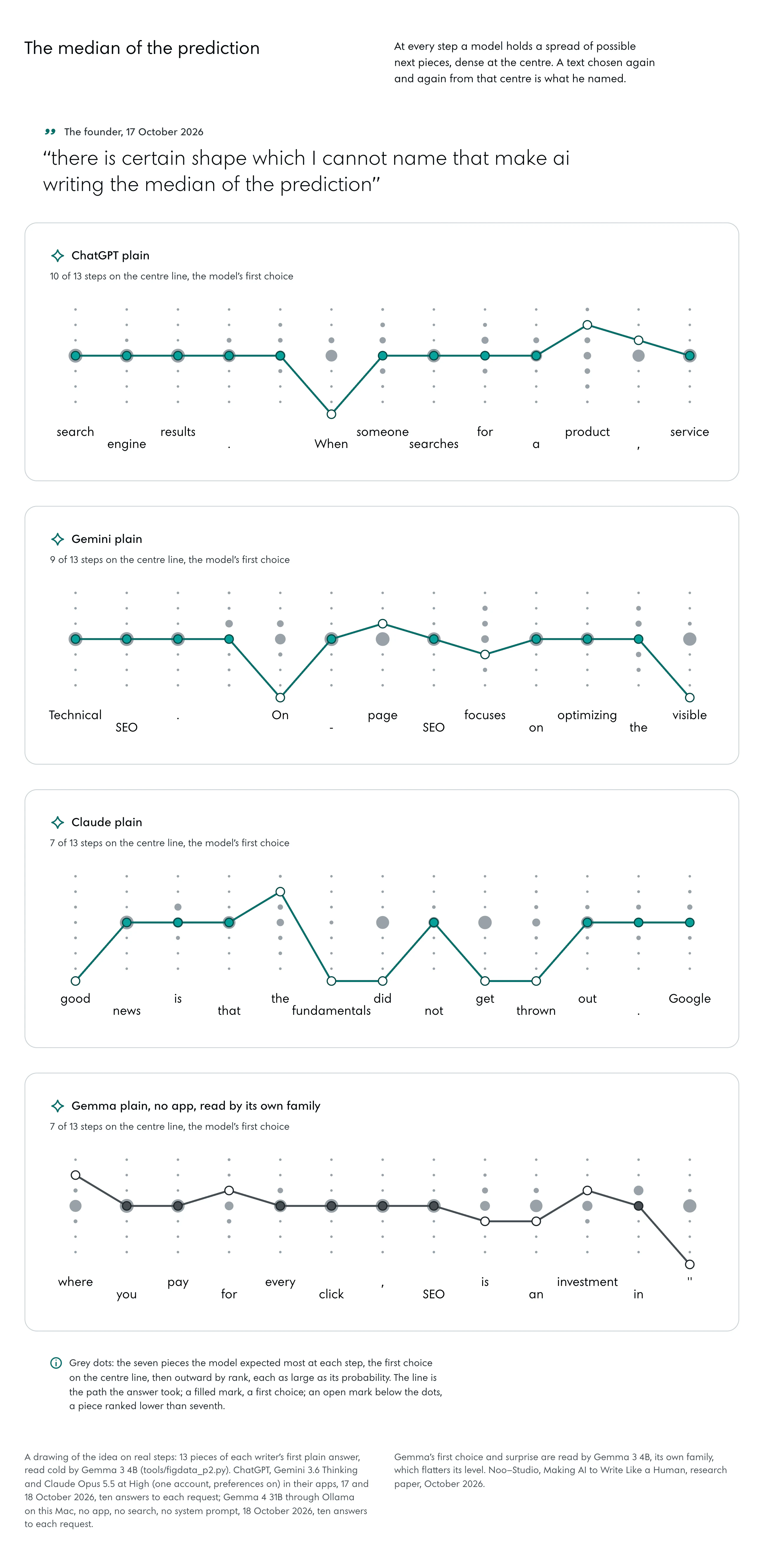
Plain Answers Take the First Choice
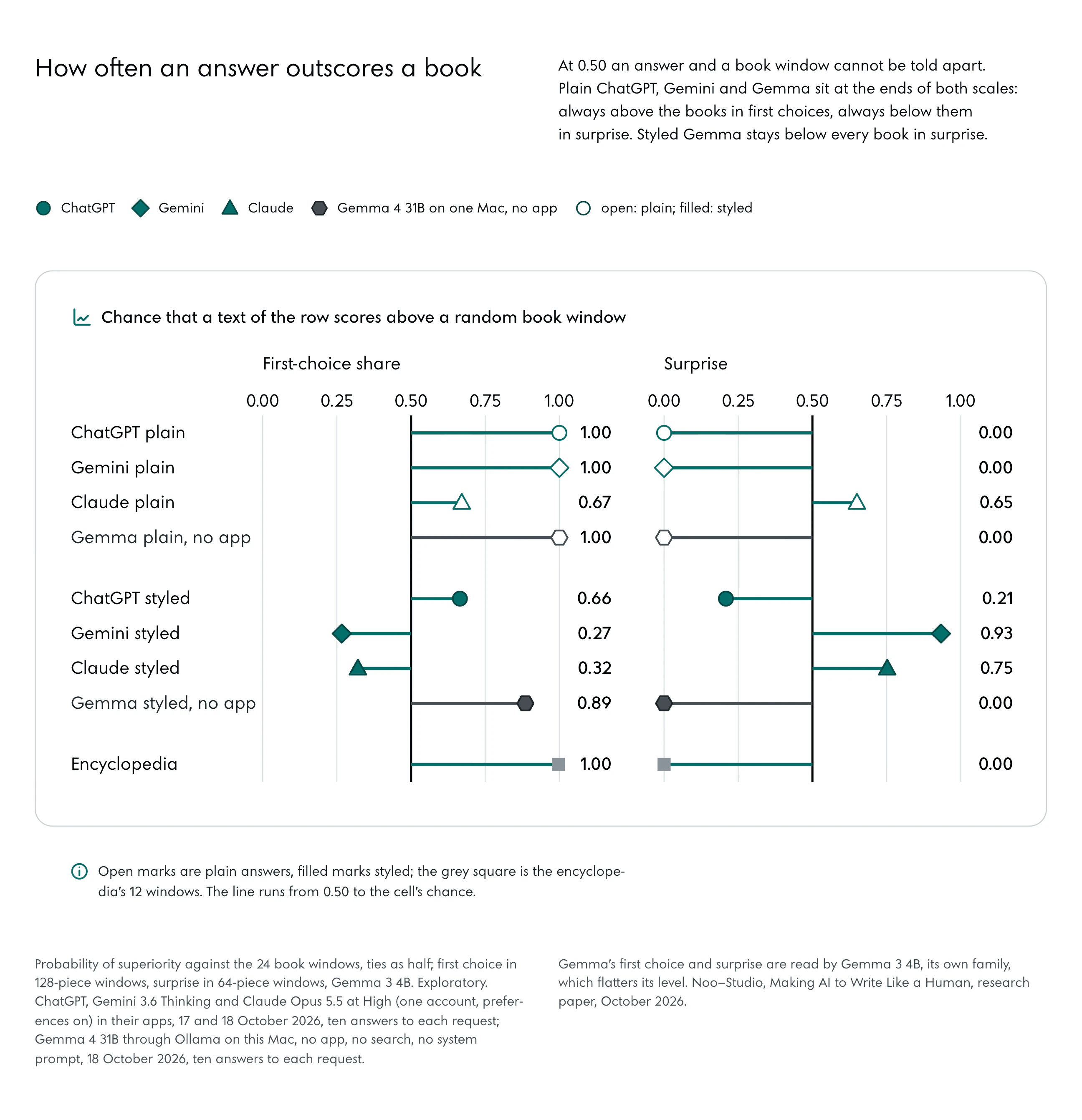
First-choice share asks at what share of positions a text used the piece Gemma 3 4B ranked first. Each text is cut into cold windows of 128 pieces, every window starting fresh, so that long book paragraphs and short answer paragraphs give the model the same context. Table 8 gives each cell’s mean and range, how many of its ten answers sit above, inside or below the books’ range, and the chance that one of its answers scores above a random book window.
| Cell | Mean | Range | Above / inside / below the books | Chance of scoring above a book window |
|---|---|---|---|---|
| ChatGPT plain | 0.502 | 0.467 to 0.520 | 10 / 0 / 0 | 1.00 |
| Gemini plain | 0.515 | 0.459 to 0.562 | 10 / 0 / 0 | 1.00 |
| Claude plain | 0.367 | 0.342 to 0.394 | 0 / 10 / 0 | 0.67 |
| ChatGPT styled | 0.366 | 0.346 to 0.389 | 0 / 10 / 0 | 0.66 |
| Gemini styled | 0.311 | 0.276 to 0.346 | 0 / 10 / 0 | 0.27 |
| Claude styled | 0.312 | 0.280 to 0.328 | 0 / 10 / 0 | 0.32 |
| Gemma plain, no app | 0.558 | 0.512 to 0.628 | 10 / 0 / 0 | 1.00 |
| Gemma styled, no app | 0.394 | 0.352 to 0.430 | 3 / 7 / 0 | 0.89 |
| Books, 24 windows | 0.340 | 0.250 to 0.405 | 0.50 | |
| Encyclopedia, 12 windows | 0.421 | 0.402 to 0.437 | 11 / 1 / 0 | 1.00 |
Half of every plain ChatGPT and Gemini text is the model’s own first guess, and every one of those twenty answers sits above the highest book window. This is measured. The chance figure makes the distance plain: 1.00 means no plain ChatGPT or Gemini answer scored below any book window.
People writing an encyclopedia entry on search are more predictable to the model than people writing books, 11 of 12 windows above the books’ range, which a genre built on definitions and settled phrasing would lead anyone to expect. The plain answers sit above the encyclopedia too. Plain Gemma, with no app, sits higher than any app, at 0.558, all ten above the books, though its reader is of its own family, a caveat the part on the fourth writer weighs.
With the six rules, all thirty of the apps’ styled answers fall inside the books’ range, and seven of Gemma’s ten, the other three just above it. The styled request mentions the expected word in one clause only, “Choose the exact word, even when it is not the most expected one”, and that clause with the rules for rhythm and plain words is enough to bring the first-choice share among people’s.
Surprise Below Every Book
Surprise reads the same probabilities more finely. It takes the probability the model gave the actual piece, whatever its rank, turns it into a cost in nats, and averages the cost over every piece, here in cold windows of 64 pieces. Table 9 is laid out like Table 8.
| Cell | Mean | Range | Above / inside / below the books | Chance of scoring above a book window |
|---|---|---|---|---|
| ChatGPT plain | 3.04 | 2.88 to 3.30 | 0 / 0 / 10 | 0.00 |
| Gemini plain | 3.17 | 2.69 to 3.68 | 0 / 0 / 10 | 0.00 |
| Claude plain | 4.47 | 4.30 to 4.72 | 0 / 10 / 0 | 0.65 |
| ChatGPT styled | 4.01 | 3.89 to 4.09 | 0 / 10 / 0 | 0.21 |
| Gemini styled | 4.92 | 4.64 to 5.27 | 4 / 6 / 0 | 0.93 |
| Claude styled | 4.56 | 4.37 to 4.79 | 0 / 10 / 0 | 0.75 |
| Gemma plain, no app | 2.65 | 2.26 to 2.87 | 0 / 0 / 10 | 0.00 |
| Gemma styled, no app | 3.67 | 3.48 to 3.79 | 0 / 0 / 10 | 0.00 |
| Books, 24 windows | 4.31 | 3.82 to 4.95 | 0.50 | |
| Encyclopedia, 12 windows | 3.56 | 3.44 to 3.69 | 0 / 0 / 12 | 0.00 |
Plain ChatGPT is less surprising to the model than every book window and every encyclopedia window; its most surprising answer, at 3.30, sits below the encyclopedia’s least surprising window, at 3.44. Gemini’s plain answers are below every book as well. Styled ChatGPT and styled Claude move inside the books in all twenty answers.
Gemini’s styled answers move further, 4 of the 10 answers beyond the highest book window, with a chance of 0.93 of scoring above a random book; its answers are short, 424 to 670 prose words, and a short text built to avoid the expected word can overshoot people quickly. A reader would meet the overshoot as prose straining for the unusual. Length alone does not make it: Gemma’s styled answers are shorter still, 246 to 547 words, and all ten stay below every book, at 3.67 nats against 2.65 plain, read by a model of their own family.
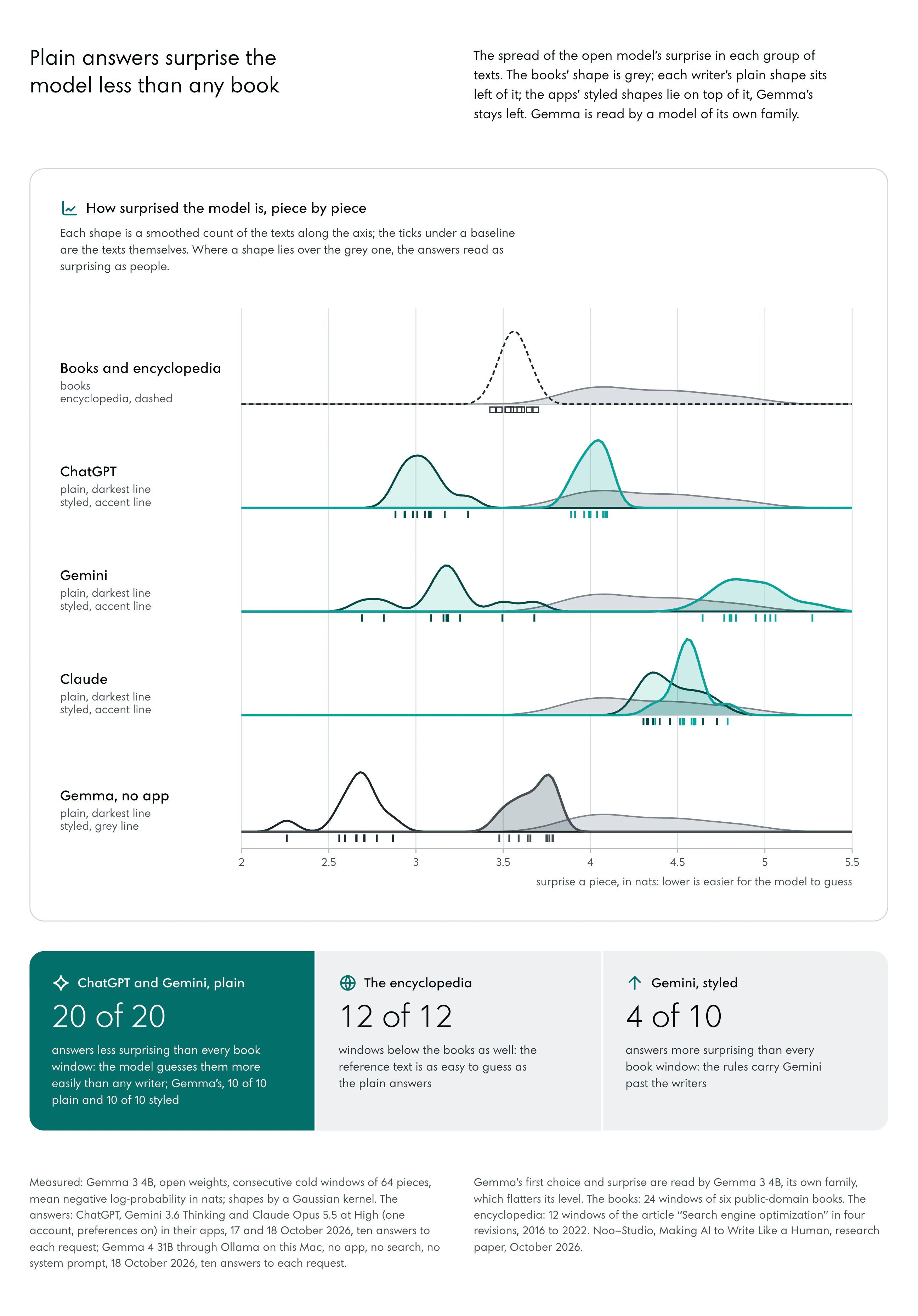
The numbers
| Texts | Mean | Range |
|---|---|---|
| Books, 24 windows | 4.31 | 3.82 to 4.95 |
| Encyclopedia, 12 windows | 3.56 | 3.44 to 3.69 |
| ChatGPT plain | 3.04 | 2.88 to 3.30 |
| Gemini plain | 3.17 | 2.69 to 3.68 |
| Claude plain | 4.47 | 4.30 to 4.72 |
| Gemma plain | 2.65 | 2.26 to 2.87 |
| ChatGPT styled | 4.01 | 3.89 to 4.09 |
| Gemini styled | 4.92 | 4.64 to 5.27 |
| Claude styled | 4.56 | 4.37 to 4.79 |
| Gemma styled | 3.67 | 3.48 to 3.79 |
Four Fields on One Number
Each discipline takes something different from Tables 8 and 9, and the differences are the reason to read them more than once.
- Statistics sees three plain cells, ChatGPT’s, Gemini’s and Gemma’s, with no overlap at all against people, a chance of 0.00 on surprise and 1.00 on first choice, and four cells that overlap, the apps’ three styled cells and plain Claude’s, the closest at 0.65 to 0.75 on surprise. Ten answers a cell against 24 windows is a small sample, and the figures are exploratory.
- Linguistics sees the encyclopedia sit between the books and the plain answers on both readings, and so sees part of the distance as genre, the effect Mosteller and Wallace named for word rates in 1963.
- Tokenization reminds every reader that the guesser has its own list of pieces, and that a different list would rank some steps differently.
- Search reads a high first-choice share as the most probable article, the same article the shared runs found ten times; the two measures are two readings of one mechanism, set out as theory in the part on theories.
Half of a plain ChatGPT or Gemini article is an open model’s own first guess; no book window comes close, and six style rules bring every app’s answer among the books.
One Open Reader and Its Limits
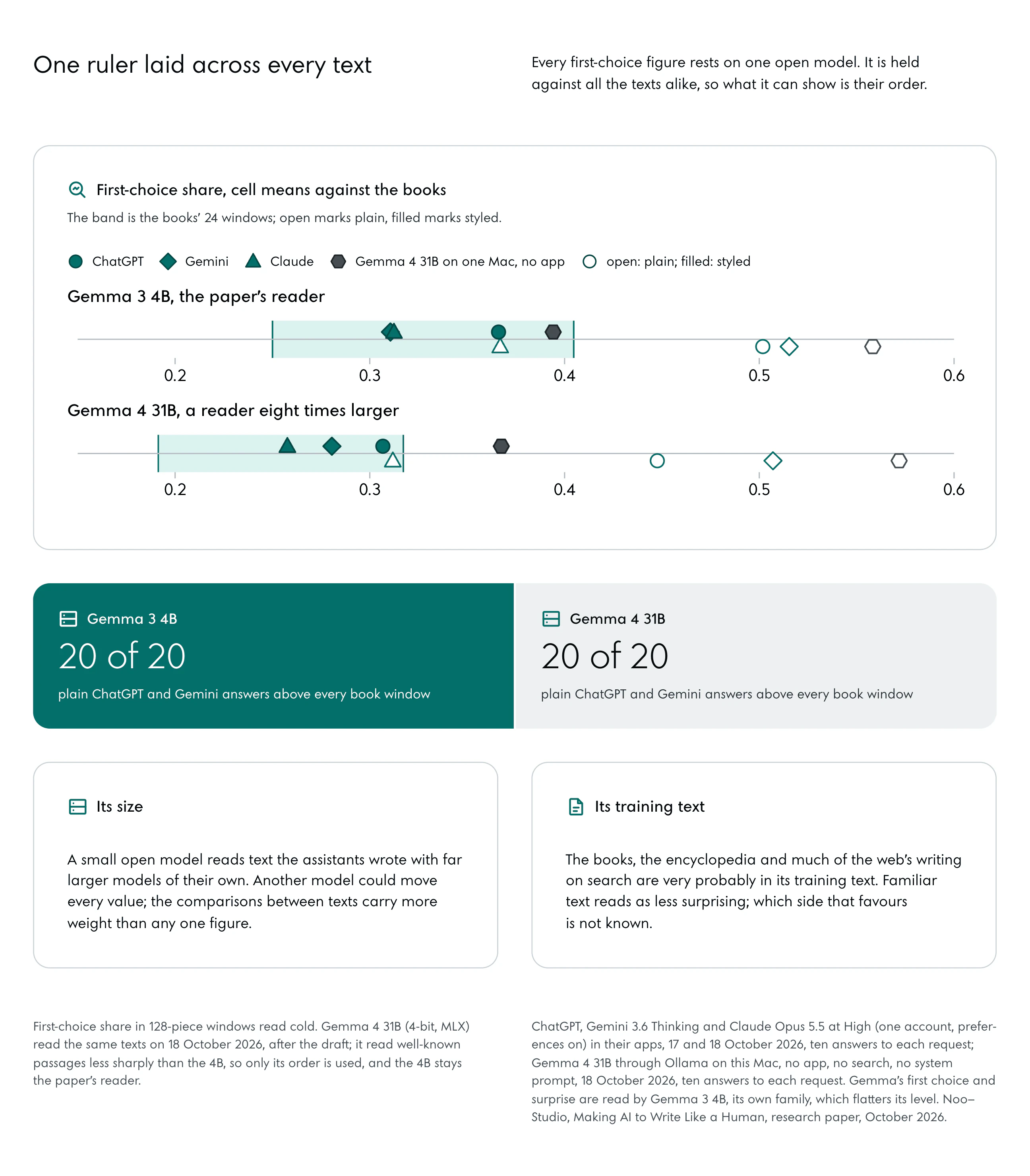
Every number in this part rests on one model. Gemma 3 4B is small and open, and it reads text that ChatGPT, Gemini and Claude wrote with far larger models of their own, and text that Gemma 4 31B, of its own family, wrote on one Mac. A larger model, or one of another family, would rank some pieces differently and could move every figure, so the figures are a ruler held against all the texts alike, and the comparisons between texts carry more weight than any single value.
Training text is the second limit. Public-domain books and the encyclopedia are very probably in Gemma’s training data, and so is a great deal of the web’s writing about search, which is the plain answers’ subject. Familiar text tends to read as less surprising.
Which side that favours here is not known, so the caveat is stated without a direction. A second open model of another family that put the plain answers inside the books on both readings would show the result to be a property of Gemma.
After the draft, Gemma 4 31B, eight times larger and of the same family, read every window again. It put the texts in nearly the same order, a rank agreement of 0.88 on first choice and 0.73 on surprise over the sixty answers and the twenty-four book windows, and it put all twenty plain ChatGPT and Gemini answers above every book window again. Its levels ran lower throughout, and on two passages every model knows by heart it read less sharply than the 4B, so only its order is used here and none of its values is cited.
A reader of another family is still waiting.
07What Six Rules Reach
Six short instructions moved every assistant, and moved it unevenly.
This part is the linguist’s: it sets every answer against book windows of its own length and against the encyclopedia, one word measure at a time, then draws the small words on one map and closes on a ledger of what each instruction bought.
Plain Vocabulary Lands Among the Books
Of the six instructions, “Prefer short plain words to long abstract ones” is the most direct. Table 10 gives the long-word share, words of three syllables or more, with each answer counted above, inside or below the books at its own length.
| Cell | Range | Above / inside / below the books |
|---|---|---|
| ChatGPT plain | 0.242 to 0.280 | 10 / 0 / 0 |
| Gemini plain | 0.182 to 0.256 | 9 / 1 / 0 |
| Claude plain | 0.098 to 0.115 | 0 / 10 / 0 |
| ChatGPT styled | 0.115 to 0.128 | 0 / 10 / 0 |
| Gemini styled | 0.069 to 0.140 | 0 / 10 / 0 |
| Claude styled | 0.049 to 0.070 | 0 / 10 / 0 |
| Gemma plain, no app | 0.110 to 0.148 | 0 / 10 / 0 |
| Gemma styled, no app | 0.028 to 0.063 | 0 / 10 / 0 |
| Books at 1,500 words | 0.020 to 0.156 | |
| Encyclopedia, 12 windows | 0.137 to 0.164 | 7 of 12 inside the books |
Plain ChatGPT and Gemini sit above the books in 19 of 20 answers; every styled answer sits inside, and plain Gemma, like plain Claude, is inside before any rule. This is measured. The rule named the feature and the feature moved.
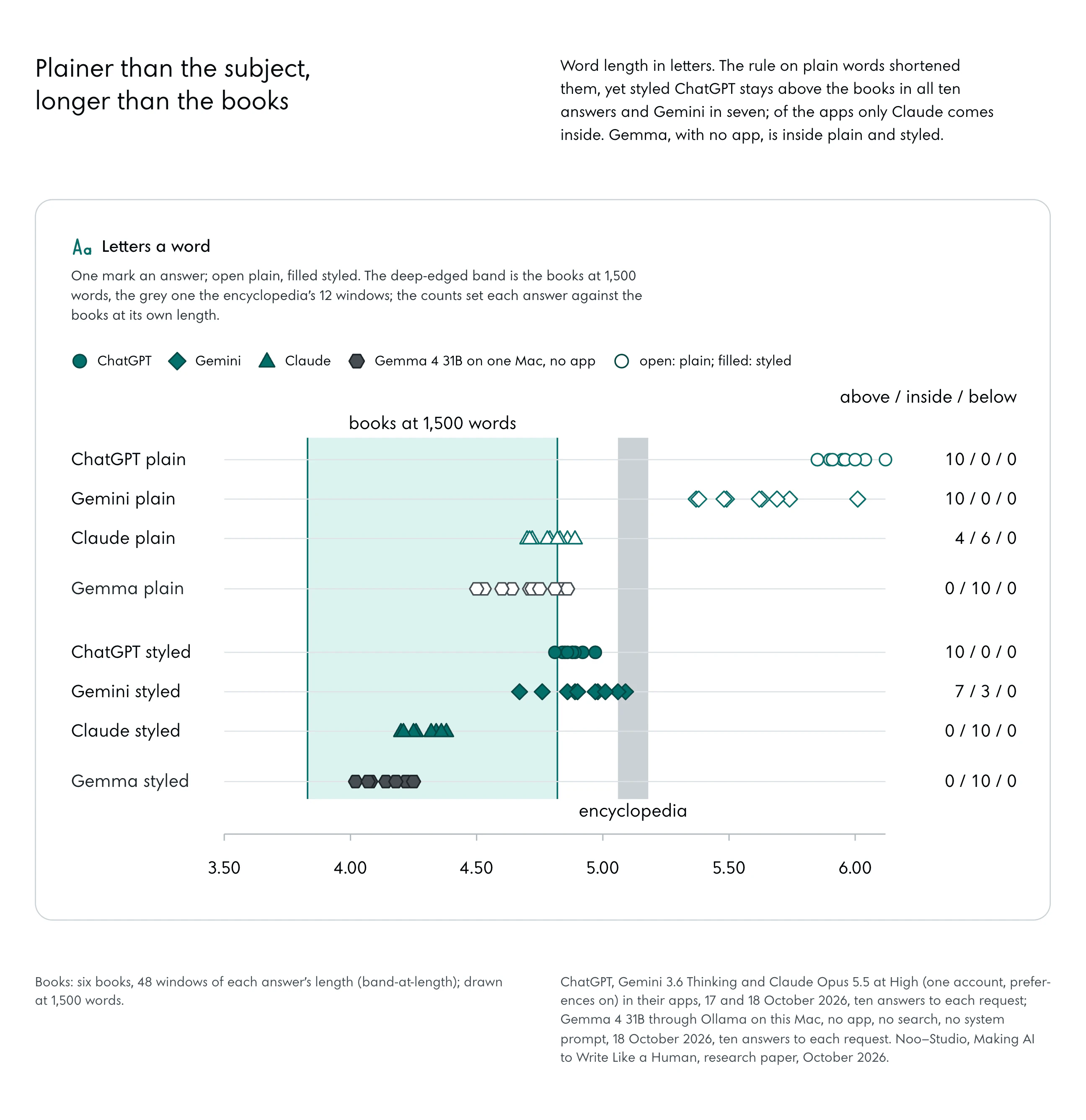
Word length in letters adds a twist. Table 11 is laid out the same way.
| Cell | Range | Above / inside / below the books |
|---|---|---|
| ChatGPT plain | 5.85 to 6.12 | 10 / 0 / 0 |
| Gemini plain | 5.37 to 6.01 | 10 / 0 / 0 |
| Claude plain | 4.70 to 4.89 | 4 / 6 / 0 |
| ChatGPT styled | 4.81 to 4.97 | 10 / 0 / 0 |
| Gemini styled | 4.67 to 5.09 | 7 / 3 / 0 |
| Claude styled | 4.20 to 4.38 | 0 / 10 / 0 |
| Gemma plain, no app | 4.50 to 4.86 | 0 / 10 / 0 |
| Gemma styled, no app | 4.02 to 4.25 | 0 / 10 / 0 |
| Books at 1,500 words | 3.83 to 4.82 | |
| Encyclopedia, 12 windows | 5.06 to 5.18 | 0 of 12 inside the books |
People writing about search use longer words than people writing books, 5.06 to 5.18 letters against at most 4.82. The apps’ styled answers come out plainer than that same-topic reference, 28 of 30 under its shortest window, and two of the three still sit above general prose, ChatGPT in 10 of 10 and Gemini in 7 of 10. Gemma’s answers sit inside the books at both requests, the styled ones at 4.02 to 4.25 letters.
On word length the rule overshoots one human reference and falls short of the other.
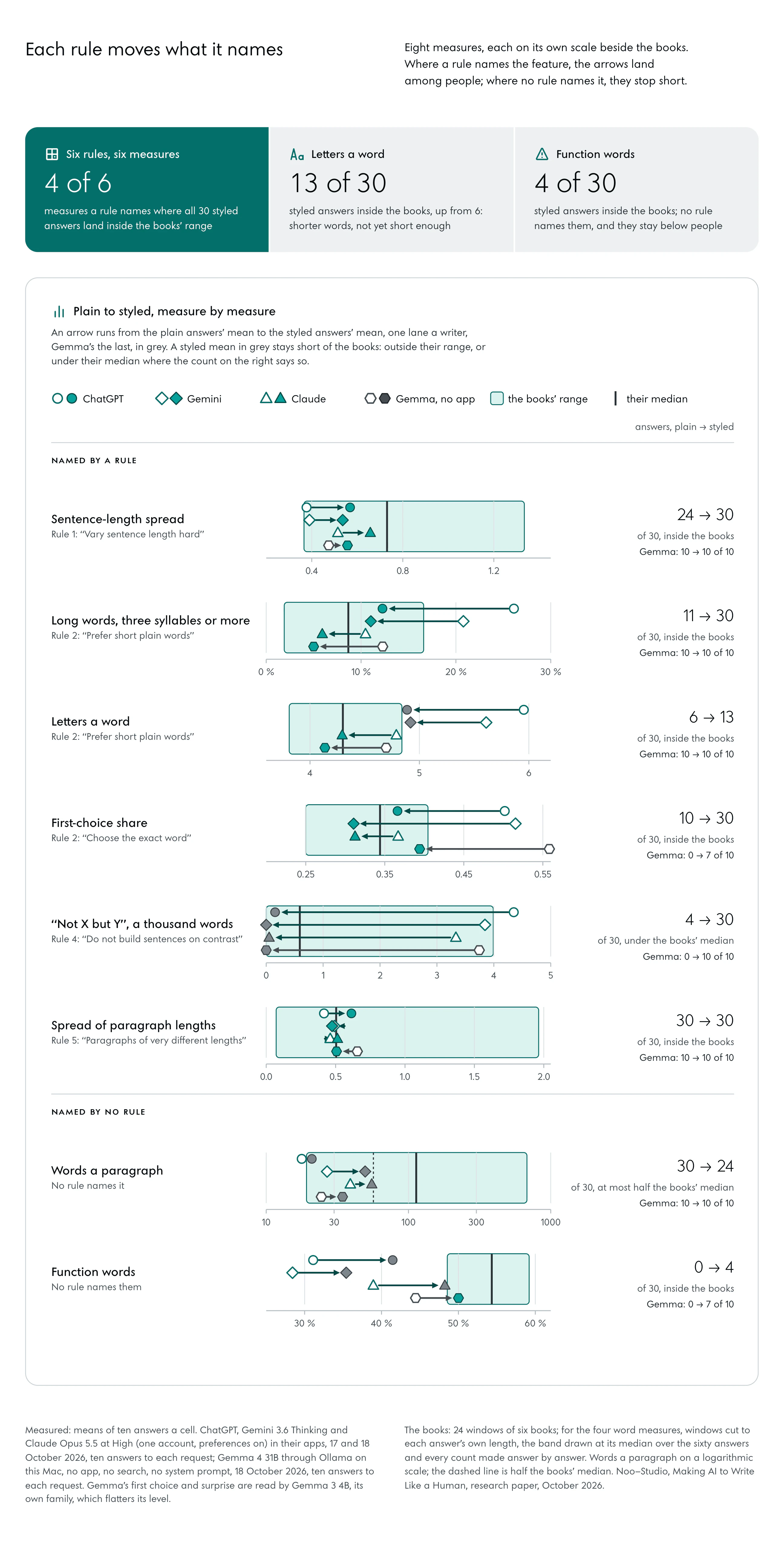
The numbers
| Measure | Rule | Books (range; median) | ChatGPT plain → styled | Gemini plain → styled | Claude plain → styled | Gemma plain → styled | Plain → styled count, apps | Gemma, of 10 |
|---|---|---|---|---|---|---|---|---|
| Sentence-length spread | Rule 1: “Vary sentence length hard” | 0.37 to 1.33; 0.73 | 0.38 → 0.57 | 0.39 → 0.54 | 0.51 → 0.66 | 0.47 → 0.56 | 24 → 30 of 30, inside the books | 10 → 10 of 10 |
| Long words, three syllables or more | Rule 2: “Prefer short plain words” | 2 % to 17 %; 9 % | 26 % → 12 % | 21 % → 11 % | 10 % → 6 % | 12 % → 5 % | 11 → 30 of 30, inside the books | 10 → 10 of 10 |
| Letters a word | Rule 2: “Prefer short plain words” | 3.81 to 4.84; 4.30 | 5.95 → 4.89 | 5.61 → 4.92 | 4.79 → 4.29 | 4.70 → 4.14 | 6 → 13 of 30, inside the books | 10 → 10 of 10 |
| First-choice share | Rule 2: “Choose the exact word” | 0.25 to 0.40; 0.34 | 0.50 → 0.37 | 0.52 → 0.31 | 0.37 → 0.31 | 0.56 → 0.39 | 10 → 30 of 30, inside the books | 0 → 7 of 10 |
| “Not X but Y”, a thousand words | Rule 4: “Do not build sentences on contrast” | 0.00 to 3.99; 0.59 | 4.35 → 0.15 | 3.85 → 0.00 | 3.33 → 0.05 | 3.74 → 0.00 | 4 → 30 of 30, under the books’ median | 0 → 10 of 10 |
| Spread of paragraph lengths | Rule 5: “Paragraphs of very different lengths” | 0.07 to 1.96; 0.50 | 0.42 → 0.61 | 0.49 → 0.47 | 0.46 → 0.51 | 0.66 → 0.51 | 30 → 30 of 30, inside the books | 10 → 10 of 10 |
| Words a paragraph | No rule names it | 19.20 to 680.00; 113.30 | 17.76 → 20.92 | 26.81 → 49.61 | 39.02 → 55.19 | 24.41 → 34.41 | 30 → 24 of 30, at most half the books’ median | 10 → 10 of 10 |
| Function words | No rule names them | 49 % to 59 %; 54 % | 31 % → 41 % | 28 % → 35 % | 39 % → 48 % | 44 % → 50 % | 0 → 4 of 30, inside the books | 0 → 7 of 10 |
The numbers
| Cell | Range | Above / inside / below the books |
|---|---|---|
| ChatGPT plain | 5.85 to 6.12 | 10 / 0 / 0 |
| Gemini plain | 5.37 to 6.01 | 10 / 0 / 0 |
| Claude plain | 4.70 to 4.89 | 4 / 6 / 0 |
| Gemma plain | 4.50 to 4.86 | 0 / 10 / 0 |
| ChatGPT styled | 4.81 to 4.97 | 10 / 0 / 0 |
| Gemini styled | 4.67 to 5.09 | 7 / 3 / 0 |
| Claude styled | 4.20 to 4.38 | 0 / 10 / 0 |
| Gemma styled | 4.02 to 4.25 | 0 / 10 / 0 |
| Books at 1,500 words | 3.83 to 4.82 | |
| Encyclopedia, 12 windows | 5.06 to 5.18 | 0 of 12 inside the books |
Rhythm Moves With One Rule
“Vary sentence length hard” is the first rule, and the spread of sentence lengths answers it fully. Table 12 gives the coefficient of variation of sentence lengths.
| Cell | Range | Above / inside / below the books |
|---|---|---|
| ChatGPT plain | 0.34 to 0.43 | 0 / 5 / 5 |
| Gemini plain | 0.28 to 0.49 | 0 / 9 / 1 |
| Claude plain | 0.40 to 0.61 | 0 / 10 / 0 |
| ChatGPT styled | 0.51 to 0.60 | 0 / 10 / 0 |
| Gemini styled | 0.48 to 0.58 | 0 / 10 / 0 |
| Claude styled | 0.58 to 0.75 | 0 / 10 / 0 |
| Gemma plain, no app | 0.39 to 0.53 | 0 / 10 / 0 |
| Gemma styled, no app | 0.42 to 0.78 | 0 / 10 / 0 |
| Books at 1,500 words | 0.39 to 1.33 | |
| Encyclopedia, 12 windows | 0.37 to 0.45 | 8 of 12 inside the books |
Every styled answer sits inside the books. Plain ChatGPT, the most even writer of the four, sits below them in half its answers, and the encyclopedia lies at the books’ lower edge: people writing reference prose on a technical subject vary their sentences less than people writing books.
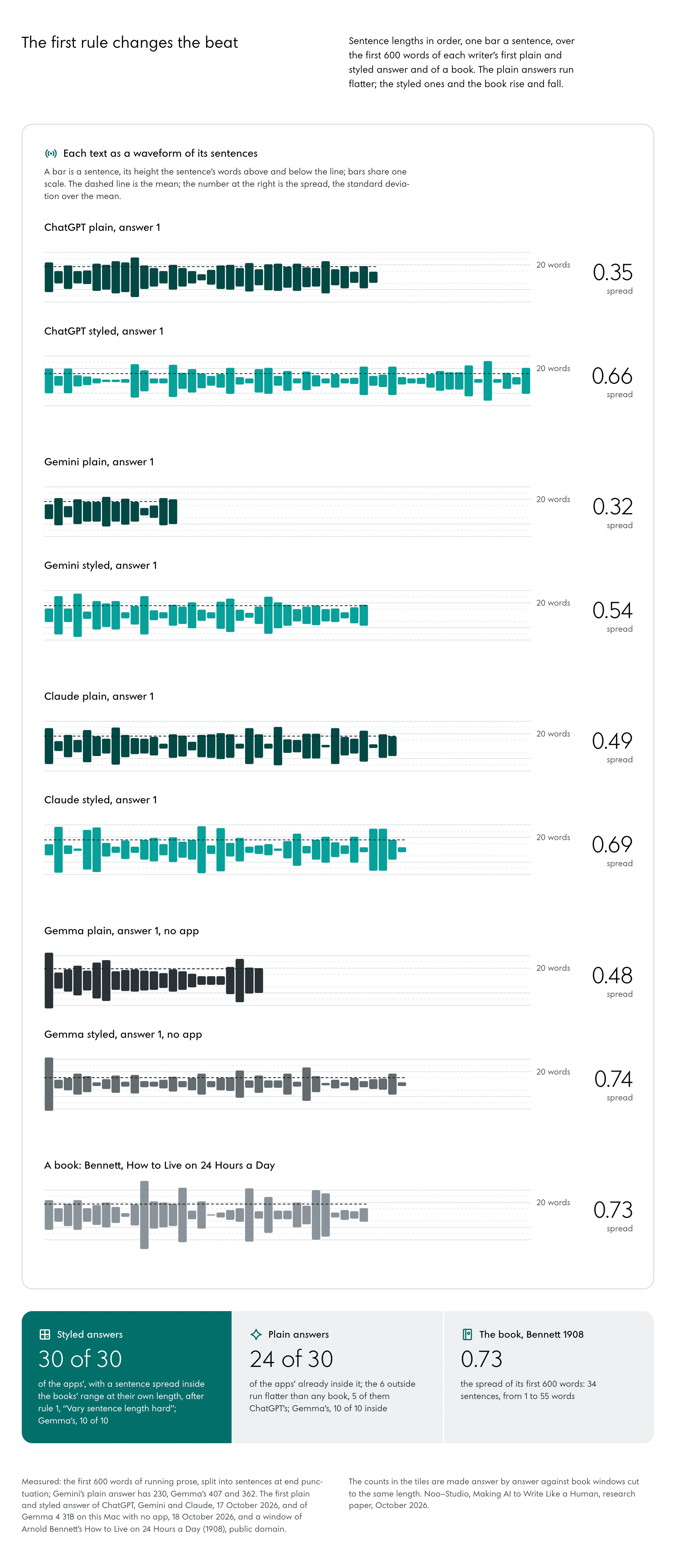
The numbers
| Text | Sentences | Mean words | Spread (cv) |
|---|---|---|---|
| ChatGPT plain, answer 1 | 35 | 17.1 | 0.35 |
| ChatGPT styled, answer 1 | 51 | 11.8 | 0.66 |
| Gemini plain, answer 1 | 14 | 16.4 | 0.32 |
| Gemini styled, answer 1 | 34 | 15.6 | 0.54 |
| Claude plain, answer 1 | 37 | 16.2 | 0.49 |
| Claude styled, answer 1 | 38 | 15.8 | 0.69 |
| Gemma plain, answer 1, no app | 23 | 18.9 | 0.48 |
| Gemma styled, answer 1, no app | 38 | 10.5 | 0.74 |
| A book: Bennett, How to Live on 24 Hours a Day | 34 | 17.6 | 0.73 |
Drawn as bars in reading order, a plain answer’s sentences rise and fall within a narrow band, a styled answer’s jump from a few words to a long run and back, and a book holds a length for a while before it breaks. Spread captures the first two differences. The order of lengths, how long people hold a rhythm before changing it, is something the spread does not read, and this run did not count it.
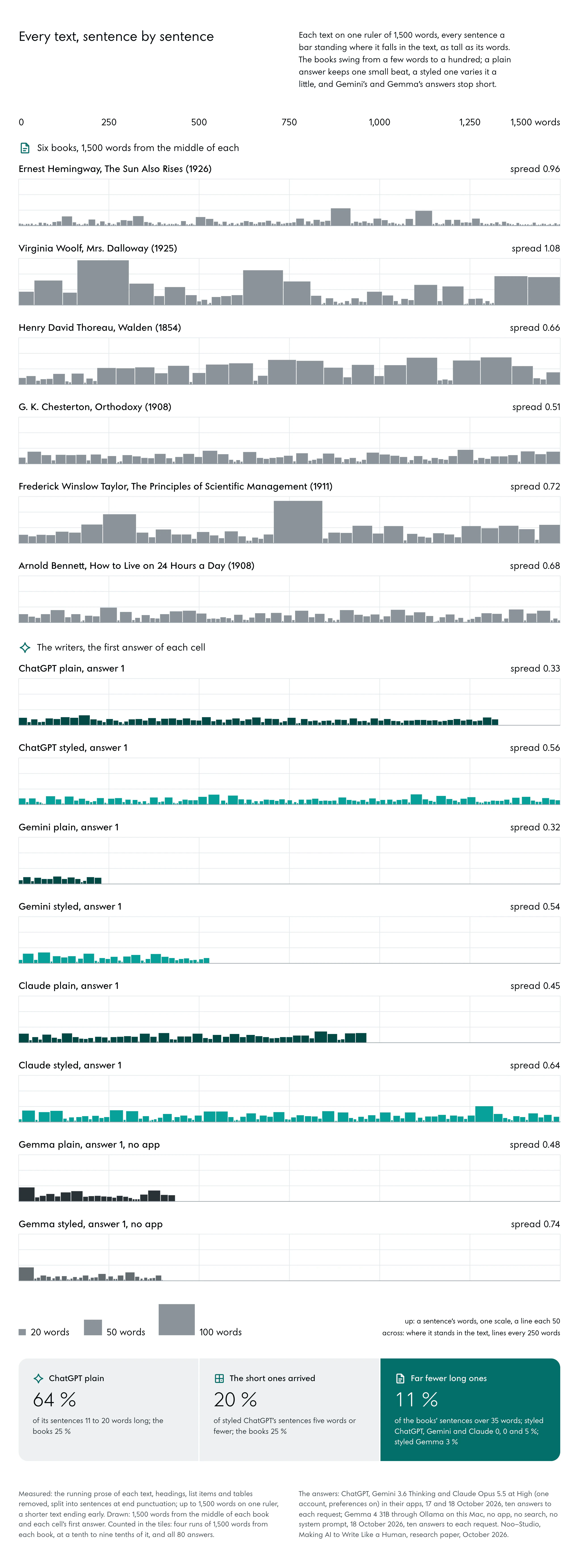
Laid out whole on runs of 1,500 words, the difference is visible at a glance. The books swing from a few words to a hundred, and 11 % of their sentences run past 35 words. Plain ChatGPT keeps 64 % of its sentences between 11 and 20 words, one small beat.
The styled answers took up the short sentences, 20 % of styled ChatGPT’s against the books’ 25 %, and far fewer of the long ones: none for ChatGPT and Gemini, 5 % for Claude, against the books’ 11 %. This is measured and exploratory: the length bands and the 1,500-word book runs were chosen after the run, and on runs longer than the paper’s windows the shares differ slightly from the tables’.
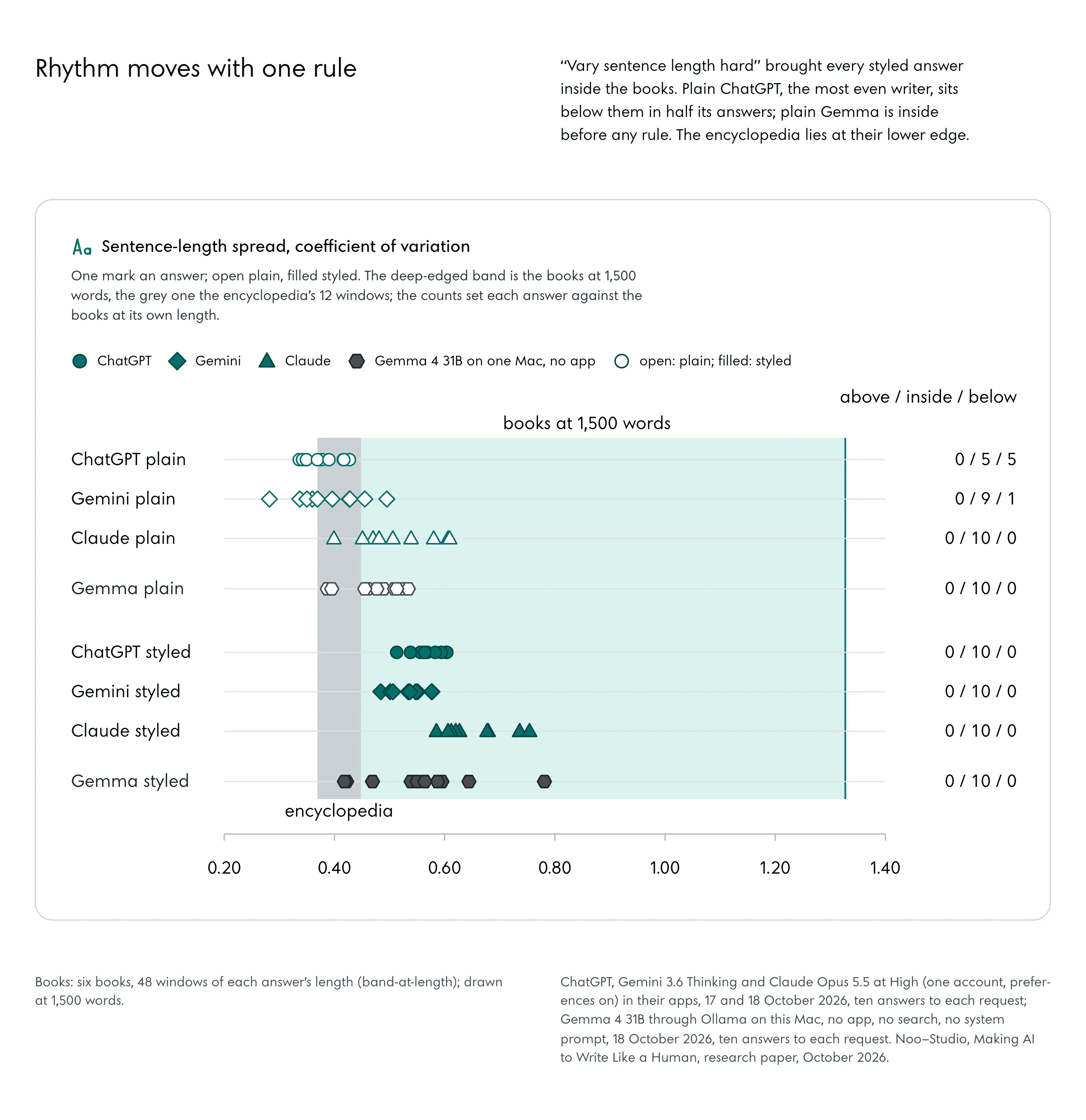
The numbers
| Cell | Range | Above / inside / below the books |
|---|---|---|
| ChatGPT plain | 0.34 to 0.43 | 0 / 5 / 5 |
| Gemini plain | 0.28 to 0.49 | 0 / 9 / 1 |
| Claude plain | 0.40 to 0.61 | 0 / 10 / 0 |
| Gemma plain | 0.39 to 0.53 | 0 / 10 / 0 |
| ChatGPT styled | 0.51 to 0.60 | 0 / 10 / 0 |
| Gemini styled | 0.48 to 0.58 | 0 / 10 / 0 |
| Claude styled | 0.58 to 0.75 | 0 / 10 / 0 |
| Gemma styled | 0.42 to 0.78 | 0 / 10 / 0 |
| Books at 1,500 words | 0.39 to 1.33 | |
| Encyclopedia, 12 windows | 0.37 to 0.45 | 8 of 12 inside the books |
Small Words Stay Below
No instruction mentions function words, and they barely move. Table 13 gives the function-word share against the books at each answer’s length.
| Cell | Range | Above / inside / below the books |
|---|---|---|
| ChatGPT plain | 0.288 to 0.324 | 0 / 0 / 10 |
| Gemini plain | 0.263 to 0.314 | 0 / 0 / 10 |
| Claude plain | 0.363 to 0.404 | 0 / 0 / 10 |
| ChatGPT styled | 0.399 to 0.428 | 0 / 0 / 10 |
| Gemini styled | 0.325 to 0.398 | 0 / 0 / 10 |
| Claude styled | 0.465 to 0.505 | 0 / 4 / 6 |
| Gemma plain, no app | 0.428 to 0.464 | 0 / 0 / 10 |
| Gemma styled, no app | 0.451 to 0.526 | 0 / 7 / 3 |
| Books at 1,500 words | 0.482 to 0.580 | |
| Encyclopedia, 12 windows | 0.382 to 0.401 | 0 of 12 inside the books |
Fifty-six of the apps’ sixty answers sit below the books, all thirty plain ones and 26 of 30 styled. Claude’s styled answers are the only app answers to reach the books, 4 of 10; Gemma’s styled answers, with no app, reach them in 7 of 10, and its plain answers sit below in all ten. This is measured, and it is the layer Mosteller and Wallace chose in 1963 precisely because writers do not steer it.
Part of the gap belongs to the subject. The encyclopedia, people writing about search, sits below the books in all twelve windows, at 0.382 to 0.401; a technical exposition names many things and spends fewer words on grammar, whoever writes it. So the distance from a styled answer to the books mixes two causes, and the encyclopedia shows how much of it the topic alone produces.
A styled ChatGPT answer at the encyclopedia’s level spends as little on grammar as people on the same subject, and less than people writing books.
Why would the small words move at all, with no rule about them? Shorter words and plainer phrasing need more grammatical joints between them; a writer who swaps “optimization of visibility” for “help people find you” adds function words unasked. Theory: the partial rise is dragged along by the rule on plain words.
No measurement here separates the dragged share from anything else the rules did.
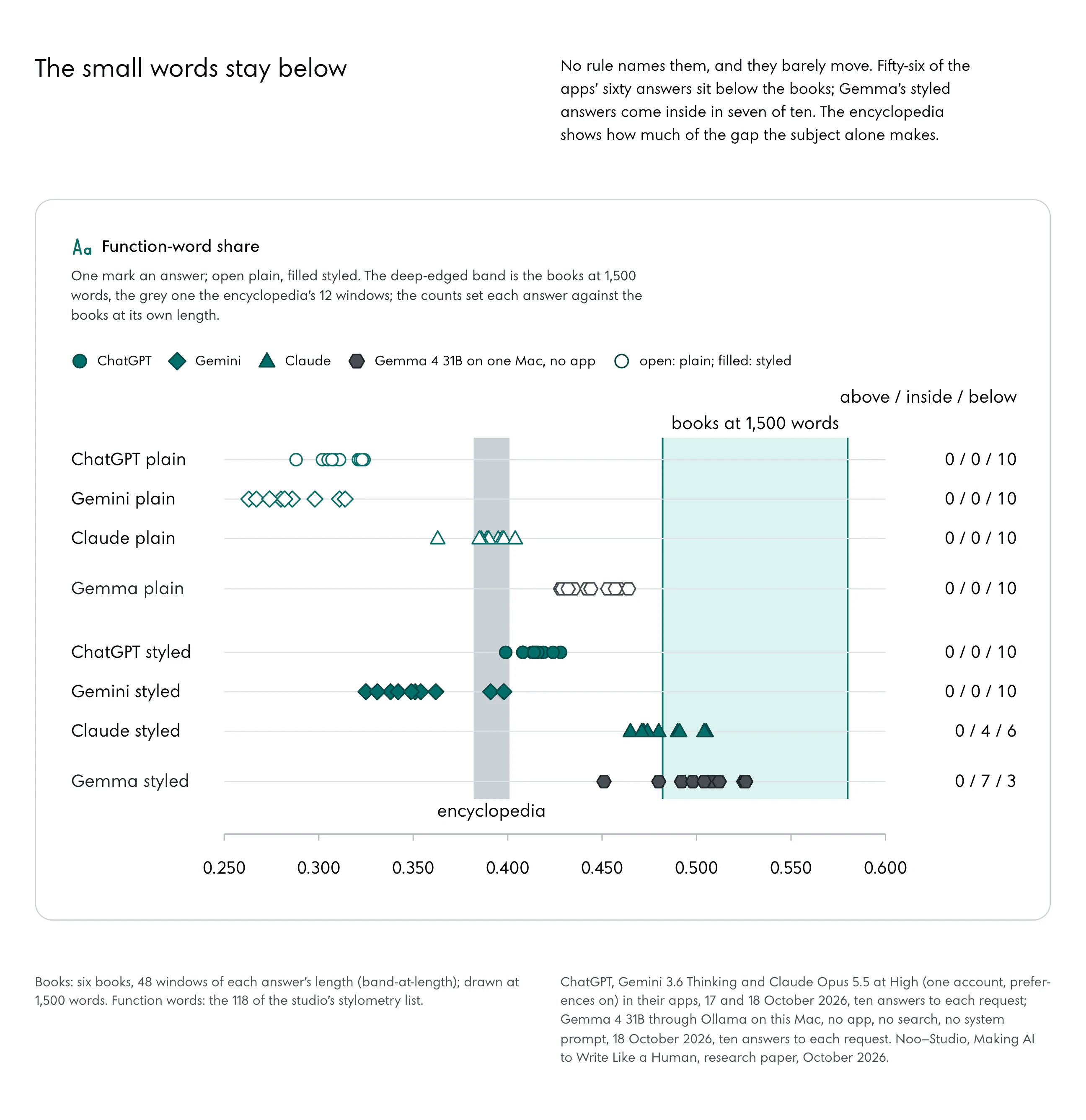
The numbers
| Cell | Range | Above / inside / below the books |
|---|---|---|
| ChatGPT plain | 0.288 to 0.324 | 0 / 0 / 10 |
| Gemini plain | 0.263 to 0.314 | 0 / 0 / 10 |
| Claude plain | 0.363 to 0.404 | 0 / 0 / 10 |
| Gemma plain | 0.428 to 0.464 | 0 / 0 / 10 |
| ChatGPT styled | 0.399 to 0.428 | 0 / 0 / 10 |
| Gemini styled | 0.325 to 0.398 | 0 / 0 / 10 |
| Claude styled | 0.465 to 0.505 | 0 / 4 / 6 |
| Gemma styled | 0.451 to 0.526 | 0 / 7 / 3 |
| Books at 1,500 words | 0.482 to 0.580 | |
| Encyclopedia, 12 windows | 0.382 to 0.401 | 0 of 12 inside the books |
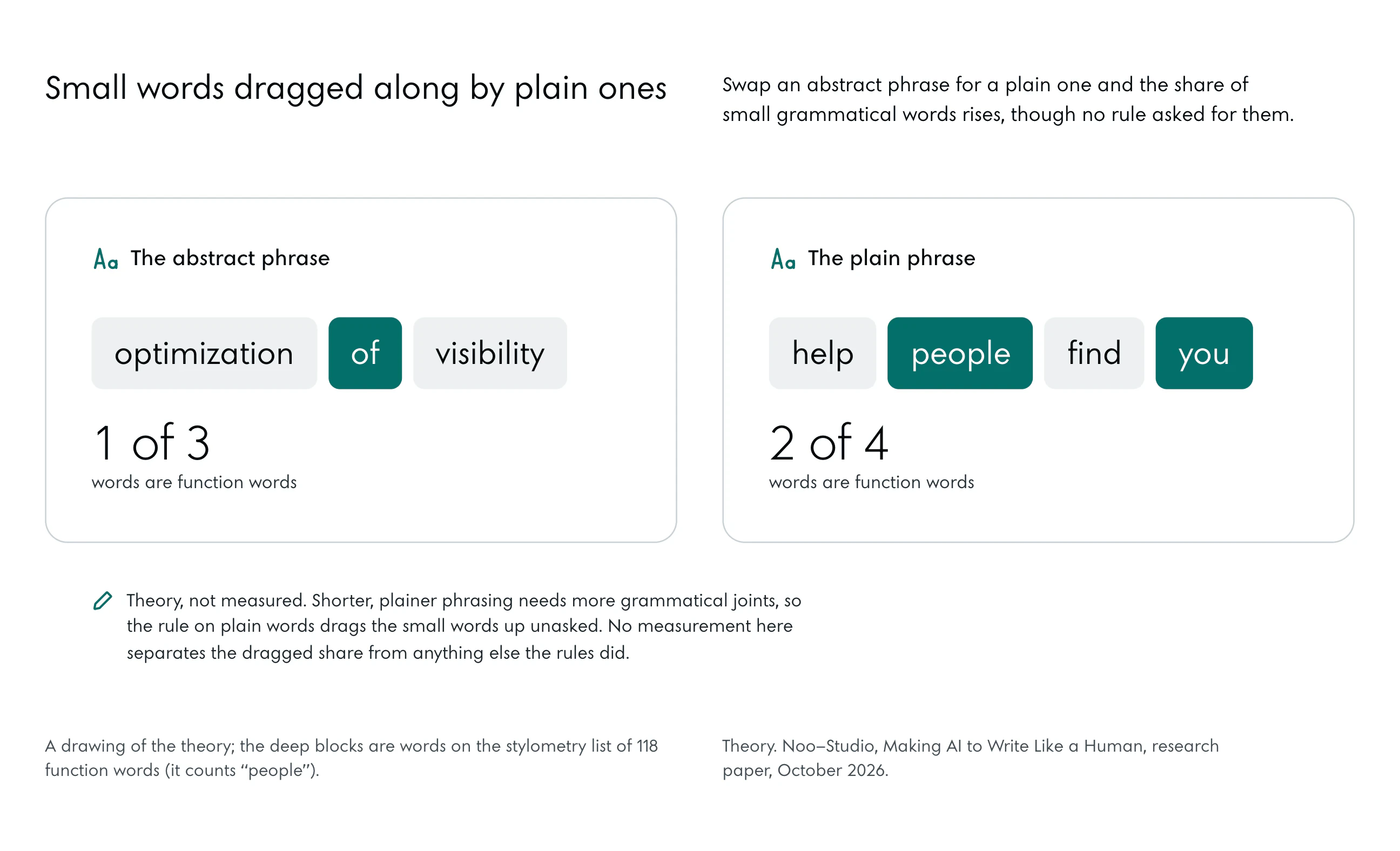
An instruction moves the feature it names, and the features beside it move only as far as they are dragged.
A Map Drawn From Grammar
Zaitsu and colleagues drew their Japanese comments on a map built from function words, and the studio redrew that measure in English. Each text becomes a profile, the relative frequency of each function word in it; the distance between two profiles is the square root of their Jensen-Shannon divergence, a symmetric measure of how different two frequency distributions are; and classical multidimensional scaling lays all the distances out on a plane. The map is fitted on the sixty answers, the book windows and the encyclopedia windows, and Gemma’s twenty answers are placed on it afterwards, without refitting.
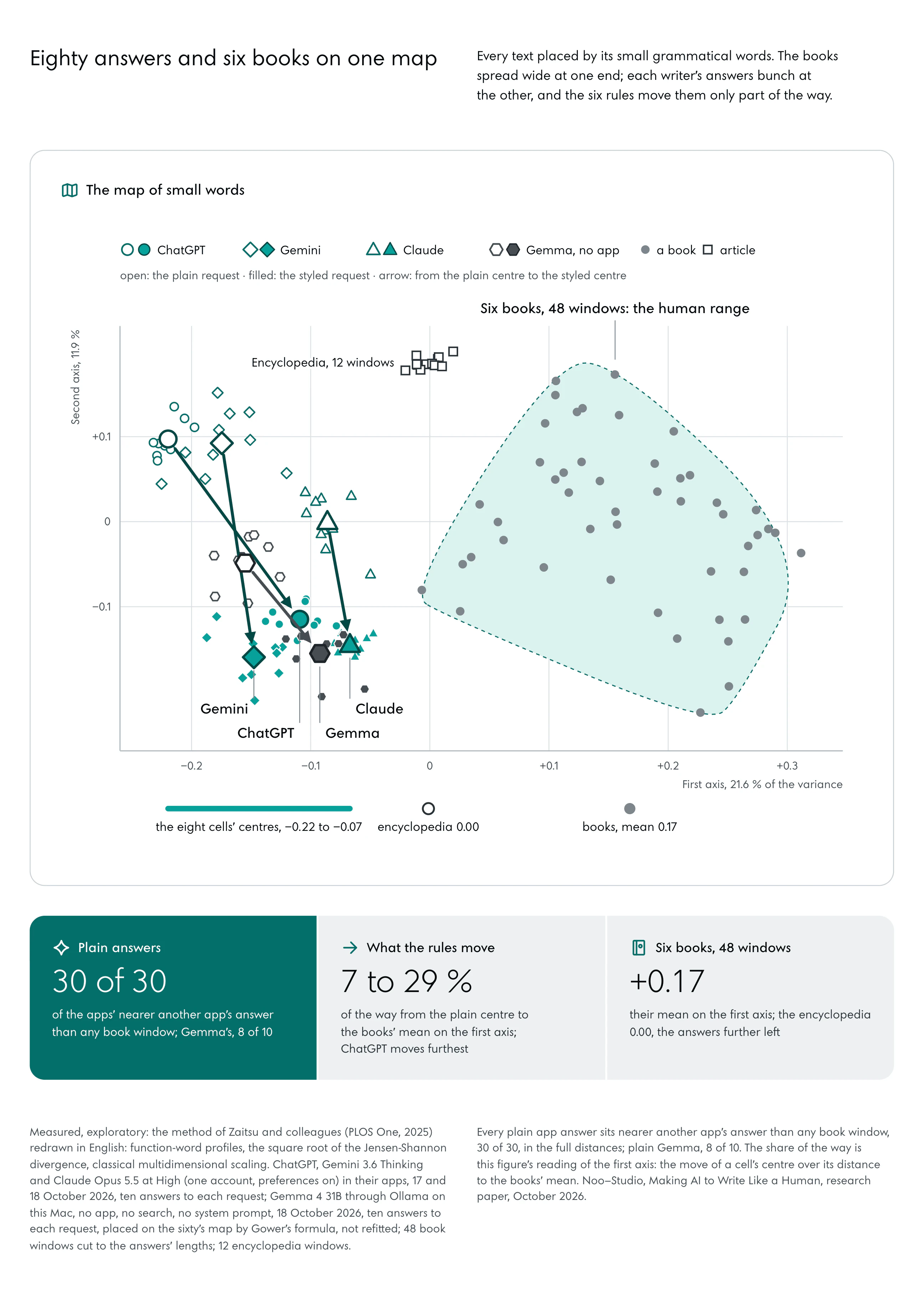
Every plain app answer sits nearer another assistant’s answer than to any book window of matching length, 30 of 30, and plain Gemma’s sit nearer an app’s answer in 8 of 10. On the plane’s first axis the books sit at one end, with a mean of 0.17, the cells’ centres at the other, from −0.07 to −0.22, Gemma’s among them at −0.16 plain and −0.09 styled, and the encyclopedia between them, at 0.00. That axis carries 21.6 % of the variance in the distances among the sixty answers and the windows, so most of what separates the texts lies off it.
The order along the axis, books, encyclopedia, answers, is the finding; the exact positions are a sketch of a space with many more directions.
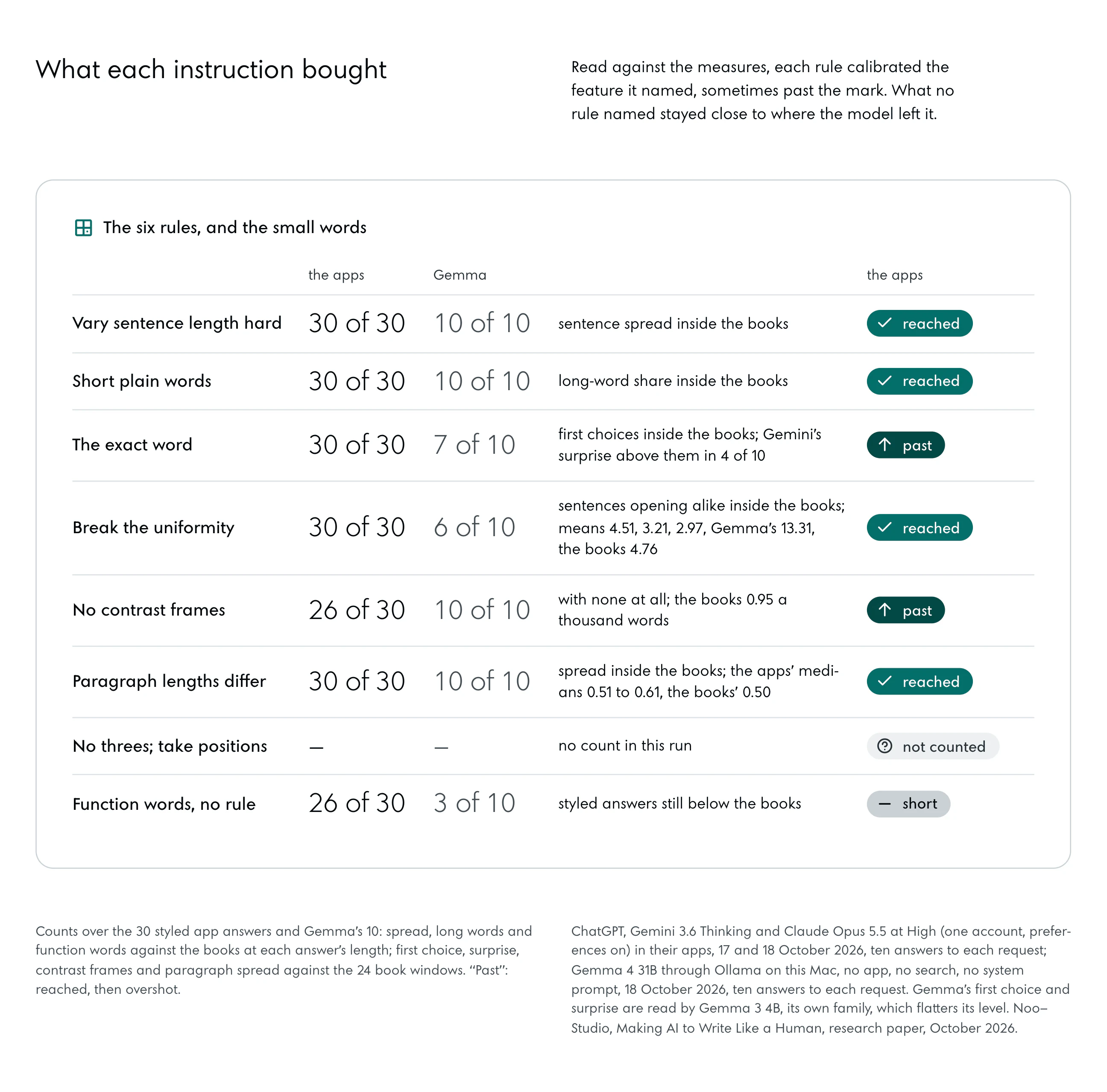
What Each Instruction Bought
Read against the measures, the six rules divide into those that reached their target, those that went past it, and those this run did not count.
- “Vary sentence length hard” brought sentence-length spread inside the books in 30 of 30 styled app answers, and in 10 of Gemma’s 10.
- “Prefer short plain words” put the long-word share inside the books in 30 of 30 and in Gemma’s 10 of 10, took 28 of 30 answers under the encyclopedia on word length, and left ChatGPT above the books on word length in 10 of 10.
- “Choose the exact word, even when it is not the most expected one”, with the rules around it, took first-choice share inside the books in every styled app answer and in 7 of Gemma’s 10, and Gemini’s surprise past them in 4 of 10.
- “Break the uniformity” gave back a human habit the plain answers lack, sentences opening alike, as the next part shows, and in Gemma’s answers overshot it to nearly three times the books’ rate.
- The rule against contrast pushed the contrast frame below people in every styled answer.
- “Paragraphs of very different lengths” brought the apps’ spread of paragraph lengths to the books’ median, brought Gemma’s, already above it when asked plainly, a little down, and left paragraphs at half a book’s length or less.
- Groups of three and taking positions have no count in this run, and neither is reported as moved or unmoved.
- Function words had no rule, and 26 of the apps’ 30 styled answers stayed below the books, and 3 of Gemma’s 10.
A machinist’s gauge block is true to one length and says nothing about any other. Each rule calibrated the feature it named, sometimes past the mark, and the features no rule named stayed close to where the model left them.
08Habits and Paragraph Blocks
Two kinds of shape remain, and both belong to the linguist and to the reader’s eye: how a text is divided into paragraphs, and the small sentence patterns that readers and detectors have learned to notice.
On both, the rules remove a machine habit and give back a human one, and on paragraph length they stop exactly where their wording stops.
Two Habits Run Opposite Ways
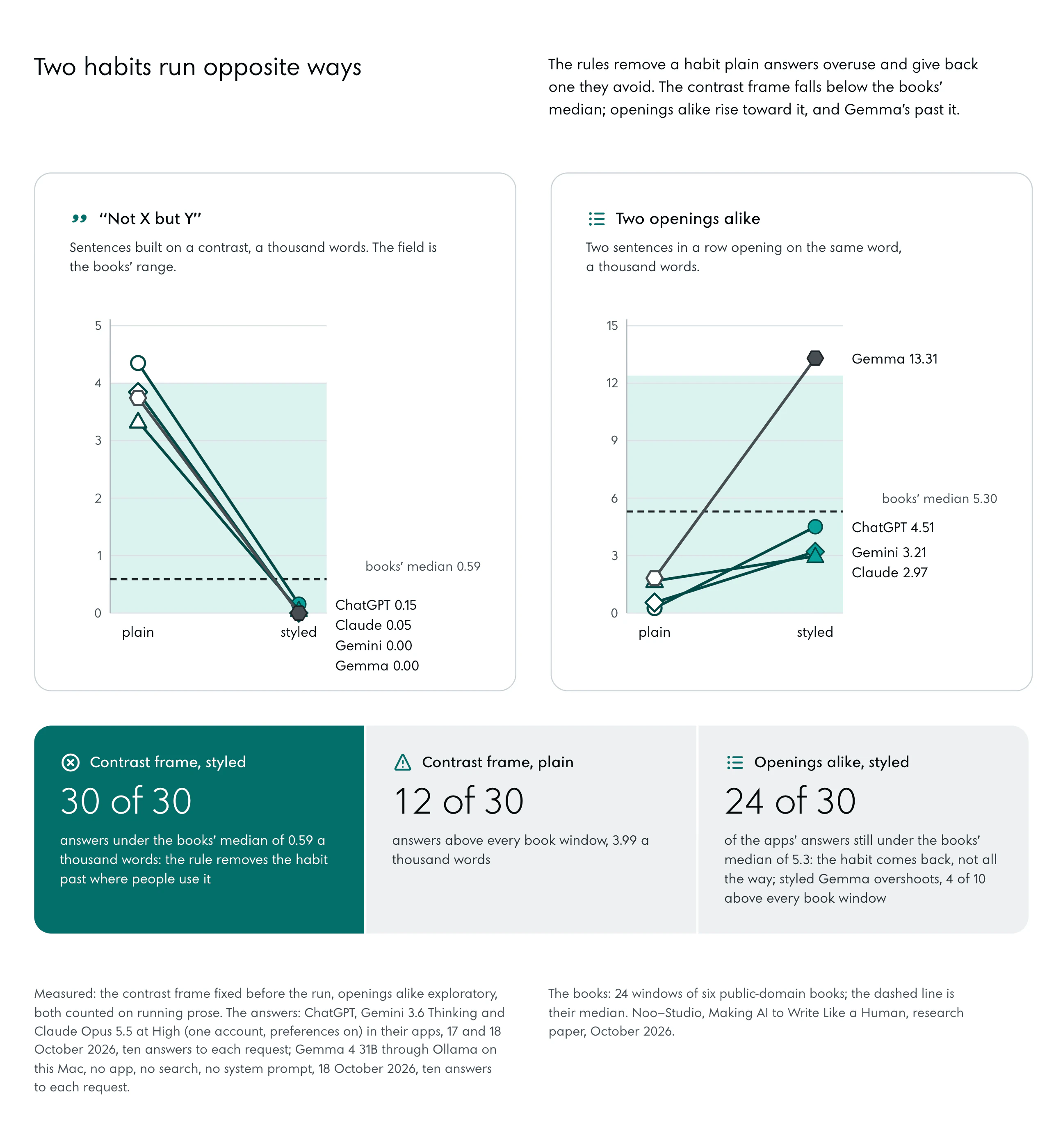
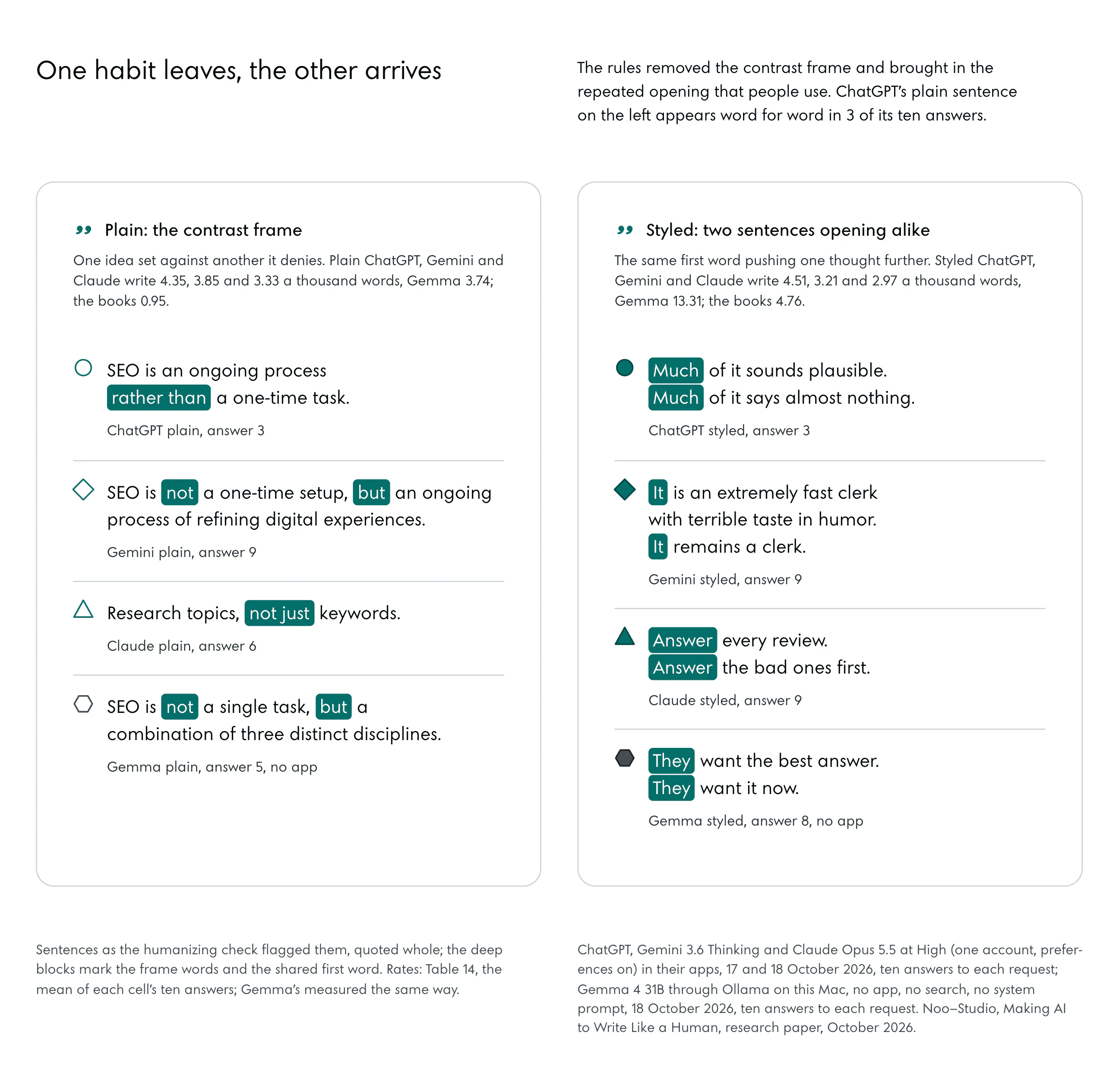
Table 14 counts both habits a thousand words, as the mean of each cell’s ten answers.
| Cell | Contrast frame (mean, range) | Two sentences opening alike | Texts with any opening repeat |
|---|---|---|---|
| ChatGPT plain | 4.35 (2.91 to 7.72) | 0.26 | 3 of 10 |
| Gemini plain | 3.85 (0.00 to 14.22) | 0.55 | 2 of 10 |
| Claude plain | 3.33 (1.76 to 5.01) | 1.67 | 8 of 10 |
| ChatGPT styled | 0.15 (0.00 to 0.53) | 4.51 | 10 of 10 |
| Gemini styled | 0.00 (0.00 to 0.00) | 3.21 | 6 of 10 |
| Claude styled | 0.05 (0.00 to 0.51) | 2.97 | 10 of 10 |
| Gemma plain, no app | 3.74 (1.66 to 7.44) | 1.82 | 5 of 10 |
| Gemma styled, no app | 0.00 (0.00 to 0.00) | 13.31 | 10 of 10 |
| Books, 24 windows | 0.95 | 4.76 | 21 of 24 |
| Encyclopedia, 12 windows | 1.09 | 1.98 | 11 of 12 |
Every plain cell writes the contrast frame at three to four times the books’ rate. Gemini’s range runs from nothing to 14.22 because its plain answers are short, 211 to 483 prose words, and one sentence moves the rate a long way. Under the rule against contrast the styled means fall to 0.15, 0.00 and 0.05, and Gemma’s to 0.00, below both human references; people use the frame now and then as a working construction, and the rule removes it more thoroughly than people ever do.
This is measured, and fixed before the run.
The second habit runs the other way. Two sentences in a row opening on the same word is a mark that style advice tells writers to remove, and plain assistants already avoid it: plain ChatGPT writes 0.26 such pairs a thousand words, against 4.76 in the books. Under “Break the uniformity” the rate rises in every cell, styled ChatGPT to 4.51 with repeats in all ten answers, and styled Gemma, with no app, past the books to 13.31, a case the part on the fourth writer takes up.
A model told to stop writing evenly starts doing what people do, picking up the same word to push one thought further. The count is exploratory, and it carries a warning for anyone using a detection list: on these counts, a text full of repeated openings is unlike a plain assistant’s text.
The numbers
| Measure | ChatGPT plain → styled | Gemini plain → styled | Claude plain → styled | Gemma plain → styled | Books (range; median) |
|---|---|---|---|---|---|
| Contrast frame, a thousand words | 4.35 → 0.15 | 3.85 → 0.00 | 3.33 → 0.05 | 3.74 → 0.00 | 0.00 to 3.99; 0.59 |
| Openings alike, a thousand words | 0.26 → 4.51 | 0.55 → 3.21 | 1.67 → 2.97 | 1.82 → 13.31 | 0.00 to 12.40; 5.30 |
Paragraphs Stay Half a Book Long
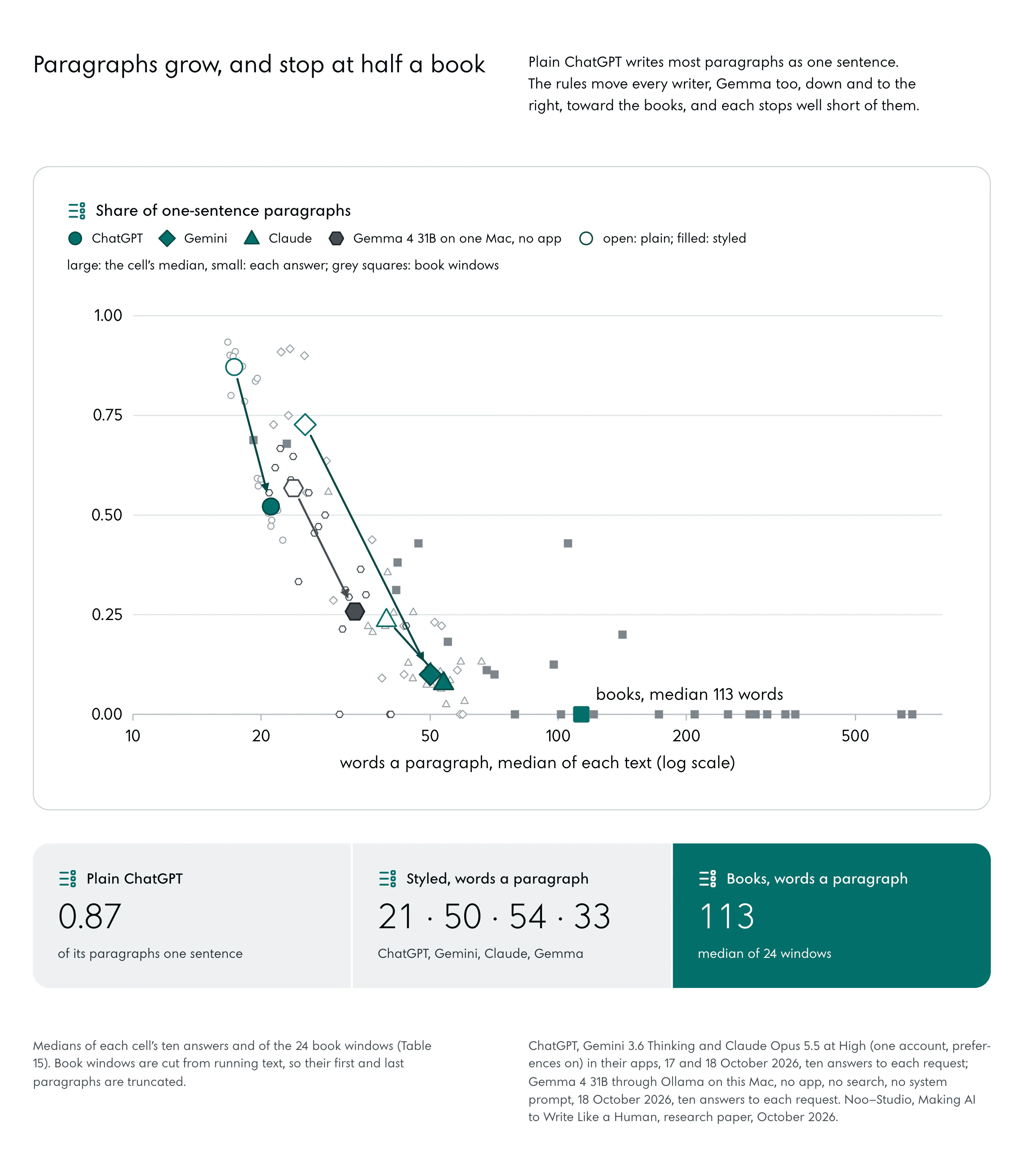
Table 15 gives the shape of each text’s units on the page as medians, of each cell’s ten answers and of the 24 windows. Book windows are cut from running text, so their first and last paragraphs are truncated, which shortens their paragraphs a little and raises their share of fragments.
| Cell | One-sentence paragraphs | Words a paragraph | Spread of lengths |
|---|---|---|---|
| ChatGPT plain | 0.87 | 17 | 0.41 |
| Gemini plain | 0.73 | 25 | 0.48 |
| Claude plain | 0.24 | 39 | 0.45 |
| ChatGPT styled | 0.52 | 21 | 0.61 |
| Gemini styled | 0.10 | 50 | 0.52 |
| Claude styled | 0.08 | 54 | 0.51 |
| Gemma plain, no app | 0.57 | 24 | 0.66 |
| Gemma styled, no app | 0.26 | 33 | 0.59 |
| Books, 24 windows | 0.00 | 113 | 0.50 |
Plain ChatGPT writes 0.87 of its paragraphs as one sentence, at 17 words a paragraph; the median book window has no one-sentence paragraph and runs to 113 words. The founder’s remark, “the paragraph length and the shape of each for some reason I always can tell”, matches what the counts show for plain answers, though this run tested no one’s judgement. A reader scanning a page sees paragraph shape before a word, which may be why the impression comes so fast.
The numbers
| Cell | One-sentence paragraphs | Words a paragraph |
|---|---|---|
| ChatGPT plain | 0.87 | 17 |
| ChatGPT styled | 0.52 | 21 |
| Gemini plain | 0.73 | 25 |
| Gemini styled | 0.10 | 50 |
| Claude plain | 0.24 | 39 |
| Claude styled | 0.08 | 54 |
| Gemma plain | 0.57 | 24 |
| Gemma styled | 0.26 | 33 |
| Books, 24 windows | 0.00 | 113 |
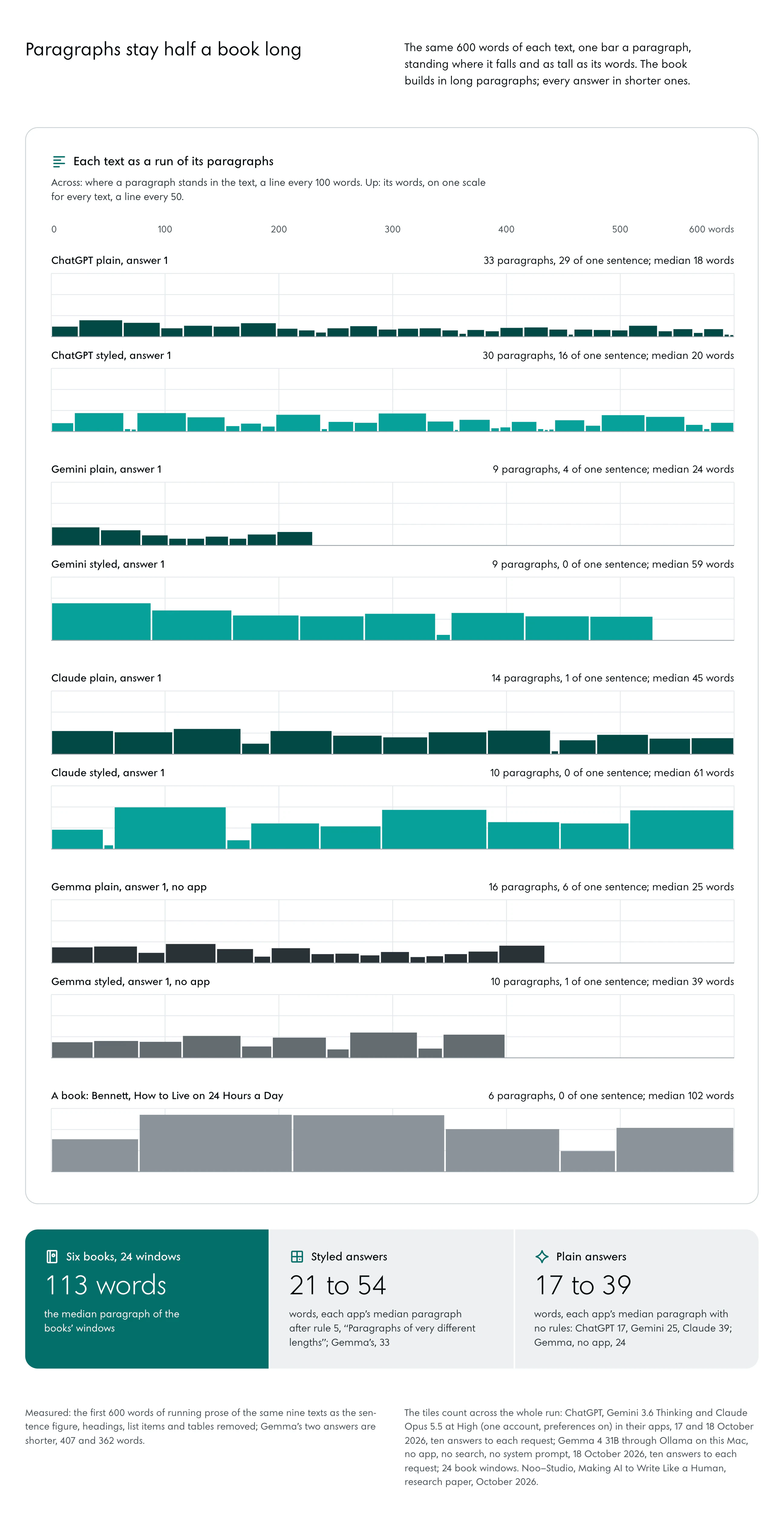
The numbers
| Text | Paragraphs | Words a paragraph, median | One-sentence paragraphs |
|---|---|---|---|
| ChatGPT plain, answer 1 | 33 | 18 | 29 |
| ChatGPT styled, answer 1 | 30 | 20 | 16 |
| Gemini plain, answer 1 | 9 | 24 | 4 |
| Gemini styled, answer 1 | 9 | 59 | 0 |
| Claude plain, answer 1 | 14 | 45 | 1 |
| Claude styled, answer 1 | 10 | 61 | 0 |
| Gemma plain, answer 1, no app | 16 | 25 | 6 |
| Gemma styled, answer 1, no app | 10 | 39 | 1 |
| A book: Bennett, How to Live on 24 Hours a Day | 6 | 102 | 0 |
The styled request says “Paragraphs of very different lengths”, and the spread reaches the books’ median in all three apps, 0.61, 0.52 and 0.51 against 0.50. That figure is the median of the 22 book windows holding more than one paragraph; their mean is 0.68, above every styled cell, so the styled answers reach a typical book window and stay under the books’ average. The request names no length, and the paragraphs stay at 21, 50 and 54 words, half a book paragraph or less.
Gemma’s paragraphs, with no app, were already varied when it was asked plainly, 0.66, and the request brought them a little down, to 0.59, at 33 words a paragraph. This is the sharpest single case in the paper of a prompt reaching what it names and stopping there.
“Paragraphs of very different lengths” bought the apps the books’ spread of sizes and left the sizes where the model keeps them.
09Pieces, Keywords and Place
Below the words sits the level the founder asked about from the start, “what AI or the Google brain will see, which is the semantic clustering within each of the model”.
A model does two things with a text before it judges anything: it cuts the text into pieces from a fixed list, and it places the whole text as a point in a space of meanings. This part reads both, and it is where the surface and the place of the answers part ways.
What a Model Receives
Every model in this paper reads pieces from a list fixed when it was trained. Gemma 3’s list holds 262,145 pieces and GPT-2’s, from 2019, holds 50,257; a common word is one piece, and a rare or long one is cut into several. Table 16 gives the means of each cell.
| Cell | Gemma 3 pieces a word | GPT-2 pieces a word | Words of two or more pieces | Keyword family a thousand words |
|---|---|---|---|---|
| ChatGPT plain | 1.226 | 1.246 | 3.9 % | 43.6 |
| Gemini plain | 1.326 | 1.375 | 8.2 % | 36.1 |
| Claude plain | 1.278 | 1.269 | 6.5 % | 10.8 |
| ChatGPT styled | 1.173 | 1.165 | 2.6 % | 8.2 |
| Gemini styled | 1.137 | 1.149 | 1.5 % | 3.8 |
| Claude styled | 1.189 | 1.178 | 3.0 % | 4.0 |
| Gemma plain, no app | 1.309 | 1.330 | 5.9 % | 36.7 |
| Gemma styled, no app | 1.149 | 1.153 | 0.8 % | 2.7 |
| Books, 24 windows | 1.222 | 1.271 | 5.8 % | 0.0 |
Plain Gemini costs the most, 1.326 pieces a word, and splits 8.2 % of its words, against the books’ 5.8 %. Styled answers cost less than the books on both lists, and split only 0.8 to 3.0 % of their words, Gemma’s fewest. A word that needs several pieces is usually rare, long or technical, so this share is the long-word layer seen at the model’s own joints, and the two readings agree: the rules made the text cheaper to cut than the books.
These counts are measured, and exploratory.
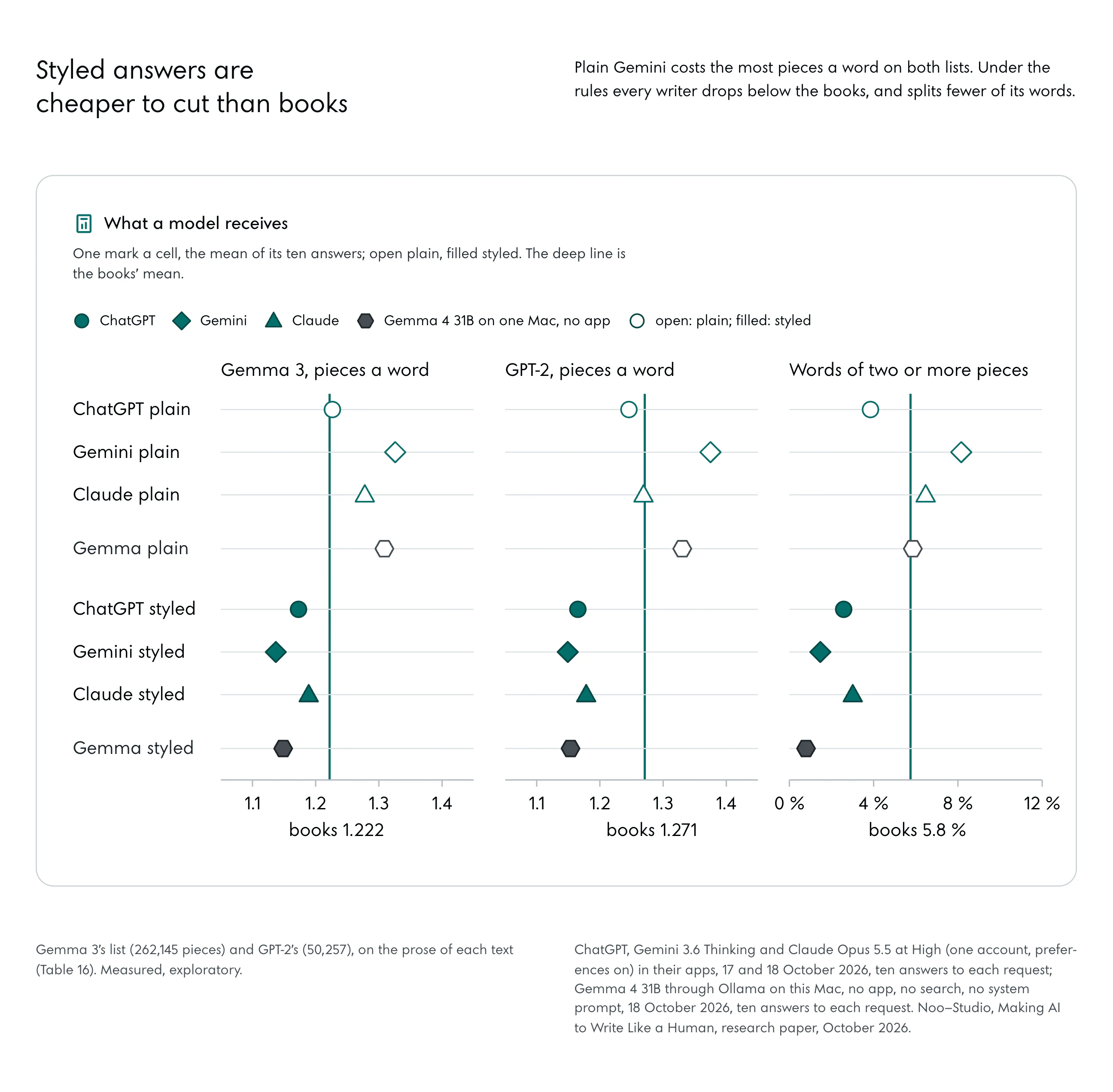
The numbers
| Cell | Gemma 3, pieces a word | GPT-2, pieces a word | Words of two or more pieces |
|---|---|---|---|
| ChatGPT plain | 1.226 | 1.246 | 3.9 % |
| Gemini plain | 1.326 | 1.375 | 8.2 % |
| Claude plain | 1.278 | 1.269 | 6.5 % |
| Gemma plain | 1.309 | 1.330 | 5.9 % |
| ChatGPT styled | 1.173 | 1.165 | 2.6 % |
| Gemini styled | 1.137 | 1.149 | 1.5 % |
| Claude styled | 1.189 | 1.178 | 3.0 % |
| Gemma styled | 1.149 | 1.153 | 0.8 % |
| Books, 24 windows | 1.222 | 1.271 | 5.8 % |
The Keyword Family Thins Out
An article about SEO carries a set of trade terms, and this paper counts nine of them as one group: “SEO”, “search engine optimization”, “optimization”, “optimisation”, “keywords”, “backlinks”, “E-E-A-T”, “Google Business Profile” and “ranking”. Plain ChatGPT uses the family 43.6 times a thousand words, plain Gemini 36.1 and plain Gemma, with no app, 36.7. Claude’s plain answers use it 10.8 times.
Under the persona, writing for owners who are “sharp but not technical”, the family falls to 8.2, 3.8 and 4.0, and Gemma’s to 2.7.
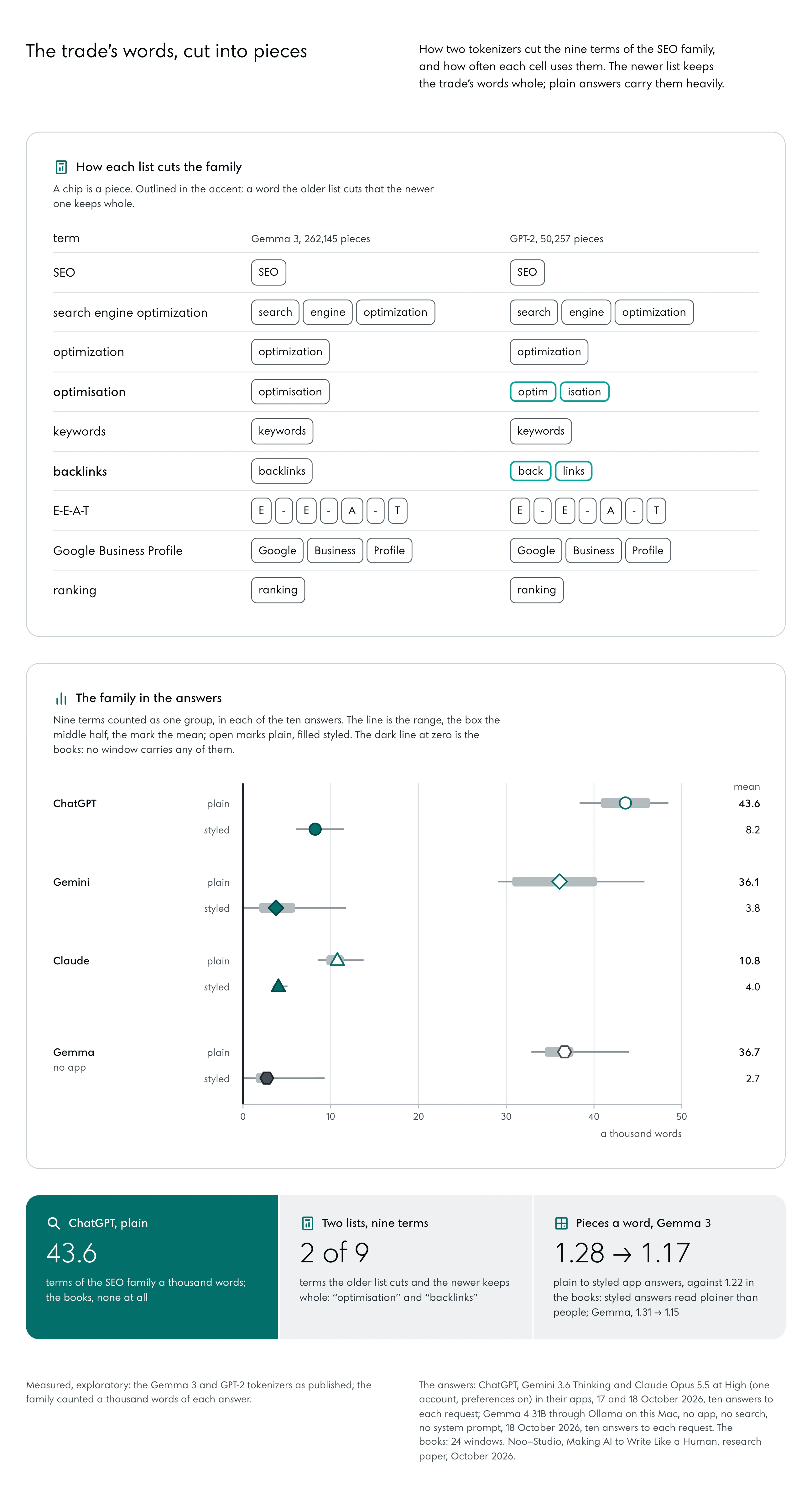
The numbers
| Cell | Keyword family a thousand words |
|---|---|
| ChatGPT plain | 43.6 |
| ChatGPT styled | 8.2 |
| Gemini plain | 36.1 |
| Gemini styled | 3.8 |
| Claude plain | 10.8 |
| Claude styled | 4.0 |
| Gemma plain | 36.7 |
| Gemma styled | 2.7 |
| Books | 0.0 |
The two lists cut the family differently, and the cut is itself a finding of the tokenizer’s field.
- Whole in both. “SEO”, “optimization”, “keywords” and “ranking” are one piece each in Gemma 3 and in GPT-2.
- Whole only in the newer list. “Optimisation” is one piece in Gemma 3 and two in GPT-2 (optim, isation); “backlinks” is one in Gemma 3 and two in GPT-2 (back, links).
- Broken in both. “E-E-A-T”, Google’s shorthand for experience, expertise, authoritativeness and trust, is seven pieces in both lists, each letter and hyphen on its own.
A newer list holds the trade’s vocabulary as whole units where an older one breaks it, and the coined acronym stays broken in both. What a whole or a broken term means for search is left untested here. The studio’s paper Semantic Token Optimisation argues, as theory, that a term a model holds whole is easier for it to place, and this run touches no ranking.
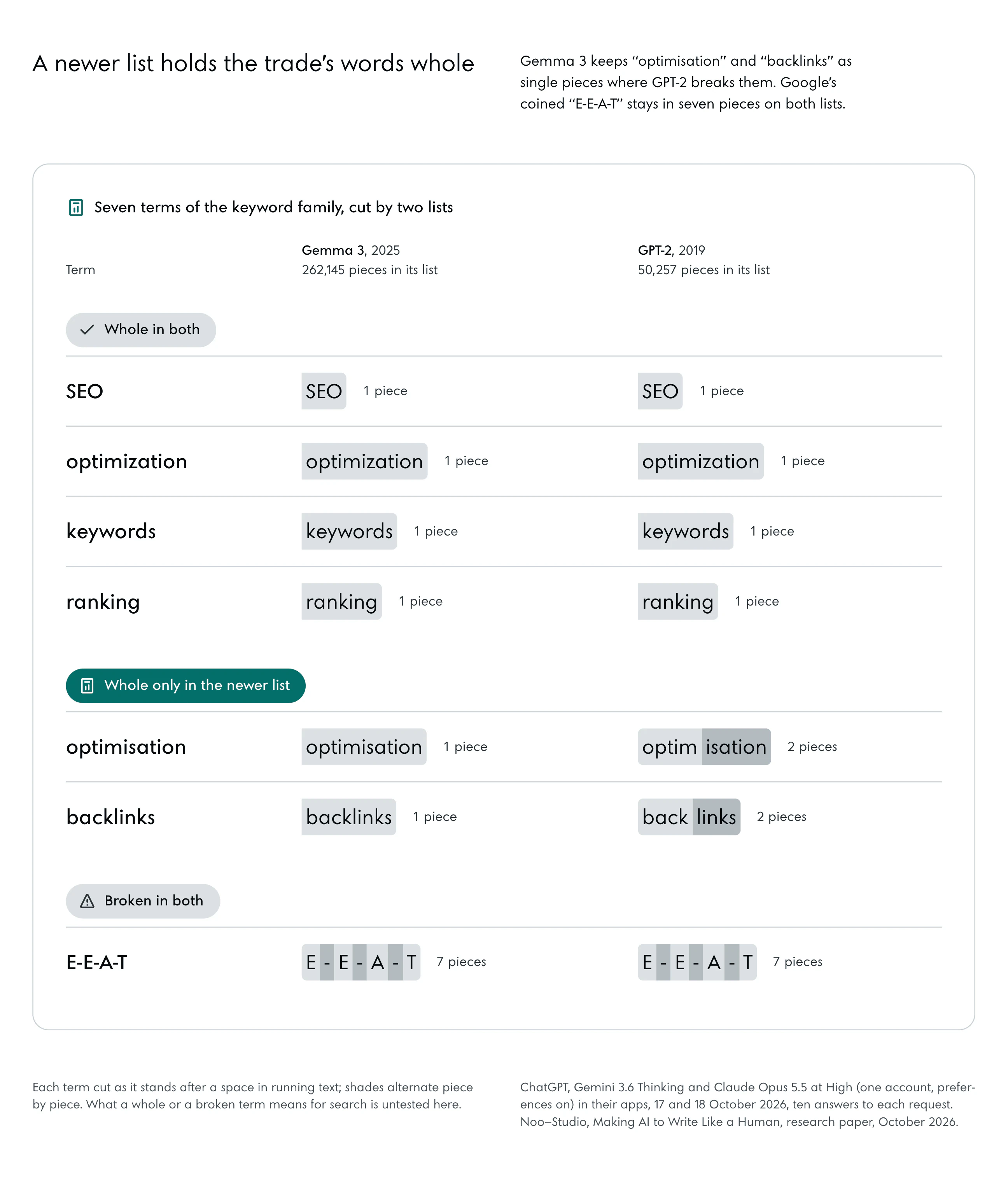
The numbers
| Term | Gemma 3 | GPT-2 |
|---|---|---|
| SEO | SEO | SEO |
| optimization | optimization | optimization |
| keywords | keywords | keywords |
| ranking | ranking | ranking |
| optimisation | optimisation | optim | isation |
| backlinks | backlinks | back | links |
| E-E-A-T | E | – | E | – | A | – | T | E | – | E | – | A | – | T |
Distance in a Space of Meanings
EmbeddingGemma, an open model built to place texts for retrieval, turns each answer into one point: the vectors of its runs of text are averaged, and the distance between two answers is one minus the cosine of the angle between their points. A low mean distance inside a cell says its ten answers mean nearly the same thing. Table 17 gives the spread of each cell and the distance from each writer’s plain answers to its own styled ones.
| Writer | Plain among themselves | Styled among themselves | Plain to own styled |
|---|---|---|---|
| ChatGPT | 0.0383 | 0.0380 | 0.2526 |
| Gemini | 0.0877 | 0.1595 | 0.3993 |
| Claude | 0.0478 | 0.0516 | 0.2942 |
| Gemma, no app | 0.0765 | 0.2168 | 0.3228 |
The three assistants’ plain answers sit 0.1228 apart for ChatGPT and Gemini, 0.2077 for Gemini and Claude and 0.2190 for ChatGPT and Claude. Those three figures give a scale for “a different article on the same subject”. ChatGPT’s ten styled answers sit 0.0380 apart, closer than its plain ones and three times closer than the nearest pair of assistants.
Claude’s barely loosen, from 0.0478 to 0.0516. Gemini’s spread almost doubles, to 0.1595, which lands inside the range that separates one assistant’s plain article from another’s. Across assistants the styled answers draw together: styled ChatGPT and styled Claude sit 0.1017 apart, nearer than any two assistants’ plain answers, while styled Gemini sits 0.1803 from styled Claude and 0.2048 from styled ChatGPT.
Gemma, read in the same space, keeps its plain answers tight, 0.0765, and its styled answers spread to 0.2168, at the top of the band between two apps’ plain articles; its move from plain to styled, 0.3228, lies between Claude’s and Gemini’s. These distances are measured, and the spread was fixed before the run.
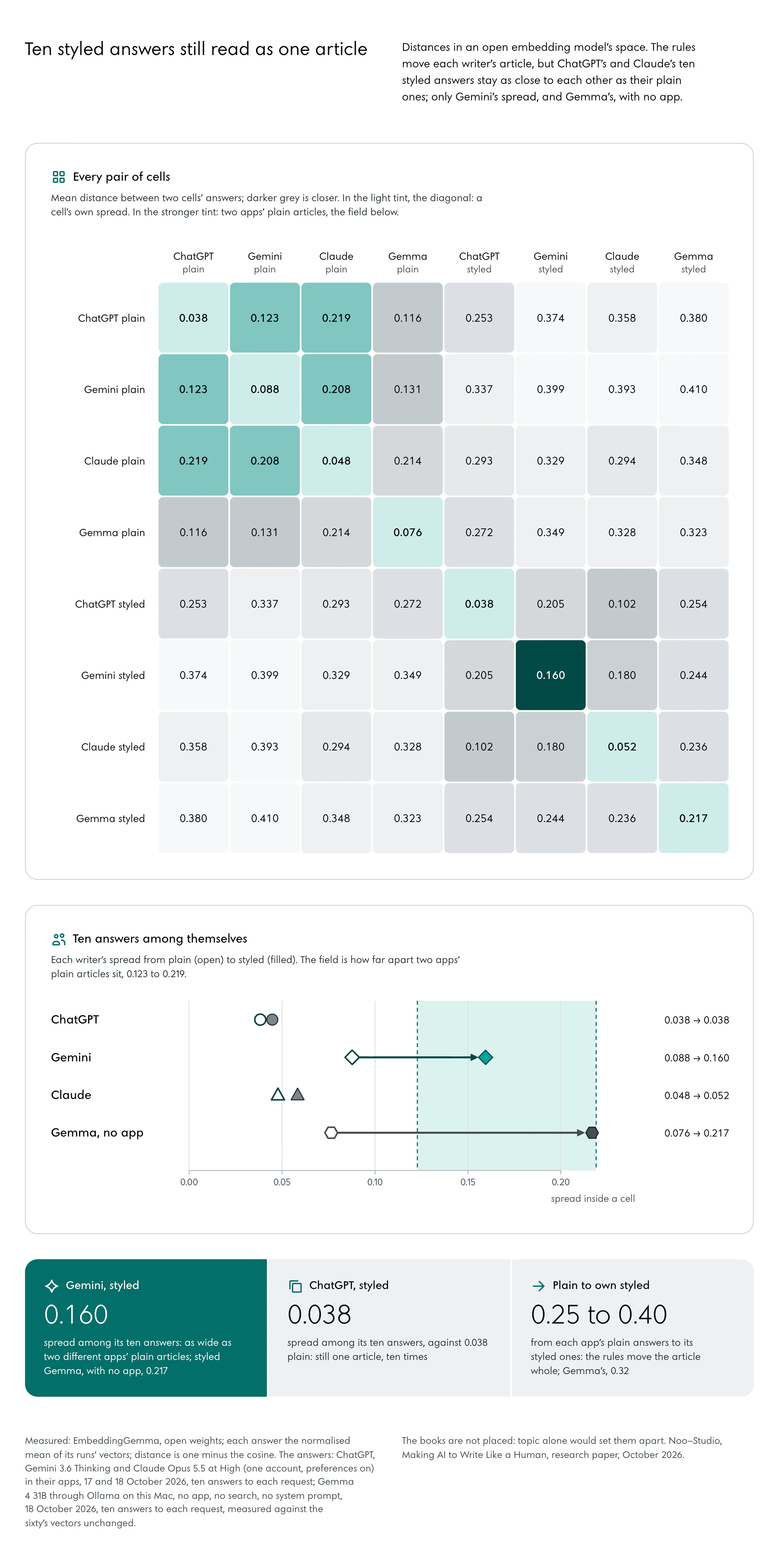
The numbers
| Cell | ChatGPT plain | Gemini plain | Claude plain | Gemma plain | ChatGPT styled | Gemini styled | Claude styled | Gemma styled |
|---|---|---|---|---|---|---|---|---|
| ChatGPT plain | 0.0383 | 0.1228 | 0.2190 | 0.1165 | 0.2526 | 0.3745 | 0.3582 | 0.3801 |
| Gemini plain | 0.1228 | 0.0877 | 0.2077 | 0.1314 | 0.3373 | 0.3993 | 0.3932 | 0.4097 |
| Claude plain | 0.2190 | 0.2077 | 0.0478 | 0.2139 | 0.2932 | 0.3292 | 0.2942 | 0.3478 |
| Gemma plain | 0.1165 | 0.1314 | 0.2139 | 0.0765 | 0.2721 | 0.3494 | 0.3282 | 0.3228 |
| ChatGPT styled | 0.2526 | 0.3373 | 0.2932 | 0.2721 | 0.0380 | 0.2048 | 0.1017 | 0.2540 |
| Gemini styled | 0.3745 | 0.3993 | 0.3292 | 0.3494 | 0.2048 | 0.1595 | 0.1803 | 0.2445 |
| Claude styled | 0.3582 | 0.3932 | 0.2942 | 0.3282 | 0.1017 | 0.1803 | 0.0516 | 0.2358 |
| Gemma styled | 0.3801 | 0.4097 | 0.3478 | 0.3228 | 0.2540 | 0.2445 | 0.2358 | 0.2168 |
Why does each assistant move further from itself, 0.25 to 0.40, than the three plain cells sit from each other? Part of the move is topic. The persona brings small firms and local search into the article, and an embedding reads meaning before style, so the distance from plain to styled mixes how the text is written with what it is about, and EmbeddingGemma cannot pull the two apart.
For the same reason the books are left out of this space: a book on another subject would sit far from every answer on topic alone, and the distance would say nothing about how it was written.
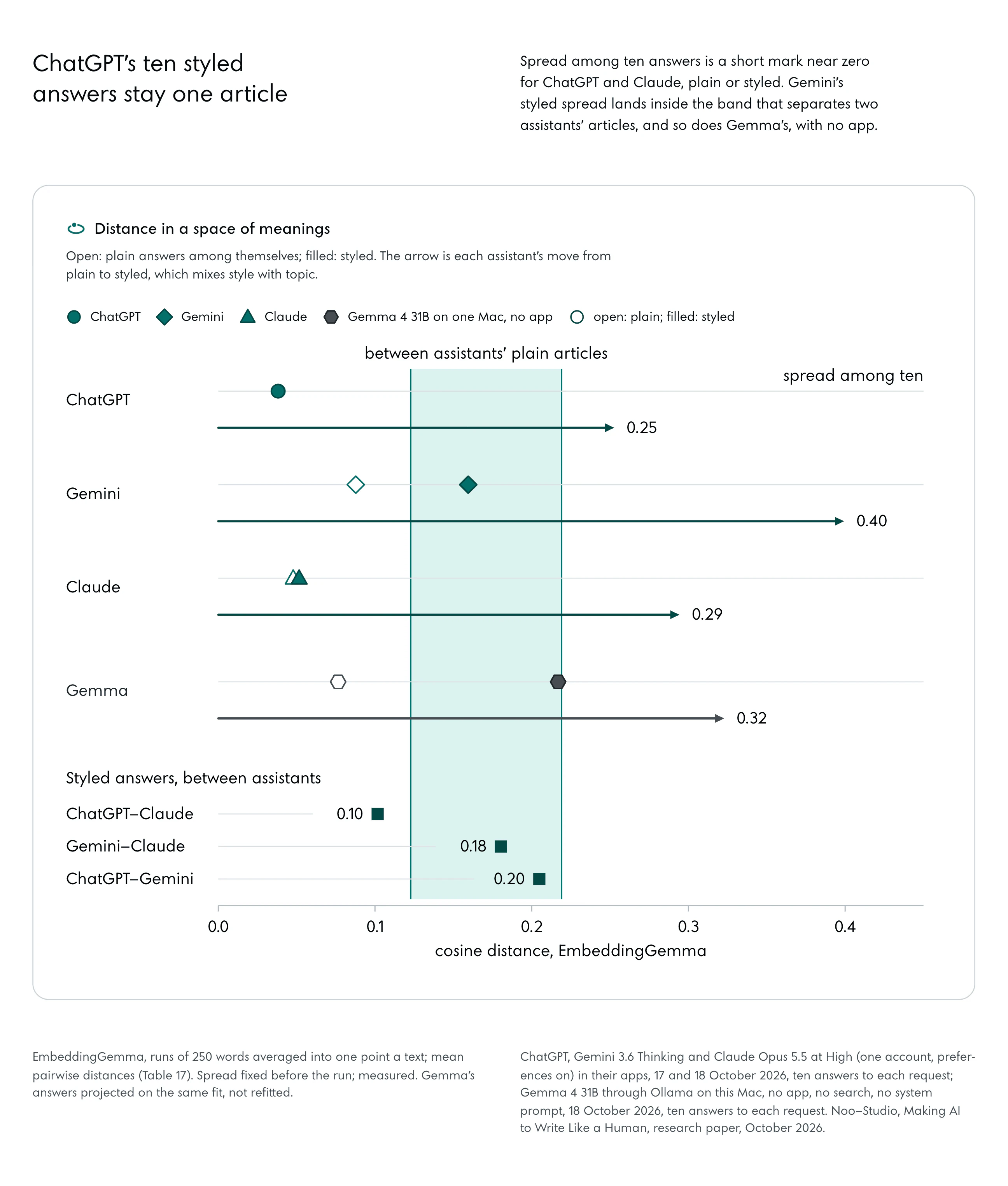
The numbers
| Assistant | Plain among themselves | Styled among themselves | Plain to own styled |
|---|---|---|---|
| ChatGPT | 0.0383 | 0.0380 | 0.2526 |
| Gemini | 0.0877 | 0.1595 | 0.3993 |
| Claude | 0.0478 | 0.0516 | 0.2942 |
| Gemma | 0.0765 | 0.2168 | 0.3228 |
| Plain, between assistants | 0.1228 · 0.2077 · 0.2190 | ||
| Styled, between assistants | ChatGPT–Claude 0.1017 · Gemini–Claude 0.1803 · ChatGPT–Gemini 0.2048 |
Surface and Place Part Ways
Set beside each other, the parts so far give one picture in two layers. On the surface, which the linguist counts and the shared-runs test reads, the styled answers moved toward people: shared runs fell from 31.9 % to 3.4 % in ChatGPT, long words and rhythm landed inside the books, the contrast frame disappeared. In place, which an embedding reads, ChatGPT’s ten styled answers are as close to each other as its ten plain ones, 0.0380 against 0.0383, and Claude’s nearly so.
Six rules rewrote the sentences of one article ten times and left them one article.
Each field reads that crossover in its own terms.
- Statistics sees the apps’ styled answers overlap with people on surprise and first choice, so a test built on predictability alone would pass them.
- Linguistics sees the named features inside the human range and the small words still below it.
- Tokenization sees plainer pieces and a thinner keyword family, a text cheaper to read than a book.
- Search and retrieval sees two readings that disagree: the run-overlap test of Broder’s lineage finds ten different texts, and the embedding finds one.
Gemini is the exception among the apps, and Gemma, with no app, is the second: the crossover is a tendency of two writers out of four. Gemini’s styled answers spread as far apart as two different assistants’ articles, and Gemma’s to the top of that band. The two are also the shortest styled cells of the run, 424 to 670 prose words for Gemini and 246 to 547 for Gemma, and four of Gemini’s came from a second account; whether either fact loosens a cell is untested.
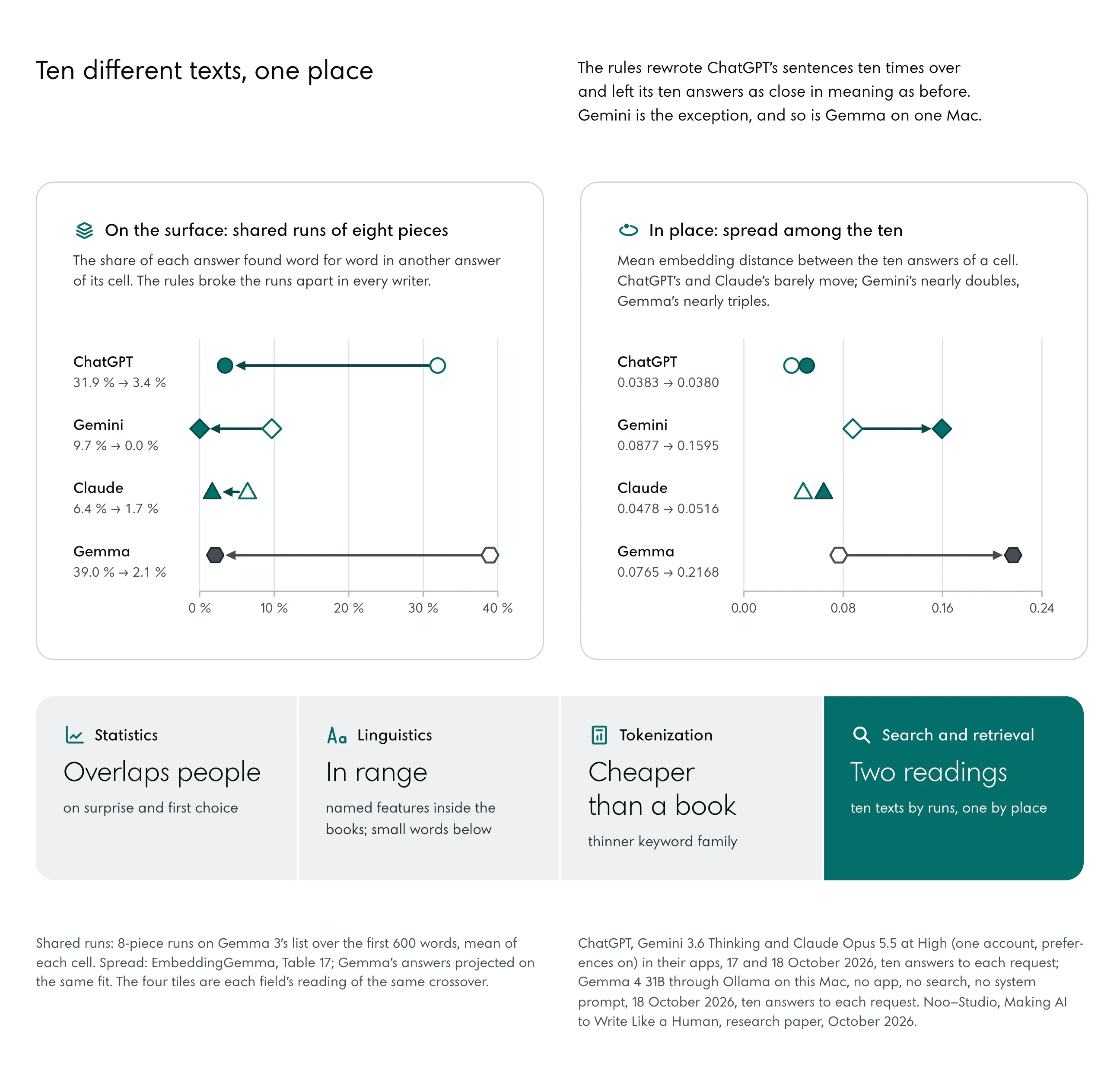
Six rules moved the surface of ChatGPT’s and Claude’s articles toward people and left each set of ten answers in one place in a model’s space.
10Claude in One Account
Claude stands apart in almost every table, and before any rule was added.
Its plain answers already sit inside the books on several measures where ChatGPT’s and Gemini’s sit outside, and this part sets out what that is, what in the run could explain it, and what would decide between the explanations.
Plain Answers That Read Styled
Table 18 gathers plain Claude’s results from the earlier parts beside the other two plain app cells and plain Gemma’s, one line a measure.
| Measure | ChatGPT plain | Gemini plain | Claude plain | Gemma plain, no app | Books |
|---|---|---|---|---|---|
| Long words, answers above the books | 10 of 10 | 9 of 10 | 0 of 10 | 0 of 10 | |
| Surprise, answers below every book window | 10 of 10 | 10 of 10 | 0 of 10 | 10 of 10 | 3.82 to 4.95 nats |
| First-choice share, mean | 0.502 | 0.515 | 0.367 | 0.558 | 0.250 to 0.405 |
| Function words, range | 0.288 to 0.324 | 0.263 to 0.314 | 0.363 to 0.404 | 0.428 to 0.464 | encyclopedia 0.382 to 0.401 |
| Shared runs inside the cell | 31.9 % | 9.7 % | 6.4 % | 39.0 % | 0.0 % |
| Keyword family a thousand words | 43.6 | 36.1 | 10.8 | 36.7 | 0.0 |
| Words a paragraph, median | 17 | 25 | 39 | 24 | 113 |
On surprise and first choice the plain Claude answers fall inside the books, with chances of scoring above a book window of 0.65 and 0.67, close to the 0.50 of no difference. Their function words reach the encyclopedia’s level, still below the books. They repeat themselves less, carry a quarter of ChatGPT’s keyword weight and write paragraphs twice as long.
All of this is measured. Some habits remain: the contrast frame at 3.33 a thousand words, three and a half times the books’ rate, and the same title opening, “SEO in 2026:”, in all ten answers. Beside plain Gemma, made with no app, Claude’s plain answers are still nearest the books or level on six of the seven lines, level with Gemma on long words; only on the small words is plain Gemma closer.
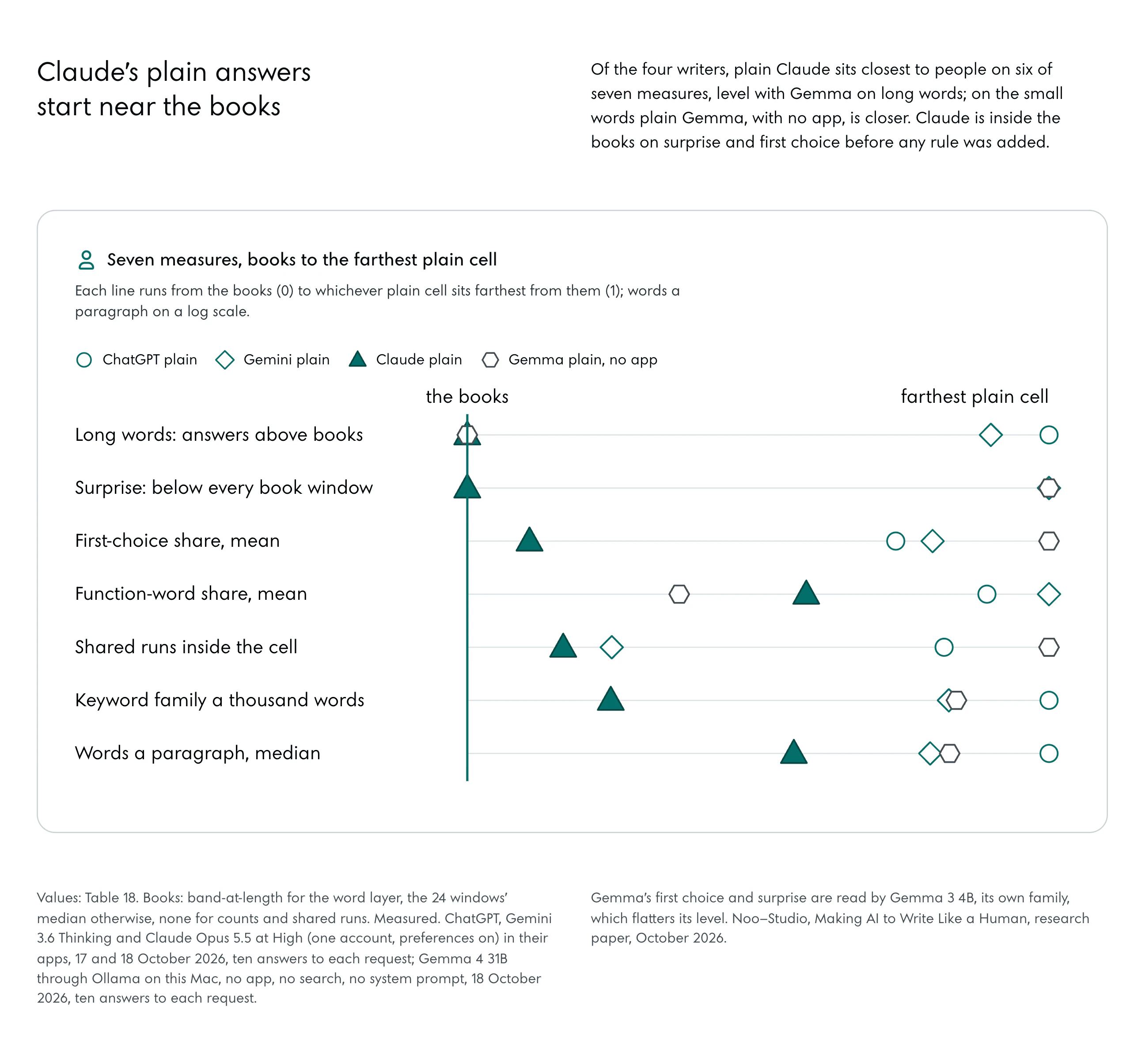
The numbers
| Measure | ChatGPT plain | Gemini plain | Claude plain | Gemma plain | Books |
|---|---|---|---|---|---|
| Long words: answers above books | 10 of 10 | 9 of 10 | 0 of 10 | 0 of 10 | 0 |
| Surprise: below every book window | 10 of 10 | 10 of 10 | 0 of 10 | 10 of 10 | 0 |
| First-choice share, mean | 0.502 | 0.515 | 0.367 | 0.558 | 0.344 |
| Function-word share, mean | 0.311 | 0.284 | 0.389 | 0.444 | 0.536 |
| Shared runs inside the cell | 31.9 % | 9.7 % | 6.4 % | 39.0 % | 0 |
| Keyword family a thousand words | 43.6 | 36.1 | 10.8 | 36.7 | 0 |
| Words a paragraph, median | 17 | 25 | 39 | 24 | 113 |
What Travels With the Request
Claude ran as Opus 5.5 at High in the founder’s own account, with his profile preferences on, and the founder kept them on by his ruling of 18 October 2026: “I don’t wanna switch off my preferences.” The profile holds a work function and one line about where work is saved. It says nothing about style, voice or the topic. Every one of Claude’s twenty answers was also written into a Claude Docs document, a page of its own beside the chat, where ChatGPT and Gemini answered in the chat.
Three readings could explain plain answers that read styled, and the paper holds all three as theory.
- The model’s own default. Opus 5.5 at High may write this way for anyone who asks plainly. A fresh account with no preferences, sent the same request ten times, would test it.
- The preferences. What a person writes into their settings travels with every request, and even a line about saving work may change how the model frames its task. This is the weakest of the three, since nothing in the profile mentions writing. Its test, the founder’s account with the preferences off, was left unrun by his choice.
- The document route. A document page invites a document, with longer paragraphs and fewer headings than a chat reply. The test is the same request with Claude asked to answer in the chat.
None of the three was run, and the paper keeps Claude as its own version throughout: Claude as one person’s account sets it, which is also how most people meet it.
Claude Under the Rules
Styled, Claude behaves like the other two on most lines and comes closest to people on the one layer no rule named. Four of its ten styled answers reach the books on function words, the only styled app answers to do so; Gemma’s, with no app, reach them in seven. Its styled surprise sits inside the books in 10 of 10, and its styled paragraphs are the longest in the run at 54 words, still under half a book paragraph.
In the embedding its ten styled answers stay almost as tight as its plain ones, 0.0516 against 0.0478.
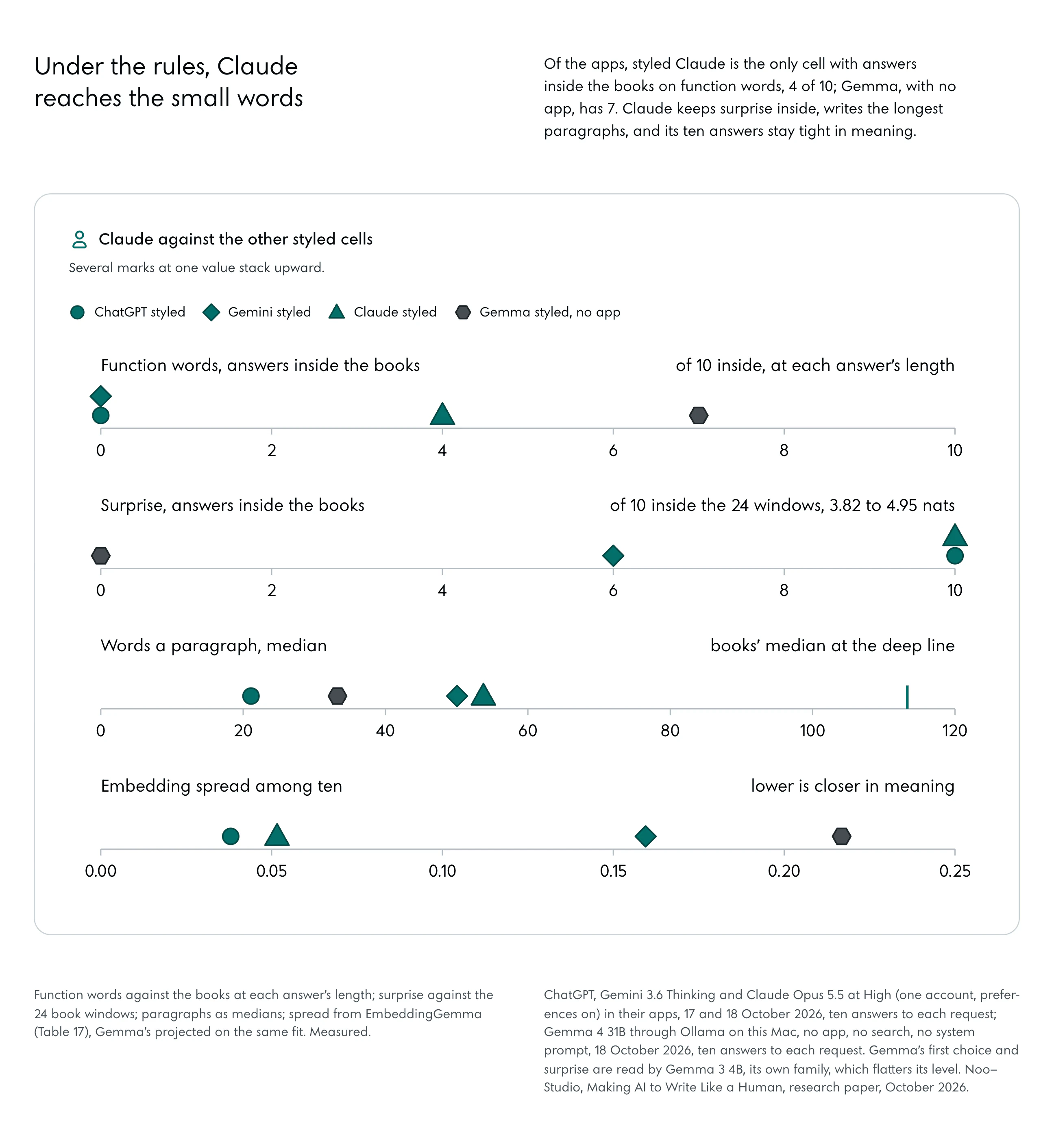
The numbers
| Line | ChatGPT styled | Gemini styled | Claude styled | Gemma styled |
|---|---|---|---|---|
| Function words, answers inside the books | 0 | 0 | 4 | 7 |
| Surprise, answers inside the books | 10 | 6 | 10 | 0 |
| Words a paragraph, median | 21 | 50 | 54 | 33 |
| Embedding spread among ten | 0.0380 | 0.1595 | 0.0516 | 0.2168 |
Claude’s plain answers sit inside the books on predictability before any rule, and the run leaves open whether the model, the account or the document page put them there.
11A Fourth Writer on One Mac
An open model with none of the apps’ surface answered the same two requests, and its plain answers already read the way the apps’ styled ones do.
Twenty Answers Without an App
Gemma 4 31B is an open model that runs on one desk computer. On 18 October, after the sixty answers were in, it received the plain request and the styled one ten times each through Ollama on this Mac, with no search, no system prompt and the model’s default settings. Nothing that an app adds at the surface was there: no retrieval, no instructions about tone, no preferences carried in from an account.
What it shares with the sixty is the request, word for word. Its styled answers are the shortest of the four writers, 371 prose words at the median against 506 to 1,956 from the apps; plain, at 438, only Gemini’s are shorter, at 290, against 1,196 for ChatGPT and 1,071 for Claude.
These twenty answers stand beside the sixty rather than among them. The sixty were made under the conditions a reader meets in an app; these were made bare, and the differences between them and the apps cannot be split between the model and its surface. They are read here for one thing: what a model does with the two requests when there is no surface at all.
Inside the Books Before Any Rule
On three of the four word-level measures, Gemma’s plain answers lie where the apps’ styled answers end up. All ten are inside the books at their own length on sentence spread, on word length and on the share of long words. The apps’ plain answers managed that on none of the three at once.
On the small words, Gemma plain sits below the books in all ten, at a share of 0.444, the highest plain cell of the four but still under the band.
The styled request moves the small words further than it moved them for any app. Seven of ten styled Gemma answers come inside the books on function words, at a mean share of 0.500; the apps’ thirty styled answers put four inside. No rule names the small words, so this is the same indirect effect the paper describes for Claude, only larger, and it comes with the length: the books’ range at 371 words is wide, and inside is easier to reach there than at 1,900.
Contrast frames went to zero in the styled answers, from 3.7 a thousand words plain, as they did for Gemini and nearly did for ChatGPT and Claude.
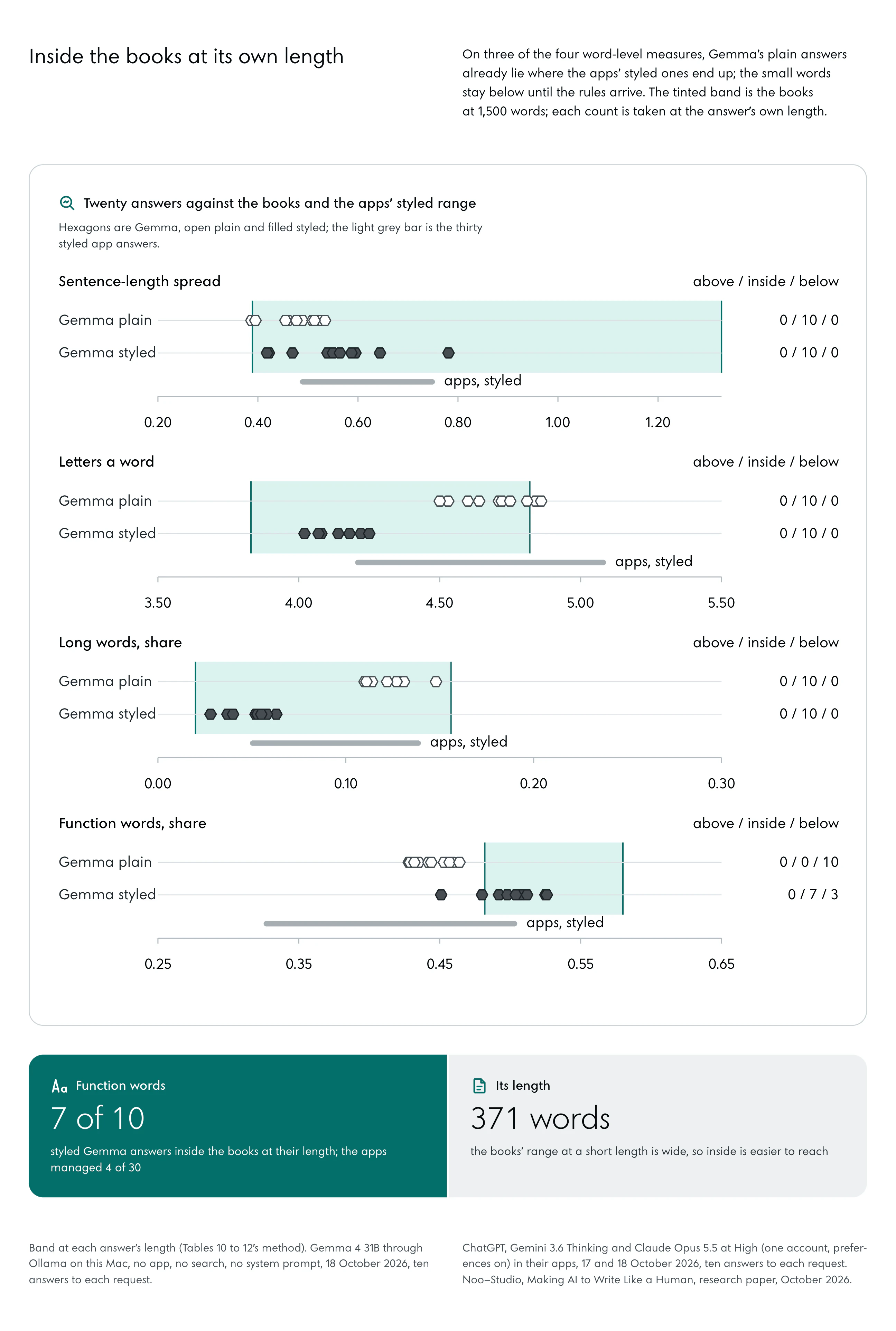
The numbers
| Measure | Gemma plain | Gemma styled | Apps styled | Books at 1,500 words |
|---|---|---|---|---|
| Sentence-length spread | 0.39 to 0.53 | 0.42 to 0.78 | 0.48 to 0.75 | 0.39 to 1.33 |
| Letters a word | 4.50 to 4.86 | 4.02 to 4.25 | 4.20 to 5.09 | 3.83 to 4.82 |
| Long words, share | 0.11 to 0.15 | 0.03 to 0.06 | 0.05 to 0.14 | 0.02 to 0.16 |
| Function words, share | 0.43 to 0.46 | 0.45 to 0.53 | 0.33 to 0.51 | 0.48 to 0.58 |
The Rule That Turned on Its Writer
One rule went the other way. “Break the uniformity” asks for sentences that do not all start alike, and in styled Gemma they start alike 13.3 times a thousand words, against 1.8 plain and 3.0 to 4.5 in the apps’ styled answers. The check behind the count flags two sentences in a row that open on the same word; 17 of the 50 pairs it found open on “you”.
The persona speaks to the reader, the rules ask for short plain sentences with the subject first, and a model that follows both writes “You spent years building a business. You are good at what you do.” The rule that names uniformity produced it.
The rule that names uniformity produced it, because two other rules had already decided how every sentence would start.
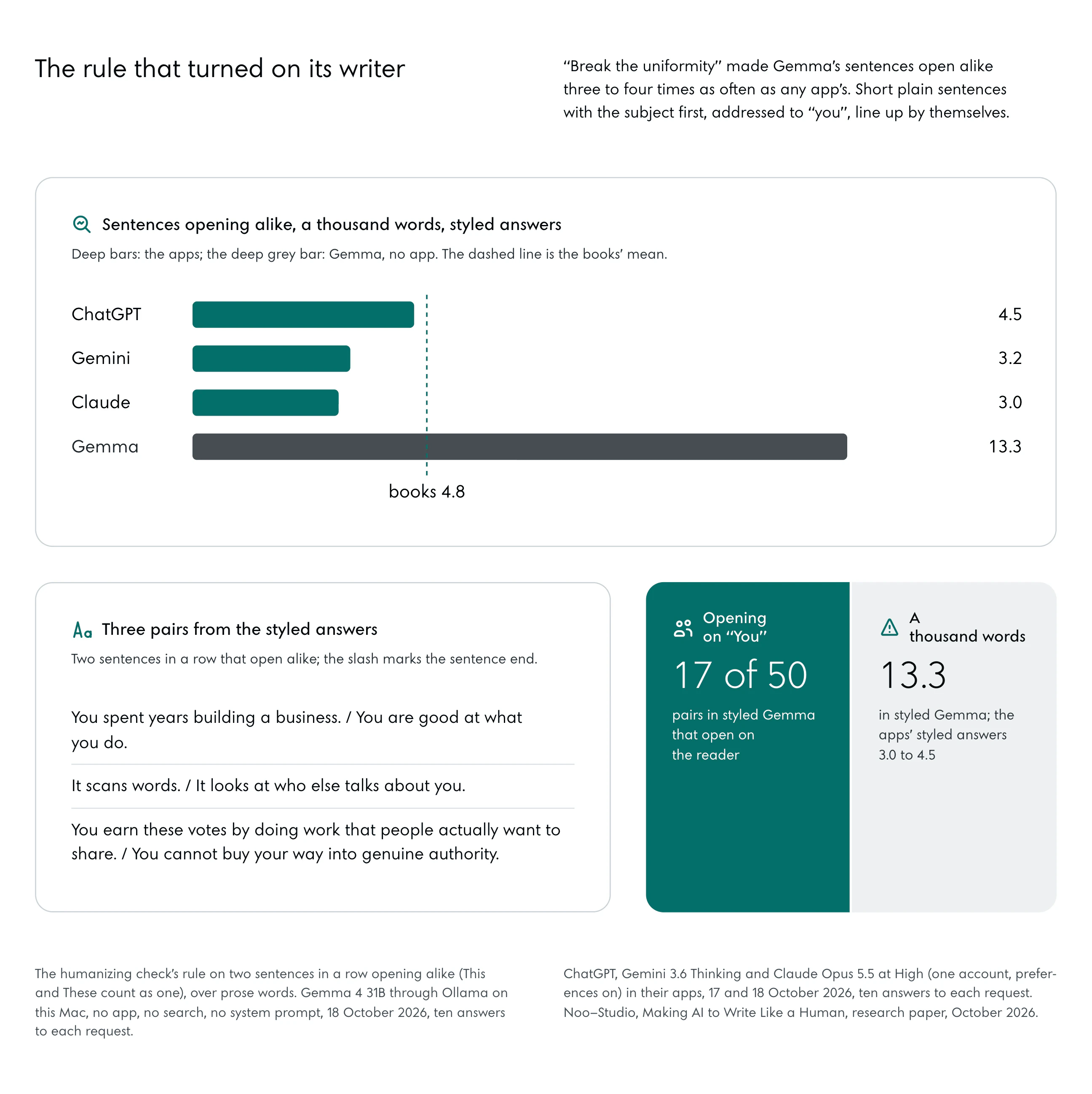
Read by Its Own Family
The paper’s reader is Gemma 3 4B, and the second reader is Gemma 4 31B: both are the writer’s own family. Plain Gemma takes the reader’s first choice 0.558 of the time under the 4B and 0.572 under the 31B, the highest cell of the four writers under both and above every book window. Styled, it drops to 0.394 and 0.368, the top edge of the books.
Surprise runs the same way: 2.65 nats plain and 3.67 styled under the 4B in the paper’s windows of 64 pieces, against 3.82 to 4.95 for the books, so every Gemma answer, plain or styled, stays below every book window.
A model reading its sibling finds the text easy to guess, so the level is suspect even where the order is not. What the order shows is enough: without an app, a plain request still produces the most expected text of the run, and the styled request moves it toward the books, to their edge on first choice and still below them on surprise, where every app’s styled answers came inside. Whether a reader of another family would put plain Gemma as far above the books is the open question of the part “One Open Reader and Its Limits”, and it is open here too.
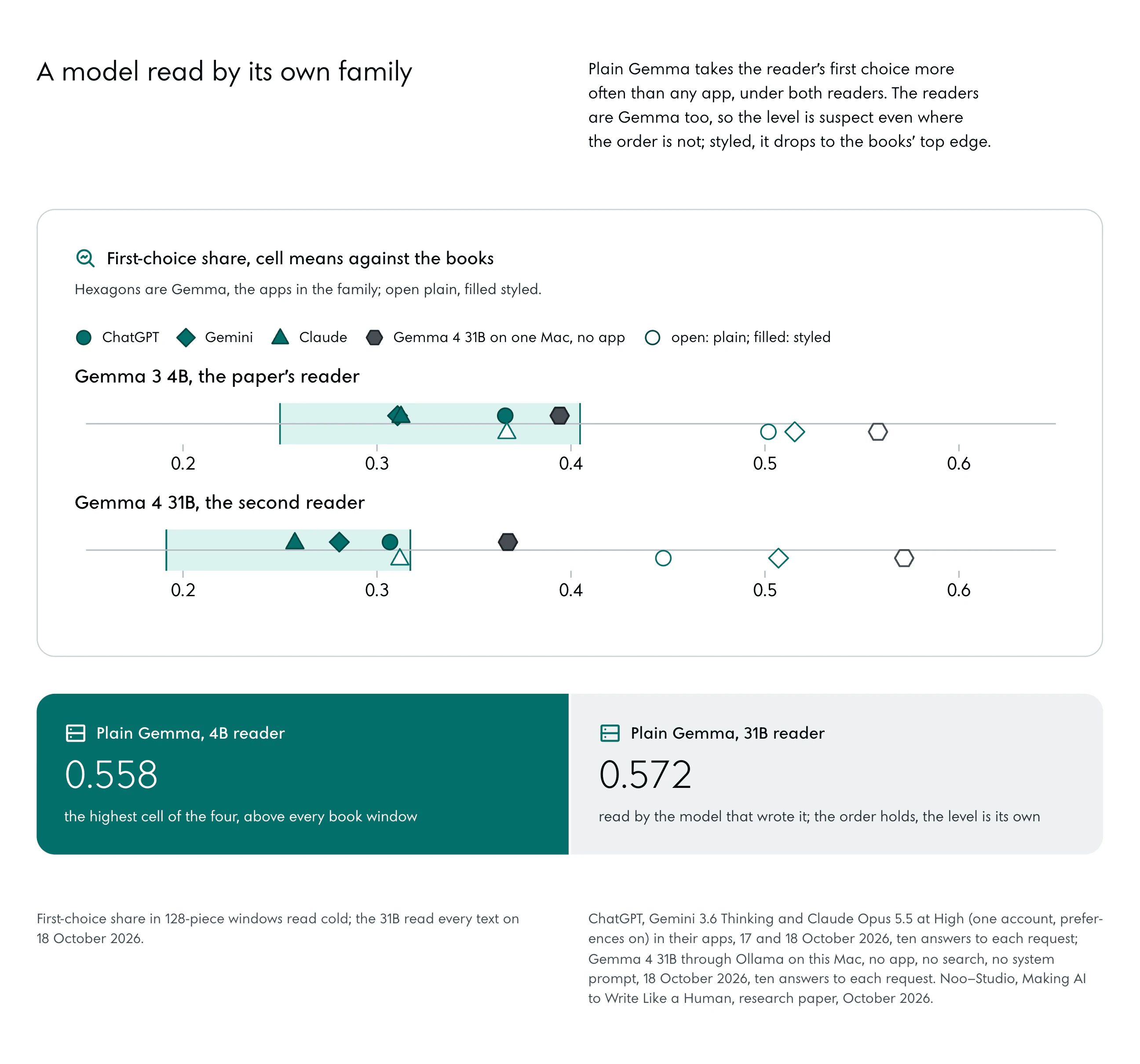
12Theories and Their Breaking Tests
Three readings of the mechanism go beyond what was measured, and the studio holds each as theory.
Each is stated once here with the evidence that supports it in this run, the result that would break it, and how near the run came to that result.
Table 19 sets the three side by side.
| Theory | What it says | Support in this run | What would break it | Nearest the run came |
|---|---|---|---|---|
| A prompt reaches what it names | Rules move the features they name and leave the rest near the model’s default | Long words and sentence spread inside the books in 30 of 30 styled answers; function words below in 26 of 30; paragraph length at half a book | A styled cell with function words inside the books in 8 of 10, without a rule that names them | Gemma styled, no app, 7 of 10; of the apps, Claude styled, 4 of 10 |
| The default article | A plain request returns the model’s most probable article, and sameness and predictability are two readings of it | Plain ChatGPT: 31.9 % shared runs and 0.502 first-choice share, its opening shared with the encyclopedia; plain Gemma, with no app, higher on both, 39.0 % and 0.558 | A plain cell with shared runs at the books’ floor and first-choice share above every book, or the reverse | Gemini plain: 9.7 % shared runs, 0.515 first choice |
| Surface and place part ways | Style rules rewrite what a linguist counts and leave the text’s place in a model’s space | ChatGPT’s styled spread 0.0380 against 0.0383 plain; Claude’s 0.0516 against 0.0478 | A styled cell spread as far as two assistants’ plain articles sit apart, 0.123 to 0.219 | Gemini styled, 0.160, and Gemma styled, 0.217: broken for both |
A Prompt Reaches What It Names
Six rules name long words, rhythm, groups of three, contrasts, paragraph spread and positions, and the four of those that were counted moved into the human range or past it. The features no rule names moved part of the way: function words stayed below the books in 26 of the apps’ 30 styled answers, paragraph length stayed at half a book paragraph, titles and opening scenes stayed where each model’s habit put them. Paragraph spread and paragraph length make the cleanest pair, since one is named and the other is not, and the named one reached the books’ median while the unnamed one stayed put.
In Gemma’s answers the named one sat above the median before any rule, and the request brought it a little down.
Of the apps, Claude’s styled cell, with four answers of ten inside the books on function words, comes nearest to breaking it; it also ran with one account’s preferences and through a document page. Gemma’s styled answers, with no app, come nearer, seven of ten, one short of the break, at lengths where the books’ band is wide. So the theory stands on this run, narrowly, and waits for a cell that tests it without those differences.
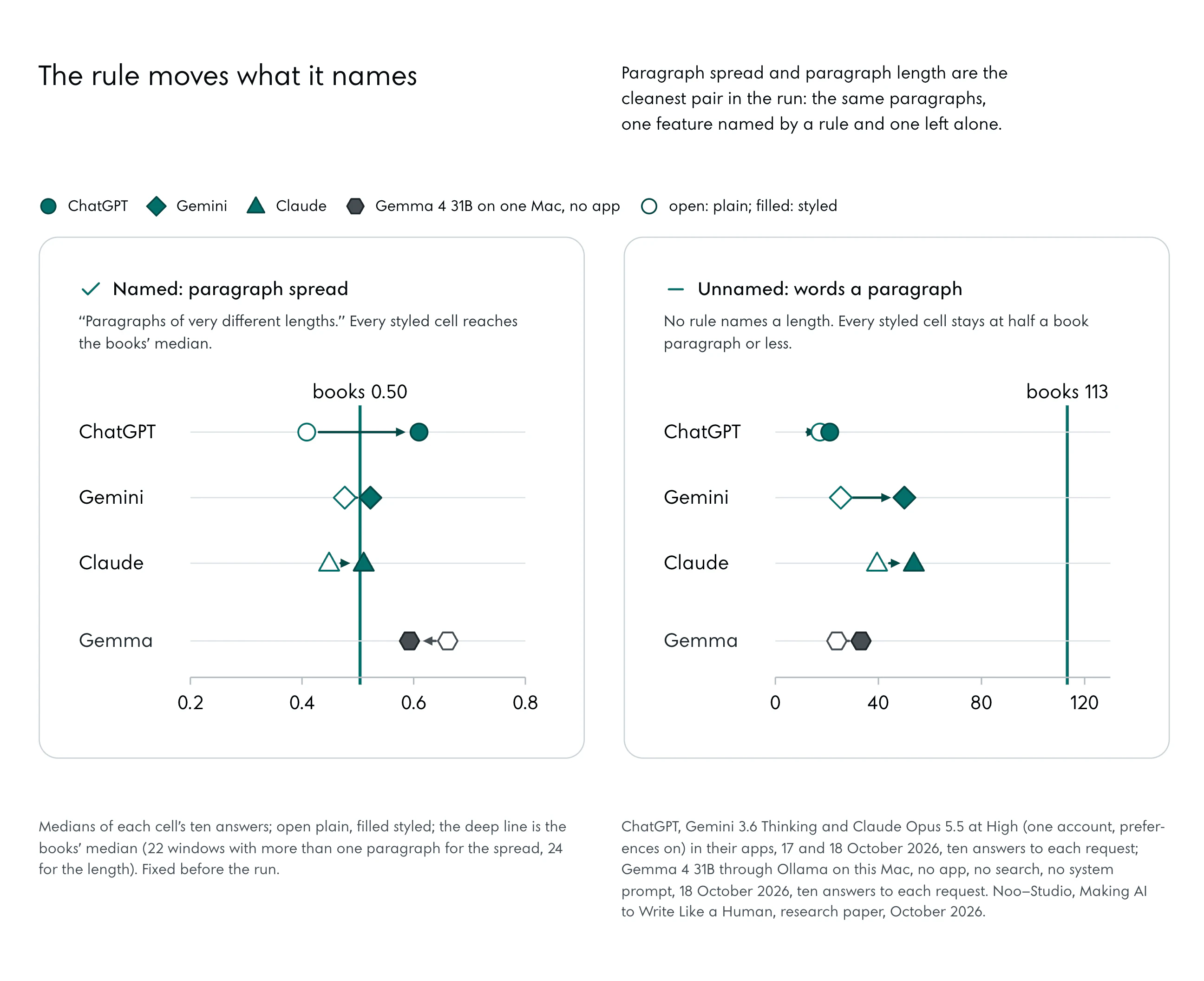
The Default Article
Asked plainly, an assistant returns its most probable article. On this reading the share of runs that repeat inside a cell and the share of pieces that were the model’s first choice measure one mechanism twice, once across answers and once inside each answer, and the encyclopedia’s opening, whose words up to “the process of improving” open ten of ten ChatGPT answers in its 2022 revision, suggests where the default was learned.
Gemini’s plain cell strains the theory without breaking it. Its first-choice share is the highest of the apps, 0.515, while its shared runs, 9.7 %, sit well under ChatGPT’s 31.9 %, though far above the books’ 0.0 %. Gemini’s plain prose is short, 211 to 483 words, and broken by lists, and short prose leaves fewer runs to share, which is one way to reconcile the two readings, though Gemma’s plain answers, also short at 380 to 602 words, share 39.0 %, so shortness alone does not; a longer prose sample from the same cell would test that account.
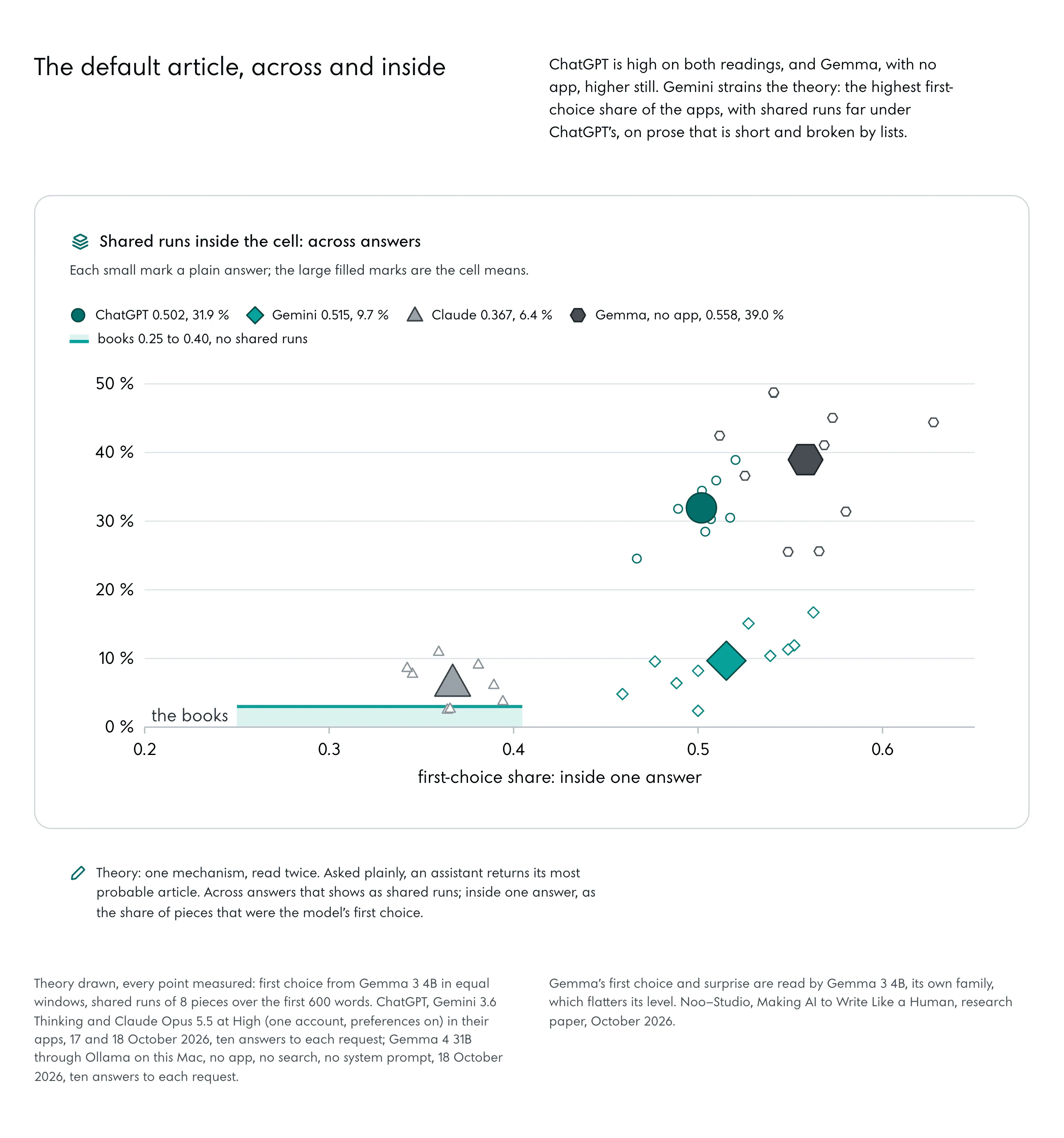
Surface and Place Part Ways
The third reading is the arc of this paper. Rules that a writer can read and follow act on sentences, words and paragraphs, and an embedding model reads what the text is about and how its parts are ordered, so the rules can change everything a linguist counts and leave the embedding’s point where it was. ChatGPT and Claude fit it closely.
Gemini breaks it: its ten styled answers spread to 0.160, inside the range that separates one assistant’s plain article from another’s. Gemma, with no app, breaks it as well, at 0.217, at the top of that range.
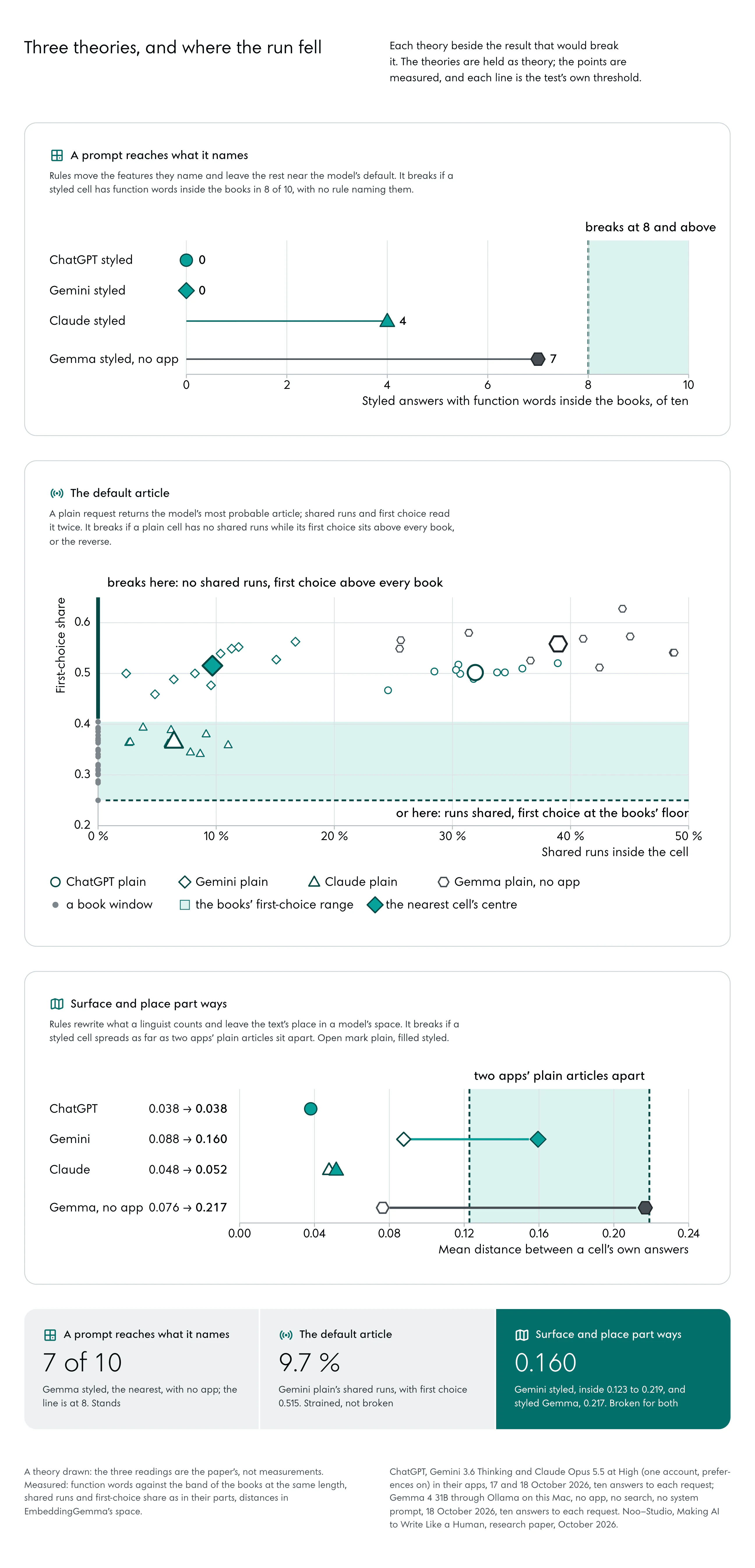
The drawing is a theory drawn, labelled as one: the theories are the paper’s readings, while every point in it is measured and every line is the test’s own threshold.
Of three theories, the run supports the first two and breaks the third for two writers of four, Gemini and Gemma, and each keeps its test in plain view.
13What a Writer Can Change
The findings reduce to one habit for anyone who writes with an assistant, and to a check that needs no laboratory. This part gives both, then what the published search policies say about text made at volume.
Name the Feature You Want Moved
A style prompt is an instrument with a narrow aperture. The six rules reached the features they named, sometimes past people: the contrast frame fell below the books and the encyclopedia in every styled answer. They left the small grammatical words short of people in the apps’ answers and paragraph length short in every writer’s, and they left titles and opening scenes where the model’s habit put them.
So the useful instruction is specific. Name the feature to be moved, in words the model can act on, and expect the features left unnamed to move only as far as the named ones drag them.
Two side effects follow from the run.
- A rule can overshoot. The rule against the contrast frame removed it more thoroughly than people ever do, and a text with none at all is unlike both the books and the encyclopedia. In Gemma’s answers “Break the uniformity” overshot the other way, to 13.3 sentences opening alike a thousand words against the books’ 4.8.
- A persona brings its own stock phrase. Eight of ten styled ChatGPT answers restate the brief in the first person, and three of ten styled Claude answers open on the same owner holding the same report, and four of ten styled Gemma answers say they have spent ten years, or a decade, “in the dirt”.
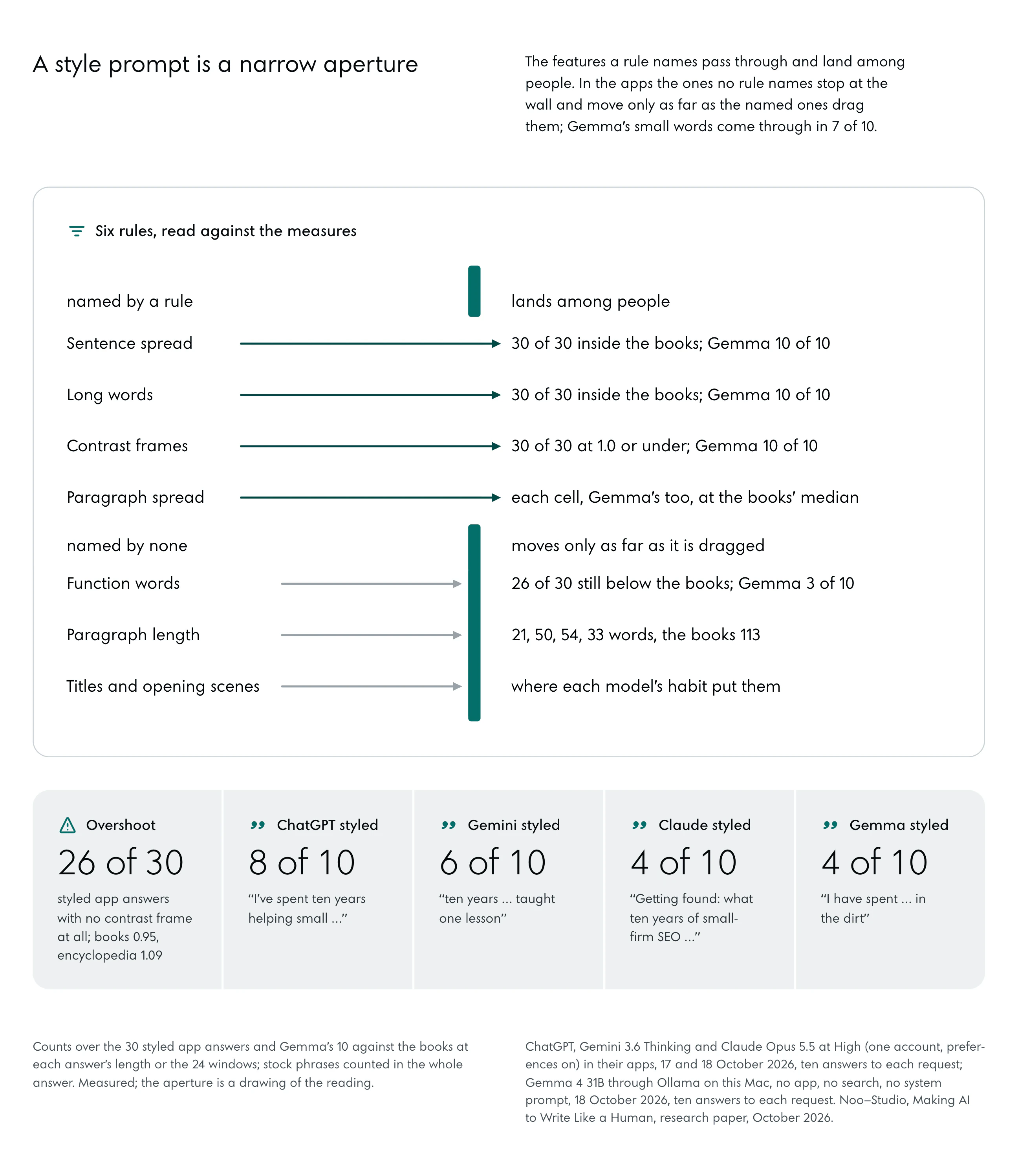
A Check at Your Own Desk
Most of the measures in this paper can be run on a text of one’s own in an afternoon, with a short script or with patience, and the human values to aim at are printed in the tables above.
- Keep the prose. Remove headings, list items, tables and code, since every count here is a count of running prose.
- Count the small words. Set the function-word share beside the books at the text’s length and, for a technical subject, beside the encyclopedia’s 0.382 to 0.401.
- Count the long words. Book windows of 1,500 words reach up to 0.156 of words with three syllables or more.
- Read the rhythm. Compute the spread of sentence lengths, then the share of one-sentence paragraphs, which in the median book window is 0.00.
- Tally two habits. Contrast sentences and pairs of sentences opening alike, a thousand words each, against the books’ 0.95 and 4.76.
- Ask again. Send the same request several times and set the titles and first lines side by side; repeated openings show the default article without any tool.
- Write one rule. Where a count sits outside both references, write one rule that names it, run the request again and measure again.
First-choice share and surprise need an open model such as Gemma 3 4B read in equal windows, and the embedding needs EmbeddingGemma beside it. Both ran on one machine for this paper, and both repay the setup for anyone who writes at volume.
Volume Under the Search Policies
Google’s guidance is plain that the tool itself is no offence: “Appropriate use of AI or automation is not against our guidelines.” What its spam policies name is many pages generated “without adding value for users”. This run measured no engine’s treatment of anything, and what follows is theory. A firm that publishes plain answers at volume is publishing, by the shared-runs measure, a third of the same text again and again, which is the kind of sameness near-duplicate detection was built to find.
Styled answers published the same way clear that surface test and, by the embedding, still amount to one article published many times over. What would break the reading is a set of styled pages from one assistant that an engine treats as distinct documents of distinct value, which only an engine’s own record could show.
The commercial side of these findings, what a firm’s pages say and how engines and AI answers read them, is the ground of the studio’s Search practice.
Name the feature you want changed, measure the rest, and ask the same question twice before publishing the answer.
14Method, Sources and Omissions
Every outside line in this paper was read on 18 October 2026, on the page it links to or in a public record of the same work.
This part says how the sources were opened and counts them by kind, sets out the instruments and windows behind every figure, gives the dates of the run, and lists what the paper leaves out.
How Sources Were Opened
Pages were fetched one at a time, and a line is quoted only where it was seen that day. Google’s pages carry the date of their last update, and that date is given beside each where it is used. Four abstracts, of Mosteller and Wallace, Burrows, Broder and Manku, Jain and Das Sarma, were read in the records OpenAlex holds, two of them because their publishers’ pages, for the Journal of the American Statistical Association and for the Association for Computing Machinery, showed a bot check to the reading tool, which was left alone.
Where this paper links to one of the four, the link is its DOI. Shannon’s paper was read in full in a public scan of the Bell System Technical Journal. StoryScope was read at its sixth version, of 10 August 2026, and every number quoted from it and from the study by Zaitsu and colleagues was checked against the page text that morning.
The other recent studies are cited for what they argue, without their figures.
Table 20 counts the outside documents by kind.
| Kind of source | Documents | Label it carries |
|---|---|---|
| Founding papers of the four fields and their direct lineage, 1951 to 2019 | 8 | Documented, from the paper or its public record |
| Recent studies of machine writing, 2023 to 2026 | 6 | Documented, as each argues; figures only from StoryScope and Zaitsu and colleagues |
| Technical reports of the open models used | 2 | Documented |
| Google’s published pages | 2 | Documented, each with its date |
| Reference work, the encyclopedia article on the subject | 1 | Documented, and measured in four revisions |
| The studio’s own papers and pages | 2 | Theory, as each states |
The human references are counted apart, since they were measured and are quoted nowhere. Six public-domain books from Project Gutenberg, each by a different author on a different subject, give the general prose: Ernest Hemingway’s The Sun Also Rises (1926), Virginia Woolf’s Mrs. Dalloway (1925), Henry David Thoreau’s Walden (1854), G. K. Chesterton’s Orthodoxy (1908), Frederick Winslow Taylor’s The Principles of Scientific Management (1911) and Arnold Bennett’s How to Live on 24 Hours a Day (1908).
The encyclopedia article “Search engine optimization” gives the same subject in four revisions from 2016 to 2022.
Instruments and Windows
Prose was taken from each answer by one rule: headings, list items, bold label lines, tables and code removed. Function words, long words, word length, sentence and paragraph counts and the two habits were counted on that prose. The word measures were compared with 48 book windows cut to each answer’s own length, eight from each book; sentence spread is the standard deviation of sentence lengths over their mean, and paragraph spread the same ratio on paragraph lengths.
- Gemma 3 4B, open weights, ran on one machine in the studio. Surprise is its mean negative log-probability a piece, in nats, read in consecutive windows of 64 pieces, each started cold; first-choice share is the share of pieces at rank one, read in cold windows of 128 pieces.
- Gemma 4 31B, open weights, wrote the fourth writer’s twenty answers through Ollama on the same machine, with default settings, no search and no system prompt, and read every window a second time as the second reader.
- EmbeddingGemma placed each answer as the normalised mean of the vectors of its runs, and distances are one minus the cosine.
- Two tokenizers, Gemma 3’s of 262,145 pieces and GPT-2’s of 50,257, cut the pieces for the token layer.
- Shared runs take each answer’s first 600 words, lowercased, cut into Gemma pieces, and count the share of runs of eight pieces that recur exactly in another answer of the same cell; the books’ floor checks each of 24 windows against the 20 windows of the other five books.
- The grammar map redraws the measure of Zaitsu and colleagues in English: function-word profiles, the square root of the Jensen-Shannon divergence between them, and classical multidimensional scaling.
- Effect sizes are the chance that a random answer scores above a random book window, with ties counted half, beside Cohen’s d on the pooled standard deviation; both are exploratory.
Every figure in the tables was written from the data by script, and none was typed by hand. The per-answer table, 96 texts by 26 measures (the sixty answers, the 24 book windows and the 12 encyclopedia windows), is published with this paper, so every count can be repeated. Gemma’s twenty answers are measured by the same scripts into a table of their own, which goes with it.
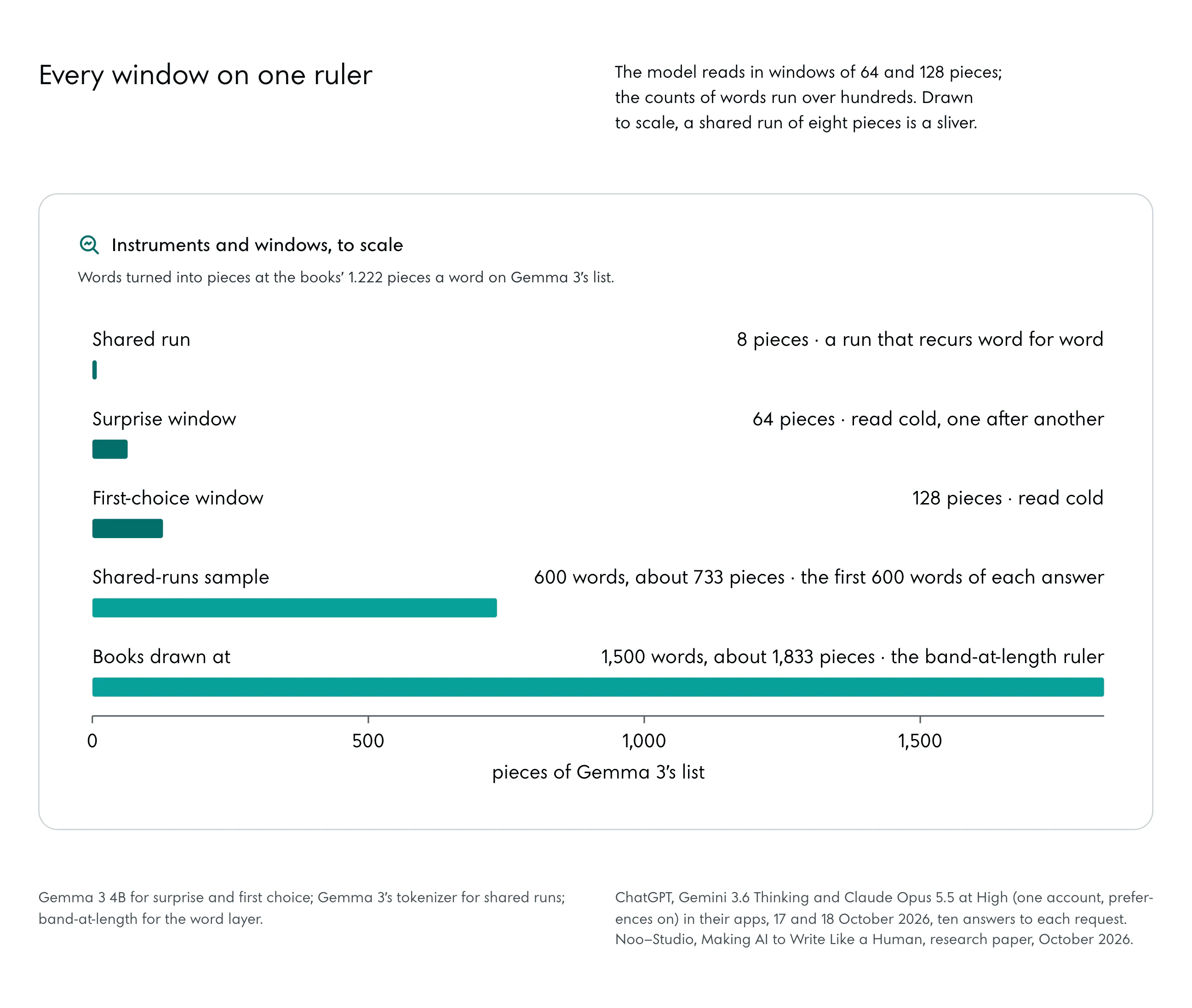
Labels on Every Claim
Documented, measured and theory are the three words set in bold. To be documented, a line has to stand on a public page opened for this paper. A measured figure comes from the studio’s run, with its model, window and n beside it.
Theory is whatever goes beyond those two, and it is always given with the test that would break it: the three theories of the part before last, the three readings of Claude’s plain answers, and the studio’s reading of what sameness means for search.
The founder’s words are quoted as he said them, from the conversations in which the run was planned and read. They are first-hand statements of what he asked and why, and none of them is offered as evidence for a result.
Dates of the Run
Times are given here once, in Poland time. Eight measures were written down with their expected results on 17 October 2026 at 22:01, before any of their runs, and fingerprinted with SHA-256 b7e31b2e7655939f96ca95673a7710bffbb155e4c653101abe3e80d94cf8e8e9 on the founder’s day page of 18 October; the record has not changed since. The answers were collected on 17 and 18 October in a browser, from paid accounts, each request in a temporary or incognito chat.
Gemini’s styled answers 7 to 10 came from a second account after the first reached its limit on Thinking, and styled answer 9 was run again at 08:40 on 18 October after the first attempt was lost when its tab closed. Every other measure, the encyclopedia readings among them, was added on 18 October after the answers were in, and the founder’s ruling that the paper report results as research, without the forecast in the running text, was given that morning at 08:57. Gemma’s twenty answers were run on this Mac on 18 October from 13:17 to 14:40, after the sixty were in, and none of its measures was fixed before the run.
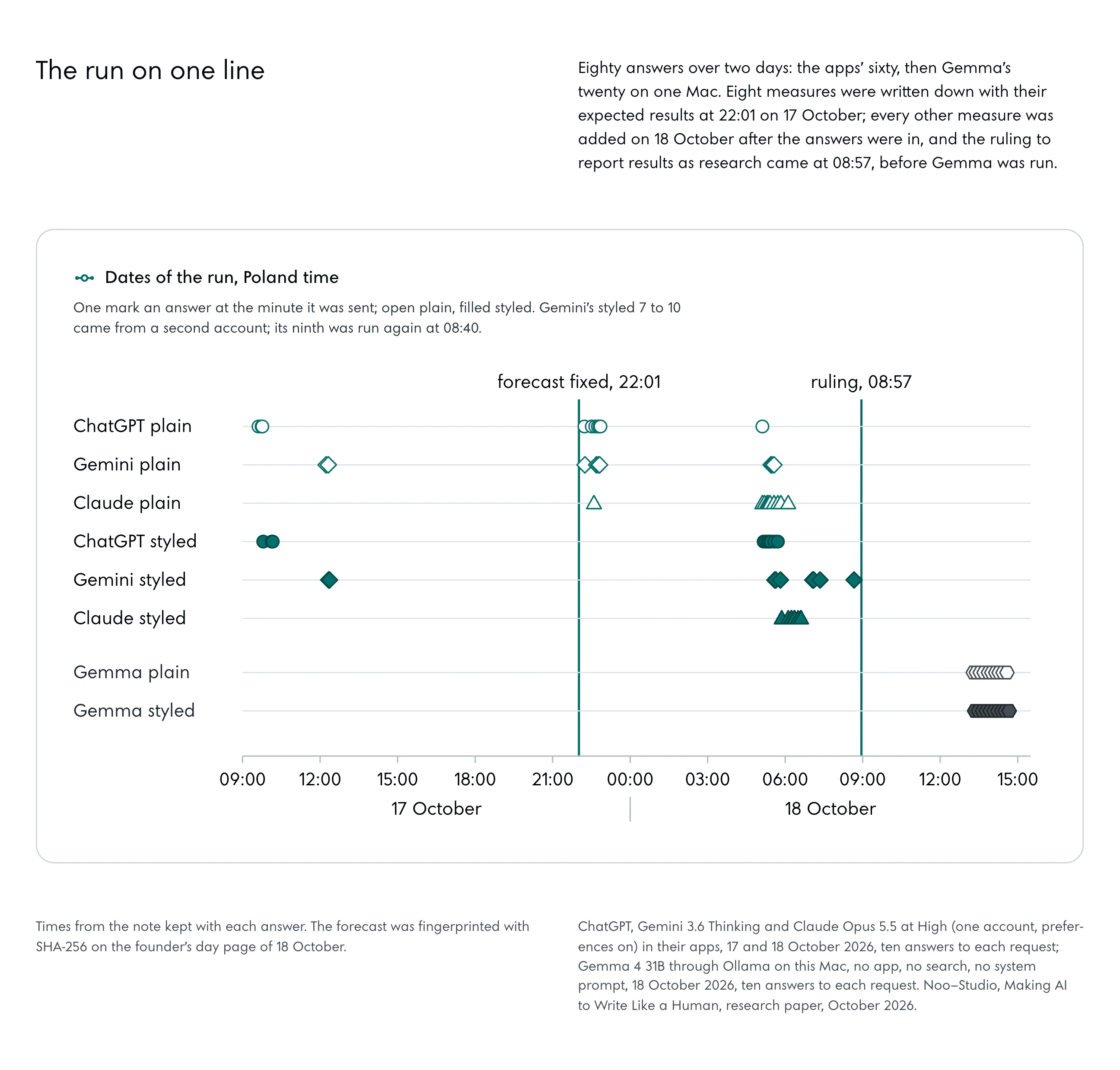
Search Inside the Apps
Each app decided for itself whether to search the web, as it does for anyone who types the request, and the note kept with every answer records what it did.
- ChatGPT searched before all twenty of its answers, plain and styled.
- Gemini showed a list of sources under one plain answer of ten; no search is recorded for the other nineteen.
- Claude searched before all ten plain answers and three of the ten styled ones.
- Gemma, on one Mac, had no search to use.
The cells were kept as they came, since search is part of what each assistant is when a person uses it. Theory: pages read during a search lend their definitions and title patterns to the answer, which would make one assistant’s plain answers more alike. The two assistants that searched every time returned the most repeated openings, and the one that rarely searched gave ten different titles, which fits the reading and does not prove it.
It breaks if the same request with search switched off returns answers just as alike; that run was not made. Gemma, which never searched, weighs against it: its plain answers repeat more than any app’s, 39.0 % shared runs, and six of ten open their titles on the same words. It is a different model, so it does not break the reading, and it fits the theory of the default article better than this one.
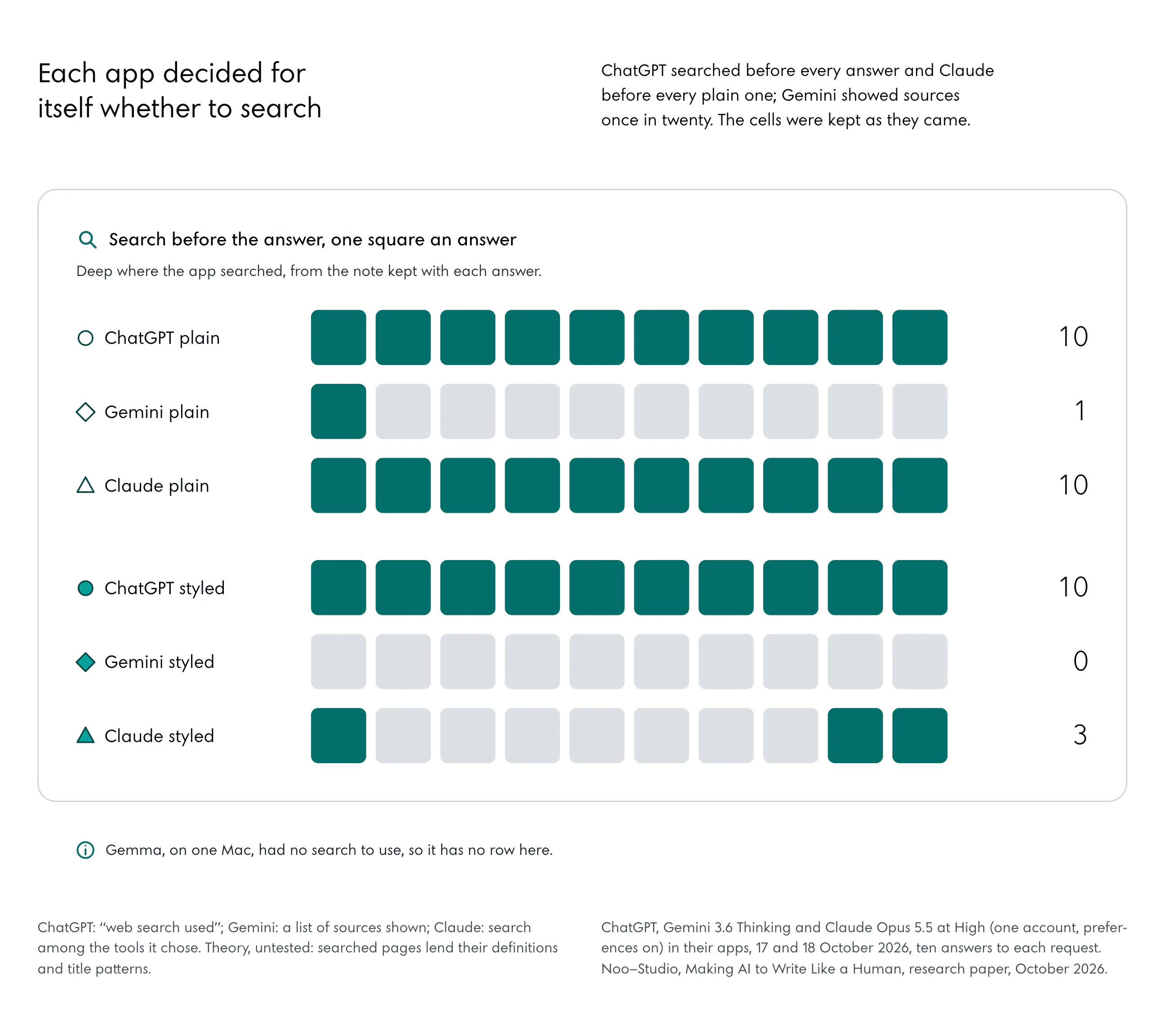
Omitted From This Paper
Left out, first, is any answer obtained through the companies’ interfaces for programs. Runs made that way to test sampling temperature were excluded by the founder on 17 October, since a person writing in an app never sees the setting, and answers from a newer Gemini model reached the same way on 18 October stay outside the paper under the same ruling.
- People to the same brief. No cell of ten people writing to “Write me an article about SEO.” exists, so the books give shared runs and first choices a floor and nothing like a match.
- Two of the six rules. Groups of three and taking positions have no count in this run.
- Claude without the account. The same request with the preferences off, or from a fresh account, was not run, by the founder’s choice.
- Human texts in the embedding. Neither the books nor the encyclopedia were placed in EmbeddingGemma’s space, so the spread of the answers has no human value beside it.
- Other topics and languages. One topic in English was measured, over two days, on apps that may change in any week.
- Search held fixed. No assistant was run with search forced on or off, so its share in the sameness above is untested.
- Ranking. No engine’s treatment of any text here was observed.
The paper can be cited as Noo–Studio, Making AI to Write Like a Human, research paper, October 2026, https://noo-studio.com/paper/making-ai-to-write-like-a-human/. Its labels travel with any sentence lifted from it: a documented claim with its source, a measured claim with its model, window and n, and a theory with its breaking test.
15Testing and Validation
Eight measures had their results written down before the run, in 35 separate lines, and 29 of those lines held. This part gives each measure’s lines and what came back, and names the tests the run leaves open.
Lines Fixed Before the Run
Table 21 sets each fixed measure beside what came back. A line counts as held when the result met the count written for it. The lines cover the apps’ sixty answers only; Gemma was run after them, and every reading of its answers is exploratory.
| Measure | Lines written in advance | What came back | Lines held |
|---|---|---|---|
| Function words | All 60 answers below the books at their own length | 56 of 60 below; four styled Claude answers inside | 0 of 1 |
| Long words | Each plain cell above the books in 8 of 10 or more; each styled cell inside in 7 of 10 or more | Plain above in 10, 9 and 0 of 10; styled inside in 10 of 10 each | 5 of 6 |
| Sentence spread | Each styled cell inside in 8 of 10 or more; plain ChatGPT below in 7 of 10 or more | Styled inside in 10 of 10 each; plain ChatGPT below in 5 of 10 | 3 of 4 |
| Surprise | Each plain cell below the books in 9 of 10 or more; styled ChatGPT inside and styled Gemini above the books’ mean, 7 of 10 or more | Plain below in 10, 10 and 0 of 10; styled ChatGPT inside 10 of 10; styled Gemini above the mean 10 of 10 | 4 of 5 |
| First-choice share | All 30 plain answers above the books’ median window; each styled cell lower than its plain cell | 29 of 30 above; lower in all three | 3 of 4 |
| Contrast frame | Styled at most 1.0 a thousand words in 8 of 10 or more; plain ChatGPT at 3.0 or more in 7 of 10 or more, in a narrow and a wide count | Every line met, the closest at 8 of 10 | 8 of 8 |
| Paragraph spread | Each styled cell more varied than its plain cell, on means | ChatGPT 0.42 to 0.61 and Claude 0.46 to 0.51; Gemini 0.49 to 0.47 | 2 of 3 |
| Embedding distances | Each plain cell tighter than its distance to its own styled cell; the plain cells nearer each other than any to its own styled cell | Widest gap between plain cells 0.219, nearest plain-to-styled 0.253 | 4 of 4 |
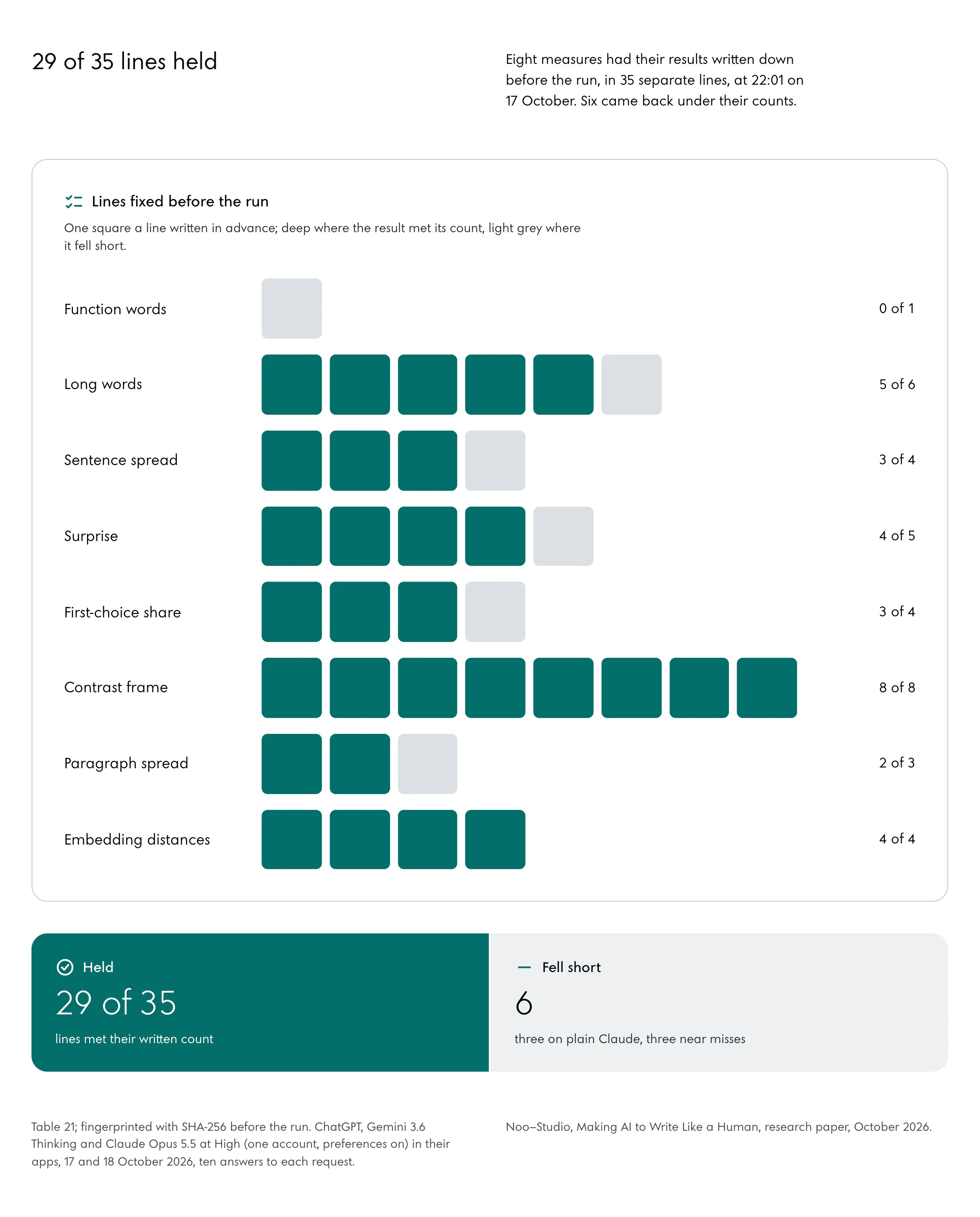
The numbers
| Measure | Lines | Held |
|---|---|---|
| Function words | 1 | 0 |
| Long words | 6 | 5 |
| Sentence spread | 4 | 3 |
| Surprise | 5 | 4 |
| First-choice share | 4 | 3 |
| Contrast frame | 8 | 8 |
| Paragraph spread | 3 | 2 |
| Embedding distances | 4 | 4 |
Where the Fixed Lines Fell Short
Six of the 35 came back under their counts, in two groups. Three concern plain Claude, whose long words, surprise and first choice already sat inside the books, the finding the part on Claude sets out. The other three are near misses: function words in 56 of 60 where all 60 were written, plain ChatGPT’s sentence spread below the books in 5 of 10 where 7 were written, and Gemini’s paragraph spread, which fell slightly on its mean while its median rose from 0.48 to 0.52.
That last line compared each styled cell with its own plain cell and needed no book figure; against the books, the styled cells reach their median and stay under their mean, as the part on paragraphs sets out.
One result had no line at all. That ChatGPT’s and Claude’s styled answers stay as tight in the embedding as their plain ones, the crossover this paper is built around, was read from the same distances after the run, and it is reported as exploratory for that reason.
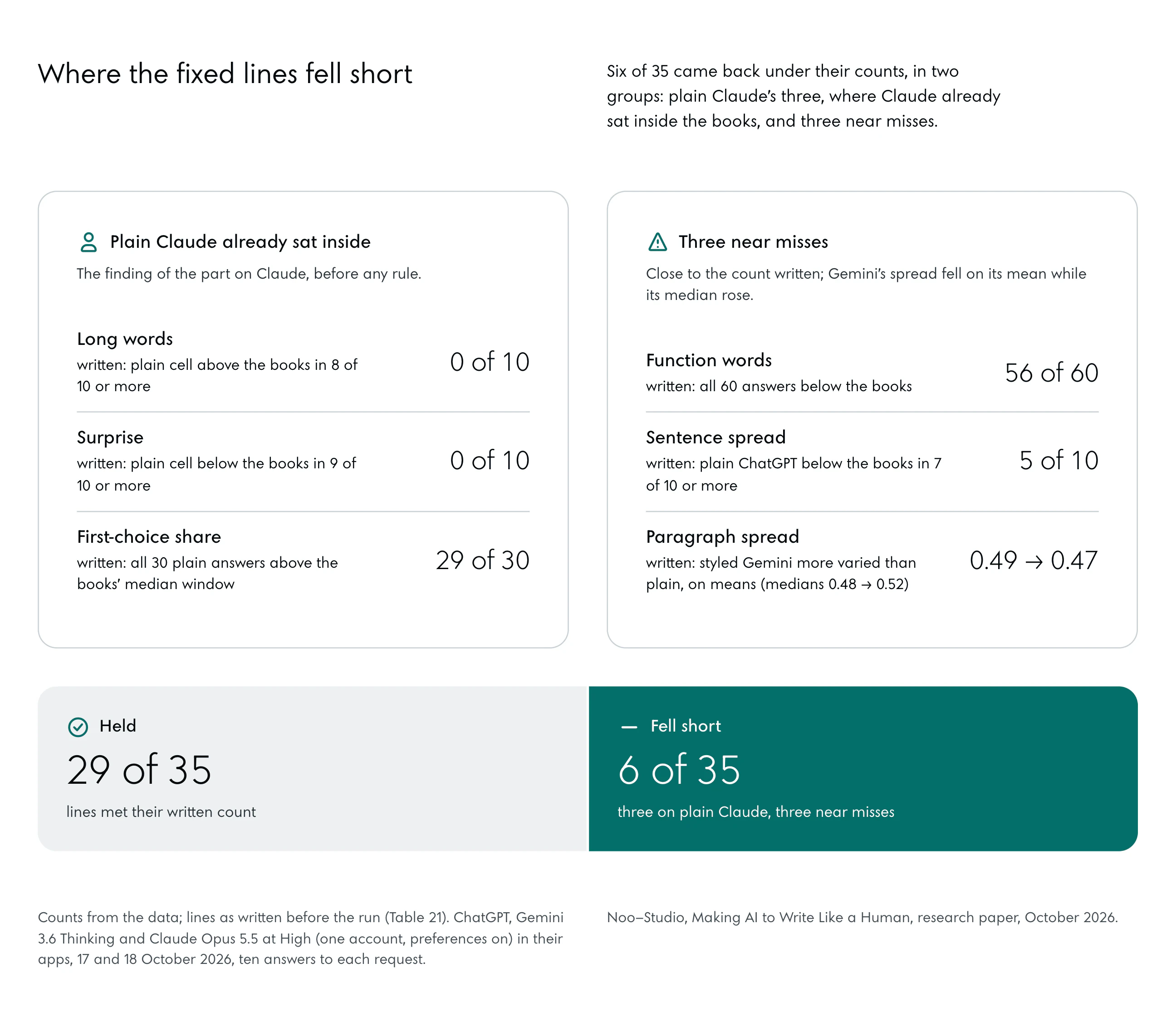
Questions Still Waiting
Each item below would settle something one run of sixty answers cannot.
- People to one brief. Ten writers sent “Write me an article about SEO.” would give shared runs, first choices and the embedding a human value on the same subject.
- Claude three ways. The same request from a fresh account, from the founder’s account with preferences off, and in the chat without a document page would separate the three readings of Claude’s plain answers.
- A reader of another family. Gemma 4 31B, eight times larger, kept the order; a model of another family reading the same windows would show how much of surprise and first choice belongs to Gemma at all.
- A rule for small words. Any styled request that names function words would test the first theory directly.
- The same run later. Apps change without notice, and the same two requests sent again in a later month would show how much of this picture belongs to October 2026.
16Sources
Every outside document this paper uses, by the kinds Table 20 counts, each at the address where it was read on 18 October 2026.
Papers and Reports
The founding papers of the four fields, the recent studies of machine writing and the reports of the two open models.
Founding papers of the four fields and their direct lineage
- Shannon, C. E. (1951). Prediction and Entropy of Printed English. Bell System Technical Journal 30(1): 50 to 64. Read in full at the Internet Archive.
- Mosteller, F., Wallace, D. L. (1963). Inference in an Authorship Problem. Journal of the American Statistical Association 58(302): 275 to 309.
- Burrows, J. (2002). ‘Delta’: a Measure of Stylistic Difference and a Guide to Likely Authorship. Literary and Linguistic Computing 17(3): 267 to 287.
- Broder, A. Z. (1997). On the resemblance and containment of documents. Compression and Complexity of SEQUENCES 1997: 21 to 29.
- Manku, G. S., Jain, A., Das Sarma, A. (2007). Detecting near-duplicates for web crawling. WWW 2007: 141 to 150.
- Sennrich, R., Haddow, B., Birch, A. (2015). Neural Machine Translation of Rare Words with Subword Units. arXiv 1508.07909.
- Holtzman, A., and colleagues (2019). The Curious Case of Neural Text Degeneration. arXiv 1904.09751; ICLR 2020.
- Gehrmann, S., Strobelt, H., Rush, A. M. (2019). GLTR: Statistical Detection and Visualization of Generated Text. arXiv 1906.04043.
Recent studies of machine writing
- Russell, J., Rajendhran, R., Pham, C. M., Iyyer, M., Wieting, J. (2026). StoryScope: Investigating idiosyncrasies in AI fiction. arXiv 2604.03136, v6 of 10 August 2026.
- Zaitsu, W., Jin, M., Ishihara, S., Tsuge, S., Inaba, M. (2025). Stylometry can reveal artificial intelligence authorship, but humans struggle. PLOS One 20(10): e0335369.
- Kobak, D., and colleagues (2025). Delving into LLM-assisted writing in biomedical publications through excess vocabulary. Science Advances.
- Padmakumar, V., He, H. (2024). Does Writing with Language Models Reduce Content Diversity? ICLR 2024.
- Reinhart, A., and colleagues (2025). Do LLMs write like humans? Variation in grammatical and rhetorical styles. PNAS.
- Shaib, C., and colleagues (2025). Standardizing the Measurement of Text Diversity: A Tool and a Comparative Analysis of Scores. AACL 2025.
Technical reports of the open models used
- Gemma Team (2025). Gemma 3 Technical Report. arXiv 2503.19786.
- Schechter Vera, H., and colleagues (2025). EmbeddingGemma: Powerful and Lightweight Text Representations. arXiv 2509.20354.
Published Pages
Google’s own guidance, the encyclopedia article measured in four revisions and the studio’s pages the paper builds on.
Google’s published pages
- Google Search Central. Spam policies for Google web search. Last updated 28 August 2026.
- Google Search Central Blog. Google Search’s guidance about AI-generated content. 8 February 2023.
Reference work
- Wikipedia. Search engine optimization, measured in four revisions, 2016 to 2022.
The studio’s own papers and pages
- Noo–Studio. Semantic Token Optimisation, research paper.
- Noo–Studio. Search, the advisory practice.
The Six Books
The people’s writing every measure is set against, from Project Gutenberg, in the public domain.
- Ernest Hemingway, The Sun Also Rises (1926).
- Virginia Woolf, Mrs. Dalloway (1925).
- Henry David Thoreau, Walden (1854).
- G. K. Chesterton, Orthodoxy (1908).
- Frederick Winslow Taylor, The Principles of Scientific Management (1911).
- Arnold Bennett, How to Live on 24 Hours a Day (1908).