A buyer asks a search engine, or an AI assistant, who does what your firm does. In a few seconds the answer names a handful of firms and quotes a page or two. Whether your firm is among them is rarely decided by what it spent that month. It was decided earlier, by how the firm is built.
That is the thesis of this studio: presence is a structure. It is not a campaign. This paper sets out what that means in practice, the order in which a structure is built, and what the studio’s own records show about structures that hold: sites that keep their place for months without being pushed, satellites that rise and fall with the site they stand on, and pages that the answer engines keep quoting after a search engine has turned away.
01What a Campaign Holds, and What a Structure Holds
An advertisement holds a place for as long as it is paid. When the budget stops, the place goes to whoever pays next. A campaign of posts holds attention for as long as someone keeps posting. Both are rented, and the rent is due every month.
A structure is different in kind. It is the way the firm is described, drawn and published, so that people and machines read the same thing every time they meet it. Built once and kept, it holds its place in search results and in AI answers for years, and it keeps doing so on the days nobody touches it.
The difference shows most clearly when something goes wrong. When Google removed the studio’s own reference network from its results in May 2026, every campaign-like measure of it went to zero at once. The structure underneath did not. Its definition pages, each stating one term plainly and saying so in structured data, kept being read by Bing and quoted by Copilot: two million citations in June, 2.72 million in the first 22 days of September. What was built held its value in every engine that kept it. The paper Every Engine Keeps Its Own Record sets out that record in full.
02Three Disciplines, Built as One
A presence is made of three disciplines. Each one is ordinary on its own. Built together, they do something none of them does alone.
Design decides the first second. The visual system, the mark, the colour, the type and the rules that hold them, is what a visitor reads before any sentence. It decides whether they stay. It has to be the same on every page and in every language, because a firm that looks different on each page reads as several small firms.
Data architecture decides what machines read. Every page can state, in structured data, who the firm is, what it offers, where, and in which language. Search engines and AI assistants read that layer before they read a sentence of copy. A page without it is a picture of text; a page with it is a set of facts a machine can repeat with confidence.
Search decides what gets recommended. Engines and assistants recommend what they can read with certainty. When the design holds and the data is plain, the firm is the safe answer to quote. When either is missing, the answer goes to someone whose pages are easier to read.
The three are connected in a way that is easy to miss. The words a visitor reads on the first screen are the same words the structured data states and the same words a search engine matches to a buyer’s question. When they are written once and placed in all three, the firm says one thing to everyone. When they are written three times by three people, it says three things, and the machine, which cannot ask, picks one or none.
03What a Machine Reads
It helps to see a structure the way a search engine or an assistant does, because they read a page in a different order from a person. A person sees the picture, the headline and the first lines. A machine reads first what the page declares about itself: what kind of thing it is, who published it, what it is about, how it relates to the other pages of the site. Only then does it read the text, and it trusts the text more when the declarations and the words agree.
This site is built that way, so it can serve as the example. The studio is declared once, as an organisation with its founder and the services it offers. Each service page declares the service it describes. Each paper declares itself as an article, with its author, its date and the terms it is about. Each term the papers use has its own page, declared as a defined term in the studio’s own set of terms, with its one-sentence definition first and the questions people ask about it. Each chart is declared as an image with its caption and its maker, and its numbers are printed beside it as a table a machine can read.
None of this is visible to a visitor, and all of it is read by every engine that visits. The effect is cumulative. A machine that has read the studio’s definition of a satellite, on a page that says exactly what a satellite is, can use that definition the next time someone asks, and can follow it to every paper that uses the word. The site becomes a set of connected facts rather than a set of pages, and connected facts are what an answer is made of.
A firm does not need a glossary to benefit. It needs the same discipline at its own scale: one statement of who it is, used everywhere; one page for each service, saying exactly what it is; one page for each question its buyers ask; and data on every page that says the same thing as the words.
04Three Suppliers, or One Structure
Each of the three disciplines can be bought separately, from three suppliers, and usually is. The design arrives from a studio, the site from an agency, the search from a freelancer, each with its own brief. The firm sits in the middle and holds them together.
| Three suppliers | One structure | |
|---|---|---|
| Who builds it | An agency for the site, a studio for the brand, a freelancer for the search, each with its own brief. | One practice, which draws the structure and builds every page on it. |
| What comes first | The look. | The structure: who it is for, the data, the pages. The look is drawn on top of it. |
| What the firm pays for | Hours, retainers and licences renewed every year. | A fixed scope in a fixed time. |
| What the firm owns | An account on someone else’s platform. | The domain, the server, the files and every login, in its name. |
| What happens after | A monthly report on traffic. | A dated check against the first record. |
The pieces rarely agree. The brand says one thing, the pages another, the structured data a third, if it exists at all. None of the suppliers is wrong in its own brief; the fault is that nobody owns the whole. The cost of that gap does not appear on any invoice. It appears as work done twice, as a site that has to be rebuilt when the brand changes, and as a search report that cannot say what it bought.
05The Six Layers, in Their Order
When the studio draws a presence, it decides it in six layers, always in the same order, so that each decision rests on one already made:
- Position: who the firm is for, and what it says first.
- Name: what the firm is called, in every language it lives in.
- Visual system: the mark, the colour, the type and their rules.
- Language: every line written in the firm’s voice.
- Content: the pages, the services and the posts, each with one job.
- Infrastructure: the theme, the server, and the data behind every page.
The order is the point. A visual system drawn before the position is decided is decoration that will be redrawn. A site built before the language is set is a set of pages that will be rewritten. Most of the cost of a presence is work done twice because it was done in the wrong order.
The order also explains why a structure compounds. Each layer is a decision that the next ones do not have to make again. A firm whose position and words are settled can add a page, a market or a language without opening the whole question; the new piece is built to fit. A firm whose position is not settled reopens it with every new piece, and pays for it each time.
06What the Studio’s Own Records Show
A thesis is only as good as its evidence, and the studio’s evidence is its own records: sites it built and runs, read from their own Search Console, Bing and Analytics accounts. Three of them show what a structure does that a campaign cannot.
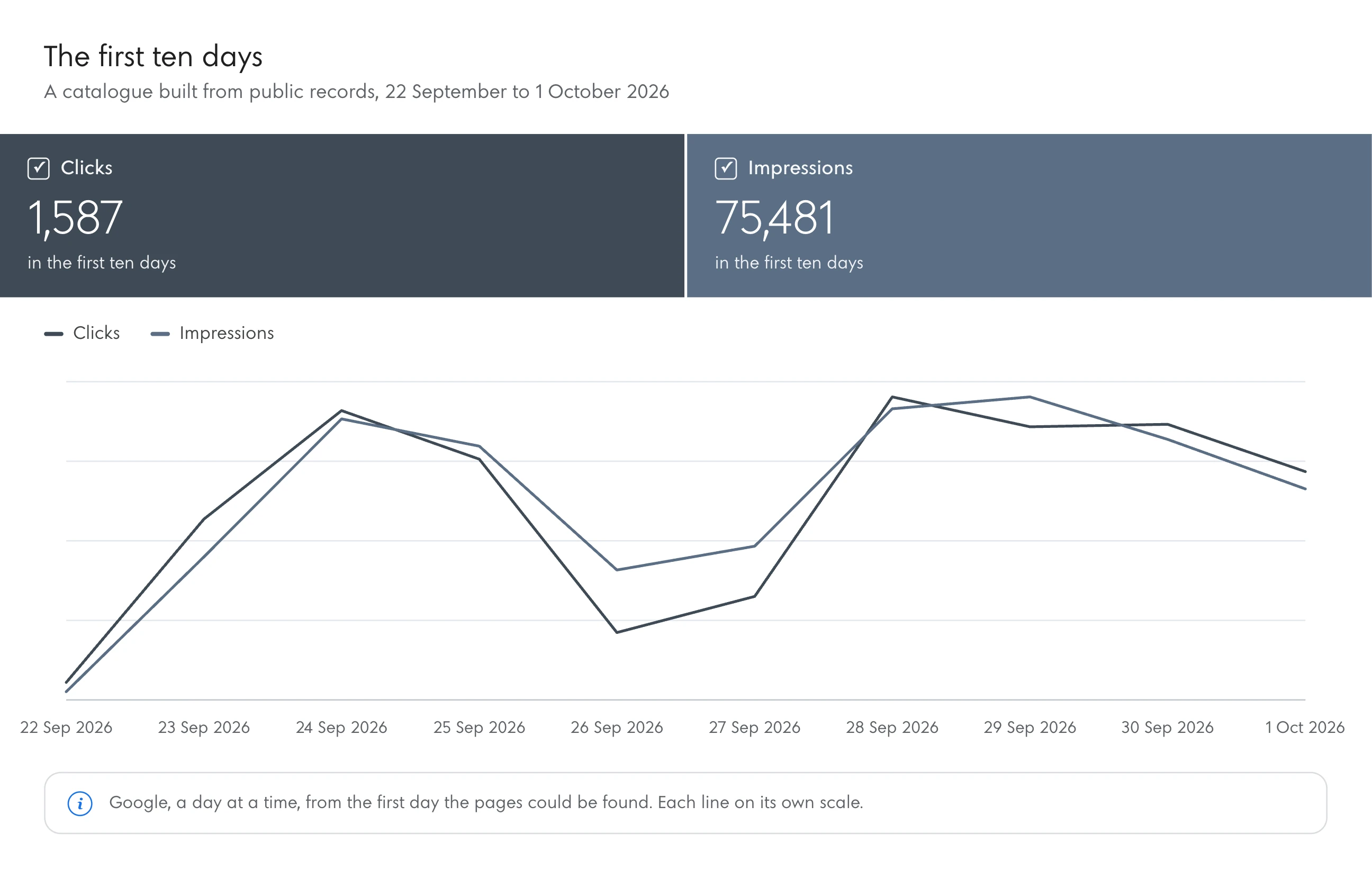
A structure is found from its second day. A catalogue the studio built from a regulator’s public records, every page stating one record plainly, with no AI-written text, drew clicks from Google on its second day. In its first ten days it was shown 75,189 times and clicked 1,579 times. Nothing was advertised. The structure was legible, so the engines read it at once.
The numbers
| Day | Clicks | Impressions |
|---|---|---|
| 22 Sep 2026 | 14 | 304 |
| 23 Sep 2026 | 145 | 5,307 |
| 24 Sep 2026 | 232 | 10,421 |
| 25 Sep 2026 | 193 | 9,411 |
| 26 Sep 2026 | 54 | 4,820 |
| 27 Sep 2026 | 83 | 5,702 |
| 28 Sep 2026 | 243 | 10,793 |
| 29 Sep 2026 | 219 | 11,239 |
| 30 Sep 2026 | 221 | 9,659 |
| 1 Oct 2026 | 183 | 7,825 |
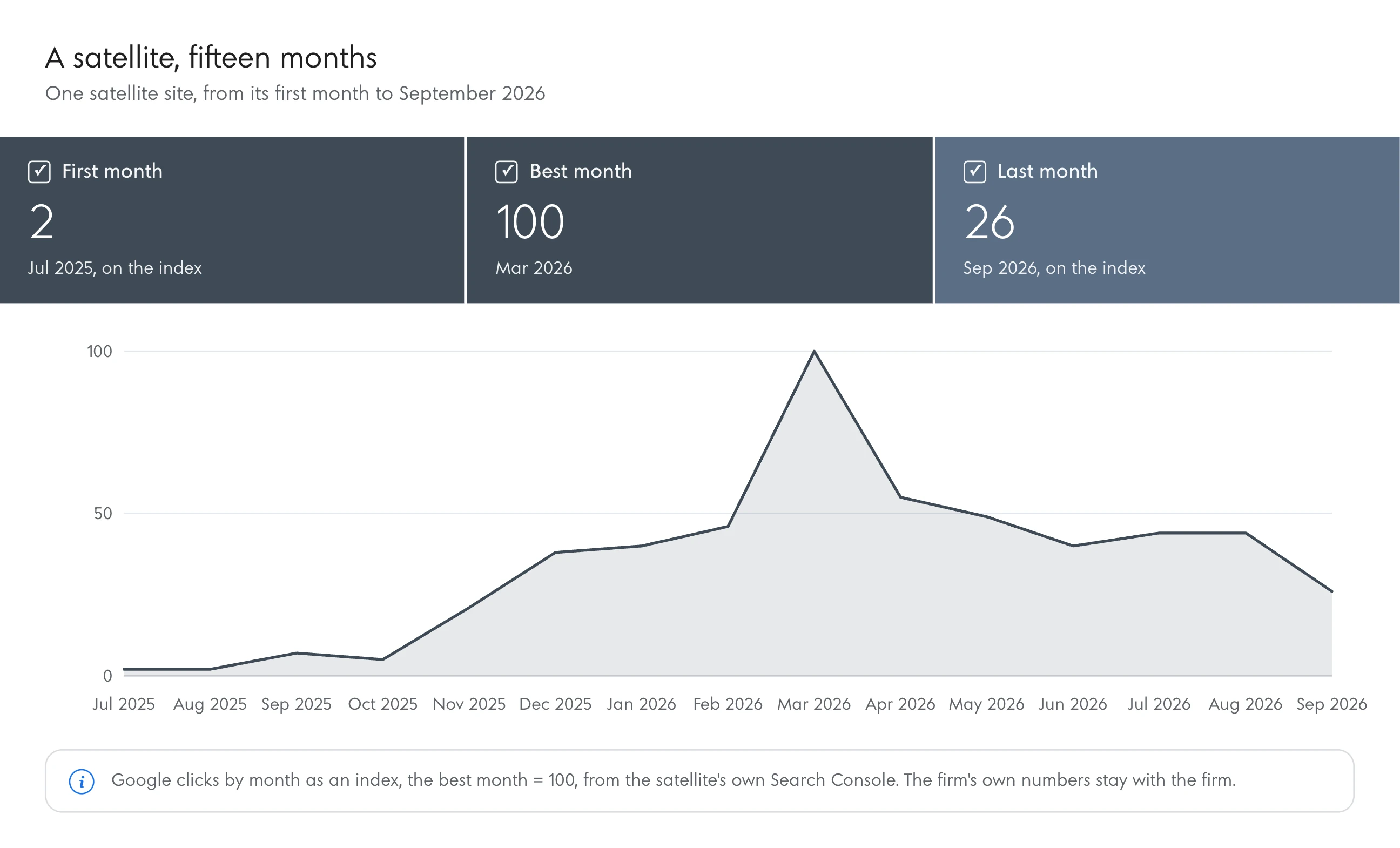
A satellite grows on its engine. A satellite site the studio built for a firm, answering the questions its buyers ask before they choose, drew 13.6 times as many clicks as in the same months a year earlier, on the same engine as the firm’s main site. The firm’s own numbers stay with the firm; its curve, as an index, shows the shape.
The numbers
| Month | Google clicks, index (best month = 100) |
|---|---|
| Jul 2025 | 2 |
| Aug 2025 | 2 |
| Sep 2025 | 7 |
| Oct 2025 | 5 |
| Nov 2025 | 21 |
| Dec 2025 | 38 |
| Jan 2026 | 40 |
| Feb 2026 | 46 |
| Mar 2026 | 100 |
| Apr 2026 | 55 |
| May 2026 | 49 |
| Jun 2026 | 40 |
| Jul 2026 | 44 |
| Aug 2026 | 44 |
| Sep 2026 | 26 |
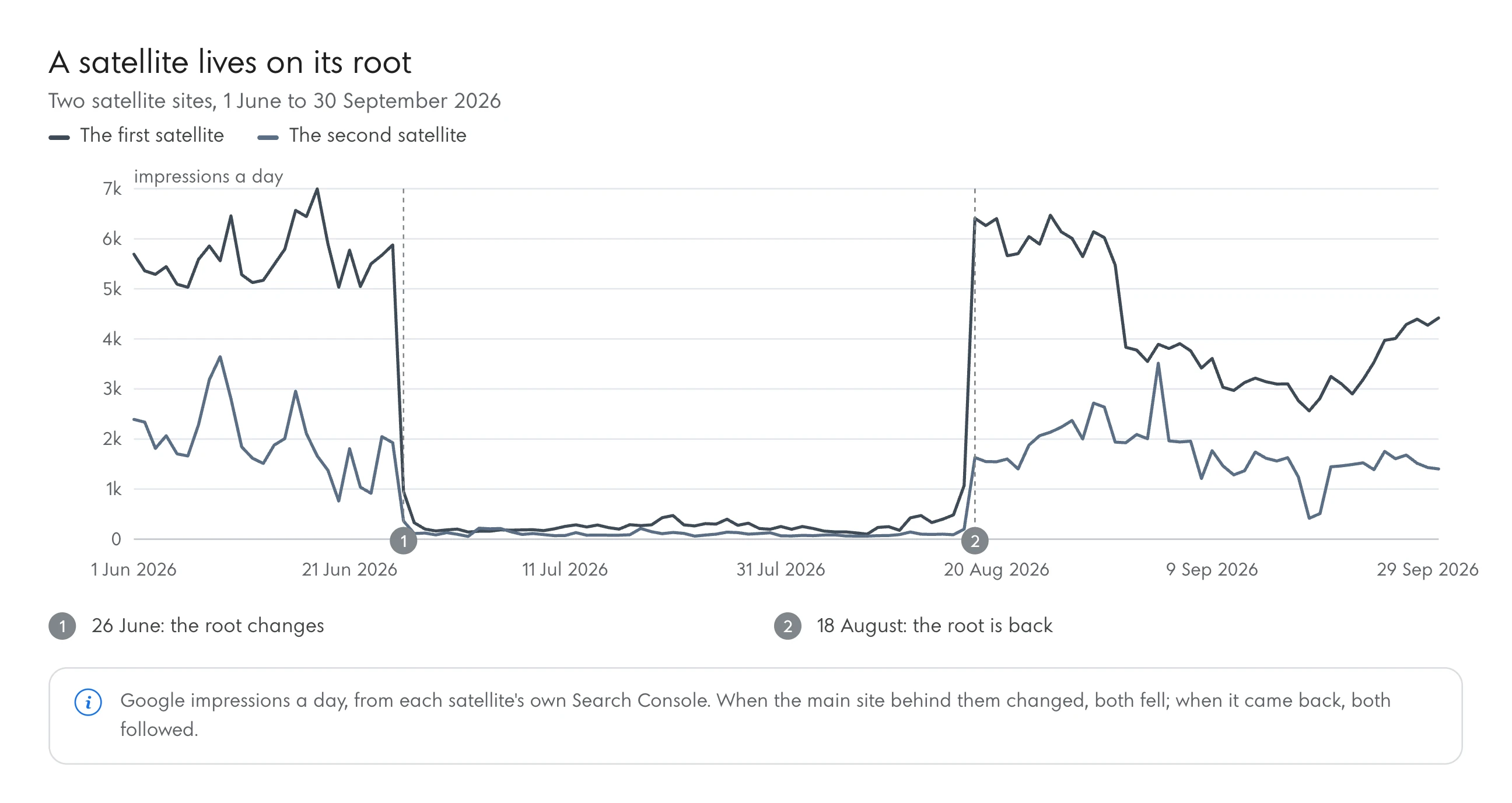
A satellite lives on its root. Two satellites of a brand, on its own domain, fell on the same day, 26 June 2026, when the site at the root of the domain changed. Nothing on the satellites had changed. They came back on the same day, 18 August, when the root was restored: 53 days, read day by day from their own Search Console. The first satellite averaged 5,757 impressions a day in the two weeks before the change, 251 while it lasted and 6,019 in the two weeks after.
The numbers
| Day | The first satellite | The second satellite |
|---|---|---|
| 1 Jun 2026 | 5,690 | 2,391 |
| 2 Jun 2026 | 5,361 | 2,337 |
| 3 Jun 2026 | 5,289 | 1,813 |
| 4 Jun 2026 | 5,446 | 2,066 |
| 5 Jun 2026 | 5,092 | 1,705 |
| 6 Jun 2026 | 5,030 | 1,663 |
| 7 Jun 2026 | 5,588 | 2,287 |
| 8 Jun 2026 | 5,855 | 3,188 |
| 9 Jun 2026 | 5,560 | 3,645 |
| 10 Jun 2026 | 6,459 | 2,804 |
| 11 Jun 2026 | 5,282 | 1,843 |
| 12 Jun 2026 | 5,125 | 1,616 |
| 13 Jun 2026 | 5,172 | 1,512 |
| 14 Jun 2026 | 5,483 | 1,879 |
| 15 Jun 2026 | 5,793 | 2,009 |
| 16 Jun 2026 | 6,567 | 2,954 |
| 17 Jun 2026 | 6,444 | 2,107 |
| 18 Jun 2026 | 6,998 | 1,661 |
| 19 Jun 2026 | 5,897 | 1,376 |
| 20 Jun 2026 | 5,032 | 762 |
| 21 Jun 2026 | 5,772 | 1,809 |
| 22 Jun 2026 | 5,046 | 1,039 |
| 23 Jun 2026 | 5,501 | 916 |
| 24 Jun 2026 | 5,673 | 2,048 |
| 25 Jun 2026 | 5,876 | 1,928 |
| 26 Jun 2026 | 952 | 363 |
| 27 Jun 2026 | 330 | 113 |
| 28 Jun 2026 | 202 | 122 |
| 29 Jun 2026 | 163 | 85 |
| 30 Jun 2026 | 186 | 132 |
| 1 Jul 2026 | 201 | 98 |
| 2 Jul 2026 | 142 | 54 |
| 3 Jul 2026 | 158 | 218 |
| 4 Jul 2026 | 159 | 207 |
| 5 Jul 2026 | 187 | 212 |
| 6 Jul 2026 | 180 | 147 |
| 7 Jul 2026 | 186 | 94 |
| 8 Jul 2026 | 190 | 112 |
| 9 Jul 2026 | 171 | 90 |
| 10 Jul 2026 | 206 | 69 |
| 11 Jul 2026 | 256 | 74 |
| 12 Jul 2026 | 287 | 131 |
| 13 Jul 2026 | 244 | 80 |
| 14 Jul 2026 | 283 | 82 |
| 15 Jul 2026 | 231 | 80 |
| 16 Jul 2026 | 201 | 80 |
| 17 Jul 2026 | 290 | 88 |
| 18 Jul 2026 | 272 | 213 |
| 19 Jul 2026 | 285 | 149 |
| 20 Jul 2026 | 428 | 109 |
| 21 Jul 2026 | 472 | 134 |
| 22 Jul 2026 | 286 | 116 |
| 23 Jul 2026 | 264 | 62 |
| 24 Jul 2026 | 311 | 81 |
| 25 Jul 2026 | 300 | 99 |
| 26 Jul 2026 | 400 | 139 |
| 27 Jul 2026 | 277 | 132 |
| 28 Jul 2026 | 320 | 100 |
| 29 Jul 2026 | 212 | 113 |
| 30 Jul 2026 | 198 | 128 |
| 31 Jul 2026 | 253 | 68 |
| 1 Aug 2026 | 199 | 63 |
| 2 Aug 2026 | 253 | 76 |
| 3 Aug 2026 | 212 | 71 |
| 4 Aug 2026 | 160 | 81 |
| 5 Aug 2026 | 147 | 84 |
| 6 Aug 2026 | 147 | 64 |
| 7 Aug 2026 | 125 | 62 |
| 8 Aug 2026 | 99 | 62 |
| 9 Aug 2026 | 233 | 71 |
| 10 Aug 2026 | 250 | 73 |
| 11 Aug 2026 | 176 | 92 |
| 12 Aug 2026 | 426 | 142 |
| 13 Aug 2026 | 472 | 100 |
| 14 Aug 2026 | 332 | 95 |
| 15 Aug 2026 | 399 | 100 |
| 16 Aug 2026 | 484 | 87 |
| 17 Aug 2026 | 1,071 | 201 |
| 18 Aug 2026 | 6,409 | 1,632 |
| 19 Aug 2026 | 6,263 | 1,550 |
| 20 Aug 2026 | 6,404 | 1,547 |
| 21 Aug 2026 | 5,660 | 1,601 |
| 22 Aug 2026 | 5,702 | 1,404 |
| 23 Aug 2026 | 6,044 | 1,878 |
| 24 Aug 2026 | 5,893 | 2,066 |
| 25 Aug 2026 | 6,470 | 2,136 |
| 26 Aug 2026 | 6,139 | 2,237 |
| 27 Aug 2026 | 6,007 | 2,371 |
| 28 Aug 2026 | 5,644 | 2,001 |
| 29 Aug 2026 | 6,142 | 2,718 |
| 30 Aug 2026 | 6,022 | 2,640 |
| 31 Aug 2026 | 5,479 | 1,938 |
| 1 Sep 2026 | 3,832 | 1,926 |
| 2 Sep 2026 | 3,777 | 2,092 |
| 3 Sep 2026 | 3,549 | 2,006 |
| 4 Sep 2026 | 3,892 | 3,516 |
| 5 Sep 2026 | 3,808 | 1,962 |
| 6 Sep 2026 | 3,905 | 1,943 |
| 7 Sep 2026 | 3,761 | 1,956 |
| 8 Sep 2026 | 3,419 | 1,210 |
| 9 Sep 2026 | 3,610 | 1,768 |
| 10 Sep 2026 | 3,035 | 1,463 |
| 11 Sep 2026 | 2,970 | 1,285 |
| 12 Sep 2026 | 3,129 | 1,365 |
| 13 Sep 2026 | 3,217 | 1,740 |
| 14 Sep 2026 | 3,145 | 1,615 |
| 15 Sep 2026 | 3,097 | 1,560 |
| 16 Sep 2026 | 3,102 | 1,627 |
| 17 Sep 2026 | 2,767 | 1,241 |
| 18 Sep 2026 | 2,564 | 416 |
| 19 Sep 2026 | 2,814 | 512 |
| 20 Sep 2026 | 3,249 | 1,445 |
| 21 Sep 2026 | 3,101 | 1,464 |
| 22 Sep 2026 | 2,899 | 1,492 |
| 23 Sep 2026 | 3,189 | 1,525 |
| 24 Sep 2026 | 3,533 | 1,388 |
| 25 Sep 2026 | 3,971 | 1,753 |
| 26 Sep 2026 | 4,007 | 1,607 |
| 27 Sep 2026 | 4,287 | 1,679 |
| 28 Sep 2026 | 4,395 | 1,517 |
| 29 Sep 2026 | 4,273 | 1,430 |
| 30 Sep 2026 | 4,420 | 1,402 |
The lesson of the third record is the one most often missed. A structure is a whole, and its parts carry each other. A satellite borrows the standing of the site it stands on; a page borrows the consistency of the pages around it. That is why the studio watches the root of every system it runs each day, and why a change to the root is treated as a change to every site on it.
07Production by Machines, Decisions by People
The studio builds with AI, and has since 2024. Pages, records and reports are produced by machines; images are made in the brand’s style by machines; outlines and documents are written out by the site itself whenever an entry changes. The Fulcrum Point site, a Moon the studio built for a practice that trains corporate teams in sustainability, writes the PDF outline of each of its fifty-two workshops every time one is saved, in the practice’s brand.
What is not automated is every decision: who the firm is for, what it says first, which page owns which question, what goes in the order of work. Those are made by people, in a room or in a conversation with the people who decide. The division is deliberate. Production is where a machine is faster and more consistent than a person. Judgement is where it is not, and where a firm’s money is actually won or lost.
The records explain why the line matters. The studio’s reference network, built with AI at very large scale in 2024 and 2025, was removed by Google in 2026 for producing pages in bulk. The structure that survived it, the plain definition pages that the answer engines kept quoting, was the part that had been decided rather than multiplied. Since then the studio’s rule is short: machines produce, people decide, and pages multiply only from data a firm holds that nobody else has.
08Built for One Firm
A structure is drawn for one firm, not filled into a template. The position is the firm’s, the words are its buyers’, the pages are the ones its questions need, the languages are the ones its markets read. Two firms in the same field get two different structures, because they are not the same firm.

Owners notice the difference at once. A proposal drawn from a firm’s own records, its own buyers’ words and its own search data reads differently from a framework that has been offered to everyone else, and the conversation about price changes with it. The studio’s experience is that once a firm can see its own structure on the table, the question stops being whether the work is worth its price and becomes which part to build first.
09What Holds
When the three disciplines are built together, in that order, a few things change that a campaign cannot buy.
The firm says the same thing everywhere, so a buyer who meets it three times meets one firm. Search engines find a consistent set of facts, so they stop guessing. AI assistants find a page that states plainly what the firm does, so they can quote it. And the people in the firm stop spending their days patching the pieces together, because the pieces were made to fit.
None of this needs to be large. The smallest complete structure the studio builds is a Moon: one site, its words and its photographs, the brand book and the templates, email on the firm’s own domain and search set up, made from one conversation and handed over in one week, in the firm’s name. Everything larger, a catalogue abroad or a system of sites on one engine, is the same structure at a greater size.
A firm that is built this way is found because of what it is. That is the only kind of being found that keeps.
10Method and Sources
The reference network is the Sustainability Directory: Bing Webmaster Tools’ AI Performance report and Search Console, November 2025 to September 2026; its full record is in the paper Every Engine Keeps Its Own Record.
The catalogue from public records: Search Console, daily, 22 September to 1 October 2026, from its own property; the case Public Records, Made Readable.
The satellite’s fifteen months: Search Console, monthly, July 2025 to September 2026, from the satellite’s own property, shown as an index; the firm is not named. The case: A Satellite, Fifteen Months.
The two satellites and their root: Search Console of both satellites, daily, June to September 2026; the root’s change and its restoration as recorded by the studio, which runs both. The brand is not named. The case: A Satellite Lives on Its Root.
Fulcrum Point: its site and its fifty-two workshops are described in the case A Practice, Set Up Once.