A firm’s main site says who the firm is, what it does and how to reach it. It cannot also answer every question a buyer asks before choosing: what a document is, how a process works, which rule applies in another market, what a term means. Those questions are asked far more often than the firm’s name, and each of them by few people. A satellite is the studio’s answer to them: a smaller site on the same engine as the main site, made for one market or one question, that sends its readers to the main site.
This paper sets out what the studio has measured about satellites, from three records. One satellite, built for a firm in mid-2025 and read month by month for fifteen months. Two satellites of another brand, which fell on the day the main site on their domain changed and came back on the day it was restored. And the Sustainability Directory, a network of eleven subject sites that grew fast and was then removed from Google, which showed the studio where the limit lies. The two client records are unnamed, and the first is given in relative figures only, as its agreement requires.
| Source | What it shows | How it was read |
|---|---|---|
| A firm’s satellite, fifteen months | what a satellite is for, and how it grows | the firm’s own Search Console and Analytics, June 2025 to September 2026 |
| Two satellites of one brand | what a satellite lives on | each satellite’s Search Console, day by day, June 2025 to October 2026 |
| The Sustainability Directory | where the limit lies | the network’s own accounts, April 2024 to September 2026 |
01What a Satellite Is For
The firm’s satellite was built in mid-2025 on a subdomain of the firm’s own domain, on the studio’s engine, to answer what the firm’s buyers ask before they choose. Its search shows what that job looks like in numbers.
Nearly nine in ten of the clicks it received in the summer of 2026 came from searches Google does not list at all, because each was asked by too few people to be shown. Of the searches Google did list for the satellite, about one in a hundred also showed the firm’s main site. The two sites were not reaching for the same readers. The main site answered for the firm; the satellite answered the questions.
The test that matters runs the other way, from the main site’s past. The main site’s own Google clicks in the summer of 2026 were about two fifths lower than a year before, and a satellite on the same domain is the first suspect. The record clears it. Of all the searches that had brought the main site its clicks in the summer of 2025, about one in a hundred showed the satellite a year later, and the main site’s clicks on those few searches held steady. Its losses came from searches the satellite never appeared for.
That is the job, and the reason it needs its own site. The questions are many, each is rare, and they belong to a market or a subject rather than to the firm. A main site that tried to answer them all would bury its own offer under them. A satellite holds them in a place built for them, and points to the firm wherever an answer leads to what the firm does.
02How a Satellite Grows
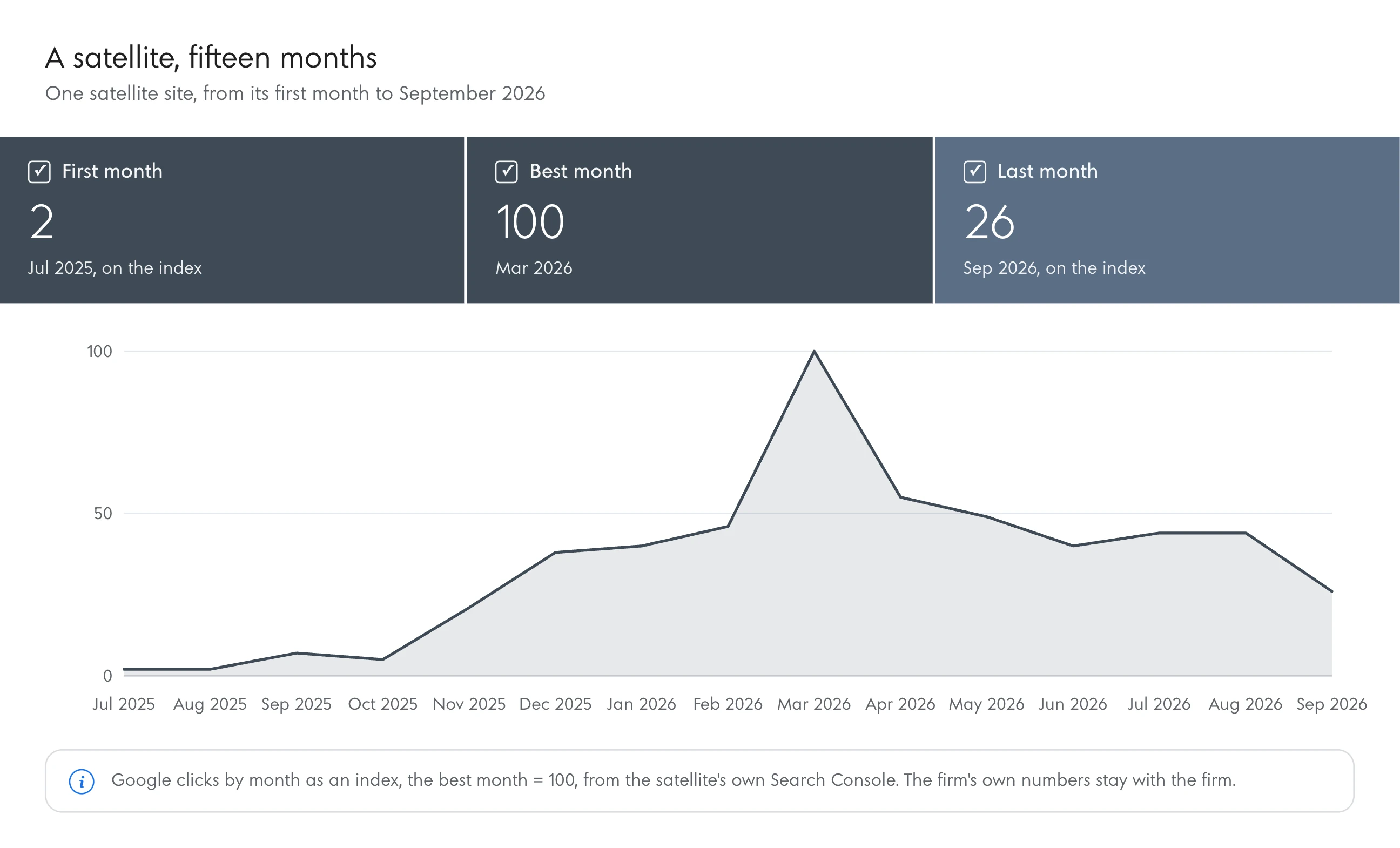
This satellite grew slowly at first, then quickly, then steadily.
The numbers
| Month | Google clicks, index (best month = 100) |
|---|---|
| Jul 2025 | 2 |
| Aug 2025 | 2 |
| Sep 2025 | 7 |
| Oct 2025 | 5 |
| Nov 2025 | 21 |
| Dec 2025 | 38 |
| Jan 2026 | 40 |
| Feb 2026 | 46 |
| Mar 2026 | 100 |
| Apr 2026 | 55 |
| May 2026 | 49 |
| Jun 2026 | 40 |
| Jul 2026 | 44 |
| Aug 2026 | 44 |
| Sep 2026 | 26 |
Its first month brought almost nothing: 2 on that scale. It grew slowly through its first autumn, reached 21 in November and 38 in December, and more than doubled again by March 2026, its best month. It has held at a little under half of that since, between 40 and 55 in every month from April to August.
Measured over the same weeks a year apart, from 25 June to 22 September, the satellite drew 13.6 times the Google clicks of 2025. Its average position rose from 20.4 to 10.4, though part of that move is Google’s own: in September 2025 Google changed how it counts results, which moved the positions and impressions Search Console reports. That is why the year is compared in clicks.
Across the firm’s whole domain, Google clicks in those weeks were 1.7 times those of a year before, and seven in ten came through the satellite. The firm had gained an entrance, not moved its front door.
03What a Satellite Leads To
A satellite that is found but leads nowhere is a reference site with someone else’s name on it. The studio counts what follows the click.
The hand-off. In the summer quarter of 2026 the satellite’s readers followed its links through to the main site five times as often as in the spring quarter. Nearly nine in ten of those hand-offs began on its glossary, the pages that define one term each, and the page they reached most often was the contact form. A definition is where a reader decides whether the firm knows its subject; the link at the end of it is where the reader acts on that.
The quote. The AI answers quote what they can rely on, and being quoted pays even in plain search. On the satellite, the pages that AI answers quoted drew 45 % more Google clicks than unquoted pages at the same position; on the main site, 79 % more. The readers who arrive from an AI assistant are further along, too: on the firm’s main site, about one visitor in five from ChatGPT started the contact form, against one in twenty-five from Google search.
The gap. The answer engines do not quote the pages that sell. On the firm’s main site, the pages that brought four in five contact-form openings drew one in ten of its appearances in AI answers; nearly four in five went to pages that brought none. The studio reads that as the strongest argument for a satellite in the record: what the answer engines quote is the explaining, so the explaining should sit where it can be quoted in full, with each explanation linked to the page that sells.
04What a Satellite Lives On
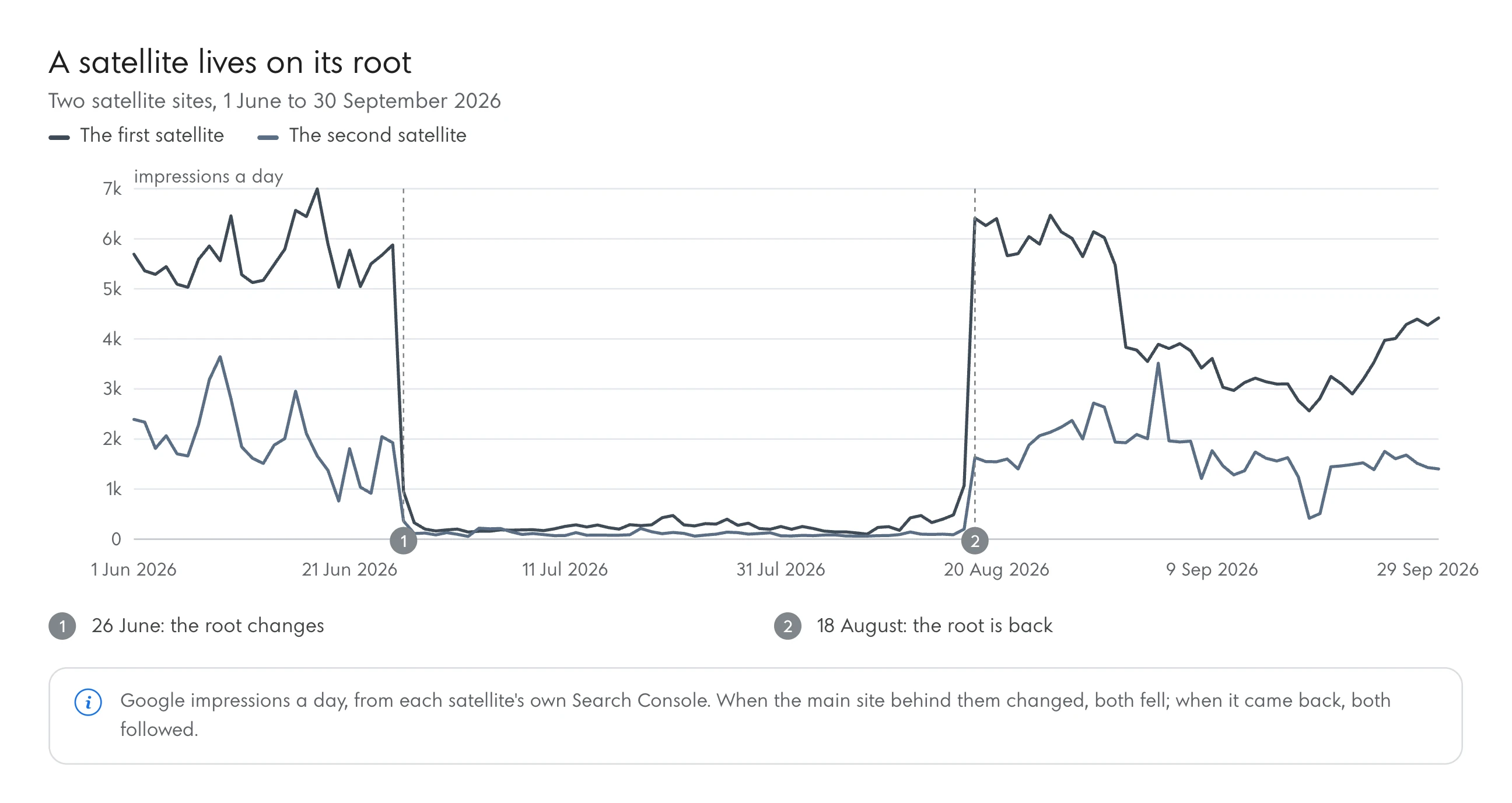
The second record is short and sharp. A brand runs two satellites on its own domain, beside the main site at its root. On 26 June 2026 the main site changed; on 18 August it was restored. Nothing on the satellites changed in between.
The numbers
| Day | The first satellite | The second satellite |
|---|---|---|
| 1 Jun 2026 | 5,690 | 2,391 |
| 2 Jun 2026 | 5,361 | 2,337 |
| 3 Jun 2026 | 5,289 | 1,813 |
| 4 Jun 2026 | 5,446 | 2,066 |
| 5 Jun 2026 | 5,092 | 1,705 |
| 6 Jun 2026 | 5,030 | 1,663 |
| 7 Jun 2026 | 5,588 | 2,287 |
| 8 Jun 2026 | 5,855 | 3,188 |
| 9 Jun 2026 | 5,560 | 3,645 |
| 10 Jun 2026 | 6,459 | 2,804 |
| 11 Jun 2026 | 5,282 | 1,843 |
| 12 Jun 2026 | 5,125 | 1,616 |
| 13 Jun 2026 | 5,172 | 1,512 |
| 14 Jun 2026 | 5,483 | 1,879 |
| 15 Jun 2026 | 5,793 | 2,009 |
| 16 Jun 2026 | 6,567 | 2,954 |
| 17 Jun 2026 | 6,444 | 2,107 |
| 18 Jun 2026 | 6,998 | 1,661 |
| 19 Jun 2026 | 5,897 | 1,376 |
| 20 Jun 2026 | 5,032 | 762 |
| 21 Jun 2026 | 5,772 | 1,809 |
| 22 Jun 2026 | 5,046 | 1,039 |
| 23 Jun 2026 | 5,501 | 916 |
| 24 Jun 2026 | 5,673 | 2,048 |
| 25 Jun 2026 | 5,876 | 1,928 |
| 26 Jun 2026 | 952 | 363 |
| 27 Jun 2026 | 330 | 113 |
| 28 Jun 2026 | 202 | 122 |
| 29 Jun 2026 | 163 | 85 |
| 30 Jun 2026 | 186 | 132 |
| 1 Jul 2026 | 201 | 98 |
| 2 Jul 2026 | 142 | 54 |
| 3 Jul 2026 | 158 | 218 |
| 4 Jul 2026 | 159 | 207 |
| 5 Jul 2026 | 187 | 212 |
| 6 Jul 2026 | 180 | 147 |
| 7 Jul 2026 | 186 | 94 |
| 8 Jul 2026 | 190 | 112 |
| 9 Jul 2026 | 171 | 90 |
| 10 Jul 2026 | 206 | 69 |
| 11 Jul 2026 | 256 | 74 |
| 12 Jul 2026 | 287 | 131 |
| 13 Jul 2026 | 244 | 80 |
| 14 Jul 2026 | 283 | 82 |
| 15 Jul 2026 | 231 | 80 |
| 16 Jul 2026 | 201 | 80 |
| 17 Jul 2026 | 290 | 88 |
| 18 Jul 2026 | 272 | 213 |
| 19 Jul 2026 | 285 | 149 |
| 20 Jul 2026 | 428 | 109 |
| 21 Jul 2026 | 472 | 134 |
| 22 Jul 2026 | 286 | 116 |
| 23 Jul 2026 | 264 | 62 |
| 24 Jul 2026 | 311 | 81 |
| 25 Jul 2026 | 300 | 99 |
| 26 Jul 2026 | 400 | 139 |
| 27 Jul 2026 | 277 | 132 |
| 28 Jul 2026 | 320 | 100 |
| 29 Jul 2026 | 212 | 113 |
| 30 Jul 2026 | 198 | 128 |
| 31 Jul 2026 | 253 | 68 |
| 1 Aug 2026 | 199 | 63 |
| 2 Aug 2026 | 253 | 76 |
| 3 Aug 2026 | 212 | 71 |
| 4 Aug 2026 | 160 | 81 |
| 5 Aug 2026 | 147 | 84 |
| 6 Aug 2026 | 147 | 64 |
| 7 Aug 2026 | 125 | 62 |
| 8 Aug 2026 | 99 | 62 |
| 9 Aug 2026 | 233 | 71 |
| 10 Aug 2026 | 250 | 73 |
| 11 Aug 2026 | 176 | 92 |
| 12 Aug 2026 | 426 | 142 |
| 13 Aug 2026 | 472 | 100 |
| 14 Aug 2026 | 332 | 95 |
| 15 Aug 2026 | 399 | 100 |
| 16 Aug 2026 | 484 | 87 |
| 17 Aug 2026 | 1,071 | 201 |
| 18 Aug 2026 | 6,409 | 1,632 |
| 19 Aug 2026 | 6,263 | 1,550 |
| 20 Aug 2026 | 6,404 | 1,547 |
| 21 Aug 2026 | 5,660 | 1,601 |
| 22 Aug 2026 | 5,702 | 1,404 |
| 23 Aug 2026 | 6,044 | 1,878 |
| 24 Aug 2026 | 5,893 | 2,066 |
| 25 Aug 2026 | 6,470 | 2,136 |
| 26 Aug 2026 | 6,139 | 2,237 |
| 27 Aug 2026 | 6,007 | 2,371 |
| 28 Aug 2026 | 5,644 | 2,001 |
| 29 Aug 2026 | 6,142 | 2,718 |
| 30 Aug 2026 | 6,022 | 2,640 |
| 31 Aug 2026 | 5,479 | 1,938 |
| 1 Sep 2026 | 3,832 | 1,926 |
| 2 Sep 2026 | 3,777 | 2,092 |
| 3 Sep 2026 | 3,549 | 2,006 |
| 4 Sep 2026 | 3,892 | 3,516 |
| 5 Sep 2026 | 3,808 | 1,962 |
| 6 Sep 2026 | 3,905 | 1,943 |
| 7 Sep 2026 | 3,761 | 1,956 |
| 8 Sep 2026 | 3,419 | 1,210 |
| 9 Sep 2026 | 3,610 | 1,768 |
| 10 Sep 2026 | 3,035 | 1,463 |
| 11 Sep 2026 | 2,970 | 1,285 |
| 12 Sep 2026 | 3,129 | 1,365 |
| 13 Sep 2026 | 3,217 | 1,740 |
| 14 Sep 2026 | 3,145 | 1,615 |
| 15 Sep 2026 | 3,097 | 1,560 |
| 16 Sep 2026 | 3,102 | 1,627 |
| 17 Sep 2026 | 2,767 | 1,241 |
| 18 Sep 2026 | 2,564 | 416 |
| 19 Sep 2026 | 2,814 | 512 |
| 20 Sep 2026 | 3,249 | 1,445 |
| 21 Sep 2026 | 3,101 | 1,464 |
| 22 Sep 2026 | 2,899 | 1,492 |
| 23 Sep 2026 | 3,189 | 1,525 |
| 24 Sep 2026 | 3,533 | 1,388 |
| 25 Sep 2026 | 3,971 | 1,753 |
| 26 Sep 2026 | 4,007 | 1,607 |
| 27 Sep 2026 | 4,287 | 1,679 |
| 28 Sep 2026 | 4,395 | 1,517 |
| 29 Sep 2026 | 4,273 | 1,430 |
| 30 Sep 2026 | 4,420 | 1,402 |
Both satellites fell on the day of the change and came back on the day of the restoration, 53 days later, with no step of their own.
| Impressions a day | Before: 12 to 25 June | During: 27 June to 16 August | After: 18 to 31 August |
|---|---|---|---|
| The first satellite | 5,741 | 252 | 6,020 |
| The second satellite | 1,687 | 105 | 1,980 |
A satellite on a firm’s domain is found partly on what Google already trusts about that domain. Its pages are its own, but its standing is shared, and it moves with the root. That has three consequences for how a System is run:
- A change on the root is a move. A new main site, new addresses or a lost verification is planned like a move, with every redirect and every record in place before the day, because every satellite moves with it.
- The root belongs in the agreement. Who owns the root domain, and who may change it, is written down before the first satellite is built.
- The record is read often enough to see a fall. A month is long enough for a satellite to lose most of its readers; the studio reads each System’s search against its first month and reports it every month.
05Where the Limit Lies
The third record is the one that set the rules. The Sustainability Directory, the studio’s own reference of sustainability terms, questions and topics, ran on the studio’s engine from April 2024 as a root site and eleven subject subdomains, from climate and energy to fashion and pollution. It was built with AI from its first month. Its subjects reached a thousand visits from search a day within six to eleven months of opening, and by March 2026 the network drew 370,755 clicks a month from Google alone. At its largest Google knew about 26 million of its addresses.
On 30 May 2026 Google issued a manual action against the whole domain. Its notice names the techniques Google acts on, among them scaled content abuse: pages produced in bulk to rank rather than to help. The record of that verdict, and of the engines that kept reading the network after it, is set out in Every Engine Keeps Its Own Record.
The Directory’s subject sites were satellites by shape and not by measure. Each was built for a subject, on one engine, under one root. But together they held about 120,000 articles and a million collection pages, written by machines and linked into each other without a person deciding any one of them, and none was made for one market or one question of one firm. The verdict drew the line the studio now builds on: a satellite multiplies only what a firm actually knows.
| The Directory’s subject sites | A satellite now | |
|---|---|---|
| Made for | a broad subject | one market or one question of one firm |
| Its pages | written in bulk by machines | few, each from the firm’s own knowledge and data, approved before it goes live |
| Its terms | used wherever they fell | defined once, one sentence first, and used the same way everywhere |
| Its links | into each other | home, wherever an answer leads to what the firm does |
| Its measure | traffic | the questions answered, the quotes, the hand-offs and the enquiries |
06How the Studio Builds a Satellite
The three records give the method. It is the same for every satellite the studio builds on its engine:
- One market or one question. Each satellite is named in the agreement before work starts, with the market or the question it serves. A firm that sells in three markets may need three; a firm with one hard question may need one.
- The questions come from the firm’s own record. The buyers’ questions are found in the firm’s search data and in the AI answers, and each question is given one page.
- Terms are defined once. Each term the firm uses has one page, one sentence first, because the definition is what the answer engines quote; every piece uses the term the same way and links back to it.
- Every piece is the firm’s. Pieces are written from the firm’s own knowledge and data and approved by the firm before they go live. Pages multiply only from what the firm knows, never from text written to fill a template.
- Every answer leads home. Wherever an answer touches what the firm does, it links to the main site’s page that sells it, and the contact form is never far.
- The root is protected. Who owns the root, and who may change it, is in the agreement, and a change on the root is planned like a move.
- The record is kept. Every satellite is read against its first month and reported every month: what each page did, which AI answers quote it, which pages hand readers on, and which bring enquiries.
A satellite is not a way to have more pages. It is a way to answer the questions a firm’s buyers ask, in a place built for them, and to bring the people who ask them home.
07Method and Sources
- The firm’s satellite: the firm’s own Google Search Console (the satellite’s property, the main site’s and the domain’s) and Google Analytics, read on 24 and 25 September 2026. The summer quarter is 25 June to 22 September 2026, compared with 27 March to 24 June 2026 and with 25 June to 22 September 2025; the year is compared in clicks only, because Google’s change of September 2025 moved positions and impressions. The searches Google lists are the ones it does not withhold as rare; the overlap between the two sites is counted on those. The hand-offs are link clicks from the satellite to the main site as Analytics recorded them. The quoted-page comparison and the contact-form rates are from the firm’s AI visibility reading of 24 and 25 September 2026. Every figure is relative: the firm’s agreement keeps its name and its numbers private.
- The two satellites: each satellite’s Google Search Console, daily, 1 June 2025 to 2 October 2026; the dates of the change and the restoration from the brand’s own account. The averages are over the windows named in the table; the days of the fall and the return are left out of the middle window.
- The Sustainability Directory: as set out in Every Engine Keeps Its Own Record, from the network’s own Search Console, Bing Webmaster Tools and Analytics.
- Not claimed: that a satellite will grow on any particular timetable, or that the firm’s enquiries came from its satellite alone.