
A firm that sells in many markets needs its site in their languages, and the usual ways of getting there make each language a second system. A plugin lays translations over the pages and has to be kept in step with them. A site per country doubles the work for every market added. A translate button hands the job to the visitor’s browser and the firm’s words to a machine it never sees. Each way, the languages drift from the original a little more with every change.
This paper follows the other way, built by the studio for Sentiention, a firm that runs sourcing, market entry and ventures between Europe and China, at sentiention.com. On 18 September 2026 its site went from English alone to fifteen languages: asked for in the morning, built, translated, checked and live that night. Every language is ordinary pages, written once in English and followed in fourteen others, with no plugin and no second site. The first translations read as machine output, and the paper sets out why and what changed. It ends with the record of the first two weeks in search.
01One Source, Fourteen Followers
The shape is the simplest one WordPress allows, and that is its strength. English lives at the root of the site. Every other language is a tree of ordinary pages under its own two-letter home: the German home is a page at /de/, and the German services page is its child at /de/services/, keeping the English address after the prefix. Because every page keeps its English name, everything the site already did by name, its forms, its templates, its sitemap, its search tags, kept working in every language with nothing added.
What had to be added fits in one file of under four hundred lines:
- A registry of the languages: each one’s prefix, its locale, its name in its own language, and a one-line offer written in it.
- The language of a request read from the first part of its address, and the site’s interface following it, from about two hundred strings per language kept as plain files.
- One helper for every internal link, which falls back to the English page where a page does not exist yet in that language, so a half-translated language never leads a reader into an error.
- The alternates search engines read, telling them which pages are the same page in another language, and which one to show when none fits.
- A language switcher that offers the same page in another language, only where it exists, by the language’s own code; no flags, no redirect, no guessing from where the visitor is.
- The cases, which WordPress cannot put under a prefix by itself, reached at /de/cases/ and its siblings through two small rules.
The result is fifteen sites to a reader and one site to the firm. A language can be staged by keeping its pages private until they are complete, and every edit in any language keeps its history like any other page.
| A translation plugin | A site per country | One source | |
|---|---|---|---|
| Where the languages live | over the pages, in its own tables | in separate installations | in ordinary pages under each language’s home |
| A change to the English | must be found and carried into each overlay | must be made again on every site | is made once; each language follows it, and links fall back to English until it does |
| What search engines read | what the plugin chooses to print | separate sites, each starting from nothing | one site, its languages declared to each other |
| What the firm maintains | the site and the plugin | as many sites as markets | one site |
02One Day
The question came on the morning of 18 September: could the site carry ten to fifteen languages “without overcomplications”. The answer the same morning was yes, without a plugin, for reasons particular to this site: it used the system’s own fonts, so every script would render without loading a typeface; it never changed the case of its text in code; and its search tags already read the language from WordPress.
The build ran on a copy of the site, so nothing the firm’s visitors saw changed until the end. Fourteen languages were asked for: German, Simplified Chinese, French, Italian, Spanish, Polish, Swedish, Danish, Norwegian, Finnish, Arabic, Hindi, Japanese and Portuguese. Each received the same pages as the English site, its cases and its legal pages. Before anything was published, four checks ran over the whole build: every language complete page by page, every number, date, address and brand name identical to the English, every address answering, and every page’s search tags valid. That night the languages went live together.
Two things were decided along the way, both by the firm.
The intake stays in English. The site’s intake asks a visitor to sign a confidentiality agreement before sending a brief. Its fields are translated, so a German visitor reads German labels, but the process behind it, the agreement, its document, the mails and the brief the firm receives, stays in English. The firm’s reason was its own: the people who send it a brief work in English. A technical reason pointed the same way: the agreement’s document could not print a name in Chinese, Cyrillic or Arabic letters, so the company and the signatory are asked for in Latin letters. Every brief records the language of the page it was sent from.
Arabic reads right to left inside a layout that does not mirror. The text and its lines run right to left, as Arabic does, while the page’s structure keeps the order of every other language. It was the firm’s explicit choice, and it kept the site one design.
03The Voice
The first translations were faithful, and that was their problem.
They were written with AI, sentence by sentence, each English sentence a unit with its own key, so that a change to one sentence could be carried into fourteen languages without touching the rest. Every number, name and address was checked against the English, and the checks passed. Then a native speaker read the Polish home page and found that it read as machine output, though every word was right.
The cause was the unit. When the English sentence is the unit, its structure comes through into every language. The Polish showed it plainly: the firm stood as the subject of nearly every sentence, as English allows and Polish does not; nouns were chained where Polish would use a verb; English metaphors were carried word for word, so that the firm “held the European front”. The checks guarded the numbers and the markup. Nothing guarded the voice.
The method changed the same day, for every language:
- Read the whole section in English, then put it away.
- Write the section as the firm would say it in that language, with the language’s own means: the subject dropped after its first mention where the language drops it, its own impersonal turns, the trade’s living words beside the English abbreviation a buyer also uses.
- Map it back to the keys afterwards. Sentences inside a key may be merged or split; a headline written as a pair is translated as a pair, for its rhythm.
- Keep the firm’s named terms as names. Where the firm names its own method in three words, those three words stay in display, in every language; the native word may appear in running prose.
The second pass covered every page that carries the voice: the home page, the services, the method, the team, the intake page, the case narratives, the contact page and the interface lines that speak for the firm. The legal pages and the functional labels were left faithful on purpose, because there accuracy is the voice.
The site says what it is. At the foot of every page, in every language, it says that its texts were drafted with AI support and that its abstract images are AI-generated and marked as such. A translated legal page says at its foot that it is a convenience translation, that the English version prevails, and links to it.
04The First Two Weeks in Search
A firm’s own site is not a catalogue; it is found mostly by people who already know the firm’s name, and its numbers are small. That is exactly why the record of its first two weeks is a clean test: nothing else changed on the site in that time, and the only new thing search could find was the languages.
| sentiention.com, its own pages | Two weeks before, 4 to 17 September | Two weeks after, 19 September to 2 October |
|---|---|---|
| Addresses Google showed | 8 | 112 |
| Of them, in the new languages | none | 104 |
| Impressions | 529 | 1,099 |
| Of them, in the new languages | none | 714 |
| Clicks | 3 | 12 |
In the two weeks after the languages went live, Google showed fourteen times as many of the site’s addresses as in the two weeks before, and twice the impressions; two impressions in three went to the new languages, and every one of the fourteen was shown at least once. German came first, with 152 impressions on eleven pages, then Norwegian, Finnish, Italian and Japanese. The clicks are still counted on two hands, twelve against three, and they will stay small: the firm’s search is mostly its name and its satellites, which are not part of this count.
What the table shows is reach, not demand. A person searching in German now meets the firm in German, on a page that says the same thing as the English and links to the same intake. Whether those readers write to the firm is the next measure, and the briefs record the language they came from.
05Three Weeks, the Whole Domain
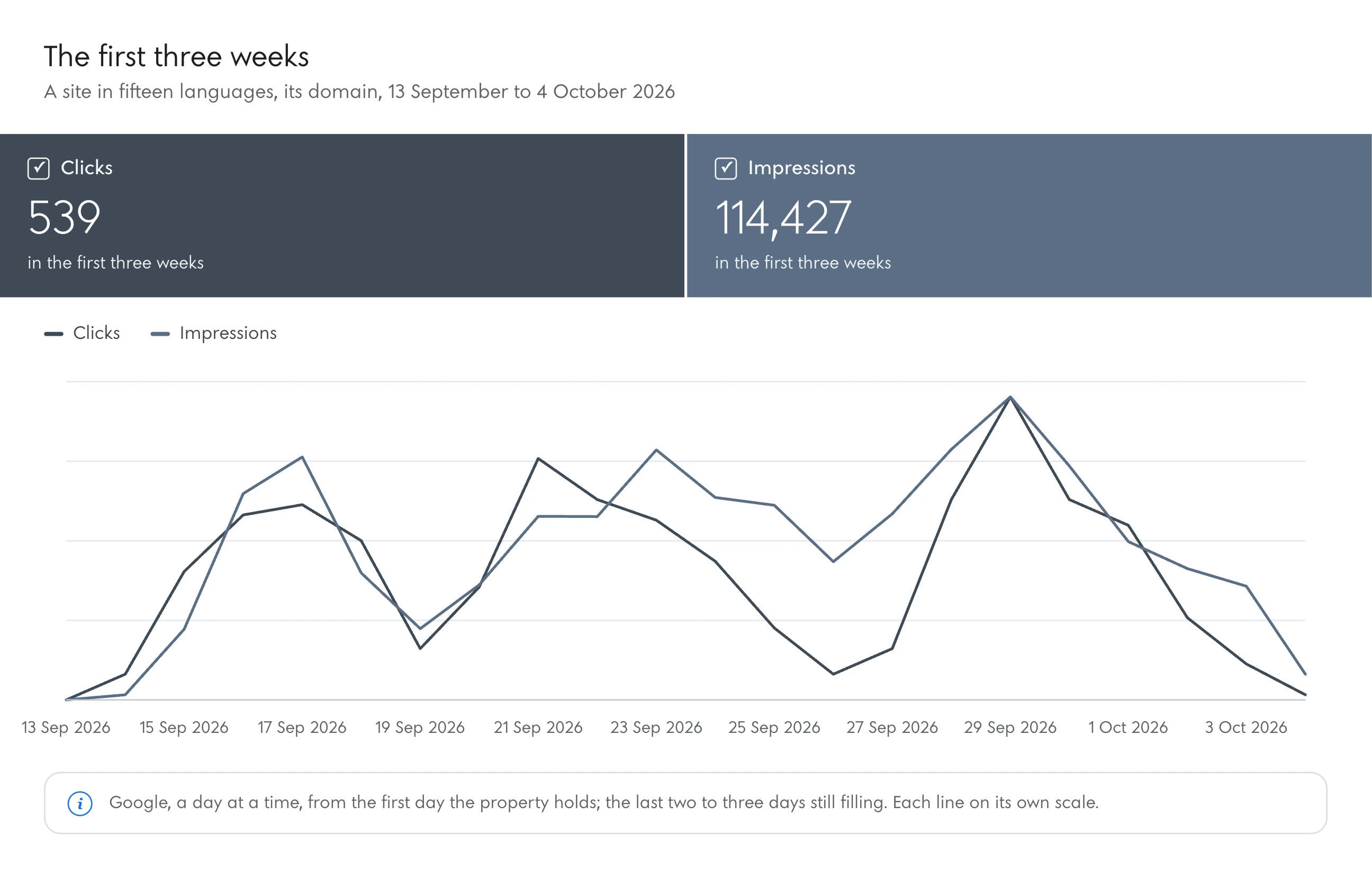
The table above counts the root site’s own pages, because that is where the languages live. The domain property in Search Console counts more: the root and the firm’s satellites together, from 13 September 2026, the first day it holds. Read on 4 October, three weeks in, it showed 113,630 impressions and 536 clicks. Those two figures stand on the studio’s Work page and on the case, and they are the ones a firm can check against its own account.
The numbers
| Day | Clicks | Impressions |
|---|---|---|
| 13 Sep 2026 | 0 | 2 |
| 14 Sep 2026 | 5 | 171 |
| 15 Sep 2026 | 25 | 2,384 |
| 16 Sep 2026 | 36 | 6,958 |
| 17 Sep 2026 | 38 | 8,192 |
| 18 Sep 2026 | 31 | 4,282 |
| 19 Sep 2026 | 10 | 2,404 |
| 20 Sep 2026 | 22 | 3,880 |
| 21 Sep 2026 | 47 | 6,192 |
| 22 Sep 2026 | 39 | 6,183 |
| 23 Sep 2026 | 35 | 8,428 |
| 24 Sep 2026 | 27 | 6,827 |
| 25 Sep 2026 | 14 | 6,565 |
| 26 Sep 2026 | 5 | 4,661 |
| 27 Sep 2026 | 10 | 6,276 |
| 28 Sep 2026 | 39 | 8,448 |
| 29 Sep 2026 | 59 | 10,219 |
| 30 Sep 2026 | 39 | 7,890 |
| 1 Oct 2026 | 34 | 5,335 |
| 2 Oct 2026 | 16 | 4,428 |
| 3 Oct 2026 | 7 | 3,836 |
| 4 Oct 2026 | 1 | 866 |
The curve is the shape a new property shows when nothing is pushed: two impressions on the first day, a few thousand a day by the end of the first week, and close to ten thousand on its best day, with the clicks following at under one in a hundred. That ratio is the one every reading of the studio’s returns: being shown is not being chosen, and a firm’s own site, with its name as most of its demand, is chosen less often than a catalogue or a reference. The record is kept day by day so that the next change, whatever it is, is measured against this one.
One more figure belongs to the languages, though it comes from the domain as a whole. In the 28 days to 4 October the site was clicked from 65 countries. The number is not large, and most of those countries gave a single click; but a firm with one language is rarely clicked from sixty-five, and the fourteen new languages are the only thing on the domain that changed in those weeks. Which languages the clicks came from, page by page, is the next column of the record.
06One Change, Every Language
A site in fifteen languages is only one site if a change stays one change. Three habits keep it that way.
Every link goes through one helper. A page added in English is reachable in every language at once, through the English page, until its translation exists; then the links move to it without anyone editing a menu.
The English is the source, and the record says so. Each translation follows a version of the English. When the English changes, the translations that followed the old version are the ones to rewrite, section by section, as the voice method requires, never sentence by sentence.
What is live is checked against what was built. Before any change is sent to the live site, a comparison reads both sides, every theme file by its fingerprint, every page, case and menu by its content, every image by its name and size. On 2 October the copy matched the live site in every theme file, every page and case and every image.
07What It Means for a Firm Selling Abroad
The studio’s Planet tier puts a firm’s presence into the languages of its markets, usually three to five of them. The case above was fifteen, and the method does not change with the number. It is presence by architecture applied to language: the structure decides what every language gets, so no language is a second project.
- Choose the languages from the record, not from a map: where the firm’s visitors and enquiries already come from, and where its buyers search in their own language.
- Keep one source. Every language is ordinary pages under its own home, keeping the original’s addresses after the prefix, so everything the site does by name works in every language.
- Declare the languages to each other, so search engines show each reader the page in their language and never treat the languages as copies.
- Translate the voice, not the sentences. Section by section, from meaning, in the language’s own cadence; the firm’s named terms kept as names; legal pages faithful.
- Decide what stays in one language. A process that the firm runs in English can stay in English, said plainly on every page that leads to it.
- Say what is translated and how. At the foot of every page, and on every legal page, which version prevails.
- Read the record by language. Reach first, then enquiries, from each language’s own pages.
08Method and Sources
- The build: the site’s theme as it runs live (the languages file, the footer, the fourteen interface files), the firm’s records of the build of 18 September 2026, and the comparison of the local copy with the live site on 2 October 2026 (`compare-live.sh`).
- Search: Google Search Console for the domain, filtered to the root site’s own addresses (the firm’s satellites, on their own subdomains, are left out), read on 4 October 2026. Two windows of fourteen days, 4 to 17 September and 19 September to 2 October, with the day of the launch left out; addresses with a jump mark (#) are left out, since they repeat their page’s impressions. Google withholds rare searches, so these figures are lower bounds.
- The domain’s three weeks: the same property unfiltered (the root and the satellites), by day, 13 September to 4 October 2026: the totals read on 4 October (113,630 impressions, 536 clicks); the chart’s rows read on 5 October, when Google’s last days had filled in a little further (114,427 and 539). Countries: the same property by country, the 28 days to 4 October, counting those with at least one click (65; 221 had an impression, most of them one to five).
- Not claimed: that the new languages have brought briefs yet; that every language was read by a native speaker before it went live.