
Every firm that makes things holds records: product sheets, specifications, certificates, the list of what it makes and where. Most of that knowledge sits in spreadsheets and PDFs that search cannot read and no buyer finds. This paper follows an experiment that asked a plain question. If a site is built only from records, with no text written to rank, no photographs and no campaign behind it, will search find it? The studio built such a site for itself, from a regulator’s public records, and kept the record of everything that followed. Google showed its first pages four hours after it was told they existed. In ten days it sent 1,579 clicks from 96 countries, and more than nine in ten landed on a page that does nothing but set out a record’s facts.
The site is Allomedo, the studio’s own index of China’s medical device manufacturing, at allomedo.com. It is not a client’s site, which is why it can be described in full: the studio owns the domain, the data, the build and the results. It went up on 21 September 2026 on the studio’s own engine, and every figure below comes from its own records.
01The Records Were Public. The Join Was Not.
The source is the United States Food and Drug Administration, which publishes what medical device makers file with it as open data: the devices listed for sale in the United States, the establishments registered to make them, the clearances granted, the recalls. The device catalogue is public domain, free to download, and large. Counted on 20 September 2026, it held 5,182,695 records. Grouped the way a buyer thinks about them, by company, brand and product code, they formed 390,420 device families from 11,874 makers, under 7,093 product codes in 21 medical specialties.
Nothing in those records is secret. Anyone who wants a single record can find it on the regulator’s own site, or on one of the sites that mirror it page by page. That is what makes the experiment useful. The question was never whether the facts existed. It was whether arranging them could give a buyer something they cannot get anywhere else.
The buyer in question holds a device from a Western brand and asks who in China is registered to make the same kind. The regulator already groups devices of the same kind under a product code, and a clearance rests on showing that a device is substantially equivalent to one already on the market, usually under the same code. So the answer is in the records, but it is kept in three places that do not meet. The device catalogue says what a firm sells under its own brand. The establishment registrations say where a firm is and what it is registered to make, and only they carry its country. The clearances say which devices passed review. To answer the buyer, the three have to be joined on company names, which the filings spell inconsistently, and the result turned around so it reads from the device instead of from the firm.
The join also shows why nobody had answered the question. Most factories in China never appear in the device catalogue under their own name. The site gives a page to 5,100 firms in China that hold a United States registration to make or export devices. Only 1,171 of them file device listings of their own; 1,989 are registered as contract manufacturers, making devices that others sell. Not one of their registrations carries a website. To a buyer searching the catalogue, most of them do not exist.
That join is the property. It came to 205,359 precomputed rows: for each kind of device, the firms in China registered to make it; for each firm, everything else it is registered to make. In the studio’s survey of the alternatives, on 20 and 23 September, no free site that search engines can read held it.
| Where a buyer looks today | What it holds | What it cannot answer |
|---|---|---|
| The regulator’s own database | the authoritative records, a search box | who else makes a device: there is no view from device to maker, and the country sits in another dataset |
| Sites that mirror the records | a page per record, indexed | the same: a mirror, not a join |
| Business marketplaces | suppliers that can be contacted | who is registered to make exactly this: their categories are self-declared |
| Paid regulatory databases | the join, in some form | anything for free: they sit behind a login, search cannot read them, and they serve regulatory work rather than sourcing |
02One Record, One Page
The first decision was the page. A site built from data stands or falls on what one page is, because everything else, the links, the lists, the sitemap and the structured data, follows from it. Allomedo’s page is the device listing: one firm’s brand of one kind of device. It is the unit a buyer arrives with and the unit the records support. Where a listing’s product code has no registered maker in China, its page could not answer the question it exists for, so it is not made. 340,248 listings became record pages.
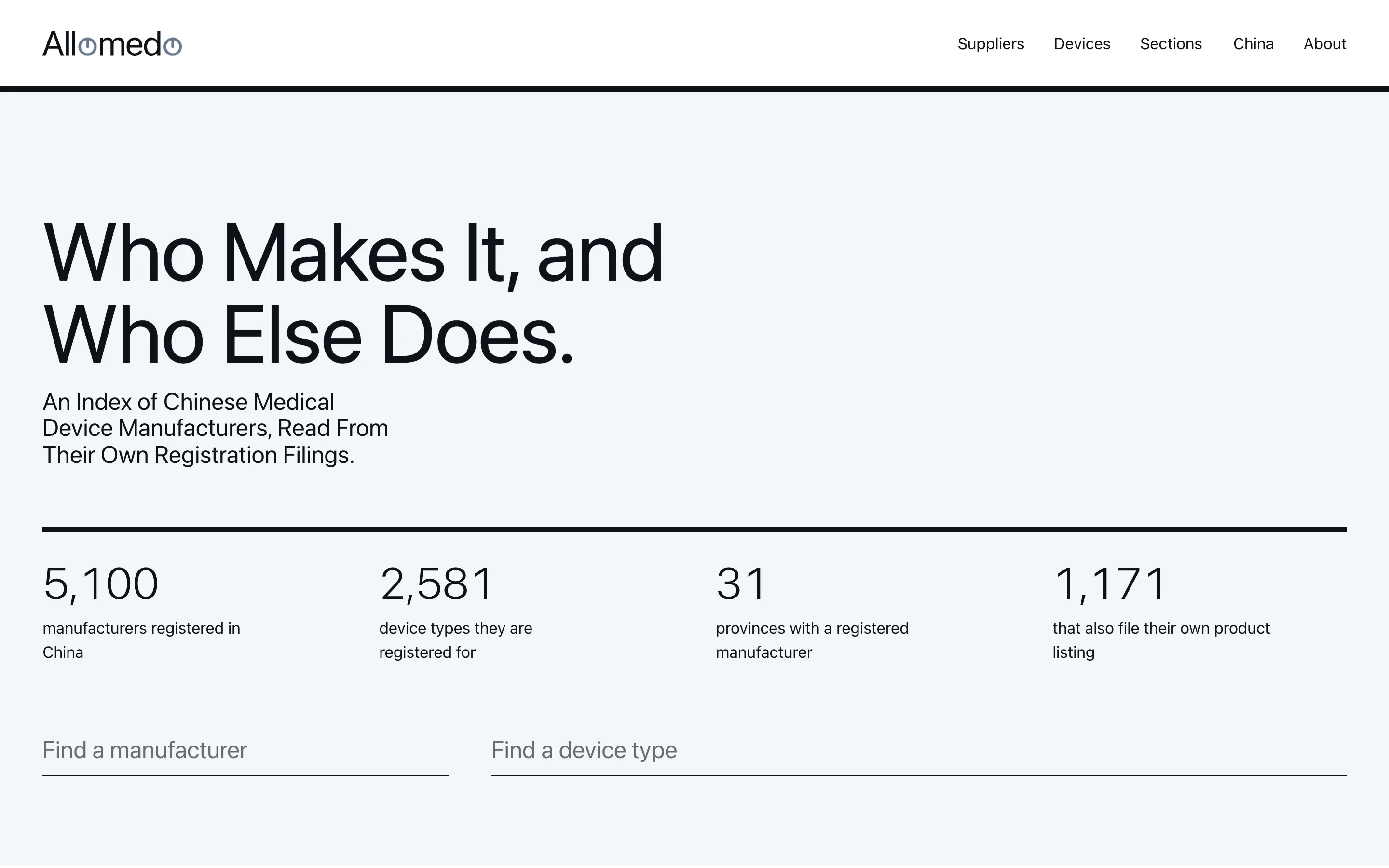
Each record page is built around one block: the firms in China registered to make that kind of device, in a table, each row with its city and province, its registration, what else it makes and whether it holds clearances or recalls, and each row a link to the firm’s own page. Counted across the listings on 20 September, the median page names 17 of them. Around that block the page states what the records hold about the device itself: its name, its maker, its product code and class, its variants and sizes, the clearances and recalls that touch its code. It opens with the description the maker filed; where there is none, with the regulator’s definition of that kind of device. The records do not all hold the same fields: four in five carry a description, one in five lists sizes. A page with fewer facts says fewer things, and nothing is padded to look complete.
Three rules shaped every page, and each came from reading the early drafts.
The subject is the device or the factory, never the regulator. The first introductions the build produced opened with where the data came from. Read as a buyer reads, they made the regulator the subject and the site its mirror: a scrape with a disclaimer bolted on, burying the one thing a buyer wants. Every page now opens with the device or the factory, and the source appears once, in a fixed line near the foot of the page.
No model writes the records. The record pages, the factory pages and the device-type pages are written by the studio’s builders from the records themselves, field by field, through templates. The engine the site runs on can write text with AI; on Allomedo its writing modules are switched off. The editorial pages, About, Contact, For manufacturers and the legal pages, were written with AI, along with the short introductions to the lists, and they are the only text that was.
No pictures. The site carries no photographs and no images of devices. It has a design, a clear typographic layout in its own colours, but nothing a visitor would call a picture. If the pages were found, it would not be because of how they looked.
03A Shape Search Can Read
A page alone is not found. It is found because something leads to it, and on a site of this size no person writes the links. On Allomedo every link comes from the data.
The records already carry a hierarchy, and the site follows it. Seventeen groups lead to their sections, and the sections to the 2,581 device types that have a registered maker in China. Each device type lists its record pages and the firms registered to make it. Each firm’s page lists everything else it is registered to make, and the firms sit in their 31 provinces. Every one of those is a page that lists the pages under it and links to the ones beside it. A search engine that arrives anywhere can walk the whole structure, and every step it takes is a fact: this device is made by these factories; this factory also makes these devices; these factories are in this province.
Nothing on a page is there to fill it. On three hundred thousand pages, any element repeated for its own sake becomes a pattern that search engines learn to discount.
Each page also states its facts in structured data, the code that tells a machine what a page is about: the device, its maker, its product code. The sitemap lists every page: 347,825 addresses when Search Console last read it, on 29 September, with no errors and no warnings.
04The First Ten Days
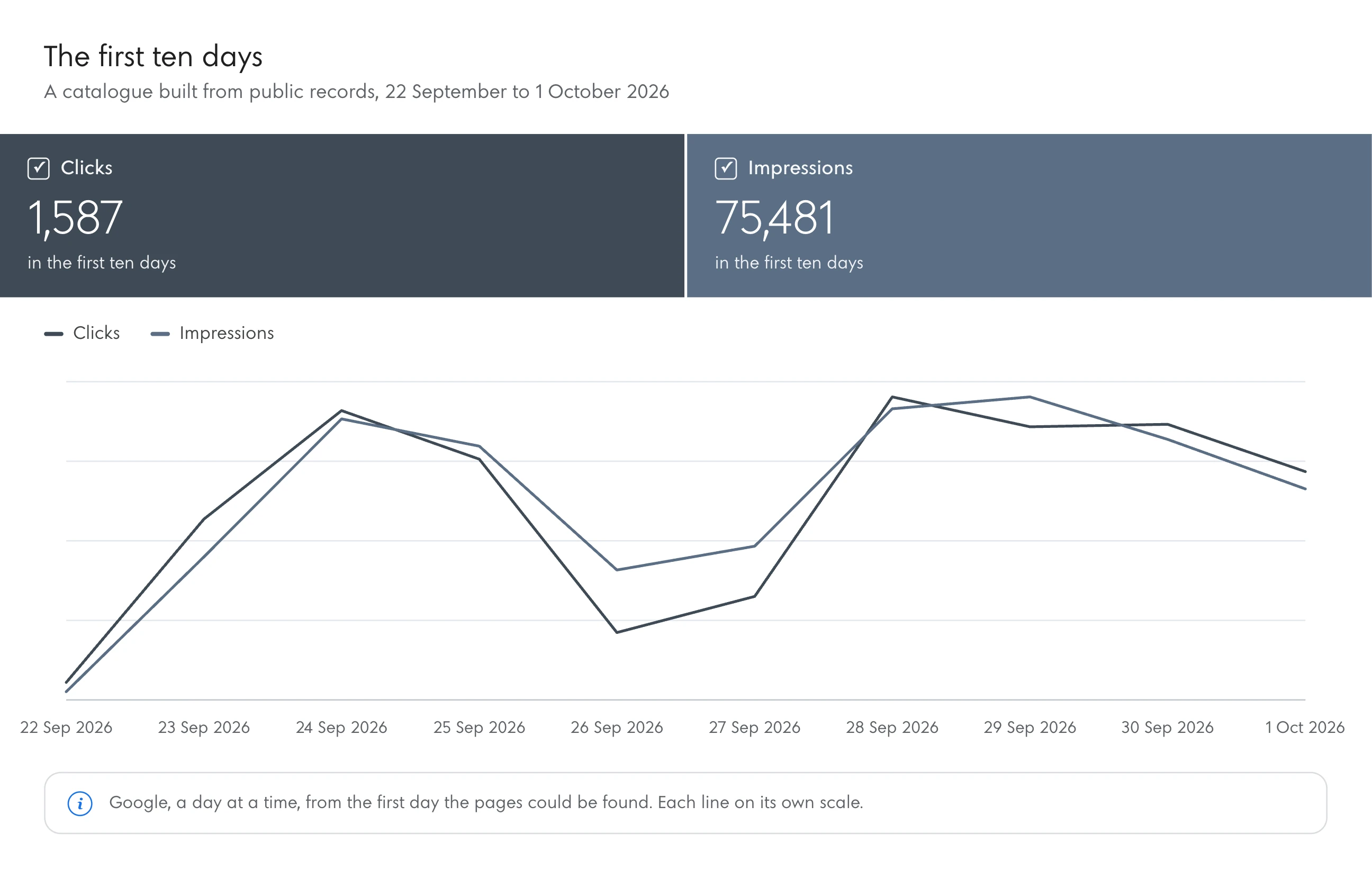
The site went up on 21 September. Its sitemap reached Search Console at four in the morning, Pacific time, on 22 September, and Google showed the first pages at eight. These are the ten days that followed, as the site’s own Search Console records them.
The numbers
| Day | Clicks | Impressions |
|---|---|---|
| 22 Sep 2026 | 14 | 304 |
| 23 Sep 2026 | 145 | 5,307 |
| 24 Sep 2026 | 232 | 10,421 |
| 25 Sep 2026 | 193 | 9,411 |
| 26 Sep 2026 | 54 | 4,820 |
| 27 Sep 2026 | 83 | 5,702 |
| 28 Sep 2026 | 243 | 10,793 |
| 29 Sep 2026 | 219 | 11,239 |
| 30 Sep 2026 | 221 | 9,659 |
| 1 Oct 2026 | 183 | 7,825 |
| Day | Clicks | Impressions | Average position | Searches listed |
|---|---|---|---|---|
| Tue 22 Sep | 14 | 304 | 7.2 | 24 |
| Wed 23 Sep | 145 | 5,307 | 9.6 | 410 |
| Thu 24 Sep | 232 | 10,421 | 9.5 | 877 |
| Fri 25 Sep | 193 | 9,411 | 9.0 | 911 |
| Sat 26 Sep | 54 | 4,820 | 11.2 | 822 |
| Sun 27 Sep | 83 | 5,702 | 11.6 | 910 |
| Mon 28 Sep | 243 | 10,793 | 9.7 | 960 |
| Tue 29 Sep | 219 | 11,239 | 9.6 | 1,089 |
| Wed 30 Sep | 221 | 9,659 | 9.6 | 940 |
| Thu 1 Oct | 175 | 7,533 | 10.5 | 774 |
In ten days the site drew 1,579 clicks from 75,189 impressions, at an average position of 9.9. Five things in those numbers matter more than the totals.
Search found it at once. A domain registered that month, with no advertising behind it, was listed for at least 410 different searches on its second day and for 1,089 on its eighth. Nothing had been done to earn that except the structure.
The long tail did the work. More than nine clicks in ten went to record pages: single device listings, each asked for by very few people. From the second day on, Search Console listed between 3,313 and 5,646 different pages with impressions every day. No single page carried the site. That is what a site built from records looks like when it works: many quiet pages, each answering one precise question.
Buyers search at work. The two weekend days drew 54 and 83 clicks, against an average of 204 on the seven weekdays from 23 September: about a third. The first weekend looked like a fall, beginning on Friday afternoon; Monday answered it with 243 clicks, the best day of the ten. The people finding the site look for suppliers in working hours, as people buying for a business do.
The buyers are not where the records are. The records are American. Two clicks in three came from outside the United States: India alone sent nearly one in five, then Germany, Japan and the United Kingdom. In ten days the site was shown in 199 countries and territories and clicked from 96 of them.
The sourcing searches have begun. The site watches the searches that carry a buyer’s words, such as manufacturer, supplier, factory, wholesale, OEM or China. They showed the site once on the first day and between 39 and 103 times a day after it. None had brought a click by 1 October. They are the searches a sourcing site exists for, and the next thing it has to earn.
Ten days is a short record, and it is reported as one. Google may still revise its view of the site, as it revised its view of the studio’s reference network in 2026, set out in Every Engine Keeps Its Own Record. What the ten days show is narrower and more useful: a structure built only from records was read, shown and clicked within days, with nothing written to rank and nothing to look at.
05What Went Wrong, and What It Taught
Not everything worked, and three things changed how the studio builds.
Valid is not accepted. On 23 September Search Console flagged a critical issue on the record pages: each declared itself a product, and Google’s rules for a product ask for a price, a review or a rating. A registry holds none of them and must not invent them. Every check before launch had confirmed that the structured data was well formed; none had checked it against Google’s own requirements for that type. The same day the pages were rewritten to describe themselves as medical devices, with the product code as a medical code, a type for which Google asks no price. Structured data is now checked type by type against each engine’s own documentation before a site goes live.
Public records can carry a field that is not public. The device catalogue is public domain, but one field inside it is not: the international nomenclature term each maker states for its device, whose name and definition are written and licensed by a separate body. The regulator publishes it under its own licence; a site that republishes the records holds no such licence. The build now strips that field before anything enters the database, and each record opens with the maker’s own description. The studio reads a publisher’s terms field by field before any record is used.
Each engine keeps its own clock. In the same ten days Bing indexed one page, showed it once and sent no one. A firm that reads only one engine reads part of the story.
06What It Means for a Firm That Holds Data
Allomedo was built to test the point the studio makes to every client, presence by architecture: a firm is found because of how its presence is built, and the strongest material it has is the data it already holds. A manufacturer’s product sheets, a distributor’s catalogue, a laboratory’s methods, a consultancy’s case records: in most firms this knowledge sits in files that search cannot see.
The method transfers without change:
- Find the unit. Decide what one page is: one product, one family, one location, one service. Everything else follows from it.
- Find the question the records answer together. The value is rarely in one record. It is in what several answer at once: who else, what else, where, since when.
- State the facts, and only the ones you may publish. Each page says what the records hold, and each field is checked against its publisher’s terms. A page with fewer facts says fewer things.
- Let the data draw the links. Every link is a relation the records already contain, so the structure is complete without anyone writing it.
- Declare it to the machines. Structured data on every page, checked against each engine’s own requirements, and a clean sitemap.
- Multiply only from data. New pages come from new records, never from text written to fill a template. Pages made to rank are what search engines remove; pages that each state a record are what they keep.
This is what the studio’s Planet tier builds for a firm that sells abroad: a catalogue site made from the firm’s own product data, a page for each product, in the languages its buyers search in. The look comes after, and it matters. But Allomedo’s first ten days show what structure does before anyone sees a picture. The case Public Records, Made Readable sets out the same days in brief.
07Method and Sources
- The records: the FDA’s openFDA bulk downloads: the device catalogue (UDI), establishment registrations and listings, 510(k) clearances and recalls. The device catalogue is public domain. Counted in full on 20 September 2026 by the studio’s own analysis of the downloaded files; every count is counted, not sampled. The build’s own counts (5,100 firms, 340,248 record pages, 2,581 device types, 31 provinces) are as of 22 and 23 September 2026.
- Search: Allomedo’s Google Search Console, read daily through its API by the studio’s search tracker; days are Pacific time, as Search Console counts them. The daily figures were read on 3 October 2026 and the countries on 4 October; the sitemap count is as Search Console read it on 29 September. Bing Webmaster Tools to 30 September.
- Lower bounds: Google withholds rare searches from its lists, so the counts of searches, of pages and of sourcing searches are lower bounds. The average position is the daily positions weighted by impressions.
- Not claimed: anything about enquiries or sales; anything about AI answers, which these figures do not measure; anything beyond the first ten days.